Virupaksha Temple Hampi: Architecture and Mysteries (2026 Edition)
This is my third visit to Virupaksha Temple in Hampi, and each time I’ve documented changes in visitor management, conservation work, and site accessibility. In 2010, the temple felt less structured—most tourists stayed near the main sanctum without exploring the outer corridors or the 100-pillared hall. By 2015, the Archaeological Survey of India (ASI) had stepped up restoration, particularly cleaning the intricate carvings that show everything from temple dancers to battle scenes.
In 2025, the infrastructure is noticeably better: directional signs guide you to hidden spots inside the Virupaksha complex, photography zones are clearly marked, and the walk from Hampi Bazaar to Virupaksha now has shaded sections and rest points.
– By Indrani Ghose | Last Updated: January 2026
What remains constant is the temple’s dual identity. Virupaksha isn’t a museum—it’s India’s oldest functioning temple where priests still conduct morning and evening rituals. For repeat visitors to Hampi like me, this living worship adds depth that static monuments can’t match.
This visit, I spent more time inside the Ranga Mantapa observing the inverted shadow mystery. Watching guides demonstrate the pinhole camera effect using simple diagrams shows how heritage interpretation has matured. Virupaksha combines Dravidian architecture, active spirituality, and verifiable scientific phenomena—a combination I haven’t seen replicated elsewhere in India.
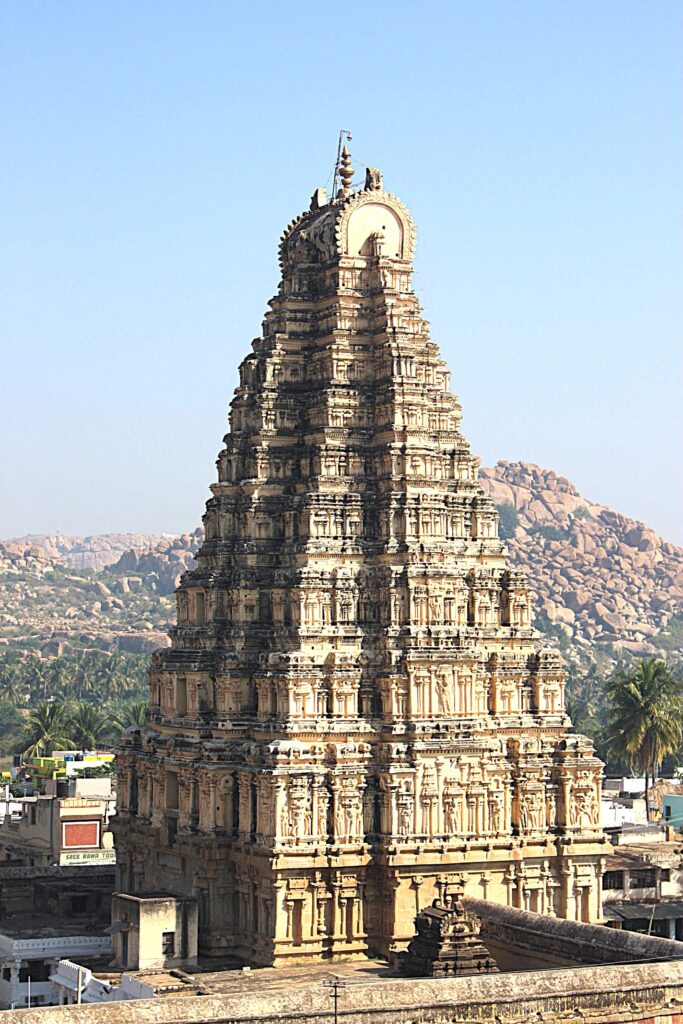
Virupaksha-Temple Hampi
Quick Facts: Why Virupaksha Anchors the Hampi Experience
| Fact | Details |
| Oldest functioning temple in India | Active since the 7th century with uninterrupted daily worship; priests still perform rituals witnessed by UNESCO documentation teams. |
| UNESCO World Heritage Site | Designated in 1986 as part of the Hampi Group of Monuments, recognized for outstanding Vijayanagara-era cultural value. |
| Dravidian architecture showcase | Features a 50-meter gopuram (tower), multiple pillared halls, and stone carvings that define South Indian temple design principles. |
| 100-pillared hall masterpiece | Contains detailed carvings depicting scenes from the Ramayana, Krishna Leela, and 16th-century courtly life. |
| Photography considerations | Best time to visit Virupaksha for photography: 6:30-8:30 AM or 4:30-6:00 PM when horizontal light enhances stone textures. |
| Location advantage | Positioned at the western end of Hampi Bazaar; serves as the natural entry point for exploring Hampi’s 500+ monuments. |
The Inverted Shadow Mystery: Understanding the Pinhole Camera Effect
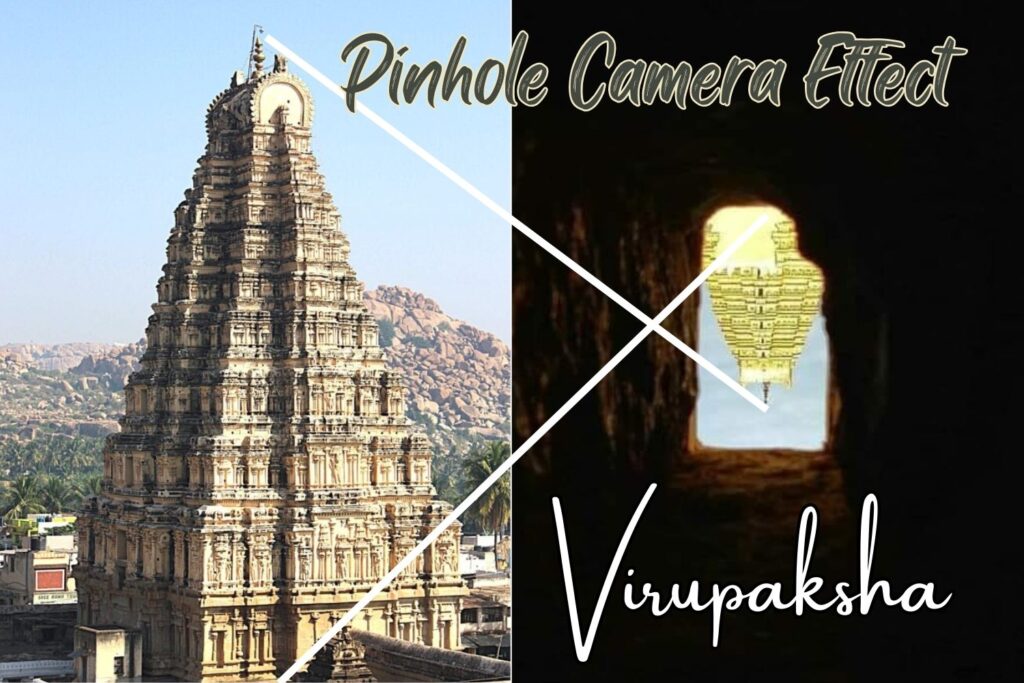
The Virupaksha Temple inverted shadow mystery generates more questions than almost any feature in Hampi. Inside the Ranga Mantapa, a small hole in the western wall projects an upside-down image of the temple’s gopuram onto the opposite surface. The effect works on the same optical principle that made early photography possible.
How the pinhole camera effect works at Virupaksha:
Light from the gopuram travels in straight lines through the small aperture. Because light rays from the top of the tower pass through the hole and hit the lower part of the projection surface—and rays from the bottom hit the upper surface—the image appears inverted. No lenses or mirrors are involved. This is pure geometric optics, the same principle that Renaissance artists used in camera obscuras.
What separates this from accidental architecture is the precision. The aperture’s size, the distance to the projection wall, and the alignment with the gopuram all suggest intentional design by Vijayanagara-era builders. Whether they understood the optical science or discovered it through trial and error remains debated among architectural historians.
For pilgrims, the inverted shadow holds symbolic meaning—the divine made visible through light. For visitors interested in science and history, it demonstrates that temple builders integrated observational knowledge into sacred spaces.
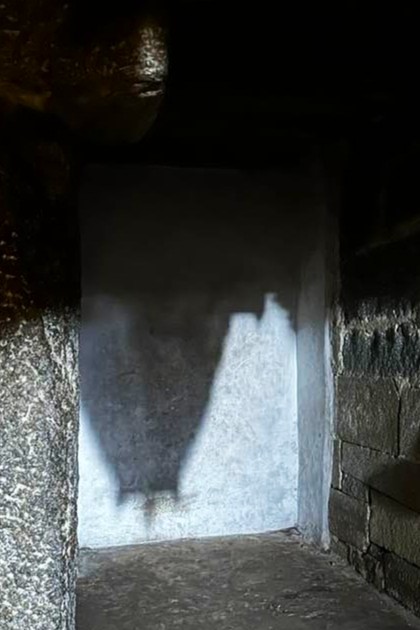
Inverted shadow of Gopuram-pinhole camera effect
Changes in interpretation:
In 2010, most visitors stumbled upon it without context. No signage explained it. By 2020, local guides had started connecting it to pinhole camera principles, though explanations varied. In 2026, the ASI has installed a small informational panel near the aperture, and guides now use diagrams showing light ray paths. This improved interpretation helps both first-time visitors and those returning to Hampi understand what they’re witnessing.
The inverted shadow adds scientific credibility to Virupaksha’s architectural reputation. It’s tangible proof that this temple complex was designed with sophisticated understanding of light, space, and perception.
Where to Find the Virupaksha Inverted Shadow
The phenomenon occurs inside the Ranga Mantapa (also called the marriage hall), located in the northern section of the Virupaksha Temple complex. After entering through the main gopuram, turn left and walk toward the columned hall.
Viewing instructions:
- Position yourself near the western wall where you’ll see the small aperture (about 3-4 inches in diameter)
- Look at the opposite wall surface, roughly 20 feet away
- The inverted image of the gopuram appears clearest between 10 AM and 2 PM when sunlight is strongest
- The projection is faint, so allow your eyes 30-60 seconds to adjust from the brighter outer courtyard
Temple staff now allow photography of the phenomenon without flash. This is one of the hidden spots inside the Virupaksha complex that rewards patient observation.
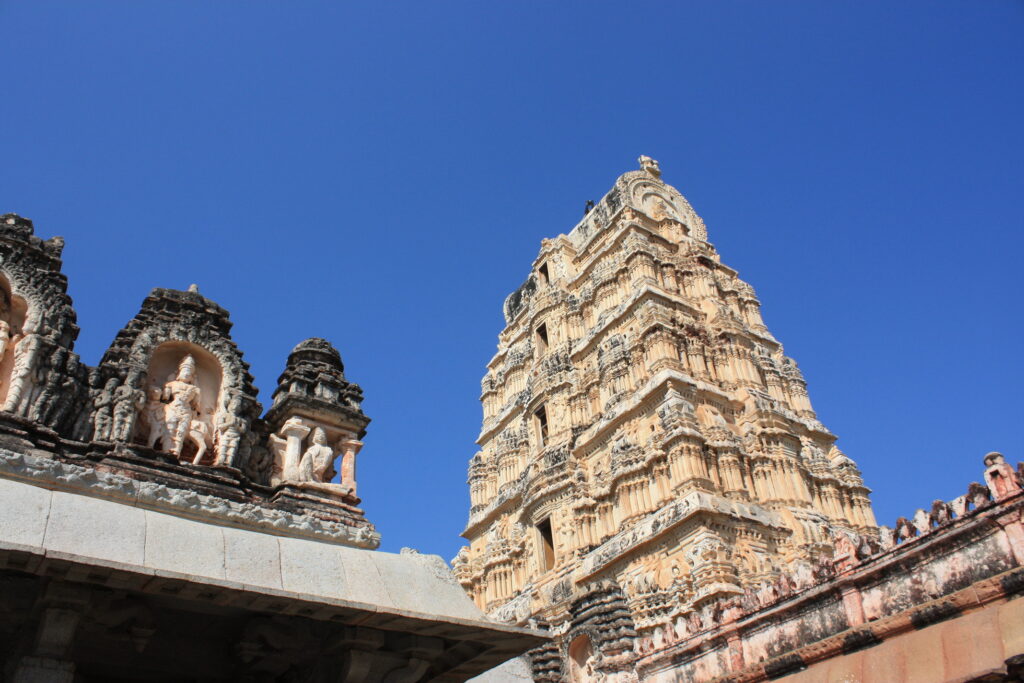
Virupaksha Temple in Hampi
Architectural Depth of Virupaksha’s Main Sanctum
Most visitors spend 20-30 minutes at the main shrine and leave. That approach misses the architectural complexity that defines this site. On my third visit, I allocated some time to document the outer structures—the nine-story eastern gopuram, the 100-pillared hall carvings, and engineering features that connect Virupaksha to Hampi’s water management system.
These elements show why Dravidian architecture in Hampi represents more than religious expression—it’s engineering, urban planning, and artistic ambition combined.
The Nine-Story Eastern Gopuram: Hampi’s Vertical Landmark
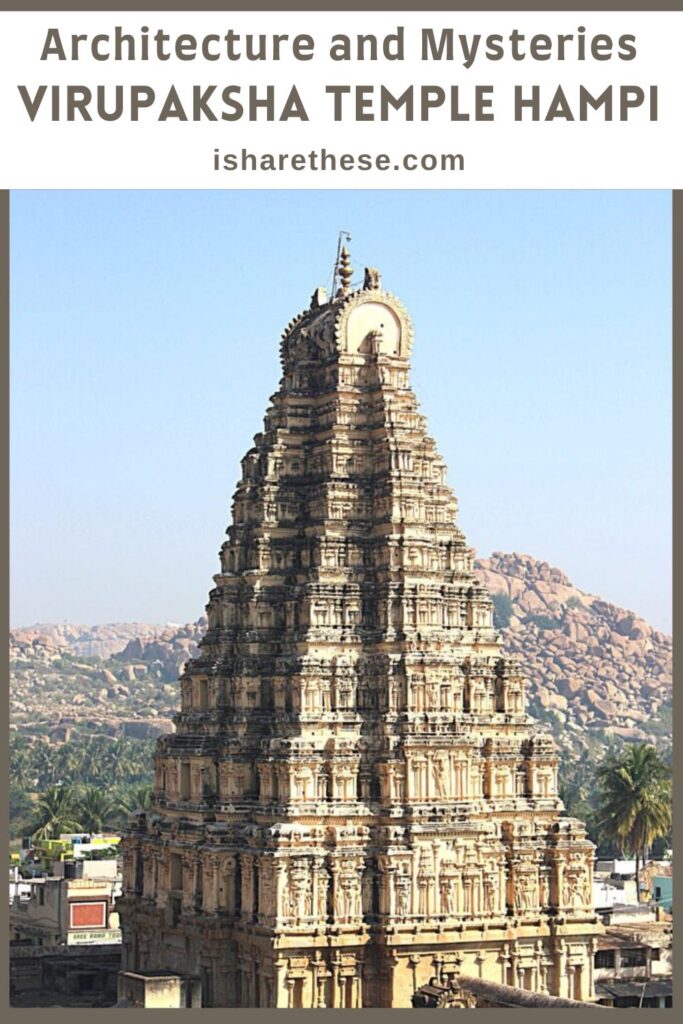
The eastern gopuram (Bistappa Tower) rises 50m above Hampi Bazaar. This nine-tiered gateway follows the characteristic Dravidian pyramid structure—each level narrows as it ascends, creating the tapering effect typical of South Indian temple design.
Built primarily in the 14th century with additions during Krishnadevaraya’s reign (1509-1529), the tower uses granite base construction with brick superstructure and lime plaster exterior. Beyond aesthetics, it marks the processional axis from the secular bazaar to the sacred sanctum.
The 2015 ASI conservation work has clarified weathered stucco figures. You can now identify Ganesha in the third tier’s southern niche, Garuda on the fifth tier’s eastern face, and numerous yaksha figures throughout.
Photography tip: The best time to visit Virupaksha for photography of the gopuram is 6.30-7.30 AM from the eastern end of Hampi Bazaar. By 10 AM, harsh overhead sun flattens the relief details.
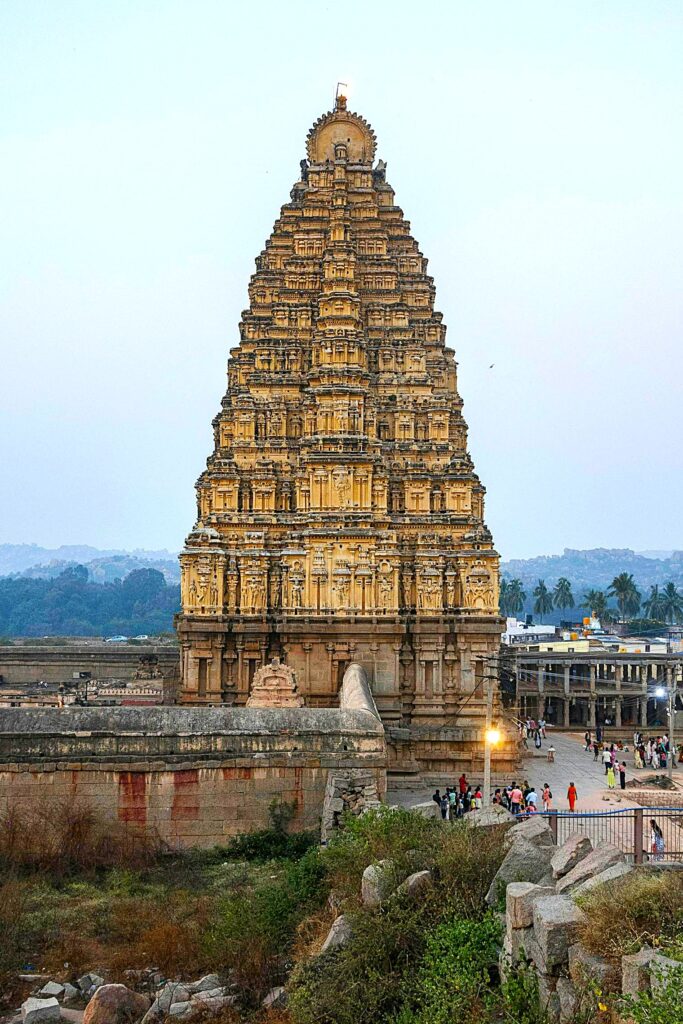
Hampi’s Vertical Landmark-9 Storey Gopura
The 100-Pillared Hall: Reading Hampi’s Story in Stone
The Maha Rangamandapa contains the richest concentration of narrative carvings in the complex. Each pillar presents distinct iconography—mythological episodes, courtly scenes, and 16th-century social documentation.
Notable carvings:
Pillar 23 (northwestern quadrant): Shows Narasimha disemboweling the demon Hiranyakashipu mid-action, with detailed anatomical accuracy and facial expressions conveying both divine fury and mortal terror.
Pillars 34-37 (southern row): Sequential Krishna narrative from butter-theft to defeating Kaliya the serpent—read left to right like a visual story.
Pillars 58-62 (eastern section): Secular life scenes including merchant convoys with loaded bullocks, courtesans in detailed dance poses, and hunting scenes. These Virupaksha Temple 100-pillared hall carvings document daily life during Hampi’s commercial peak.
What makes these significant: Unlike purely devotional imagery, this hall integrates sacred and secular subjects, suggesting multiple functions—religious ceremonies, royal audiences, and merchant gatherings during festivals.
For repeat visitors: Bring a flashlight to examine upper portions of pillars. Many carvings extend above eye level, especially detailed ceiling bracket figures in the northeast corner that most guides skip.
Engineering Legacy: The Underwater Temple Connection
The relationship between Virupaksha and the nearby underwater Shiva temple (500 meters northeast) reveals sophisticated hydraulic engineering. Both structures share water management principles still visible today.
Stone drainage channels along Virupaksha’s northern compound wall route monsoon runoff toward the Tungabhadra River—the same design that allows the underwater temple to withstand seasonal flooding without foundation erosion. Both use stepped platform construction elevating sanctums above ground level.
Temple priests explain that ritual practices include water drawn from the Tungabhadra, symbolically connecting the temples. This reflects understanding that Hampi’s temples form an integrated network within the river ecosystem—architecture designed for monsoons rather than against them.
Key takeaway:
- The Bistappa gopuram functions as urban landmark and processional gateway.
- The 100-pillared hall preserves religious narratives and social documentation.
- The engineering systems connect Virupaksha to Hampi’s broader hydraulic network.
Together, these show why Dravidian architecture in Hampi represents the culmination of technical and artistic development adapted to specific environmental conditions.
Mythology Meets History: The Pampa Legend and Vijayanagara Patronage
The Virupaksha Temple’s foundation story centers on Pampa Devi, a local river goddess who performed rigorous penance to marry Lord Shiva. According to the legend, impressed by her devotion, Shiva manifested as Virupaksha (meaning “eyes like a carp”) and accepted her. This mythological origin explains why the temple remains an active worship site—the marriage of Shiva and Pampa is celebrated annually during the temple’s chariot festival in February.
Historical records add political context. During the Vijayanagara Empire (1336-1646 CE), Virupaksha transformed from a regional shrine into the kingdom’s spiritual anchor. Kings used temple patronage to legitimize their authority—connecting royal power to divine sanction.
Krishnadevaraya’s Architectural Legacy
The most significant contribution came from Emperor Krishnadevaraya (ruled 1509-1529), who commissioned the eastern gopuram and the grand pillared corridor in 1510 CE. His stone inscriptions inside the temple document military victories, land grants, and ritual endowments. One inscription on the northern wall records his donation of a jeweled crown to the deity after defeating the Sultan of Bijapur—tying political triumph directly to divine blessing.
On my third visit, I noticed how temple guides now present both narratives depending on their audience.
- Pilgrims hear the Pampa devotion story during ritual explanations.
- History enthusiasts get details about Krishnadevaraya’s inscriptions and architectural additions.
This dual interpretation—myth serving spiritual needs, history serving scholarly curiosity—makes Virupaksha function as both sacred space and historical archive.
Photography Strategy and Hidden Quiet Zones
Best time to visit Virupaksha for photography
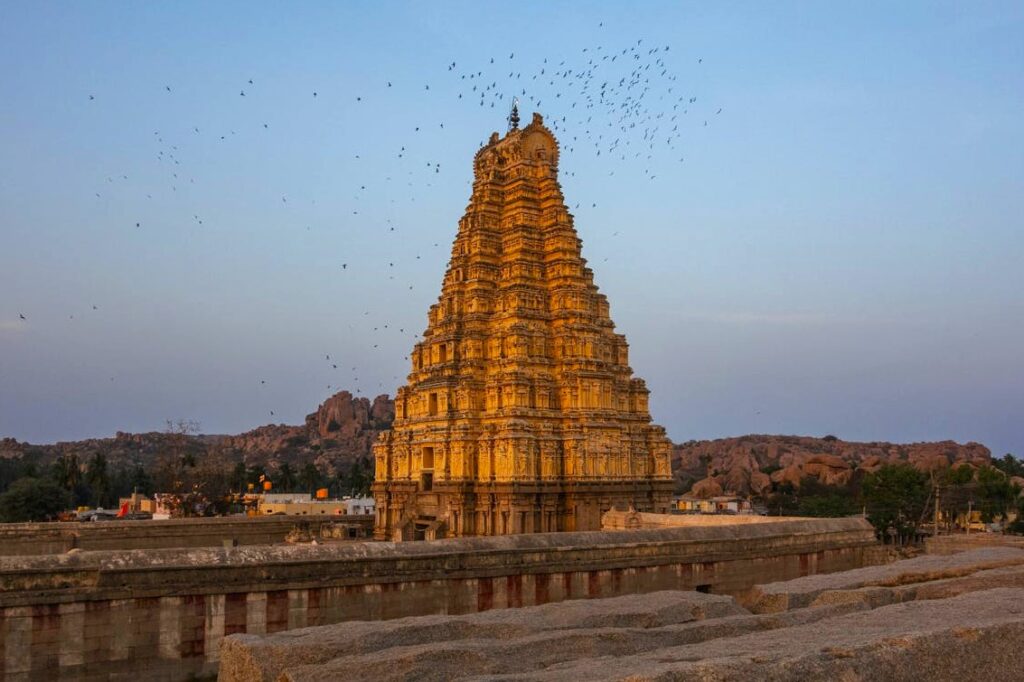
Gopuram shots: 6.30-7.30 AM when horizontal light hits the eastern facade. From Hemakuta Hill (5-minute walk west), you can frame the entire temple complex aligned with Hampi Bazaar—a composition that shows the temple’s urban integration.
Interior carvings: 4-5.30 PM when angled sunlight enters the 100-pillared hall through western openings, creating natural side-lighting that emphasizes relief depth on the Narasimha and dancer panels.
Inverted shadow: 10 AM-2 PM when the pinhole camera effect in the Ranga Mantapa is most visible due to strong overhead sunlight.
Virupaksha Temple Hampi
Hidden spots inside Virupaksha complex
Behind the main sanctum: Smaller subsidiary shrines dedicated to Bhuvaneshwari and Pampa receive fewer visitors. These spaces allow quiet observation of daily rituals—priests performing abhishekam (ritual bathing of the deity) around 7 AM and 6 PM.
Northwestern courtyard: Contains a series of Nandi (bull) sculptures in descending size order. Most visitors miss this area entirely, making it ideal for photography without crowd interference.
Tungabhadra riverbank view: Walk 200m north from the temple complex to the river’s edge. From this angle, you can photograph Virupaksha’s reflection in the water during winter months (November-February) when water levels are higher and calmer.
Practical tip from repeat visits: The Hampi Bazaar to Virupaksha walk gets extremely crowded between 9 AM-12 PM. For atmospheric shots of the approach—vendors, pilgrims, the gopuram in the distance—visit between 6.30-8 AM when foot traffic is lighter and morning haze adds depth to wide-angle compositions.
FAQ about Virupaksha Temple
Q. What is the Virupaksha Temple inverted shadow mystery?
A small aperture in the Ranga Mantapa wall projects an upside-down image of the gopuram on the opposite surface using the pinhole camera effect. Best visible between 10 AM to 2 PM.
Q. What is the best time to visit Virupaksha for photography?
Early morning (6.30 to 7.30 AM) for gopuram exterior shots, and late afternoon (4 to 5.30 PM) for interior carvings when natural light enhances stone details.
Q. How long does the Hampi Bazaar to Virupaksha walk take?
Approximately 5-7 minutes covering 400m. The walk is now pedestrian-friendly with shaded sections.
Q. Are the 100-pillared hall carvings accessible to visitors?
Yes, the hall is open during temple hours (6 AM to 6 PM). Photography is permitted without flash.
Q. Is Virupaksha Temple still functioning?
Yes, it’s India’s oldest functioning temple with daily rituals conducted since the 7th century.
Sunset View of Virupaksha Temple in Hampi
Final Thoughts and Extending Your Hampi Exploration
Virupaksha Temple synthesizes multiple layers—the Pampa mythology that sustains active worship, the Vijayanagara Empire’s architectural patronage visible in Krishnadevaraya’s additions, the pinhole camera effect demonstrating optical knowledge, and the 100-pillared hall’s documentation of 16th-century life. For Hampi repeat visitors, each return reveals details missed previously.
After exploring Virupaksha, extend your route to connected sites within walking distance: Tungabhadra River View Point (10 minutes north) for coracle rides, the Sasivekalu Ganesha (5 minutes south-east) famous for 8 feet tall monolithic image of Lord Ganesha, and the King’s Balance (25 minutes north-east) that complete Hampi’s sacred geography. Each location adds context to Virupaksha’s central role in the settlement’s ritual landscape.
On my third visit, I confirmed what earlier trips suggested: Hampi rewards patient, repeated exploration. The site reveals itself gradually—not through rushed monument-hopping, but through focused attention to individual spaces and their interconnections.
Pin and Save this for Later
About the Author
 Indrani Ghose is a cultural travel writer and heritage documentation specialist with over 15 years of experience exploring and writing about temples across India and Southeast Asia. Having visited over 150 sacred sites, she brings both scholarly depth and personal narrative to heritage travel writing.
Her work has been published in Lonely Planet, The National (UAE), Whetstone Asia, Deccan Herald, and various architecture and heritage journals.
Indrani believes that travel writing serves as a bridge — helping readers experience places more deeply by providing context, answering questions, and sharing both practical logistics and emotional resonance.
Connect with Indrani: Follow Indrani on Instagram | Twitter | Facebook for heritage travel insights, photography tips, and offbeat destination discoveries.







I have not visited Hampi yet. Will surely remember about it whenever I go there. Nice capture of the temple.
Great temple and amazing functioning period! Excellent capture on the temple tower… But i get clear pictures only by clicking on it. along the post it looks blur
Good move from blogspot to .com 🙂
Thanks Jeevan for the feedback on the pics. Still learning to work with wordpress. I will look into that.
Lovely shots! And congrats on your own domain!
Thank you Ladyfi! A long way to go now!
I hope the facelift restores the beauty of this very old spot. Wow. That is quite old.
It should definitely get better.
Thanks for the comment.