Ishwara Temple Arasikere: The 16-Pointed Star Marvel of Hoysala Architecture
The Ishwara Temple in Arasikere, also called the Chandramouleswara Temple, represents one of the boldest architectural achievements of the Hoysala dynasty. Constructed around 1220 CE under King Narasimha II’s patronage, this 13th-century Hindu temple in Hassan district showcases engineering ambition that exceeds many better-known monuments.
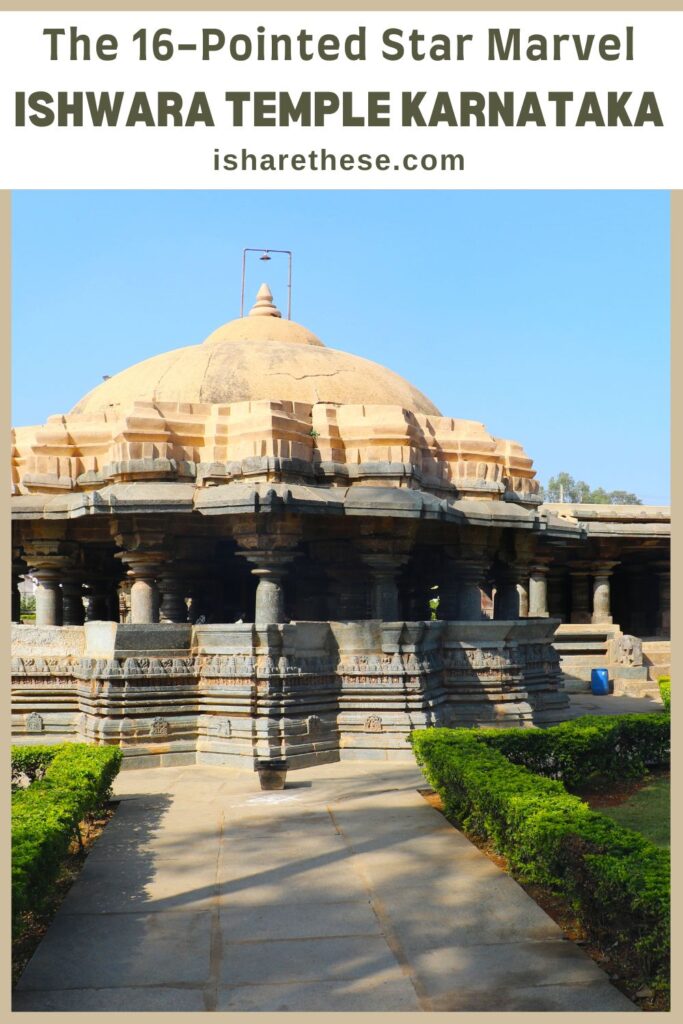
The road from Bangalore to Jog Falls is studded with several gems of Hoysala origin. We made our first halt at Ishvara Temple Arsikere (Arasikere), one of the oldest towns of Karnataka. What sets this Lord Shiva temple apart is its 16-pointed star-shaped mandapa—the most geometrically complex stellate plan ever attempted by Hoysala architects.
– By Indrani Ghose | Last Updated: January 2026
While temples at Belur and Halebidu draw larger crowds, Arasikere’s Ishwara Temple pushes the boundaries of what was architecturally possible with soapstone construction. The intricate carvings and mathematical precision visible here offer tangible evidence of medieval India’s advanced understanding of geometry and sculpture.
For anyone exploring Hoysala architecture or planning Hassan district tourism, this temple provides an unfiltered look at how 13th-century craftsmen solved complex design challenges—making it essential viewing for heritage enthusiasts seeking depth beyond the typical tourist circuit.

Ishwara Temple Arasikere: The 16-Pointed Star Marvel of Hoysala Architecture
The Architectural Blueprint: Why Arasikere’s Shivalaya is Unique
The 16-Pointed Stellate Mandapa
The Ishwara Temple’s mandapa stands as its most distinctive element. Most Hoysala temples feature 8- or 12-pointed star plans, but Arasikere’s architects pushed this concept to 16 points. This stellate plan creates alternating projections and recesses that form a “rotating star” effect when viewed from different angles.
The design isn’t merely decorative—it fundamentally changes how light interacts with the stone surfaces throughout the day.
During my June 2017 visit, with family, I walked the temple’s perimeter multiple times and noticed how each vantage point revealed different sculptural details.
The 16-pointed configuration means the play of shadows shifts constantly as the sun moves, creating depth that would be impossible with simpler floor plans. This complexity explains why architectural historians consider Arasikere the most intricate stellate-plan temple in the entire Hoysala corpus.
The mathematical precision required to execute this design without modern tools demonstrates remarkable engineering capability.
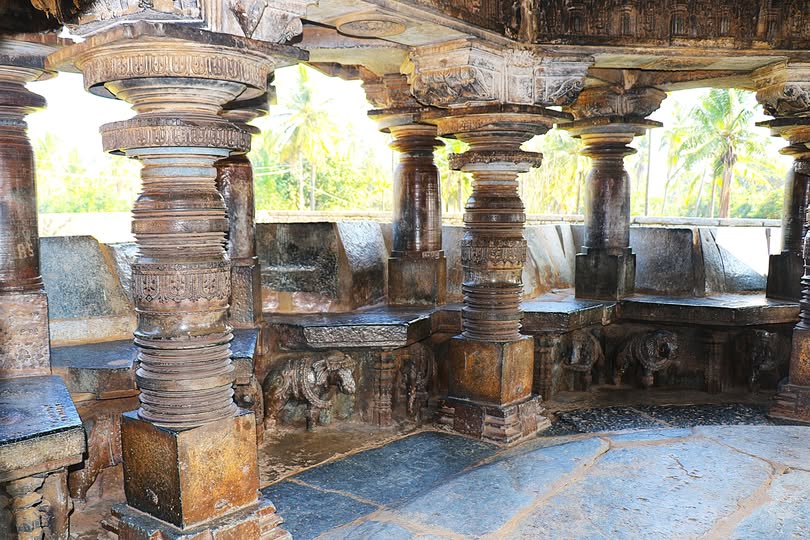
The 16-Pointed Stellate Mandapa
The mukhmantapa (open pillared hall) is most impressive. Do sit here in the stone benches. Very small area, yet a cool and calm place. Transport yourself back in time and you will find yourself discussing matters of importance to the society then!
Soapstone Mastery
Hoysala builders consistently chose chloritic schist, known as soapstone, for their temples. This material offers a crucial advantage: when freshly quarried, soapstone remains relatively soft, allowing artisans to carve intricate details that would be nearly impossible in harder stone. As it ages and hardens through exposure, the carvings become permanent.
At the Ishwara Temple, this soapstone workmanship reaches exceptional levels. The carved surfaces display motifs spanning Shaiva, Vaishnava, Shakta, and Vedic traditions, effectively making the temple walls a comprehensive visual encyclopedia of medieval Hindu iconography.
The domed mandapa ceiling particularly demonstrates soapstone’s potential—concentric floral patterns carved with precision that resembles metalwork or jewelry rather than stone sculpture.
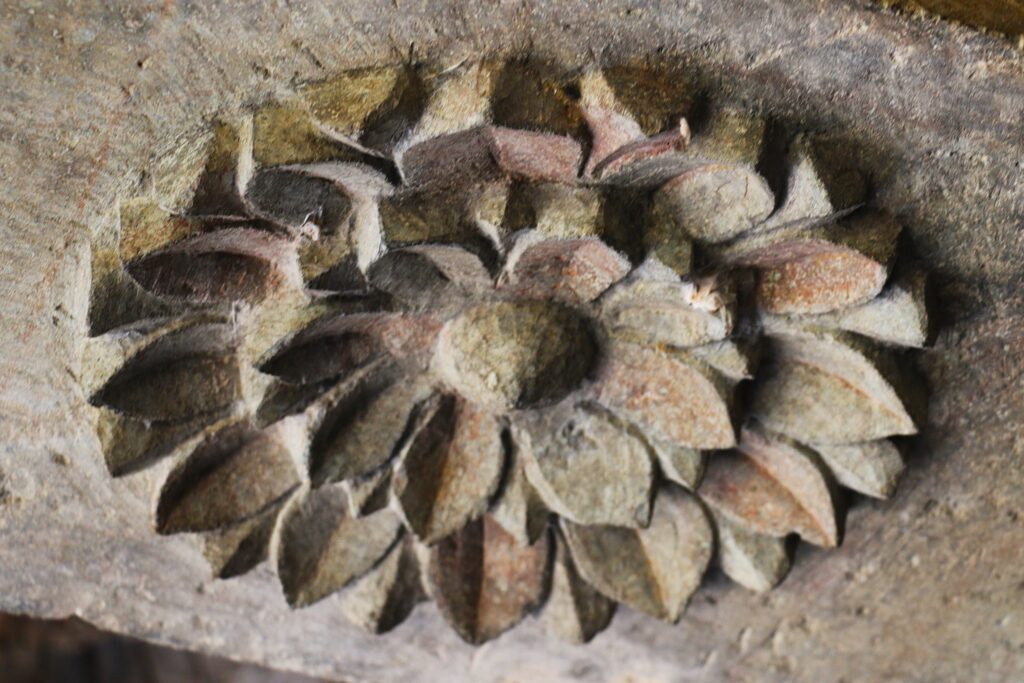
Concentric floral pattern on ceiling
Comparative Table: Arasikere vs. Other Hoysala Temples
| Feature | Ishwara Temple, Arasikere | Chennakeshava Temple, Belur | Hoysaleswara Temple, Halebidu |
| Date | c. 1220 CE | c. 1117 CE | c. 1121 CE |
| Plan Type | 16-pointed stellate mandapa | 8-pointed stellate plan | 12-pointed stellate plan |
| Material | Soapstone (chloritic schist) | Soapstone | Soapstone |
| Complexity | Most intricate stellate geometry | Famous for sculptural detail | Largest Hoysala temple, dual shrines |
| Unique Feature | Rotating star mandapa + domed ceiling | Iconic bracket figures (madanikas) | Extensive friezes of epics |
This comparison clarifies Arasikere’s position within Hoysala architecture. Belur and Halebidu receive more visitors and are UNESCO World Heritage Sites, but Arasikere’s Ishwara Temple represents the technical peak of stellate-plan experimentation.
The 16-pointed mandapa required solving geometric problems that earlier temples didn’t attempt, making it essential for understanding how Hoysala architectural thinking evolved during the dynasty’s mature phase.
History and Inscriptions: A Legacy of King Veera Ballala II
King Veera Ballala II commissioned the Ishwara Temple around 1220 CE, during the Hoysala dynasty’s peak. This wasn’t merely temple construction—it was an assertion of architectural ambition during an era when building temples signaled both devotion and political strength.
During my 2017 visit the inscriptions carved directly onto the outer walls caught my attention. The temple exterior displays nearly 120 deity figures spanning Shaiva, Vaishnava, Shakta, and Vedic traditions—standard for Hoysala temples.
What’s extraordinary is that individual sculptors’ names appear inscribed beside their work. I found myself reading these ancient signatures, realizing I was looking at something unusual: medieval artisans who received public credit for their craftsmanship.
In 13th-century Indian temple art, anonymity was the norm. Patrons and kings received recognition while artisans remained nameless contributors. At Arasikere, someone—perhaps the king, temple administrators, or the guild itself—decided these craftsmen deserved acknowledgment.
Standing before these inscriptions, I understood this temple functions as both a religious site and a historical document preserving actual names of people who worked here eight centuries ago.
There are 120 large images depicting various Gods we were told by our guide. These images add grace and beauty to the temple when seen from a distance.

Defaced and damaged figures of Ishwara Temple Arasikere
But as I observed carefully, I was disappointed to see the damage done to the sculptures. Almost all figures have been defaced. The details of eyes and nose have been scraped off, it was really sad to see the destruction.
The Interior Sanctum: Darshan of Lord Chandramouleswara
Walking into the garbhagriha (sanctum) shifts the experience from observation to participation. The sanctum houses the Shiva linga dedicated to Lord Chandramouleswara, but reaching it isn’t straightforward.
The 16-pointed stellate plan eliminates any direct axial approach—I had to move through angled passages created by the star-shaped walls. The smart architecture plan deliberately slows your approach, turning the act of viewing the deity into a deliberate, winding journey rather than a straight line.
This struck me as intentional ritual design. The indirect path encourages pradakshina (circumambulation), the traditional practice of walking around the sanctum. The stellate geometry doesn’t just create visual interest—it enforces a spiritual practice through architecture.
Hoysala craftsmen achieved this finish using stone-turning techniques that created perfectly circular, polished columns. The precision is striking: these pillars look machine-lathed despite being 13th-century handwork. Their cylindrical fluidity contrasts sharply with the angular stellate walls, creating visual tension between curves and points.
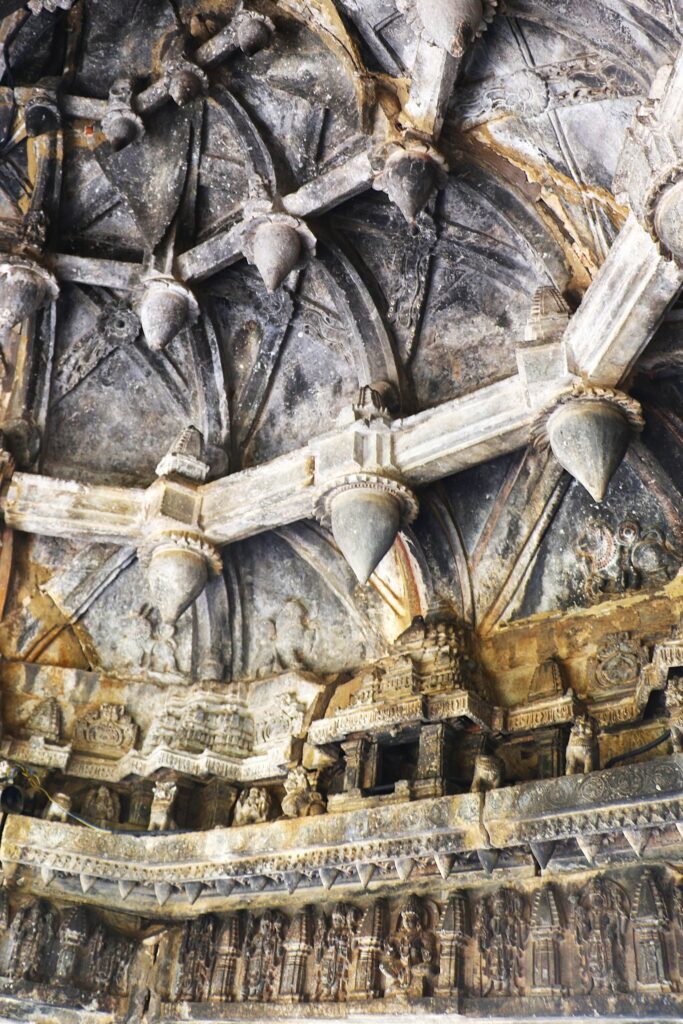
Ceiling details of Mukhamantapa – Ishwara Temple Arasikere
Above, the domed mandapa ceiling features concentric rings of floral and geometric patterns radiating outward like a carved lotus. From below, it resembles a three-dimensional mandala.
During my visit, I noticed how the dome’s shape affects sound—voices and ritual chanting resonate differently here than in flat-ceilinged spaces, likely an intentional acoustic feature for ceremonial use.
The garbhagriha experience at Arasikere reinforces how Hoysala architects merged devotional requirements with innovative design. The winding approach, polished pillars, and acoustic dome aren’t decorative choices—they’re functional elements that shape how worshippers physically and spiritually engage with the space.

Intricately carved Lathe turned Pillars
The lathe-turned pillars supporting the mandapa deserve close examination. When I ran my hand along one (gently—these are protected monuments), the surface felt unnaturally smooth for hand-carved stone. Individual pillars feature lathe-turned profiles so refined they appear machine-made despite being hand-carved in the 13th century.
Planning Your Visit: Travel Guide to Arasikere
About Arsikere
Arsikere translates to Queen’s Tank in Kannada. Arasi means queen in Kannada. Arsikere is one of the largest city in Hassan district. This region is known for its coconut production and is also called as kalpataru nadu. It was also known by the names: Udbhava Sarvajna Vijaya and Ballalapura.
Best Time to Visit
October through March offers the most comfortable conditions for exploring the Ishwara Temple. I visited in June 2017 during early monsoon season—the surrounding landscape was green, but afternoon heat and humidity made extended outdoor photography challenging.
If you’re planning detailed architectural photography or want to spend time examining exterior carvings, the cooler winter months provide better lighting and comfort.
Summer (April–May) brings intense heat that makes midday visits uncomfortable, though early mornings remain manageable.
How to Reach
Arasikere sits 140 km northwest of Bengaluru and 41 km from Hassan town, making it accessible as either a day trip or part of a multi-day Hoysala circuit.
By Train: Arasikere Junction functions as a major railway hub with direct connections to Bengaluru, Mysuru, and Hubli. The temple is approximately 2 km from the station—autorickshaws are readily available.
By Road: KSRTC buses run regularly from Hassan (1 hour) and Bengaluru (3–4 hours). Private taxis offer more flexibility for visiting multiple temples in one day.
By Air: Bengaluru’s Kempegowda International Airport is the nearest air connection, followed by road or rail to Arasikere.
Nearby Attractions
Arasikere works well as part of a Hoysala heritage circuit:
- Belur (Chennakeshava Temple): 35 km east, renowned for madanika bracket figures
- Halebidu (Hoysaleswara Temple): 40 km northeast, featuring extensive narrative friezes
- Shravanabelagola: 80 km south, home to the monolithic Gommateshwara statue
- Javagal, famous for Lakshmi Narasimha Temple, is about 33 km from Arasikere.
Budget two days minimum to cover these sites without rushing. Hassan town serves as a convenient base with decent accommodation options.
Practical Tips
The temple remains an active worship site—dress modestly and remove footwear before entering. Photography is permitted outside and in the mandapa, though flash and tripods may be restricted inside the sanctum.
I recommend visiting early morning (7–9 AM) when natural light enters the mandapa at optimal angles for photography and crowds are minimal. Bring water, as the immediate temple area has limited facilities.
Local guides sometimes offer services at the entrance—they can point out specific sculptural details and inscriptions you might otherwise miss.

The pillars are decorated with fine bead work, each bead so well defined. The outer walls of the temple are divided in to three sections. The parts are: the bands (pattika) at the base, the wall proper from the top of basement to the eaves and the parapet.
FAQ about Ishwara Temple in Arasikere
Q. Why is the Ishwara Temple in Arasikere unique?
The 16-pointed stellate mandapa represents the most geometrically complex floor plan attempted by Hoysala architects—exceeding the 8-pointed design at Belur and 12-pointed plan at Halebidu.
Q. Who built the Ishwara Temple Arasikere and when?
King Veera Ballala II commissioned construction around 1220 CE during the Hoysala dynasty’s mature phase.
Q. What material was used for construction?
Chloritic schist (soapstone), chosen because it’s soft when quarried, allowing intricate carving that hardens over time for preservation.
Q. How many deity sculptures appear on the outer walls?
Approximately 120 sculptures representing Shaiva, Vaishnava, Shakta, and Vedic traditions. Rare inscriptions credit individual sculptors by name.
Q. Can you walk straight to the Shiva linga?
No. The stellate plan eliminates direct axial access, creating angled passages that encourage ritual circumambulation before darshan.
Q. Is photography allowed inside Ishwara Temple Arasikere?
Yes for the mandapa and exterior. Exercise discretion inside the sanctum during active worship.
Q. How much time should I allocate?
45 minutes for a basic visit, 90+ minutes if you’re examining architectural details or photographing systematically.
Q. Is there an entry fee?
No, it is an ASI-protected monument.
Q. What is the difference between Ishwara and Chandramouleswara temple?
They are names for the same shrine.
Q. Are there active rituals?
Currently maintained by ASI; mostly historical, but locals offer prayers.
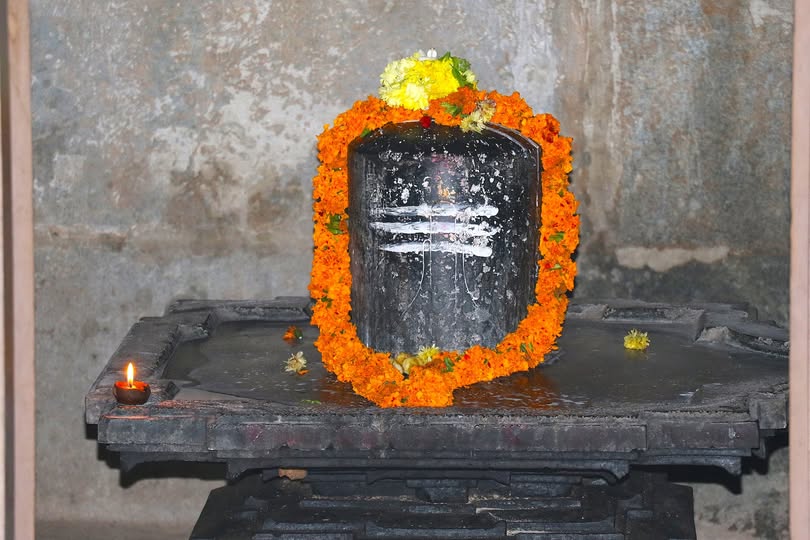
Shiva Linga worshiped by Locals
Final Thoughts
The Ishwara Temple at Arasikere challenges the common assumption that Belur and Halebidu represent the peak of Hoysala achievement. While those sites deserve their fame, Arasikere’s 16-pointed mandapa demonstrates a level of geometric ambition unmatched elsewhere in the dynasty’s portfolio.
My 2017 visit revealed something that photographs can’t fully convey: how the stellate architecture transforms simple circumambulation into an evolving visual experience. Each step around the mandapa presents different angles, shadows, and sculptural details—the temple actively resists being captured in a single image or understood from one viewpoint.
For travelers exploring Hassan district tourism, Arasikere offers what crowded heritage sites often lack—space to observe without distractions. You can spend time tracing individual carvings, reading sculptor inscriptions, and understanding how 13th-century architects solved complex spatial problems.
Pin and Save this to Plan a Trip for Later
About the Author
 Indrani Ghose is a cultural travel writer and heritage documentation specialist with over 15 years of experience exploring and writing about temples across India and Southeast Asia. Having visited over 150 sacred sites, she brings both scholarly depth and personal narrative to heritage travel writing.
Her work has been published in Lonely Planet, The National (UAE), Whetstone Asia, Deccan Herald, and various architecture and heritage journals.
Indrani believes that travel writing serves as a bridge — helping readers experience places more deeply by providing context, answering questions, and sharing both practical logistics and emotional resonance.
Connect with Indrani: Follow Indrani on Instagram | Twitter | Facebook for heritage travel insights, photography tips, and offbeat destination discoveries.






Good idea of combining more pictures in one frame. Crisp and nice presentation. May Lord Ishwara bless you for your good efforts. I would like to share these pictures to retired colleagues of mine.
Thank you very much for the blessings Chandra Sekhara Rao!
Please do share it with your friends.
I visited 2 smaller hoysala temples during my site visit and was struck by the craftsmanship……
This temple is exquisite too….great captures indrani di!! 🙂
Truly remarkable site and temple complex! Amazing how inch by inch art has been inscribed thoroughly. Great capture and detail, including the damage done to the sculptures… hope people realize the wealth of sculptures and art and preserve further damages.
Stunning, The mukhmantapa does look calm and peaceful, this is what i love about temples, Lovely post 🙂
Wow Indrani, great post. Thanks for sharing, would love to visit.
The architecture of this temple is amazing! Such fine details.. But real pity about the damage.
Thank you for linking up on Travel Tuesday! 🙂
The temple is gorgeous. And so beautifully articulated, Indrani. Almost makes me feel like I was there.
I definitely want to visit this place and experience what you have written
Hello Indrani, lovely images of the temple and the carvings. The details are just beautiful. It is a grand place. Have a happy day and week ahead!
Impressive shots.From the photos we could feel the grandeur of this place.This place is surely a gem.
Cheers,
Sriram & Krithiga
Amazing carvings and architecture, very nice images!
Hoysala architecture is always unique in its style- the pillars, ornamentation on idols and carving on the ceilings. Its really pride of Karnataka. Thanks for sharing the pictures and information.
I love your collages! Beautiful.
Beautiful temple , Never knew about this temple .I have to add this to my list .thanks for sharing.
There is something about temples that attract everyone. Great detailing.
I am impressed by the details in these buildings. The shapes and columns are very unique. I do not think I have seen something similar before. So great you had the opportunity to stop and explore.
Love the detailing and the art work … we have so many hidden gems in our country that needs to be preserved ..
Such a beautiful temple it is Indrani and you are right in calling these gems ! They are gems. I don’t know a thing about architecture but am always being drawn to it perhaps, as it seems to me just another sort of handicraft! Thankfully, I am able to detect the Hoysala architectural designs and motifs ..specially the linear circles on the pillars , the intricate work on every nook and that star shaped structure !But, Its utterly disgraceful and saddening to see the damage to it .
Stunningly beautiful temple , and the sculpted interiors are too impressive !
Wow! Detail work on pillars and crafted sculptures are simply great. Great idea to collect such gems on the way 🙂
Beautiful work of art! It seems sandstone. And, the statues look highly polished!
Beautiful carvings of a religious place . your journey is specific in traveling.
The wonders that Hoysala kings left for the humanity are marvelous! I had an opportunity to explore some of those last year. But there are so many more to cherish. Thanks for showing this one, Indrani!
The Pictures certify how well the temple is maintained. Beautiful architectural work. Wonderful clicks!
The images that are simply ancient looks beautiful. Did not know India still sustains with those wonderful prehistoric architectures.
Such an amazing and beautiful place, Indrani!! Wonderful captures and, as always, thank you for the history!! I do enjoy these posts so very much!! I hope you have a great new week! Enjoy!!
Beautiful pictures. The gradual loss of heritage is saddening.