Great Meteoron Monastery – First Monastery of Meteora Greece
The Great Meteoron: A Decade of Reflecting on Meteora’s Highest Sanctuary
That feel of the crisp cool air and the silence of the Pindus Mountains enveloping me as I first ascended the stone steps to the Great Meteoron Monastery in a winter morning has stayed with me for over a decade. As someone who has spent the last 19+ years documenting heritage sites across Europe and Asia, I have learned that the true value of a place like Meteora lies not just in the view, but in the layers of history held within its frescoes and manuscripts.
In this guide, I am revisiting my own archives—and my original photography—to help you navigate this UNESCO World Heritage site of Greece with a deeper understanding of its 14th-century origins. Be it your first trip plan or looking to appreciate the architectural genius behind this “floating” sanctuary, this guide combines practical 2026 logistical tips with the historical context every visitor deserves to know before they climb.
By Indrani Ghose | Last Updated: June 2026

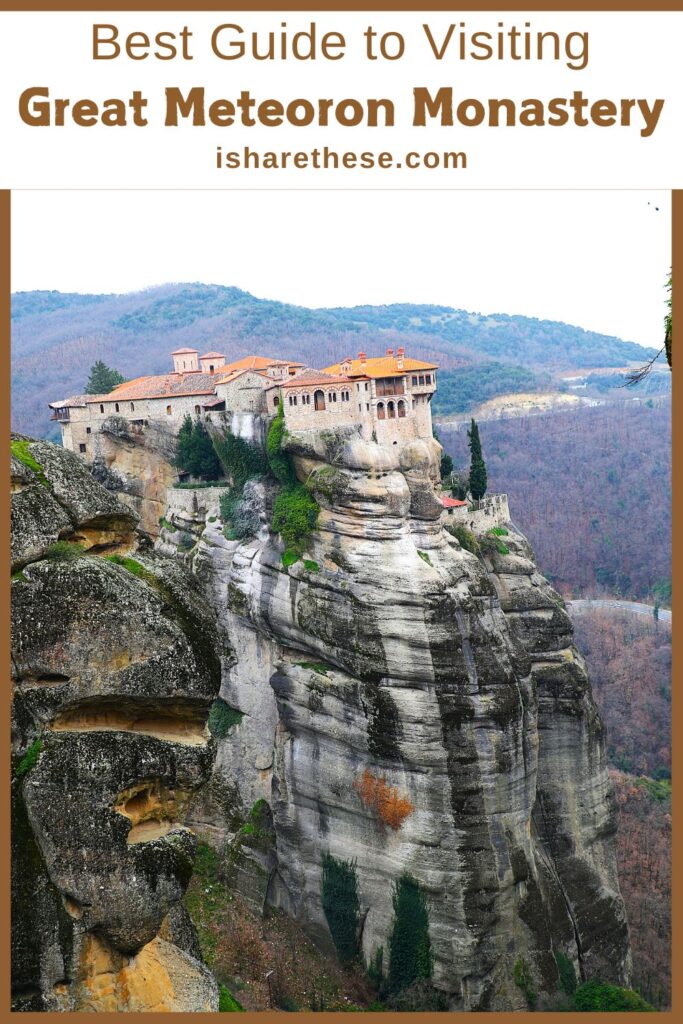
View of the Great Meteoron Monastery perched on a sandstone cliff in Meteora, Greece.
The Great Meteoron Monastery of Meteora is really GREAT with its several superlative interesting facts. It is located on a peak which is highest when compared to peaks of other 5 active monasteries. Area wise too it is the largest. Keep the best part of your tour time for this monastery.
After visit to St Stephen’s Nunnery we rushed to visit Great Meteoron. During winters this monastery closes at 2 PM and it being the biggest one we didn’t want to run short of time.
Until the early 20th century the monastery could be accessed by only ropes and ladders. In 1923 steps were carved out in the sides of the mountain. Since then access is a lot easier. I saw how precariously those ancient ladders used to enter the monastery were placed. Approach is a lot easier today.
Quick Facts: Essential Visitor Information for the Great Meteoron
| Detail | Information |
| Location | Great Meteoron Monastery, Meteora, Thessaly, Greece – the largest of the six active Meteora monasteries |
| Founded | circa 1340, by Saint Athanasios the Meteorite |
| Opening Hours (2026) | Generally 9 AM – 3 PM; hours shift seasonally and the monastery closes on certain weekdays (typically Tuesdays). (Always verify on the official Meteora site before your visit.) |
| Entry Fee | Approximately €3–4 per person; cash only |
| Dress Code | Modest attire required. Men must wear long trousers; women need long skirts and covered shoulders. Wraps and skirts are available on loan at the entrance |
| Accessibility | Access involves steep stone staircases. Not wheelchair accessible. Wear sturdy, comfortable walking shoes |
| Photography | Permitted in outdoor areas and courtyards; prohibited inside chapels. Follow posted signs and avoid using flash |
| Best Time to Visit | Early morning on weekdays for smaller crowds; late afternoon light is ideal for photography. Sunrise from the rock platforms offers dramatic views |
| Facilities | On-site museum housing Byzantine manuscripts, icons, and frescoes; rest areas; and panoramic viewpoints over the Thessaly plain |
| Nearby | Varlaam Monastery, Rousanou Monastery, Holy Trinity Monastery, Kalambaka town, and marked Meteora hiking trails |
| Travel Tip | The Great Meteoron Monastery is best combined with visits to two or three other monasteries in a single day. A day trip from Athens by train to Kalambaka takes approximately 3.5–4 hours and is one of the most practical ways to visit Meteora without a car |

You can see the remains of ladders and ropes used before 20th century to get access to the monastery even today
Trivia: Great Meteoron Monastery
- It is located on a peak named – Platys Lithos meaning Broad Rock, at a height of 1000ft (615m) above sea level.
- It is also known by name: Holy Monastery of Transfiguration of Jesus
- In 1923 they added 146 steps for an easy and quick approach to the summit, though not a steep climb.
- It is an all male monastery.
- This is the oldest monastery of Meteora. Though St Nicholas Monastery was the first one where monks halted, it was at Great Meteoron the first monastery came up.
- In 1988, UNESCO enlisted the monasteries of Meteora in its prestigious list of World Heritage sites.

Church inside of the Monastery of the Great Meteoron, Meteora, Kalambaka, Greece, Europe
History: The Rise of the “Suspended in the Air” Monasteries
The Great Meteoron Monastery — officially the Monastery of the Transfiguration — is the oldest and largest of the Meteora monasteries. Its story begins in the 14th century, when Saint Athanasios the Meteorite, a monk from Mount Athos, sought a place of solitude among the sandstone rock pillars of Thessaly. Around 1340, he established a hermitage on one of the highest formations, naming it “Meteoron” — meaning suspended in the air — a description that still holds today.
From Hermitage to Monastic Powerhouse
Under Athanasios, the site grew from a simple retreat into an organised community of Orthodox monks. His successor, Saint Ioasaph — formerly John Uroš, a Serbian prince who renounced his throne for monastic life — significantly expanded the complex during the late 14th and early 15th centuries. He funded the construction of additional chapels, cells, and protective walls.
For centuries, the only access to the monastery was via removable ladders and a net-and-rope basket system, which both protected the monks and gave the site an almost mythical remoteness.

Custodian of Byzantine Heritage
The Great Meteoron became a critical refuge for Orthodox culture during the Ottoman period. Monks preserved illuminated manuscripts, icons, and frescoes within its walls — many of which are now displayed in the monastery’s museum. The architecture reflects Byzantine traditions: thick stone walls, barrel-vaulted roofs, and interior frescoes depicting scenes from the New Testament and the lives of saints.
Despite centuries of political upheaval, wars, and natural erosion, the monastery has endured. It remains an active place of worship and one of Greece’s most visited heritage sites — a living monument to both spiritual resilience and Byzantine craftsmanship.

Cave of St. Athanasios Great Meteoron
Architectural Marvels and Frescoes: What to Look For
Inside the Great Meteoron: What to See and Do
If you are keen to know, see and understand Greek Orthodoxism then this is the place. Watch out for the following:
- Magnificent frescoes from 14th and 15th centuries still adorn the walls and interior of the church.
- Hermit cave of St. Athanasios
- Monk’s old refectory with a table on which they dined from 16th century. Original tableware too is displayed.
- Several religious wood carvings
- Kitchen where the monks cooked, the original bread oven too on display
- And finally the sacristy which contain shelves of the skulls of the monks who have lived there over the years
Stepping inside the Great Meteoron Monastery feels like entering a living museum of Byzantine spirituality. Beyond its dramatic cliffside setting, the interiors reveal centuries of devotion, artistry, and resilience.
The well preserved frescoes, relics, and spaces reflect the monastery’s dual role — an active place of worship and a guardian of Orthodox heritage. When I visited in January 2015, the winter quiet made the experience feel even more mystic. With thin tourist traffic, there were moments when there was no one between me and these extraordinary spaces.
The Refectory: A Hall of Monastic Life
One of the most striking spaces is the Refectory — a vast, vaulted hall where monks once gathered for communal meals. Built with stone arches and heavy wooden beams, it now serves as a museum.
Inside, you’ll find illuminated manuscripts, religious artifacts, and everyday monastic tools that paint a clear picture of life in near-total isolation.
The refectory’s scale and state of preservation make it one of the finest examples of monastic architecture in Thessaly. These old tools look ordinary but they speak volumes about how the Meteora monasteries sustained themselves across centuries.

Original tableware inside Monk’s old refectory
The Skull Room (Sacristy): A Sobering Reminder
Equally memorable is the Skull Room, or Sacristy — a small chamber where the skulls of former monks are carefully arranged on shelves. The display is rooted in Orthodox tradition: a quiet, tangible reminder of humility, impermanence, and the cycle of life and death.
Standing there in January 2015, I found it the most reflective moment of the entire visit. The atmosphere is solemn rather than unsettling — closer in spirit to Évora’s Chapel of Bones in Portugal than to anything theatrical. Both spaces use mortality as a form of devotion, not spectacle.

Human skulls on the shelf inside Skull Room, or Sacristy
The Katholikon: Heart of Worship
At the center of the monastery stands the Katholikon, the main church dedicated to the Transfiguration of Christ. Built in the 14th century and later expanded, it features a domed structure covered in Byzantine frescoes painted in deep reds, blues, and ochres.
The scenes depict biblical events, saints, and acts of martyrdom — considered masterpieces of post-Byzantine art for their theological precision and visual power. The Katholikon remains an active place of worship. On the day I visited, the faint smell of incense and the ray of light through narrow windows made it feel removed from the modern world entirely.
Frescoes and Artistic Legacy
Throughout the monastery, frescoes and icons narrate stories of faith across the walls and ceilings. Many date to the 16th century, created during a period of flourishing Orthodox artistic patronage. Their preservation gives modern visitors direct access to centuries of theological symbolism and Byzantine craftsmanship.
For those interested in Meteora monastery photography, the frescoes combined with the natural light filtering through stone-cut windows offer genuinely striking compositions — though restraint and respect for signage are essential. Today rulers are stricter, photography inside the Katholikon is not permitted.

Ancient frescoes in great monastery Greece – Pic taken in Jan 2015

Ceiling – Great Meteoron Monastery Interior – Picture taken in Jan 2015
Essential Logistical Tips: How to Get to Great Meteoron
Reaching the Great Meteoron Monastery takes some planning, but the logistics are manageable once you know what to expect.
Getting There from Kalambaka and Kastraki
Both towns sit at the base of the Meteora rock formations and serve as the main gateways.
Local buses run to the monastery area, though schedules are limited and don’t always align with early morning visits.
Taxis and private cars offer more flexibility — and if you’re visiting multiple monasteries in one day, hiring a car or joining a guided tour is the most efficient option.
Parking is available close to the Great Meteoron entrance, but spaces fill fast during peak season. Arriving before 9 AM gives you the best chance of securing a spot and beating the crowds. We had our car for the trip and with not much tourist traffic we found a slot in the parking area easily.
Managing the Climb
Access to the monastery involves a series of steep stone steps — there’s no avoiding them if you want to go inside. Wear sturdy, comfortable shoes, and take the ascent at your own pace. Those with mobility concerns, or anyone who simply wants a panoramic perspective without the full climb, can stop at the elevated viewpoints along the approach road. These offer clear sightlines across the rock formations and are genuinely worthwhile for photography in their own right.
Wheelchair Access
The steep staircase makes the monastery inaccessible for wheelchair users. The surrounding viewpoints and road-level vantage points remain good alternatives for taking in the landscape.
Opening Hours and Dress Code
Hours and dress code are covered in the Quick Facts section above. The key practical note: confirm the current schedule before you travel, as the monastery closes on certain weekdays and hours shift between seasons.
Tips to Visit Great Meteoron Monastery
- If you have time to visit only one monastery in Meteora then let this be the one.
- Being the largest monastery set aside more time for this monastery when you fix the itinerary to tour Meteora monasteries.
- There are no eateries or washroom inside the monastery so prepare yourself for that.
- Please follow the dress code mentioned, they provide wraparound which you can avail free of cost.

Centre piece of Jesus Christ in a fresco in door frame in the Monastery
FAQ about Visiting Great Meteoron Monastery Greece
What are the opening hours of the Great Meteoron Monastery in 2026?
The monastery generally opens from 9:00 AM to 3:00 PM, though hours shift between seasons. It closes on certain weekdays — Tuesdays is the most commonly cited closure day, but this can change. Always check the current schedule directly before your visit to avoid making the trip on a closed day.
How do I get to the Great Meteoron Monastery from Athens?
The most straightforward option is the direct train from Athens (Larissa Station) to Kalambaka, which takes approximately 3.5 to 4.5 hours depending on the service. Buses are also available. From Kalambaka, local taxis, shuttle buses, or a guided tour will take you up to the monasteries. If you’re planning to visit several monasteries in one day, hiring a car gives you the most flexibility over timing.
Is there a dress code at the Meteora monasteries?
Yes, and it’s strictly observed. Men must wear long trousers; women need long skirts and covered shoulders. If you arrive without suitable clothing, wraps and skirts are usually available to borrow at the entrance free of charge.
Can I take photos inside the monastery?
Photography is permitted in the outdoor courtyards and across the surrounding viewpoints. Inside the Katholikon and chapels, it is not allowed. Follow posted signage throughout the site and avoid using flash anywhere on the premises.
How do I visit Great Meteoron Monastery without crowds?
Arrive as early as possible — ideally right at opening time — and aim for weekday visits outside of July and August. January through March offers the quietest conditions. Shoulder season months like April, May, and October balance manageable crowds with better weather than mid-winter.
Is the monastery accessible for visitors with mobility difficulties?
Access requires climbing a steep flight of stone steps, which makes the interior inaccessible for wheelchair users. Visitors with mobility concerns can still experience the site meaningfully from the elevated viewpoints along the approach road, which offer clear views across the rock formations and monastery exterior.
Is parking available near the Great Meteoron?
Yes, there is a small parking area near the entrance. Spaces are limited and fill quickly, particularly between May and September. Arriving before 9 AM is the most reliable way to secure a spot without having to walk uphill from a lower parking area.

Bell Tower of Church inside of the Monastery of the Great Meteoron, Meteora, Kalambaka, Greece, Europe
My Visit to Great Meteoron — January 2015
I visited the Great Meteoron Monastery in January 2015, and the timing turned out to be one of the best decisions of the trip. Winter in Meteora means thin crowds, cool air, and a quality of light that photographers genuinely prize — soft, low, and long-shadowed across the sandstone cliffs. On the morning I arrived, I could stand in the courtyard in near silence and take in the full scale of the place without anyone else in the frame.
The winter light was ideal for photography. Early in the morning, warm tones settled across the stone walls and picked out the texture of the rock faces below. My favourite position was near the outer courtyard wall, where the monastery appeared to float above the mist-covered plains of Thessaly — exactly the “suspended in the air” effect the name promises.
What I remember most clearly, though, wasn’t a photograph. It was the Skull Room — that small, still chamber housing the skulls of former monks. In January, with almost no other visitors around, it carried a weight that’s hard to describe without sounding dramatic. It didn’t feel grim. It felt honest.
Meteora has grown considerably as a destination since 2015 I have read in various travel reviews of the place. Summer crowds are now substantial, and the infrastructure — signage, facilities, tour groups — reflects that growth. But the essence of the place hasn’t changed.
The silence between the cliffs, the scale of the rock formations, and the sense of genuine remoteness are all still there if you time your visit well.
For today’s visitors, the same principles apply: arrive early, go in the shoulder season if you can, and give yourself more time than you think you’ll need. The Great Meteoron rewards patience.
Pin and Save this for later
About the Author
 Indrani Ghose is an Indian Travel Writer and Blogger based in Bangalore, India. She has written for numerous publications across the globe – including Lonely Planet, The National UAE, Whetstone Asia, Deccan Herald.
With over 19 years of experience documenting global heritage sites, Indrani Ghose is dedicated to preserving the narratives of historical architecture. From the monasteries of Meteora to the ancient temples of India, her work focuses on the intersection of deep historical research and the lived experience of modern travel. Indrani Ghose’s archive of original photography serves as a primary resource for students of history and seasoned travelers alike.
You can follow her on her social media handles Instagram, Twitter, Pinterest and Facebook to see the wonderful destinations, beautiful offbeat places and get instant updates about them.






We had planned a trip to Greece a few years ago but didn’t get there. I was considering visiting Meteora but wasn’t sure. After reading this, it will definitely make our itinerary when we do visit. The monastery has a great history and I just love how it’s perched on the cliff. I can’t imagine how the monks used to have to use ropes and ladders to access it!
The history of this monastery is really interesting. It bursts lots of question in my mind, such as what was the reason behind it could only reach by ropes and ladders or why collecting the skulls. It makes want to visit this monastery.
Wow, the things mankind will do to get closer to God… Building a monastery on top of a rock is an incredible feat, but I guess the monks guaranteed themselves some peace and quiet in order to pray… I heard you can do prayer retreats at Mount Athos (well, men can…), I guess it would be a humbling experience for a faith practitioner. Great photos by the way!
I’ve wanted to go here for a while but we’ve not got around to visiting Greece again. But now we’re back over in Europe for a while once everything settles down a bit it might be the perfect time to go back! It really does look an impressive place to explore and photograph!
The monasteries that sit atop a hill are fascinating and a photographers dream. They are fascinating to look at both inside and out. I have not yet visited one but would appreciate the modernization with the stairs that were installed.
Truly Amazing, Thanks for the details post.