The Ultimate Sanchi Stupa Guide: Architecture, History, and Travel Tips
The Sanchi Stupa is one of India’s most significant Buddhist monuments — and one of its most undervisited. Located about 46 km northeast of Bhopal in Madhya Pradesh, this UNESCO World Heritage Site is among the oldest surviving stone structures in the country.
Emperor Ashoka built the original stupa in the 3rd century BCE to enshrine sacred Buddhist relics, and it has been a site of pilgrimage and scholarship ever since.
When I visited the Sanchi Stupa in March 2021, I felt as though I had stepped into the pages of the history books I grew up reading. The site answered my long-held curiosity as its architecture, carved gateways, and hilltop setting came alive in ways photographs never quite capture.
Join me on a virtual tour as I walk through Sanchi and rediscover these stories with archaeologist, Padma Shri K. K. Muhammed, our guide on Times Passion Trail.

My first capture of Sanchi Stupa – UNESCO site
Quick Facts — Sanchi Stupa at a Glance
| Feature | Details |
| Location | Sanchi, Madhya Pradesh — 46 km from Bhopal |
| Built By | Emperor Ashoka, 3rd century BCE |
| UNESCO Status | World Heritage Site (inscribed 1989) |
| Key Attraction | The Great Stupa (Stupa No. 1) with four carved gateways (Toranas) |
| Best Time to Visit | October – March |
| Entry Fee (2026) | ₹30 (Indian citizens) · ₹500 (foreign nationals) |
| Timings | 6.30 AM – 6.30 PM (all days) |

Horizontal panels on torana of Sanchi Stupa
Why Sanchi Stupa is a Masterpiece of Buddhist Art
Most heritage sites are either architecturally impressive or historically significant. Sanchi Stupa is both — and the combination is what makes it genuinely remarkable.
The Significance of the Great Stupa (Stupa No. 1)
The Great Stupa is the centerpiece of the Sanchi complex, and its design is deeply intentional. The hemispherical dome — called the anda — represents the cosmic mountain and symbolizes the universe itself. At its summit, a tiered stone umbrella (chattra) signifies the Buddha’s elevated spiritual status.
Beneath the dome lies a relic chamber containing sacred remains associated with the Buddha, which is why Sanchi has been a pilgrimage site for over two millennia. For devout Buddhists, this isn’t a museum — it’s a living sacred space.
The four gateways, or toranas, are where the artistry reaches its peak. Each gateway is carved with scenes from the Jataka tales — stories of the Buddha’s previous lives — as well as events from his final life and episodes from early Buddhist history. The level of narrative detail packed into stone panels, without a single image of the Buddha himself (a convention of early Buddhist art), is extraordinary.
How the Structure Evolved
Ashoka’s original 3rd-century BCE stupa was a relatively modest brick construction. During the Shunga period (2nd century BCE), it was substantially enlarged: the brick core was encased in stone, a circumambulatory path was added, and the elaborately carved railings and gateways were constructed. This is the form visitors see today.
Later dynasties made additions, but the Shunga-era expansion remains the defining phase of Sanchi’s architectural identity.
Why It Stands Apart
Sanchi holds a specific place in art history: it is the oldest surviving stupa in India and set the architectural template followed by Buddhist monuments across South and Southeast Asia. The toranas are widely regarded as among the finest examples of early Indian stone sculpture. UNESCO’s 1989 inscription acknowledged not just the site’s age, but its unmatched artistic and cultural depth.

Archaeologist KK Muhammed describing the panels of Sanchi Stupa
History — Who Built Sanchi Stupa and Why?
The Sanchi Stupa has a layered history that spans several centuries and multiple dynasties. It is best to hire a guide here. Understanding who built it — and why — makes the site considerably more interesting to walk through.
The Origins: Emperor Ashoka, 3rd Century BCE
The story begins with one of ancient India’s most consequential political transformations. After the devastating Kalinga War (circa 261 BCE), the Mauryan emperor Ashoka renounced military conquest and converted to Buddhism. What followed was an extraordinary programme of monument-building across his empire — and Sanchi was among the earliest and most significant of those projects.
Ashoka commissioned the original stupa to enshrine sacred relics of the Buddha, establishing the site as a place of pilgrimage and devotion. The structure at this stage was a relatively modest hemispherical brick mound, but its intention was clear: to mark Buddhist faith in permanent architectural form and encourage its spread among his subjects.
Sanchi was not a random choice of location. The site’s hilltop position made it visible across the surrounding plains, and its proximity to Vidisha — a prosperous trading town — meant it sat within reach of a large lay community. Ashoka’s personal connection to the region was also significant: according to Buddhist tradition, he had lived in Vidisha before becoming emperor, and his first wife Devi was from the town.
Expansion Under the Shunga Dynasty, 2nd Century BCE
Ashoka’s brick stupa did not survive entirely intact. During the Shunga period, the structure was damaged — ancient sources suggest it may have been partially demolished during a period of anti-Buddhist sentiment — and subsequently rebuilt on a larger scale.
The Shunga dynasty’s reconstruction was transformative. The brick core was encased in stone, the diameter was enlarged, and a stone balustrade was added to define the circumambulatory path around the base. Most significantly, the four carved toranas (gateways) were constructed, most likely completed during the early Satavahana period in the 1st century BCE.
It is this Shunga-era expansion that gives Sanchi its present form. The gateways in particular — densely carved with Jataka tales, Buddhist symbols, and royal imagery — represent a different artistic ambition from Ashoka’s original structure. Where Ashoka built for devotion and pilgrimage, the Shunga expansion turned Sanchi into a monument of visual and narrative sophistication.

Sanchi Stupa Torana
Purpose and Symbolism
The stupa’s design is not arbitrary. Every element carries meaning rooted in Buddhist cosmology:
- The dome (anda) represents Mount Meru, the cosmic mountain at the centre of the universe in Buddhist and Hindu cosmology — a metaphor for the Buddha’s spiritual presence.
- The harmika, a square railing at the summit, marks the sacred space of the Buddha.
- The chattra, a tiered stone umbrella above the harmika, denotes honour and elevated status.
- The circumambulatory path (pradakshina patha) is designed for ritual clockwise walking — a meditative practice that remains in use by Buddhist pilgrims today.
Why It Matters
The Great Stupa at Sanchi is the oldest surviving stone stupa in India and the architectural reference point from which later stupas across South and Southeast Asia were developed. Its construction reflects Ashoka’s use of architecture as a deliberate instrument of spiritual outreach — a vision that proved more durable than his empire.
For me, knowing this and connecting with the history I had read helped understand what the site looks like. The stupa is an accumulation of political will, religious devotion, and artistic ambition across three centuries. That layering is part of what makes Sanchi worth the trip.
Decoding the Four Gateways (Toranas)
If the Great Stupa is the heart of Sanchi, the four toranas are its voice. These gateways — one at each cardinal direction — are covered in some of the most detailed stone carvings in early Indian art. Constructed primarily during the 1st century BCE, they were added after the stupa itself and represent the high point of the site’s artistic achievement.

North gateway Sanchi stupa 1
One convention runs through all four gateways: the Buddha is never shown in human form. This practice, known as aniconism, was standard in early Buddhist art. Instead, his presence is conveyed through symbols — the lotus (purity), the Dharma wheel (his teachings), the Bodhi tree (enlightenment), and the riderless horse (renunciation). Once you know this visual language, the carvings become readable.
Various parts of Torana
- Buddhist Torana in Sanchi basically consists of 2 square vertical columns.
- Both columns are covered with carvings.
- These columns support 3 separate horizontal panels which again has innumerable characters from various stories carved on them.
- Between each of the panels there are ornamental balusters.
- All the 3 panels are supported on the columns by figures like group of 4 elephants, lions and dwarfs.
- Total height of torana is 10.36m and width is 3m.
The entire structure looks magnificent, and that is an understatement!
North Gateway
Widely regarded as the most elaborate of the four, the North Torana is densely packed with scenes from the Jataka tales — stories of the Buddha’s previous lives that illustrate virtues like compassion, self-sacrifice, and moral restraint. The Dharma wheel and Bodhi tree appear repeatedly, anchoring the narrative in Buddhist philosophy. When I visited in March 2021, this gateway drew the longest crowd of observers, and it’s easy to understand why — the layering of figures across three horizontal beams rewards close attention.
South Gateway
The South Torana is the oldest of the four and is associated with the miracles attributed to the Buddha. Key episodes are represented symbolically: his first sermon at Sarnath appears through the Dharma wheel, while the lotus motif reinforces the idea of spiritual purity emerging from worldly impermanence. The South Gateway is also where many visitors enter first, making it a natural starting point.
East Gateway
The East Torana focuses on the early life of the Buddha — his birth, his royal upbringing, and his renunciation. A riderless horse represents the moment Siddhartha Gautama left his palace; the Bodhi tree marks his eventual enlightenment. This gateway offers some of the clearest illustration of how aniconism works in practice — absence becomes a storytelling device.

Yakshi in Sanchi Stupa Torana – Close-up of the Eastern Gateway carvings – still remarkably sharp after 2,000 years (Photo from my March 2021 visit).
West Gateway
The West Torana shifts focus outward, depicting the spread of Buddhism and the devotion it inspired. Celestial figures, royal processions, and repeated Dharma wheel motifs suggest a faith that had grown beyond a single founder into a living tradition.
Why the Gateways Matter
Taken together, the four toranas trace an arc: from the Buddha’s past lives, through his birth and enlightenment, to the global reach of his teachings. They function as visual scripture — carved for an audience that may not have been literate, but could follow a story told in stone.
For anyone researching the symbolism of Sanchi Stupa’s four gateways, this is the interpretive framework that makes the carvings legible.
Practical Visitor Information
Sanchi is straightforward to visit from Bhopal, and a single day is enough to cover the main stupa complex, the site museum, and the surrounding monuments — provided you start early.
Getting There
- By Road: Sanchi is 46 km from Bhopal via NH146, roughly a 1–1.5 hour drive depending on traffic. Taxis and private cabs can be booked from Bhopal city or Raja Bhoj Airport. State-run MPRTC buses also operate regularly from Bhopal’s ISBT to Sanchi town and are the most budget-friendly option.
- By Train: Sanchi has its own small railway station with limited connectivity. A more practical option is to take a train to Vidisha (10 km from Sanchi) and hire a taxi or auto-rickshaw from there. Several express trains from Bhopal stop at Vidisha.
- By Air: Raja Bhoj Airport in Bhopal is the nearest airport. Direct cabs to Sanchi are available; the journey takes around 1.5 hours.
- Local Transport: Auto-rickshaws and shared jeeps connect Vidisha to Sanchi town. From the town, the stupa hill is a short walk.
We made a road trip from Bhopal to Sanchi and then to Chanderi in Madhya Pradesh in March 2021.

Eastern Gateway Sanchi Stupa
Key Visitor Details (2026)
| Entry Fee | ₹30 (Indian citizens) · ₹500 (foreign nationals) |
| Timings | 6.30 AM – 6.30 PM, all days |
| Best Time to Visit | October – March |
| Nearest Town | Sanchi (1 km from site) |
| Nearest City | Bhopal (46 km) |
On-the-Ground Tips
- Start early. Arriving by 7–8 AM gives you the site largely to yourself, and the morning light on the sandstone is excellent for photographs.
- Allow 2–3 hours for the stupa complex and at least another 30–45 minutes for the Sanchi Archaeological Museum, which houses original sculptures and explains the site’s excavation history.
- Wear comfortable footwear — the hill approach involves uneven stone paths.
- Combine with nearby sites: Udayagiri Caves (13 km) and Vidisha town make natural additions to a heritage day itinerary. These also count among the notable UNESCO-adjacent sites near Bhopal.
I visited on a quiet weekday in March 2021 and found the site uncrowded by mid-morning — a reminder that Sanchi, despite its significance, hasn’t yet been overtaken by mass tourism.
The Best Time to Visit Sanchi Stupa
The short answer: October to March is the ideal window, with March being a particularly strong choice for most travelers.
During March, temperatures in the Sanchi region are comfortably in the mid-20s °C — warm enough to be pleasant, cool enough to walk the site without discomfort. The skies are generally clear, humidity is low, and the site itself tends to be less crowded than during peak winter holiday months like December and January.
I visited in March 2021 and found the conditions close to ideal, carvings on the toranas was sharp in the light.
The lighting in March highlights the preservation of the stone’s texture, making it the best time for heritage photography. By mid-morning the site was still quiet enough to study the carvings without navigating around tour groups.
For photographers specifically, March offers excellent natural light. The low-angle sun in the early morning and late afternoon casts directional shadows across the carved panels, bringing out relief detail that flat midday light obscures. The sandstone takes on a warm amber tone around golden hour that is difficult to replicate in any other season.
Seasons to avoid:
- April – June: Temperatures regularly exceed 40°C. The site is exposed with limited shade, making extended exploration genuinely uncomfortable.
- July – September: Monsoon season brings humidity and occasional heavy rain. The paths on the stupa hill can become slippery, and overcast skies flatten the light for photography.
If your travel window is fixed outside October–March, early morning visits in shoulder months (September or late March) are the next best option.

Balustrade of stupa
Sanchi Stupa After Dark — The Light and Sound Show
The daytime visit covers the architecture and history. The Light and Sound Show adds a different dimension entirely.
Held after sunset on the stupa grounds, the show uses illumination, narration, and music to walk visitors through the story of Buddhism in India — from the Buddha’s life and Emperor Ashoka’s conversion, to the construction of the stupa and its significance as a pilgrimage site.
The show runs on select evenings, and timings and ticket details can change by season. I’ve covered all of that separately — including what to expect, how to book, and whether it’s worth the extra stop — in my dedicated post on the Sanchi Stupa Light and Sound Show.
If you’re already making the trip from Bhopal, combining both the daytime visit and the evening show into a single day is entirely feasible and well worth planning for.

Elephant Carvings on Torana Sanchi Stupa
Why Sanchi is the Best-Preserved Buddhist Site in India
Preservation at heritage sites is rarely accidental. At Sanchi, it is the result of an unusual history — and deliberate modern effort.
Most major Buddhist sites in India suffered repeated destruction between the 12th and 14th centuries, as waves of invasion targeted monasteries and monuments. Nalanda was burned. Sarnath was dismantled for building material. Sanchi escaped largely because it had already been abandoned — the local Buddhist community had dispersed, and the site sat largely forgotten on its hilltop for nearly five centuries.
This long period of neglect, paradoxically, became its greatest protection. With no active population and no obvious strategic value, the stupas, railings, and gateways were left undisturbed. When British surveyor General Taylor rediscovered the site in 1818, much of the original structure remained intact — damaged in places, but not demolished.
What followed was a sustained conservation effort. The Begums of Bhopal — Shah Jahan Begum and later Sultan Jahan Begum — funded restoration work and protected the site during the 19th century, a contribution that is often underacknowledged in popular accounts.
In the early 20th century, Sir John Marshall, then Director-General of the Archaeological Survey of India, led systematic scientific restoration. His team stabilised the Great Stupa, re-erected fallen gateway sections, and documented the site comprehensively.
The result is what visitors see today: a monument that retains its original spatial layout, its carved gateways largely intact, and its hilltop setting unchanged. Among Buddhist heritage sites in India, that combination is genuinely rare.

Stories on panels of Sanchi Stupa Torana
Sanchi Stupa vs. Dhamek Stupa
Both are landmark Buddhist monuments, but they represent different moments in the faith’s history and differ significantly in age, purpose, and architectural style.
| Feature | Sanchi Stupa | Dhamek Stupa |
| Location | Sanchi, Madhya Pradesh | Sarnath, Uttar Pradesh |
| Built By | Emperor Ashoka, 3rd century BCE | Gupta rulers, 5th–6th century CE |
| Purpose | Enshrines relics of the Buddha | Marks the site of Buddha’s first sermon |
| Architecture | Hemispherical dome with four carved gateways (toranas) | Cylindrical tower with floral and geometric carvings |
| Artistic Style | Aniconic — Buddha represented through symbols | Decorative Gupta-period stonework, no narrative panels |
| Preservation | Best preserved stupa in India | Partially ruined but monumental in scale |
| UNESCO Status | World Heritage Site (1989) | Part of Sarnath archaeological complex |
The key distinction is one of context. Sanchi reflects Ashoka’s empire-wide programme of Buddhist monument-building — it is a relic shrine and a statement of royal patronage. Dhamek is site-specific: it stands where the Buddha delivered his first sermon, making it one of the most spiritually significant locations in Buddhism regardless of its architectural era.
Artistically, Sanchi’s toranas tell stories through symbolic carving; Dhamek’s stonework is ornamental rather than narrative.
If you’re choosing between them: Sanchi offers more architectural and artistic depth. Dhamek offers deeper spiritual and historical specificity. If your itinerary allows, both are worth the trip — they complement rather than duplicate each other.

Inscription in Sanchi Stupa
Beyond the Great Stupa — Hidden Gems of the Sanchi Complex
Most visitors spend the bulk of their time at the Great Stupa, which is understandable. But the wider Sanchi complex rewards those who explore further. Several smaller structures on and around the hill are historically significant in their own right — and far less crowded.
The Ashokan Pillar (Column 10) — A Fragmented but Eloquent Relic
Standing near the southern gateway, the Ashokan Pillar — catalogued as Column 10 in ASI records — is one of the most historically layered objects on the site. The pillar is now broken, its capital separated from the shaft, but its inscriptions in Brahmi script remain legible to scholars and are displayed in the Sanchi Museum nearby.
The inscriptions reflect Ashoka’s concern for discipline and cohesion within the Buddhist Sangha (monastic community). The capital, with its four lions, follows the same typology as the Sarnath lion capital that became India’s national emblem.

Standing by the base of Ashoka’s Pillar 10, located strategically just beside the Southern Torana. Even after centuries of exposure, you can still observe the distinct, high-glass sheen on the finely polished sandstone, a hallmark of Ashokan stonework. (Photo: March 2021).

These fragmented blocks within the protective enclosure are what remain of the legendary Ashoka Pillar. They bear the Brahmi inscription warning monks against creating schism in the Buddhist community—a powerful historical document in stone.
The original Lion Capital is housed in the Sanchi Archaeological Museum (located at the foot of the hill).
Stupa 2 and Stupa 3 — Where the Relics Were
Stupa 3, smaller and simpler than the Great Stupa, carries perhaps the most direct human connection on the site. It once enshrined the relics of Sariputra and Mahamoggallana, the two principal disciples of the Buddha. The relics were excavated by British archaeologist Alexander Cunningham in 1851 and taken to London, where they remained at the Victoria and Albert Museum for decades. They were returned to India in 1953 and are now enshrined at a modern vihara near the site. The stupa itself retains its single carved gateway, less elaborate than the Great Stupa’s toranas but worth examining closely.

Stupa 3 in Sanchi – Sanchi Stupa 3, built during the Shunga period. This structure once held the sacred relics of Buddha’s chief disciples, Sariputra and Mahamoggallana, making it a highly revered site in the complex.
Stupa 2 sits on a lower terrace of the hill, slightly apart from the main cluster. It is notable for its medallion carvings on the railings — among the earliest examples of decorative Buddhist stone carving at Sanchi, predating the toranas of the Great Stupa. The medallions depict animals, mythical creatures, and floral motifs in a style that feels less formal and more exuberant than the later gateway carvings.
Temple 17 — A Milestone in Indian Temple Architecture
Temple 17 is small enough to walk past without registering its significance, which would be a mistake. Built during the Gupta period (5th century CE), it is one of the earliest surviving free-standing structural temples in India.
Its design is deliberately spare: a flat roof, a square sanctum (garbhagriha), and a shallow pillared porch. There is no elaborate superstructure.
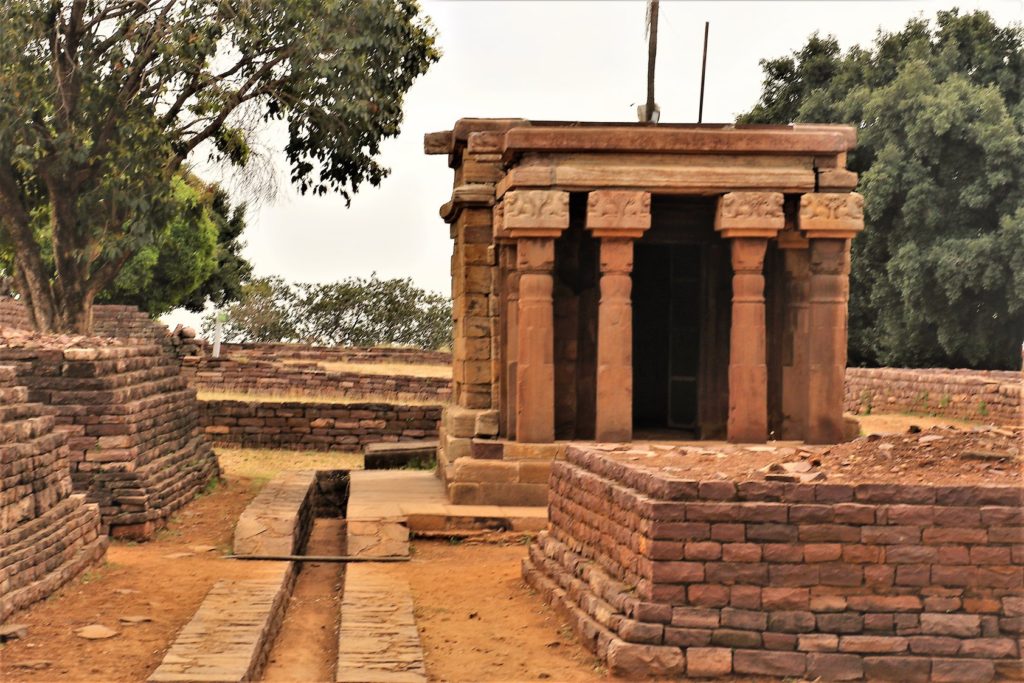
A study in minimalist geometry: Temple 17 from the Gupta Dynasty. Its flat-roofed, square sanctum architecture is one of the earliest examples of a structural Hindu temple in India. (Photo: March 2021).
Temple 18 — The Apsidal Hall
Temple 18 is the most visually distinctive of Sanchi’s secondary structures. Its apsidal (curved-end) plan and row of standing columns give it a profile that feels different from anything else on the hill — which is why it has long been informally called the Greek Temple by visitors.
Personally, it reminded me of my visit to the Temple of Olympian Zeus in Athens, Greece—the resemblance in columned design is striking. This fusion of styles makes Temple 18 a fascinating stop for anyone interested in cross-cultural architectural history.

The surviving fluted pillars of Temple 18. This monument bears a striking resemblance to Hellenistic architecture, and standing here, I was instantly reminded of my visit to the Temple of Olympian Zeus in Athens, Greece.
FAQ Sanchi Stupa
Q: Who built the Sanchi Stupa and why?
Emperor Ashoka commissioned the original stupa in the 3rd century BCE to enshrine sacred relics of the Buddha and to mark his personal commitment to Buddhism following the Kalinga War. Later rulers, particularly during the Shunga period, expanded and embellished the structure.
Q: What do the four gateways (toranas) of Sanchi Stupa symbolize?
Each of the four toranas faces a cardinal direction and is carved with scenes from the Jataka tales and key events in Buddhist history. The Buddha is never depicted in human form — instead, symbols such as the lotus (purity), the Dharma wheel (his teachings), the Bodhi tree (enlightenment), and the riderless horse (renunciation) represent his presence. This convention is known as aniconism.
Q: What is the best month to visit Sanchi Stupa?
October to March is the recommended window, with March being particularly well-suited — comfortable temperatures, clear skies, and good natural light for photography. Summer months (April–June) are hot and exposed; the monsoon (July–September) brings humidity and overcast conditions.
Q: How far is Sanchi Stupa from Bhopal?
Sanchi is approximately 46 km northeast of Bhopal — about a 1–1.5 hour drive via NH146. It is easily done as a day trip, with enough time to cover the stupa complex, the archaeological museum, and the evening Light and Sound Show if you start early.
Q: Is there a Light and Sound Show at Sanchi Stupa?
Yes. The evening show uses narration, music, and illuminated lighting across the stupa and gateways to tell the story of Buddhism and Emperor Ashoka’s role in building the site. It runs on select evenings; timings and ticket details are covered in full in my dedicated post on the Sanchi Stupa Light and Sound Show.
Q: What is the entry fee for Sanchi Stupa in 2026?
As of 2026, the entry fee is approximately ₹30 for Indian citizens and ₹500 for foreign nationals. The site is open daily from 6.30 AM to 6.30 PM.
Q: How is Sanchi Stupa different from Dhamek Stupa?
Both are significant early Buddhist monuments, but they differ in origin and context. Sanchi Stupa was built by Ashoka and expanded over several centuries; it is notable for its elaborately carved toranas and is the oldest surviving stupa in India. Dhamek Stupa in Sarnath marks the site where the Buddha delivered his first sermon and is architecturally simpler, with geometric and floral carvings. Sanchi is the more intact and visually detailed of the two.
My Personal Photo Journey
My best memory from my visit to Sanchi is doing the pradakshina (circumambulation) of the Great Stupa barefoot. Following tradition, I walked in a clockwise direction. There are two levels for this ritual walk—one at the ground level, enclosed by stone railings, and another on the elevated circular terrace, which I reached by climbing a staircase.
I paused in my path often to observe the structure up close. The exposed brick layers, along with traces of mortar and limestone, revealed the construction techniques that have held the stupa together for centuries. The massive dome stood before me like a cosmic mountain, while the square platform at the top—the harmika—was crowned by a triple umbrella.
For me, this symbolized the Three Jewels of Buddhism: the Buddha, the Dharma, and the Sangha. Capturing these details through my lens felt like documenting not just architecture, but a living spiritual legacy.

Brick layered Dome of Sanchi stupa

Hermika and Chhatri
See a different Torana design here: Lodurva Jain Temple in Jaisalmer
Pin this for later…

About the Author
 Indrani Ghose is a cultural travel writer and heritage documentation specialist with over 15 years of experience exploring and writing about temples across India and Southeast Asia. Having visited over 150 sacred sites, she brings both scholarly depth and personal narrative to heritage travel writing.
Her work has been published in Lonely Planet, The National (UAE), Whetstone Asia, Deccan Herald, and various architecture and heritage journals.
Connect with Indrani: Follow Indrani on Instagram | Twitter | Facebook for heritage travel insights, photography tips, and offbeat destination discoveries.







Wow! I love how detailed the structures are. This is interesting to know what they symbolize. Thank you for sharing this as I learned something new today. I would love to visit someday. 🙂
Oh my goodness! I can’t believe that Buddha’s remains are that spread out. That is such an amazing fact. I love it! It’s also interesting that it’s so old. The architecture is really interesting, too. Great photos!
What an incredible sight to visit. I’ve never visited Buddhist sites in India and need to rectify this. I am particularly fascinated by the fact it was built by Samrat Ashoka after he had seen the horrors of war, and felt a need to repent for the massacre he and his army inflicted during the Kalinga war. Such an experience made him turn to peace! The site itself looks exquisite, can you imagine that rediscovery of it in 1818, what a thrill! I appreciate your details on history and also how to best see the many aspects and details.
The Sanchi stupa has so intricate carvings and it is printed in indian currency notes too,so I cant wait to visit here.I loved knowing about history behind sanchi stupa and its so interesting to know about remains of Buddha is preserved here so well.I am huge buddist literature follower and So I want to visit all the buddhist sites.I have had read about it but the stories behind it ,I never knew it. Glad to know it from this article.
Now I have another UNESCO place on my list. I graduated from Architecture and the Sanchi Stupa is an iconic monument I’d love to explore its intricate details and ornaments. I haven’t known all these explanations of the Hindu symbols. Thank you for explaining all these things to us. Good read !
Wow it’s amazing to think of all the history that has happened there. It’s also very interesting that it just sat empty for so many years. I’m glad that it’s been preserved so that people can visit it and learn a bit about history.
I am always feel fascinated about many of India’s monuments and these are the remains of thousands of years of civilization. I would definitely be jaw-dropped when I see it in-person. Hope we can visit Sanchi Stupa and pay my respect.
What an amazing opportunity to see history come to life! I learned so much about the stupa and some of the history of Buddhism. Thank you for so many teachable moments!
So much history here and it was nice to see at the end that is a Sanchi is UNESCO World Heritage site. I always wonder about the architects behind these monuments and how much pre-planning was done before the building began.
I love how India has made this UNESCO World Heritage site free for them, but charges tourists. It makes traveling in your own country accessible. And what a site it is, the architecture, the history and the significance is wonderful.
How fascinating it must be to visit the oldest Buddhist UNESCO site in India. It certainly is a uniquely shaped monument with its spherical shape. Interesting that the 3 layers represent the 3 jewels of Buddhism. The detail on the gateways is amazing. So great that it was restored with such care. The faces on the carvings are always so cool to look at. They provide a full range of emotion. Looks like an interesting spot to visit.
What a great history lesson you’ve written here! It’s very interesting to see that this stupa is so different from the ones we saw in the Tibetan cities in China. By the way, it must have been awesome to visit this site with an archaeologist. 😉
Your photos are beautiful! The different stupas are so intricate, you can almost feel the history pouring from them. Thank you for sharing this article, I learned a lot from reading it 🙂