Complete Guide to Bhojeshwar Temple, Bhopal: The Unfinished Marvel
The first time I saw Bhojeshwar Temple, it didn’t feel unfinished — it felt paused in time.
Bhojeshwar Temple — commonly known as Bhojpur Temple or Raja Bhoj Shiva Temple — is one of India’s most compelling heritage sites. Located about 32 km southeast of Bhopal, this monumental shrine rises from a rocky outcrop above the Betwa River, its massive stone form both stark and deeply evocative.
I visited in March 2021, and what struck me instantly was not just the scale, but the silence — the kind that makes you instinctively slow down, look closer, and wonder what was left unsaid here.
By Indrani Ghose | Last Updated: Mar. 2026

Bhojpur ka Mandir Bhopal
Commissioned by the Paramara king Raja Bhoj in the 11th century, the temple houses one of the largest monolithic Shiva lingams in India — nearly 7.5 feet in diameter and rising to about 18 feet including its platform. Standing before it, you don’t just observe — you feel dwarfed, almost reverentially so.
What makes Bhojeshwar Temple truly remarkable is this striking contrast: its colossal ambition and its sudden abandonment. Construction stopped abruptly, and to this day, no historical record definitively explains why.
Now protected by the Archaeological Survey of India, the site remains a powerful testament to early medieval temple architecture in central India. For me, it isn’t just another monument — it is a place that lingers in my mind till date. Its unfinished story has left me curious.
Quick Facts: Bhojeshwar Temple, Bhojpur
| Attribute | Details |
| Location | Bhojpur village, ~32 km from Bhopal, Madhya Pradesh |
| Founder | Raja Bhoj (Paramara dynasty, 11th century) |
| Dedication | Lord Shiva |
| Key Feature | World’s largest monolithic Shiva lingam (7.5 ft high, 21 ft platform) |
| Architecture Style | Bhumija style, cyclopean masonry (no mortar) |
| Unique Aspect | Temple remains unfinished; architectural drawings etched on nearby rocks |
| Material Used | Massive limestone blocks |
| River Nearby | Betwa River |
| Protection Status | Archaeological Survey of India (ASI) protected monument |
| Entry Fee | Free |
| Visiting Hours | 6 AM – 7 PM daily |

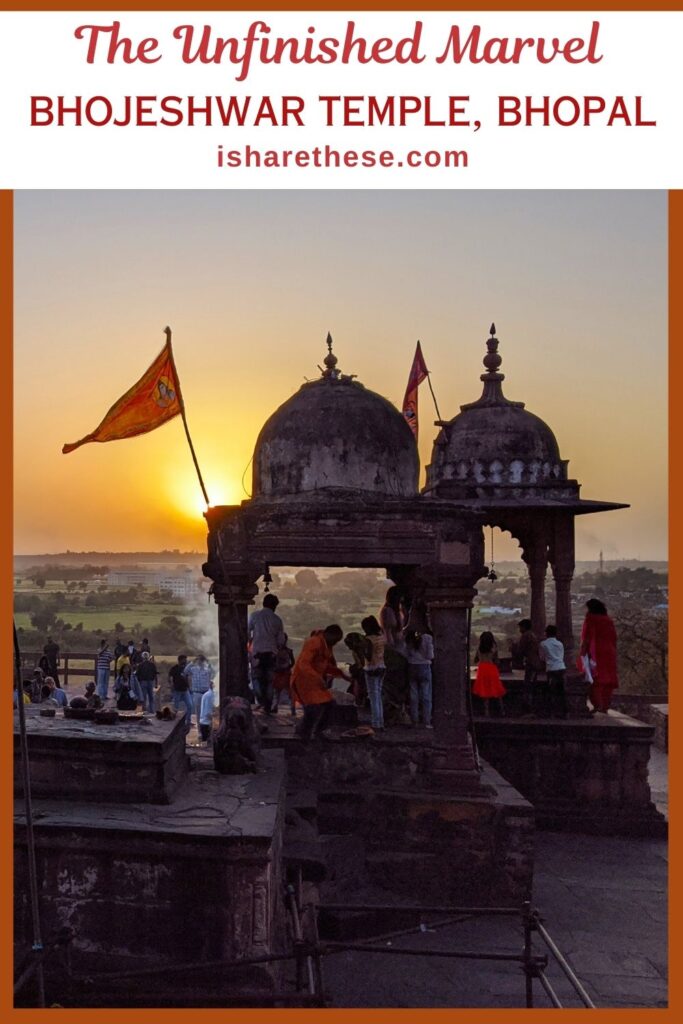
Sunset – Bhojpur Mandir Bhopal
Bhojeshwar Temple vs. Bhojshala: Clearing the Confusion
Two heritage sites, one royal name — this is where many travellers and researchers get confused. Bhojeshwar Temple in Bhojpur and the Bhojshala in Dhar are entirely separate monuments. Both carry the legacy of the Paramara king Raja Bhoj, but they differ in location, character, religious association, and historical context.
Bhojeshwar Temple (Bhojpur, near Bhopal) is a Hindu shrine built by Raja Bhoj in the 11th century. It is dedicated to Lord Shiva and is best known for its massive monolithic Shiva lingam and its dramatically unfinished superstructure. The temple is an ASI-protected site and remains an active place of worship visited by pilgrims and heritage travellers throughout the year.
Bhojshala (Dhar, Madhya Pradesh) is an entirely different monument located over 200 km from Bhopal. Historians believe it originally functioned as a Sanskrit learning institution established under Raja Bhoj’s patronage. Over subsequent centuries, Islamic architectural elements were added to the structure, and the site came to be used as a mosque.
Today, Bhojshala is a contested monument with a complex, sensitive history that continues to be debated in legal and cultural forums.
The simplest way to keep them apart: Bhojeshwar Temple is a Shiva temple near the Betwa River, 29 km from Bhopal, accessible in under an hour. Bhojshala is a disputed mosque-heritage site in Dhar district — a separate destination, 257 km from Bhopal, with a separate story.
When planning your itinerary, this distinction matters practically.
- If you’re searching for the Shiva lingam, the Paramara temple architecture, or the Bhojpur heritage site, Bhojeshwar Temple outside Bhopal is your destination.
- Bhojshala requires a separate trip to western Madhya Pradesh entirely.
The Giant of Bhojpur: One of World’s Largest Monolithic Shiva Lingam
The Lingam: Scale, Material, and Craftsmanship
At the heart of Bhojeshwar Temple stands its most striking feature — a colossal monolithic Shiva lingam that rises approximately 7.5 feet above its base. Carved from a single block of stone, it sits on a substantial platform measuring 21 feet on each side.
The combination of scale and material integrity makes this one of the most remarkable examples of monolithic sculpture in medieval Indian temple architecture.
Unlike the modest lingams found in most Shiva shrines, the Bhojpur lingam was conceived on an entirely different scale. This was designed to be a supreme centre of Shaivite worship, projecting both spiritual authority and the political ambition of the Paramara dynasty under Raja Bhoj.
The Platform: Cyclopean Masonry in Practice
The platform supporting the lingam is as architecturally significant as the lingam itself. Built using cyclopean masonry — a technique involving large, precisely cut stone blocks fitted together without mortar. The tightly interlocked stones have held their form for nearly a thousand years without binding material, which speaks to the precision of the cutting and placement.
This same masonry technique is visible throughout the temple’s plinth and surviving walls, making Bhojeshwar Temple one of the clearest examples of cyclopean architecture in central India.

The Platform with Shiva Lingam: Cyclopean Masonry
The Open Sky and the Unfinished Question
What gives this lingam an added layer of visual and historical power is its unfinished context. The temple’s superstructure — the shikhara and enclosing walls — was never completed. As a result, the lingam stood partially exposed, open to natural light and the elements in a way that no completed temple would allow.
This unfinished state is not neglect; it is history preserved in mid-action. It raises a question that no historical record has definitively answered: why did construction stop? Theories point to the death of Raja Bhoj around 1055 CE, political instability following Paramara decline, or logistical constraints of the project’s sheer ambition. None has been conclusively established.
Why It Still Draws Visitors Today
For devotees, the Bhojpur lingam is an object of active veneration — a living symbol of Shiva’s presence, undimmed by a thousand years of exposure. For architects and historians, it is a rare case study in monolithic stone carving and large-scale medieval construction.
And for the general traveller, standing in front of this giant stone form under open sky is a genuinely arresting experience — one that no photograph fully prepares you for.
I can confirm this from my own visit in March 2021: the scale of the lingam only becomes real when you’re standing at its base. Images compress it. In person, it dominates the entire sanctum.
Why is Bhojeshwar Temple Incomplete? The Mystery of the Abandoned Site
One of the most searched questions about Bhojeshwar Temple is also its most compelling: why was this ambitious project never finished? Standing before the colossal Shiva lingam under open sky — where a towering shikhara should have risen — the sense of incompleteness is immediate and hard to ignore. Historians, archaeologists, and local tradition each offer their own answers, ranging from folklore to documented historical evidence.

Incomplete doorframe carvings on the facade of Bhojeshwar Temple
The “One-Night Challenge” Legend
Local lore frames the abandonment as the result of a dramatic wager: masons were reportedly challenged to complete the entire temple in a single night. When dawn broke before the work was done, construction had to stop permanently.
It is a compelling story, and it has circulated widely — but scholars treat it as symbolic rather than historical. The Bhojpur version likely emerged to explain what ordinary visitors could not easily rationalise: how could such a sophisticated structure simply be abandoned mid-work?
Historical Theories: Death, Succession, and Political Instability
The more credible explanations are rooted in 11th-century political history. Raja Bhoj died around 1055 CE, and his death is widely considered the most probable trigger for the halt in construction. A project of this scale — requiring sustained royal patronage, a large skilled workforce, and continuous resource supply — could not easily survive a change in reign, particularly if successors faced competing priorities or diminished treasuries.
A related theory points to external pressure. The Paramara dynasty, which Raja Bhoj led, faced sustained military challenges from neighbouring powers, including the Chaulukyas of Gujarat and the Kalachuris. Political instability following Bhoj’s death likely redirected both resources and attention away from Bhojpur entirely.
Neither theory is mutually exclusive. The most reasonable reading of the evidence is that Raja Bhoj’s death, combined with a weakening of Paramara power in the decades that followed, made resuming such an ambitious project practically impossible.

I tried to capture the ceiling, Lingam and the base in one frame inside Bhojeshwar Temple in this picture
Architectural Evidence on the Rocks
The most tangible and archaeologically significant clue to the temple’s unfinished state lies not inside the shrine but on the rock surfaces nearby. Etched into these rocks are detailed construction drawings — outlines for pillars, shrine layouts, and decorative elements — that functioned as working blueprints for the craftsmen on site.
This kind of on-site architectural drafting is exceptionally rare in the context of Indian temple construction. Most medieval temples were built from oral traditions, established proportional systems (as described in the Vastu Shastra and Manasara texts), and the accumulated expertise of hereditary craftsmen. The presence of drawn plans at Bhojpur suggests either an unusually complex or experimental design, or a project that was scaled beyond conventional practice — possibly both.
For historians of Indian architecture, these rock drawings are as valuable as the temple itself. They offer direct evidence of how a major Paramara-era construction project was planned and managed.
The Unfinished Legacy
Whatever the cause, the incomplete state of Bhojeshwar Temple has become inseparable from its identity. Unlike temples that were damaged by invasion or modified beyond recognition, Bhojpur simply stopped — frozen at a specific moment in the 11th century, with tools apparently set down and never picked up again.
This frozen quality gives the site a character that finished temples rarely possess. The raw stonework, the exposed lingam, the visible construction ramps still partially in place — all of it makes the building process itself visible in a way that a completed monument would conceal.
For visitors, the unanswered question is part of what makes Bhojeshwar Temple memorable. For scholars, it remains an open research problem. And for the site itself, the mystery has ensured a kind of enduring attention that many fully completed temples of the same era no longer receive.

Beauty in unfinished Sculptures on Bhojeshwar Temple – imagine the beauty had it been completed.
Cyclopean Architecture: How Raja Bhoj Built Without Mortar
One of the most technically remarkable aspects of Bhojeshwar Temple is its construction method. The temple platform and surviving walls were built using cyclopean masonry — a technique in which large, precisely cut stone blocks are fitted together without mortar, relying entirely on weight, gravity, and the accuracy of the cutting to hold the structure in place.
This approach is rarely documented in central Indian temple architecture, which makes Bhojeshwar Temple a significant reference point for historians of medieval construction.
Bhumija Style: The Intended Design
The temple was planned in the Bhumija style of architecture, a tradition closely associated with the Paramara dynasty of Malwa. Bhumija temples are characterised by tall curvilinear shikharas divided into vertical rows of miniature spire forms, creating a dense, layered visual effect. The style represents a distinct regional variant of the broader Nagara architectural tradition of northern India.
Because the superstructure at Bhojpur was never completed, no Bhumija shikhara rises above the sanctuary today. However, the surviving plinth, doorframe carvings, and lingam platform reveal the scale and sophistication of what was intended.
Paradoxically, the incomplete state makes the construction logic more visible than it would be in a finished building — the raw stone joints, the coursing patterns, and the platform engineering are all exposed to direct inspection.

Bharvahaks on brackets holding the ceiling above.
The Construction Ramp: Medieval Logistics Made Visible
One of the most unusual surviving features at Bhojpur is a large earthen and stone ramp adjacent to the temple. Archaeologists identify this as the ramp used during construction to haul heavy stone blocks up to the platform level. It stretches for a considerable distance and is substantial enough to have supported loaded stone sledges or rollers carrying multi-tonne blocks.
Intact construction ramps from medieval Indian temple projects are exceptionally rare. At most sites, such infrastructure was dismantled once construction was complete or has since eroded.
At Bhojpur, the abrupt halt in construction meant the ramp was simply left in place — making it, alongside the rock-etched blueprints, one of the most direct pieces of evidence for how large-scale Paramara construction actually worked in practice.
For architecture historians, the combination of the ramp, the cyclopean platform, and the Bhumija design intent makes Bhojeshwar Temple as valuable as an unfinished manuscript — more revealing in some ways than a completed text.
… abandoned construction of Bhojeshwar Temple
As per the agamas (various Hindu spiritual practices) damaged idols of Gods and Goddesses aren’t worshiped in temples. Therefore the construction was abandoned. And thus it remained incomplete for long with water seeping in through the roof on to the lingam during the rains.
The locals however did not abandon the idol, they continued to worship, offer prayers and celebrate festivals albeit in a smaller scale.

New pillars added to facade of the temple.
Reclaiming and Conservation
The land around Bhojpur Temple Bhopal was soon gobbled up by local land sharks. In 2006-2007, archaeologist KK Muhammed from Archaeological Society of India (ASI) took up the task of reviving the place around. With his strong convincing and organizing capabilities he reasoned out with the land sharks the importance of the place and why it should be conserved.
Thanks to archaeologist KK Muhammed, ASI could fence off the entire area in and around Bhojeshwar Temple to prevent any future encroachment.
Stones were procured locally, carved and added to the facade of the temple. His team made a massive effort to recreate the temple.
Extensive repair work on the roof was carried out. Fiberglass elements were added to the roof which sealed the leakages. As we looked up we could hardly distinguish between the stone and fiberglass elements, so perfect the work is!

Fibreglass with inverted lotus motif in ceiling of Bhojpur Shiva Temple Bhopal
My visit to Bhojeshwar Temple
Door frame of this temple is a mighty one. It measures 10 m in height and 5 m in width. Large steps lead up to the temple. Then there is another flight of stairs to descend to garbhagriha, base of the huge Linga – abstract representation of the deity Shiva!
A purohit was busy distributing holy water into the cupped hands of the devotees. I too received my bit of blessing, but that was after I clicked him at his work.
We then went around the lingam. The place is dimly lit and the walls have no windows. But with the rays of the setting sun streaming in the ornate details of the sculptures was visible.
This temple is a west facing one unlike many other Hindu temples which face towards east. Another unusual feature is that the temple has a rectilinear roof and not the usual curvilinear tower that you find in most Hindu temples.
In the courtyard of the temple there are 2 small shrines, both dedicated to Lord Shiva. As the sun set in the horizon, the silhouettes of the shrines and lingams seemed to emit an aura, so magical, so pure!
Just besides the temple, in the vacant spaces you will find stone slabs that were meant to be used, unfinished carvings of stones, and an architectural plan of the temple etched on a stone slab. The ramp used for lifting up heavy slabs of rocks is still there.

Purohit in Bhojeshwar Temple Bhopal
Practical Information: Timings, Entry Fee, and How to Reach Bhojpur from Bhopal
Here are the key visitor details for Bhojeshwar Temple:
| Detail | Information |
| Timings | 6 AM – 7 PM (daily) |
| Entry Fee | Free (no ticket required) |
| Distance from Bhopal | ~32 km (approx. 45–60 min by road) |
| Best Route | Bhopal → Obaidullaganj → Bhojpur village |
| Nearest Railway Station | Bhopal Junction (~32 km) |
| Nearest Airport | Raja Bhoj Airport, Bhopal (~35 km) |
Traveler tips to visit Bhojeshwar Temple
- You can combine this temple in your trip to Bhimbetka Rock shelters which is 23.6 km south.
- Photography is permitted.
- Evenings are the best time to visit. It is bathed with rays of setting sun, so ideal for sunset photography.
- No tickets required to enter.
- Open on all days 6 AM to 7 PM.
- Footwear not permitted inside the complex.
- Cover yourself well; no bare shoulders or shorts.
FAQ: Bhojeshwar Temple, Bhopal
Is Bhojeshwar Temple in Bhojpur a mosque?
No. Bhojeshwar Temple is a dedicated Hindu shrine and has functioned as a Shiva temple since its construction in the 11th century. The confusion typically arises from conflation with Bhojshala in Dhar — a separate monument, over 200 km away, that is linked to Raja Bhoj but is a disputed heritage site with a mosque on its premises. Bhojeshwar Temple in Bhojpur has no such dispute. It is an ASI-protected monument and an active place of Hindu worship.
Who built Bhojeshwar Temple?
The temple was commissioned by Raja Bhoj, the Paramara dynasty king who ruled Malwa from approximately 1010 to 1055 CE. Raja Bhoj was a notable patron of arts, literature, and architecture. He is credited with authoring the Samarangana Sutradhara, a Sanskrit treatise on architecture, town planning, and mechanical devices — which makes his association with a temple of this structural ambition particularly fitting.
Why is Bhojpur Temple incomplete?
No historical record gives a definitive answer. The most widely accepted theory among historians is that Raja Bhoj’s death around 1055 CE halted the project, with his successors either unable or unwilling to continue a construction of this scale.
A separate architectural theory, associated with archaeologist K K Muhammad, suggests that a structural miscalculation may have contributed — specifically, that the intended roof design exceeded the load-bearing capacity of the pillars as built, making completion impractical or leading to a partial collapse. This theory is not universally accepted but is based on on-site assessment and is worth noting as a credible alternative explanation.
How big is the Shiva lingam at Bhojeshwar Temple?
The monolithic Shiva lingam stands approximately 7.5 feet tall with a circumference of around 17.8 feet. It is set on a large tiered square platform, bringing the total height of the installation to an estimated 18 feet, with some sources citing figures up to 22 feet depending on measurement methodology. The lingam is carved from a single block of stone, which is what makes it one of the largest monolithic Shiva lingams in India.
What is architecturally unique about Bhojpur Temple?
Several features make Bhojeshwar Temple architecturally distinctive.
It was designed in the Bhumija style, a variant of Nagara temple architecture closely associated with the Paramara dynasty.
The construction uses cyclopean masonry — large stone blocks fitted together without mortar, held in place by weight and precision cutting alone.
Most remarkably, detailed construction drawings etched into the rock surfaces near the temple have survived.
What are the timings and entry fee for Bhojeshwar Temple?
- Timings: 6 AM to 7 PM, open daily
- Entry Fee: Free for all visitors
- Museum: An adjoining ASI site museum is present; it is generally closed on Mondays — confirm locally before visiting
- Parking: Paid parking is available near the temple entrance
Timings are subject to change on festival days and public holidays. Verify current hours before visit.
How far is Bhojpur Temple from Bhopal?
Bhojeshwar Temple is approximately 32 km from central Bhopal, via the Bhopal–Obaidullaganj–Bhojpur route. The drive typically takes between 45 minutes and one hour depending on traffic.
Other Popular Shiva Temples
Interested in more Shiva Temples? Check my travel blog posts on these temples dedicated to Bhagwan Shiva:
Kotilingeshwara Temple in Kolar
Menal Shiva temple in Chittorgarh
Grishneshwar Jyotirlinga Temple in Aurangabad
Pin this for later…
You can save and share this post on Bhojeshwar Mandir Bhopal with buttons below the post. Grateful for each and every share, Thanks!
About the Author
 Indrani Ghose is a cultural travel writer and heritage documentation specialist with over 15 years of experience exploring and writing about temples across India and Southeast Asia. Having visited over 150 sacred sites, she brings both scholarly depth and personal narrative to heritage travel writing.
Her expertise lies in decoding temple architecture, dynastic histories, and cultural practices, while her personal journeys across Madhya Pradesh—including Bhojpur, Bhopal, and other historic towns—add authenticity and lived experience to her writing.
Her work has been published in Lonely Planet, The National (UAE), Whetstone Asia, Deccan Herald, and various architecture and heritage journals.
Connect with Indrani: Follow Indrani on Instagram | Twitter | Facebook for heritage travel insights, photography tips, and offbeat destination discoveries.