Chanderi Travel Guide: How to Explore India’s Loom Town in 24 Hours
Chanderi Travel Guide: How to Explore India’s Loom Town in 24 Hours (2026 edition)
I visited Chanderi in March 2021, and even in a single day, this small Madhya Pradesh town made a strong impression. It has medieval forts, Mughal-era mosques, Rajput palaces, and a weaving tradition that is still very much alive. Yet Chanderi rarely gets the attention it deserves — it’s often skipped in favour of Orchha or Sanchi.
This Chanderi travel guide is for anyone who wants to explore India’s “loom town” efficiently. Whether you’re planning a day trip from Bhopal, a detour from Gwalior, or a standalone heritage stop, this guide gives you practical, firsthand information to make the most of your visit.
Mr. Muzaffar Ansari, travel guide Chanderi, guided this Times Passion Trail through this tour.
By Indrani Ghose | Last Updated: Apr. 2026
Key Takeaways for Chanderi in Madhya Pradesh:
- Chanderi Fort dates to the 11th century and anchors the town’s skyline.
- The town is ideal for a day trip from Bhopal (approx. 220 km) or Gwalior (approx. 240 km).
- Chanderi sarees are world-famous — authentic shopping is available directly from weavers.
- Most heritage sites are walkable and clustered within the old town.
- March offers clear skies, good light for photography, and fewer crowds than peak season.
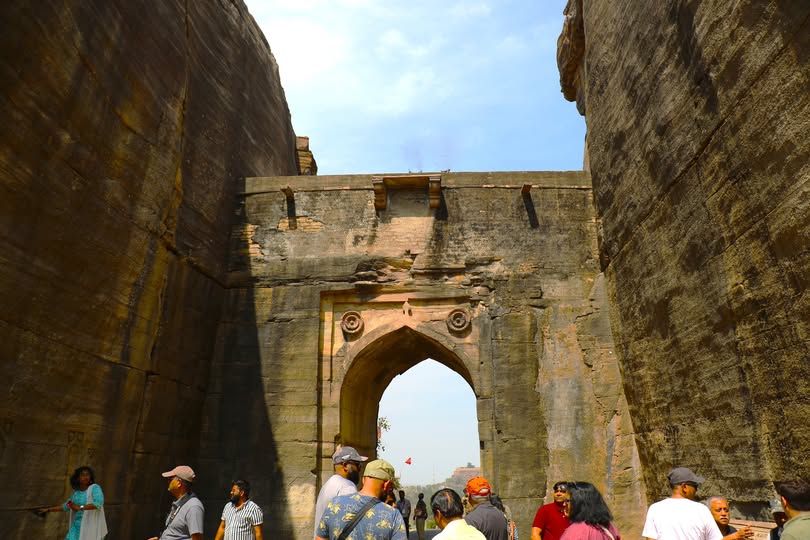
Khooni Darwaza of Chanderi Fort
Is Chanderi Worth a Visit?
Yes — Chanderi is worth visiting for its rare combination of living craft heritage and well-preserved medieval architecture, all accessible within a single day.
The 11th-century Chanderi Fort dominates the skyline and sets the tone for a town that has seen Bundela Rajput, Malwa Sultanate, and Mughal influences. Within a compact area, you’ll find medieval gateways, mosques, Rajput palaces, and stepwells — each layer telling a different part of the town’s history.
What makes Chanderi stand out from other heritage towns in Madhya Pradesh is its living textile tradition. The weaving clusters here produce the world-famous Chanderi saree — known for its sheer texture, fine zari work, and lightweight silk-cotton blend. Watching artisans work on handlooms in their homes turns a sightseeing trip into something more meaningful.
For travellers based in Bhopal or Gwalior, Chanderi works perfectly as a day trip. The town is walkable, unhurried, and genuinely welcoming. Unlike busier tourist circuits, it still feels intimate — making it ideal if you want both history and authenticity without the crowds.
Best Time to Visit Chanderi — and Why March Works
The best time to visit Chanderi is October to February, when cool, dry weather makes walking tours comfortable. That said, March is a strong alternative — and my 2021 visit confirmed it.
The standard travel window runs through the post-monsoon and winter months. Temperatures stay manageable, and the heritage sites — especially the open-air Chanderi Fort — are easy to explore on foot. This is also when the town sees more visitors, so expect some activity around the main gateways and markets.
I visited in March 2021, and the conditions were better than expected. The skies were clear and the morning light was excellent for photography — particularly at the fort and the ornate Kati Ghati gateway. Mornings were cool enough to explore weaving clusters and old lanes at a relaxed pace. By early afternoon the sun was warm, but the trade-off was noticeable: fewer tourists, quieter heritage sites, and easy access to stepwells and lesser-known corners without waiting or jostling.
If you’re comfortable with mild heat and prefer a less crowded experience, March is a smart choice. Pack water, wear light clothing, and plan your outdoor sightseeing before noon. The town’s charm holds up well even outside peak season.
The Perfect One-Day Chanderi Itinerary
A one-day trip to Chanderi is best structured around three slots: a heritage-focused morning, an architecture-heavy afternoon, and a craft-centred evening. This sequence keeps walking distances manageable and lets you experience the town’s three defining layers — its medieval past, its architectural variety, and its living textile tradition — without feeling rushed.
Chanderi’s main sites are clustered within a compact area, which makes it genuinely feasible as a day trip from Bhopal or Gwalior. Start early to make the most of the cooler morning hours, especially if you’re visiting between February and April.
Morning — The Citadel (Chanderi Fort and Jageshwari Mata Temple)
Start your morning at Chanderi Fort for panoramic views of the town, then visit the Jageshwari Mata Temple within the complex for a glimpse of living heritage.
Chanderi Fort sits on a rocky hill above the town and is best visited first thing in the morning, when the light is sharp and the heat hasn’t built up yet. The climb to the fort is manageable on foot and rewards you with sweeping views of the town’s domes, gateways, and the surrounding plains.

Chanderi Fort located on Chandragiri Hill in Chanderi
Once inside, look out for the Khooni Darwaza — literally “Gate of Blood” — named after a battle fought here during the medieval period. The gateway’s worn stonework and the silence around it carry a weight that no signboard can fully explain.
Walk along the ramparts and you’ll get some of the best elevated views of Chanderi’s old town, including its weaving clusters and the distinctive silhouette of the Badal Mahal Gate below.
Three Gates of Chanderi Fort
Along the 5km long fort wall there are 3 gates (darwaza) which were built for protection from invading armies.
Khooni Darwaza is the main gate to the fort. The name translates to Bloody or Murderous gate. As the name implies this was one spot where criminal, traitors were murdered. They would bleed to death when thrown at the spiked gates as punishment.
Hawa Paur is the highest gate of Chanderi Fort.
Kati Ghati, which is to the south of Chanderi Fort has an interesting tale. This gate was cut out of a single rock and the architect who designed the gate proudly showed it to the king. The gate has dimensions of 59m length, 12m breadth and 24.6m height.
However the King found fault with it saying there is no provision for hinges in this structure to fix a door. How can this gate protect Chanderi?
Realizing his blunder the architect excused himself from the gathering and committed suicide. You can see a tomb nearby which is his resting place.

Kati Ghati Chanderi Madhya Pradesh Best things to do
Jageshwari Mata Temple
From the fort, make your way to the Jageshwari Mata Temple, located within the same complex. Dedicated to Chanderi’s guardian deity, this is an active place of worship — not just a heritage site. On my March 2021 visit, I found locals offering prayers here in the early morning, which gave the space a sense of continuity that purely archaeological sites often lack.
The combination of fort ruins and a functioning temple in the same compound is one of those quiet details that makes Chanderi feel different from more commercialised heritage towns.
Allow 90 minutes to 2 hours for this stop.
Afternoon — The Architecture (Badal Mahal Gate and Koshak Mahal)
Spend your afternoon at the Badal Mahal Gate and Koshak Mahal — two of Chanderi’s finest examples of medieval architecture and among the best photo spots in the town.
After lunch at one of the small dhabas near the town centre, head to the Badal Mahal Gate (Palace of Clouds Gateway).
In India there are ruins with doors and there are ruins without doors!
Badal Mahal Darwaza is a door in such a site where the palace is completely gone. Thanks to the underground palace rooms, there is some evidence left of how grand the structure must have been. One can only imagine!
This platform like place was the stage where royal guests were welcomed with cultural performances. The mahal (palace) here was built so tall that it is believed during rains the clouds swept past it. Hence it got the name badal, meaning clouds.
Built in the 15th century, this is Chanderi’s most recognisable structure — a tall, ornately carved stone gateway that once formed part of the town’s fortifications. Its proportions are impressive up close, and the detailed stonework on its arches rewards careful attention.
This is one of the most photographed spots in Chanderi, and for good reason: the gateway frames the sky dramatically, especially in afternoon light.

Badal Mahal Darwaza Chanderi Madhya Pradesh Things to Do
A short distance away is Koshak Mahal, a three-storeyed palace commissioned by Sultan Mahmud Khilji of the Malwa Sultanate in the 15th century. The structure was never completed, but what remains is architecturally significant — its massive pointed arches, symmetrical layout, and scale reflect a confident Indo-Islamic design sensibility. Walking through the open halls gives you a clear sense of what the palace might have been. The ruined state, rather than diminishing it, adds a particular atmosphere that photographers and history enthusiasts will appreciate.
Both sites are within easy walking distance of each other. Allow 1.5 to 2 hours for this block, including time for photography.
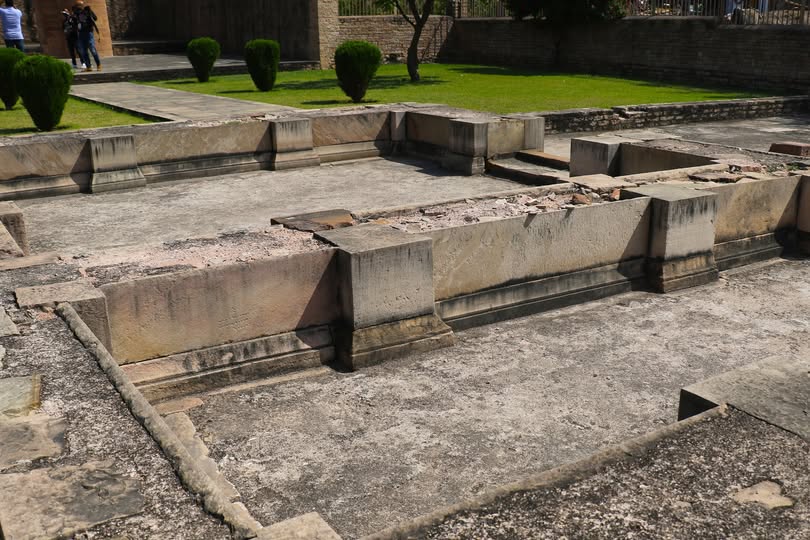
Remains of Koshak Mahal Chanderi
Evening — The Craft (Handloom Park and Bahar Shahar Weavers’ Colony)
End your day at the Handloom Park or the Bahar Shahar weavers’ colony to see Chanderi sarees being made firsthand — and to buy directly from the artisans who make them.
No visit to Chanderi is complete without engaging with its weaving tradition. The town’s identity is inseparable from the Chanderi saree — a fabric known for its fine silk-cotton blend, translucent texture, and delicate zari motifs drawn from nature and local heritage. This is not a cottage industry preserved for tourists; it is the town’s primary livelihood, and the workshops are working spaces, not showrooms.
The Handloom Park and the Bahar Shahar colony are two of the most accessible areas for visitors. Here, you can watch artisans at their looms — a process that is slower and more precise than most people expect. Each saree can take several days to complete, depending on the complexity of the design. Many weavers are open to visitors and will walk you through the process, from thread preparation to the finished fabric.
This is also the most practical time to shop. Buying directly from weavers or from co-operatives in the colony means you’re getting an authentic product at a fair price, while supporting the artisans directly. If you’re looking for a reliable Chanderi saree shopping guide for tourists, this is the straightforward answer: skip the roadside stalls and come here instead.
Allow 1 to 1.5 hours for the weaving visit, more if you plan to shop.

Handloom Park Chanderi Madhya Pradesh
Summary — One Day in Chanderi:
| Time | Stop | Focus |
| Morning | Chanderi Fort + Jageshwari Mata Temple | Heritage, views, living worship |
| Afternoon | Badal Mahal Gate + Koshak Mahal | Architecture, photography |
| Evening | Handloom Park / Bahar Shahar | Craft, authentic saree shopping |
Shopping Guide — How to Buy Authentic Chanderi Sarees
The most reliable way to buy an authentic Chanderi saree is to purchase directly from weavers at the Handloom Park or the Bahar Shahar weaving colony — this guarantees both authenticity and fair pricing.
Visiting the weaving clusters means you see the craft firsthand before you buy. You can examine the fabric at the source, ask questions about the weave and motifs, and make an informed purchase rather than relying on a retailer’s word.
When evaluating fabric, focus on three things: texture, finish, and weight. Genuine Chanderi fabric feels crisp yet soft — not stiff or synthetic. Hold it up to the light: authentic Chanderi silk and silk-cotton blends have a characteristic translucency. Synthetic imitations lack this quality and often feel heavier or plasticky.
Here’s a quick comparison of the three main types:
| Type | Key Features | Best For | Price Range |
| Pure Silk Chanderi | Lustrous, lightweight, sheer drape | Weddings, festive occasions | Higher |
| Chanderi Cotton | Airy, matte finish, breathable | Daily wear, summer | Moderate |
| Silk-Cotton Blend | Balanced sheen and durability | Office wear, versatile styling | Mid-range |
Prices vary based on design complexity and zari work.
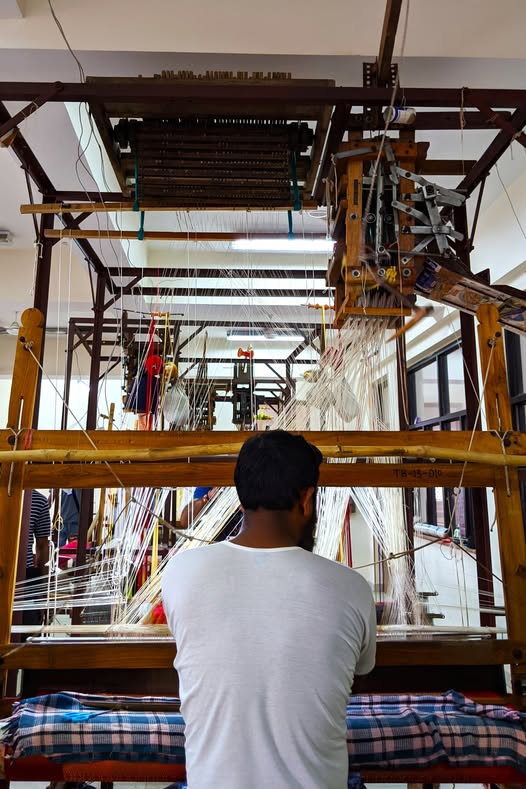
Weaver at work in looms of Chanderi Handloom Park
Practical tips to buy Chanderi fabrics:
- Ask about motifs — peacocks, lotuses, and geometric patterns are traditional markers of authentic Chanderi craft.
- Many weavers accept custom orders if you have a specific colour or design in mind.
- Co-operatives in the weaving colony offer fixed, transparent pricing — useful if you’re not comfortable negotiating.
- Avoid roadside stalls near tourist entry points; the quality and provenance of sarees sold there is harder to verify.
Buying here also means your money goes directly to the artisan community that keeps this 600-year-old tradition alive.
Bhopal to Chanderi — Road Trip Guide
The Bhopal to Chanderi road trip covers approximately 215 km and takes 5–6 hours by car, making it a comfortable one-day drive — especially if you build in a stop at Sanchi along the way.
The route is straightforward and largely well-maintained. From Bhopal, head towards Sanchi (about 46 km), then continue through Vidisha and Ashoknagar before arriving in Chanderi. The landscape along the way is a mix of flat agricultural land and gentle rolling terrain — not dramatic, but pleasant and easy to drive.
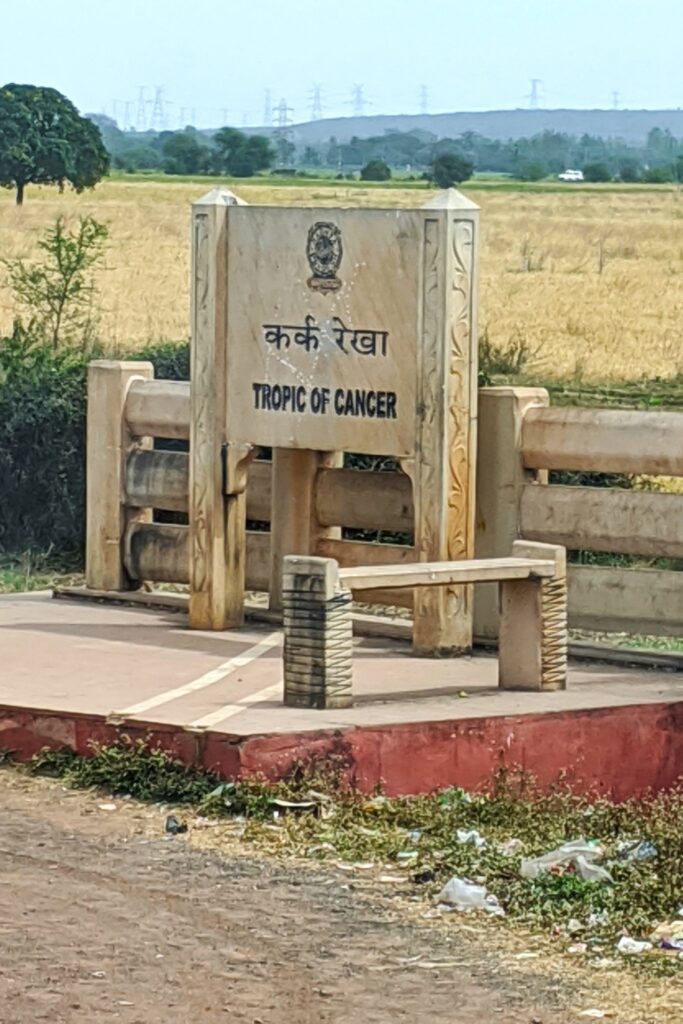
On the way from Bhopal to Chanderi we crossed Tropic of Cancer
Recommended route: Bhopal → Sanchi → Chanderi
Breaking the journey at Sanchi is genuinely worth the detour. The UNESCO-listed Buddhist stupas here — including the Great Stupa commissioned by Emperor Ashoka in the 3rd century BCE — are among the best-preserved ancient monuments in India. Spending two to three hours at Sanchi’s stupa complex and museum gives you a strong cultural context before you arrive at Chanderi’s medieval heritage. The two sites complement each other well: one Buddhist and ancient, the other medieval and Islamic-Rajput in character.
From Sanchi, continue through Vidisha, then pick up the road towards Ashoknagar and on to Chanderi. This stretch has roadside dhabas where you can stop for lunch or tea. By mid to late afternoon, you should be in Chanderi with enough time to check in and begin exploring.
Practical notes:
- Depart Bhopal early — by 7 to 7.30 AM — to reach Sanchi before it gets busy and still have adequate time in Chanderi.
- A private car or self-drive is the most flexible option; direct buses between Bhopal and Chanderi exist but are slower and less convenient for a packed day.
- Fuel up in Bhopal or Sanchi; options thin out between Vidisha and Chanderi.
- If you have a Bhopal travel blog, this is a natural internal linking opportunity — the road trip can serve as a connector piece between your Bhopal and Chanderi content.
| Leg | Distance | Approx. Drive Time |
| Bhopal → Sanchi | 46 km | ~1 hour |
| Sanchi → Vidisha | 10 km | ~20 minutes |
| Vidisha → Chanderi | ~160 km | ~3 hours |
| Total | ~215 km | ~5–6 hours |
History of Chanderi
Hindu epic story Mahabharata has mention of this kingdom of Chanderi. This region of Bundelkhand was known by the name Chedi, it was ruled by Chedi dynasty. Mahabharata mentions King Shishupal had ruled this kingdom till he was killed by Lord Krishna.
Fast forward several centuries, the next mention of Chanderi is found in inscriptions excavated in Chandragiri hills. Inscriptions on stones excavated here mention this fort was built by Kirti Pal, a Pratihara king of 11th century. (This is not to be confused with Chanderi Fort near Mumbai.)
3 Battles of Chanderi
So sought after this Chanderi kingdom was that several rulers have fought tooth and nail to conquer and annex it. Hold over Chanderi Kingdom kept alternating between Mughals and Rajput Kings and then between Rajput Kings and British colonisers.
Most tragic incident happened at the famous second Battle of Chanderi between Babur and Medini Rai. Babur recaptured Chanderi but all its residents had committed suicide by the time he entered the kingdom. He mentions this in Baburnama.
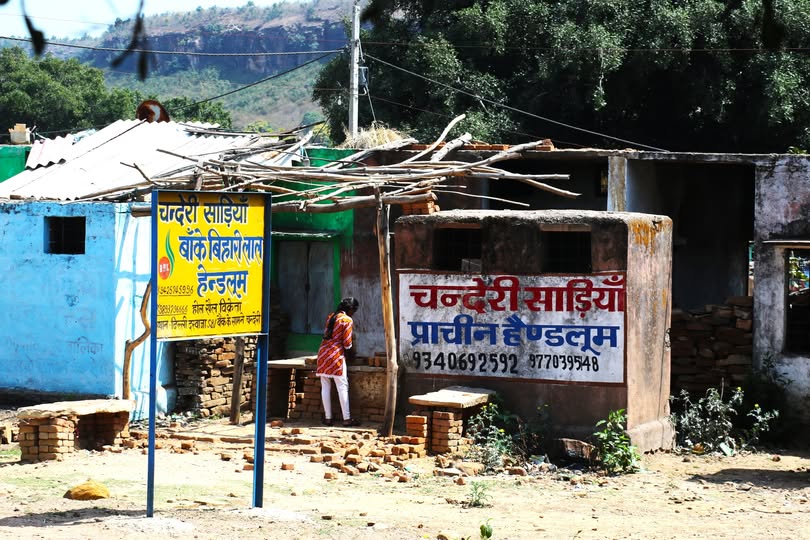
Chanderi Street Scene – advertisement for Chanderi Sarees
Offbeat Places to Visit in Chanderi
Jauhar Memorial of Chanderi
One of the saddest places I have been to is the Jauhar Monument of Chanderi. It is a spine chilling spot in Chanderi Fort Complex. The memorial is a very small monument, a slab of stone with the story of brave women of Chanderi etched on it.
This stone depicting jauhar scene was erected here under a canopy long after the incident took place. Rajput women of Chanderi chose self immolation (jauhar) over capture by the invading army. It is said King Medini Rai, their most powerful warrior, died fighting against the Mughal army.
Babur, the Mughal invader of India, had written –
Women committed suicide (jauhar) before we came. Men advanced towards my army but they were na ked.
It is understood that since the attack was sudden they couldn’t collect enough wood to burn women so they shed their clothes to speed up the burning of these women.
When I arrived, Chanderi Fort was on fire. I looked up to see the non warrior men willingly getting beheaded by jallad. I did not kill anyone. They all killed themselves!
This incident had wiped off all Hindu and Jain residents of this place. The above part was narrated to us by our guide. The whole group went numb in silence listening to him.
Do read: Jauhar Smarak of Chanderi
Baiju’s Samadhi
Close to Jauhar Smarak there is the Samadhi (memorial) of Baiju Bawra, a great musician. He is famous for having defeated Tansen, another great musician, in a music contest in Emperor Akbar’s court.
Baiju Nath Prasad, his actual name, of Chanderi was a reputed Dhrupad singer and was associated to the court of Raja Man Singh of Gwalior.
Popular belief here is that couples write their names on the leaves of cacti growing here to remain united forever!
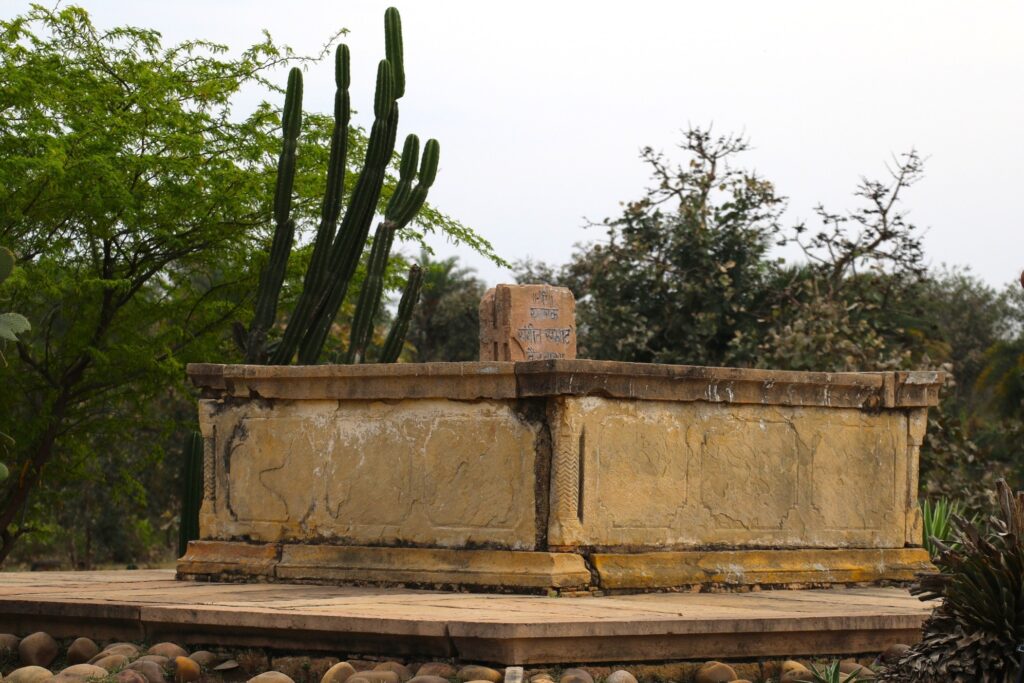
Samadhi (memorial) of Baiju Bawra
Archaeological Museum Chanderi
One of the best museums, this Archaeological Museum is a must visit in Chanderi. It is well maintained and most important well stuffed with some real rare artifacts. Guide Muzaffar Ansari gave such detailed explanations of the displays there; it made our trip a good learning experience.
There are different sections displaying Jain history, Hindu mythology, depictions of Stone Age era, old coins and arms. The displays have small boards with explanations.
Tickets – 5INR for adults, unbelievable but true!

Varaha statue in Archaeological Museum Chanderi
Jama Masjid of Chanderi
This is the second mosque I visited in Madhya Pradesh; the first one was Tajul Masajid in Bhopal. Jama Masjid was built when Chanderi came under the rule of the Delhi Sultanate under Ghiasuddin Balban.
A classic example of Islamic architecture in India, this was the oldest and biggest mosque of Bundelkhand. Today it has the same position in Chanderi, in terms of dimensions.
Highlights of Jama Masjid Chanderi
- 3 perfect domes outline the structure.
- There is just a single large tree the shade of it covering almost the entire area.
- It can accommodate around 2000 people.
- One architectural highlight here is the convoluted brackets. These are abstractions of regional temple architecture.
- Another specialty is that this is the only mosque in India with no minars.
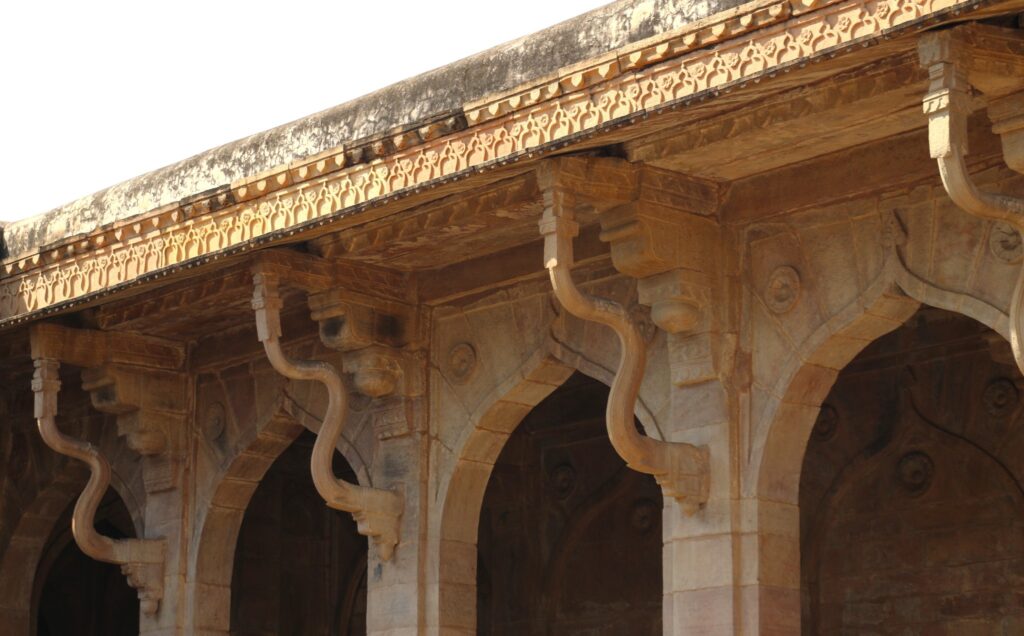
Jama Masjid of Chanderi Madhya Pradesh
Places to stay in Chanderi
For lunch we halted at Kila Kothi. Location is amazing. It is just behind the Chanderi fort and offers picturesque top view of Chanderi town. If you are craving for royal hospitality this is the perfect place to stay.
Till some years back this was owned by the Scindia family. It was then a state Guest house for a short while. Bollywood actress Anoushka Sharma inaugurated this as a hotel. It is now owned by MP Tourism.

Kila Kothi Hotel Chanderi Madhya Pradesh
Planning Your Visit — Location, and Tips
Location:
- Chanderi is in Ashoknagar district, Madhya Pradesh, about 215 km from Bhopal and 230 km from Gwalior.
- Well connected by road; nearest railway station is Lalitpur (40 km away).
Travel Tips:
- Best Season: October–March for pleasant weather; March offers clear skies with fewer crowds.
- Transport: Local autos and walking are best for exploring the compact town.
- Photography: Early morning and late afternoon light highlight the fort and gateways.
- Shopping: Buy sarees directly from weavers in Bahar Shahar or Handloom Park for authenticity.
- Food: Limited options; try local dhabas for simple vegetarian meals.
- Stay: Few guesthouses available; most travelers prefer day trips from Bhopal, Gwalior, or Lalitpur.
- Etiquette: Respect weaving households and temples—ask before photographing artisans or rituals.
Quick Reference Table:
| Aspect | Details |
| Nearest City | Bhopal (215 km), Gwalior (230 km) |
| Railway Access | Lalitpur (40 km) |
| Best Time to Visit | Oct–Feb (cool), March (clear skies, fewer crowds) |
| Must-See Sites | Chanderi Fort, Badal Mahal Gate, Koshak Mahal |
| Shopping Tip | Buy direct from weavers for authenticity |
Chanderi Trivia: Recently the town got more exposure for the successful Bollywood movies shot here – Stree and Sui Dhaaga.
FAQ about Chanderi Travel
Q: How far is Chanderi from Bhopal?
Chanderi is about 215 km from Bhopal, roughly a 5–6 hour drive. The route is scenic and can be combined with a stop at Sanchi for a balanced heritage road trip.
Q: How much time do you need to explore Chanderi?
A single day is enough to cover the fort, key monuments, and weaving clusters. However, staying overnight allows you to experience the town’s quiet evenings and shop at leisure.
Q: Are Chanderi sarees expensive?
Prices vary depending on fabric type and design. Cotton sarees are moderately priced, while pure silk sarees are higher. Buying directly from weavers ensures authenticity and fair value.
Q: Is Chanderi suitable for photography?
Yes. The fort’s panoramic views, Badal Mahal Gate, and weaving workshops offer excellent photo opportunities. Early morning and late afternoon light are best for capturing the town’s charm.
Q: How does Chanderi compare to Orchha for heritage travellers?
Both towns are worth visiting, but they offer different experiences. Orchha has larger, more dramatic monuments — its cenotaphs and riverside temples are visually striking and better known on the tourist circuit. Chanderi is quieter, more compact, and adds a living craft dimension that Orchha does not. If you have to choose one for a day trip, Orchha delivers more monument variety; if you want heritage combined with an authentic artisan culture, Chanderi is the stronger choice.
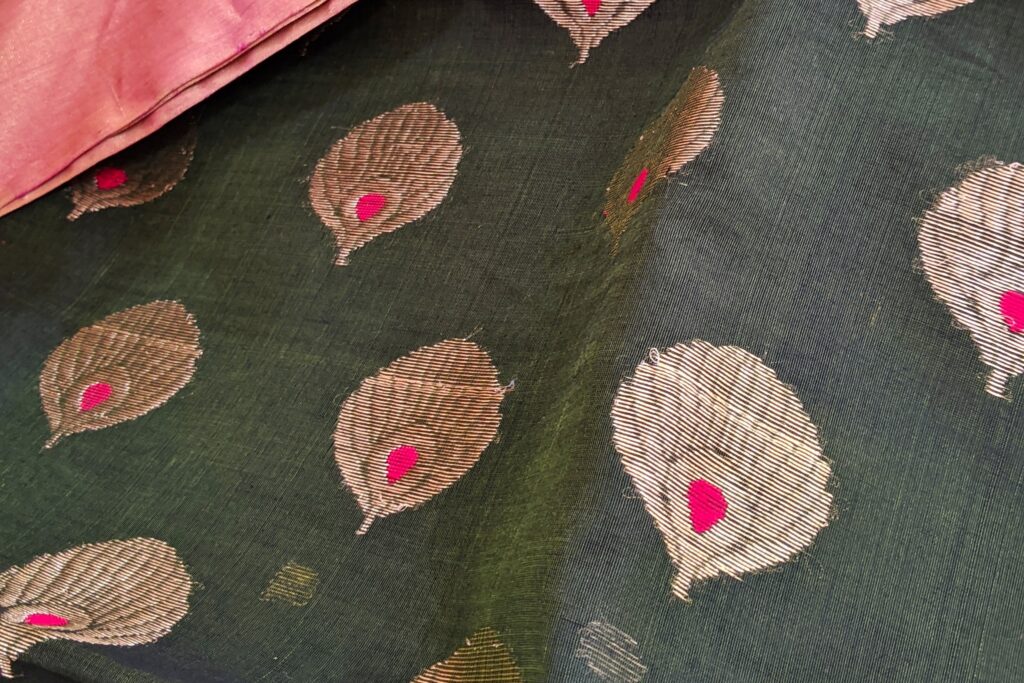
Chanderi Cotton with Zari work – airt matte finish and breathable
Final Thoughts
Chanderi is one of those rare destinations where history hasn’t been packaged for mass tourism. The fort still feels like a fort. The weavers still work in their homes. The gateways stand without crowds queuing in front of them.
My March 2021 visit covered all three registers in a single day — the medieval at the fort, the architectural at Badal Mahal Gate and Koshak Mahal, and the living at the weaving clusters in the evening. Each part of the day felt distinct, and together they gave a complete picture of what Chanderi is: a town that has held on to its identity through craft as much as through stone.
For travellers weighing options in Madhya Pradesh, Chanderi sits comfortably alongside Orchha and Sanchi on a heritage itinerary — but it earns its place for different reasons. It is compact, walkable, photogenic, and genuinely connected to a living tradition. Whether you’re coming from Bhopal on a day trip or building it into a longer central India circuit, Chanderi is worth the detour.
If you value authenticity over spectacle, and craft alongside history, this loom town belongs on your list.
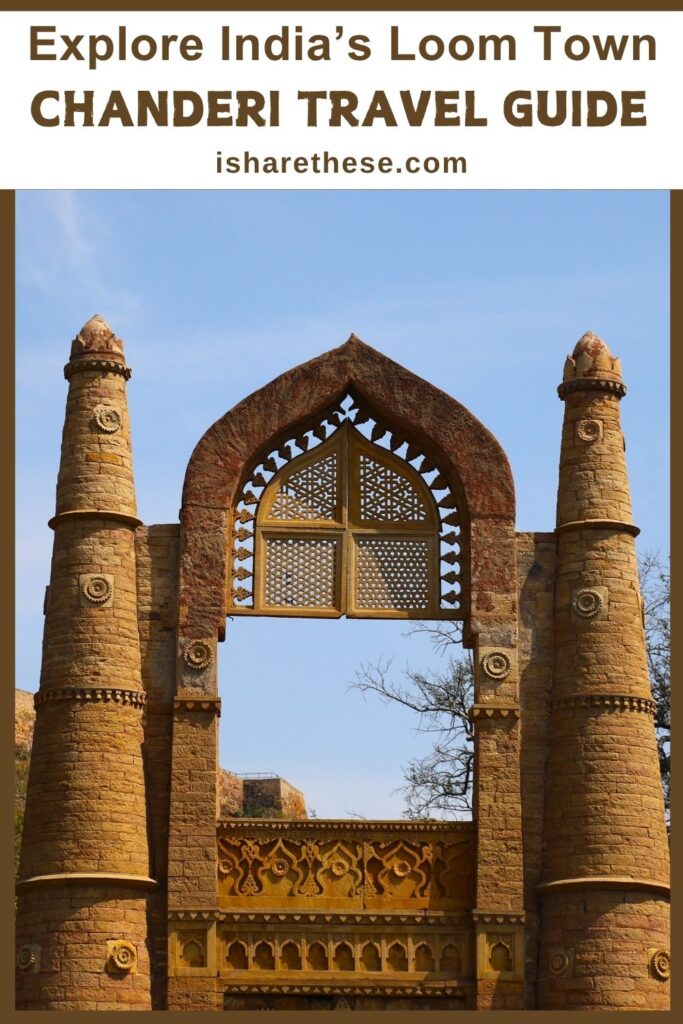
Pin this for later…
About the Author
 Indrani Ghose is a cultural travel writer and heritage documentation specialist with over 15 years of experience exploring and writing about temples across India and Southeast Asia. Having visited over 150 sacred sites, she brings both scholarly depth and personal narrative to heritage travel writing.
Her work has been published in Lonely Planet, The National (UAE), Whetstone Asia, Deccan Herald, and various architecture and heritage journals.
Connect with Indrani: Follow Indrani on Instagram | Twitter | Facebook for heritage travel insights, photography tips, and offbeat destination discoveries.






The archaeological museum looks like a great place to spend time! I love the architecture there and would love to learn more about it. It’s also very touching about the women who gave their lives to avoid capture. What an interesting place!
Wow! I did not realize that there are a lot of things to do and see in Chanderi. It would be amazing to visit their handloom center. Happy to know that the weavers have a stable income.
There is history and Mystery in Madhya Pradesh, chanderi is no exceptional. The Jauhar story also gave me goosebumps which I only watched in Hindi movies till date. The intricately carved gate looks beautiful and My dream is to visit Handloom weaving units of chanderi saree. I love sarees and want to know about this handloom apart from famous Patola of Gujarat.
What a beautiful and full of culture and history place to visit. I especially liked the architecture. It is so powerful, in spirit. One can only imagine the stories these walls can say. I think my reaction to the Rajput women would have been the same as the group’s. Such a sad story, but also an impressive story! Also, I believe that the King was unfair to the architect that created Kati Ghati. I can only imagine the work he put in sculpting that huge piece of stone!
Absorbing post because of the fact that I love the history of a place and read about it before my visit. It helps me relate once there. Haven’t been to Chanderi as yet and would love to be there some time. Madhya Pradesh has some real treasure and this certainly is one.Chanderi Fort and Jama Masjid look such beautiful creations. My wife would love to be Handloom Park and can’t miss out that.
So much history at Chanderi! Definitely a place I’d like to visit. The fort looks indeed like a magnificent structure and so does the Badal Mahal Darwaza door. This stone depicting the scene of women of Chanderi who chose to commit suicide over being capture by the invading army must have been quite a sad place to see.
The fact about Jauhar story gave me shiver goosebumps thinking about their immolation and sacrifice to keep the pride high. Chanderi has so much history and all we knew about this place was through the weave handloom that women love .The tale of Kati Gati is interesting indeed . Chanderi is definitely high on my visit list of places in MP. Will bookmark your blog
That Badal Mahal Darwaza, even the gate only looks wonderful. I can’t imagine how the palace would be if it’s still there. Must be really fascinating! Are those places busy?
Amazing architecture throughout and I can only imagine the opulence of Badal Mahal Darwaza in its full glory. Hopefully the excavation sheds more light on this building.