Visiting Shravanabelagola? 7 Things to Know About Bahubali Temple
Standing Before a 1000-Year Sentinel
The world falls quiet at the feet of a statue that hasn’t blinked in over a millennium! When I first spotted the Gomateshwara Temple from the highway near Hassan, I had to pull over. The 57-foot Bahubali statue stood serene on Vindhyagiri hill—a towering figure of peace visible from miles away.
I visited Shravanabelagola for the first time in February 2008 with my family. The 694 stone cut steps Shravanabelagola that lay ahead to reach the summit, felt both inviting and challenging. My kids sprinted ahead, while I took pauses along the way savouring the sights down below.
— Indrani Ghose, travel blogger | Updated Nov 2025
Built in 981 CE by Chavundaraya, a minister of the Ganga dynasty, this monolithic statue remains India’s tallest. Be it the grand Mahamastakabhisheka held every 12 years or the serene atmosphere of this Jain heritage site, Gomateshwara deserves a spot on your Karnataka itinerary.
In this guide, I’ll share everything from temple timings to climbing tips, plus how to reach Shravanabelagola and what to expect during your visit.
Quick Facts: Essential Information at a Glance
Some important facts of Bahubali Temple you need to know before you plan your trip:
Location: Shravanabelagola, Hassan District, Karnataka
Main Attraction: 57-foot (17 m) Bahubali statue on Vindhyagiri Hill
Steps to Summit: 694 stone-cut steps (barefoot climb required)
Built: 981 CE by Chavundaraya of the Ganga Dynasty
Religion: Jain temple and pilgrimage center
Special Festival: Mahamastakabhisheka (every 12 years; next in 2030)
Entry Fee: Free
Temple Timings: 6 AM to 6.30 PM daily
Time Needed: 2-3 hours for complete visit
Distance from Bangalore: 144 km (approximately 3 hours by road)
Distance from Hassan: 51 km (approximately 1 hour)
Best Visiting Season: October to March

Trekking to the Gomateshwara statue and experiencing the breathtaking views of Shravanabelagola
Brief History: The Story Behind the Statue
Before I share more about my climb, let me give you the background of this remarkable monument.
The 57-foot (17-metre) Bahubali statue was commissioned in 981 CE by Chavundaraya, a devoted minister and commander under the Ganga dynasty. He chose Vindhyagiri Hill in Shravanabelagola as the site for this ambitious project—carving the world’s tallest monolithic statue from a single block of granite.
Who Was Lord Bahubali?
The statue honors Lord Bahubali (also called Gomateshwara), a Jain figure who renounced his kingdom to pursue enlightenment. According to Jain tradition, he meditated standing for an entire year until vines grew around his legs—a symbol of complete detachment from worldly matters.
Why the Statue Shows Vines and Anthills
The statue depicts Lord Bahubali, son of the first Jain Tirthankara, Rishabhanatha. After winning a combat duel against his brother Bharata for kingdom rights, Bahubali realized the emptiness of power. He renounced his throne and meditated standing in one spot for an entire year.
According to legend, he stood so still that vines grew around his legs, anthills formed at his feet, and snakes coiled nearby. This complete detachment from worldly matters led to his enlightenment.
The carvings you see on the statue’s legs represent this legendary meditation.
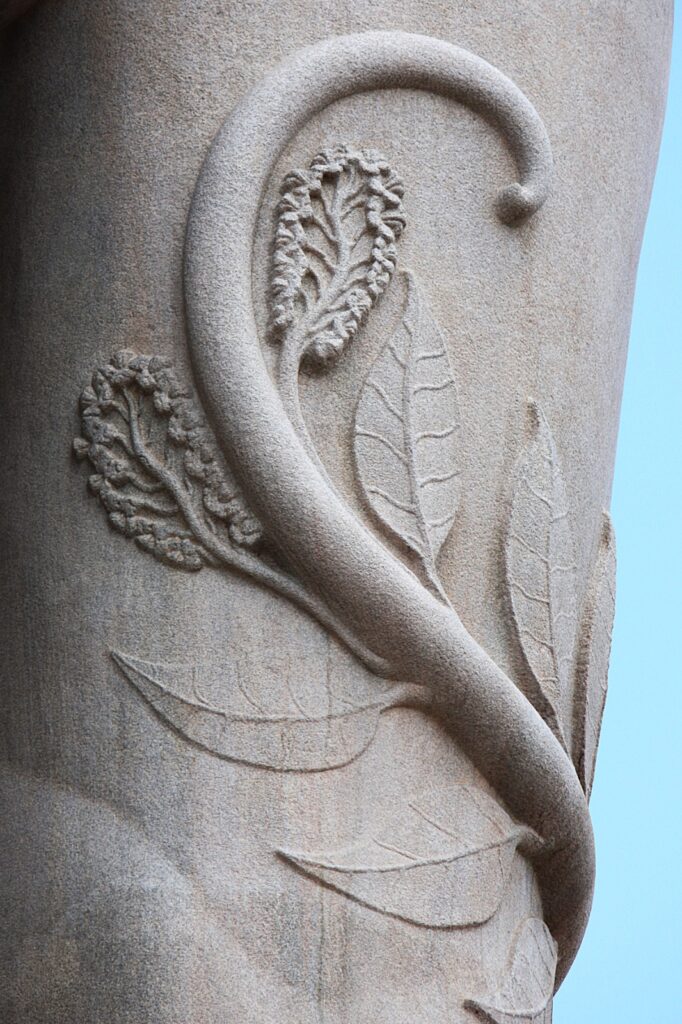
Vines growing on arms
The Mahamastakabhisheka Festival
After installing the huge statue of Gomateeshwara, Chamunda Raya performed the great ceremony of consecration of the image on March 13, in 981 AD. The ceremony was conducted according to Jain scriptures in a manner that matched the enormity of the image.
This anointing ceremony came to known as Bahubali Mahamastakabhisheka Mahotsav.
Every 12 years, on auspicious dates calculated from location of heavenly bodies, this temple hosts one of India’s most spectacular religious ceremonies. During Mahamastakabhisheka, thousands of devotees gather to watch priests pour milk, saffron water, sandalwood paste, and turmeric over the statue from scaffolding built around it.
Today, Shravanabelagola remains one of Hassan district’s most significant pilgrimage sites, drawing both devotees and history enthusiasts to Karnataka.

Bharat and Bahubali fight By Jain cloud – Own work, CC BY-SA 4.0, https://commons.wikimedia.org/w/index.php?curid=44541447
Our Visit: Climbing the 694 Steps to Vindhyagiri Hill
The ascent to Gomateshwara is part of the experience—and it’s not easy.
What the Climb Is Really Like
The 694 rock-cut steps are uneven. Some are shallow and wide, others steep and narrow. Around step 300, I started feeling the burn in my calves. By step 500, I paused a while.
The biggest challenge? You must climb barefoot. Temple rules don’t allow shoes on the sacred hill. When I visited at 11 AM in February, the granite was already hot enough to make me hop between shaded spots.
My solution: Wear thick cotton socks. They protect your feet from the heat while respecting the barefoot tradition. Most locals do this, and security allows it.
The entire climb took me about 35-40 minutes with breaks. My kids, racing ahead, made it in 20 minutes.
Palanquin Service for Elderly Visitors
If the climb seems too difficult, local bearers offer doli (palanquin) service. Four men carry you up in a covered seat for ₹500-800. I saw several elderly pilgrims using this option, and it’s completely acceptable.
Watching the Bahubali statue grow larger with each step kept me motivated. The view alone made every step worth it.

Trekking to the Gomateshwara statue and experiencing the breathtaking views of Shravanabelagola
Standing Inside the Temple Courtyard
My First Impressions of the Bahubali Statue
When I finally reached the summit and walked through the entrance gate, the statue stopped me in my tracks.
At 57 feet tall, the Bahubali statue towers over the courtyard. But it’s not the size that strikes you first—it’s the expression. The face radiates complete calm. The eyes gaze into the distance with a serenity that makes the surrounding noise fade away.
I had read all interesting facts of Gomateswara statue before visiting Shravanabelagola. But nothing prepared me for that first sight of the colossal Bahubali statue! The temple has no roof, yet not one part of the statue was visible from outside. As I crossed over the doorstep I first sighted the purohit busy offering prayers. As I kept walking my neck turned up, up and up till I sighted the head!
The face with half-closed eyes and a gentle, serene smile! It was hypnotic to say the least. Only after I recomposed a bit my eyes scanned the statue for its finer details. Jain poet Hemchandra had described the Gommateshwara statue as “verily the personification of tranquillity”.
As my neck cricked, my gaze floated down scanning the other details. The creepers grew symmetrically on both arms and thighs, while the saint stood motionless. Snakes winding the anthills were minuscule in size compared to the ever still monk. It was a mix of childlike innocent expression on face with the body of a muscular wrestler.
I looked for a path to climb the upper gallery, but they kept it locked to prevent people from crowding over the structure.

Gomateshwara Bahubali at Shravanabelagola India The dimensions of the features of the statue that I could gather from a pamphlet that was sold at the base of the foothill are: Head – 11 ft. Neckline to navel 10 f ft. 11 in. Each arm – 30 ft. Nose – 3 ft. 9 in. Ears – 5 ft. 10 in. Pen is – 4 ft.
The View from the Top
From Vindhyagiri Hill’s summit, you get a panoramic view of Shravanabelagola town below. The white temple pond (Kalyani) shimmers in the center, surrounded by traditional houses with red-tile roofs. On the opposite side, Chandragiri Hill rises with its own cluster of smaller Jain temples.
The contrast is powerful—the busy town below and the silent statue above. Pilgrims sit in corners of the courtyard, meditating or praying quietly. The atmosphere feels timeless.
This isn’t a place you rush through. Plan to spend at least 30 minutes at the top, absorbing both the artistry and the peace that Gomateshwara represents.
Beyond Gomateshwara: Other Must-Visit Sites in Shravanabelagola
The main Bahubali statue draws most visitors, but Shravanabelagola has several other significant temples and attractions worth exploring.
Monuments of Jainism at Shravanabelagola have been nominated by the State Department of Archaeology Museums and Heritage in Karnataka along with other monuments like those in Lakkundi for the UNESCO World Heritage Site’s tentative list.
After descending from Vindhyagiri Hill, I spent another two hours discovering these lesser-known sites that reveal the town’s deep Jain heritage.

Bahubali feet – Discovering the beauty of the monolithic Gomateshwara statue in Shravanabelagola
Chandragiri Hill: The Easier Climb with the Best Views
Most tourists skip Chandragiri Hill, located directly across from Vindhyagiri. That’s a mistake.
This smaller hill has only 200 steps—much easier than the 694-step climb you just completed. I reached the summit in about 15 minutes without breaking a sweat.
Why climb Chandragiri? The view. From the top, you get the best photographic angle of the Gomateshwara statue framed against the sky. This is the classic postcard shot of Shravanabelagola that you see in travel magazines.
Historical significance: Chandragiri houses the Chandragupta Basadi, a temple dedicated to Emperor Chandragupta Maurya. According to Jain tradition, the Mauryan emperor renounced his throne and spent his final years here in meditation under the guidance of Jain monk Bhadrabahu.
The hill contains several smaller Jain basadis (temples), each with inscriptions dating back to the Ganga dynasty period. These ancient stone carvings document the history of Jain settlements in Karnataka from the 10th century onward.
Entry: Free. Same barefoot rule applies.
Time needed: 45 minutes to 1 hour
Bhandari Basadi: Medieval Jain Architecture
Back at ground level, visit Bhandari Basadi—the largest Jain temple in Shravanabelagola town.
Built in the 12th century, this temple showcases the grandeur of medieval Jain architecture. The moment I entered, the pillared halls caught my attention. Each column features intricate carvings of dancers, musicians, and geometric patterns.
The main sanctum contains idols of multiple Tirthankaras (Jain spiritual teachers). The temple priest explained that devotees come here for daily prayers before ascending Vindhyagiri Hill.
What makes it special: Unlike the simple courtyard atop Vindhyagiri, Bhandari Basadi displays elaborate decorative work—testament to the artistic skills of 12th-century craftsmen.
Location: Town center, 5-minute walk from Vindhyagiri base
Entry: Free
Time needed: 20-30 minutes
Walking Through Shravanabelagola Town
After visiting the major temples, I spent time walking through the local market area.
The town has a distinctly religious character. You’ll see Jain monks in white robes walking the streets, families carrying offerings to temples, and shops selling puja items like flowers, incense, and oil lamps.
The local market sells fresh produce, traditional sweets, and religious artifacts. I noticed some bookshops specializing in Jain scriptures and philosophy texts—something you won’t find in typical tourist towns.
Cultural insight: The entire town revolves around the temples. During Mahamastakabhisheka (held every 12 years), the population swells from a few thousand to over a million pilgrims. Even in off-years, the town maintains its devotional atmosphere.
Locals are friendly and happy to discuss the upcoming 2030 festival. Several shopkeepers showed me photos from the 2018 Mahamastakabhisheka when scaffolding covered the statue and priests poured 1,000+ pots of offerings over Bahubali.
Time to explore: 30-45 minutes

At the feet of Gomateshwara Bahubali at Shravanabelagola
How to Reach Gomateshwara Temple Shravanabelagola
Planning a trip to the Gomateshwara Temple Shravanabelagola is straightforward, thanks to its location in Hassan district, Karnataka. Here’s a breakdown of the options:
By Air
The nearest major airport is Kempegowda International Airport, Bangalore, about 144 km away. From the airport, travelers can hire taxis, use app-based cabs, or book private transfers. The drive takes around 3.5–4 hours depending on traffic.
By Train
Shravanabelagola has a small railway station, Shravanabelagola Railway Station (SBGA), but the nearest major hub is Hassan Junction, about 50 km away. Hassan is well connected to other big cities.
By Road
Road travel is the most common way to reach the Bahubali statue Shravanabelagola.
- From Bangalore: The NH75 route via Nelamangala and Kunigal is the fastest, taking about 3.5 hours.
- From Mysore: A shorter 85 km drive via Krishnarajapet makes this a convenient weekend trip.
- From Hassan: Just 50 km away, the drive is under 90 minutes.
- KSRTC Bus Services: Regular buses run from Bangalore and Hassan, offering affordable travel.
- Self-Drive Experience: Roads are mostly smooth, though traffic near towns can slow you down. Driving gives flexibility to explore nearby Hassan tourist places.

Jain pilgrimage to the Gomateshwara statue in Shravanabelagola
Where to Stay in Shravanabelagola
Staying in Shravanabelagola (Best for Early Climbers)
If your priority is the 6.30 AM climb (highly recommended to beat the heat), stay in the temple town. The facilities are basic, but the location is unbeatable.
- Hotel Raghu: Located right next to the Vindhyagiri entrance. It is basic but clean enough for a one-night stay. You can wake up, walk 2 minutes, and start climbing.
- OYO 43654 Sdk Residency: 2.1 km away from Gomateshwar Temple
- Jain Dharamshalas: Places like Vidyananda Nilaya offer very affordable rooms (approx ₹500) for families. Note: These are strictly vegetarian and alcohol-free zones.
I recommend staying at Hotel Raghu in Shravanabelagola for one night. The advantage of starting your climb at sunrise—before the tour buses arrive—outweighs the lack of luxury.
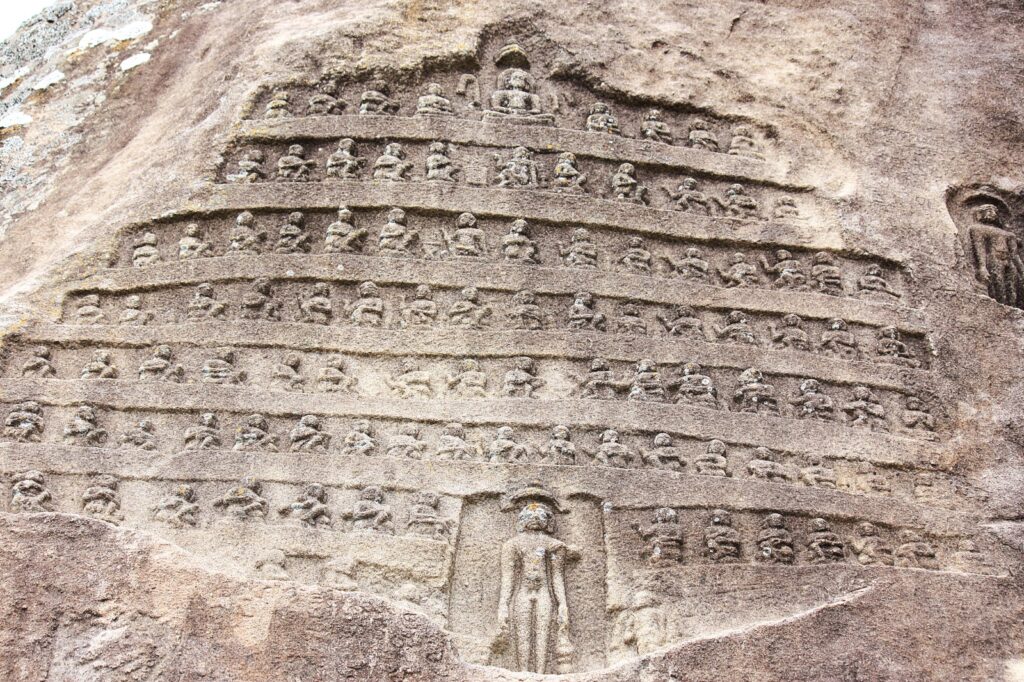
Akhanda Bagilu, Vindhyagiri Hill, Shravanbelgola
Best Time to Visit Gomateshwara Temple
The Gomateshwara Temple Shravanabelagola can be visited year-round, but the best time is between October and March, when the weather is cooler and ideal for climbing the 694 steps Shravanabelagola.
Summers can be harsh, with the granite steps heating up quickly. If you plan to witness the grand Mahamastakabhisheka, check the official Shravanabelagola timings and book accommodation well in advance, as the town gets crowded.
For a balanced experience—pleasant weather, fewer crowds, and clear views from Vindhyagiri hill—winter months are the most rewarding.
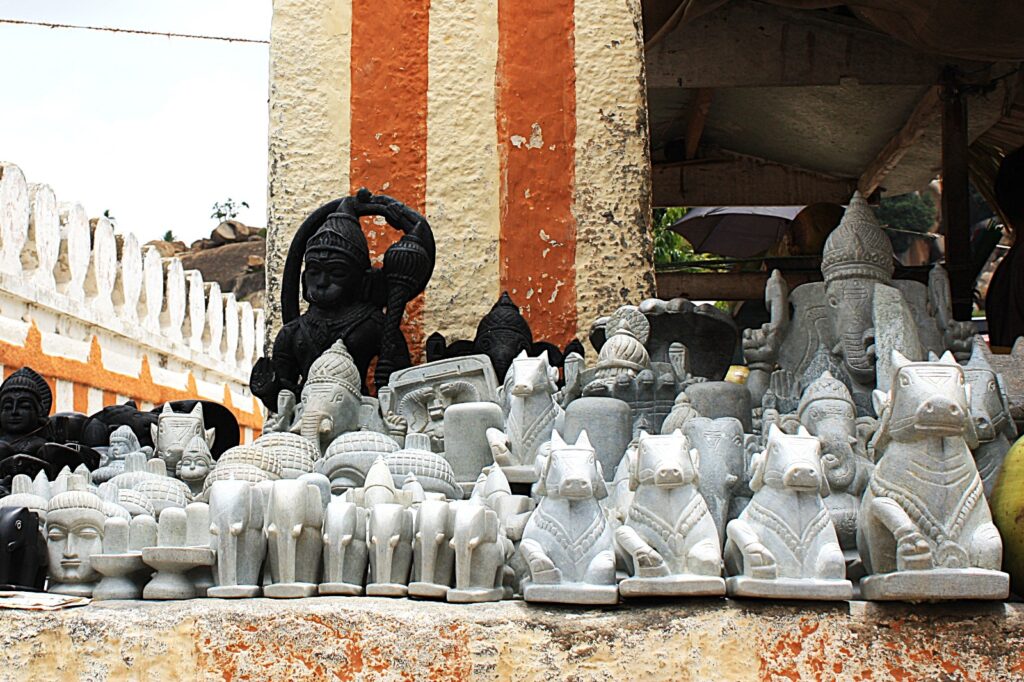
Souvenirs from Shravanabelagola
Entry Fee for Gomateshwara Temple
No, there is no entry fee to visit the Gomateshwara statue at Shravanabelagola. The temple is free to enter for all visitors. However, there are a few important clarifications:
Regular Darshan: Free
The basic darshan (viewing) of the statue is completely free, though donations are accepted for temple maintenance.
Special Darshan (Optional)
Some sources mention that special darshan tickets, which allow you to get closer to the statue, may cost INR 200 to INR 500 per person, though this appears to be optional and not required for regular visitors.
Other Costs to Consider:
- Palanquin/Doli service: ₹500-800 if you need assistance climbing the 694 steps (optional, for elderly or those unable to climb)
- Photography: Allowed and free
Temple Timings:
The temple is open from 6.30 AM to 11.30 AM and 3.30 PM to 6.30 PM, though some sources show slightly different timings.
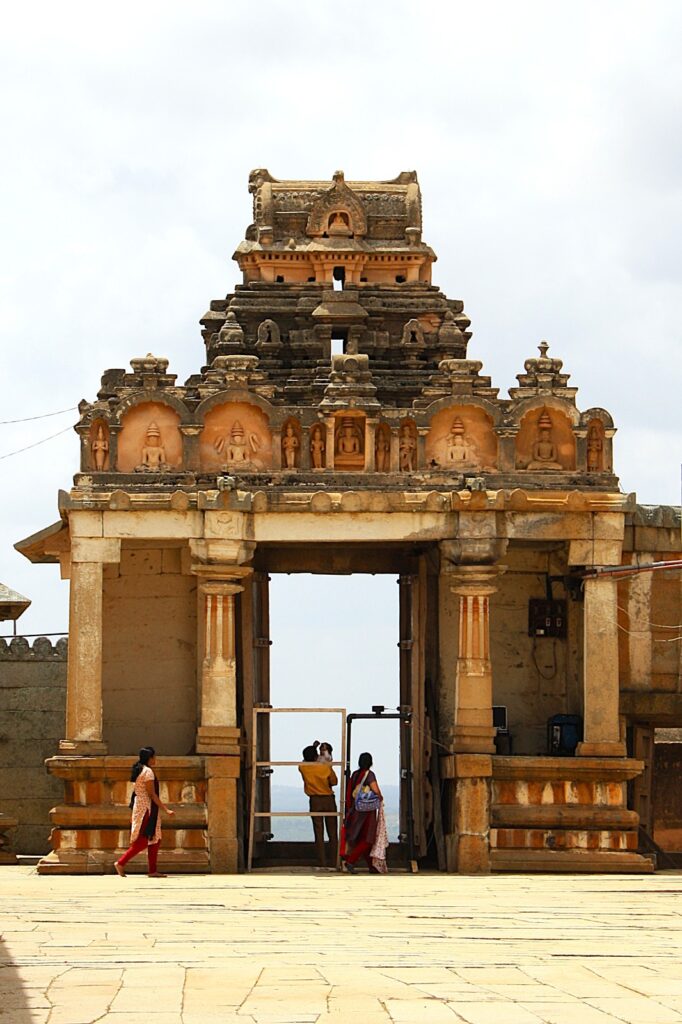
Entrance to Gomateshwara Temple
FAQ Gomateshwara Statue Shravanabelagola
What is the significance of the Gomateshwara statue?
The Gomateshwara statue is a massive statue of the Jain god Bahubali, located in Shravanabelagola, Karnataka. It stands at a height of 57 feet and is considered to be one of the largest free-standing statues in the world.
When is the next Bahubali Mahamastakabhisheka Mahotsav in Shravanabelagola?
The next Mahamastakabhisheka festival is scheduled for 2030.
How was the Gomateshwara statue built?
The Gomateshwara statue was carved out of a single granite rock and was built using a technique called ‘anchored scaffolding.’ The scaffolding was anchored to the rock face, and workers carved the statue from the top down.
What is the best time to visit the Gomateshwara statue?
The best time to visit the Gomateshwara statue is between October and March, when the weather is cool and pleasant. It is also advisable to visit early in the morning to avoid crowds and the heat.
What to see inside Gomateshwara temple in Vindhyagiri?
- Gomateshwara Statue
- Odegal Basadi
- Gullakayajji Mantapa
- Tyagada Kamba (Pillar of Sacrifice)
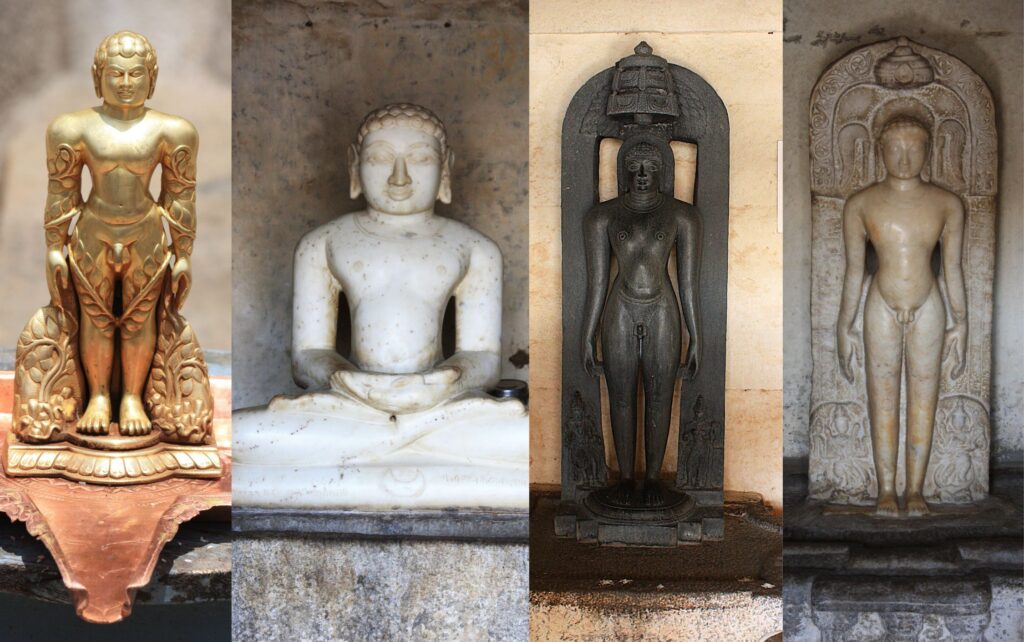
Statues of Bahubali and Tirthankaras
Final Thoughts: Why Gomateshwara Should Be on Your Karnataka Bucket List
Standing before the 1,000-year-old Bahubali statue after conquering those 694 steps is unforgettable. This isn’t just another temple visit—it’s where ancient craftsmanship, spiritual devotion, and physical challenge meet.
The climb tests you, but the reward at the summit makes every step worthwhile. Karnataka Tourism Board has done well to maintain this place. Beyond the main attraction, Chandragiri Hill and the town’s Jain heritage add depth to your journey.
Pro tip: Visit early morning (6-8 AM) to avoid heat and crowds. Carry water, wear cotton socks, and allow time for Chandragiri’s perfect photo angle.
Have you climbed to Gomateshwara? Share your experience and tips in the comments below!
Pin and Save this for later
About the Author
 Indrani Ghose is a cultural travel writer and heritage documentation specialist with over 15 years of experience exploring and writing about temples across India and Southeast Asia. Having visited over 150 sacred sites, she brings both scholarly depth and personal narrative to heritage travel writing.
Her work has been published in Lonely Planet, The National (UAE), Whetstone Asia, Deccan Herald, and various architecture and heritage journals.
Connect with Indrani: Follow Indrani on Instagram | Twitter | Facebook for heritage travel insights, photography tips, and offbeat destination discoveries.
Related posts: Other Temples of Karnataka
Complete Guide to Cave Temples of Badami
Yoga Narasimha Temple Baggavalli







Read about it in my school days..
Lovely clicks.
Beutifull pictures, and a beautifull story to go with them (I support your suggestion to current world leaders)
OH wow that is BIGGGGGGGGGG
thanks for sharing and telling us all about it
Bikram's
Hi Indrani,
All post are excellent.
Good Work, Keep it up.
Superb writting!
I have visited Shravanbelgola 3 years before and liked the place very much.Good to see your post and feel like visiting again.
Really interesting pictures in both your sites!! I visited India many times and now i often are visiting your blog to see good indian pictures.
Ciao Marco
What am amazing, awe inspiring work of art and with what a legend behind it…
Reminded me of the beautiful Budhdhas that the Taliban destroyed… 🙁 Can't imagine how somebody could destroy something so beautiful and of such historical value! If only some of these rulers could feel like Bahubali did… 🙁
Maybe you could tell me – why did they make these massive Buddha statues, like the one here and the ones the talibs destroyed in Afghanistan? any relevance to the huge size? Typically Buddhists are not for a huge show, this aspect has confounded me…
Initially, while trying to post a comment in a hurry, I missed out on the story as well as was mistaken that this was the statue of budhha. But that's a really interesting story you have in this post with some great pictures. Thanks for sharing this nice post.
Many steps to get to the statue but am sure it's worth the climb 🙂 An interesting story.
It looks like seeing the statue was worth that climb.
The story is quite interesting and the pictures are great.
Splendid series of photographs and a great lesson: the ability to stop the roller-coaster ride to try the Truth.
A beautiful post, really thanks!
amazing post indrani … I liked the photos and also the way you have described your visit .. great work boss.. kudos ….
aabhar
vijay
pls read my new poem "झील" on my poem blog "
Hi Indrani!
Interesting post! I'm always learning any time I come here!!
Excellent pictures also!
Blogtrotter is now showing that Reykjavik is not entirely grey… ;)). Enjoy and have a fabulous weekend!
Such a lovely story. I went to Shravanabelagola over 3 decades ago – and I don't remember the nice steps that you have shown in your picture. I remember it was blazing hot, and we practically ran up the hill non-stop, so that our bare feet did not get burned.
Fantastic Indrani. As you say, sometimes, words are too much
Beautiful photos!
Bahubali was a wise man and deserves a fitting monument.
Yes, I wish our leaders would duel to solve things instead of having wars. They would be much more likely to find peace without bloodshed.
Fascinating information and photographs.
Nice to know about this Jain Site !
Beautiful images and commentary.
Thanks for sharing and for providing some insight about the country, people and culture.
beautifully narrated and glorious images!
Nice account. And well, we make so many statues of gods and people that we forget the significance of their greatness. Thanks for bringing it to our attention.
Beautiful pictures, Indrani!
Our leaders should learn very much from this story.
Have a nice week!
Did you climb so many steps 😉
Wonderful shots !!
Lovely and clear words written.
That statues is soooo BIG 🙂
Amazing statue! And I like it all the more for the wonderful Story behind it.
This statue is so beautiful. I remember visiting more than 20 years ago!
What a great story and photos. I enjoyed the post.
Thanks for stopping by my site.
Very nice and informative, as usual and lovely pictures. The suggestion that world leaders should copy the idea of putting off war is an excellent one.
Excellent post, Indrani. The photos are magnificent and the text is well written. I also wish that other world leaders would learn from this.
amazing post…great description with great photographs as always
That's quite a story and lesson, too bad modern world leaders don't study it carefully! Love the photos, too, especially the robed man at the feet. Beautiful!
Such a gigantic statue!! Loved the story behind it and most of all your last line.."certain experiences are silencing!"
I wish today’s world leaders took a lesson from this. 🙂
wonderfully written…
Indrani,
What a beautiful story. Loved reading it.
Sorry have been MIA for a month now. Work + vacation + house guests are my excuses. Hope to be more regular from now on.
Wow that's one huge statue. India is really amazing. One of these days…hmmm…soon I hope I can visit India.
I've been there years back Indrani. To read about it from you is nice. Thank you for sharing.
What an amazing story. Huge statue. Thanks for visiting my blog. I'll be back here. (((Hugs))) Jo (South Africa)
Hi Indrani
Nice post and beautiful pictures.Once we happened to drive into Sravanabelagola – but it turned out to be some festival day and the crowds were humongous. Hence we totally missed seeing the statue. Hope to make it again some time again in future.Isn't Bahubali also known as Statue of Gomateswara? Once I saw the live proceedings of the Maha Mahamastabhisheka on TV.That was really awesome.
Rgds Ram
That's a huge statue – great photos. Love the tiny (in proportion) organ.
What a great story. Those stairs look a little intimidating. But the statue is magnificent. Great captures.
What an interesting world to me ! and these statues they are sooo huge !! Very impressive !
Wonderful pictures. I have been visiting your blog for a while and I'm very much inspired by the way you are clicking the shots.
Keep snapping and blogging (-:
That would be an interesting climb. The people are dwarfed by the big statute. Love the details.
Very interesting moral story, well illustrated as well.
fabulous photos! It is really a huge statue. I like the unique last photo, as i see it.
Wow that's a whole lot of steps to climb but am sure the bonus of the view up there is worth it. Very beautiful post.
What an amazing place! And such lovely photographs you've shared.
I recently went to Portugal where a wealthy man created a fake Buddhist garden, with gigantic imported garden statues.
Your site is the real thing. I wish I could visit there.
i love the story behind..have heard it a 100 times and still wanna hear it more, just doesnt suffice.
Seldom hear much about the Jain culture. Thank you so much for sharing Your World.
You're right, that entire Shravanabelagola experience is special. And I heartily echo your wish too.
Absolutely fascinating narrative and as always the images are beautiful.
620 steps? That would deter me from seeing that in person. But who knows, right?
Great post. Fascinating as always.
Beautiful snaps. This is one place near Bangalore that I have not seen yet.
That's amazing! Really awesome post. When I look at the bottom picture I can't help but think that it would make a very interesting fountain.
Marvelous shots, Indrani! And I love reading the history behind the shots that you share with us. A great post as always!
Have a great week!
Sylvia
quite a history behind this amazing statue. the trek to it is most rewarding obviously.
reminds me of a stairway i took to a temple in china that went on and on and on. but once at the top it was the most spectacular view ever and the temple was pretty amazing too.
Wow, that is some amazing statue. i love the story behind it. Wouldn't it be nice if our leaders could be so wise.
* * *
Please visit me at The Chrysalis Stage and Esoteric Uncovered.
Follow me on twitter and facebook