Ananta Basudeba Temple, Hooghly, West Bengal
Ananta Basudeba Temple Bansberia: A Complete Guide to Hooghly’s Terracotta Masterpiece
When I first stood before the Ananta Basudeba Temple in Bansberia, Hooghly, the terracotta façade arrested my attention completely. Every surface was covered in sculpted panels — mythological scenes pressed into fired clay — some crisp, some slowly crumbling.
The temple sits within a twin temple complex alongside the well-known Hangseswari Temple. The contrast between them is immediate and striking. Hangseswari, built in the 19th century, reflects tantric influence through its unusual lotus-shaped towers. Ananta Basudeba, built in 1679, represents the classical Bengal terracotta tradition at its most refined — an Eka-ratna structure, meaning a single tower rising from a square base, covered in narrative relief panels.
Raja Rameswar Datta, a local zamindar and Vaishnava devotee, commissioned the temple to honour Lord Krishna (Basudeba). The panels that wrap the exterior depict scenes from the Ramayana, Mahabharata, and Krishna’s life — functioning as both devotional art and visual scripture.
This guide draws on my own field visit and photographs. It covers the temple’s history, architecture, terracotta panels, and practical visitor information.
Quick Facts
- Location: Bansberia, Hooghly, West Bengal
- Deity: Lord Krishna (Basudeba)
- Year Built: 1679
- Builder: Raja Rameswar Datta
- Architectural Style: Eka-ratna (single tower)
- Special Feature: Terracotta panels depicting scenes from Hindu epics
- Nearby Attraction: Hangseswari Temple (tantric architecture, 19th century)
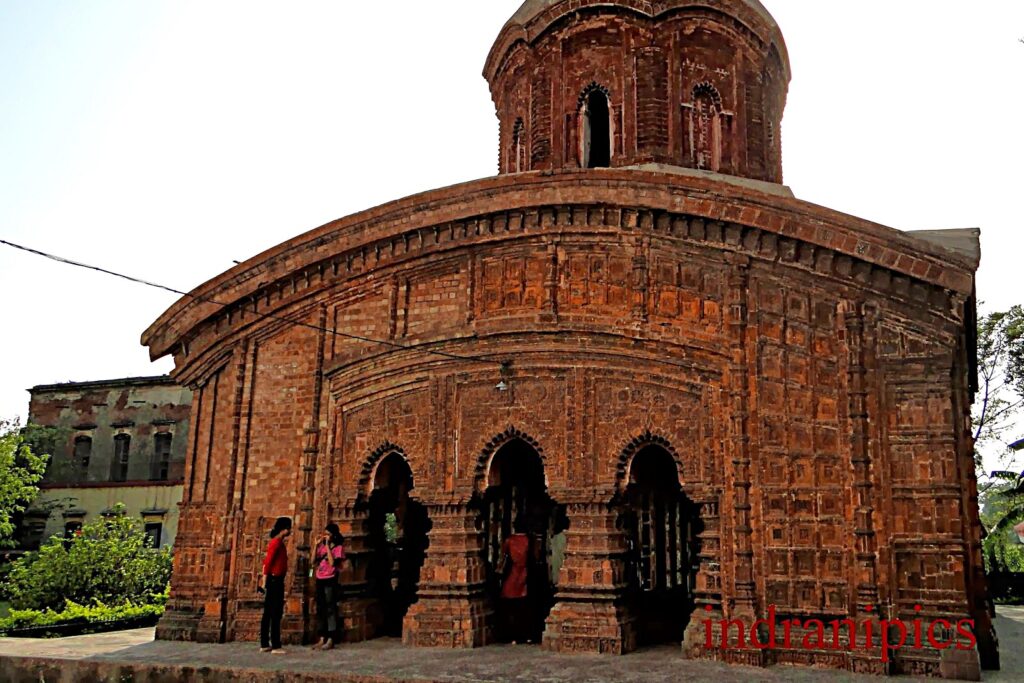
Ananta Basudeba Temple Hooghly
The Historical Legacy of Raja Rameswar Datta (1679)
During my visit, a purohit at the temple shared the history behind this structure — local oral tradition often has interesting fillers that written records leave behind.
The Ananta Basudeba Temple was built in 1679 by Raja Rameswar Datta, a zamindar of Bansberia with deep Vaishnava beliefs. His decision to dedicate the shrine to Lord Krishna was consistent with the religious climate of 17th-century Hooghly, where Vaishnavism had taken strong root among both the gentry and common people.
Commissioning a temple was, for zamindars of the era, both an act of personal faith and a public declaration of status and patronage.
The late 17th century was a productive period for Bengal’s temple architecture. Regional landlords were funding construction across the Gangetic plains, and terracotta had become the dominant material — practical, locally available, and capable of extraordinary decorative detail.
Datta’s choice of the Eka-ratna form, a square sanctum topped by a single curved tower (shikhara), followed established convention. What distinguished his commission was the quality and density of the terracotta work applied to its exterior.
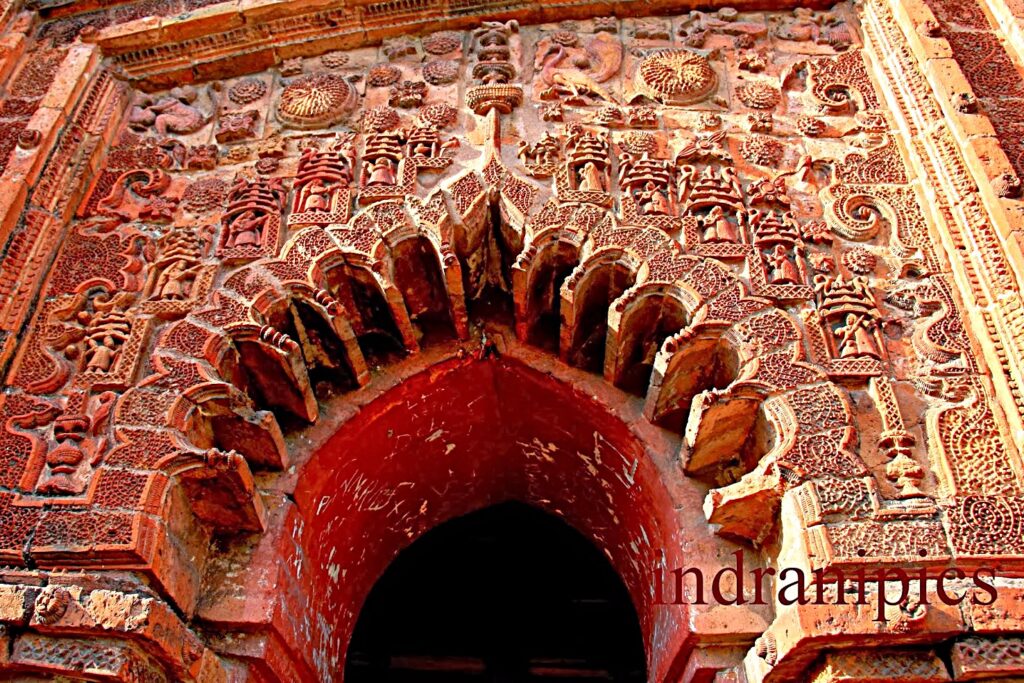
Arch over door of Ananta Basudeba Temple which still retains the sculpture details
Temple Structure and Layout
The panels covering the temple’s outer walls depict episodes from the Ramayana, Mahabharata, and the life of Krishna. These were not purely decorative. In an era of limited literacy, such panels made sacred narratives accessible to worshippers who could not read texts. They also served as a record of the artistic traditions and iconographic conventions of late 17th-century Bengal.
The temple’s placement next to Hangseswari — built over a century later by Raja Nrisinhadeb Roy Mahasay — creates an unplanned but instructive contrast. Ananta Basudeba represents the Vaishnava terracotta tradition; Hangseswari reflects tantric symbolism. Seen together, the two temples trace nearly 200 years of Bengal’s evolving sacred architecture on a single site.
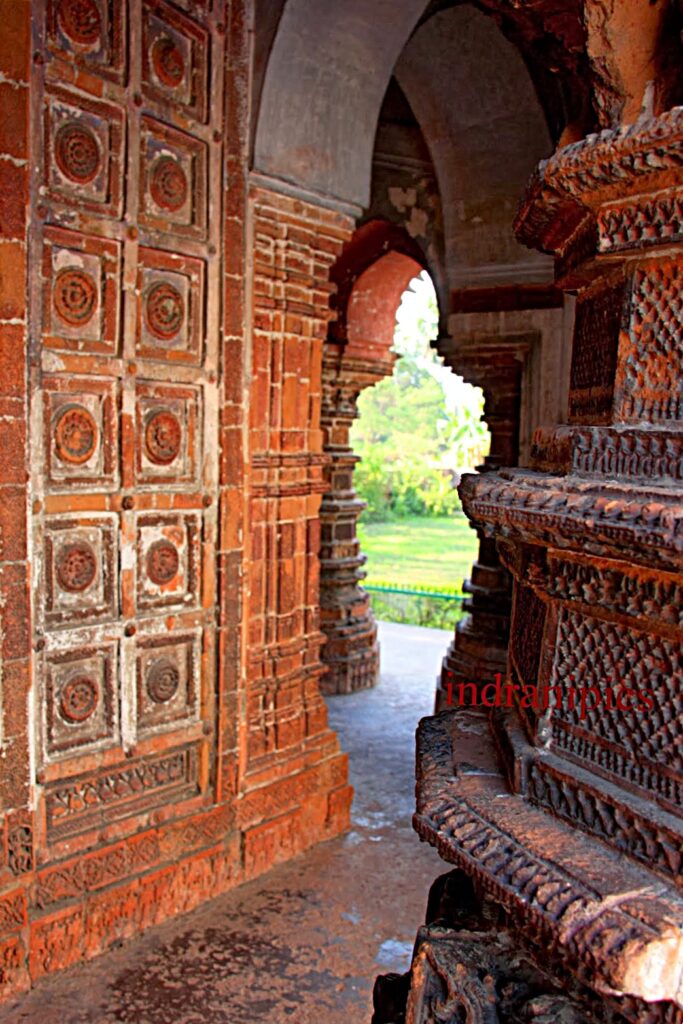
Terracotta panels on walls and pillars
Decoding the Eka-Ratna Architecture and Curved Cornices
The Ananta Basudeba Temple is a well-preserved example of Bengal’s Eka-ratna architectural style. The term means “single jewel” — a reference to the single tower, or shikhara, that rises from a square base. This form was widely used in 17th-century Hooghly, where zamindars commissioned temples that reflected both Vaishnava devotion and regional building traditions.
The layout follows a clear vertical logic. A square sanctum sits beneath a flat roof, which is then crowned by a single octagonal tower tapering upward. The tower draws the eye upward toward the finial, reinforcing the idea of the temple as a point of connection between the earthly and the divine — a concept central to Hindu sacred architecture.
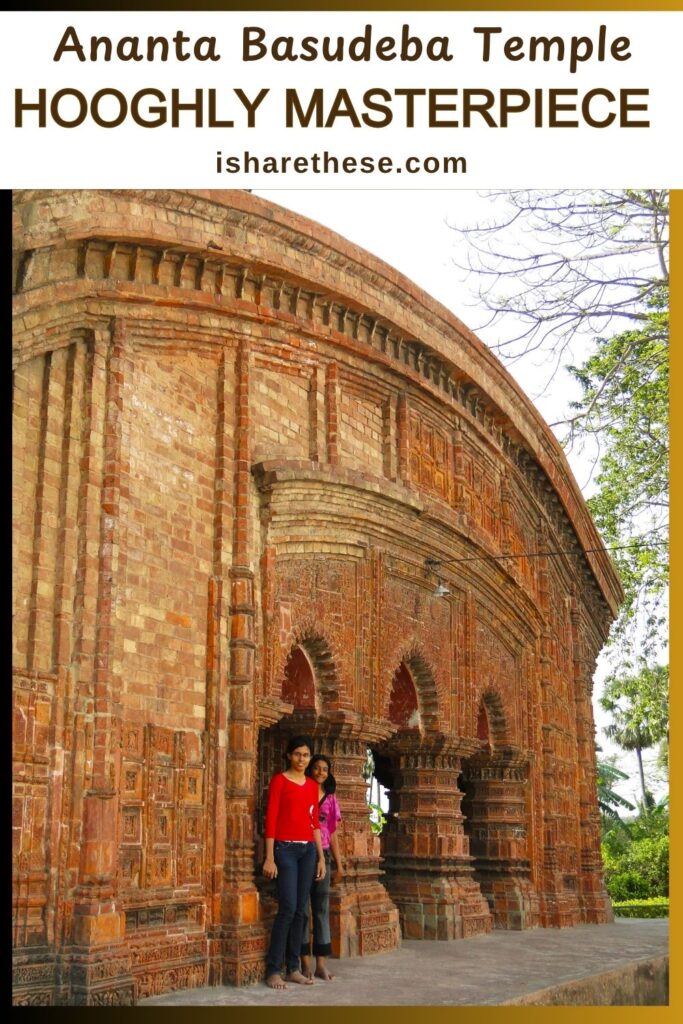
What I found most striking in person was the curved cornice running along the roofline. This is a defining feature of Bengal temple architecture, borrowed directly from the curved rooflines of traditional thatched rural homes — the bangla or do-chala hut form. The cornice is not structural; it is a conscious design choice that roots the temple in its local landscape. It softens the transition between the flat wall surface and the rising tower, giving the building a fluid, organic silhouette.
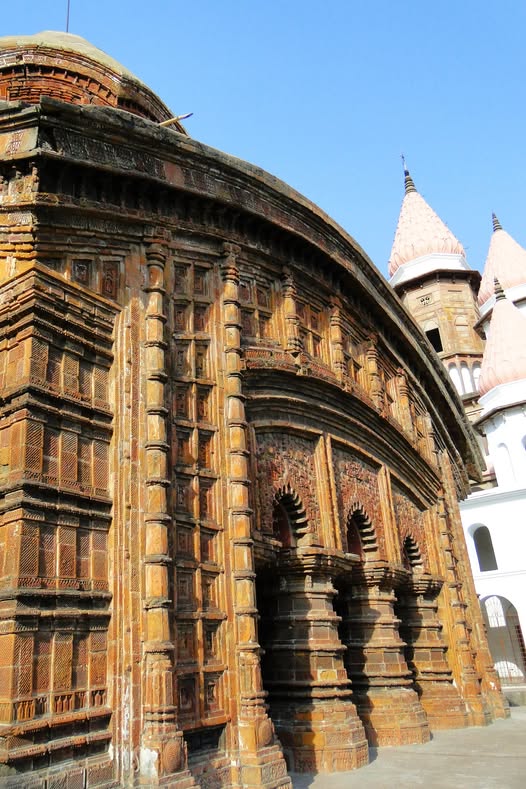
Eka-Ratna Architecture and Curved Cornices of Ananta Basudev Temple
The arched entrance openings, framed by terracotta panels, reinforce this balance between geometry and ornament. The flat roof provides structural stability, the cornices add regional character, and the single tower asserts the shrine’s sacred purpose.
Together, these elements make the Eka-ratna form both functional and symbolic — a structure that is firmly of Bengal, yet aspires to something beyond it.
The Intricate Terracotta Panels — Themes and Iconography
The terracotta panels are the reason most visitors slow down at the Ananta Basudeba Temple. Every exterior surface — the triple-arched entrance, the side walls, the recessed panels between pilasters — is covered in baked clay reliefs. These are not background decoration. They are the primary visual language of the building, and they repay close attention.
Epic Battles
Several panels depict scenes from the Ramayana and Mahabharata. During my visit, I spent considerable time with these — warriors in combat, chariots at full charge, archers drawing bows. The multi-headed figure of Ravana appears more than once, and the Kurukshetra battlefield is rendered with elephants, horses, and foot soldiers pressed into the clay with surprising precision.
These panels were not purely artistic choices. In 17th-century Bengal, where most worshippers could not read Sanskrit texts, such visual narratives made the epics accessible. They reinforced the moral framework of dharma — the perpetual contest between order and chaos — in terms that any visitor could follow.
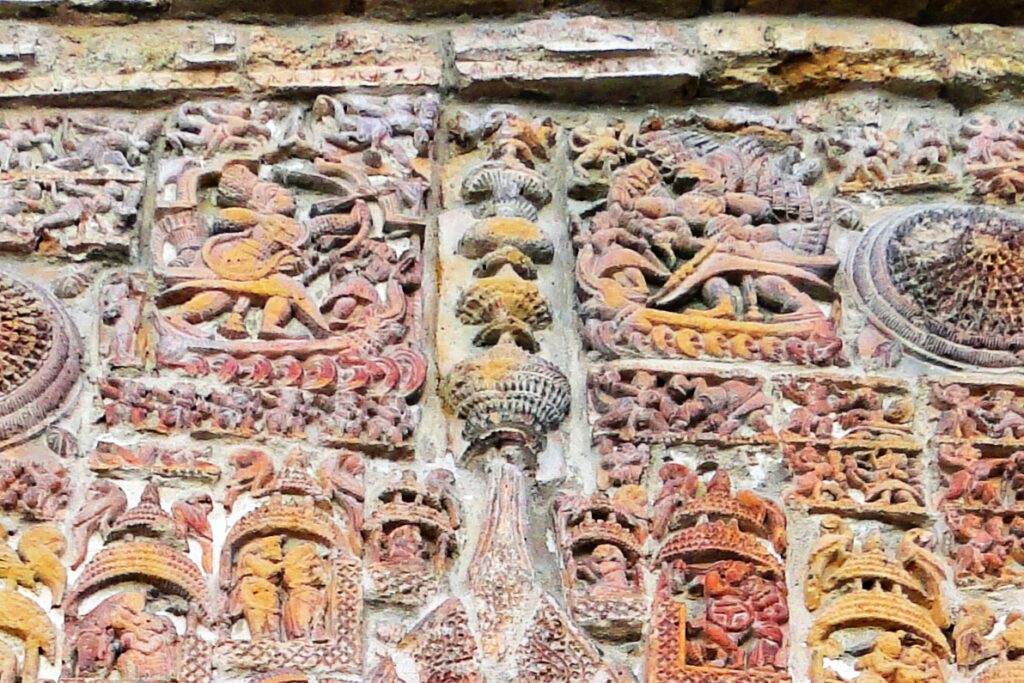
Ramayana Battle Scene on the terracotta panel above arch
The Krishna Leela
Given that the temple is dedicated to Lord Krishna, the panels depicting his life are tiny, yet the most detailed and numerous. Scenes of Krishna lifting the Govardhan Hill to shelter villagers from Indra’s storm, playing the flute among the gopis, and subduing the serpent Kaliya appear across the façade.
One panel I photographed shows Krishna dancing on Kaliya’s hoods, surrounded by figures of devotees and animals, their postures and expressions rendered with care despite the small scale. These images establish Krishna as protector, divine beloved, and cosmic hero — themes central to Vaishnava theology and to the purpose of this temple.
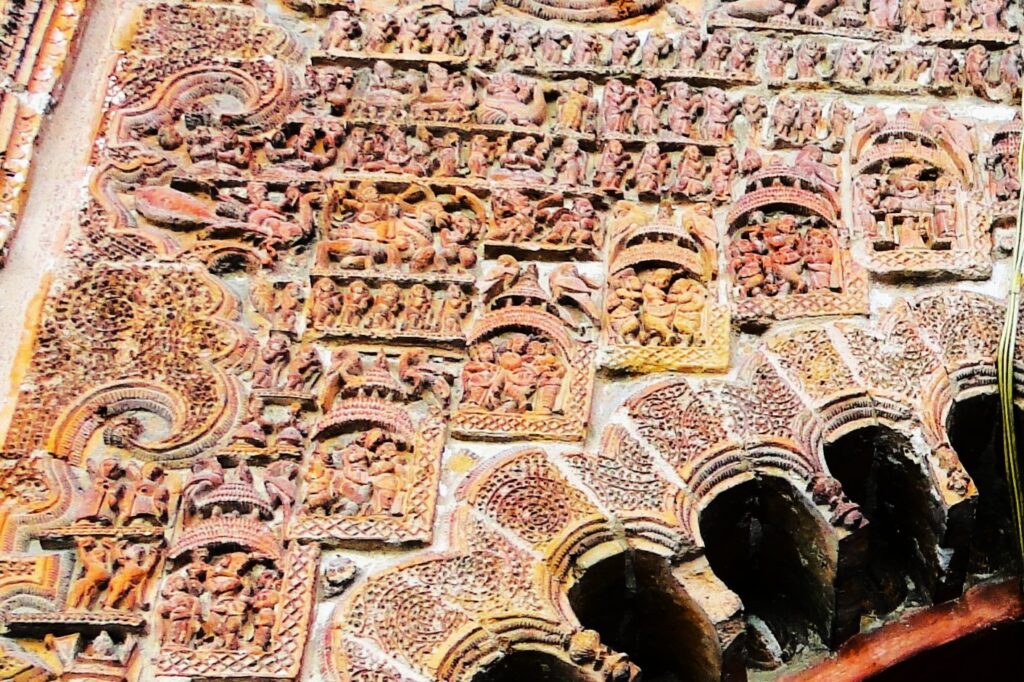
Arch top infused with sculptures depicting Krishna’s life
Social and Everyday Life
What sets the Ananta Basudeba Temple apart from many contemporaries is its inclusion of secular and social subjects alongside the devotional. Panels show musicians and dancers performing in what appear to be royal court settings. Ships move across stylized waves — a likely reference to Bengal’s active river and sea trade.
Perhaps most striking are the figures that appear to depict European soldiers, recognisable by their dress and weaponry. This is consistent with the historical reality of 17th-century Hooghly, which had significant Portuguese and Dutch commercial presence. Local wildlife — elephants, deer, peacocks — also appears, situating the temple firmly in its natural and geographic context.
These secular panels do something important. They record the world as it was lived around the temple at the time of its construction. For the modern visitor, they function as historical documents as much as devotional art — evidence of Bengal’s cultural exchanges, trade networks, and social life in the late 1600s.
Taken together, the terracotta panels of the Ananta Basudeba Temple are among the most layered and informative examples of this art form in the Hooghly region.
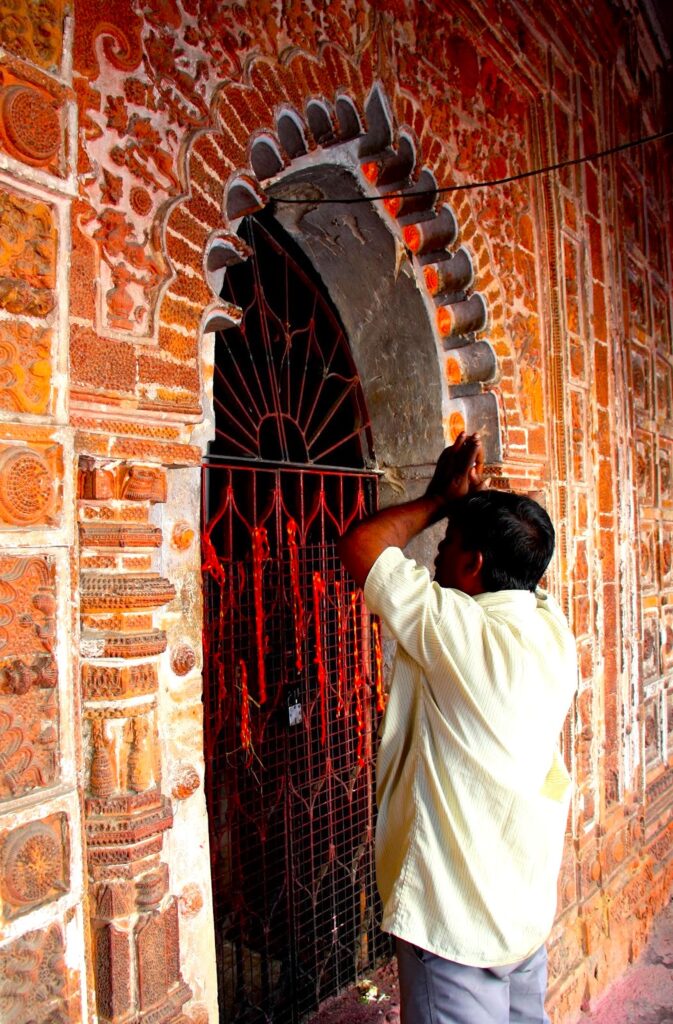
A Local Devotee Seeking His blessings
Walking Tour checklist within the Temple
Look for hidden gems:
- Bottom Row Panels: Focus on secular life, boats, and hunting scenes.
- Middle/Archway Panels: Focus on the avatars of Vishnu and standard mythological warfare.
- Pinnacle Bases: Focus on geometric patterns and floral bands.
Logistics and Visitor Practicalities for Bansberia
Getting to the Ananta Basudeba Temple in Bansberia, Hooghly is straightforward from Kolkata or Howrah, which makes it a practical choice for a day trip.
By Train
The most reliable option is the Howrah–Katwa local line. Trains on this route stop at Bansberia station, from where the temple complex is a short rickshaw ride away. Tribeni is another nearby station on the same line. If you are coming from a different direction, Bandel Junction serves as a useful interchange — from there, an auto-rickshaw to Bansberia takes around 15–20 minutes. Train services are frequent, and the journey from Howrah takes roughly 45–60 minutes depending on the service.
By Road
The temple is also accessible by road via NH 19. Private cabs and app-based taxis can reach Bansberia directly, though road traffic between Kolkata and Hooghly can be unpredictable, particularly on weekends.
Timings and Entry
The temple is open during daylight hours, generally from 6 AM to 6 PM. Timings may shift slightly around major festivals. There is no entry fee, which makes it one of the more accessible heritage sites in the Hooghly district.
Photography
Photography of the terracotta panels and exterior is permitted. Natural light gives the best results — mid-morning works well before harsh overhead shadows set in. Avoid using tripods or flash inside the sanctum, as is standard practice at active temples.
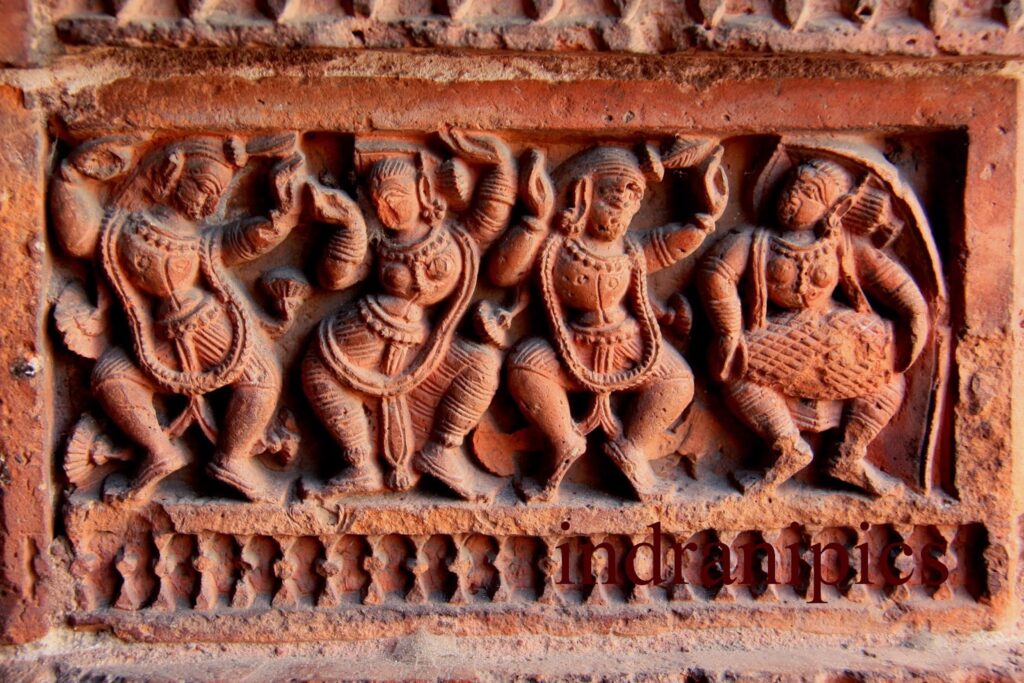
Dancing Figures on terracotta panel
Nearby Attractions
- The Hangseswari Temple stands immediately adjacent and is worth visiting in the same trip. Its lotus-shaped towers and tantric architectural symbolism offer a sharp visual contrast to Ananta Basudeba’s terracotta tradition.
- The Swanbhaba Kali Temple, also in the area, can round out a half-day heritage circuit covering three distinct periods and traditions of Bengal’s sacred architecture.
FAQ about Ananta Basudeba Temple
Is there an entry fee for the Ananta Basudeba Temple?
No. Entry to the temple complex is free. There are no charges for visiting either the Ananta Basudeba Temple or the adjacent Hangseswari Temple.
What are the temple timings?
The temple is generally open from 6 AM to 6 PM daily. During major festivals, timings may extend. It is worth checking locally if you plan to visit during a significant religious occasion.
How do I reach Bansberia from Kolkata?
Take a train from Howrah on the Howrah–Katwa line to Bansberia station. Local cycle-rickshaws and auto-rickshaws are available just outside the station for the short ride to the temple complex. Alternatively, travel to Bandel Junction and hire an auto-rickshaw from there.
Is photography allowed?
Yes. Photography of the terracotta panels and the temple exterior is permitted. Avoid tripods and flash inside the sanctum.
What other attractions are nearby?
The Hangseswari Temple, notable for its unusual lotus-shaped towers, is directly adjacent. The Swanbhaba Kali Temple is also within easy reach, making a combined visit to all three feasible in a single half-day.
Why is the Ananta Basudeba Temple historically significant?
Built in 1679 by Raja Rameswar Datta, the temple is one of the better-preserved examples of the Eka-ratna terracotta tradition in the Hooghly region. Its panels document both Vaishnava devotional themes and aspects of 17th-century Bengali social life, giving it value beyond its religious function.
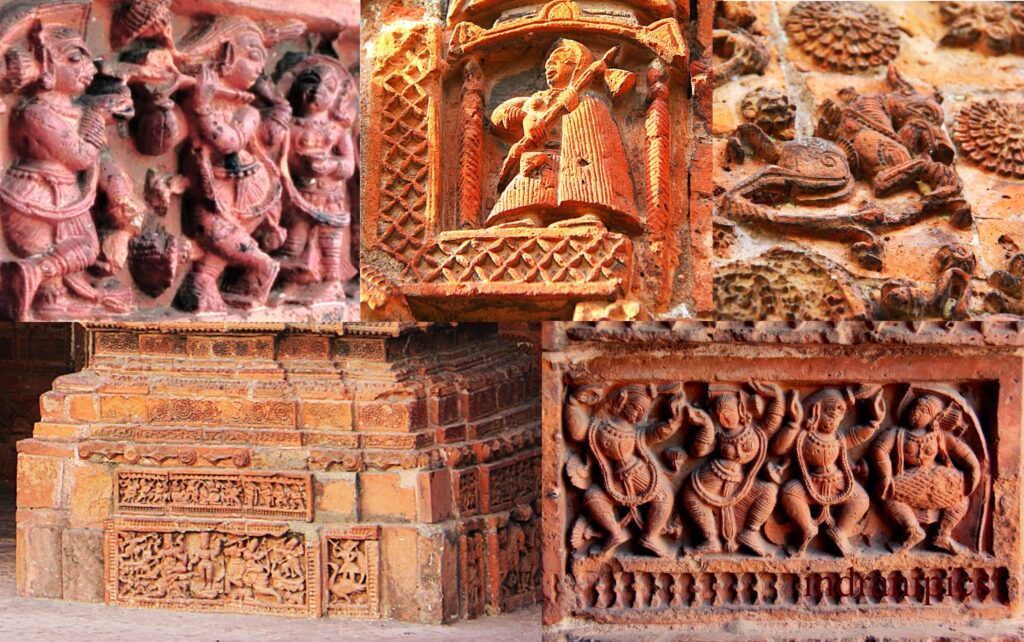
Terracotta Panels with various themes of sculptures
The Current State of Preservation
When I visited the Ananta Basudeba Temple, the passage of time was evident. Some terracotta panels showed erosion, with softened details from centuries of weathering. Unfortunately, graffiti and scribblings by visitors were also visible—a common issue at heritage sites that damages the very surfaces people come to admire.
I was happy to see the conservation work during my visit. The Archaeological Survey of India (ASI) was supervising restoration, focusing on stabilizing eroded sections rather than cosmetic overpainting. This careful approach ensures the temple’s authenticity is preserved while halting further deterioration.
For visitors, this is an important reminder: the temple is a living heritage site under active conservation. Treat the surfaces with respect—avoid touching the panels or adding to graffiti. The terracotta you see today has survived for over 340 years, and its future depends in part on how responsibly we engage with it now.
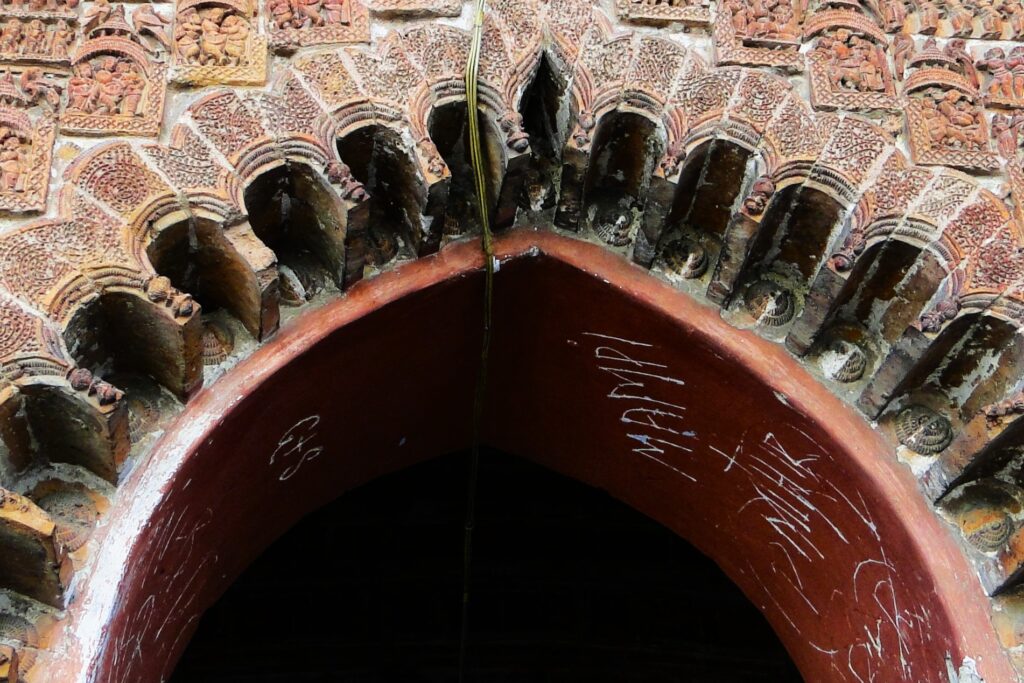
Defaced walls and Arches of the temple
My Final Thoughts
Visiting the Ananta Basudeba Temple in Bansberia is more than a heritage stop—it’s a journey into Bengal’s layered past. Built in 1679 by Raja Rameswar Datta, the temple stands as a living monument to Vaishnava devotion and terracotta artistry. Its Eka‑ratna architecture, curved cornices, and intricate panels narrating epics, Krishna Leela, and everyday life make it a rare cultural archive in clay.
I could see a classical terracotta shrine just beside the lotus‑towered Hangseswari Temple within one complex, the Bansberia temple complex, and that made the experience so richer. A complex that reflects centuries of architectural evolution. For travelers, photographers, and heritage enthusiasts, Ananta Basudeba offers both spiritual resonance and visual delight.
Having explored the temple first hand, I can say it rewards slow observation—every panel reveals a story, every curve echoes tradition. If you’re planning a heritage trail in Hooghly, this temple deserves a prominent place on your West Bengal itinerary.
Pin and Save this for Later
About the Author
 Indrani Ghose is a cultural travel writer and heritage documentation specialist with over 15 years of experience exploring and writing about temples across India and Southeast Asia. Having visited over 150 sacred sites, she brings both scholarly depth and personal narrative to heritage travel writing.
Her work has been published in Lonely Planet, The National (UAE), Whetstone Asia, Deccan Herald, and various architecture and heritage journals.
Connect with Indrani: Follow Indrani on Instagram | Twitter | Facebook for heritage travel insights, photography tips, and offbeat destination discoveries.






Hari OM
what a beauty this is – Love the shots through the walkway…well all of the really! YAM xx
nice place to visit…I guess I've to stop taking leaves from office as of now and have to start visiting such places once I have them in sufficient number…
Amazing. I remember — the first time I heard of Terracotta architecture, I was so amazed.
I'm wondering — is it only in West Bengal that you find Terracotta temples?
What treasures we have all over India! Beautiful pictures, as always.
Lovely 2 learn about this Indrani.
There is an Ananta Basudev Temple at Bhubaneswar too 🙂
I feel sad to see the negligence we show for these exquisite monuments. These should have been taken utmost care as a heritage. I liked the photography plus the historical story you shared through this post.
Such beautiful terracotta work! Thanks for sharing!
I love the earth tones of this temple and the art blows me away.
Always intrigued by the rich color and the sculpted figures.
I love the angle of the picture through the entrance. Such amazing architecture. Indrani you always find something in the temple to make it different from the others, though most of them are pretty same. You sure have eyes that are really sharp.
i am a big sucker for all the temples and the carvings in the temple. love them.
I always enjoy seeing the architecture from different parts of the world. Really beautiful!
Beautiful temple and awesome carvings and your captures are superb as always, Indrani! I do love the detail you capture!! Hope you have a great week!!
Real sharp corners inside, but the terra cota work is superb.