Ultimate Guide to Chennakesava Temple, Somanathapura: A Hoysala Masterpiece
The Chennakesava Temple at Somnathapura stands as one of India’s most precisely executed architectural achievements. Built in 1258 CE by Somanatha Dandanayaka, a commander under the Hoysala king Narasimha III, this temple demonstrates what happens when geometry, devotion, and craftsmanship converge.
Located 35 km east of Mysuru on the banks of the Kaveri River, it earned UNESCO World Heritage status in 2023 as part of the “Sacred Ensembles of the Hoysalas.” The temple’s star-shaped platform, mirror-perfect symmetry, and thousands of hand-carved soapstone sculptures make it essential viewing for anyone interested in medieval Indian art.
I last visited in February 2022 (my third visit), and the experiences fundamentally changed how I understand Hoysala architecture.
— Indrani Ghose, travel blogger | Updated Feb 2026

Chennakesava Temple at Somnathapura
Quick Facts on Somanathapura Temple Mysore
| Feature | Details |
| Official Name | Chennakesava Temple (Keshava Temple) |
| Location | Somanathapura, Mysore District, Karnataka |
| Constructed In | 1258 CE (13th Century) |
| Built By | Somanatha Dandanayaka (General under King Narasimha III) |
| Architectural Style | Hoysala Architecture (Trikuta Style) |
| UNESCO Status | World Heritage Site (Inscribed 2023) |
| Deities | Keshava (Missing), Janardhana, & Venugopala |
| Primary Material | Chloritic Schist (Soapstone) |
| Entry Timings | 9 AM – 5.30 PM (Open daily) |
| Distance from Mysore | Approximately 38 km (1-hour drive) |
.

Chennakesava Temple on raised star shaped platform Somanathapura Mysore
Why Somanathapura is the Pinnacle of Hoysala Architecture
The Chennakesava Temple at Somnathapura is often regarded as the finest expression of Hoysala architecture because it distills the dynasty’s defining qualities—geometry, symmetry, and intricate ornamentation—into a perfectly balanced whole.
Unlike the larger complexes at Belur and Halebidu, Somnathapura presents a compact yet complete vision of Hoysala artistry. Its trikuta (three-shrine) plan rises on a stellate platform, reflecting the Hoysalas’ fascination with star-shaped layouts that create constantly shifting visual perspectives.
The temple’s soapstone carvings are exceptionally precise. Bands of sculpture narrate episodes from the Ramayana, Mahabharata, and Bhagavata Purana, interwoven with dancers, musicians, animals, and warriors. The soft stone allowed sculptors to achieve remarkable depth and fluidity, and as it hardened over time, the details were preserved with extraordinary clarity.

540 elephants in the lowermost part of the horizontal band
Compared to Belur’s emphasis on decorative pillars and Halebidu’s monumental sculptural panels, Somnathapura stands out for its coherence and symmetry. The temple feels complete—almost like a visual compendium of Hoysala art—making it especially rewarding for close study and photography.
Set amid the quiet Kaveri landscape, the site’s calm atmosphere enhances the experience, allowing visitors to engage with the carvings at intimate range. Somnathapura is therefore not merely another Hoysala monument, but a distilled masterpiece that presents the dynasty’s architectural philosophy in its most refined form.

Rows of Elephants and horses in the lowermost part of the horizontal band
The Stellate (Star-Shaped Plan)
The Chennakesava Temple is built on a stellate, or star-shaped, platform—a hallmark of Hoysala design. This geometric innovation creates multiple projecting angles, giving the temple a dynamic appearance from every viewpoint. Instead of a simple square or rectangular base, the star-shaped plan allows the outer walls to be richly carved with continuous friezes and sculptures.
Walking around the temple, visitors notice how the projections and recesses catch sunlight differently, highlighting carvings at various times of the day. This design was not only aesthetic but also symbolic, representing cosmic order and divine geometry.
The trikuta layout (three sanctums) further enhances the symmetry, with each shrine radiating from the central hall. For photographers, the stellate plan offers endless angles and perspectives, making Somnathapura one of the most visually rewarding temples in Karnataka.

Star shaped platform of Chennakesava Temple at Somnathapura
Soapstone Magic (How 13th-Century Artisans Carved Details)
The temple’s intricate detailing owes its brilliance to soapstone, a soft material that artisans could carve with precision before it hardened over time. In the 13th century, Hoysala sculptors used soapstone to achieve lifelike expressions, delicate jewelry patterns, and even the folds of garments.
Scenes from Hindu epics are etched into the walls with astonishing clarity—horses mid-gallop, dancers frozen in graceful poses, and deities adorned with elaborate crowns. The artisans worked layer by layer, polishing the stone to create a metallic sheen that still surprises visitors today.
Unlike granite, soapstone allowed for minute detailing, which explains why Somnathapura’s carvings remain sharp even after centuries. For heritage travelers, understanding this material adds depth to the experience: it was not just artistry, but also engineering foresight that made the temple timeless.

Facade of Shikhara of Chennakesava Temple Somanathapura
Key Features to Witness: The Trikuta Structure
The Chennakesava Temple functions as a trikuta (three-shrine) structure, housing three sanctums dedicated to different manifestations of Vishnu: Keshava, Janardhana, and Venugopala. This tripartite layout represents a mature Hoysala architectural convention that balances theological completeness with spatial efficiency—devotees can worship multiple divine forms without leaving a single sacred complex.
Keshava Sanctum (Central Shrine)
The central sanctum originally enshrined Lord Keshava, the primary deity, but the idol disappeared centuries ago—likely during 14th-century invasions following the Hoysala dynasty’s decline. Historical records from the Mysore Archaeological Survey suggest the idol was either looted or destroyed during conflicts with the Delhi Sultanate forces that swept through Karnataka after 1310 CE.
Despite this absence, the sanctum remains architecturally significant. The doorway (mahadwara) features five decorative bands (shakhas) depicting makaras, scrolling vines, and Vishnu’s dashavatara (ten incarnations).
The inner walls carry relief panels showing Vishnu’s cosmic forms—Anantashayana (reclining on the serpent), Vaikuntha (four-armed), and Varaha (boar incarnation rescuing Earth).
When I visited, a priest explained that devotees still circumambulate the empty garbhagriha, treating the architectural space itself as sacred.

Deities of Chennakesava Temple in Somnathapura
Janardhana Sanctum (Northern Shrine)
Located to the left when facing the temple, this shrine houses Janardhana—Vishnu in his role as humanity’s protector and sustainer. The surviving idol stands approximately 1.5 meters tall, carved from black stone rather than soapstone, suggesting it may predate the temple’s construction or was imported from another site.
The sculpture depicts Janardhana with four arms holding shankha (conch), chakra (discus), gada (mace), and padma (lotus). The detail work on the kiritamukuta (crown) and hara (necklace) demonstrates exceptional metalworking knowledge translated into stone. Notice how the idol’s feet rest on a lotus pedestal with individually rendered petals—a signature Hoysala detail.
Venugopala Sanctum (Southern Shrine)
The right sanctum contains Venugopala—Krishna as the divine flute player. This idol captures Krishna in tribhanga (triple-bend) posture, playing the venu (flute) with visible finger placements that correspond to classical Carnatic positions. The pastoral iconography contrasts sharply with Janardhana’s martial bearing, demonstrating Vishnu’s theological range.
The Venugopala sculpture has become the temple’s most photographed element. The idol’s smile appears differently depending on viewing angle—straight-on it looks serene, from the side slightly mischievous. This optical effect likely resulted from the sculptor working from multiple perspectives. Paint traces in protected crevices, suggest the entire temple was once polychromed.
The Navaranga (Central Hall)
These three sanctums radiate from a common navaranga (nine-bay hall) with lathe-turned pillars that show tool marks from 13th-century woodworking techniques translated into stone. I touched them and the texture of the chloritic schist (soapstone) felt smooth and cold in spite of the scorching heat outside.
The hall’s interconnected layout allows ritual circumambulation of all three deities simultaneously—an architectural innovation that reduced redundant movement in worship sequences.

Three shikhara and 16-pointed star patterns of Chennakeshava Temple Somnathpura
16 Unique Ceiling Designs
Above the navaranga, 16 ceiling panels display distinct compositions—evidence that Hoysala workshops assigned different artisan teams to each section. During my visit, I documented all 16 using a wide-angle lens at f/8 to capture depth. The designs include:
- Lotus medallions with concentric petal layers (northwest corner)
- 16-pointed star patterns showing geometric precision (above Keshava doorway)
- Apsara dancers in circular frames with flowing scarves (northeast bay)
- Yali-makara hybrids (mythical creatures) in spiral compositions (western bay)
- Floral vines radiating from central rosettes (southern bay)
- Concentric circles housing miniature Vishnu avatars (eastern bay)
- Gandharva musicians playing veena and mridangam (above entrance)
- Sudarshana chakra motifs with flame patterns (central bay)
- Interlaced diamond grids creating optical depth (northern bay)
- Garuda figures mid-flight carrying Vishnu (above Janardhana sanctum)
- Mandala diagrams representing cosmic order (above Venugopala sanctum)
- Elephant processions with mahouts (southwestern corner)
- Navagraha panels (nine planetary deities) in miniature (south-eastern bay)
- Lotus ponds with fish and waterfowl (western entrance)
- Vine scrollwork with parrots and peacocks (northern entrance)
- Geometric tessellations combining squares and hexagons (southern entrance)
Each ceiling required an estimated 200-400 hours of carving time. Use a flashlight or phone light to illuminate recessed details—the play of shadow reveals three-dimensional depth invisible in ambient light alone.

Lotus Buds on Ceilings inside Chennakesava Temple

Star shaped outline around floral buds in ceiling inside Chennakesava Temple carved in granite
Somnathapura vs. Belur and Halebidu: Which Should You Visit?
The three major Hoysala temples serve different traveler priorities, and understanding these distinctions helps you allocate time effectively. If visiting all three isn’t feasible, match the temple to your primary interest.
Belur (Chennakesava Temple, 1117 CE)
This remains an active worship site, meaning you’ll experience living Hindu ritual alongside architectural study. The Narasimha pillar—a single stone shaft carved with 40+ figures—represents Hoysala technical achievement at its peak. Belur’s madanikas (bracket figures) show women in 42 distinct poses, each capturing a different moment of daily life or dance.
However, active worship means restricted photography angles, dress codes (no shorts/sleeveless tops), and festival crowds that can number thousands during Maha Shivaratri or Vaikuntha Ekadashi.
Halebidu (Hoysaleswara Temple, 1121 CE)
The largest Hoysala construction presents twin shrines on a massive platform with 240+ meters of continuous frieze work. The scale allows epic narrative sequences—entire Ramayana chapters unfold across single walls.
Halebidu suffered deliberate defacement during 14th-century invasions; many deity faces were chiseled off, and the planned superstructures (shikharas) were never completed. This incompleteness makes it valuable for understanding medieval construction sequences, but the damaged sculptures can feel less emotionally engaging than intact work.
Somnathapura (Chennakesava Temple, 1258 CE)
Built last, Somnathapura synthesizes lessons from both predecessors into a compact, complete form. Its non-active status (managed by ASI, not temple authorities) means unrestricted access, no dress codes, and permission to use tripods.
The preservation quality exceeds both Belur and Halebidu—you can see individual chisel marks and original polishing patterns. The smaller footprint (roughly 10×10 meters per shrine) concentrates exceptional work into a walkable circuit.

Idol of Chennakesava in Somanathapura Mysore
Comparison Table of Somnathapura, Belur, Halebidu Temples
| Feature | Somnathapura | Belur | Halebidu |
| Construction Date | 1258 CE | 1117 CE | 1121 CE |
| Size | Compact trikuta (3 shrines) | Large single shrine | Monumental twin shrines |
| Preservation | Excellent—90%+ carvings intact | Very good—active maintenance | Partial—visible invasion damage |
| Crowd Levels | Low (50-200 daily visitors) | High (500-2,000+ on weekends) | Moderate (200-500 daily) |
| Active Worship | No (ASI monument) | Yes (living temple) | No (ASI monument) |
| Photography | Unrestricted, tripods allowed | Restricted angles, no tripods | Unrestricted |
| Best For | Detail study, photography | Devotional experience, pillars | Scale, narrative friezes |
| Time Needed | 2-3 hours | 3-4 hours | 3-4 hours |
| Distance from Mysuru | 35 km (45 min) | 220 km (4 hours) | 220 km (4 hours) |
Decision Framework: Choose Somanathapura for intimacy and photographic access. Select Belur for spiritual atmosphere and the finest single pillar in Hoysala art. Pick Halebidu for monumental scale and understanding historical context.
Ideally, visit all three across 2-3 days—they represent beginning, middle, and culmination of Hoysala architectural evolution.

64 cells around Chennakeshava Temple – small Basadis or temple rooms built encompassing the wall
Practical Traveler’s Intel (2026 Updated)
Somanathapura’s 2023 UNESCO World Heritage inscription as part of “Sacred Ensembles of the Hoysalas” brought infrastructure improvements that enhance the visitor experience while maintaining site integrity.
Getting There
From Mysuru (35 km, 45 minutes): Take State Highway 33 through T. Narasipur. KSRTC operates hourly buses (₹40) from Mysuru City Bus Stand to Somnathapura village; alight at “Keshava Temple” stop.
Private taxis cost ₹800-1,200 round-trip with 2-hour waiting time. Ride-sharing apps (Ola/Uber) function reliably on this route as of 2026.
From Bengaluru (135 km, 2.5 hours): Drive via NH275 and SH17. No direct buses exist—travel to Mysuru first, then transfer.
Organized tours from Bengaluru typically combine Somnathapura with Srirangapatna and Mysuru Palace as a day circuit. You can visit the Chamundeshwari Temple, Ranganathittu Bird Sanctuary and St. Philomena Cathedral from here.
Entry and Timings
The Archaeological Survey of India manages ticketing. Hours: 9 AM to 5.30 PM daily (no weekly closures). Entry fees (2026 rates): ₹40 Indians, ₹600 foreigners. Students with valid ID receive 50% discounts. Tickets include access to the small site museum displaying recovered sculptures and inscriptional records. Audio guides (₹100 rental) are available in English, Kannada, and Hindi.
Best Time to Visit for Photography
Seasonal: October through March offers 22-28°C temperatures and dry conditions. Avoid June-September monsoons—waterlogged grounds restrict access to certain exterior walls.
Daily timing: Arrive 9 to 10 AM when eastern and southern facades receive direct sunlight at 45-60° angles, ideal for revealing carved depth. The 24-pointed stellate plan means different walls peak throughout the day.
Western facades photograph best 4 to 5 PM. Overcast days actually work well—diffused light eliminates harsh shadows that can obscure fine details.
On-Site Experience
The non-active temple status means no ritual schedules, dress codes, or restricted zones. You can touch walls (gently) to feel tool marks, use flash photography, and access all exterior circumambulatory paths. Guards patrol to prevent vandalism but don’t restrict movement. The small scale (10-minute walk around perimeter) allows multiple circuits studying different frieze bands each time.

Food being taken for Bakasura on a bullock cart – scene from Mahabharata
Facilities and Logistics
Available: Paved parking (₹20 for cars), clean restrooms, drinking water, small refreshment kiosk selling packaged snacks and cold drinks. Shaded benches positioned around the exterior offer rest points.
Not available: Full meals—nearest restaurants are in T. Narasipur (8 km) or Mysuru. No accommodation exists in Somnathapura village; stay in Mysuru and visit as a day trip.
Accessibility: The site is wheelchair-accessible via paved paths to the main platform, though interior stairs prevent sanctum access for mobility-limited visitors.
Heritage Compliance
UNESCO site rules prohibit drones without ASI permission (₹5,000 application fee, 2-week processing). Tripods and monopods are permitted. Don’t touch deity sculptures directly or climb on platforms. The soft soapstone damages easily—ASI installed subtle barriers around high-risk carvings after 2024.
Local context: Somnathapura village (population ~3,000) depends partly on heritage tourism. Hiring local guides (₹300-500 for 90-minute tours) supports community stakeholders while providing oral history unavailable in signage.

One of the 16 pillars, each had different designs and different repetitive patterns
Missing Keshava Idol History
The central Keshava sanctum stands empty—the most historically significant absence in Hoysala temple architecture. While the flanking Janardhana and Venugopala idols remain intact, the primary deity disappeared sometime between 1310-1330 CE during Delhi Sultanate incursions into southern Karnataka.
Historical accounts from the Mysore Gazetteer (1927) note that Muhammad bin Tughlaq’s forces swept through the region in 1327 CE, targeting prominent Hindu temples. Somnathapura’s remote location likely saved its architectural fabric, but the central idol—being the most valuable and symbolically important—was either looted for its materials or destroyed as iconoclasm.
The empty garbhagriha creates an unusual visitor experience. Without an active deity, the temple functions purely as an ASI monument, allowing unrestricted access but eliminating devotional atmosphere. The carved doorway remains—its five bands depicting Vishnu’s dashavatara—but the absence shifts focus entirely to architectural study rather than worship.

Damaged statues in Somanathapura Temple Mysore
Expert Tips and Planning
The Shadow Play Timing: Best Hour for Viewing Carvings
Visit between 10 to 11 AM to see the Ramayana friezes at their most dramatic. During this window, angled sunlight strikes the southern wall carvings, creating shadows that emphasize the three-dimensional relief work—warriors’ musculature, chariot wheels, and layered battle formations become distinctly visible.
The morning shadow contrast reveals depth that’s otherwise difficult to perceive, particularly in panels depicting the Rama-Ravana battle and Hanuman’s leap to Lanka. This natural lighting effect lasts approximately 45 minutes before the sun shifts overhead.
Photographers should use this hour for detail shots without needing flash or artificial lighting, which is prohibited inside the temple complex.
During my March 2017 visit, I observed this effect on the southern prakara wall—the difference between 10.30 AM and 1 PM viewing was striking, confirming this as the optimal photography and appreciation window.
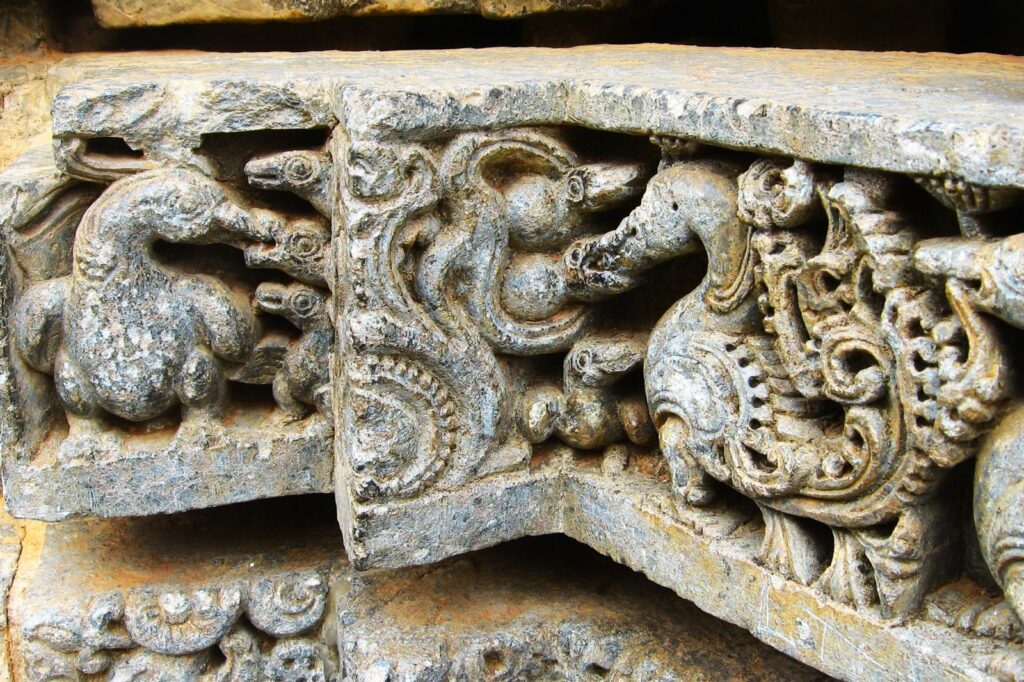
Bird feeding chicks – sculpture on horizontal band of the temple base
Half-Day Circuit: Somnathpur + Talakadu (4 Hours)
For travelers combining heritage sites with natural landscapes, this route covers two distinct destinations in one morning:
Hour 1–2: Somnathpur (Chennakesava Temple)
- Arrive by 8 AM to avoid crowds and heat
- Walk clockwise around the trikuta (three-shrine) structure, examining friezes on each wall
- Focus on southern wall carvings between 10 to 11 AM for shadow detail
- Allow 15–20 minutes inside each garbhagriha (sanctum)
Hour 3: Drive to Talakadu (25 km, 35-minute drive)
- Travel via Bannur Road toward Talakadu, a town known for sand dunes formed by historical Kaveri floods
- Visit Vaidyanatheshwara Temple (Panchalinga Darshana site), partially submerged in sand
- Brief walk through the “desert landscape” unique to this region
Hour 4: Kaveri Riverside Break
- Stop at Kaveri riverbank viewpoints near Talakadu
- Local vendors sell coconut water and snacks
- Return route: Talakadu → T. Narasipura → Mysuru (45 km, 1 hour) or direct to Bengaluru (150 km, 3 hours via SH 17)
Best For: Weekend travelers from Bengaluru or Mysuru seeking a UNESCO heritage site plus offbeat natural scenery in a single compact trip. Start by 8:00 AM to complete the circuit by noon.
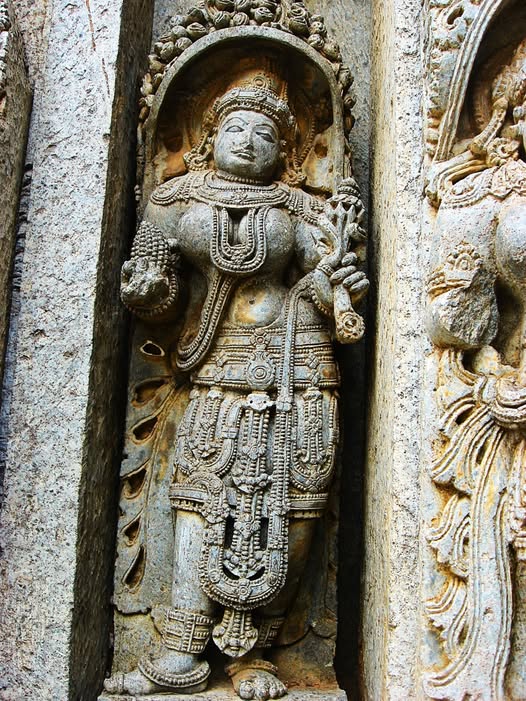
Notice the detailed ornaments on the statue
FAQ about Chennakesava Temple, Somnathapura
Q1: Why is the Keshava Temple at Somnathapura no longer a “living” temple?
Unlike the temple at Belur, the idols at Somnathapura were damaged and desecrated during 14th-century invasions (notably by Malik Kafur and Muhammad Bin Tughlaq). According to Hindu tradition, a broken or Khandita idol cannot be used for formal worship, which is why no daily rituals are performed here today.
Q2: What happened to the original Keshava idol?
The main Keshava idol in the western sanctum went missing after historical raids. While a replacement was installed during the Vijayanagara era, it lacks the legendary craftsmanship of the original Hoysala masters. Visitors can still see the original, beautifully preserved idols of Janardhana and Venugopala in the other two shrines.
Q3: Who was the lead architect of the Somnathapura temple?
The temple is credited to the master sculptor Ruvari Malithamma. He was one of the most prolific artists of the Hoysala era, and you can still find his signature carved at the base of several sculptural panels—a rare practice in ancient Indian history.
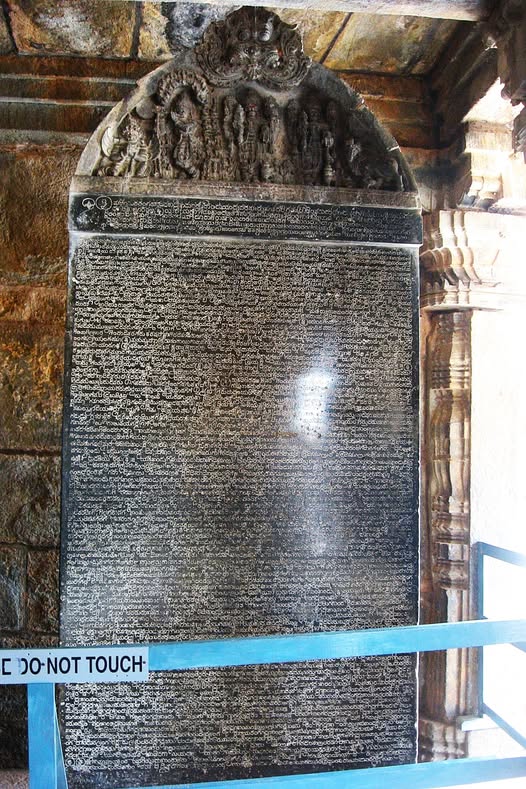
Inscription that mentions master sculptor Ruvari Malithamma
Q4: Is there an entry fee for the Chennakesava Temple in 2026?
Yes. As an ASI-protected site and UNESCO World Heritage monument, the current entry fee is ₹25 for Indian citizens and ₹300 for foreign nationals. Digital payment via QR code is preferred at the entrance.
Q5: How does Somnathapura Temple differ from Belur and Halebidu temples?
While all three belong to the “Sacred Ensembles of the Hoysalas,” Somnathapura is unique because it is a Trikuta (triple-shrine) temple that is perfectly symmetrical and complete with its original stone towers (Shikharas). Belur and Halebidu are larger but either lack towers or have a single-shrine focus.
Q6: How can travelers reach Somnathapura?
It is located about 35 km from Mysuru and 135 km from Bengaluru. Road travel via taxi or bus is the most convenient option for a day trip.
Q7: What is the best time to visit Somnathapura for photography?
October to March offers pleasant weather and soft sunlight. Morning light enhances the eastern walls, while late afternoon highlights the western friezes, making it perfect for detailed photography.

Final Thoughts
The Chennakesava Temple at Somnathapura is more than just a monument—it is a living testimony to the brilliance of Hoysala architecture. From its trikuta layout and star‑shaped platform to the missing Keshava idol that sparks curiosity, every detail tells a story of devotion, artistry, and resilience.
Compared to Belur and Halebidu, Somnathapura offers a quieter, more intimate experience, making it ideal for travelers who want to study carvings closely or capture them through photography. With its UNESCO World Heritage status, the temple is now firmly on the global heritage map, ensuring its preservation for generations to come.
For heritage enthusiasts, photographers, and cultural travelers, Somnathapura is not just a stop—it is a destination that deepens your understanding of medieval Karnataka and the timeless legacy of the Hoysalas.
Pin this for later
About the Author
 Indrani Ghose is a cultural travel writer and heritage documentation specialist with over 15 years of experience exploring and writing about temples across India and Southeast Asia. Having visited over 150 sacred sites, she brings both scholarly depth and personal narrative to heritage travel writing.
Her work has been published in Lonely Planet, The National (UAE), Whetstone Asia, Deccan Herald, and various architecture and heritage journals.
Connect with Indrani: Follow Indrani on Instagram | Twitter | Facebook for heritage travel insights, photography tips, and offbeat destination discoveries.






Oh, Indrani..You have left so much for me to catch up…
Will read over the weekend..Nice pictures, anyway.
devika
first two blogs updated.
These are just incredible shots of some wonderful architecture. You’ve captured it beautifully, as always.
This temple kindled my interest in Hoysalas and I went on the trail including 30 temples..had posted it in my earlier blog , but been wanting to do another post on it..unfortunately ,my pics are analog ..yours are splendid..and they are a reminder that my hoysala trail is long overdue
a country rich in cultural history as yours is really worth sharing. at least, we don’t need to spend to travel and see them anymore. and this is one of the finest things in blogging! thank you indrani!
and thanks for dropping by my site again. have a great weekend!
thoroughly fascinating pics – what intricate work on the walls! i must agree it is superb!!
I have been here 2 years back, and i think this temple is better maintained than bellur and halebidu or may be here the damage done was less. But the approach roads was bad and i heard that it is still the same.
so much like belur halebid! thank you so much for introducing somnathpur. have put it on my must visit list now!
What details are you exactly looking for? You can mail me. indranidotghatgmaildotcom. 🙂
Your photos of Asian architecture are always fabulous.
Great review about the temple and it structure look very attractive and awesome. Moreover can you share the experience in more details with me.
I thought the pictures from the inside turned out rather well, while not extremely sharp. That piper in the dark was my favourite from these.
i remember we went to this place for a schoool trip, how fun it was!! I guess u have captured my memories of the place perfectly for me to reconstruct it! Absolutely beautiful. 🙂
Congrats to Indrani, Mallithama, Masanthamma, Chameya, Bhameya for
their works :))
The Temple looks superb. In these days when people head for Theatre
complexes, you are unusual..!!!!
the details r so intricate. the craftsmen mus b very skilled
great pics and interesting anecdotes.
Somnathpur or Somanathapura temple architecture belong to the Hoysala style architecture of Belur or Belooru and Halebid or Halebeedu. Hence the carvings look similar. These temples stand as testament to the glorious days of Karnataka emergence as a nation (the term nation here indicates a cultural group) Hoysala kings in some respect can be compared to Chola Kings in the way they encouraged architecture and arts. This is not surprising as Hoysalas emerged after the decline of the Chola dynasty and the influence of the latter cannot be underestimated. Indeed, if one could take time to study the architecture, particularly the carvings at Brihadeeswarar temple at Tanjore and compare the style of those in Belooru, Halebeedu and Somanathapura, one can feel as if a further chapter was added. Ofcourse, the carving material is softer in Hoysala architecture thus producing finer details. It was said this exercise took decades to accomplish.One significant aspect of this Hoysala architecture was that the architects and sculptors left their signatures or names on stone slabs.
Every primary school Kannada texts in those days (1950s) had pages of these pictures and description of Hoysala dynasty. Belooru, Halebbedu and Somanathapura were the essentials on every school trips. A compendium called ‘Mysooru Kaipidi’ ( Mysore handbook) was a source often referred to
in our classes those days.
OMG, the pictures are wonderful. The architecture, the intricate carvings, detail are all marvellous.
Excellent pics, Indrani.
Can you try to visit a temple in Belur campus of NAL? It’s quite ancient, and you can find similar inscribed stones there.
Wow gorgeous building those design speak really the artistic ability of your people even in olden days..Lovely..
Those are all great shots and a very interesting post. I love the detail you showed us in these photographs.
I”m blown away by craftmanship.
Magnifique cette architecture, on dirait de la dentelle ces sculptures…
Indrani, so good.
The architecture and the intricate carvings are remniscent of the Belur temple – which also I have seen only in pictures.
Thanks for the information too. Your guide seems to have know his stuff. 🙂
Hello !
You have great pictures of the temple !
Belle promenade à effectuer !
oh wow! these are gorgeous pics! i love anything and everything about architecture! 🙂 thanks for sharing these! 😀