The Star of Amruthapura: A Guide to the Amrutheshwara Temple (Road Trip Story)
Discovering the Amrutheshwara Temple Amruthapura
In June 2017, during my road trip from Bangalore to Jog Falls, I made an unplanned stop at the quiet village of Amruthapura near Tarikere in Chikmagalur district. After a brief halt at Yoga Narasimha temple in Baggavalli what started as a short detour turned into one of the most memorable discoveries of my journey—a 12th-century architectural marvel that rarely appears on standard tourist itineraries.
The Amrutheshwara Temple sits approximately 20km from Tarikere town, accessible via a well-maintained state highway. As I approached the temple complex, the first thing that caught my attention was its distinctive star-shaped platform (technically called a stellate plan)—a signature feature of mature Hoysala architecture.
– By Indrani Ghose | Last Updated: January 2026
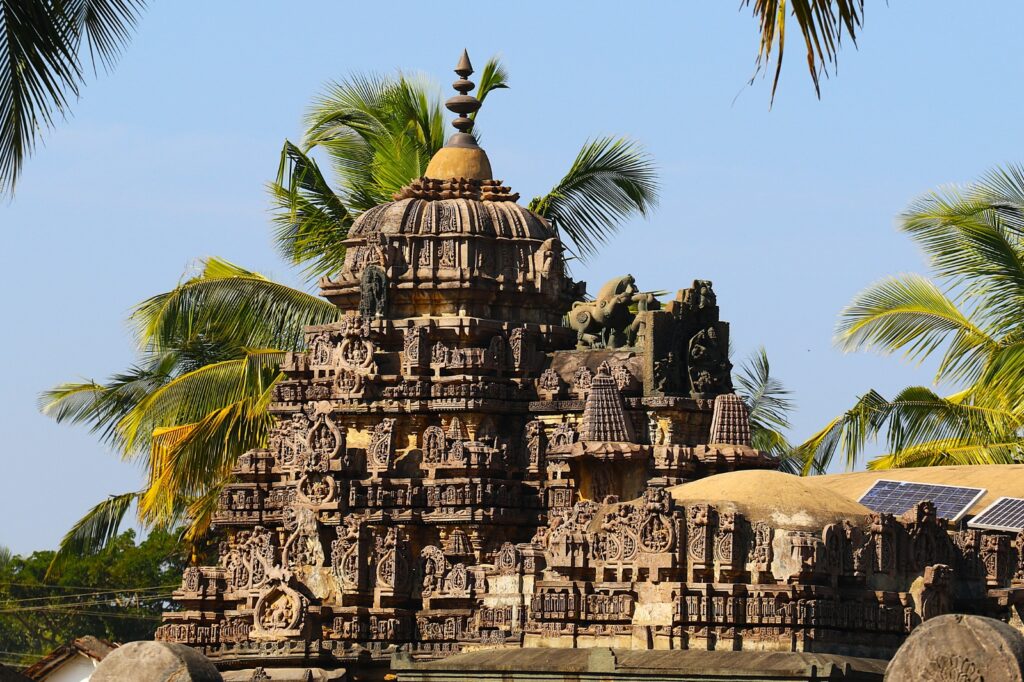
Sri Amrutheshwara Temple Open Timings 6 AM to 6 PM
Speciality of Amrutheshwara Temple
Built in 1196 CE during the reign of Hoysala King Veera Ballala II, the Amrutheshwara Temple showcases the architectural sophistication that made this dynasty famous across South India.
The temple’s exterior walls were covered in intricate carvings, each panel telling stories from Hindu epics with remarkable detail. What makes this temple particularly special is its anti-clockwise narrative sequence of Ramayana carvings—a rare feature that sets it apart from other Hoysala temples.
Unlike the crowded heritage sites of Belur or Halebidu, Amruthapura offers visitors a chance to experience Hoysala craftsmanship in relative solitude, making it an ideal stop for travelers seeking authentic cultural encounters along the Bangalore-Jog Falls route.
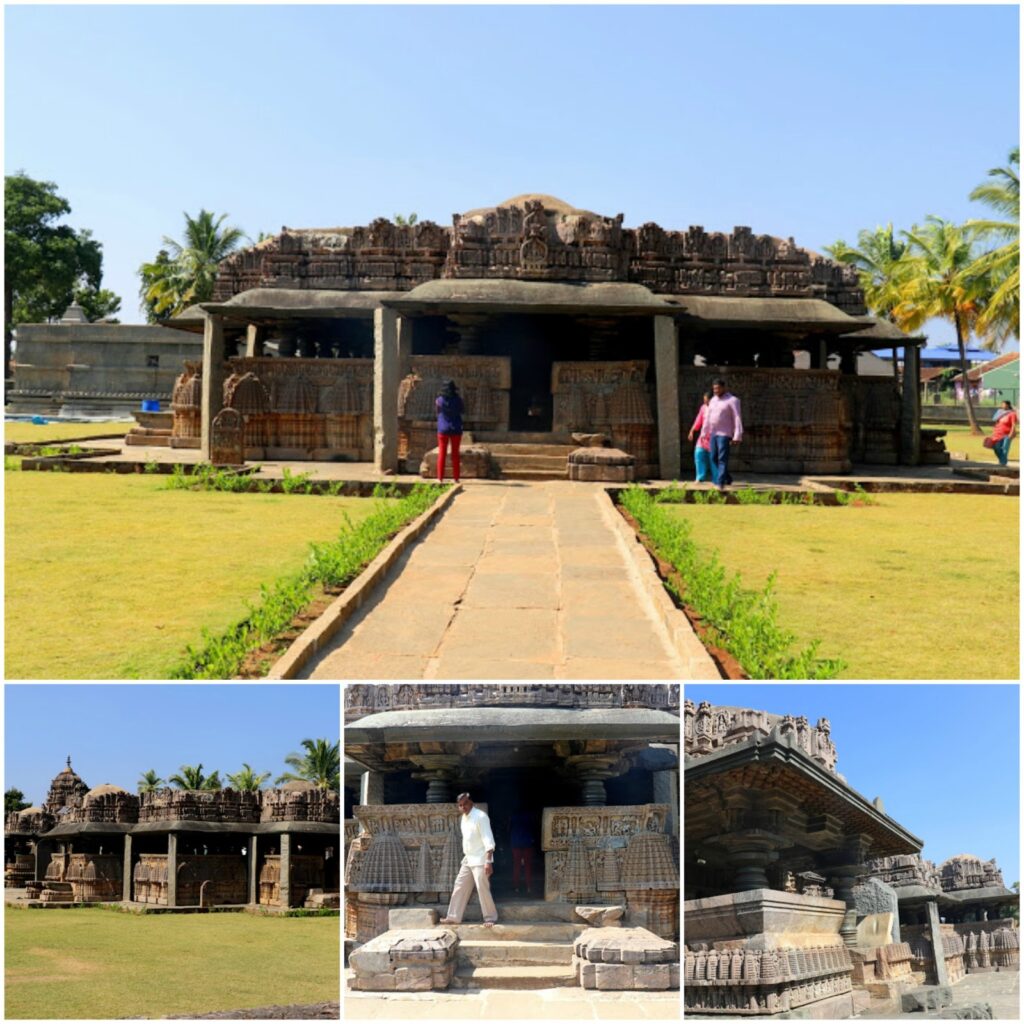
Amrutheshwara Temple maintained by ASI
The Legacy of King Veera Ballala II and Amrutheshwara Dandanayaka
The Amrutheshwara Temple was commissioned in 1196 CE by Amrutheshwara Dandanayaka, a military commander (Dandanayaka translates to “commander of forces”) serving under Hoysala King Veera Ballala II. This period, spanning roughly 1173–1220 CE, represents the golden age of Hoysala architecture, when the dynasty controlled large parts of present-day Karnataka and invested heavily in temple construction.
Veera Ballala II is credited with expanding Hoysala territories and patronizing arts, literature, and religious institutions. The temple at Amruthapura reflects this dual emphasis on military strength and cultural refinement—commissioned by a warrior but executed with artistic precision.
The temple’s connection to cultural luminaries adds another layer of historical significance. Janna, one of the most celebrated poets in Kannada literature, was active during this era and had associations with the Hoysala court.
More directly linked to Amruthapura is Ruvari Mallitamma, a master sculptor who began his career working on this temple. Mallitamma would go on to become one of the most prolific Hoysala sculptors, and his artistic style—characterized by detailed ornamentation and dynamic figure composition—can be traced back to his early work at Amrutheshwara.
The temple’s walls function as visual narratives, displaying elaborate panels from the Ramayana and Mahabharata. These aren’t merely decorative elements; they serve as educational tools that made epic stories accessible to people across literacy levels.
For modern visitors interested in Indian temple architecture or regional history, Amruthapura provides insight into how the Hoysalas used religious architecture to demonstrate both devotion and dynastic prestige.
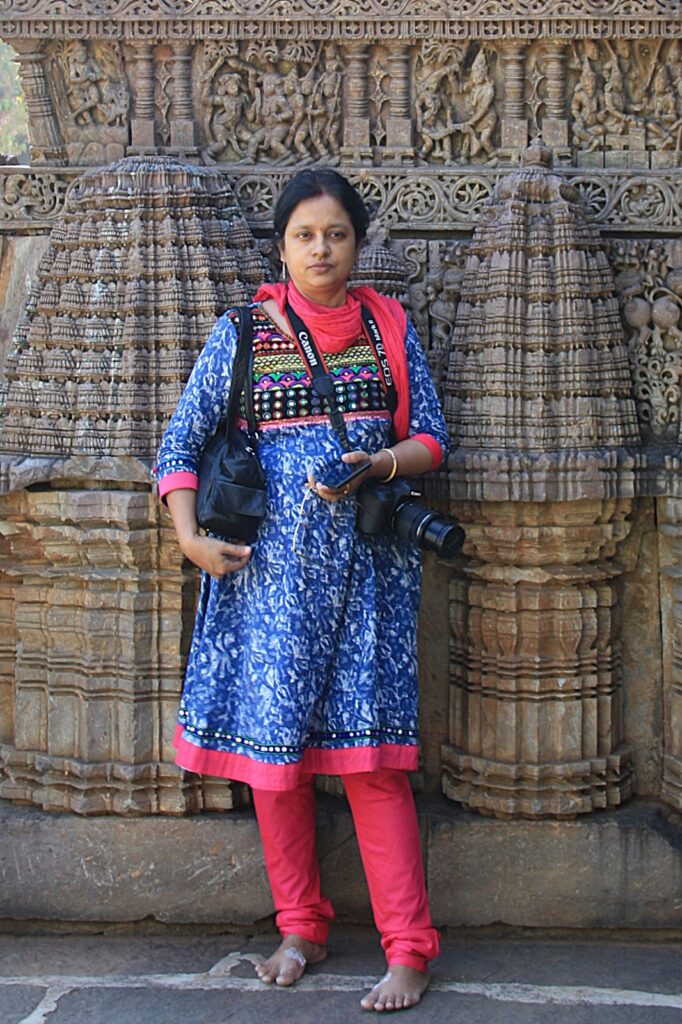
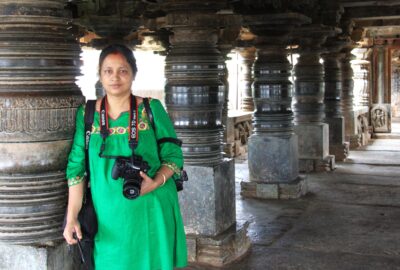
That is me with intricately carved friezes in background
Quick Facts about Amrutheshwara Temple Amruthapura
| Attribute | Details |
| Year Built | 1196 CE |
| Built By | Amrutheshwara Dandanayaka (Military Commander) |
| Dynasty | Hoysala, under King Veera Ballala II |
| Deity | Lord Shiva (Amrutheshwara) |
| Location | Amruthapura village, 20 km from Tarikere, Chikmagalur district |
| Architectural Style | Hoysala (star-shaped plan) |
Architectural Marvels: Lathe-Turned Pillars and Star-Shaped Plans
When I first stepped into the mantapa (hall) of the Amrutheshwara Temple, I was greeted to the sight of lathe-turned pillars carved from polished black soapstone. Their surfaces so smooth, perfectly cylindrical, with grooves and bulges, they reflected the afternoon light like dark mirrors.
I’ve visited several Hoysala temples, but there’s something particularly striking about Amruthapura’s pillars— they look machine-made rather than hand-carved. Running my hand along one of the pillars (carefully, with permission from the caretaker), I could barely detect the tool marks.
Ekakuta – Single Shrine structure
The Amrutheshwara Temple follows the Ekakuta design—a single-shrine layout dedicated to Lord Shiva. Unlike the multi-shrined complexes at Belur or Halebidu, this compact structure puts all its architectural energy into one focused space.
The mantapa’s open design lets you walk freely around the pillars, and I found myself circling multiple times, noticing how the columns create sightlines that naturally draw your eyes toward the inner sanctum. Each pillar has subtle variations in its ornamentation, yet together they establish a visual rhythm.
For anyone interested in Hoysala architecture hidden gems, Amruthapura offers something many larger temples don’t—the space and silence to actually study the craft without crowds. I spent nearly an hour just in the mantapa, photographing the pillars from different angles.
The Star-Shaped Vimana and Mantapa
The temple’s star-shaped plan becomes obvious once you walk around the exterior. The vimana (tower above the sanctum) sits on a stellate platform—essentially a square base with projecting angles that create a multi-pointed star pattern. This isn’t just decorative geometry; each projection serves as a canvas for miniature shrines and sculptural panels.
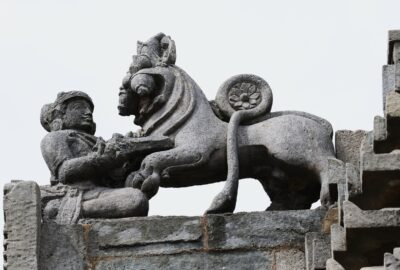
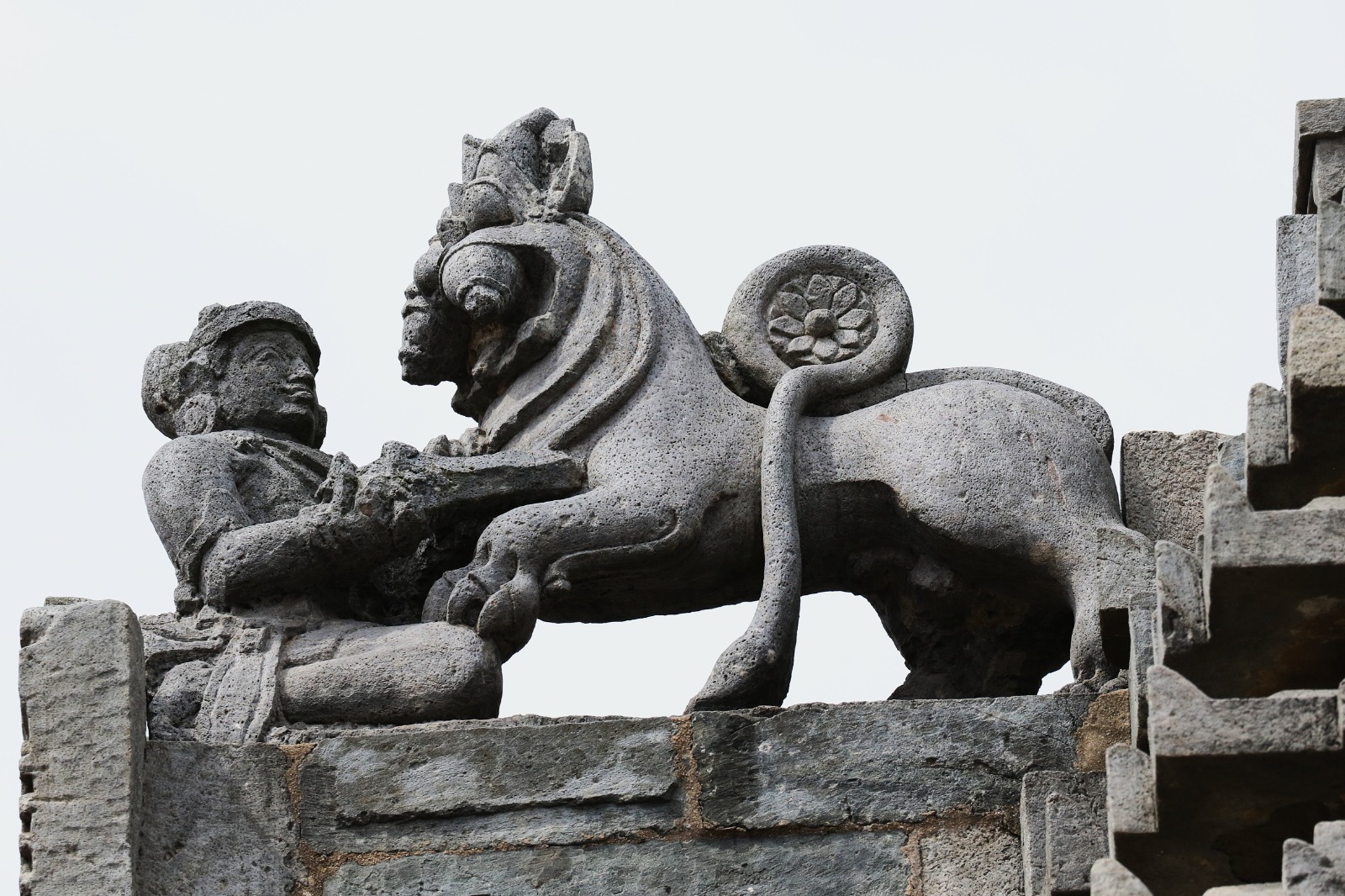
The carvings remain remarkably sharp despite eight centuries of exposure to Karnataka’s monsoons and summer heat. I could make out facial expressions on figures barely six inches tall—warriors in battle stances, celestial beings in flight, forest scenes with detailed flora.
Standing at one corner, I tried to imagine the planning and execution at worksite in 1196 CE—dozens of sculptors working simultaneously on different sections. It simply must have been extraordinary.
The Sacred Shiva Linga from River Gandaki
Inside the sanctum sits the temple’s spiritual center—a Shiva Linga that, according to local tradition and the temple priest I spoke with, was brought from the Gandaki River in present-day Nepal. The Gandaki is famous for naturally occurring shaligram stones, considered especially sacred in Hindu tradition.
The contrast struck me immediately: outside, every surface explodes with ornate carving, but the Linga itself is simple, smooth, and dark—a quiet focal point amid all the visual complexity. The priest explained that pilgrims specifically sought out this temple because of the Gandaki Linga’s reputation, making Amruthapura a significant spiritual destination in medieval Karnataka, not just an architectural showpiece.
This detail reveals something important about how these temples functioned. They weren’t museums or monuments—they were active religious centers connected to broader pilgrimage networks stretching across the Indian subcontinent.

Stories in Stone: Decoding the Ramayana and Mahabharata Friezes
After spending time inside the mantapa, I stepped outside to examine the temple’s outer walls—and this is where Amrutheshwara truly distinguished itself from other Hoysala temples I’d visited.
The temple’s exterior features 140 sculptural panels arranged in horizontal bands, depicting episodes from both the Ramayana and Mahabharata. But here’s what makes this temple unusual: the narratives move in opposite directions. The Ramayana unfolds anti-clockwise along the southern wall, while the Mahabharata progresses clockwise on the northern side.
Scholars still debate whether this was a deliberate symbolic choice or simply the preference of the sculptors working on different sections.
I started my walk on the southern side, following Rama’s story from right to left. The panels begin with scenes from Rama’s birth and early life, progressing through his exile, Sita’s abduction, the alliance with Hanuman and Sugriva, and culminating in the battle with Ravana. One panel in particular stopped me—the depiction of the Lanka war.
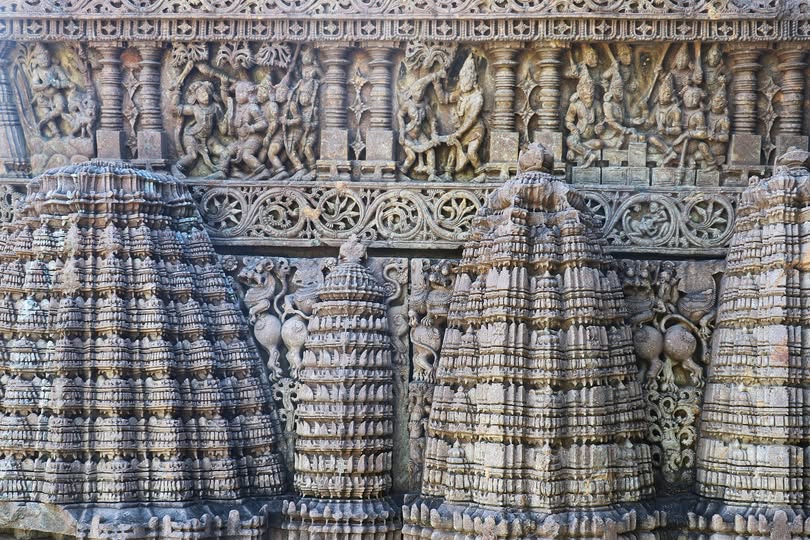
Dushasana disrobing Draupadi-Mahabharata
Despite the small scale (each panel is roughly two feet wide), the sculptor managed to convey incredible detail: warriors in dynamic combat poses, the multi-headed Ravana drawing his bow, the monkey army surrounding Lanka’s walls. I could make out individual facial expressions—determination on Rama’s face, fury on Ravana’s.
Moving to the northern wall, the Mahabharata sequence flows in the conventional clockwise direction. Here I found scenes I recognized immediately: Arjuna in meditation, Krishna delivering the Bhagavad Gita on the battlefield, Bhishma lying on his bed of arrows, the dice game that triggered the Pandavas’ exile.
These weren’t just decorative art—they functioned as visual literature for a society where oral storytelling and temple visits were how most people encountered these epics. Standing there in 2017, I was seeing the same “textbook”, that villagers had been reading for over 800 years.
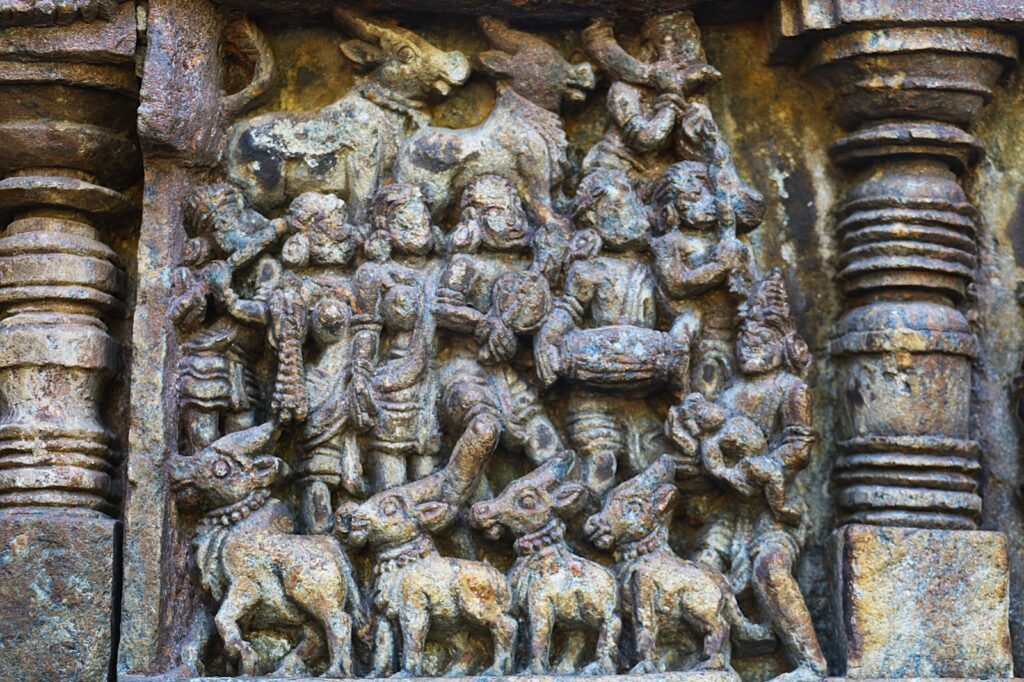
Young Krishna playing flute with Gopikas while grazing cows
The preservation quality surprised me throughout. Unlike the weathered carvings at some other heritage sites, Amruthapura’s panels remained sharp enough to photograph fine details even with my basic camera. The soapstone had held up remarkably well, protected perhaps by the temple’s relatively low profile—fewer visitors means less touch-based wear.
Photography is strictly prohibited in the interiors and I could manage to take some pics from outside. Nothing to get disappointed about, because the exterior has such intricate work that it hogs all the attention of the tourists. The wall relief sculptures depict several Gods, Goddesses, mythological creatures and stories. There are a total of hundred and forty panel sculptures with depictions from the Hindu epics we were told.
If you are there give particular attention to south side wall of the temple. This part has stories from Ramayana on seventy panels sculpted in anti clockwise direction.
The north side has stories from Krishna’s life in 25 panels and also from Mahabharata in 45 panels. These depictions are in clockwise direction. Such details engraved in them that you can actually tell the stories looking at them. I could explain them to my daughters.
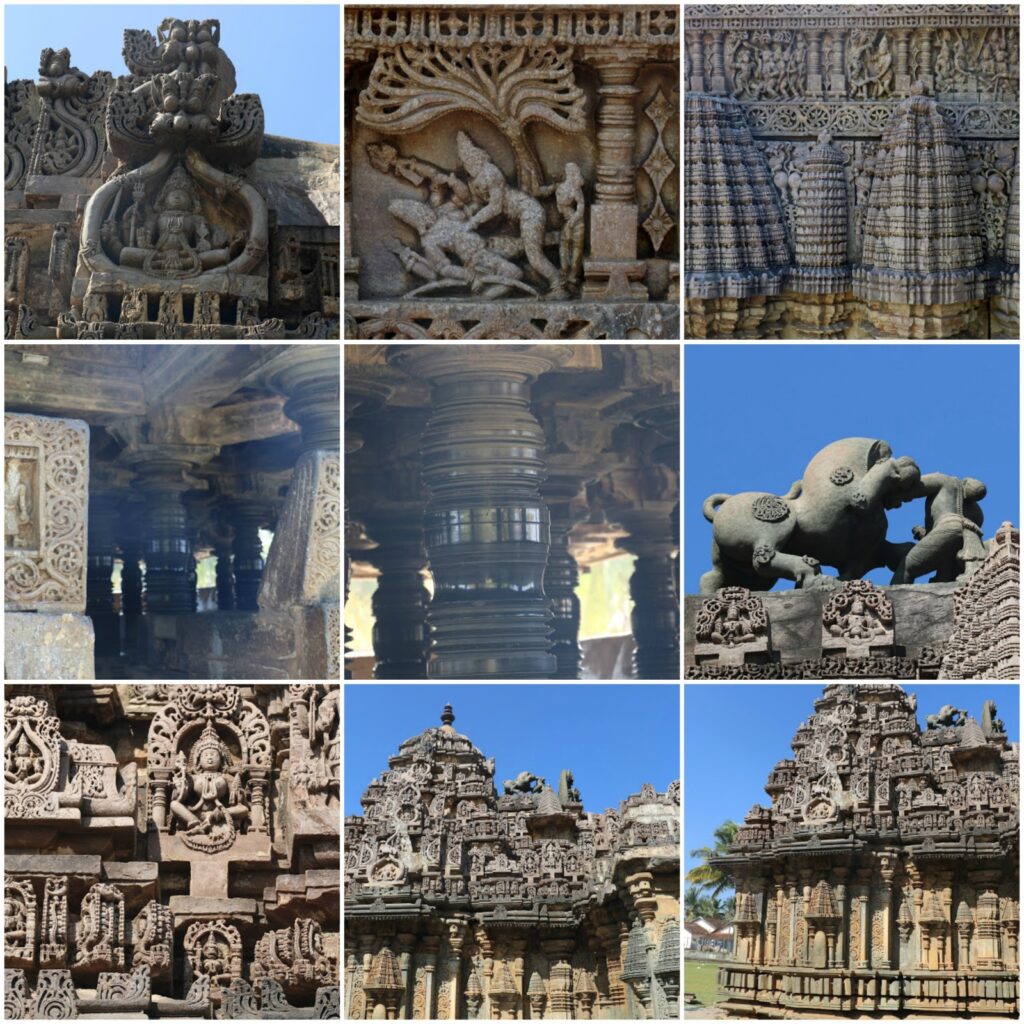
Collage of Amruthapura Temple
Bangalore to Jog Falls: Making Amruthapura Your Perfect Stop
Most travelers driving from Bangalore to Jog Falls stick to the direct NH 206 route, eager to reach the waterfalls. But adding Amruthapura to your itinerary requires just a 20-kilometer detour from Tarikere—and it transforms a long drive into a more culturally rich journey.
The temple sits approximately 250km from Bangalore, making it an ideal mid-journey stop after roughly 4-5 hours of driving (depending on your starting point and traffic). From Amruthapura, Jog Falls is another 130km west through Shimoga, which means you’re splitting a 6-7 hour drive into more manageable segments with a meaningful cultural break in between.
I made this stop in June 2017 during the early monsoon season, and the timing proved perfect. The countryside between Tarikere and Amruthapura was intensely green, with paddy fields reflecting cloudy skies and coffee estates lining the roads.
Essential Visitor Information for Amruthapura
Timings: Open daily from 7 AM to 7 PM (though the outer carvings can be viewed anytime)
Entry Fee: No entry fee; photography is freely allowed throughout the complex
Best Time to Visit:
- June to September for monsoon greenery and dramatic lighting (be prepared for occasional rain)
- December to February for pleasant weather and clear skies ideal for photography
- Avoid March to May unless you’re comfortable with heat (temperatures can exceed 35°C)
Distance from Major Cities:
- Bangalore: ~250 km (4.5-5 hours via NH 206)
- Shimoga: ~67 km (1.5 hours)
- Chikmagalur: ~35 km (1 hour)
- Tarikere: ~20 km (30 minutes)
Getting There: From Tarikere town on NH 206, take the road toward Amruthapura village. The temple is well-signposted. Google Maps works reliably in this area.
Facilities: Basic parking, ASI-maintained toilets, small sheltered areas. No dedicated restaurant at the temple, but several eateries available in Tarikere.
Nearby Attractions:
- Kavaledurga Fort (45 km) – medieval hill fort ruins
- Mandagadde Bird Sanctuary (30 km) – seasonal bird watching spot
- Chikmagalur coffee estates (35-40 km)
- Bhadravathi (30 km), famous for Sri Venugopala Lakshmi Narasimha Temple.
Tips from My Visit:
- Carry water and snacks—limited options in Amruthapura village
- Wear comfortable walking shoes; you’ll be circling the temple multiple times
- If visiting during monsoon, bring an umbrella for sudden showers
- The temple caretaker is usually present and helpful; a small tip is appreciated
- Mobile network coverage is decent (Airtel and Jio worked for me)
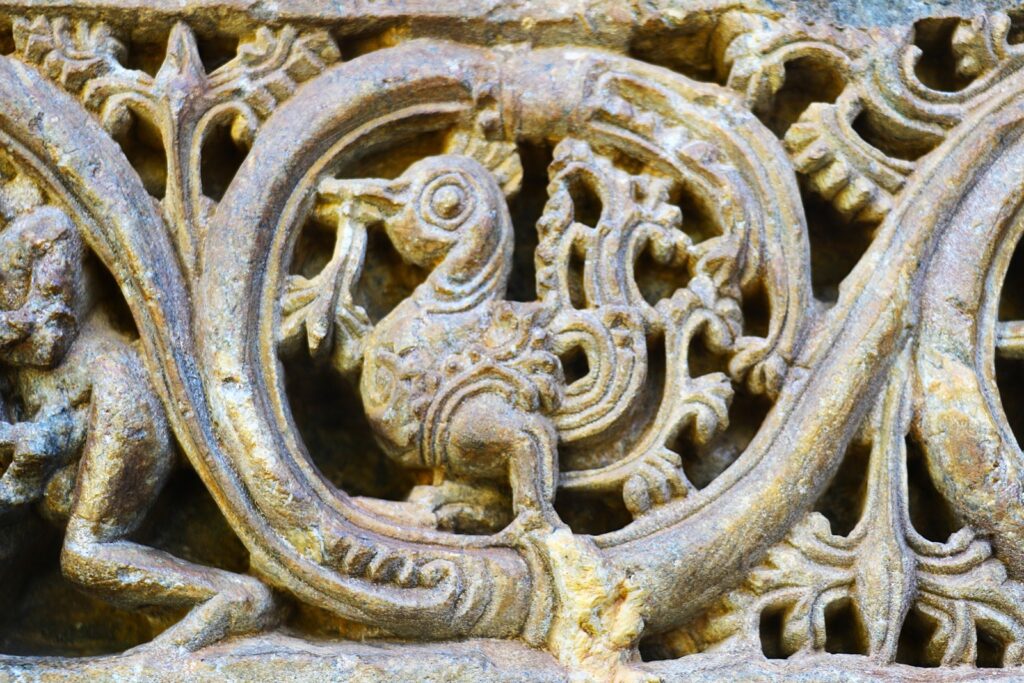
Fine Carving of Bird in Amruthapura temple
Final Thoughts: Why Amruthapura Deserves a Place on Your Itinerary
Seven years after my visit, the Amrutheshwara Temple remains one of the most memorable stops from any road trip I’ve taken in Karnataka. It’s the kind of place that changes how you think about Indian heritage tourism.
What makes Amruthapura special isn’t just its architectural merit (though the star-shaped plan, lathe-turned pillars, and 140 narrative panels are objectively impressive). It’s the experience of discovering something significant that hasn’t been commercialized, or packaged for mass tourism. There’s no ticket booth pressure, no aggressive guides, no souvenir shops—just an 800-year-old temple standing quietly in a Karnataka village, maintained by the ASI but visited primarily by locals and the occasional informed traveler.
For road trippers, Amruthapura offers something increasingly rare: the satisfaction of finding a genuine hidden gem. There’s something deeply satisfying about stopping at a place that still feels like your personal discovery, even though it’s been there for eight centuries.
If you’re mapping out a Bangalore to Jog Falls journey, add those extra 20km. The Amrutheshwara Temple isn’t just worth the detour—it might end up being the highlight of your trip.
Pin this for Later
About the Author
 Indrani Ghose is a cultural travel writer and heritage documentation specialist with over 15 years of experience exploring and writing about temples across India and Southeast Asia. Having visited over 150 sacred sites, she brings both scholarly depth and personal narrative to heritage travel writing.
Her work has been published in Lonely Planet, The National (UAE), Whetstone Asia, Deccan Herald, and various architecture and heritage journals.
Indrani believes that travel writing serves as a bridge — helping readers experience places more deeply by providing context, answering questions, and sharing both practical logistics and emotional resonance.
Connect with Indrani: Follow Indrani on Instagram | Twitter | Facebook for heritage travel insights, photography tips, and offbeat destination discoveries.









Pride of Kannada Land..
It is really amazing place . I had visited this few years ago. Another temple of Hoysala Architecture
Amazing Pics. Thanks to you this place is now on our wish list 🙂
Both the temples Amruthapura temple and Ishwara temple are the architechtural and sculptural marvels with such intricate carvings on the ceilings and walls showcase the glory of Hoysala Dynasty . Amazing pics.
The temple is truly a work of art. You captured the intricate carvings beautifully. Great post Indrani 🙂
Those carvings are indeed intricate. A lovely temple!
Lovely pics ma’am.
India is actually an amazing place. So many variations of cultures and variations deep within. Sometimes, it gets amazing to explore more and more.
Amazing temple, and detailed carvings. Whenever I look at such work, I always wonder how talented these men must’ve been!
(A big hellow to you, back after a break :))
Wow! the temple looks amazing so do all those sculptures! The Hoysalas really did leave us quite a lot of sculptural wonders, didn’t they?
The detailed workmanship is absolutely stunning!
Very true, the work of intricate is too intense here! Great temple to grab attention entirely and the way stories depicted on stones are quite amazing to think… their records are very strong!
The Ramayana and Mahabharata stories must have been fascinating!
Amazing pics …book marking this right away for the next long weekend
Marvelous Architecture.. And you have described it doubly well.. Thanks for sharing, Indrani!
The detailed carvings had me mesmerized! Amazing shots and lucky u!
This is such an architecturally beautiful temple. Feeling spiritual after seeing the pictures!
I always enjoy seeing these amazing places. Thank you for posting about them. Their history is also very interesting.
Glorious details in every temple. I am sure they depict something important.
Great temple. Brilliant architecture. And you have captured the beauty of sculptures exquisitely.
Amazing sculptures. It must require immense potential and patience to build something like that. Lovely pictures!
Hello, Indrani! Wonderful images of the temple and carvings. The details are always amazing to me. Thanks for sharing your visit. Have a happy new week!
Wonderful place for a visit and walk… Also, amazing architecture of historic buildings. So interesting aspects on wall relief sculptures!
Greetings in january!
Awesome temples and terrific captures as always, Indrani!! I would love to have an opportunity to visit these in person, although your pics are the next best thing to being there!! Thank you so much for sharing!! I hope you have a great new week!