Portuguese Blue Tiles: A Timeless Tale of Art, Culture, and Craftsmanship
As I turned a corner in Alfama, sunlight spilled across walls dressed in cobalt tiles — an unforgettable first impression of Lisbon. It was my first day in the city, and what fascinated me most were these Portuguese blue tiles gleaming in the morning light.
With laundry fluttering from wrought-iron balconies and the distant strains of Fado drifting from a nearby café, the scene felt almost cinematic. Beneath my fingertips, the cool ceramic patterns whispered stories of the past; every step through those narrow-cobbled lanes felt like walking through a living postcard — textured, fragrant, and alive.

Colorful Tiles of Lisbon
The rhythmic repetition of geometric motifs across facades gave Lisbon’s architecture a character all its own. Yet, few travelers realize that these azulejos did not originate in Portugal. The art was first brought by the Moors from North Africa in the 13th century. Over time, Portuguese craftsmen adopted and reinterpreted it, transforming a foreign tradition into a national symbol of beauty and identity.
During the rest of my journey through Portugal — from Lisbon’s tiled stairways to Porto’s grand São Bento Railway Station — I saw azulejos everywhere. The word azulejo comes from the Arabic al-zulayj, meaning “polished stone,” though in Portuguese, it resonates with the word azul, or blue. These glazed tiles, painted in serene blue and white tones, have become a defining feature of Portugal’s cultural heritage — celebrated for their intricate designs, durability, and luminous depth of color.
For me, photographing Portuguese blue tiles became an irresistible pursuit — a way of capturing not just the artistry, but the soul of a country that paints its stories on stone.

Azulejos – Portuguese Blue Tiles
Historical Origins: From Moorish Influence to Baroque Grandeur
While photographing the blue-tiled walls of Lisbon, I admired how a foreign art form took such deep root in Portugal. The story of azulejos stretches across centuries, tracing a journey from the Islamic world to Iberia’s artistic soul.
The Moorish influence on Portuguese tiles began in the 13th century when the Moors, who ruled parts of the Iberian Peninsula, brought with them the intricate art of glazed tilework. Inspired by Islamic geometry, these early tiles avoided human and animal figures. The art was mesmerizing patterns of stars, arabesques, and interlocking lines that seemed infinite. Later, the Spanish Mudejar style added its own flourish, blending Christian and Islamic aesthetics.
By the 16th century, Portuguese artisans began creating narrative scenes — biblical stories, royal portraits, and mythological tales. The arrival of Italian Renaissance influences brought depth, perspective, and emotion into the once-abstract art form.
During the Baroque era in the 17th and 18th centuries, the golden age of azulejos in Portugal, grand churches, palaces, and monasteries were covered in elaborate blue-and-white panels that shimmered in candlelight. These Baroque azulejos of Portugal captured the history, devotion, and artistry in equal measure.

Colorful wall Tiles of Lisbon
Symbolism and Storytelling in Blue Tiles
Have you ever paused to truly look at a large azulejo panel? It’s like opening a beautifully bound, centuries-old book.
The Chapters of Ceramic: Common Themes
The tiles are masters of narrative, a careful selection of stories meant to inspire, teach, or simply document life.
- Religious Stories: The tiles depict the lives of saints, biblical parables, and dramatic heavenly moments. They were a powerful tool for religious instruction, especially in churches and monasteries like the stunning São Vicente de Fora.
- Maritime Legends: As a nation of legendary seafarers, Portugal’s tiles naturally celebrate the sea. Look for images of caravels sailing across choppy waters, fantastical sea creatures, and depictions of key naval battles. They tell the grand saga of the Age of Discovery.
- Daily Life: My favorite tiles are the ones that capture the everyday. You might spot a simple scene of a peasant working in the fields, a busy marketplace, or nobles strolling through a garden. These offer a precious, timeless glimpse into the country’s past social fabric.
Why Blue Dominates Portuguese Tilework: Color Psychology
While azulejos come in many colors, it’s the iconic cobalt blue and white (known as azul e branco) that are instantly recognizable. This wasn’t just an artistic choice; it was historical and psychological.
- The Chinese Influence: The trend started in the 17th century, inspired by imported Chinese porcelain—especially the classic blue-and-white ceramics. It quickly became a status symbol.
- Serenity and Depth: Psychologically, blue evokes a sense of calm, tradition, and depth, mirroring the vast Atlantic Ocean that shaped Portugal’s destiny. It provides a striking contrast against the harsh, bright Mediterranean sun, making the designs pop without being garish.
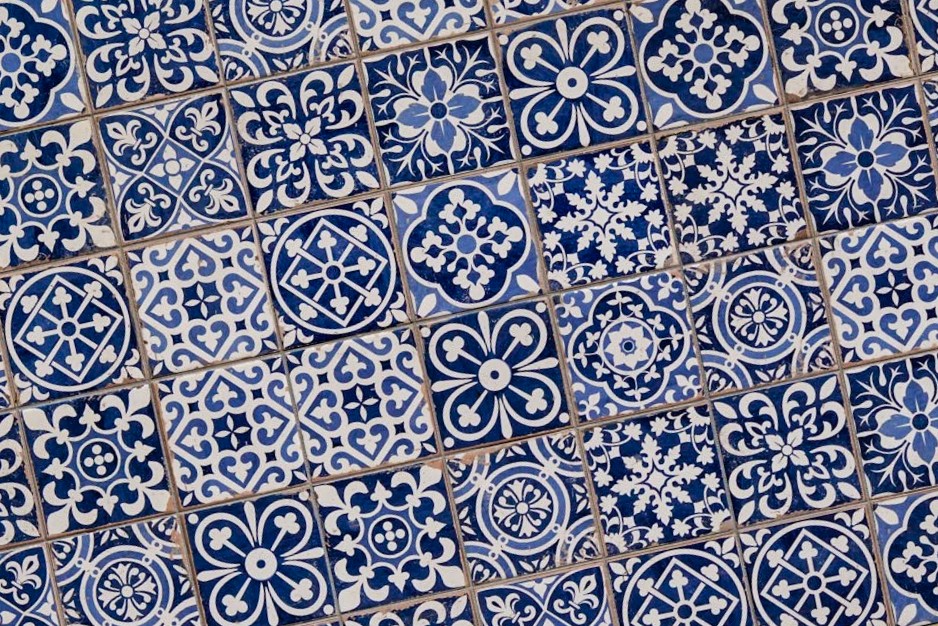
Azulejos – Portuguese Blue Tiles
Where to See the Best Portuguese Blue Tiles
To truly appreciate the scale and artistry of azulejos, you need to see them in person. As your personal travel expert, I’ve mapped out the must-see locations, perfectly optimized for your geo-search for “Portuguese tile murals.”
Lisbon: The Capital of Ceramic Art
Lisbon is an absolute treasure trove for tile enthusiasts. Don’t just look down; remember to look up at the stunning facades!
- Mosteiro de São Vicente de Fora: Beyond its religious significance, this is a top spot. Its cloister is adorned with massive, intricate tile panels from the 18th century, illustrating La Fontaine’s fables. It’s breathtaking and often less crowded than other spots.
- National Tile Museum (Museu Nacional do Azulejo): If you’re serious about azulejos, this is your Mecca. Housed in the beautiful former convent of Madre de Deus, it traces the history of tile-making from the 15th century to the present. A visit here is essential for anyone searching for the best places to see Portuguese tiles in Lisbon.
Porto: Northern Charm and Grand Scale
Up north, Porto offers a different, often more dramatic and larger-scale tile experience.
- São Bento Railway Station (Estação Ferroviária de São Bento): This is, arguably, the most famous tile display in the country. The station’s main hall is coated in over 20,000 azulejos by artist Jorge Colaço, depicting scenes of Portuguese history and transportation. It’s an unforgettable sight right when you step off the train.
- Igreja do Carmo (Carmo Church): Located near the university, the side façade of this baroque church is covered with a massive blue-and-white tile mural. It’s one of the most photographed spots in the city, perfectly showcasing the grand-scale tilework that defines Portuguese tile murals in Porto.
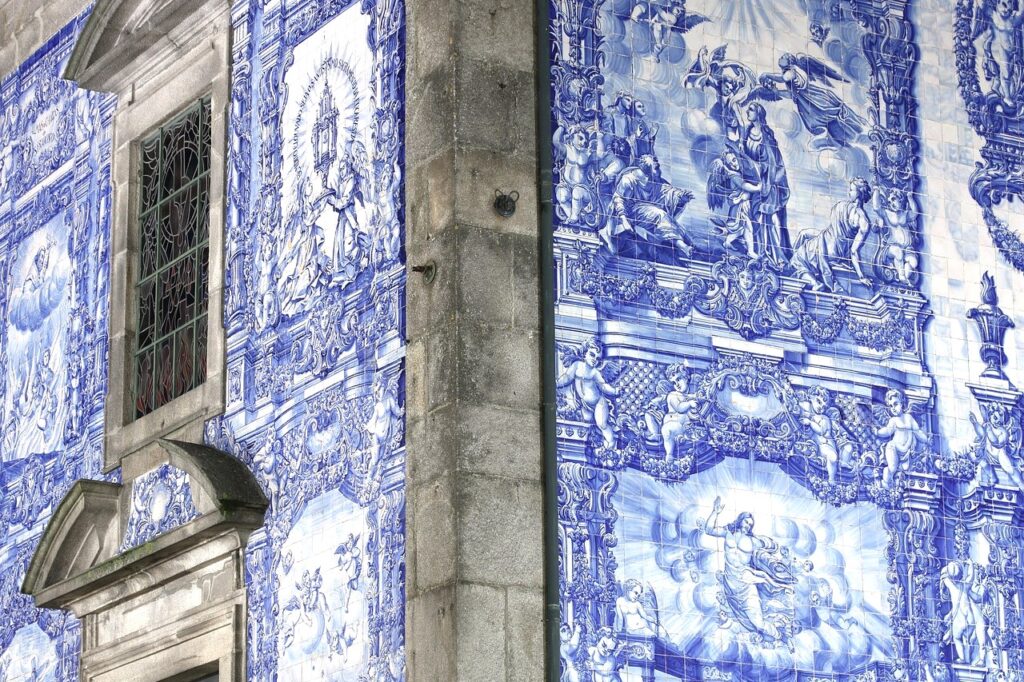
Portugal, Porto, Church
Craftsmanship: How Portuguese Blue Tiles Are Made
Portuguese blue tiles, a centuries-old craft, known locally as azulejos are historical documents, spiritual expressions, and artistic feats.
Step-by-Step: From Earth to Art
- Clay Shaping – Artisans knead and mold the terracotta clay, sourced from Portugal’s mineral-rich soil into square slabs, traditionally 14×14 cm. Each tile is sun-dried before undergoing its first kiln firing, known as the bisque stage.
- Glazing – Once cooled, the tiles are dipped or brushed with a white tin glaze—an opaque surface that acts as a canvas. This glaze gives azulejos their signature luminosity and allows cobalt blue to shine with striking clarity.
- Hand-Painting – Using fine brushes and cobalt oxide, painters sketch intricate motifs—floral scrolls, biblical scenes, maritime tales. The blue pigment appears dull gray at first, only revealing its brilliance after firing.
These painted tiles tell tales and endure through time … at long tables scattered with pots of myriad colors, artisans paint angels and flowers, graceful swirls and bold lines, onto gleaming white ceramic squares. – National Geographic
- Firing – The painted tiles return to the kiln for a second firing at around 1000°C. This process vitrifies the glaze, fuses the pigment, and seals the tile’s durability.
The result is a radiant, glassy surface that can withstand centuries of sun, rain, and admiration. Many workshops in Lisbon and Porto still follow these traditional methods. At Fábrica Sant’Anna, tiles are made entirely by hand, preserving techniques from the 18th century. Visitors can watch artisans at work and even try their hand at painting—a tactile way to connect with Portugal’s cultural soul.
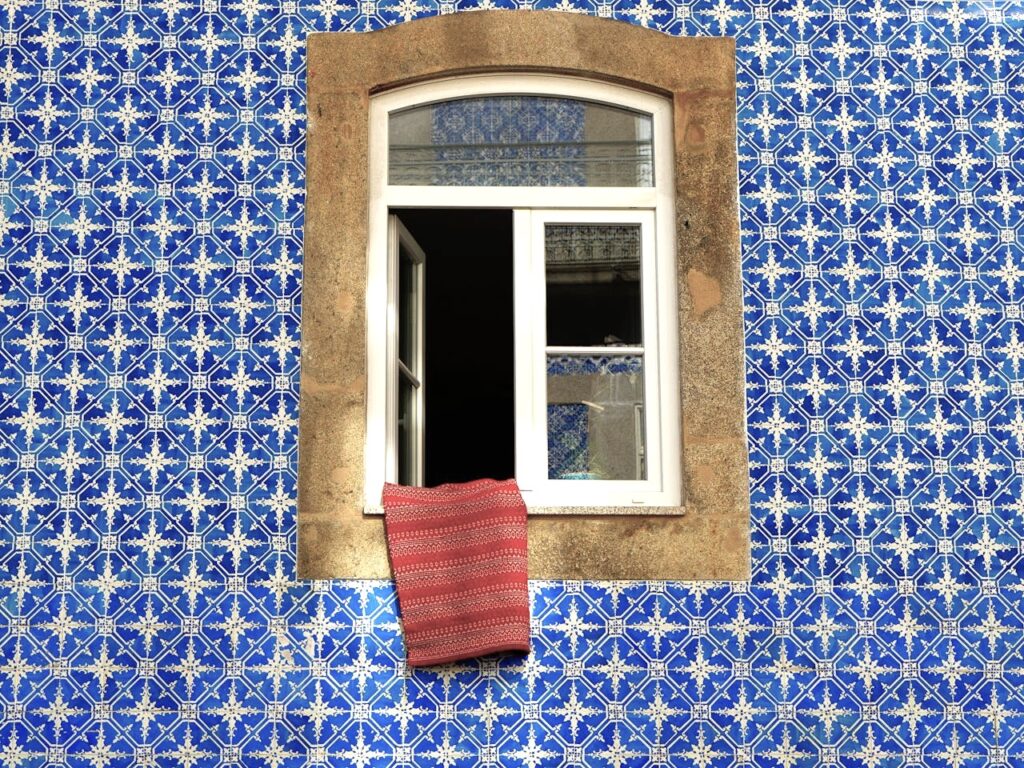
Blue Mosaic on Wall around Windows
Two Types of Portuguese Tiles
Azulejos
These tiles are called Azulejos. Azule in Portuguese means blue, thus the blue-white tiles are known Azulejos. These have been in use in Portugal since 15th century. Each of the tiles then was hand painted. The oldest designs were mostly in 2 colors – blue and white. They often depict some story or scene.
Alicatado
Then there are geometric patterns on tiles. When placed one after another, the facade acquires a grand appearance.

Portuguese Blue Tiles
Modern Revival: Azulejos in Contemporary Design
With time azulejos are used to suit modern needs. Designers, architects, and artists are reimagining these tiles for modern spaces—blending heritage with innovation.
In Fashion, Home Décor, and Public Art
- Fashion: Portuguese designers like Luís Buchinho have incorporated tile motifs into textiles, turning blue-and-white patterns into wearable art.
- Home Décor: From kitchen backsplashes to statement walls, azulejos are making a comeback in minimalist interiors. Modern designs often feature geometric abstractions or monochrome palettes.
- Public Art: In Lisbon’s metro stations, contemporary tile murals celebrate urban life. The Oriente Station, for instance, showcases azulejos by international artists, proving that tilework transcends borders.
Sustainable Tile-Making Practices
Eco-conscious studios are now producing azulejos using recycled clay, low-emission kilns, and natural pigments.
Some initiatives even upcycle broken tiles into mosaics, reducing waste while preserving beauty. This fusion of sustainability and design reflects Portugal’s growing commitment to ethical craftsmanship.

Wall Tiles of Lisbon
Tips for Travelers and Collectors
When I first stumbled upon a tiny ceramic shop in Alfama, I nearly bought every blue tile in sight – they all look cute and precious. Tile-hunting across Portugal can be a tricky affair. As a responsible collector you have to understand the difference between authentic craftsmanship and stolen heritage. Here are some tips:
How to Ethically Buy Tiles (Avoid Stolen Heritage Pieces)
The sad truth is that Portugal has lost countless historic azulejos to theft. Buildings stripped of their century-old tiles is not just destruction on a physical level but they leave cultural wounds that is hard to heal. As responsible travelers, ensure that you indulge in ethical buying of tiles.
Always buy from legitimate sources
Reputable tile shops and certified workshops will provide documentation for their pieces. Always ask for provenance of antique tiles. Any established dealer should explain where the tiles came from. Red flags include suspiciously low prices for “antique” pieces, sellers who can’t or won’t explain the tile’s origin.
The Portuguese government takes heritage theft seriously, and tourists have faced legal consequences for purchasing stolen tiles.
My golden rule?
If it seems too good to be true—an 18th-century panel for the price of a dinner—it probably is. Stick to new tiles made by traditional methods, or certified antique pieces from established dealers who can verify their legitimacy.
Tile Workshops and Experiences in Portugal
Want to truly understand azulejos? Get your hands dirty. I’ve found that Portuguese tile workshops offer something far more valuable than any souvenir: the experience of creation itself.
Portuguese tile workshops Lisbon
The Museu Nacional do Azulejo occasionally runs workshops where you can learn traditional hand-painting techniques from master craftspeople.
In the Chiado district, several ceramic studios offer half-day or full-day azulejo painting classes. These workshops walk you through the entire process: sketching your design, mixing pigments, applying paint with traditional brushes, and understanding how the colors transform during firing. You’ll leave with your own tile (imperfections and all) and a profound respect for the artisans who’ve perfected this craft over generations.
Looking to buy authentic azulejos Portugal?
Workshop studios are actually your best bet. Places like Viúva Lamego, a historic tile factory operating since 1849, sell both reproduction historical tiles and contemporary designs.
Porto also offers fantastic options. The São Bento train station is surrounded by shops where craftspeople demonstrate their methods. Many of these shops ship internationally, so you don’t need to worry about cramming fragile tiles into your luggage.
Budget-friendly tip
Many workshops in smaller towns like Óbidos or Coimbra cost less than their Lisbon counterparts while offering equally authentic experiences. Plus, you’ll escape the tourist crowds and often get more personalized instruction.

Colorful tiles of Lisbon on facades
Conclusion: Why Portuguese Blue Tiles Endure
Looking at the several pictures, I have taken of the centuries-old azulejo panel, I’m always struck by the same thought: these tiles have outlived their creators, survived earthquakes and revolutions, and continues to enchant new generations of admirers. That’s the quiet magic of Portuguese blue tiles.
They endure because they’re more than decoration. Each tile is a small act of defiance against forgetting—visual stories that preserve history when paper crumbles and memories fade. They’re public art that democratizes beauty, turning everyday train rides and neighborhood walks into gallery experiences.
In a way you can say that – They’re windows into Portugal’s soul—simultaneously delicate and durable, traditional and evolving, local and universal. Aren’t they?
Have you encountered Portuguese blue tiles on your travels?
I’d love to hear about your favorite azulejo moments—that unexpected tile panel that stopped you in your tracks, a workshop experience that changed how you see craftsmanship, or even tiles you’ve spotted in surprising places outside Portugal. Share your stories in the comments below.
Pin this for later…
 About the author: Indrani Ghose is a travel blogger and photographer who has explored 15+ European countries across multiple trips. Based in Bangalore, she shares authentic travel experiences to help fellow travelers navigate the world more safely and confidently. You can follow her on her social media handles Instagram, Twitter and Facebook to see the wonderful destinations, beautiful offbeat places and get instant updates about them.







The fusion of traditional Portuguese craftsmanship with modern design in these blue tiles is truly inspiring. They effortlessly blend heritage with contemporary style, making them a standout choice for any interior.
I love the mosaic tiles architecture of Europe. Loved it in Italy too. And I had no clue that Azulejos tiles have been in use in Portugal since 15th century. That’s brand new info for me. Thanks for sharing.
I have seen similar tiles somewhere but can’t remember where. Now I know there’s a name to them. I particularly love the blue and white azulejos – like you said, they are soothing to the eyes!
Wow. So beautiful. I am most delighted to see the peacock. This part of Lisbon is often not documented. It is so unfortunate that such tiles are stolen. I thought Europe was better when it comes in such petty crimes.
Your pictures are really pretty 🙂 I didn’t know there were 2 kinds of tiles. I’ve to Lisbon quite some time ago, would love to visit back!
I’m visiting Portugal in a couple of weeks, I’m glad I read this before going as you’ve given me some photographing inspiration! It’s an awful story that people steal these tiles and resell them in markets. Thanks for teaching me how to name them, Azulejos! I’m going to Porto so I expect the tile designs will be slightly different.
I remember the story about the fake tiles when in Lisbon too! As a traveller, you wouldn’t know the difference unless a local guide told you! Such a wonderful place in general, Portugal is always one of my favourite places to visit. Thanks for sharing
These are really cool ! I did not know these existed in Lisbon. They look to be in great condition still. I saw something like this on my trip to Barcelona
I’ve read a bit about the churches of Lisbon and their blue and white tiles! Didn’t know that they were common in other buildings too all over the city! The hydrangea are so pretty!
These tiles just do so much to lift the appearance of the buildings and really look beautiful. Such a shame about the theft and vandalism but I suppose you get that in virtually every big city. I love the photos you took, the tiles really do look so good.
These designs are incredible! I would love to see the place personally. It would definitely a perfect place to take photos as your background. Thanks for sharing this article. Very Interesting!
Gorgeous! I hear that is the thing to purchase when visiting. You found some beautiful ones.
Gorgeous! Gorgeous! Gorgeous! I often find that tiles often reflect so much about the place . You’ve definitely captured this!
How gorgeous. I love tiles, especially hand painted ones and the azulejos look totally unique. I’d be so tempted to take some home as a souvenir but not if they’re stolen! That tiled peacock is stunning.
The Portuguese certainly spread their influence far and wide. I came across some of those Azulejos tiles in Macao, which is a former Portuguese colony. It’s interesting to see the differences between the tiles in Macao and the ones in Lisbon.
Wow–these tiles are all gorgeous! I love that they use the tiles to create art like that. The simple blue and white tiles are really pretty, but I love the peacock, too! Would love to wander around and look at the tiles in Lisbon sometime!
I love the colorful tiles of Lisbon. I am now researching about it as we are going next year. I am really excited about it.
I too love the tiles of Portugal – I’ve just come back from Porto and the North. Did you know they originated from when the Moors tried to invade Portugal!
I love the tiles. They looks so beautiful on those buildings! I would love to visit LIsbon and see them in person
Loved the tiles!
The peacock one is my favourite and the blue/white color is quite common in Europe. Saw many in Spain.
Such lovely architectural details! Now I wish I can visit Lisbon! #photofriday
Love the Alicatado style with the geometric patterns. Interesting to note how precious these tiles are why preserving them is so important, I’m glad to see more culture preserve elements of their heritage.
The colourful tiles sure add a lot of character to the place. And I’m guessing the paint on the tiles lasts for a long time, so it doesn’t need to be touched up from time to time.
Esa fachada de la foto 7 es un clásico … Los azulejos típicos de todo Portugal:)
Besos.
Looking Beautiful Arts.. Awesome I am Impressing Thanks.
beautiful tile work. Wow
Interesting. We have tiles with images in India but the trrend never caught up, I guess. Have seen them in pooja rooms where a few tiles create an image of a God.
The Great Artistic Expression.. Truly eye capturing!
Really wonderful to know this colorful facade of Lisbon’s tiles! The white and blue color tiles look elegant, though I liked the cutting work on the first two colorful tiles work peacock and fruit vase. The extension of balconies in front of doors also impresses me.
Beautiful tiles-just like jigsaw puzzles.
Beautiful patterns and colours on the tiles.
What a beautiful place to visit . your pictures are saying lot of words specially first one of Peacock is really fantastic.
So sad to read about the theft of these wonderful pieces of art. Beautiful post and most informative!
Wow, they are exquisite! It’s a shame that people steal them.
Amazing
I love tiles and your post was awesome! It’s rare to find them outdoors here.
Wow! So so beautiful. Thanks for this amazing post 🙂
Really beautiful pieces of art! Very informative post on the tiles and their history in Portugal… Thanks for the share.. 🙂
those are beautiful tiles … gorgeous
Bikram’s
Beautiful! I have a thing for tiles, so really enjoyed this post. 🙂 That peacock is so gorgeous.
The peacock is great. I’ve always loved the blue windmill tiles of Delph.
Wow that all seem so exquisite and delightful.
Amazing pictures! I had been to Delft last weekend and the art looks so similar.. and the colours are the same too 🙂 love the blue and white combo !!! 🙂
Hello, the tiles are colorful and so pretty. Love the different designs and the peacock. Great post, thanks for sharing. Enjoy your week!
The Portuguese are truly masters of tiles, every way you walk there are tiles, tiles, tiles. I love them.
Wow..so pretty pictures! 🙂
Wow…. Awesome!! Loved the peacock one!!
Nice designs. I’ve seen the use of such tiles in India too. But didn’t know that their use could be dated so back. Thanks for sharing!
Lovely tiles.BTW did you buy any tiles for souvenir?Love the peacock and flower tiles so much.We think that those are antique colorful tiles right?
Cheers,
Sriram & Krithiga
The tiles of Lisbon really are gorgeous!
Amazing tile art work!
The tiles look beautiful. Thanks for bringing all these small details to us.
A small bit of Lisbon resides in Goa too, and seeing them Azulejos adorning pretty little villas in the Goan countryside is beautiful. Great post!
So Beautiful
Fascinating arrangement of the tiles on the walls.
I loved learning about the different styles of the tiles and getting to see the antique ones. This was a wonderful post. Thanks for sharing.
Didn’t know the difference between azulejos. Would love to visit Lisbon to see the house facades. So sad to hear some people are into destructing these works of art.
A terrific post and photos for the day, Indrani!! Wonderful history! I have been there, thanks for the memories!! Have a lovely week!
I love the beautifully painted tiles. I still cannot differentiate between Portuguese tiles, Mexican tiles, or Morrocan tiles.
This is a great theme. So many wonderful photos featured around prettily painted tiles.
Wow.. they’re beautiful. The peacock is amazing and the vase of flowers must be on the same building since the flowers match the one the peacock has at its feet.