The Ultimate Guide to Bhimbetka Cave Paintings
Tracing Humanity’s First Brushstrokes: A Journey to Bhimbetka’s Ancient Rock Art
Standing before the towering sandstone cliffs of the Bhimbetka Rock Shelters, it is hard NOT to feel a direct connection to the earliest humans who once stood in the same spot. Just 45 kilometres south of Bhopal — barely an hour’s drive from the city’s Mughal-era minarets — these 750 rock shelters hold something that predates every civilisation we know: a 30,000-year record of human life, painted onto stone.
I visited in March 2021, when soft spring light filtered through the dry teak forest and landed directly on panels of red and white pigment that have outlasted empires. As someone who photographs heritage sites across Madhya Pradesh, the contrast was striking.
My earlier work documenting Bhopal’s Taj-ul-Masajid captured the refinement of 19th-century Islamic architecture. Bhimbetka was something else entirely — unmediated, ancient, and urgent. If the Taj-ul-Masajid represents the peak of a long tradition, Bhimbetka is where the tradition begins.
By Indrani Ghose | Last Updated: Mar. 2026
In this guide, I’ll share what I saw and learned navigating the site’s most important panels — the Zoo Rock with its 453 animal figures, the cathedral-scale Auditorium Cave, and the giant Boar Rock — and why Bhimbetka cave paintings deserve to be the first stop for anyone seriously exploring the cultural history of Madhya Pradesh.
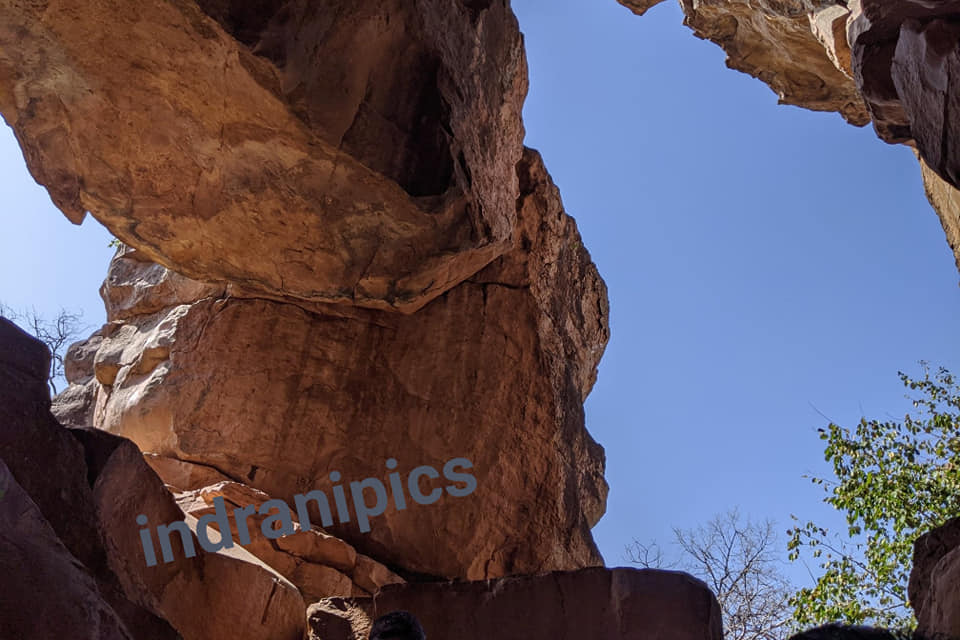
Bhimbetka rock shelters Bhopal – UNESCO site
Bhimbetka Cave Paintings — Quick Facts
- Location: Raisen District, 45km South of Bhopal, Madhya Pradesh.
- Significance: A UNESCO World Heritage Site featuring over 750 rock shelters with art spanning from the Upper Paleolithic to the Medieval period.
- Declared UNESCO WHS: 2003
- Age: The oldest paintings date back over 30,000 years, making them some of the oldest human expressions in the world.
- Number of Paintings: Over 500 rock shelters contain paintings; around 15 are open to visitors on a marked trail
- Top Highlights: The Auditorium Cave (the site’s ‘Cathedral’), Zoo Rock (depicting 453 animal figures), and the giant Boar Rock.
- Best Time to Visit: October to March (I visited in March 2021; the morning light is ideal for photography).
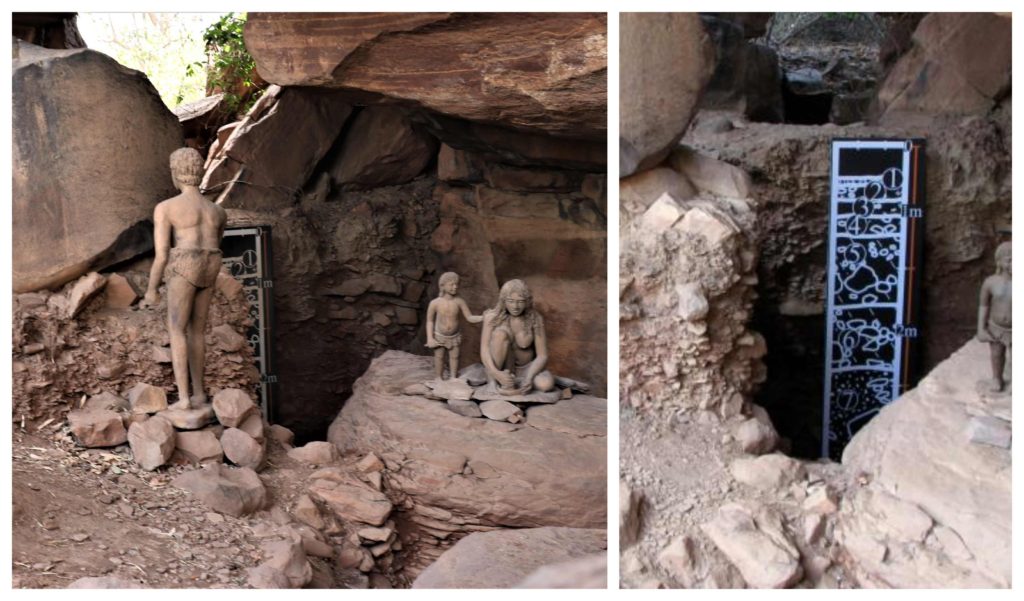
A board in Cave 1 explaining various layers of earth excavated here
The Historical Evolution of Bhimbetka Cave Paintings
One of the most remarkable things about the Bhimbetka rock shelters is that they are not a single moment frozen in time. They are a layered archive. Archaeologists have identified at least seven distinct periods of rock art here, spanning from the Upper Paleolithic to the Medieval era.
Each period reflects a different way of life, a different relationship with the natural world, and a different visual language. The table below maps that evolution clearly.
Chronological Evolution of Bhimbetka Rock Art: 30,000 BCE to the 15th Century AD
| Period | Estimated Era | Primary Colours | Key Subjects & Themes | Artistic Style |
| I: Upper Paleolithic | Before 10,000 BCE | Green and Dark Red | Large bison, tigers, rhinoceros, and elephants; very few human figures | Large, linear forms filled with geometric “wash” patterns |
| II: Mesolithic | 10,000 – 4,000 BCE | Red and White | Group hunting, communal dances, honey collection, family scenes | Smaller, dynamic figures; stylised humans with rhythmic, energetic movement |
| III: Chalcolithic | 4,000 – 2,500 BCE | Red, White and Yellow | Contact with settled farming communities; pottery motifs; agricultural life | Similar to Mesolithic but with evidence of outside cultural influence; more domestic scenes |
| IV & V: Early Historic | 2,500 BCE – 7th Century AD | White, Yellow and Red | Horse and elephant riders; religious figures (Yakshas); early script markings | Schematic and decorative; figures in tunic-like dress; metal weapons depicted |
| VI & VII: Medieval | 7th – 15th Century AD | Manganese Black, Red and Purple | Battle scenes, geometric designs, secular processions | More rigid and highly stylised; frequent superimposition over earlier paintings |
During my March 2021 visit, one detail stayed with me long after I left. The red hematite pigments of the Mesolithic panels — some of them over 10,000 years old — were visibly more vivid than several of the Medieval paintings applied centuries later.
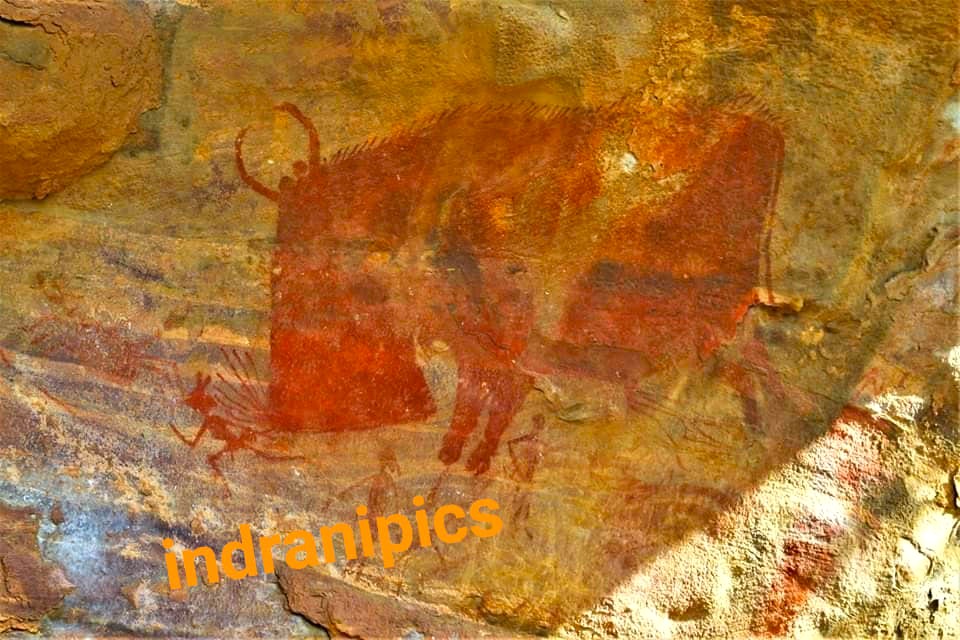
My fav piece of art in the oldest art gallery of India – the Giant Boar
The Mesolithic artists used iron oxide-based pigments mixed with animal fat, plant extracts, and sometimes manganese, which bonded chemically with the silica in the rock surface. As a result, paint had, over millennia, became part of the stone itself.
It is one of the reasons these Bhimbetka cave paintings have survived at all — and a detail that no photograph, however well-exposed, fully captures until you are standing directly in front of the rock.
5 Must-See Highlights at Bhimbetka: From Zoo Rock to the Auditorium Cave
Exploring the Bhimbetka rock shelters can feel overwhelming at first. With over 750 shelters spread across a forested sandstone ridge, and paintings layered across 30,000 years of human history, there is far more here than a single visit can absorb.
The marked visitor trail covers around 15 shelters and takes roughly 90 minutes at a comfortable pace. Within that trail, five highlights stand out — for their scale, their artistic detail, and what they reveal about prehistoric life in central India.
-
The Auditorium Cave – Bhimbetka’ Gopuram
The Auditorium Cave earns its nickname immediately. Its entrance is gopuram-scale — a wide, high overhang of weathered sandstone that frames the forest below like a natural proscenium. Inside, the ceiling soars, and the walls hold paintings from multiple periods stacked across the same surfaces.
Archaeologists believe the cave’s size and acoustics may have made it a communal gathering space, used for collective rituals rather than daily shelter.
When I visited in March 2021, this was the shelter that stopped me completely. The layering of paintings here — Paleolithic animals beneath Mesolithic hunters beneath Early Historic riders — makes the Auditorium Cave the single most compressed record of Bhimbetka’s full timeline. If you visit only one shelter, make it this one.
-
Zoo Rock — The Most Famous Panel in Prehistoric India
Zoo Rock is the highlight most visitors come specifically to see, and it delivers. This single panel contains 453 individual figures — deer, elephants, bison, tigers, wild boar, and human hunters — arranged with a density and energy that genuinely earns the name. It is the largest and most complex composition at Bhimbetka, and one of the most studied examples of prehistoric rock art in South Asia.
What makes Zoo Rock particularly valuable is its documentary quality. The animals are observed with real accuracy — body proportions, movement, and behaviour are captured in ways that tell us precisely which species shared this landscape with early humans.
For anyone interested in prehistoric art in India, Zoo Rock is the clearest evidence that these were not simply decorative marks. They were records.
-
Boar Rock — Where Realism Meets Ritual
The giant boar painted on Boar Rock is one of the most visually arresting images at Bhimbetka. Its scale is deliberately exaggerated — the animal is painted far larger than life, with a solidity and presence that separates it from the naturalistic animal figures elsewhere on the trail.
Most archaeologists interpret this exaggeration as intentional and symbolic: the boar likely represented something beyond the animal itself — strength, danger, or a totemic significance within the community that painted it.
Boar Rock is a useful corrective to the idea that all Bhimbetka paintings are straightforward documentation. Some of them are clearly doing something else.
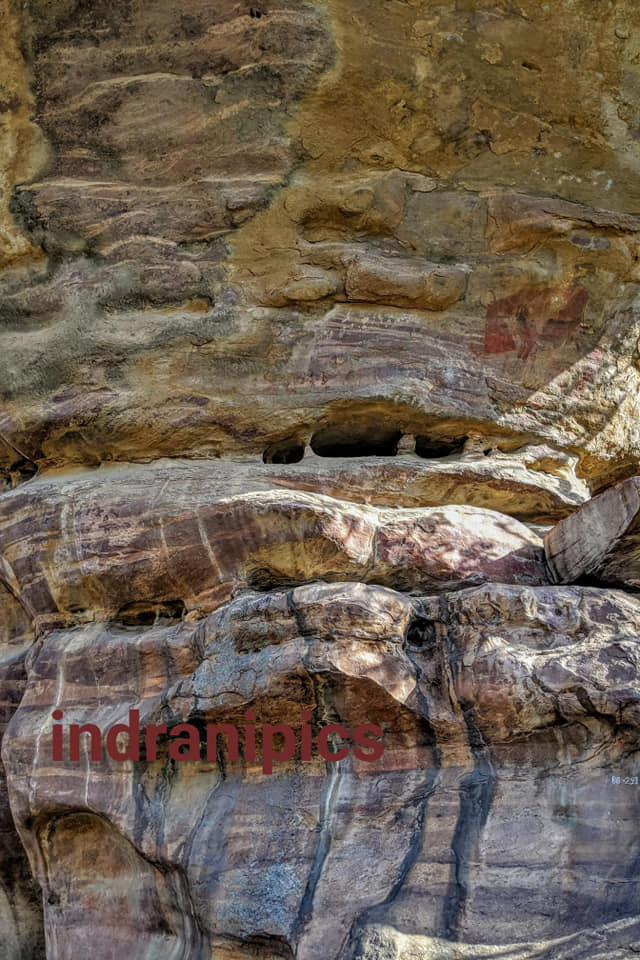
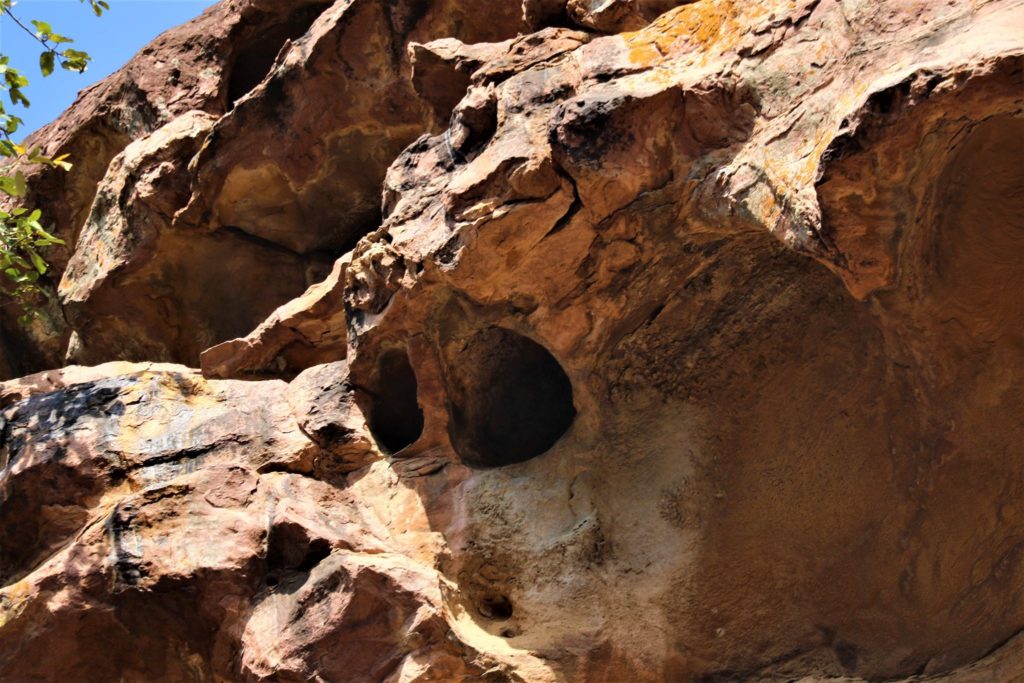
Mushroom shaped shelter is known as Boar rock – Cave 15
-
The Amphitheatre Cluster — A Layered Conversation Across Millennia
Near the Auditorium Cave, a cluster of adjacent shelters offers one of the best opportunities at Bhimbetka to read superimposition directly. Paleolithic animal figures sit beneath Mesolithic hunting scenes, which in turn are overlaid with Early Historic depictions of horsemen and geometric symbols. In some panels, three or four distinct eras of painting occupy the same square metre of rock.
This is where the concept of Bhimbetka as a living site — continuously returned to, continuously added to — becomes most tangible. These shelters were not museums. They were active spaces, and each generation of users painted over, around, and sometimes directly on top of what came before.
-
Handprints and Geometric Designs — The Most Personal Marks
Scattered across several shelters on the trail are human handprints — stencilled outlines made by pressing a painted hand directly against the rock. They are among the simplest images at Bhimbetka, and among the most affecting. Alongside these are abstract geometric motifs: grids, spirals, and repeated line patterns whose precise meaning remains debated.
Together, these marks serve as a reminder that Bhimbetka was not only a space for recording the external world — animals, hunts, rituals — but also for asserting presence. Someone was here. This is what they left.
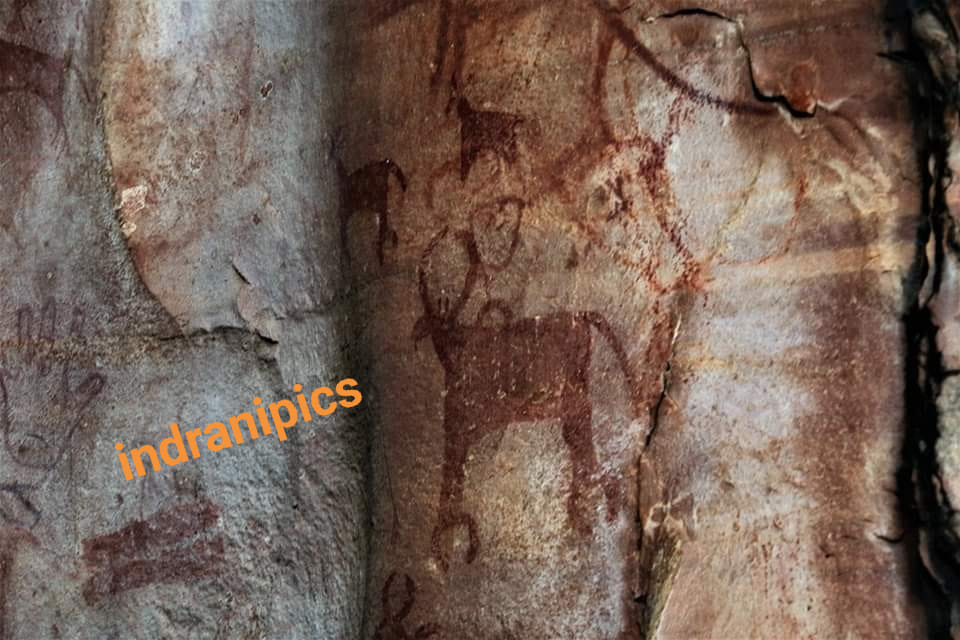
Cave 3 – notice the hand impression of a child? – Rock paintings of Bhimbetka Caves.
These five highlights give a structured entry point into a site that can otherwise feel too large and layered to navigate. Taken together, they cover the full range of what makes Bhimbetka cave paintings significant — scale, artistry, documentary value, symbolic depth, and an unbroken human presence stretching back 30,000 years.
For anyone making the journey from Bhopal, they are the essential itinerary.
Planning Your Visit to Bhimbetka: Logistics, Timings, and What to Expect
Visiting the Bhimbetka rock shelters is straightforward, particularly if you are planning a Bhopal to Bhimbetka day trip. The site sits 45 kilometres south of Bhopal along the NH46 Bhopal–Hoshangabad highway, and the drive takes approximately one hour by taxi or private car. No direct public bus runs to the site entrance, though state buses on the Bhopal–Hoshangabad route stop at Obaidullaganj, around 8 kilometres away, from where an autorickshaw or shared vehicle can cover the remaining distance.
The Archaeological Survey of India manages the site, and basic facilities — including restrooms and a small interpretation centre — are available at the entrance. Food options inside are limited, so carry water and light snacks.
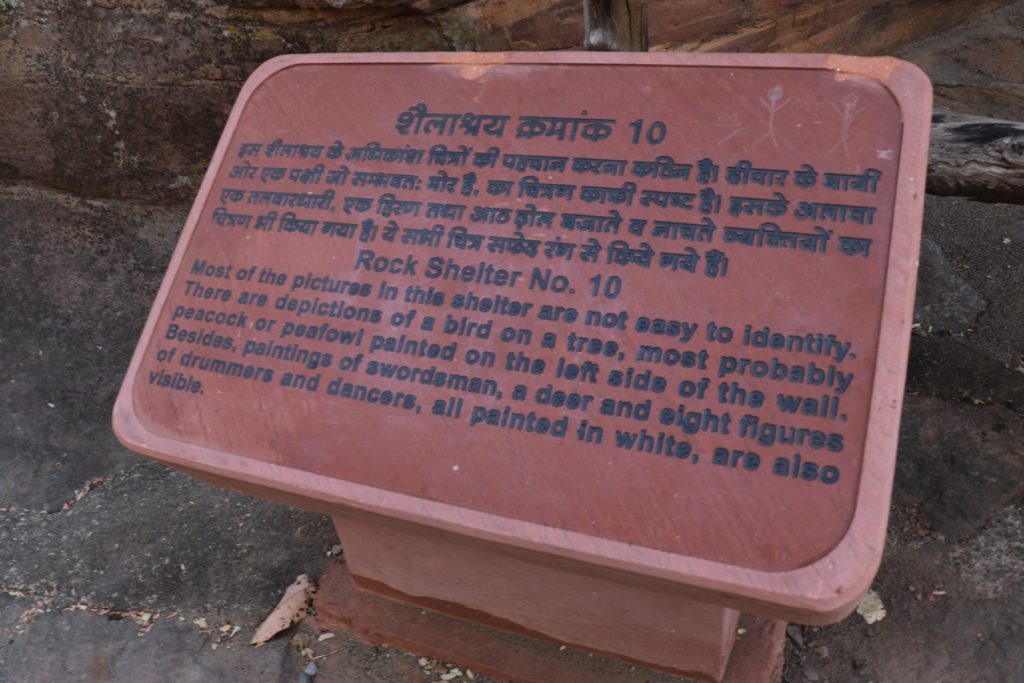
Explanations in front of caves in Bhimbetka, every cave has one such board.
Quick Reference: Bhimbetka Visit Essentials
| Detail | Information |
| Location | Raisen District, 45km south of Bhopal via NH46 |
| Entry Fee | ₹40 (Indian nationals) / ₹600 (foreign nationals) — verify current ASI rates before visiting |
| Timings | Sunrise to sunset; closed on Mondays |
| Best Season | October to March |
| Ideal Visit Duration | 2–3 hours for the main trail |
| Nearest Town | Obaidullaganj (8km) |
| How to Get There | Taxi or private car from Bhopal (recommended); state bus + autorickshaw possible |
| Photography | Permitted; flash strictly prohibited inside shelters |
| Facilities | Restrooms, interpretation centre, no food stalls inside |
Planning a Longer Day
Bhimbetka pairs well with two nearby heritage sites that together make a full-day itinerary from Bhopal. Bhojpur Temple, roughly 28 kilometres from Bhimbetka, houses one of the largest Shiva lingas in India and dates to the 11th century.
Sanchi Stupa, about 60 kilometres northeast of Bhimbetka, is another UNESCO World Heritage Site and one of the oldest Buddhist monuments in the subcontinent. Combining all three in a single day is possible with an early start and private transport, and covers a remarkable sweep of Indian history — prehistoric, Hindu medieval, and early Buddhist — in one circuit.
Photography at Bhimbetka — Practical Tips for Shooting Rock Art
Photographing prehistoric cave paintings is genuinely different from most heritage photography. The subjects are fixed, often high on a wall, frequently shaded, and protected by conservation rules that limit how close and how you can shoot. Based on my March 2021 visit, here is what actually works.
Work with the natural light, not against it The single most important variable at Bhimbetka is the angle of available light. In March, late morning sunlight — roughly between 9.30 and 11.30 AM — falls across the painted surfaces at an oblique angle that brings out the red hematite and white pigments with far more depth than direct overhead light.
No flash — no exceptions Flash photography is strictly prohibited at Bhimbetka, and for good reason. Repeated exposure to intense light accelerates the degradation of mineral pigments that have survived 30,000 years. Disable your flash before entering any shelter. Shoot on a higher ISO — between 800 and 1600 works well in shaded shelters — and compensate with exposure adjustment in post-processing if needed.
Match your lens to the subject A wide-angle lens is the right choice for large shelters like the Auditorium Cave, where capturing the full scale of the space is the point. For the dense figure clusters on Zoo Rock, or for individual animals painted high on the wall, a zoom lens in the 70–200mm range lets you isolate and frame details without moving closer than the barriers allow.
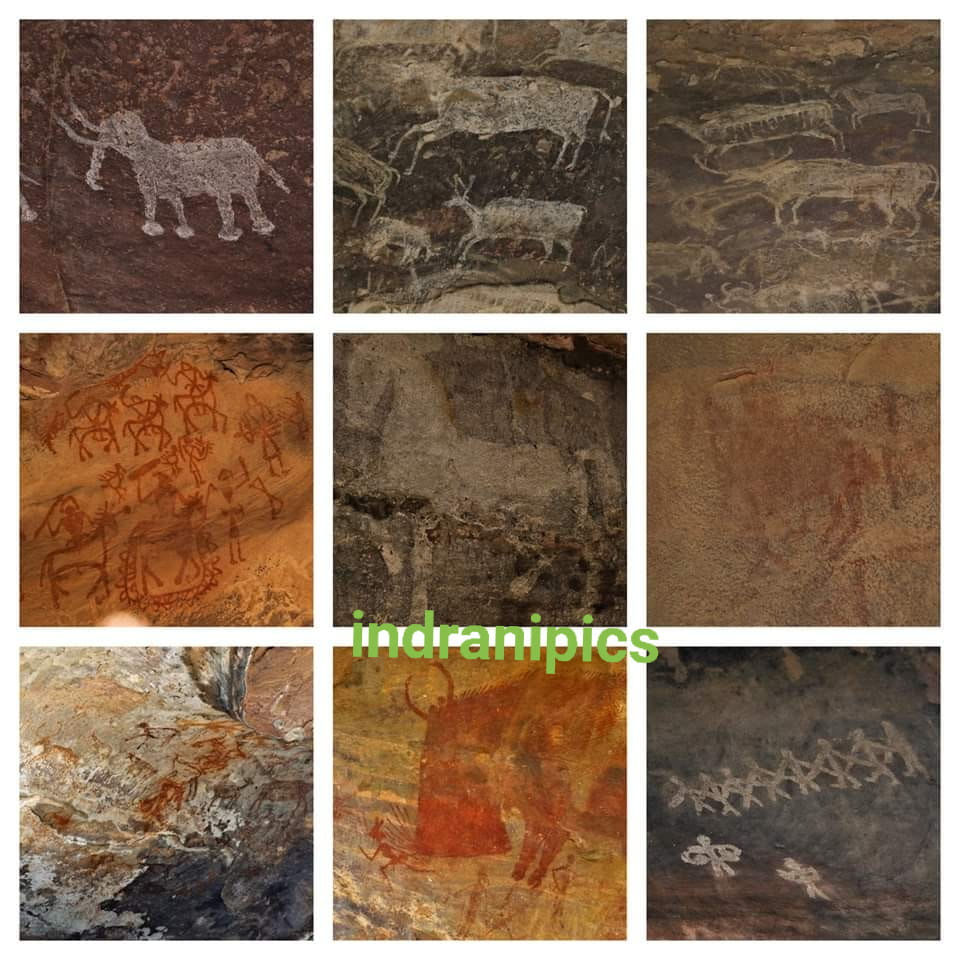
Rock Paintings of Bhimbetka Caves – 1 Pic 1 from Cave 1./ Row 1 Pic2, 3 from Cave 4 -zoo rock shelter./Row 2 Pic 1 – Cave 8./ Row 2 faded paintings Pic 2 and 3 – Cave 10./Row 3 Pic 1 – Cave 12/Row 3 Pic 2 – Cave 15.
Stabilise without a full tripod The terrain at Bhimbetka is uneven — compressed earth paths, rocky approaches, and narrow passages between shelters. A full tripod is impractical in most spots and obstructs other visitors on a busy day. A lightweight monopod gives you the stabilisation you need for slower shutter speeds in low light without the footprint.
Respect the boundaries absolutely Every shelter on the marked trail has protective railings or rope barriers. Stay behind them. The temptation to step closer for a better frame is understandable, but the oils from human skin and the vibration of footfall close to the painted surfaces cause real, cumulative damage. The integrity of these paintings is more important than any individual photograph — and practically speaking, a zoom lens removes the need to get closer anyway.
The goal when photographing Bhimbetka is not to replicate what you can find in an archaeology journal. It is to document what you actually saw — the scale, the setting, the quality of light on ancient pigment. That is the image worth making.
FAQ About Bhimbetka Cave Paintings
What is the significance of the Bhimbetka rock shelters?
Bhimbetka is one of the oldest and largest collections of prehistoric rock art in the world. Declared a UNESCO World Heritage Site in 2003, it contains over 750 rock shelters with paintings spanning 30,000 years — from the Upper Paleolithic to the Medieval period.
Who discovered these prehistoric rocks of Bhimbetka?
Dr. Vishnu Shridhar Wakankar traveling in train, passing through this region, noticed sighted oddly shaped outline of the distant hills. Curious he set off to explore the hilly region and stumbled on the caves. This happened in March 1957.
How old are the Bhimbetka cave paintings?
The oldest paintings at Bhimbetka are estimated to be over 30,000 years old, placing them in the Upper Paleolithic period.
Are the Bhimbetka caves worth visiting from Bhopal?
Yes. The site is 45 kilometres from Bhopal, about an hour by road, and the marked trail takes two to three hours to cover comfortably.
Which animals are depicted in the rock art of Bhimbetka?
The paintings depict a wide range of animals, including bison, elephants, tigers, deer, wild boar, rhinoceros, crocodiles, and lizards. The fauna depicted in the oldest Paleolithic paintings includes several megafauna species that are now either extinct or no longer found in central India.
What is Zoo Rock at Bhimbetka?
Zoo Rock is the most famous single panel at Bhimbetka, containing 453 individual figures — the highest concentration of painted images at the site. It depicts animals, human hunters, and everyday scenes in a dense, layered composition.
How were the Bhimbetka paintings made to last so long?
- The sheltered overhang positions of most paintings also protected them from direct rain and wind erosion.
- Over thousands of years, these mineral pigments bonded chemically with the silica in the sandstone, effectively becoming part of the rock surface rather than sitting on top of it.
Is Bhimbetka suitable for children?
Yes. The marked trail is walkable, the paintings are visually engaging, and the site tells a story that is easy to explain to younger visitors. Comfortable shoes and water are essential.
What is the best time of day to visit Bhimbetka?
Mid-morning, between 9.30 and 11.30 AM, is ideal. At this time, natural light falls at an oblique angle across the painted rock faces, bringing out the red and white pigments most clearly. This is also the best window for photography.
Can you touch the paintings at Bhimbetka?
No. Touching the painted surfaces is strictly prohibited and causes irreversible damage. The oils from human skin accelerate pigment degradation.
Is Bhimbetka open on public holidays?
The site is open on most public holidays but is closed every Monday. Timings are sunrise to sunset.
Bhimbetka rock shelters India
Why Bhimbetka Belongs on Your Itinerary
Standing inside the Bhimbetka rock shelters, you don’t just see prehistoric art—you step into a timeline of human creativity that stretches back 30,000 years. From the bold Paleolithic animals to the intricate Mesolithic hunting scenes and the later historic warriors, the caves offer a rare chance to witness how culture evolved across millennia.
For me, visiting Bhimbetka was worth every moment of the short drive from Bhopal. The site is well maintained, accessible, and deeply rewarding, whether you’re a history enthusiast, a photographer, or simply curious about India’s UNESCO World Heritage treasures. Highlights like Zoo Rock and Auditorium Cave make the experience unforgettable, while the sheer scale of the art leaves you humbled.
If you’re planning a trip to Bhopal, make sure Bhimbetka is on your itinerary—it’s a journey into the origins of storytelling itself. Plan your visit, explore responsibly, and let Bhimbetka inspire your own creative journey.
Pin and Save this for Later
About the author
 Indrani Ghose is a travel blogger and photographer who has explored 15+ European countries across multiple trips. Based in Bangalore, she shares authentic travel experiences to help fellow travelers navigate the world more safely and confidently. You can follow her on her social media handles Instagram, Twitter and Facebook to see the wonderful destinations, beautiful offbeat places and get instant updates about them.