Hoysala Architecture of Karnataka’s Hidden Marvels
Most travellers visiting Karnataka stop at Belur and Halebidu — admire the carvings, take photographs, and leave. But the real magic of Hoysala architecture reveals itself only when you begin driving into the countryside: quiet village temples on empty roads, sculpted walls glowing in early morning light, and narrative friezes you can stand beside without crowds.
Over several road trips through Hassan and Chikkamagaluru, I explored more than ten lesser-known Hoysala temples — from the Lakshmi Narasimha temple at Javagal to the Ishvara temple at Arasikere. These shrines may not appear in standard itineraries, yet they display the same artistic mastery as the famous monuments, often in a far more intimate setting.
— By Indrani Ghose | February 2026
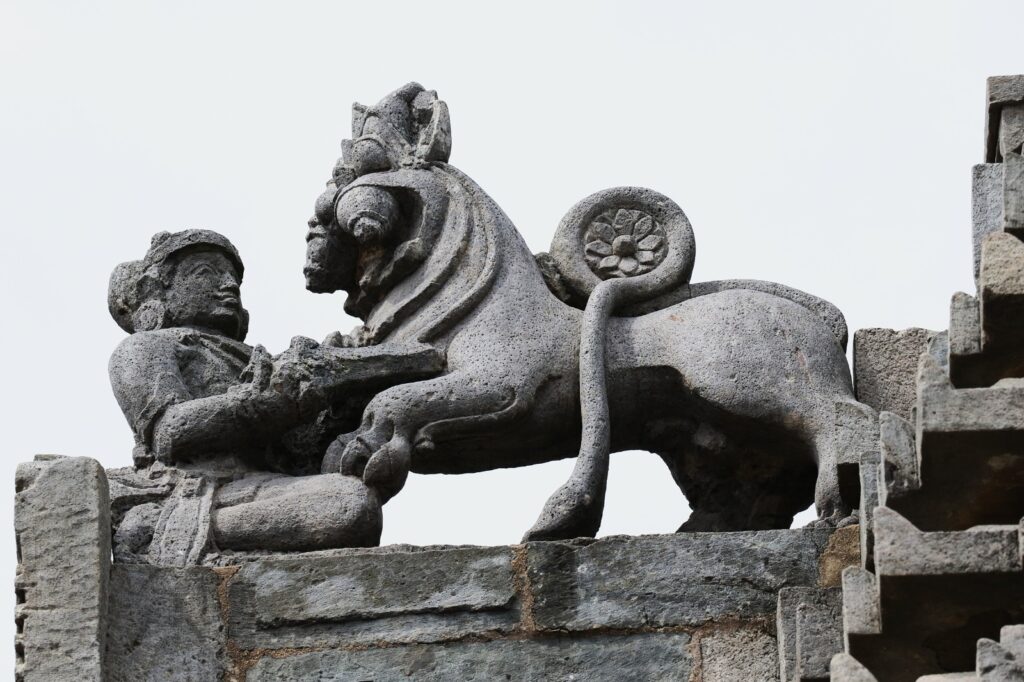
Mythical founder, Sala, stabbing a lion-like creature with a dagger – Emblem of Hoysala Empire
In 2023, UNESCO recognised the Sacred Ensembles of the Hoysalas at Belur, Halebidu and Somanathapura as World Heritage Sites, affirming what travellers discover on the ground: the Hoysalas created one of the most refined temple traditions in India. Characterised by star-shaped plans, intricate soapstone carvings, and a distinctive fusion of northern and southern architectural ideas, their temples reward slow exploration rather than hurried sightseeing.
This guide explains not only what makes Hoysala architecture unique, but also how to experience it — how to read the sculptural stories, when to visit for the best light, and how to build a rewarding heritage circuit from Bengaluru over a weekend or a few days.
Hoysala vs Dravidian Temple Architecture
Hoysala temples are often categorized within South India’s Dravidian architectural tradition—and historically, they do emerge from that lineage. However, standing before a Hoysala shrine after visiting classic Dravidian complexes like the Brihadeeswarar Temple in Thanjavur or the Meenakshi Temple in Madurai reveals fundamentally different architectural intentions.
- Dravidian temples pursue monumentality and axial grandeur
- Hoysala temples invite intimate, circular observation
Dravidian temples—especially Chola-period structures and later Vijayanagara expansions—organize around a strong central axis.
You enter through towering gateway gopurams (often reaching 50+ meters), cross expansive courtyards, and progress toward the sanctum crowned by a pyramidal vimana. The experience is deliberately processional: movement flows inward toward the deity, and architecture creates sacred hierarchy through scale and enclosure.
Hoysala temples reverse this experience.
The shrine sits on a raised jagati, immediately exposing its sculptural exterior. There are no dominating entrance towers—instead, the eye travels around the building rather than toward it. Pradakshina (circumambulation) becomes essential, not merely devotional but visual, as walls narrate epics and cosmology in sequential friezes meant to be read while walking.
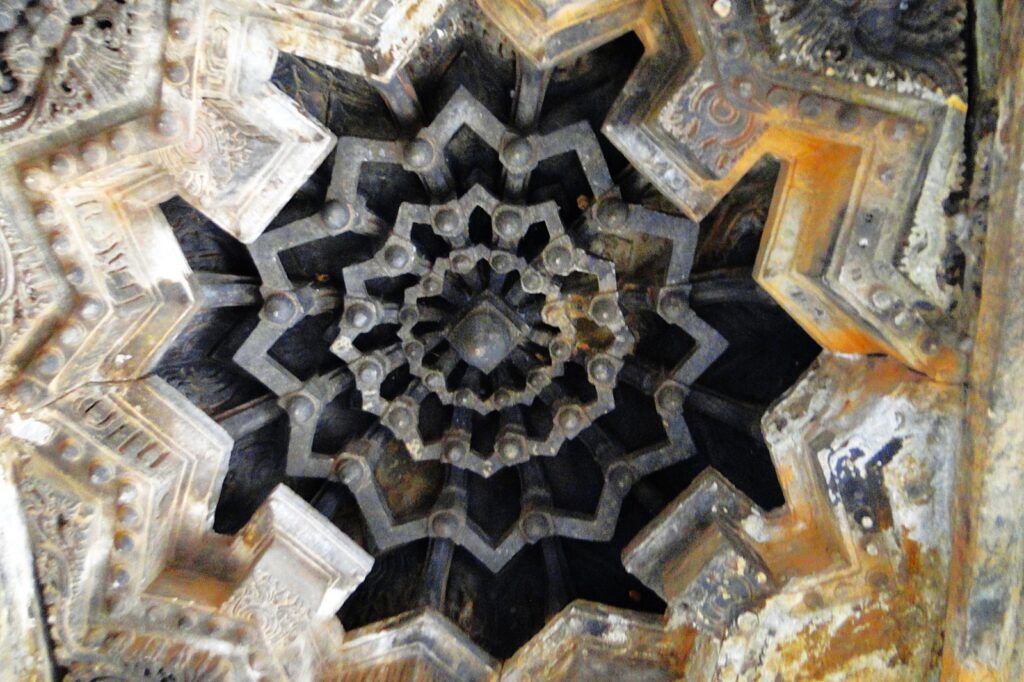
Amazing Geometry in Ceiling in a Hoysala Temple Karnataka
Key Architectural Distinctions: 2 South Indian Traditions, 2 Different Experiences
| Feature | Hoysala Architecture | Dravidian Architecture |
| Overall impression | Intricate and sculptural | Monumental and axial |
| Layout | Stellate (star-shaped), multiple projections | Straight axial plan within enclosures |
| Entry focus | Exterior walls and platform | Towering gateway (gopuram) |
| Vertical emphasis | Low, layered superstructure | Tall pyramidal vimana and gopuram |
| Surface treatment | Dense carvings covering almost every surface | Select sculptural zones separated by plain walls |
| Material | Soapstone enabling fine detailing | Granite suited to massive construction |
| Viewing experience | Circumambulation and close viewing | Processional movement toward sanctum |
| Emotional effect | Intimate, jewellery-like | Majestic, awe-inspiring |
In simple terms: Dravidian temples like Thanjavur’s Brihadeeswarar overwhelm through scale and inspire awe from distance. Hoysala temples like Belur captivate through detail and reveal themselves only through patient, close observation.
Understanding this distinction transforms how you explore both—instead of looking up in admiration, you begin looking closely in discovery.
The UNESCO Hoysala Temples “Big Three”
In 2023, the Sacred Ensembles of the Hoysalas at Belur, Halebidu and Somanathapura were inscribed as UNESCO World Heritage Sites — a recognition of the artistic peak the dynasty reached in the 12th and 13th centuries. Together, the three temples form a perfect introduction to the style: elegance, density and symmetry.
Belur — The Sculptural Showcase
The Chennakeshava Temple at Belur is often the first encounter travellers have with Hoysala architecture, and it works exactly as an introduction should. The carvings are refined, rhythmic and approachable, best represented by the famous bracket figures such as the mirror-holding dancer. The walls read almost like an illustrated manuscript, with episodes from the epics unfolding panel by panel.
Belur rewards slow walking rather than checklist sightseeing. Morning or late afternoon light reveals the sculptural depth far better than midday glare.
Ideal visit time: 1.5–2 hours
Halebidu — The Narrative Epic
A short drive away, the Hoysaleswara Temple at Halebidu feels dramatically different. Here the emphasis shifts from elegance to abundance. The twin-sanctum temple is wrapped in continuous friezes that seem almost endless, giving the impression of a stone chronicle rather than a decorated building.
If Belur introduces the style, Halebidu immerses you in it. Every step adds detail — mythical animals, battle scenes, dancers, and deities layered in dense succession.
Ideal visit time: about 2 hours, unhurried
Somanathapura — The Geometric Perfection
The Keshava Temple at Somanathapura completes the trio with balance and precision. Smaller and more contained, it reveals the architectural logic behind what Belur and Halebidu express artistically. The three shrines mirror each other in layout and ornament, creating a sense of order rather than visual overload.
Because of its compact scale and quieter atmosphere, it is often the easiest place to understand how a Hoysala temple is structured.
Ideal visit time: 60–90 minutes
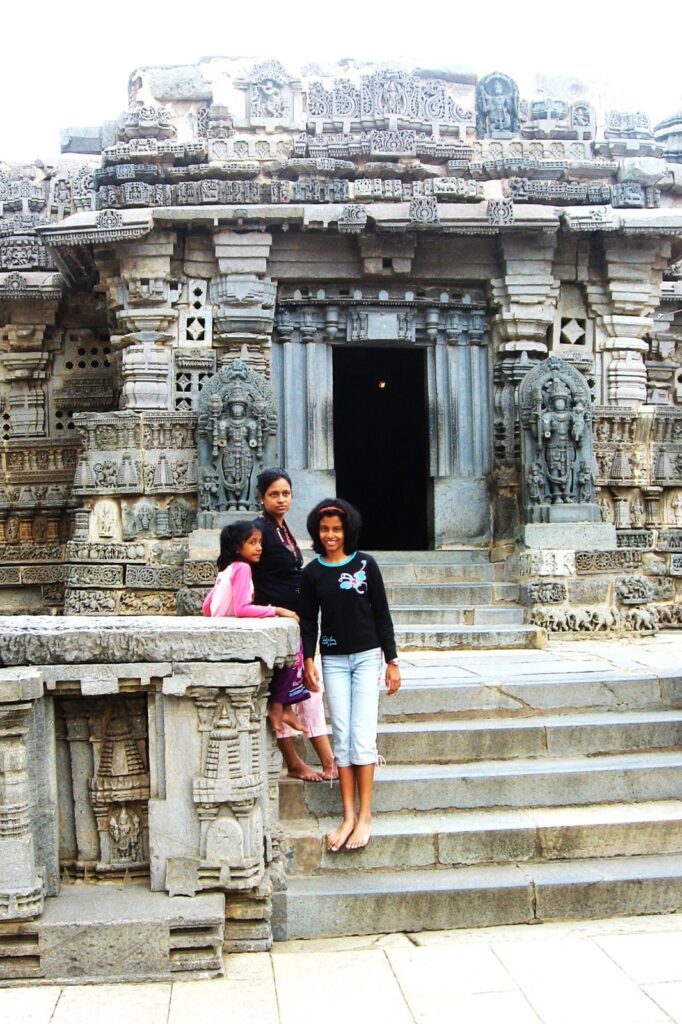
Me with my daughters in front of Somanathapura Temple
Together, these three monuments form the foundation of any Hoysala journey — but they are only the beginning. The real surprise lies in the lesser-known temples scattered across rural Karnataka, where the same craftsmanship survives without the crowds.
Lesser-Known Hoysala Temples Worth Visiting
The famous trio introduces Hoysala architecture. The real discovery begins once you leave the main highway. Across Hassan and Chikkamagaluru districts, village temples preserve the same craftsmanship in far quieter settings — often with no crowds and no barricades between you and the carvings.
To make planning easier, these temples are grouped by travel clusters so they can be covered in a single day’s circuit.
Around Hassan
Javagal – Lakshmi Narasimha
A compact but complete Hoysala temple where the narrative panels are unusually clear and readable. Ideal for learning how to identify epic scenes without the visual overload of Halebidu.
Best for: first-time learners of Hoysala sculpture
Time needed: ~45 minutes
Belavadi – Veeranarayana
A rare trikuta temple with a spacious, luminous hall. Unlike most Hoysalas, the interior dominates the experience — calm, symmetrical and meditative rather than ornate.
Best for: atmosphere and photography of interiors
Time needed: ~1 hour
Mosale – Twin Temples
Two nearly identical shrines facing each other across a courtyard — perfect for noticing stylistic differences within the same workshop tradition.
Best for: architecture enthusiasts
Time needed: ~40 minutes
Doddagaddavalli – Lakshmi Devi
One of the earliest Hoysala temples, built partly in granite. The fierce deities and lakeside setting create a mood very different from the later decorative temples. I had unique experience about a light bulb in the Lakshmi Devi Temple here.
Best for: history + ambience
Time needed: ~45 minutes
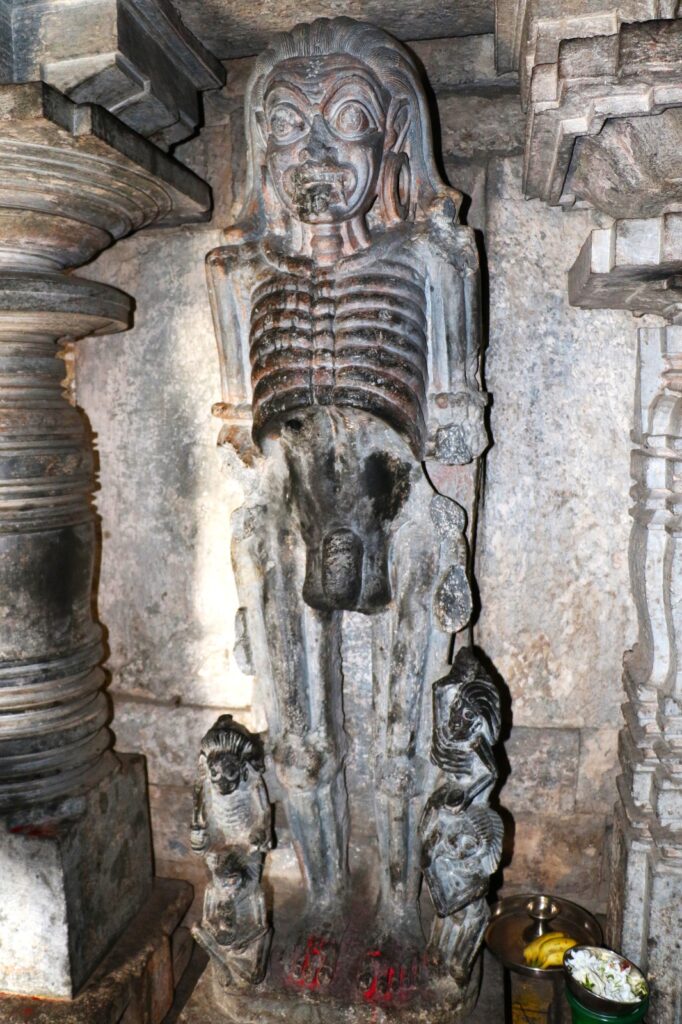
Bhoota Preta in Doddagaddavalli Hoysala Temple
Around Chikkamagaluru
Amruthapura – Amruteshwara
Known for long Mahabharata narrative panels that read almost like a carved comic strip when walked clockwise. I have some in my Amrutheshwara Temple blog. The temple priest I spoke with said, the Shiva Linga inside the main shrine was brought from the Gandaki River in present-day Nepal.
Best for: storytelling friezes
Time needed: ~1 hour
Baggavalli
Less ornate but locally distinctive — useful for noticing how regional craftsmen interpreted the Hoysala style. I have pictures of the Navaranga (main hall) of the Yoganarasimha Temple here that is famous for the 20 lathe-turned pillars in a blog.
Best for: quiet exploration
Time needed: ~30 minutes
Basaralu (optional detour)
Small yet refined, ideal as a final stop when returning toward Mysuru or Bengaluru.
Best for: short architectural stop
Time needed: ~30 minutes
Near Bengaluru
Arasikere – Ishvara
Famous for its 16-pointed star hall, one of the most geometrically complex Hoysala interiors. Light patterns shift dramatically through the day. I’ve covered Arasikere Ishvara Temple in a blog, where I explain how the dome’s shape affects sound.
Best for: geometry and photography
Time needed: ~1 hour
Kambadahalli
A Jain complex showing how the style adapts when ornamentation is restrained.
Best for: comparative architecture
Time needed: ~30 minutes
Kaidala
Traditionally associated with master sculptor Jakanachari; modest but culturally significant.
Best for: historical context
Time needed: ~25 minutes
How to Choose
- Photographers: Belavadi, Arasikere, Doddagaddavalli
- Architecture learners: Javagal, Mosale, Amruthapura
- Relaxed weekend travellers: Belavadi + Arasikere circuit
Exploring even two or three of these sites transforms the Hoysala experience — the temples stop feeling like monuments and begin to feel like living workshops scattered across the countryside.
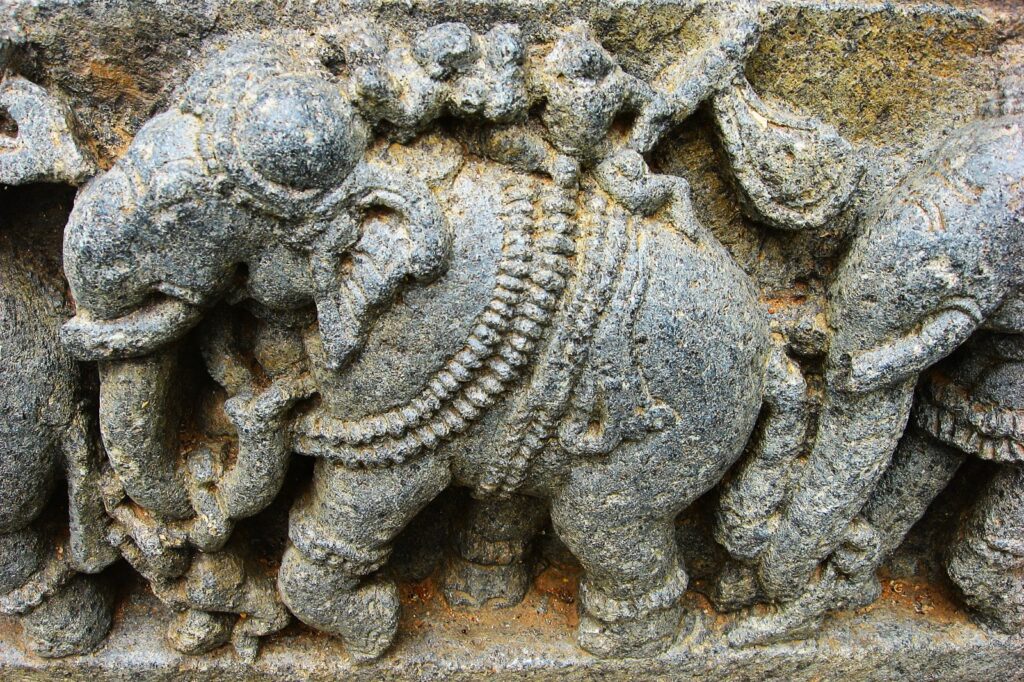
Close up image of Elephant statue in the Horizontal band in Hoysala Temple Base
Planning the Temple Clusters
The lesser-known Hoysala temples are surprisingly close to one another, which makes them ideal for slow exploration rather than rushed sightseeing. Most sites in the Hassan region lie within roughly 15–35 km of each other, connected by rural but motorable roads. You can comfortably base yourself at Belur or Halebidu and explore two to four temples in a relaxed day, stopping often rather than driving long stretches.
The Chikkamagaluru group works best as a second-day circuit when travelling westward, while Arasikere naturally fits either at the beginning of the journey from Bengaluru or on the return leg. Because distances are short, the real time investment is not travel but observation — each temple rewards lingering far more than covering many stops.
A practical approach is to treat the famous sites as anchors and the village temples as extensions radiating around them.
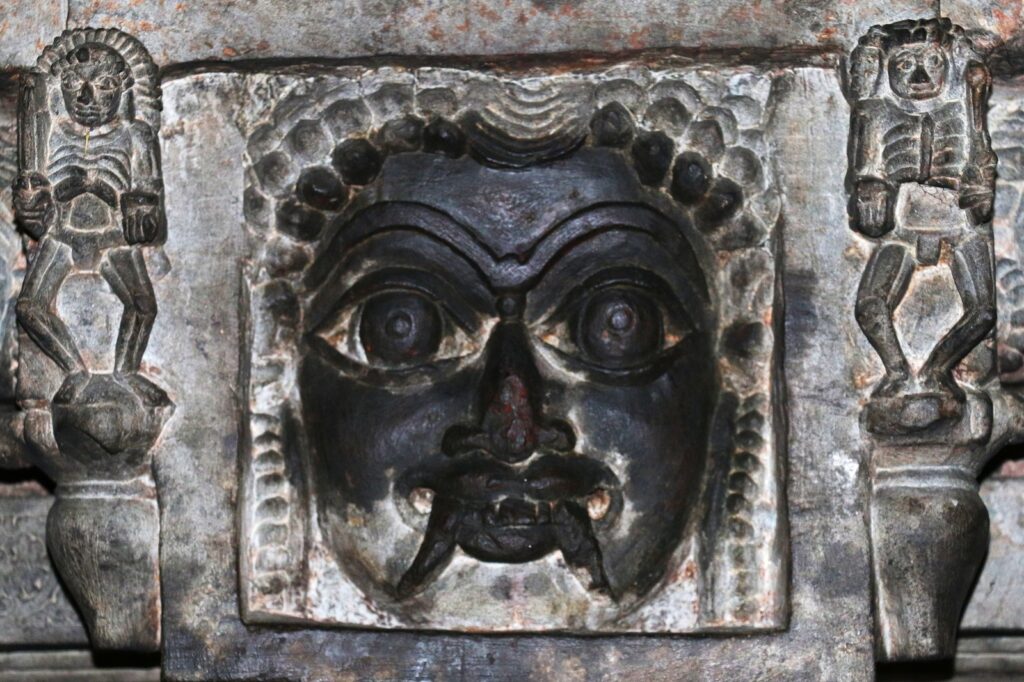
Bhuta and the Preta, guarding the Kali’s shrine in Doddagaddavalli
If You Have Limited Time
If you can add only one non-UNESCO temple to your itinerary, choose based on interest:
- Atmosphere and spacious halls: Belavadi
- Geometry and uniqueness: Arasikere
- Learning to read carvings: Javagal
With half a day, combine one major site with one nearby village shrine — for example Halebidu + Javagal or Belur + Doddagaddavalli.
With a full extra day, a satisfying circuit is: Belur → Halebidu → Mosale → Doddagaddavalli → Belavadi.
This sequence gradually moves from dense sculpture to calm interiors, preventing visual fatigue.
Trying to cover everything in a single day usually reduces the experience to photography rather than discovery.
Why These Temples Feel Different From the Famous Ones
At the major monuments you admire the architecture; in the smaller temples you understand it.
There are usually no barricades, queues, or fixed walking routes. You can stand close enough to notice chisel marks, compare panels side-by-side, and observe how sculptors repeated and modified patterns. Without crowds, circumambulation becomes natural rather than procedural — you pause when a scene catches your eye rather than when a pathway directs you.
These quieter shrines also reveal variation. Instead of a perfected royal monument, you see experimentation: simpler friezes, unusual iconography, or a hall emphasised over the exterior. After visiting them, returning to Belur or Halebidu feels different — the carvings stop appearing decorative and begin to feel intentional.
Together, the large and small temples complete the story: the famous ones display mastery, the village ones explain it.
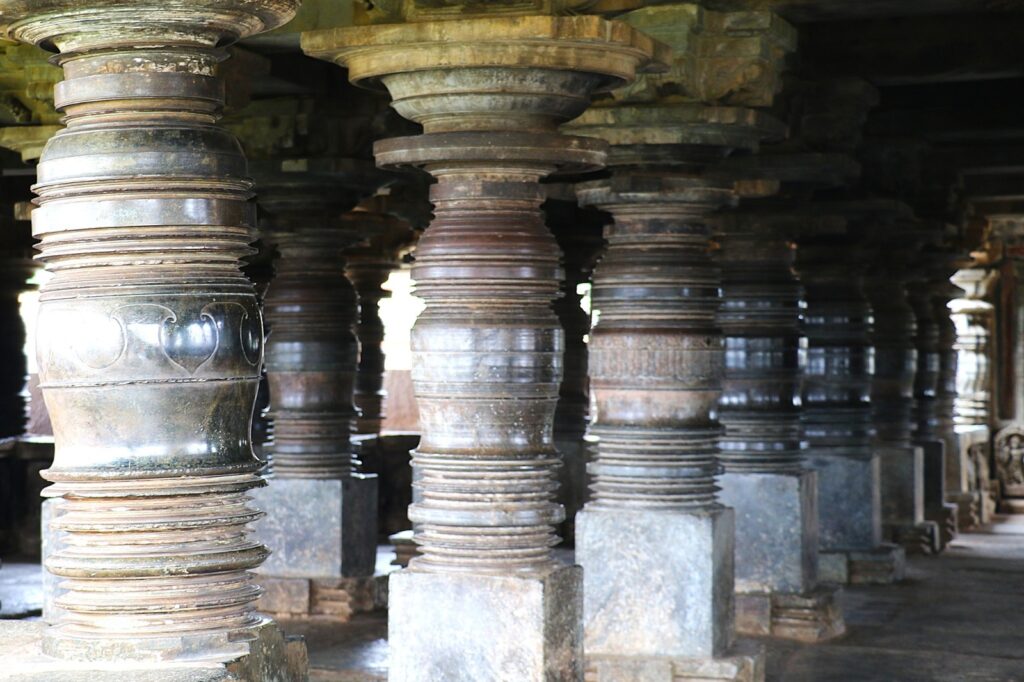
Hoysala Temple Halls lined with Lathe turned smooth pillars
How to “Read” a Hoysala Temple? Decoding the Friezes as You Walk
A Hoysala temple is not meant to be glanced at from the front. It is meant to be walked around slowly. The outer walls are arranged like a visual narrative, and the carvings begin to make sense only when you follow them in order during the clockwise circumambulation (pradakshina).
Instead of looking randomly, start from the base and let your eye travel upward. Almost every Hoysala temple follows a similar visual grammar — not rigid, but recognisable once you notice it.
- The World of Strength — Elephants
At the lowest band runs a continuous line of elephants, each carved differently. They represent the physical world: stability, weight, and the foundation of existence. Walking along them feels grounding — the temple is literally resting on the strength of the earth.
- The World of Action — Horses and Warriors
Above them appear horses, riders, and processions. Movement enters the composition. This layer shifts from existence to activity — life in motion, effort, conflict, and human ambition.
- The World of Courage — Lions and Yalis
Next come the leonine creatures, real and mythical. Their fierce expressions mark a threshold: the struggle against fear and chaos. Architecturally, this band acts like a protective boundary before sacred narratives begin.
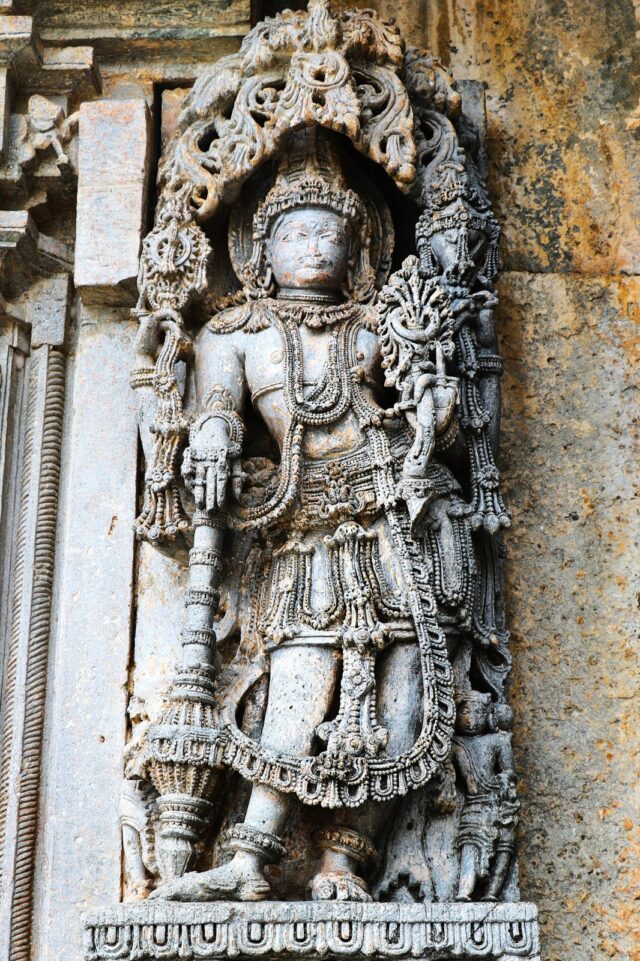
Human size Divine figures carved on Hoysala Temple wall
- The World of Story — The Epics
The broadest panels contain episodes from the Ramayana, Mahabharata and the Bhagavata Purana. Here the temple slows you down. You begin recognising familiar moments — a battle stance, a bow drawn, a vanara army marching. The path becomes a story rather than a corridor.
- The World of Grace — Dancers and Musicians
Higher still, celestial dancers and musicians appear. After struggle and duty comes harmony. The mood changes: figures bend, sway and celebrate. The stone suddenly feels light.
- The World of the Divine — Gods Above
Near the top sit deities and mythical forms, completing the ascent from earthly life to cosmic order. By the time your eyes reach here, you have symbolically travelled from the material world to the spiritual one — without entering the sanctum.
The beauty of this system is experiential. Once you notice it in one temple, you begin seeing variations everywhere — and the carvings stop being decoration. They become a guided journey in stone, where walking itself is part of understanding.
Instead of rushing, choose one wall and follow it fully. A single slow circuit often reveals more than photographing every sculpture.
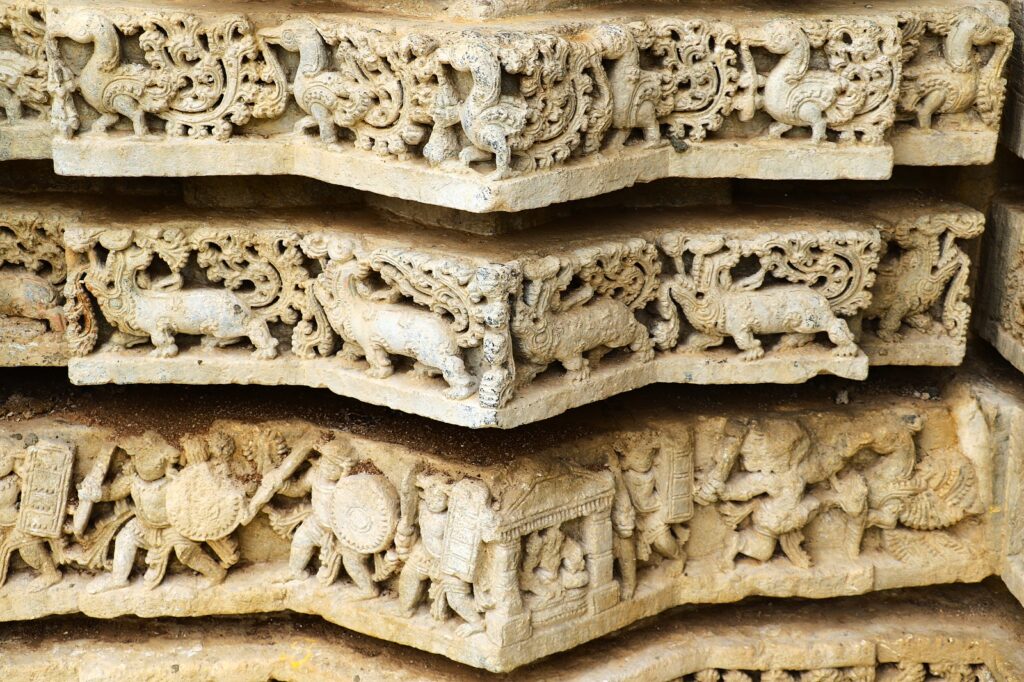
Photographer’s Tip – Choose a wall in the Hoysala Temple and follow its story
Planning Your Hoysala Heritage Circuit
Visiting Hoysala temples requires advance planning due to their distribution across Hassan, Chikmagalur, and Mandya districts.
Road conditions on national highways are excellent, but rural temple access roads can be narrow and poorly signposted—Google Maps pins are generally accurate but carry offline maps as mobile coverage is patchy in villages.
Best travel season: October through February offers cool weather (18-28°C), clear skies for photography, and minimal rainfall. Avoid June-September monsoons when rural roads become difficult and lighting is poor.
Essential logistics: Carry water, snacks, and cash (village temples lack facilities). Fuel stations are available in Hassan and major towns but scarce on rural routes. Most temples open sunrise to sunset with no formal entry fees, though donations are appreciated.
Suggested Road Trip Itineraries from Bengaluru, Hassan
Day 1: Bangalore → Belur and Halebidu (220 km, 4.5 hours)
Depart Bangalore by 6 AM. Visit Belur’s Chennakeshava Temple at opening (sunrise light optimal for photography). Drive 16 km to Halebidu’s Hoysaleswara Temple for afternoon exploration (allocate 2-3 hours). Overnight in Hassan (accommodation options range from budget lodges to mid-range hotels).
Day 2: Hassan → Doddagaddavalli, Arasikere, Belavadi (total 85 km)
Morning visit to Doddagaddavalli (18 km from Hassan), then Arasikere’s 16-pointed mantapa (40 km from Hassan on NH 73). End at Belavadi (16 km from Halebidu) for late afternoon light. Overnight in Chikmagalur or return to Hassan.
Day 3: Hassan → Hosaholalu, Javagal → Somanathapura → Bangalore (total 320 km)
Morning circuit covering Hosaholalu and Javagal (both within 30 km of Hassan). Drive to Somanathapura via Mysuru (140 km, 2.5 hours), visit Keshava Temple, then return to Bangalore (135 km, 3 hours).
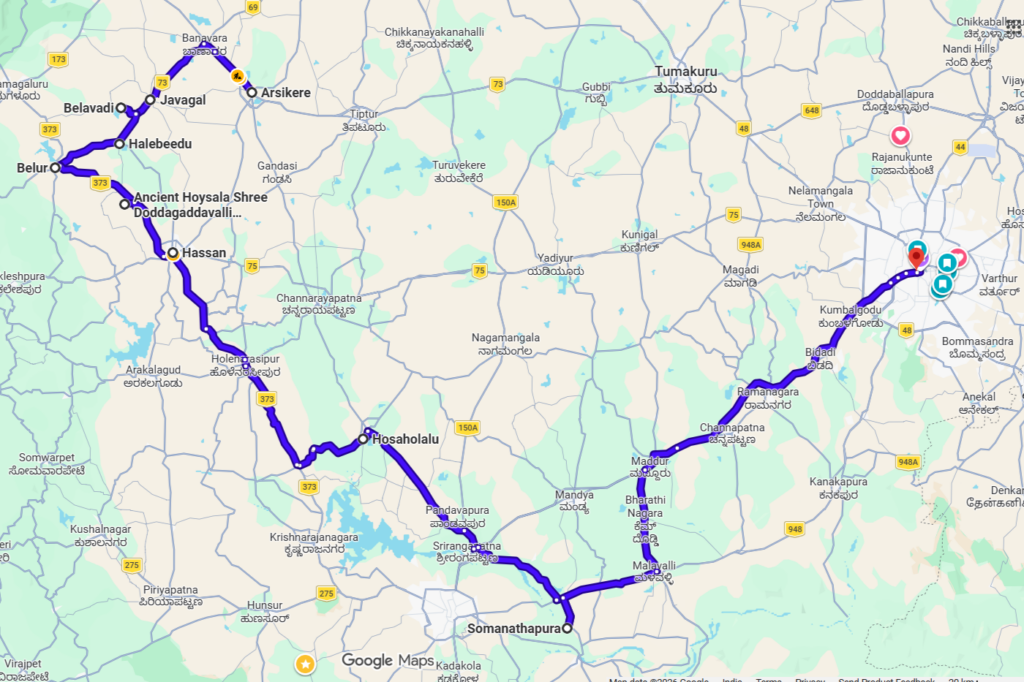
Hoysala Heritage Circuit from Bengaluru
FAQ on Hoysala Temples of Karnataka
Q1. What makes Hoysala architecture unique compared to Dravidian style?
Hoysala temples feature stellate (star-shaped) plans, intricate chloritic schist carvings, lathe-turned pillars, and the Vesara hybrid style blending Dravidian and Nagara elements. Unlike linear Dravidian temples with towering gopurams, Hoysala structures are compact and horizontal with emphasis on surface ornamentation rather than vertical monumentality.
Q2. How long does it take to cover the main Hoysala circuit?
A comprehensive 3-day road trip covers the UNESCO Big Three (Belur, Halebidu, Somanathapura) plus 4-5 lesser-known temples like Doddagaddavalli, Arasikere, Belavadi, Hosaholalu, and Javagal. A focused 2-day trip can cover just the UNESCO sites.
Q3. What is the best time to photograph Belur sculptures?
Early morning (6:30-8:00 AM) or late afternoon (4:00-5:30 PM) provides raking light that creates shadow depth, enhancing three-dimensional relief in soapstone carvings. Midday overhead sun flattens details.
Q4. Are these temples still active places of worship?
Yes, most Hoysala temples function as active Hindu shrines with daily pujas. Dress modestly (covered shoulders and knees), remove footwear before entering mandapas, and avoid photography during rituals unless permitted.
Q5. Which hidden Hoysala temples are near Bangalore?
Somanathapura (135 km via Mysuru) is the closest UNESCO site, accessible as a day trip. Hosaholalu and Javagal (approximately 200 km via Hassan) are feasible for weekend travelers willing to start early.
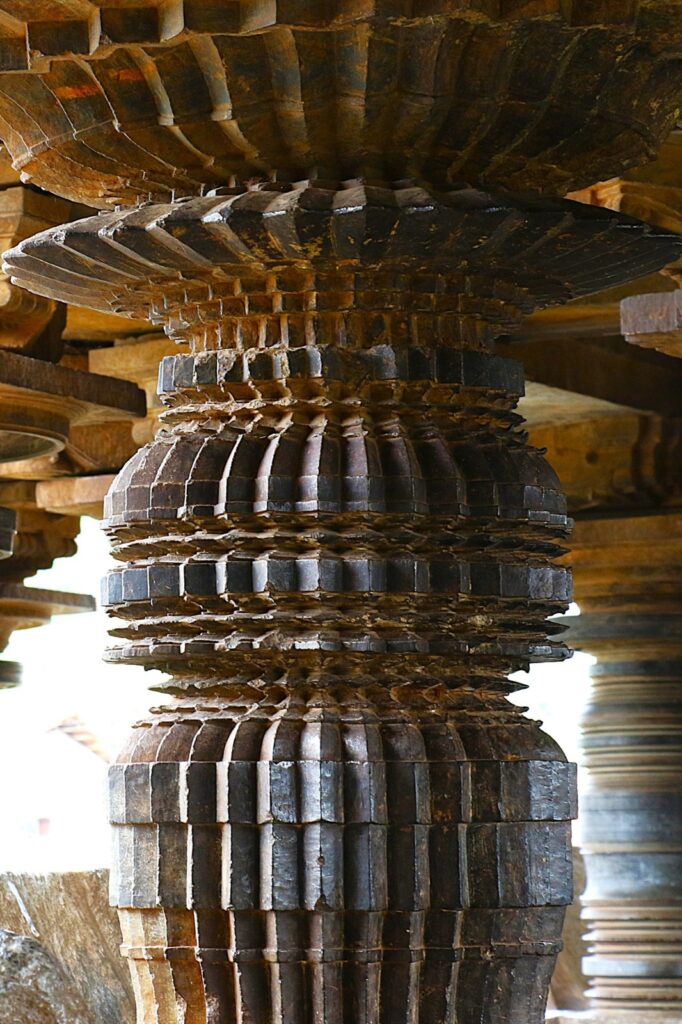
The edges sharp and fresh as if chiselled just yesterday
Final Thoughts
Hoysala architecture is more than a chapter in Karnataka’s history— the temples are a living testament to how art, geometry, and devotion can merge into timeless design. From the UNESCO-recognized ensembles at Belur, Halebidu, and Somanathapura to the hidden gems scattered across Hassan, Chikkamagaluru, and near Bengaluru, each temple offers a unique perspective on medieval craftsmanship.
For travelers, the journey is not just about visiting monuments but about experiencing temples as sculptures—walking around friezes, decoding layers of meaning, and appreciating jewellery-like detailing carved in soapstone.
Enjoy chasing the perfect light as a photographer in the temple halls, study the star-shaped plans as an architecture enthusiast, or simply seek serenity a casual visitor, the Hoysala circuit rewards curiosity at every stop.
By linking the famous with the forgotten, this guide aims to help you plan meaningful explorations and discover why the Hoysalas remain one of India’s most distinctive architectural dynasties.
Pin and Save this for later
About the Author
 Indrani Ghose is a cultural travel writer and heritage documentation specialist with over 15 years of experience exploring and writing about temples across India and Southeast Asia. Having visited over 150 sacred sites, she brings both scholarly depth and personal narrative to heritage travel writing.
Her work has been published in Lonely Planet, The National (UAE), Whetstone Asia, Deccan Herald, and various architecture and heritage journals.
Connect with Indrani: Follow Indrani on Instagram | Twitter | Facebook for heritage travel insights, photography tips, and offbeat destination discoveries.