Ras Mancha Temple, Bishnupur, West Bengal
Ras Mancha Temple: Bengal’s Unique Terracotta Pyramid
The Ras Mancha in Bishnupur surprised me even more than the remarkable twin-roofed Jor Bangla Temple. Its pyramid-like outline seemed completely out of place among Bengal’s terracotta temples.
Built around 1600 AD by King Bir Hambir of the Malla dynasty, it is the only temple in Bengal built in a stepped pyramidal form — a complete break from the shikhara towers and curved roofs that define most Hindu temples. Its purpose was equally unusual: during the annual Ras festival, idols from all the surrounding temples of Bishnupur were brought here so that devotees could worship them together in one place.
That combination — a unique architectural form designed for a specific communal ritual — is what makes the Ras Mancha stand apart. Located in the heart of Bishnupur, a town renowned for its terracotta temples, the Ras Mancha is the monument that defines the town’s identity. If you visit just one site here, make it this one.
By Indrani Ghose | Last Updated: June 2026
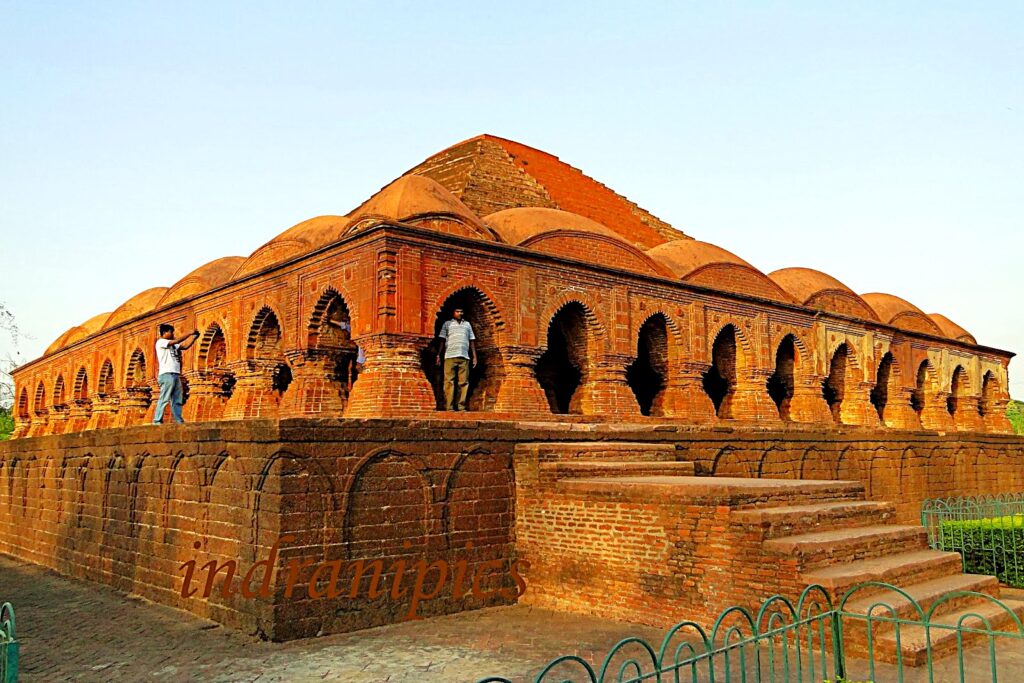
Ras Mancha Temple built on raised platform
What Makes the Ras Mancha Temple Architecturally Unique?
The architecture of the Ras Mancha Temple sets it apart from every other terracotta shrine in Bishnupur — and in India. The structure is built on a large square base that rises in three tapering tiers, forming a stepped pyramid.
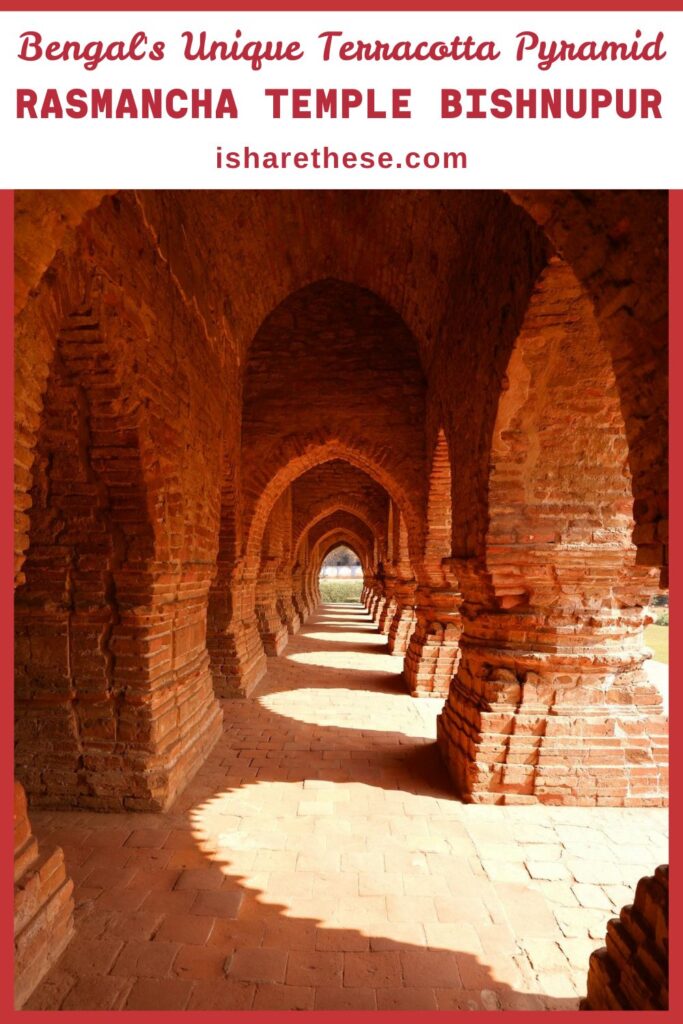
Each tier is lined with arched passageways, creating an open gallery that wraps around the entire building. These galleries were not decorative: they were functional spaces where devotees could walk around and view the idols brought from surrounding temples during the Ras festival.
The outer walls and arches and bare. carry terracotta panels depicting scenes from the Ramayana, Mahabharata, and the life of Krishna. What makes this notable is how the panels are embedded throughout the galleries rather than concentrated on a single façade, creating a continuous visual narrative as you walk through.
The most distinctive feature, however, is structural: the Ras Mancha has no central sanctum. It was never a traditional place of worship in the conventional sense. It was a ceremonial stage — built to serve an event rather than house a deity permanently.
This is what separates the Ras Mancha from all other terracotta temples of Bishnupur: its pyramidal form, gallery system, and event-driven design make it a genuinely one-of-a-kind monument.
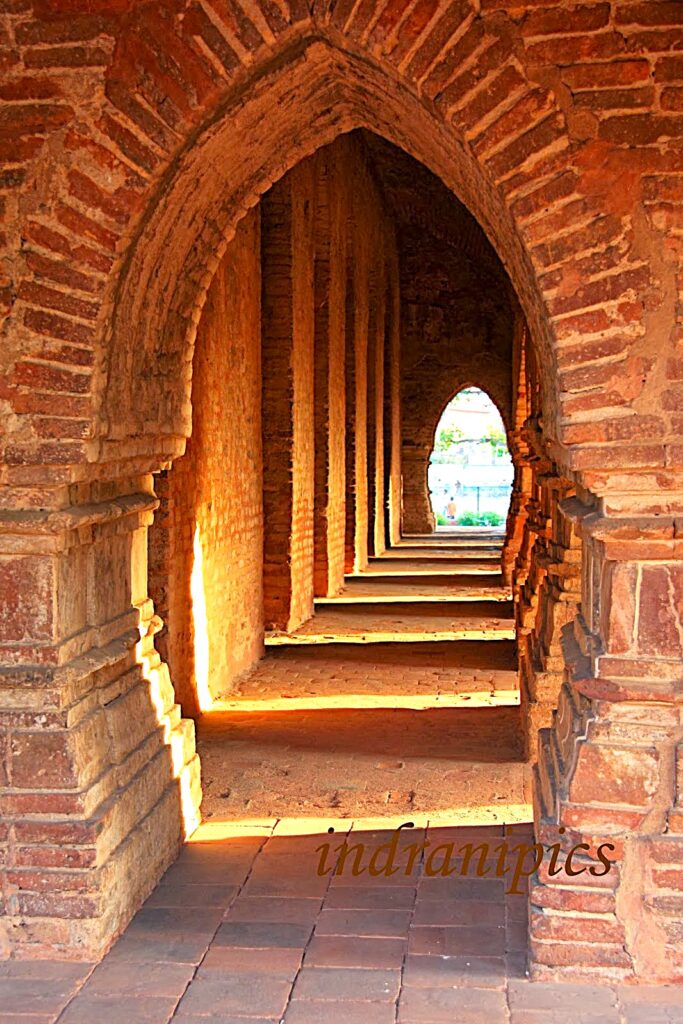
Sunlight Filtering in through the Arches
The History of the Ras Mancha: A Malla Kingdom Masterpiece
The Ras Mancha was commissioned by King Bir Hambir of the Malla dynasty around 1600 AD. Bishnupur served as the capital of the Malla kings, rulers who were notable patrons of art, music, and architecture. Under their reign, the town became the centre of terracotta temple building in Bengal — a tradition that produced over two dozen temples across roughly two centuries.
The Ras Mancha was built with a specific ritual purpose: to serve as the central venue for the annual Ras festival of Lord Krishna. Every year, idols from the surrounding temples of Bishnupur were carried in procession and displayed here together. For devotees, this meant access to multiple deities in a single location — a significant act of community worship.
Since the inner sanctum cast no shadow, the locals called this temple, Alok Mandir.
The pyramidal design was very different from established temple forms of the time. It reflected the Malla dynasty’s willingness to innovate, adapting architecture to serve a communal function rather than purely a religious one.
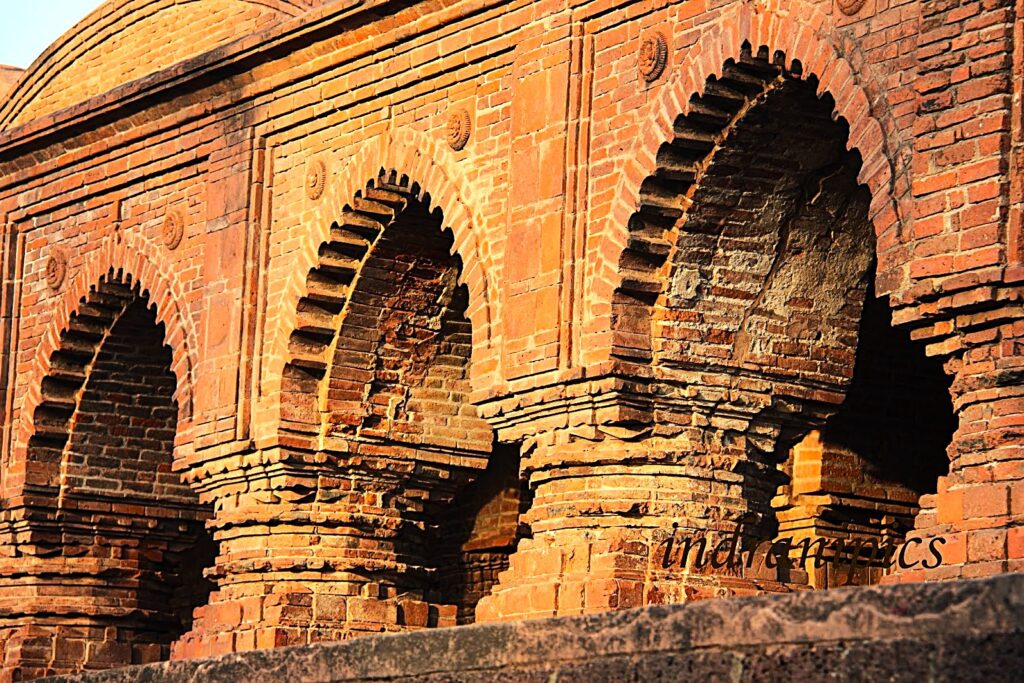
Raw brick Structure of the Arches
My Visit to the Rasmancha Mandir in Bashnupur
Climbing the short flight of steps leading to the raised platform, I came face to face with the temple’s distinctive arched façade. Much of the original lime plaster had peeled away over the centuries, exposing the brickwork beneath.
Unlike many of Bishnupur’s terracotta temples, the façade bore very little decorative terracotta work. Only a few circular medallions with geometric patterns survived high above eye level, safely beyond the reach of curious hands.
Passing through one of the arches, I entered the outer gallery and slowly made my way around the structure. Beyond it lay a second ring of arches enclosing a series of chambers, now secured with grilled doors.
Our guide explained that during the annual Ras festival, idols from various temples across Bishnupur were once brought here and displayed in the central sanctum. In those days, there were no doors or barriers; devotees could walk through the galleries, circumambulate the structure, and view the deities gathered under one roof.
I was pleased to see how well the Ras Mancha Temple and its surroundings within the fence around it was maintained well by the Archaeological Survey of India. It looked like a rust colored glowing gem surrounded by ring of emerald green layer.
For historians, architects, and travellers interested in Malla Kingdom history and Bengal’s terracotta heritage, this temple is a must visit. For me, standing inside those arched galleries, the scale and intention of the structure felt genuinely impressive.
Essential Travel Logistics for Your Bishnupur Trip
Getting to Bishnupur is straightforward. The town has its own railway station — Bishnupur Junction — with direct trains from Kolkata’s Howrah and Sealdah stations. The journey takes around 3 to 3.5 hours.
If you prefer road travel, Bishnupur is approximately 130 km from Kolkata, roughly a 4–5 hour drive depending on traffic, making it a practical weekend trip.
The Ras Mancha Temple is maintained by the Archaeological Survey of India.
Entry fees are nominal: ₹25 for Indian citizens and ₹300 for foreign nationals, with free entry for children under 15. One ticket covers multiple ASI-protected monuments in Bishnupur, including several other terracotta temples — good value if you plan a full-day visit.
The best time to visit Bishnupur is between October and March. The weather is pleasant, and the open-air temple complex is comfortable to explore on foot. Summers are hot and humid, and the monsoon season brings heavy rain that can make sightseeing difficult.
Within Bishnupur, most temples are clustered close together. Autos, cycle rickshaws, and walking are all practical options.
Photography is permitted throughout the complex, but avoid touching the terracotta panels — the carvings are fragile and irreplaceable.
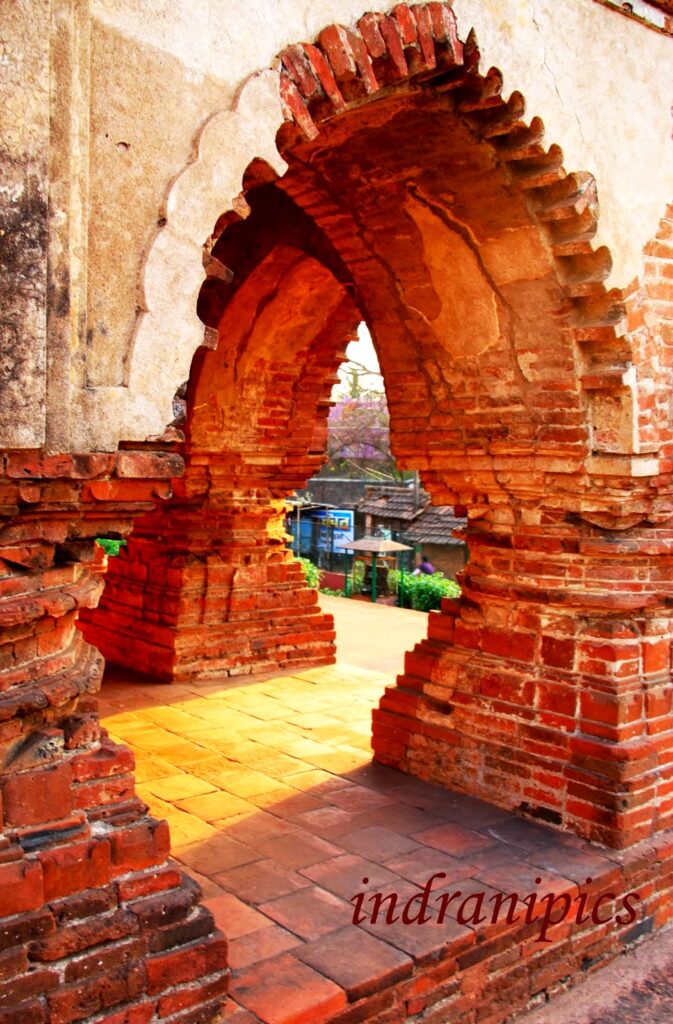
Lime Plaster peeled away at places
FAQ about Ras Mancha Temple Bishnupur
Q. What is the Ras Mancha Temple famous for?
A. The Ras Mancha is the only temple in Bengal built in a stepped pyramidal form. Unlike conventional Hindu temples, it has no central sanctum. It was designed as a ceremonial venue where idols from surrounding temples were displayed together during the annual Ras festival of Lord Krishna.
Q. Who built the Ras Mancha Temple?
A. King Bir Hambir of the Malla dynasty built the Ras Mancha around 1600 AD. The Malla kings ruled from Bishnupur and were major patrons of terracotta architecture in Bengal.
Q. What is the entry fee for the Ras Mancha Temple?
A. The ASI entry fee is ₹25 for Indian citizens and ₹300 for foreign nationals. Children under 15 enter free. The ticket also covers access to other protected monuments in Bishnupur.
Q. What is the best time to visit Bishnupur?
A. October to March is ideal. The weather is dry and pleasant, making it comfortable to explore the open-air temple complex. Avoid peak summer (April–June) and the monsoon months (July–September) if possible.
Q. How is the Ras Mancha different from other terracotta temples in Bishnupur?
A. Most terracotta temples in Bishnupur — such as Jor Bangla or Madan Mohan — follow traditional Bengali roof styles and function as active shrines. The Ras Mancha is distinct in three ways: its stepped pyramidal form, its open gallery system, and its original role as a festival stage rather than a permanent place of worship.
Final Thoughts
The Ras Mancha Temple earns its place as Bishnupur’s most distinctive monument — not because of its age or size, but because of the thinking behind it. It was designed to serve a community, built around a ritual, and given a form that exists nowhere else in Indian temple architecture.
Bishnupur’s other temples — Jor Bangla, Kalachand Temple, Shyamrai — are worth visiting for their terracotta craftsmanship. But the Ras Mancha gives you the larger picture: what the Malla kings were trying to build, and why Bishnupur became the centre of terracotta heritage in Bengal.
The group of terracotta temples in Bishnupur is included in UNESCO-recognised heritage cluster. This terracotta temple town deserves a place on every heritage traveller’s itinerary. The Ras Mancha is the best place to start.
If you found this guide useful, you may also want to read my pieces on Chanderi: India’s Loom Town and Sanchi Stupa’s Buddhist legacy — both cover India’s historic sites with the same practical focus.
Pin and Save this for Later
About the Author
 Indrani Ghose is a cultural travel writer and heritage documentation specialist with over 15 years of experience exploring and writing about temples across India and Southeast Asia. Having visited over 150 sacred sites, she brings both scholarly depth and personal narrative to heritage travel writing.
Her work has been published in Lonely Planet, The National (UAE), Whetstone Asia, Deccan Herald, and various architecture and heritage journals.
Connect with Indrani: Follow Indrani on Instagram | Twitter | Facebook for heritage travel insights, photography tips, and offbeat destination discoveries.






Beautiful temple .amazing architchture of bricks terracotta shining like gold.lovely arches and pyramid like structure. Really one can’t give a miss if one visits kolkatta.
This place reminds me of Talatal Ghar in Sibsagar. Has got a very similar architecture. They are also of the similar period as Ras Mancha, but yet it is ironic that the latter still awaits UNESCO attention for so many years.
Noted on my bucket list. It will be even more ‘criminal’ for a ‘Bong’ not to visit. Thanks
Never seen anything like this….wow.
wow, it looks so beautiful and wonderful. Doesn't look like a temple though 🙂 Great captures 🙂
amazing amazing clicks… every brick is shining like rusted gold …loved it !Kokila
wow! beautiful captures indrani.
history sure can captivate an individual…
I've visited the Rash-mancha Temple..its really gorgeous…great shots Indrani.
Never heard of these temples. Thanks for posting. Will keep in mind when visiting that part of the country. 🙂
What the huge walls of the temple!! Sounds an interesting place to visiting.. thanks for sharing your experience with us through this article..
I wonder what is stopping the World Heritage authorities to declare this a UNESCO monument! Such a beautiful architecture, and there's less visible vandalism too!
Beautiful clicks..:) and i seriously wish it gets into the world heritage site list…
Did not know it is a Heritage site. The architecture is awesome.
You made awesome pictures here! I could understand from your write up how significant this temple complex was. The pyramid like structure seems unique on its kind
i wish i could get there and see it one day,
it's indeed beautiful.
Excellent capture of Wonderful architecture !
Amazing terracotta architecture. I am eagerly waiting for a chance to visit Kolkata.
so charming. idk if that's the appropriate word for this gorgeous temple, but i find it replete with charm. i hope that it gets that much coveted status so that it can be ensured of protection and preservation.
Fantastic photos and beautiful structures.
I am charmed.
Greetings from far away Polish.
Lucia
What a beautiful temple! Your first photo is simply gorgeous.
What interesting architecture, I would love to visit one day.
Such an incredibly beautiful temple, Indrani! I, too, love the arches! Superb captures and such wonderful detail!! Thanks as always for sharing the beauty!
Amazing temple and your photos detailed it so well! What a beautiful travel you did!
Wow! Magnificent to say the least. The most beautiful. And so well composed the first image is. I hope too that this would be a heritage site.
The architecture is so lovely, wonderful arches. I wonder why it's taking so long to be declared a World Heritage Site.
Liebe Indrani, herzlichen Dank für diesen interessanten Einblick…
Grüsse aus der Schweiz, Hans-Peter
for a building built five hundred years ago these temples look in surprisingly good condition. How do you get to Vishnupur for Kolkata