Madhukeshwara Temple Banavasi: A Complete Guide to Karnataka’s Oldest Town
When I visited Banavasi in May 2017, the pre-monsoon heat blanketed Karnataka’s oldest town in stillness. The Varada River wound quietly past temple walls, its banks untouched by the usual tourist crowds. This remoteness is Banavasi’s strength—it remains exactly what it has been for 1,700 years: the first capital of Karnataka.
Founded by Mayura Sharma in the 4th century CE, Banavasi became the Kadamba dynasty’s seat of power, marking the birth of Karnataka’s political identity. The Madhukeshwara Temple stands at its center, built in the Kadamba Nagara architecture style with a honey-colored linga that gave the shrine its name.
– By Indrani Ghose | Last Updated: January 2026
For travelers willing to venture beyond Gokarna or Goa, Banavasi offers something rare: a heritage site where history isn’t reconstructed—it’s preserved. Located 22km from Sirsi in Uttara Kannada district, this town remains one of South India’s most underappreciated archaeological treasures.

Madhukeshwara Temple Banavasi
The Historical Legacy of the Kadambas
The Madhukeshwara Temple’s foundation dates to approximately 345 CE, when Mayura Sharma established the Kadamba dynasty after defeating the Pallava rulers. Historical records describe Mayura Sharma as a Brahmin scholar who turned warrior following an incident of disrespect in Kanchipuram. His victory created Karnataka’s first indigenous dynasty, making Banavasi—then called Vanavasi—the region’s earliest documented capital.
The Kadambas developed the Kadamba Nagara architectural style, characterized by stepped pyramidal towers and modest ornamentation compared to later Dravidian temples. This style influenced subsequent dynasties including the Chalukyas and early Hoysalas. The Halmidi Inscription, discovered near Hassan and dated to 450 CE, represents the oldest known Kannada script and directly links to Kadamba patronage of the language.
Banavasi’s cultural importance extended to literature. Adikavi Pampa, the 10th-century poet considered the father of Kannada literature, wrote: “It is a virtue to be born in Banavasi as a human being.” This quote appears in his epic Vikramarjuna Vijaya and reflects the town’s literary prestige during the medieval period.
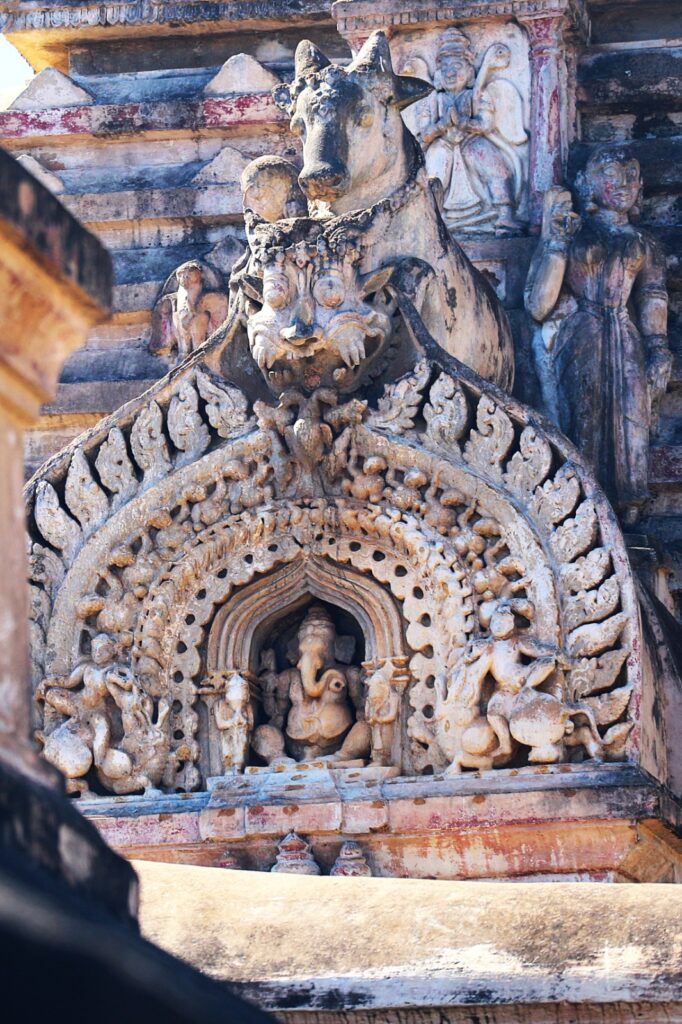
Image of Ganesh, Nandi and Garuda on Facade
The temple complex shows architectural layers from multiple eras. While Kadamba-era foundations remain, Chalukya renovations from the 7th century added structural elements, and Hoysala artisans contributed sculptural details during the 12th century. This layering makes Madhukeshwara Temple an architectural timeline of Karnataka’s ruling dynasties.
For travelers interested in Karnataka’s origins, Banavasi provides direct connection to the state’s political and cultural birth. The Kadamba legacy here isn’t abstract history—it’s visible in stone, script, and the town’s continued reverence.
Why is the Deity Called ‘Madhukeshwara’?
The temple’s presiding deity is Lord Shiva, worshipped as Madhukeshwara—”madhu” meaning honey in Sanskrit and “ishwara” meaning lord. The name references the honey-colored linga inside the sanctum, which differs markedly from the black stone lingas typical of South Indian Shiva temples.
The linga’s golden-brown hue comes from the specific stone composition, though local tradition attributes spiritual significance to the color. Devotees consider the honey tone a symbol of divine sweetness and prosperity. Architecturally, the linga sits within a simple square sanctum typical of Kadamba Nagara design, without the elaborate decoration seen in later temple styles.
When I entered the sanctum in 2017, the honey linga’s warm color was immediately visible even in dim lamplight. Temple priests explained that this unique coloration has made Madhukeshwara Temple a reference point in comparative studies of Karnataka’s Shaivite shrines. The honey linga remains the temple’s most distinctive architectural entity and primary draw for both pilgrims and heritage researchers.
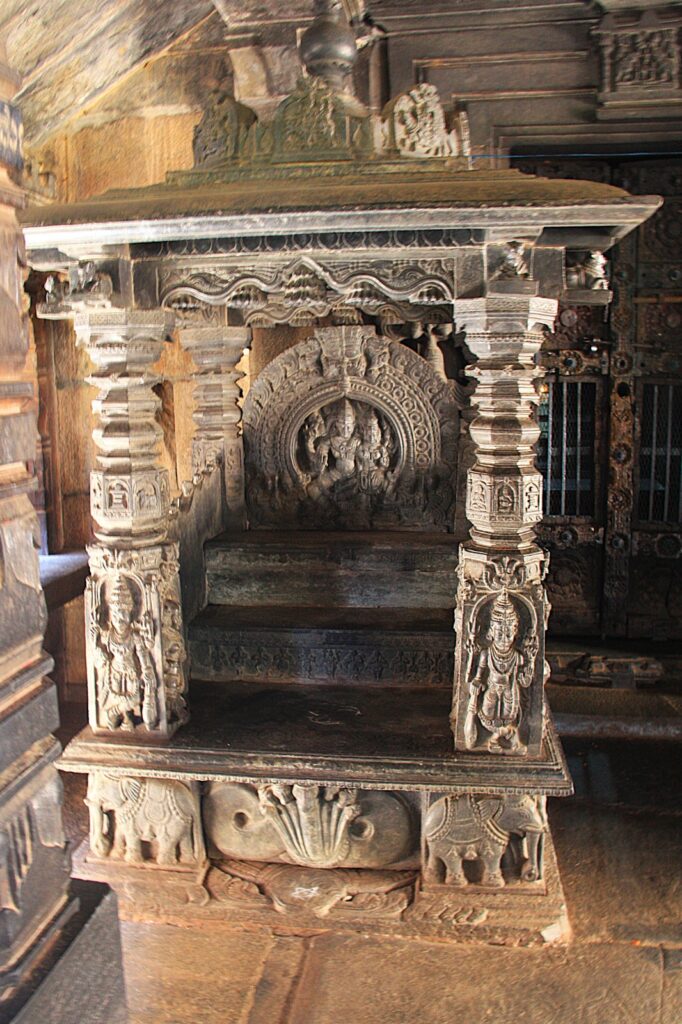
Stone triloka mandapa with Shiva and Parvathi sitting on the throne in SRI MADHUKESHWARA TEMPLE BANAVASI Karnataka India Asia
Architectural Marvels: A 1,500-Year Design Evolution
The Madhukeshwara Temple functions as an architectural palimpsest—each dynasty left visible marks on the structure.
- The Kadamba foundation from the 4th century CE forms the core,
- with Chalukya additions from the 7th century,
- Hoysala sculptural work from the 12th century,
- and Sonda dynasty contributions from the 17th century.
Walking through the prakara (outer enclosure) in May 2017, I observed how these layers created a coherent whole rather than a disjointed assemblage.
The Kadamba Nagara Vimana: Stepped-Pyramid Architecture
The main sanctum features the Kadamba Nagara style vimana—a stepped-pyramid tower that distinguishes this architectural tradition from both North Indian shikhara designs and later Dravidian gopurams.
The vimana rises in distinct horizontal tiers, each layer slightly receding to create the stepped effect. Unlike the curved profiles of Hoysala temples or the towering gateways of Chola architecture, Kadamba Nagara emphasizes geometric simplicity and proportional balance.
This stepped-pyramid design became the template for early Karnataka temple architecture, influencing structures across the Western Ghats region. The vimana at Madhukeshwara Temple represents one of the earliest surviving examples of this style in South India.

Architectural Details of Madhukeswara Temple
The Monolithic Stone Cot: Sonda Dynasty Craftsmanship
The stone cot inside the mantapa (pillared hall) is a single-block granite structure. This stone cot was a gift of a Sode chief, Raghu Nayaka to the temple during the 17th century.
The cot measures approximately six feet in length with pillars supporting an ornate canopy. The pillar work mimics turned wood detailing—a technical achievement given granite’s hardness.
Temple records indicate the cot was used during Vasantotsava (spring festival) ceremonies when deities were placed on it for public darshan.
In 2017, the polish on the stone remained mirror-smooth despite centuries of handling, suggesting highly refined stone-finishing techniques. It was kept in a room with grilled doors and we were able to take pics only through the grills.

Monolithic Stone Cot
The Two-Eyed Nandi: Alignment Engineering
Most temples have a Nandi looking straight at the Shiva Linga. However, the monolithic Nandi bull positioned in the mantapa of Madhukeshwara is a masterpiece of perspective and demonstrates precision in sculptural alignment.
This sculpture’s positioning creates a dual sightline:
- the left eye aligns with the Madhukeshwara linga in the central sanctum
- while the right eye directs toward the Parvati shrine in the adjacent chamber.
This geometric calculation required exact measurements during carving and installation.

The ‘Clever’ Nandi – A Geometric Wonder
The Triloka Mantapa Ceiling: Cosmological Narrative
The main hall ceiling depicts the Triloka (three worlds) concept from Hindu cosmology through carved panels:
- Bhuloka (earth realm) shown through human and floral motifs
- Patala (underworld) represented by Naga serpent carvings
- Swarga (celestial realm) indicated by the central dome with apsara figures
This iconographic program follows temple design texts like the Shilpa Shastras, which prescribed specific visual representations for cosmic layers.

Triloka Mantapa (The Three Worlds)
Inscribed Naga Sculpture
Another must see here is the inscribed Naga (serpent)sculpture carved on a thin rectangular slab. It has 5 hooded coiled serpent as the central figure.
Inscription is in Brahmi characters of 2nd century and Prakrit language along the side borders.
The inscription reads that the naga is a gift along with a tank and vihara by Sivaskanda Nagasri, daughter of Haritiputera Chutukulananda. It is kept in the navaranga of the temple.

5 hooded Naga sculpture
Comparison of Architectural Features
| Feature | Dynasty Influence | Key Highlight |
| Main Sanctum | Kadamba | Honey-colored Shiva Linga |
| Pillars | Chalukya | Lathe-turned, highly polished granite |
| Stone Cot | Sonda Kings | Monolithic granite with “wooden” finish |
| Outer Shrines | Hoysala | Ornate carvings and star-shaped patterns |
These architectural elements—the stepped-pyramid vimana, monolithic installations, calculated alignments, and narrative ceiling work—establish Madhukeshwara Temple as a primary reference for studying Kadamba Nagara architecture’s evolution across dynasties.
My May 2017 Visit: A Personal Retrospective
May in Uttara Kannada can be unforgivingly hot, yet the stone floors of the Madhukeshwara Temple remained cool underfoot—a quiet relief as I stepped into the sanctum. Banavasi, though small and tucked away, would perhaps have faded into obscurity if not for this temple, standing resilient since the 3rd century AD. To think of a shrine nearly 18 centuries old, dedicated to Bhagwan Shiva, was humbling.
We arrived just as the pujari was preparing to close the main shrine for the forenoon. By sheer luck, we were among the last batch allowed to offer puja archana—flowers and fruits placed reverently before the honey-colored linga. The moment felt deeply personal, a rare alignment of timing and devotion.
Outside, the temple complex was well maintained, its carvings and structures a delight for history buffs and architecture lovers. I recalled my earlier visits to Ajanta and Ellora, monuments from the 8th century, and realized how much older Banavasi truly is.
After the doors closed, a young pujari guided us around the complex, narrating its layered history. Later, in one of the local khanavalis (small eateries), I tasted authentic jolada rotti with spicy chutneys—a rustic meal that completed the experience of Banavasi’s timeless charm.
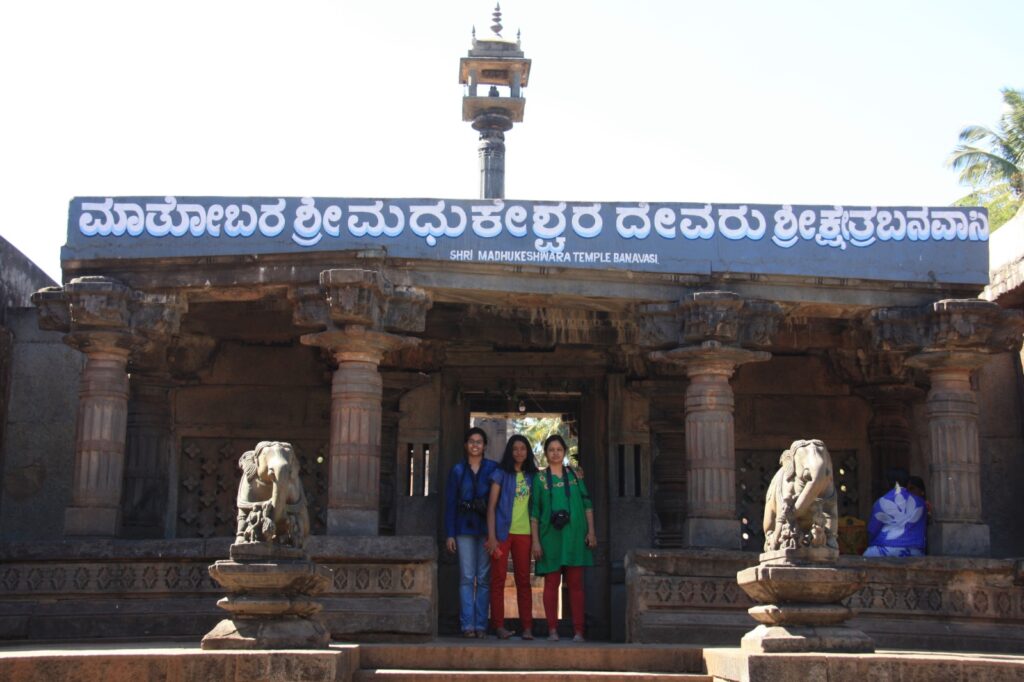
Entrance of Sri Madhukeshwara Temple Banavasi
What to See in Madhukeswara Temple Banavasi
Below are the highlights one must see in this ancient temple of Banvasi.
- Madhukeshwara Temple is east facing, has a square garbhagriha and a circumambulatory passage all around it.
- It is dedicated to Bhagwan Shiv, the supreme God in Shaivism, a major branch of Hinduism.
- Main idol here is of Madhukeshwara linga on a decorated yonipitha. The linga is honey (madhu) colored, hence the name. No photography is allowed only in this part of the temple.
- There are 2 sub shrines housing Mahishamardhini and Ganesha.
- Right in front there is a hall with massive pillars (not in height but in cross section). These are square pillars, very typical of Chalukya period.
- We then came out to navaranga, a mini hall which houses an ornate Nandi image. This Nandi is 7 ft tall and made from one single stone.
- The priest told us the sculpting feat behind the turned face of the Nandi, with one eye he sees the Shivalinga and with another the Parvati temple.
- Notice the sculptures of Adimadhava and Kartikeya.
- Entrances on 3 sides are indications of work by Kalyana Chalukya period.
- Shikhara has beautiful stucco figures of Nandi in four corners, 10 incarnation of Vishnu, 12 forms of Aditya, Dikpalakas, the guardian deities, and also Nagabandhas.
- Roof of Navaranga is flat at center and slopes along periphery.

Divine figures sculpted on walls of Madhukeshwara Temple Banavasi
- Dhvajasthamba is in the front of the temple.
- Sub shrines in the complex are: Dhundiraja, Ganapati, Chintamani Narasimha, these are contributions from Sonda Kings.
- Highly ornate stone cot
- 5 hooded serpent head
Ancient Holy Town Banavasi
Banavasi of Uttara Kannada district is the oldest town of Karnataka. It was the capital of Kadamba Empire in 345AD. Madhukeswara Temple is a part of the remains of this ancient kingdom. Since olden times life in this quaint little town revolved around this temple. Today it has around 1500 families and a population of 6700. I saw some of the houses which had old charming facades.
Very few parts are left of Banavasi Fort. Excavations carried out here during the later part of 20th century yielded some coins and potteries belonging to Satavahana period.
Places to Visit in Banavasi are:
- Adikadambeswara Temple
- Tripurantakeshvara Temple
- Allamaprabhu Temple
- Gudnapur with lot of inscriptions
- Pampavana, a garden with many medicinal plants
Festivals in Banavasi
- Ideal time to visit is during Kadambotsava, a cultural festival celebrated for continuous two days in the month of December. Musical bands and folk dancers participate in this grand festival.
- Another major festival celebrated here is Mahashivaratri during the month of February.
- Madhukeshwara Car Festival
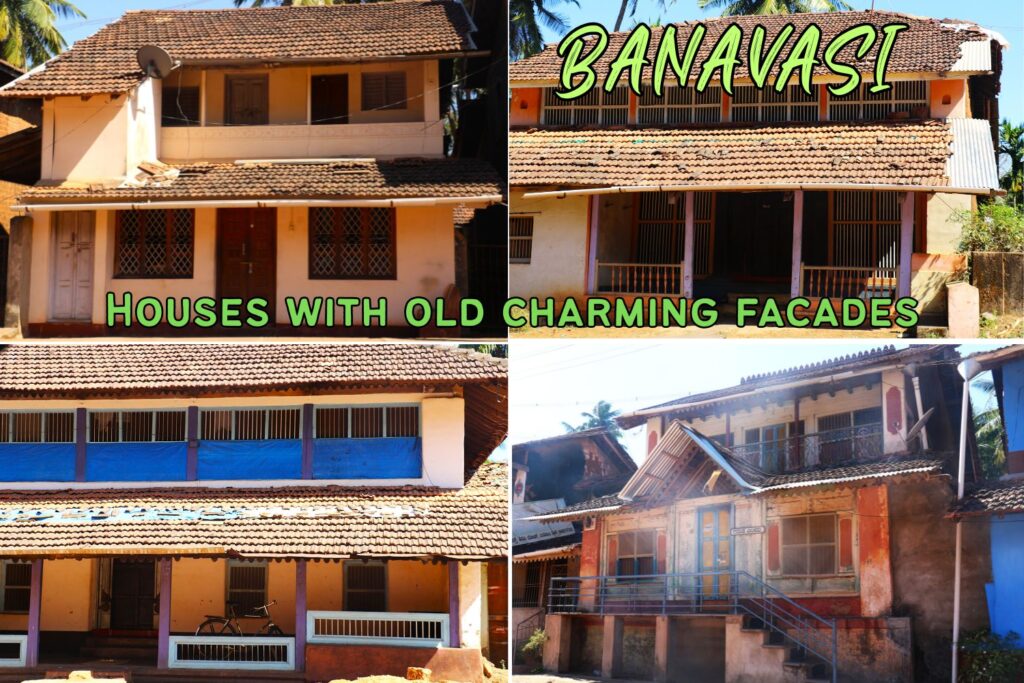
Banavasi Old Houses
Travel Guide to Visit Madhukeshwara Temple Banavasi
Banavasi is located 22 km southeast of Sirsi in Uttara Kannada district. The nearest major city is Hubli, approximately 100 km away, with the closest airport at Hubli Airport (100 km) and railway station at Hubli Junction.
By Road: State-run KSRTC buses operate daily between Sirsi and Banavasi, with departures every two hours. The journey takes 45 minutes. Private vehicles can follow NH-206 from Sirsi, turning at the Banavasi junction—the road is paved but narrow through forested sections of the Sahyadri range.
Distances by road:
Sirsi to Banavasi – 22 km
Karwar to Banavasi – 144 km
Shimoga to Banavasi – 123 km
Jog Falls – 51 km
Best Time to Visit: October to February offers moderate temperatures (15-28°C) ideal for temple exploration. Avoid May through early June when temperatures exceed 38°C. The monsoon season (June-September) brings heavy rainfall to this Western Ghats region, making road access difficult.
Travel Tips
- Dress modestly when you visit the temple.
- Temple Timings: Open from 6 AM to 12 PM and then from 4 PM to 8 PM.
- Search out a guide to explain the temple history and sculptures. There are ever willing.
- Free lunch offered at the temple.
- Plenty of parking space around the temple complex.
Madhukeshwara Temple Timings 2026: The temple opens from 6 AM to 1 PM and 4 PM to 8 PM daily. Morning hours (6-9 AM) see fewer visitors and better light for photographing the honey linga and stone cot.
Accommodation: Banavasi has limited lodging—one government guesthouse with basic facilities. Most travelers stay in Sirsi (22 km away), which offers hotels ranging from budget to mid-range options. We stayed in Shimoga and made a half-day trip to this temple. Plan for a half-day visit covering the temple complex and Varada River banks.
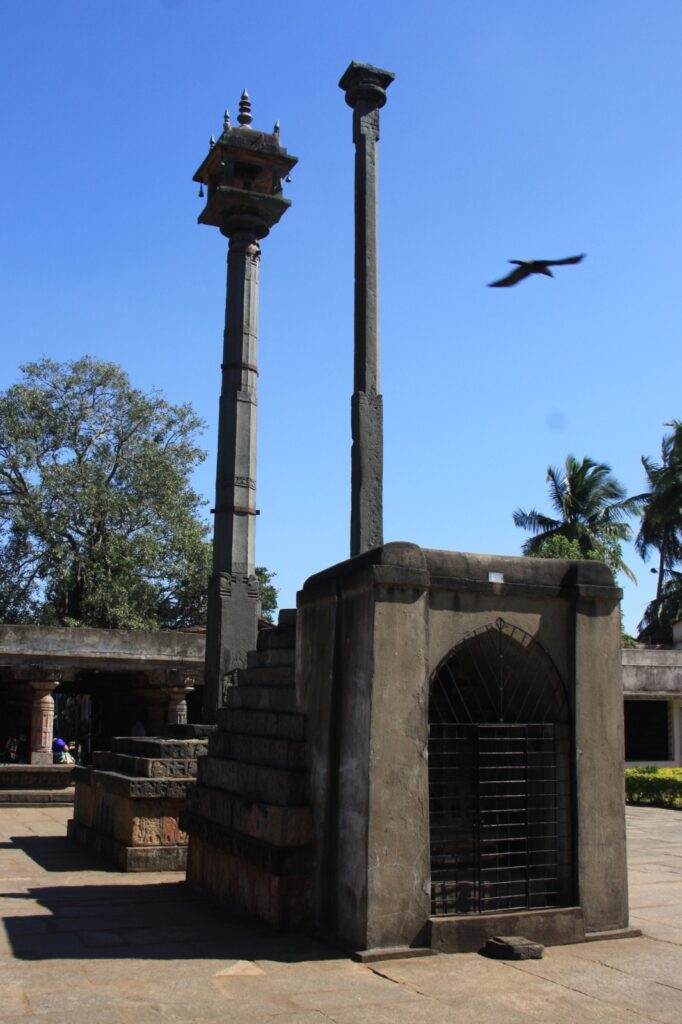
Deepastambha and Dhwajastambha in Banavasi Temple
FAQ about Madhukeshwara Temple in Banavasi
Q. What is special about Madhukeshwara Temple?
Madhukeshwara Temple houses a rare honey-colored Shiva linga and represents one of the earliest examples of Kadamba Nagara architecture with its stepped-pyramid vimana.
Q. Who built the temple and when?
It was established by Mayura Sharma of the Kadamba dynasty in the 4th century CE.
Q. Why is Banavasi called Karnataka’s first capital?
Mayura Sharma established the Kadamba dynasty in Banavasi around 345 CE, making it Karnataka’s first indigenous ruling capital and the birthplace of the state’s political identity.
Q. How far is Banavasi from Sirsi?
Banavasi is 22km from Sirsi, reachable by KSRTC bus (45 minutes) or private vehicle via NH-206.
Q. What is the best time to visit Banavasi?
November to February offers the most pleasant weather for temple visits and exploration.
Q. What are Madhukeshwara Temple timings?
The temple opens 6 AM-1 PM and 4 PM-8 PM daily.
Final Thoughts
Banavasi is more than just a stop on Karnataka’s heritage trail—it is a reminder of how history, faith, and everyday life intertwine in India’s oldest town. My May 2017 visit left me with a sense of gratitude: arriving just before the temple doors closed, offering puja archana to the honey-colored linga, and listening to the young pujari narrate centuries of legacy felt like stepping into living history.
The Madhukeshwara Temple is a priceless monument of Kadamba Nagara architecture, a cultural anchor that has kept Banavasi relevant for nearly 1,800 years.
For travelers, the experience is layered: the cool stone floors against the summer heat, the rustic taste of jolada rotti in local khanavalis, and the quiet flow of the Varada river all add texture to the visit.
Compared to the grandeur of Hoysala temples or the rock-cut caves of Ellora, Banavasi’s charm lies in its simplicity and continuity. It is a place where Karnataka’s story began, and where visitors today can still feel that origin.
Pin this for later…
About the Author
 Indrani Ghose is a cultural travel writer and heritage documentation specialist with over 15 years of experience exploring and writing about temples across India and Southeast Asia. Having visited over 150 sacred sites, she brings both scholarly depth and personal narrative to heritage travel writing.
Her work has been published in Lonely Planet, The National (UAE), Whetstone Asia, Deccan Herald, and various architecture and heritage journals.
Indrani believes that travel writing serves as a bridge — helping readers experience places more deeply by providing context, answering questions, and sharing both practical logistics and emotional resonance.
Connect with Indrani: Follow Indrani on Instagram | Twitter | Facebook for heritage travel insights, photography tips, and offbeat destination discoveries.






Really worth to see the place of kadamba dynasty thanks to elaborate this historical ancient place
India is such a historical place!! i would love to visit it… Beautiful photos, thanks for sharing with us
How could you capture those first photos without any people in them? Is this site not very well known or you were just lucky?
The architecture is absolutely breathtaking!
I love a good temple complex. I would love to go here.
Karnataka has unlimited wealth of history and architecture. So much to do, so much to see. Adding this one to my list too.
This kind of architecture is timeless and we have such rich heritage. Thanks for this share.
I can imagine the atmosphere is totally different during one of the festivals in December of February. It would be great to see just how lively it becomes.
They have really elaborate and magnificent sculptors in this temple! The place looks rich in history and it really intrigues me to visit and see it with my own eyes.
Love the architecture of this temple. It’s quite fascinating indeed!
What a lovely write-up! I’m so happy I stumbled upon this blog post as I plan to visit India this year. Karnataka overall is a beautiful place I’ve heard so I will bookmark your Indian-destination articles and come back for more as I come closer to my departure. Thank you for sharing!
The Kadamba empire! Heard a lot about this from some friends I met in Belgaum a few years ago, but its still one of those places that is little known. Temples aren’t really on my list on the road, but what do you do when cities are built around them, yes? HA!
Soo old but goodie! Oh you are so beyond lucky to visit this place. I truly wish that this could be well preserve and free from human vandalism, and God forbid not be destroyed by an earthquake.
Wow. Being in India. I never knew about it. Thanks for introducing us to such an ancient temple. It is going to be in my to do list.
Oh wow! The carvings look so intricate and statues are amazingly well preserved. It’s amazing just how many temples there are around India!
Such an interesting place full of history. It seems like every item there holds a special story. The cot has so many details and floral ornaments, it is really impressive. There’s a reason why they keep it locked.
Temples that make us proud of our history are so awesome. The pictures capture stories of eons ago. Is there a special prasad there?
OMG!! Every time I read a post about India I get more in love! Unfortunately I still don’t know when I will finally go there :S This Madhukeswara Temple Banavasi is stunning, the architecture, the decorations, the statues… lovely!! Your pics are amazing 🙂 Best travel, E
I haven’t heard about Madhukeswara Temple Banavasi earlier. Great to know about a temple from 3rd century and more over that it is well maintained . Thanks for sharing.
This architecture is absolutely impressive! Going there sounds like an amazing experience 🙂 I would love to see it. I hope I will make it this year!
I love this post – so well rounded with a great experience, tips, pictures and history. It truly sounds like a lovely place to visit.
The temples are so cool. It’s amazing the temple are so well preserved being so ancient. I would like to see these in person one day.
Loved the architecture, I can see the highlights of history. Indian temples provide such beautiful art to see and explore.
I do hope one day to visit your beautiful country, meanwhile I will continue to enjoy your always interesting blog. Wishing you all the best for 2017, and thanks for your continuing support over the years.
Looks like a beautiful temple. Great captures Indrani, even we visited Hassan recently and were impressed by architecture. The carvings of this temple are so intricate and beautiful. We are too tempted to visit this place considering that this a 3rd-century temple.
What a beautiful temple, it makes me want to book a flight back to India, and i only got back last week! Really helpful that you put the opening times etc, so many people dont and it means some people could be disappointed!
Wow! It looks like a beautiful temple to visit. Thanks for sharing about the history and the place. I think visiting during Kadambotsava would be a great way to witness the temple.
I have never heard of this place till I read your blog. And you say it is 1800 years old? I love how each set of rulers added their additions and improvements to the temple. That Nandi statue must be huge. Hopefully I will get to visit one day.
Wow..another gem of a place that I had not heard of. I did a google search for this temple after reading your post. Looks like its almost 2.5 hrs drive from Shivamogga where I have been intending to go. Will visit this temple as well when the trip happens
Wow! They have such amazing art in these temples. I loved the Nandi sculpture. Truly magnificent. This must have been an amazing trip!
Wow! That’s a really old temple Indrani. I love visiting such temples as well and it’s not added to my list 🙂
The carvings and statues look very well preserved. It’s impressive how intricate the carvings are too, particularly since they’re in stone. Such neat temples.
It really looks beautiful. So many amazing decorations. It is hard to believe how old some temples really are when seeing all the details built into them. 🙂
I love Indian historical structures and their architecture!Even the smallest temples of olden days have so much work to display. Such a beautiful temple and that Naga statue is pretty unique 🙂
I love exploring these historic temples. There’s something so peaceful about them.
I couldn’t help but admire these early works that still stand proudly and passed the test of time. The early people of this place are great architects and engineers, and the modern ones should learn meticulously how to do it 🙂
Such a beautiful temple and so old. You were lucky to arrive in time to see it!
Wow, Madhukeswara Temple is so gorgeous! And visiting a place that’s been around for so long must be truly fascinating. I’ve only been to a few places that are as (or slightly older than that) and they aren’t as well preserved (mostly due to wars in the region).
I love to admire the beauty of religious and historical edifices, love the architecture! Thank you for sharing!
Wow, these temples look so well preserved! The history of temples in India is just incredible. We are hoping to travel to India again this year and would love to visit. Thanks for sharing!
How amazing to experience living history that is 18 centuries old! The reliefs are beautiful. I hope to visit one day in person.
WOW! An 18 centuries old temple! This would be an unforgettable trip. Great tip to search out a guide.
I love visiting historical places so this is right up my alley. I would love to check out the temple and learn about it. India has so may temples I think I would love to just go on a temple tour.
wow, 18 centuries old the Madhukeswara Temple would be amazing to explore. I love looking at the architecture and hieroglyphics. It’s so incredible to me how man could make such beautiful buildings and carvings without modern tools and now that we have the tools we don’t make things as embellished and beautiful anymore. A truly lost art.
As an art, history and religious monuments lover, I have really enjoyed reading your post. It reminded me how much India has to offer when talking about world heritage.
This is truly impressive being built in the 3rd century and many of the reliefs and details are still intact – amazing to still see this in complete condition
Those temples are in remarkable condition considering how old they are. Very interesting carvings.
Unbelievable! So lucky to have been able to see this! It is so old and so amazing. The majestic cot sounds so intriguing. Hope one day I will also have the chance to see this.
Banavasi of Uttara Kannada district is the oldest town of Karnataka. It was the capital of Kadamba Empire in 345AD. Madhukeswara Temple is a part of the remains of this ancient kingdom. Since olden times life in this quaint little town revolved around the temple. Very few parts are left of Banavasi Fort. Very interesting site to visit . The first sight of the temple resembles to Kamakhya temple of Guwahati in some ways.
Very useful tips, thank you! I was in India recently, unfortunately not in this area. Hopefully next time. 🙂
Magnificent art. Stones carved by hands are fascinating. With the then available tools, the precision is just amazing. Great bit of information and lovely pictures. If I happen to plan south on one of my vacations I’ll definitely mark this place!!
– Pixellicious
Every time I visit your blog, I discover a new historical site. There are so many historic locations within Karnataka.. looks like I should come up with a separate list to cover all these temples. Thanks for helping us discover the forgotten parts of our state..
The architecture and sculptures in the place look very intricate. A feast for history and architecture buffs indeed! Definitely seems like it is a good idea to seek out guides to show you around; I hope that they’re not too pushy? Sadly, that’s the experience I’ve had at some of India’s more famous monuments…I’m hoping that’s not the case in what seems to be a less-touristed spot.
So much history!! Many thanks for writing in this way. Monuments should be appreciated more when there is a background told.
India is so rich in history and culture. Visiting India is definitely in my bucket list.
I’m always shocked at how history India has that I am unaware of.
Wow the buildings are so old. And all those scupltures are so detailed. It must have taken many years to create all of that!