The Badami Cave Temples: A First-Hand Guide to Chalukya Architecture and History
The Chalukya Marvel: Why the Badami Caves are Unmissable in Karnataka
Tucked between rugged sandstone cliffs and overlooking the serene Agastya Lake, the Badami Cave Temples are a breathtaking blend of ancient artistry and spiritual legacy. During my October 2024 visit with my family, these rock-cut marvels transported us back to the 6th century, when the Chalukya dynasty carved their devotion into stone.
This guide combines my first-hand exploration with historical research to help you experience these caves fully. I’ve documented my personal journey through the caves—capturing the intricate carvings, and the quiet awe that settles in as you stand before the colossal figure of Lord Shiva in Cave 1. Whether you’re a history buff, a spiritual seeker, or a curious traveler, this post will help you plan your visit with practical tips, cultural insights, and original photography from my trip.
— Indrani Ghose, travel blogger | Updated Nov 2025
The Badami Cave Temples—recognized among India’s finest examples of 6th-century rock-cut architecture and on UNESCO’s tentative World Heritage list since 2014—are storytellers carved in stone. Join me as we explore why this Archaeological Survey of India-protected monument deserves a prominent place on your Karnataka heritage trail.

Agastya Lake Badami – View of Agastya Lake from that height is soothing.
Quick Facts: Badami Cave Temples
- Timings: 9 AM to 5.30 PM (Open daily)
- Entry Fee: ₹25 (Indian citizens), ₹300 (Foreign nationals); Free for children under 15
- Nearest Airport: Hubli Airport (105 km)
- Nearest Railway Station: Badami Railway Station (5 km)
- Best Way to Reach: KSRTC buses or taxis from Hubli (110 km), Hospet (140 km), or Vijayapura
- Best Time to Visit: October to March (temperatures 15-30°C)
- Coordinates: 15.91° N, 75.74° E
- Accessibility: Moderate climb; approximately 100+ carved rock steps
- Photography: Permitted; tripods not allowed inside caves
- Time Needed: 2-3 hours for all four caves
History and Cultural Significance
Origins and Timeline: The Chalukya Dynasty Era
The Badami Cave Temples were carved between 550-750 CE under Early Chalukya patronage, when Badami served as their capital city (called Vatapi). Pulakeshin I (543-566 CE) initiated the site, while rulers like Mangalesha and Pulakeshin II expanded it into a spiritual and artistic center.
Inscriptions in Cave 3 date it precisely to 578 CE. These monuments reflect the dynasty’s strategy to establish cultural dominance through rock-cut architecture, merging political authority with sacred expression across four main caves and several smaller shrines.
Who built Badami Caves
These magnificent examples of Indian rock cut architecture, the Badami caves construction dates back to 540AD. It was under reign of Chalukya dynasty then.
Pulakeshin I founded the city and made it his capital and it remained so till 757AD. His son Kirtivarman I and his brother Mangalesha I (ruled in 598 – 610 AD) constructed the cave temples. Kirtivarman had three sons named Pulkeshin II, Vishnuvardhana, and Buddhavarasa.
These caves speak highly of the secular nature of the rulers then. They had high tolerance to other religions then, Buddhism and Jainism.

Nataraja in first cave of Badami
Legend around Badami Caves
There is a history prior to what we get to read in books and online today. It tells how Badami got its name.
Badami was named Vatapi after a demon who devoured on innocent people living there by deceit. Vatapi’s brother Ilvala invited people for meal, Vatapi would take the form of goat which would be cooked and eaten. After the victim would have taken the meal, Vatapi would take his original form and emerge out killing the victim. He tried the same trick on Sage Agastya, but the clever sage digested his meal before Vatapi could take his form.
Later the town got renamed to Badami due to the color of the sandstone hills.
The Blend of Dravidian and Nagara Architectural Styles
Walking through the caves, I observed the remarkable fusion of Dravidian (southern) and Nagara (northern) architectural traditions—a defining Chalukyan innovation.
The pillared mandapas, bracket figures, and horizontal emphasis reflect Dravidian aesthetics, while the ornate ceiling panels and decorative motifs show Nagara influence.
Cave 3’s elaborately carved pillars feature unique “pot-and-foliage” capitals. This architectural synthesis positions Badami as a crucial evolutionary link between India’s two major temple-building traditions, predating the later Vesara style.
Religious Importance: Hinduism and Jainism Influences
The four main caves demonstrate early medieval India’s religious pluralism.
Caves 1-3, dedicated to Shiva and Vishnu, showcase Hindu cosmology through sculptures of Nataraja’s cosmic dance, Vishnu’s Trivikrama avatar spanning ceiling panels, and Varaha rescuing goddess Earth.
Cave 4, carved around 700 CE, serves as a Jain sanctuary featuring Mahavira in kayotsarga posture and the 24 Tirthankaras. This peaceful coexistence of faiths within one complex reflects the Chalukyas’ religious tolerance and Badami’s role as a spiritual crossroads.

Idol of Harihara
A Cave-by-Cave Exploration: Art, Architecture, and Deities
Badami Cave Architecture
Badami caves were built by using sandstone available on the hills in Badami town. The architectural plan of the caves includes an entrance, a mukha mandapa or veranda, a hall, and a garbha griha or small shrine. The veranda is supported by a series of columns and brackets. The caves were built on the basis of Nagara and Dravida architecture.
Cave 1: Lord Shiva’s Grand ‘Tandava’ (The Shiva Cave)
Cave 1, carved around 550-575 CE and dedicated to Lord Shiva, creates an immediate sensory impact—the temperature drops noticeably, and early morning light illuminates the rust-red sandstone in dramatic contrasts.
The showstopper is the 5-foot-tall Nataraja (Tandava-dancing Shiva) sculpture carved on the wall opposite the entrance, featuring 18 arms in various mudras.
According to Archaeological Survey of India documentation, this represents one of India’s earliest complete depictions of Shiva’s cosmic dance, predating later Chola bronzes by centuries.
The cave measures approximately 70 feet in length with a square mandapa (hall) supported by four ornately carved pillars featuring unique bracket figures. The inner sanctum houses a Shiva linga, while guardian dwarpalas (door guardians) flank the entrance. I spent nearly 30 minutes here photographing how afternoon light creates moving shadows across the dance poses—truly cinematic stone carving.
Harihara and Ardhanarishwara Sculptures: The Fusion of Deities
Two theologically significant panels grace Cave 1’s walls: Harihara (right half Vishnu, left half Shiva) and Ardhanarishwara (half-Shiva, half-Parvati). These rare 6th-century compositions symbolize philosophical unity—transcending sectarian divisions common in that era.
The Ardhanarishwara’s detailed ornamentation on Parvati’s side contrasts beautifully with Shiva’s ascetic simplicity, demonstrating the sculptors’ nuanced understanding of iconographic symbolism.

Ardhanarishwari
Cave 2: A Shrine to Lord Vishnu’s Avatars (The Vishnu Cave)
Cave 2, positioned to the northeast and dating to approximately 575 CE, showcases early Vaishnava iconography. While smaller than Cave 1 (about 60 feet deep), it features exceptional narrative relief work.
The cave’s layout follows similar architectural principles—a verandah, columned hall, and sanctum—but emphasizes horizontal storytelling panels rather than singular monumental sculptures.
During my visit, I noticed Cave 2 receives gentler lighting throughout the day, making it ideal for photography between 10 AM to 2 PM. The ceiling here features geometric lotus rosettes and makara (mythical aquatic creatures) motifs.
Varaha (Boar) and Vamana (Dwarf) Reliefs: Stories from Mythology
The Varaha panel (right wall) depicts Vishnu’s boar avatar rescuing goddess Bhudevi (Earth) from the demon Hiranyaksha’s ocean captivity—notice how Bhudevi clings to the boar’s tusk in a dynamic diagonal composition.
The left wall features Vamana’s Trivikrama transformation, where the dwarf-brahmin grows cosmically large to measure the universe in three steps.
These Puranic narratives carved in high relief demonstrate sophisticated storytelling techniques, with multiple story moments captured in single frames—similar to modern comic panels.

Varaha Temple Cave 2 in Badami
Cave 3: The Largest and Most Detailed Vaishnava Cave
Cave 3 dominates the complex—both in scale and artistic achievement. A Kannada inscription at the entrance dates it precisely to 578 CE during King Mangalesha’s reign. At approximately 70 feet wide and 65 feet deep with a ceiling height of 15 feet, this cave required removing an estimated 3,000-4,000 cubic feet of sandstone—a remarkable engineering feat for 6th-century tools.
I was particularly struck by the cave’s acoustics; hand claps produce a notable echo, suggesting intentional acoustic design for ritual chanting. The twelve ornate pillars feature bracket figures of amorous couples (mithuna) and celestial beings, each uniquely carved.
An Architectural Masterpiece: Inscriptions and Painted Ceilings
Cave 3 preserves faint traces of original painted ceilings—rare survivors showing celestial figures, floral patterns, and geometric designs in mineral pigments. Conservation experts have documented these using multispectral imaging to reveal details invisible to naked eyes.
The inscriptions provide valuable historical data: they mention temple rituals, royal donations, and even reference local administration, making this an important epigraphic source for Chalukyan history.
Narasimha and Trivikrama: Giant Sculptures and Intricate Details
The 5-foot-tall Narasimha panel (Vishnu’s man-lion avatar) shows him disemboweling demon Hiranyakashipu—fierce yet controlled, with intricate detailing in the lion’s mane and ornaments. Opposite, the Trivikrama relief spans nearly 15 feet vertically, depicting Vishnu’s cosmic stride with one leg raised high.
Notice the miniature figures of gods and sages carved around the giant form, providing scale and narrative context. These monumental sculptures demonstrate advanced understanding of proportion, anatomy, and spatial composition.

Narasimha avatar of Lord Vishnu
Cave 4: The Serene Jain Tirthankaras (The Jain Cave)
Cave 4, situated highest on the cliff (requiring an additional 40-50 steps beyond Cave 3), dates to approximately 700 CE—making it the youngest main cave. My enthusiastic kids climbed on. Whoa! We got to see panoramic views of Badami town and Agastya Lake. This Jain cave reflects distinctly different aesthetic priorities: simpler pillars, restrained ornamentation, and emphasis on meditative figures rather than dynamic narratives.
The cave measures about 50 sqft. with an open courtyard design. I found the atmosphere notably quieter here—fewer visitors make the full climb, creating a genuinely contemplative space.
Lord Mahavira and Parshvanatha: Classic example of Religious Harmony
The sanctum features a 7-foot-tall Mahavira in kayotsarga (standing meditation) posture, arms hanging naturally with palms forward—embodying Jain principles of non-attachment. Turn to right to see the statue of Parshvanatha, the 23rd Tirthankara, with his characteristic seven-hooded serpent canopy (symbolizing protection during meditation). Additional panels depict other Tirthankaras and attendant yaksha-yakshi figures.
This Jain addition to a predominantly Hindu complex illustrates the Chalukyas’ religious pluralism—a pragmatic political strategy allowing them to govern diverse populations. Cave 4 completes Badami’s spiritual narrative: from Shaivite devotion to Vaishnava theology to Jain asceticism, all coexisting within 300 feet of cliff face.

Practical Tips for Visiting the Badami Caves
What to Expect: The Climb, Facilities, Wildlife, and Panoramic Views
Visiting the Badami Cave Temples requires a moderate climb of approximately 100+ steps carved into sandstone cliffs, with the total ascent covering about 200 feet vertically. I recommend wearing closed-toe shoes with good grip—the steps are uneven, narrow in places (some only 2 feet wide), and can become slippery during monsoons or early morning dew.
The site’s monkey population is substantial and habituated to tourists. During my visit, I observed troops of 15-20 bonnet macaques near Caves 2 and 3. Keep all food, water bottles, and loose items secured in closed bags. If approached, don’t make eye contact or sudden movements—they’re generally harmless but opportunistic.
Basic facilities include restrooms and a small drinking water station near the ticket counter, but I recommend carrying 1-2 liters of water per person, especially October through March when temperatures can reach 30°C. The climb takes 45-60 minutes to reach Cave 4, with limited shade along the route.
Government-certified Archaeological Survey of India guides are available at the entrance (₹300-500 for 2 hours). I hired guide Basavaraj, who provided inscriptional translations and iconographic details unavailable on signage. Local freelance guides also offer services—verify their knowledge with a few test questions before committing.
The summit viewpoint beyond Cave 4 offers 270-degree panoramas of Agastya Lake, Badami town, and the surrounding Deccan plateau—particularly stunning 30 minutes before sunset when the sandstone cliffs glow amber-red.

Lord Vishnu sitting on Adishesha
How to Reach Badami: Detailed Transport Options
Badami’s accessibility has improved significantly with better road connectivity, making it feasible as a day trip or weekend destination.
By Air: Hubli Airport (officially Huballi Airport, 105 km, 2.5 hours) offers daily flights from Bengaluru. Pre-book taxis (₹2,500-3,000) or use app-based cabs. KSRTC buses run 4-5 times daily (₹150-200, 3 hours).
By Train: Badami Railway Station (5 km from caves, 10-minute auto-rickshaw ride at ₹100-150) connects to Bengaluru (450 km, 9-10 hours overnight), Hospet (100 km, 2 hours), and Vijayapura/Bijapur (120 km, 2.5 hours). The Rani Chennamma Express and Hampi Express are popular options. Book well in advance during peak season.
By Road: I drove from Hampi (140 km, 3.5 hours via NH67 and SH14) and found excellent road conditions with multiple fuel stations and roadside dhabas. From Bengaluru, the 500 km journey takes 8-9 hours via NH48 and NH50—consider breaking it at Chitradurga (200 km). KSRTC operates overnight sleeper buses from Bengaluru (₹600-800, departing 10 PM, arriving 6 AM).
Local Transport: Auto-rickshaws and cycle-rickshaws operate from the railway station to caves (₹100-150). Most hotels offer bicycle rentals (₹100-150/day)—excellent for exploring nearby attractions. The town is compact and walkable.
Best Time for Photography: Capturing the Golden Hour
Photography timing dramatically affects your Badami Cave Temples images. Based on my visit and subsequent research with local photographers, here’s the optimal schedule:
Golden Hour (4.30 AM to 6 PM): The westward-facing caves receive warm, directional light that creates dramatic shadows, emphasizes carved textures, and makes the rust-red sandstone glow luminously.
Morning Light (7 AM to 9 AM): Softer, diffused light reduces harsh shadows, ideal for detailed close-ups of smaller carvings and inscriptions. The eastern-facing lake and Bhutanatha Temples photograph beautifully with sunrise backlighting.
Avoid Midday (11 AM to 3 PM): Overhead sun flattens relief details and creates unflattering harsh shadows. Use this time for the shaded Jain Cave 4 or interior sanctum photography.
Equipment Tips: A wide-angle lens (16-35mm) captures full panels; 50mm prime works for details. ISO 800-1600 needed inside caves without flash. Tripods prohibited inside, so stabilize on pillars for longer exposures.
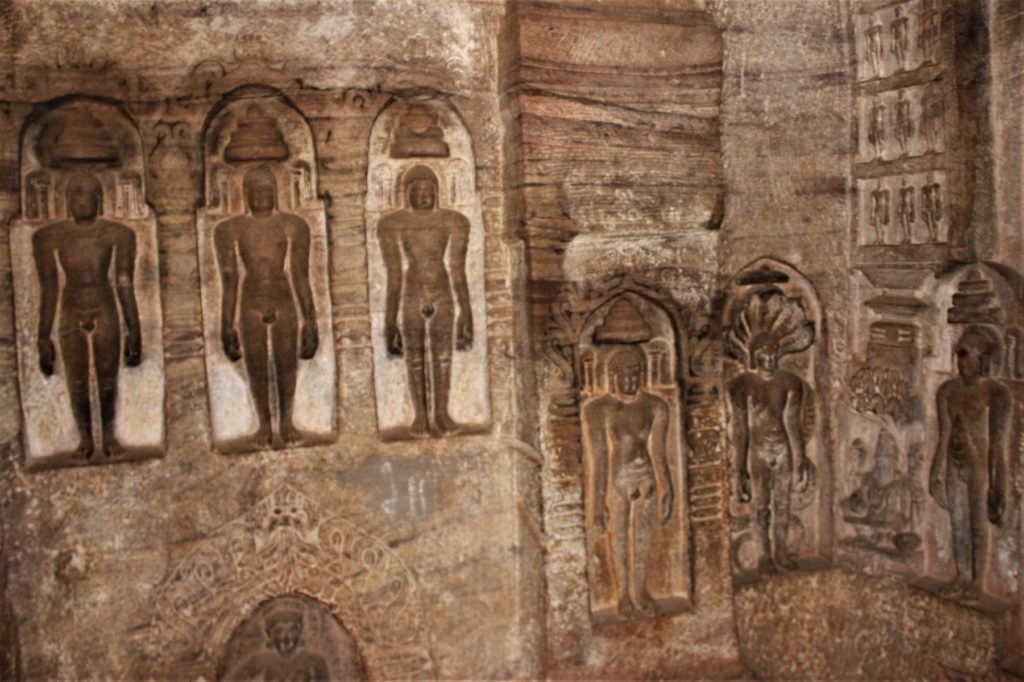
Sculpted images in Jain temple Badami
Entrance Tickets and Timings: Complete Visitor Information
Operating Hours: 9 AM to 5.30 PM daily, including all national holidays. Last entry at 5 PM. Note that caves aren’t illuminated after sunset—plan accordingly.
Entry Fees (2024-25):
- Indian citizens/SAARC/BIMSTEC nationals: ₹25 per person
- Foreign nationals: ₹300 per person
- Children under 15 years: Free entry
- Still camera: Included in ticket
- Video camera: Additional ₹25
Ticketing: Purchase tickets at the Archaeological Survey of ASI counter near the base. No advance online booking available currently—tickets sold on-site only. During peak season (December-January), expect 15-20 minute queues between 10 AM to 12 PM. I arrived at 8.45 AM in October and purchased tickets immediately with no wait.
Payment: Carry cash—digital payment acceptance is inconsistent. The nearest ATM is 1 km away in Badami town.
Combination Tickets: Badami’s archaeological sites don’t offer combo tickets yet, but retain your cave ticket if visiting the Badami Archaeological Museum (₹10 entry, closes 5 PM).
Special Access: Photography for commercial/research purposes requires additional ASI permissions obtained through regional office in Dharwad.
The Optimal Route: Strategic Cave-by-Cave Progression
The recommended route follows the natural cliff progression, building architectural and spiritual complexity:
Cave 1 (Shiva – 10-15 minutes): Start here after purchasing tickets. The lowest cave establishes the Chalukyan style vocabulary—pillar designs, bracket figures, spatial organization. Photograph the Nataraja first as morning light is favorable.
Cave 2 (Vishnu – 10-12 minutes): Twenty steps leftward/northward. Smaller but introduces Vaishnava iconography. Compare pillar styles with Cave 1.
Cave 3 (Vishnu – 20-30 minutes): Forty steps upward. The climax—allocate maximum time here. The 578 CE inscription, painted ceilings, and monumental Trivikrama justify extended exploration. Rest on the verandah while absorbing architectural details.
Cave 4 (Jain – 15-20 minutes): Additional 50+ steps to cliff summit. The philosophical contrast to Hindu caves makes this sequence meaningful. The Jain aesthetic simplicity provides contemplative closure.
Total Time: 75-90 minutes pure cave time, plus 30-40 minutes for the climb and photo stops. Budget 2.5-3 hours total including breaks. Descending takes 20-25 minutes—watch your footing and stick to marked paths.

Tirthankara Jain temple
Nearby Attractions: Beyond the Caves
Agastya Lake (Agastya Tirtha): Directly below the caves, this ancient reservoir (approximately 1 km long) was engineered by the Chalukyas for water management. The best sunset views are from the embankment steps, where local families gather for evening walks. The lake reflects the cliff formations beautifully during the calm pre-sunset hour (5.30 PM to 6.15 PM).
Bhutanatha Temple Complex (East Bank): Built between 7th-11th centuries in early Chalukyan and later Kalyani Chalukyan styles, this active temple complex comprises two main shrines literally at the water’s edge. The pillared mandapas and waterside setting offer excellent photography opportunities, especially during evening aarti (6.30 PM).
Additional Badami Attractions:
Within 5 km: Badami Archaeological Museum (1 km, extensive sculpture collection), Malegitti Shivalaya Temple (cliff-top structural temple, 2 km climb), Badami Fort ruins (panoramic views, 1.5 km).
Within 15 km: Mahakuta Temple Group (14 km, 7th-century Shaiva temples with natural spring), Banashankari Amma Temple (5 km, Shakti peetha with annual fair).
Within 50 km: Aihole (46 km, “cradle of temple architecture” with 125+ temples), Pattadakal (20 km from Aihole, UNESCO World Heritage Site with exquisite 8th-century temples).
Suggested Itinerary: Dedicate one full day each to Badami and the Aihole-Pattadakal circuit, staying overnight in Badami to maximize exploration time.
Festivals and Cultural Events: Timing Your Visit
Visiting during festivals adds vibrant contemporary context to Badami’s historical monuments:
Mahashivaratri (February/March – dates vary per lunar calendar): The most significant event, drawing thousands of devotees to Cave 1 and Bhutanatha Temples for all-night pujas and abhishekams. The 2026 date is February 15th. Expect crowds but witness authentic ritual traditions unchanged for centuries. Special decorations illuminate the caves with oil lamps—photographically stunning but arrive early for space.
Chalukya Utsav (November, typically first weekend): A three-day Karnataka Tourism initiative featuring classical dance performances (Bharatanatyam, Kuchipudi) staged at the cave complex, heritage walks led by historians, local craft exhibitions, and food festivals. The 2024 edition ran November 8-10. Cultural programming contextualizes the monuments’ artistic legacy.
Banashankari Temple Fair (January/February): While at the nearby temple, this annual jatra attracts regional devotees with processions, traditional theatre (Bayalata), and livestock markets—offering insights into contemporary rural Karnataka culture.
Practical Advice: Book accommodation 2-3 months advance for Mahashivaratri. Festival periods see 200-300% increase in visitors—archaeological experience may be compromised by crowds, but cultural immersion is unparalleled.

Trivikrama second cave of Badami – vaman avatar of Lord Vishnu
Indian Cave Temples
India has the most number of examples of rock cut architecture. They are mostly religious in nature, revered by locals for centuries. I have collated information on several cave temples in India . Read here – 20 Cave Temples of India
Tips to visit Cave Temples of Badami
- Total steps around 190, difficult to access for physically challenged.
- Tour time can take one to one and half hours.
- Visit in morning hours when sunlight falls on the entrance of the caves.
- Parking is available, photography is allowed.
- Guide services available.
- Take water along. No eateries around the cave.
Badami Cave Temples: Comprehensive FAQ
Q1. Where exactly are the Badami Cave Temples located, and what are the GPS coordinates?
The Badami Cave Temples are located in Badami town (formerly Vatapi), Bagalkot district, northern Karnataka, India. Precise coordinates: 15.91° N, 75.74° E. The caves are situated on the southern edge of town, carved into red sandstone cliffs overlooking Agastya Lake. Badami is approximately 500 km northwest of Bengaluru, 140 km from Hampi, and forms part of Karnataka’s “Golden Triangle” heritage circuit with Aihole and Pattadakal.
Q2. What is the best time to visit the Badami Cave Temples for weather and photography?
Optimal months: October through March offers comfortable temperatures (15-28°C) with minimal rainfall—ideal for the moderate climb and outdoor photography. December-January sees peak tourist traffic.
Photography timing: Late afternoon (4:30-6:00 PM) provides dramatic golden-hour lighting on the west-facing caves, making carvings appear three-dimensional. Morning (7 AM to 9 AM) offers softer light for detailed close-ups.
Q3, How many caves are in the Badami complex, and what does each represent?
The Badami site comprises four main rock-cut caves plus several smaller excavations:
- Cave 1 (6th century): Dedicated to Lord Shiva, featuring the iconic 18-armed Nataraja Tandava sculpture, Harihara, and Ardhanarishwara
- Cave 2 (6th century): Vaishnava shrine showcasing Vishnu’s Varaha and Vamana avatars
- Cave 3 (578 CE): The largest Vaishnava cave with inscriptions, painted ceilings, and monumental Narasimha and Trivikrama sculptures
- Cave 4 (late 7th century): Jain sanctuary featuring Mahavira and Parshvanatha Tirthankaras, demonstrating religious pluralism
Additionally, there are smaller natural caves and rock shelters with Buddhist links near the north cliff, though these lack the architectural sophistication of the main four.
Q4. Are professional guides available, and should I hire one?
Yes, highly recommended. Two guide categories operate at Badami:
Government-certified ASI guides: Available at the ticket counter (₹300-500 for 2-hour tour covering all four caves). These guides undergo Archaeological Survey of India training, providing accurate historical context, iconographic interpretations, and inscription translations.
Independent local guides: Negotiate rates (₹200-400). Quality varies—ask test questions about specific sculptures (e.g., “Which avatar is shown in Cave 2’s left panel?”) to assess knowledge.
Q5. What are the photography rules and restrictions inside the Badami caves?
Allowed:
- Still photography with cameras and smartphones (included in entry ticket)
- Video recording (₹25 additional fee)
Prohibited:
- Tripods and monopods inside cave interiors (stability concerns on carved floors)
- Flash photography (degrades mineral pigments in painted ceilings)
- Commercial/professional shoots without prior ASI permission from Dharwad regional office
- Touching or leaning on sculptures
Q6. How much time should I allocate to explore the Badami Cave Temples thoroughly?
Minimum recommended: 2.5-3 hours for a comprehensive visit covering all four main caves with moderate-paced climbing.
Q7. Are the Badami Cave Temples accessible for children, elderly visitors, and people with mobility challenges?
Accessibility assessment:
Children (5+ years): Manageable with supervision. My observation: families with 6-10 year-olds successfully completed the climb with breaks.
Elderly/seniors: Feasible for moderately active seniors with good balance. The climb gains approximately 200 feet elevation over 300-400 feet distance.
Mobility challenges: Unfortunately, wheelchairs and walkers cannot access the caves—no ramps or elevators exist.
Recommendations: Carry walking sticks, wear supportive footwear, climb during cooler morning hours (7AM to 9 AM), take frequent breaks, and consider limiting to Caves 1-3 if Cave 4’s additional climb seems daunting. Hiring a guide provides psychological support and pacing assistance.
Q8. What are the current entry fees and ticket details for Badami Cave Temples?
Entry fees (2024-25):
- Indian citizens/SAARC/BIMSTEC nationals: ₹25 per person
- Foreign nationals: ₹300 per person
- Children under 15 years: Free entry (any nationality)
- Video camera: Additional ₹25 (still photography included)
Purchase location: ASI ticket counter at cave base (no online booking available)
Payment: Cash preferred—digital payment acceptance inconsistent; nearest ATM 1 km away in Badami town
Operating hours: 9 AM to 5.30 PM daily (last entry 5 PM)
Ticket validity: Single-day, single-entry. Retain ticket throughout visit for verification.
Group discounts: None currently offered. School/college groups (20+ students) should contact ASI Dharwad regional office for educational visit arrangements.
Q9. Can I visit Badami Cave Temples during monsoon season or summer?
Monsoon (June-September): Technically open, but not recommended. Heavy rainfall makes sandstone steps dangerously slippery, increasing fall risk significantly. Rock seepage occurs. Flash flooding in the area is possible. If you must visit, bring non-slip footwear, avoid rainy days, and exercise extreme caution.
Summer (April-June): Open but physically challenging. Temperatures reach 35-42°C with minimal shade during the climb. Dehydration and heat exhaustion risks increase.
Winter (October-March): Ideal conditions—comfortable temperatures, clear skies, and safe footing.
Q10. What other heritage sites should I combine with Badami for a complete Karnataka itinerary?
Essential Chalukyan Triangle (UNESCO-recognized):
Aihole (46 km, 1 hour): “Cradle of Indian temple architecture” with 125+ experimental temples from 5th-8th centuries. Allocate 3-4 hours. Must-see: Durga Temple, Lad Khan Temple, Ravana Phadi cave.
Pattadakal (22 km from Badami, 45 minutes): UNESCO World Heritage Site showcasing mature Chalukyan architecture—both Dravidian and Nagara styles perfected. Allocate 2-3 hours. Must-see: Virupaksha Temple, Mallikarjuna Temple.
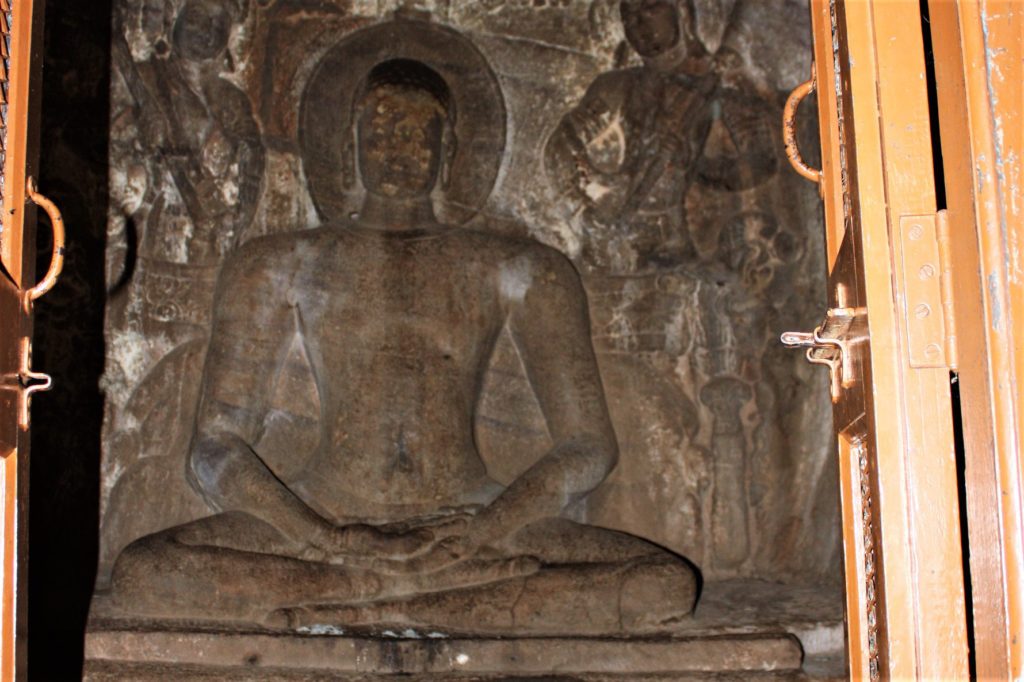
Idol inside shrine of Jain temple of Badami
Final Thoughts: Why the Badami Caves are an Engineering Miracle
The Badami Cave Temples are more than a historical site—they’re a classic example of ancient India’s architectural genius and spiritual depth. Carved directly into a sandstone cliff without modern tools, these 6th–8th century marvels showcase precise symmetry, structural integrity, and artistic mastery that defy time.
Each cave narrates a story—not just of gods and myths, but of a civilization that valued art, tolerance, and innovation. Whether you’re a traveler, photographer, or heritage lover, Badami offers a rare chance to walk through living history etched in stone.
Pin and Save this for Later
 Indrani Ghose is a cultural travel writer and heritage documentation specialist with over 15 years of experience exploring and writing about temples across India and Southeast Asia. Having visited over 150 sacred sites, she brings both scholarly depth and personal narrative to heritage travel writing.
Her work has been published in Lonely Planet, The National (UAE), Whetstone Asia, Deccan Herald, and various architecture and heritage journals.
Indrani believes that travel writing serves as a bridge — helping readers experience places more deeply by providing context, answering questions, and sharing both practical logistics and emotional resonance. This FAQ represents that philosophy: every answer aims to not just inform but to enhance your actual experience when you visit.
Connect with Indrani: Follow Indrani on Instagram | Twitter | Facebook for heritage travel insights, photography tips, and offbeat destination discoveries.








I remember reading about Chalukya dynasty in school and history did not interest me the least bit at the time. However, I can only imagine that my interest would have been there if I had actually got the opportunity to see these temples with my own eyes. The cave temples at Badami look really amazing, the carvings from centuries ago are so intriguing and although I have been to the caves in Ajanta, which as you say are bigger and more than these, I’d love to also explore Badami someday! Good to know about the 190 steps beforehand, I usually travel with my parents and they may not enjoy that climb!
Beautiful caves indeed . I have came to know that similar caves are present in “Vidisha-MP” near Sanchi Stupa . But Indrani ji , do you have any idea that why these caves are always dedicated to HIndu , Jain and Buddhist Gods everywhere ??
The caves are really beautiful and wonderful !! The statue and architecture is lovely..Great post..
The carvings are beautiful and striking. Great craftsmen !
I only bow and say thanks with
the heart full of joy.
नमस्ते
wow! you always wow with your wonderful travel snippets about the beautiful places you visit!
What a fabulous place, Indrani! The sculptures are amazing. For its beauty and interest I understand that it's a UNESCO World Heritage Site.
Very fine images!
i'm always fascinated about hindu gods…they're like pharaohs in egypt…they both have mysterious and deep stories to tell… wonderful photos…
The carvings are stunning, and the cavves must be cool and inviting!
awesome structures… the Hindu culture has spread far and wide. In Malaysia too, there are many signs of Hindu culture that have survived until this day
Thankfully this is a World Heritage site and will be protected for future generations.
The pictures of the sculptures are fantabulous to say the least…and the write up is exquisite…you must be having fun doing this
what kind of camera are you using?
Interesting place! the one in man-lion form is just wonderfully craved and its unlike general.
Indrani,
Just gorgeous. I recognize some of the figures. We just opened the new Arts of India Gallery at our museum. I must have learned something from the museum and you! Thanks!
Marvellous! Absolutely marvellous! I dream to visit South India! Maybe in 2010 or in 2011. But now, in September, I will fly from Istanbul to Delhi and will continue to Ladakh, Dharamsala and Amritsar! An organized trip. I'll share the photos of your beautiful country on my blog when I'll return to Istanbul.
Have a great week full of joy and happiness,
Best regards,
All these sculptures are very beautiful! India must have had a great number of great sculptures, and architects!
Nice pictures. I wonder, religion has given us such master pieces of art but science has only given us impatience… It is good that they are at least protecting these monuments.
BTW you have been awarded and tagged on the topic 'Fast Furious and Danceable songs'. Do it, if you find time.
Destination Infinity
Your photos are fabulous. I enjoyed seeing this most magnificent place through your eyes.
Thanks for stopping by 🙂
History of such caves has been fascinating for me. I've visited places like kanheri caves, elephanta caves, in mumbai, just to get a feel of that era. These are some nice pictures and great information you've shared in this post 🙂
I amazes me how many castles and sculptures I've seen on your blog this past year. I'm glad I discovered it!
I'm always happy to read about heritage sites that are well maintained and protected. Even your caves are filled with visual history! Lots to learn and appreciate.
This is beautiful. Such lovely and intricate carvings. Nataraja is a fascinating pose to sculpt. I love the portrayal of nataraja in Indian dances as well. Lovely post.
Amazing. All this goes back to the 6th & 7th century? Do they still do work like this in modern day India? I mean, the labor it took to do all this and all the temples and forts you have in India – you're a nation of artists and artisans.
Amazing Indrani! And informative for me, I had no idea about these caves, and these beautiful sculptures!!!
The good part is these are protected and taken care of!
What an amazing place.. Wish I was in India and could just hop on a cheap flight… 🙁
Thanks for the lovely post.. another one saved in my favourites..
It is pleasing to see how well preserved these ultra-high relief staues have been over time in comparison to those weathering out in the open.
A delightful and informative post.
It was obvious from the photos that the caves were well maintained and the carvings could really shine there like they deserve.
Indrani,
I'm loving this place… Esp, the first pic of Nataraja (Lord Shiva) with 18 arms is not common… It ia feast to eyes… Thanks for this..
My Travelogue
It's hard to imagine the people whose hands must have expertly carved these and the people who lived there then, watching and appreciating them. So fascinating!
These are amazing carvings. So full of spirit yet celebrating the human form.
Wow! These are magnificent and very well preserved. I can understand why it's a World Heritage Site. Are they natural caves?
The rock in the bottom of the canyon is called Vishnu schist.
Beautiful images and great architecture! The carvings are so detailed and intricate.
Nice sculptures Indrani. It's something similar to ELephanta caves.
Is that natural light falling on sculptures or you did some tricks.
What a beautiful place, and justifiably a UNESCO World Heritage Site. Great shots.
Janice.
Amazing caves !!
The first shot from the
"18 armed Nataraja"
and
the fourth cave
are my favorites 🙂
Wonderful ART ..
Magnificent shots, Indrani! What a fabulous place and the history is fascinating. Always appreciate that you share that with us as well as the photos. Marvelous post!
Enjoy!
Sylvia
The caves are amazing. I am so enchanted by the beautiful carvings. You have so many architectural and artistic treasures in your country.