Vaikunta Perumal Temple Kanchipuram: A Spiritual Haven
What is the significance of the Vaikunta Perumal Temple in Kanchipuram?
Built in the 8th century by the Pallava king Nandivarman II, the Vaikunta Perumal Temple is one of Kanchipuram’s most important sacred sites — and one of the 108 Divya Desams celebrated in the Nalayira Divya Prabandham, the Tamil Vaishnava canon of devotional hymns.
I made it a point to visit the Vaikunta Perumal Temple during both my trips—first in 2010 and again in March 2022. Each time, I was left deeply impressed by how its centuries-old architecture is seamlessly wrapped in layers of history, with inscriptions that narrate the Pallava dynasty’s story in stone.
– By Indrani Ghose | Last Updated: March 2026
Known locally as Thiru Parameswara Vinnagaram, the temple is dedicated to Lord Vishnu and stands as one of the finest surviving examples of Pallava temple architecture. At over 1,300 years old, it is remarkable not just for its age but for what it preserves: rare Pallava dynasty stone inscriptions carved into its walls, offering direct evidence of the dynasty’s political and religious history.
The unique fact that sets it apart is its three-tiered design, where Vishnu is worshipped in seated, reclining, and standing forms — each on a separate floor. For pilgrims, it is a Divya Desam of deep sanctity. For heritage travellers, it is an irreplaceable window into Pallava Kanchipuram.

Vaikunta Perumal Temple: Modest Rajagopuram
The Unique Three-Tiered Architecture of Vaikunta Perumal Temple
The Vaikunta Perumal Temple is one of the very few temples in India where Lord Vishnu is enshrined in three distinct postures across three vertically stacked sanctums.
Ground Floor — Seated (Asanam) The main sanctum at ground level houses Vishnu in a seated posture, symbolising his role as the eternal cosmic ruler. This is the primary shrine that all visitors can access during regular temple hours, and it is where most of the daily rituals take place.
First Floor — Reclining (Sayanam) One level up, Vishnu is depicted reclining on Adisesha, the divine serpent. This sanctum is not open on regular days — access is typically permitted only on Ekadashi and certain festival occasions. On both my visits — in 2010 and in March 2022 — this floor was accessible only at specific times, so checking the temple calendar before you visit is strongly recommended.
Second Floor — Standing (Sthanakam) The uppermost sanctum presents Vishnu in a majestic standing posture. The vertical progression — seated, reclining, standing — is deliberate. It represents the three states of Vishnu’s cosmic presence and guides the devotee through a complete, layered experience of darshan. (Access to higher levels is restricted by the Archaeological Survey of India, I came to know later.)
Beyond the sanctum structure, the temple’s outer walls carry stone inscriptions from the Pallava period, documenting royal grants, land records, and dynastic history. These are among the most significant epigraphic records from the Pallava era and are studied by historians and archaeologists to this day.
The architecture itself — compact, vertical, and precisely scaled — reflects the Pallava genius for building upward rather than outward.

Dhwajastambha in Vaikunta Perumal temple

Base of dhwajastambha – The Divine Beauty of Vaikunta Perumal Temple in Kancheepuram: A Photographic Journey
How the Temple Walls Tell the History of the Pallava Dynasty
The Vaikunta Perumal Temple is as much a historical record as it is a place of worship. Its walls carry stone inscriptions dating to the reign of Nandivarman II (8th century CE) — and these are not ceremonial dedications alone.
These inscriptions focus narrowly on ritual or endowment, the panels here also capture political succession, inter-dynastic alliances, and aspects of everyday civic life in Kanchipuram, making them one of the most reliable primary sources available for reconstructing Pallava history. Historians and epigraphers have long described the temple as a “history book in stone”.
As a heritage traveller, this was a major draw for me. I wasn’t not reading about history on a placard, rather I was seeing the original source, carved into granite over 1,300 years ago. The Archaeological Survey of India (ASI), which maintains the temple, has documented many of these inscriptions, and scholarly work on them continues to yield new insights into the Pallava period.
If you have an interest in epigraphy, dynastic history, or simply want to understand what made Kanchipuram the political and cultural capital of the Pallavas, these walls are worth slow, careful attention.
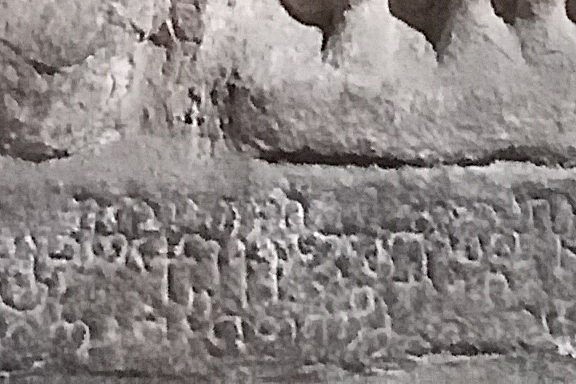
Inscriptions
Mentions of Vaikunta Perumal Temple in scriptures
This temple is revered in Nalayira Divya Prabhandham, which was composed during 7th to 9th century CE, Vaishnava canon by the Vaishnavite Scholar Thirumangai Azhwar in his 10 hymns.
Try and read up the book by D Dennis Hudson on Vaikuntha Perumal Temple before you visit the temple. In his book he mentions that the idol in the middle floor of the temple is worshipped in 12 different forms of Vishnu – Keshava, Narayana, Madhava, Govinda, Vishnu, Madhusudan, Trivikram, Vamana, Sridhara, Hrishikesh, Padmanabha, Damodara.

Lions sculpted on pillars of the corridor of Vaikunta Perumal Temple in Kanchipuram
Interesting legends associated with the temple
There are two interesting legends associated with Vaikunta Perumal Temple of Kanchipuram. Read on to know them:
1. The temple is located in a region which was previously called Vidarbha Desa. Viroacha King who ruled had no heirs due to his misdeeds in previous birth. He prayed in Kailasanathar Temple. God Shiva, the presiding deity of the temple blessed him that the Dwarapalas (the gatekeepers) of the Vishnu temple will be born as sons to him.
Both princes were devoted to God Vishnu. They conducted yagna (sacrifice) for welfare of the people of their kingdom. Bhagwan Vishnu was immensely pleased with their worship. He appeared as Vaikundanatha to the princes – Dwarapalakas – Pallavan and Villalan.
2. It is believed there was a secret underground tunnel laid out from this temple all the way till Mahabalipuram, and another to King Parameswara’s court. When the ruling British got to know about this they visited the temple to see it for themselves. The devotees quickly joined hands to build steps that led to temple sannidhi (holy place) within the complex itself thus confusing the British and turning them away.
What to see in Vaikunta Perumal Temple
At the Entrance — The Gopuram and Outer Walls
The approach to the temple begins with a modest but well-proportioned rajagopuram (entrance tower). Before you step inside, pause at the outer walls. This is where the Pallava dynasty stone inscriptions are most visible — carved panels running along the base and sides of the structure. These are not decorative borders; they are historical records.
If you have any interest in epigraphy or Pallava history, spend 10–15 minutes here before entering. Morning light (6–7.30 AM) falls well on the eastern face and makes the carvings easier to read and photograph.
The Mandapam — Pillared Corridor
Stepping inside, you see a moat separates the pillared corridor from the sanctum. The pillars are sculptured with statues of lion. Take a moment to look at the ceiling panels and bracket figures before moving toward the main sanctum.
Lion Pillars of the Temple
Most impressive and unique feature of the temple are the pillars. They are like the signature, stamp of Pallava architecture in Tamil Nadu. Each one of the tapering pillars has a lion carved on it. The colors vary from pale sandstone to dark granite color.
The lions have been designed differently too. It is a clear indication that the pillars were restored by the different dynasties that ruled the region.
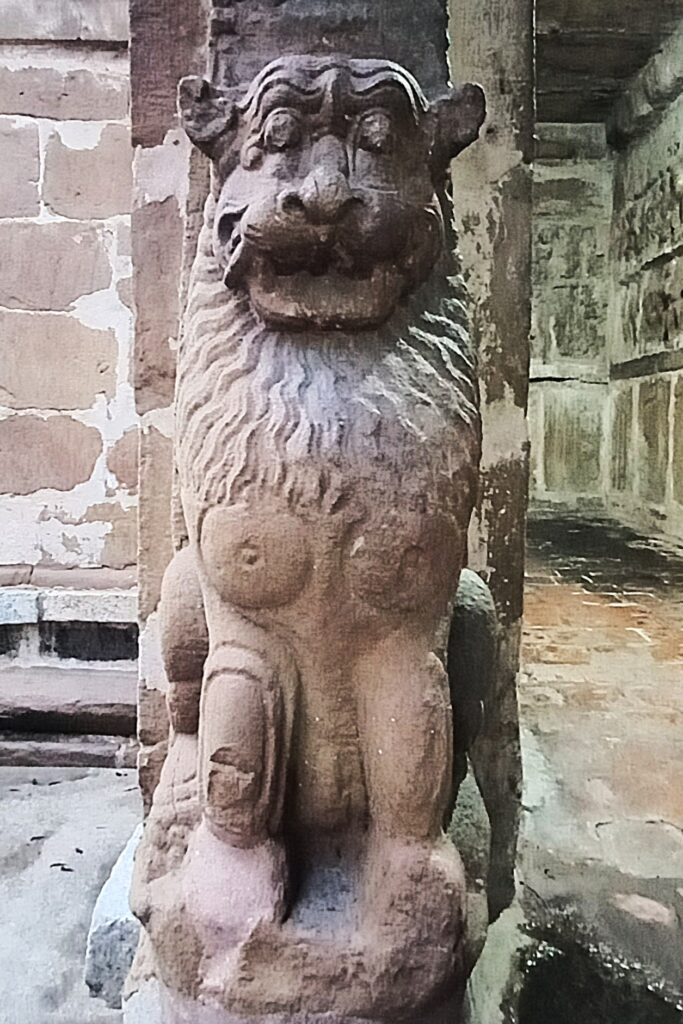
Lion carved on pillars
They support the enclosed passage inside the temple. This architectural style, that of pillars in rows, led to a distinctive style followed by the later temples. It led to the evolution of the architectural style of 1000 pillared halls in latter temples.
Lakshmi as Anandavalli
God Vishnu is worshipped as Vaikunta Perumal and his consort Lakshmi as Anandavalli.

Lakshmi as Anandavalli in Vaikuntha Perumal Temple
Temple Tank
The temple is surrounded by a granite wall enclosing all the shrines and water bodies of the temple. The temple tank is called Airammadha theertham and the vimanam is known as Mukunda vimanam. Before you leave allow a few minutes at this temple tank.
Vaikunta Perumal vs. Kailasanathar Temple — Which Should You Visit?
Kanchipuram has two Pallava-era temples that stand above the rest in historical and architectural importance: the Vaikunta Perumal Temple and the Kailasanathar Temple. Both were built under the same dynasty, but they serve different interests — and understanding that difference helps you plan your visit more effectively.
Vaikunta Perumal Temple A Vaishnava Divya Desam, unique for its three-tiered sanctums housing Vishnu in seated, reclining, and standing postures. Its walls carry some of the most significant Pallava dynasty inscriptions in existence, making it equally valuable for pilgrims and historians.
Kailasanathar Temple The oldest surviving temple in Kanchipuram, dedicated to Shiva. It is celebrated for its intricate sandstone carvings, compact Dravidian form, and a series of miniature shrines encircling the main structure. Architecturally, it represents the Pallava style at its most refined.
How to choose:
- Come to Vaikunta Perumal for Vaishnava pilgrimage, epigraphic history, and the rare multi-posture Vishnu darshan.
- Come to Kailasanathar for sculpture, Shaivite tradition, and early Dravidian architectural form.
The practical answer, though, is to visit both. They are located within the same city, and together they give you a complete picture of Pallava religious patronage — both Vaishnava and Shaivite. Add Ekambareshwar Temple to complete a focused Kanchipuram heritage circuit in a single day.

Temple corridor – Exploring the Ancient Beauty of Vaikunta Perumal Temple
Planning Your Visit — Timings, Location, and Tips
The Vaikunta Perumal Temple is easy to visit with a little advance planning. Here is the key information you need:
| Detail | Information |
| Location | Near Kanchipuram town centre; well-connected by road from Chennai (~75 km) |
| Temple Timings | 6 AM – 12 PM and 4 PM – 8 PM (verify locally during festival periods) |
| Best Time to Visit | October–February for cooler weather and manageable crowds |
| Special Access | First-floor sanctum (Reclining Vishnu) open only on Ekadashi and select festival days |
| Dress Code | Traditional attire preferred; men may be required to remove shirts at the sanctum entrance |
| Nearby Temples | Kailasanathar Temple, Ekambareshwar Temple, Kamakshi Amman Temple |
| Photography | Permitted in outer precincts; restricted inside the sanctums |
| Travel Tip | Stone floors get very hot by mid-morning — carry socks or visit early |
A few practical notes from my own visits: the temple is most peaceful in the early morning slot, before tourist groups arrive. If you are on a Divya Desam pilgrimage circuit, Kanchipuram alone has three Divya Desams — Vaikunta Perumal, Ulagalanda Perumal, and Yathoktakari Temple — making it possible to cover all three in a single day with good planning.
How to reach Vaikunta Perumal Temple Kanchipuram?
By air: The nearest airport to Kanchipuram is Chennai International Airport (Meenambakkam), 2 hours drive away.
By rail: Kanchipram can be reached from Chennai Central railway station and Arakkonam railway station. The temple is 2.4 km from Kanchipuram Railway station.
By road: Temple is at a walkable distance from Kanchipuram Bus station. Kanchipuram is 75 km away from Chennai and is well connected by a good network of roads.
Festivals and Special Occasions at Vaikunta Perumal Temple
The temple’s festival calendar draws pilgrims from across Tamil Nadu and offers visitors a dimension of the temple that regular darshan alone cannot provide.
Vaikunta Ekadashi The most significant occasion at this temple. On this day — which falls in the Tamil month of Margazhi (December–January) — the first-floor sanctum housing the Reclining Vishnu (Sayanam) is opened for public darshan. This is one of the few opportunities in the year to access the upper floors, and devotees consider it exceptionally auspicious. Crowds are large; plan to arrive early.
Brahmotsavam The annual festival involves ceremonial processions of the temple’s utsava murti (processional deity) through the streets of Kanchipuram. This is one of the most visually rich occasions to witness temple tradition in practice.
Panguni Uthiram Observed across Vaishnavite temples in Tamil Nadu, this festival in the Tamil month of Panguni (March–April) marks divine celestial marriages and includes special rituals at Vaikunta Perumal.
Monthly Ekadashi Each Ekadashi — occurring twice a month — sees enhanced prayers and larger gatherings, though upper-floor access is not guaranteed on all of them.
For heritage travellers, attending even one of these festivals adds a lived dimension to the visit. That said, come prepared for crowds, limited parking, and longer waiting times at the sanctum entrance.
Micro-Itinerary — Kanchipuram Divya Desam Circuit
Kanchipuram is one of the few cities in India where you can cover multiple Divya Desams in a single day. There are 14 Divya Desams associated with Kanchipuram in the Divya Prabandham, though several are located at a distance or have restricted access. The following circuit covers the most accessible ones in a logical geographic sequence.
Suggested Half-Day Route
- Vaikunta Perumal Temple (Thiru Parameswara Vinnagaram) Start here at 6 AM when the temple opens. Allow 45–60 minutes for the three-tiered sanctums and the inscription panels on the outer walls.
- Varadaraja Perumal Temple (Hastagiri) About 10 minutes by auto. One of the most important Divya Desams in Kanchipuram — note the famous stone chain carved from a single rock and the large gopuram. Allow 45–60 minutes.
- Yathoktakari Perumal Temple (Thiru Neeragam) Close to Varadaraja Perumal. Vishnu here is in a reclining posture. Compact temple; 20–30 minutes is sufficient.
- Ashtabhuja Perumal Temple Vishnu with eight arms (Ashtabhuja), symbolising divine protection. A smaller shrine — allow 20 minutes.
- Deepa Prakasa Perumal Temple (Thiru Vilakkoli) A quieter, less-visited Divya Desam where Vishnu is worshipped as the embodiment of light and knowledge. Worth a short stop.
Practical Tips for Travelers
- Total time: 4–5 hours for the above circuit
- Transport: Local auto-rickshaws are the most practical option; negotiate a half-day rate upfront
- Add Kailasanathar or Ekambareshwar Temple in the afternoon if you want to balance Vaishnava and Shaiva heritage in one day
- Carry water, socks for hot stone floors, and modest traditional clothing

Vaikunta Perumal Temple wall sculptures
FAQs about Vaikunta Perumal Temple
Q1. Who built the Vaikunta Perumal Temple?
The temple was built in the 8th century CE by the Pallava king Nandivarman II. It remains one of the best-preserved examples of Pallava temple architecture in Tamil Nadu.
Q2. Why is this temple significant?
It is one of the 108 Divya Desams — sacred Vishnu temples celebrated in the Nalayira Divya Prabandham. Its three-tiered sanctum design, showing Vishnu in seated, reclining, and standing postures, is extremely rare. The temple also preserves important Pallava dynasty stone inscriptions of historical value.
Q3. Is the upper floor open to visitors daily?
No. The first-floor sanctum (Reclining Vishnu) is accessible only on Ekadashi and certain festival days. The second-floor sanctum (Standing Vishnu) has similarly restricted access. Check the temple calendar or the HR&CE Tamil Nadu website before planning your visit.
Q4. What is the temple’s other name?
It is formally known as Thiru Parameswara Vinnagaram, the name used in the Divya Prabandham hymns.
Q5. Can visitors see the Pallava inscriptions?
Yes. The stone inscriptions are carved into the outer walls and are visible to all visitors. They document Pallava royal lineage, land grants, and dynastic history, and are maintained under ASI oversight.
Q6. How does Vaikunta Perumal Temple compare to Kailasanathar Temple?
Both are Pallava-era masterpieces, but they differ in focus. Vaikunta Perumal is Vishnu-centric, notable for its multi-tiered sanctums and epigraphic records. Kailasanathar is Shiva-centric, celebrated for its sandstone sculpture and early Dravidian form. If your time allows, visit both — they complement each other well as a Pallava heritage pair.
Q7. What is the meaning of the name Vaikuntha Perumal?
Vaikuntha meaning: Bhagwan Vishnu’s abode, where he stays with Lakshmi
Perumal meaning: the ‘Great One’, is the name of a Hindu deity.
Conclusion
The Vaikunta Perumal Temple in Kanchipuram earns its place among South India’s most important heritage sites on two counts: as a living Vaishnava pilgrimage destination and as a primary source of Pallava history carved in stone.
Built by Nandivarman II in the 8th century, it is one of the 108 Divya Desams, and its three-tiered sanctum — presenting Vishnu in seated, reclining, and standing postures — remains architecturally unique. The Pallava inscriptions on its walls continue to be studied by historians and are irreplaceable as historical records.
Having visited in 2010 and again in March 2022, I can say with confidence that the temple rewards careful attention. It is not a site you walk through quickly. The layers — architectural, epigraphic, devotional — reveal themselves gradually.
If you are building a South India heritage itinerary, Vaikunta Perumal Temple belongs near the top of that list — not as an afterthought, but as an anchor point.
Pin this for later

About the Author
 Indrani Ghose is a cultural travel writer with expertise in documenting global heritage sites. She visited over 150, big and small, temples documenting architectural heritage, festival traditions, and practical travel insights. She has written for numerous publications across the globe – including Lonely Planet, The National UAE, Whetstone Asia, Deccan Herald. You can follow her on her social media handles Instagram, Twitter, Pinterest and Facebook to see the wonderful destinations, beautiful offbeat places and get instant updates about them.






Hello Indrani,
Wow!
Nice info on the Shiva temple!
The temples in the south are so mystical and magnificent!!
Nice blog..will visit often..
Great pics too!!
Hi Indrani — thank you for sharing your beautiful pictures and for the history lesson. (Such an easy way to learn, looking at your pictures and well-chosen words.) You live in such a beautiful place.
Hi Indrani! This looks another place that should be put in my list; but how will I manage to see it all? Like Jorge Amado would say, you can't do it all, but you have to try… ;))
Thanks for your support to Blogtrotter Two, now departing Miami by air; my Easter egg for you… ;). Have a great weekend!!
Wonderful post Indrani 🙂
Unique temple !!!!
Have a Happy Weekend 🙂
Indrani, it's a fantastic temple, the carvings are amazing. Wonderful images, thanks for sharing!
How they stored their data those days! Through their sculptures. Lovely!
I have visited this temple and its absolutely marvellous. The architecture is very beautiful and you have taken lovely shots.
I marvelled at the intricate carvings. The thought that the craftsmen did these works of arts with limited tools during their time amazes me.
You always have nice pictures. I like that it is so different from what I have seen.
Wow! look at the details, such exquisite etchings and architecture.
Blogging has really brought me around the globe.
Beautiful post. I do not know how I reached here so late.
Thanks for sharing this Indrani…I was almost going to leave a comment on your last post.. but last year my husband and I visited Kanchipuram, and he took a few photos there 🙂
Also, Indrani, did you notice the unique way some people do prayer in the grabha graha- by crawling in a tiny crawl space around the backside of the god inside the building itself. Small kids and men did it. My husband did it.
The amount of human effort that must have gone into these temples is astounding.
Beautiful photos. I especially love the photos of the columns/posts. Thank you for sharing.
such amazing place. fantastic structures and great photos. thanks
Another interesting post with beautiful photos from your wonderful world.
Beautiful light on some of these photos, especially the golden sunlight. All those different variations of Shiva and Vishnu confuse me, but it's all beautiful.
Wonderful shots of the beautiful temple. Even though small when compared to other temples in the area it has its own charm.
wow. beautiful temples. i really want to go to your country because there is so much things to see.
Another marvelous and informative post with gorgeous photos, Indrani! Your posts are the next best thing to being there! Thanks for sharing so much of the beauty of your country! Have a wonderful week!
Sylvia
Feature with a purpose always sounds even more interesting. Another series of shots to enjoy. Thanks, Indrani.
kanchipuram is full of temples. And I don't remember visiting this one.
beautiful pictures. temples looks clean.
Nisha
aloha,
thanks for sharing a little bit of your world, it looks like a wonderful time to be there and with no crowds. i love the amazing courtyard and the beautiful lion pillars, very unusual and exotic
Second from bottom is my fav. A great pic of an great place. Postcard perfect!
Such intricate carvings in the temple! I have to admit I didn't know Hinduism has four sects. But Hinduism has been around for so long it makes sense that there would be many people with different ideas. Thanks for this interesting post, Indrani!
Very interesting post and shots. I know I've said this many times but I'm always so amazed by the intricacy of the carvings on architecture in India.
Another interesting look at your part of the world.
Another fabulous post Indrani. Thank you!
Lovely post, thanks for the tour 🙂
Himvad Gopalswamy Temple