The Ultimate Guide to Ekambareswarar Temple, Kanchipuram: 2026 Visitor Info & Heritage
Kanchipuram, often called the “City of Thousand Temples,” is home to one of South India’s most revered shrines — the Ekambareswarar Temple. Dedicated to Lord Shiva, this temple holds a unique place among the Pancha Bhoota Stalams — five sacred sites where Shiva is worshipped as the five elements of nature. Ekambareswarar represents Prithvi, the Earth element, and its sanctum enshrines the Prithvi Lingam, believed to have been formed from sand by Goddess Parvati herself.
I first visited in 2010, and returned in March 2022. Both times, the sheer scale of the complex — and the quiet energy inside it — stayed with me long after I left. From the 57-metre Raja Gopuram visible across the city, to the legendary 3,500-year-old mango tree said to represent the four Vedas, this temple is as much a living heritage site as it is a place of active worship.
By Indrani Ghose | Last Updated: Mar. 2026
This guide covers Ekambareswarar Temple’s history, architecture, significance, festivals, and everything you need to plan your visit in 2026.

Ekambareswarar Shiva Temple Kanchipuram
Ekambareswarar Temple — At a Glance
Here’s a quick and concise overview answering the most common high-intent queries about the temple:
| Aspect | Details |
| Location | Big Bazaar Street, Kanchipuram, Tamil Nadu – 631 502 |
| Deity | Lord Shiva, worshipped as Ekambareswarar (Lord of the Mango Tree) |
| Goddess | Elamkathir Kuzhalammai (Parvati) |
| Significance | One of the five Pancha Bhoota Stalams; represents the Earth (Prithvi) element |
| Main Lingam | Prithvi Lingam — made of sand, not consecrated with water |
| Architectural Style | Dravidian; 57 m Raja Gopuram; 1,000-pillared mandapam |
| Unique Feature | Ancient mango tree (~3,500 years old) with four branches, each symbolising one of the four Vedas |
| Temple Timings | 6 AM – 12.30 PM and 4 PM – 8.30 PM (verify locally before visiting) |
| Key Festivals | Panguni Uthiram, Maha Shivaratri, Vaikasi Visakam |
| Best Time to Visit | February–April (festival season); November–January (cooler weather) |
| Nearby Temples | Kamakshi Amman Temple, Varadaraja Perumal Temple, Kailasanathar Temple |
| How to Reach | Chennai (75 km by road); Kanchipuram Railway Station (2 km); Chennai International Airport (75 km) |
| Entry Fee | Free entry to the main temple; nominal fees for special darshans |
The 3,500-Year-Old Mango Tree at Ekambareswarar Temple — What Makes It Sacred?
One of the most compelling aspects of Ekambareswarar Temple has nothing to do with stone or mortar. It’s a tree.
The ancient mango tree inside the temple courtyard is believed to be over 3,500 years old, making it one of the oldest living trees associated with any Hindu temple in India. But its significance goes beyond age. According to temple tradition, the tree has four distinct branches, each bearing a different variety of mango fruit. These four varieties are held to represent the four Vedas — Rig, Yajur, Sama, and Atharva — the foundational scriptures of Hindu knowledge.
The symbolism is very evident. The tree is seen as a living expression of the idea that all paths of spiritual knowledge, however different, emerge from the same root.

Ekambaranathar Temple sacred Mango tree – Pic taken in 2010
During both my visits — in 2010 and again in March 2022 — I noticed that this was one of the spots where devotees actually slowed down. Ask the purohits there, even the elderly pilgrims, they speak about the tree with a familiarity that suggests an ongoing relationship, not just reverence for the past. I offered prayers at its base; then simply stood quietly beneath, looking up at it, totally amazed.
For anyone visiting Ekambareswarar Temple, the mango tree is easy to overlook amid the scale of everything else. DON’T. It is one of the most distinctive features of the entire Kanchipuram heritage trail — a place where botany, scripture, and lived faith intersect in a way that’s genuinely uncommon.
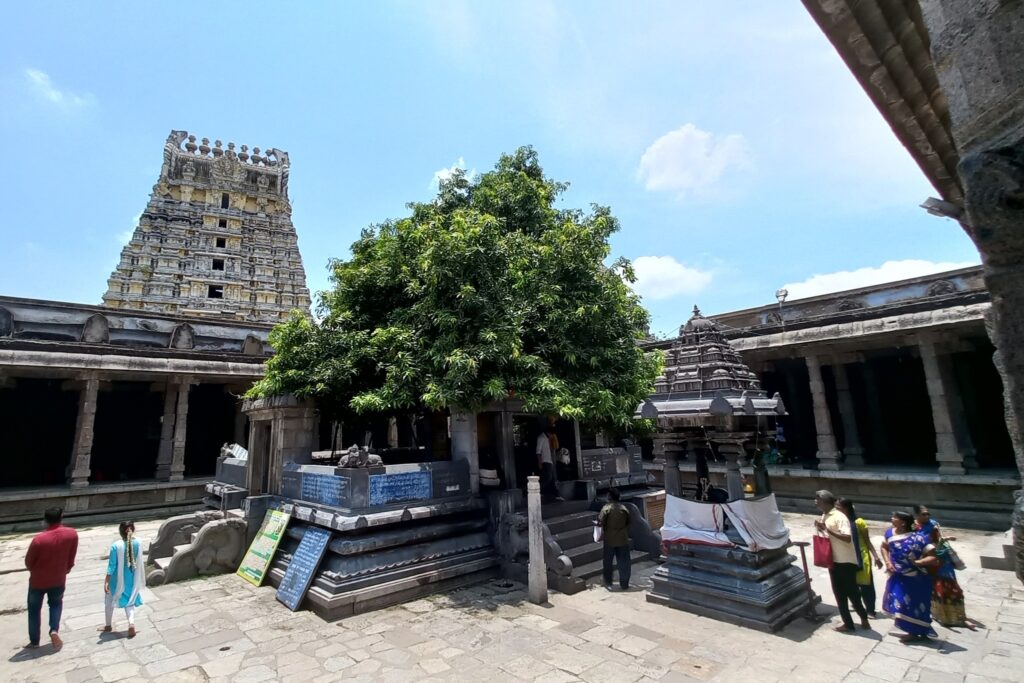
The Ekambaranathar Temple sacred Mango tree that I saw in 2010 had grown huge in 2022
Ekambareswarar Temple Architecture: The Raja Gopuram, 1,000-Pillar Hall, and More
Ekambareswarar Temple is among the finest examples of Dravidian architecture in temples of South India — and its scale alone commands attention. The complex covers approximately 23 acres, making it one of the largest temple precincts in Tamil Nadu.
The Raja Gopuram
The south-facing Raja Gopuram is the first thing you see approaching the temple, and it dominates the Kanchipuram skyline. Rising to 57 metres (about 192 feet), it ranks among the tallest temple towers in India.
The gopuram was built during the Vijayanagara period (14th–16th centuries), a time when temple construction across South India reached its most ambitious scale. Its exterior is densely decorated with stucco figures — gods, celestial beings, mythological narratives — arranged across multiple tiers.
I was stunned by the sheer density of sculpture on the tower. It is worth examining closely; each panel tells a story from the Hindu epics or Puranas.

Ekambarnatha Temple RajaGopuram
The Thousand-Pillar Hall
Inside the complex, the Aayiram Kaal Mandapam (1000-Pillar Hall) is a standout space. The hall is architecturally remarkable in two ways.
- First, its scale — hundreds of carved granite pillars creating a forest-like interior that filters light and sound in unusual ways.
- Second, several of its columns are musical pillars: when tapped, they produce distinct tonal notes, an engineering feature found in select South Indian temples and still not fully explained by modern acoustics research.

Aayiram Kaal Mandapam – 1000 pillar Hall
The Sahasra Lingam
One of the temple’s quieter highlights is the Sahasra Lingam — a single large lingam into which 1,008 miniature lingams have been carved. It is a powerful visual representation of the idea that Shiva’s presence is not singular but infinite and all-pervading. Devotees perform abhishekam (ritual bathing) here with devotion.
What to Notice as You Walk Through
During my visits, what struck me most wasn’t any single feature but the cumulative effect: the way the architecture moves you from the busy street outside into progressively more intimate spaces, each one shifting the atmosphere.
The Pallava, Chola, and Vijayanagara dynasties all contributed to what stands today, and that layered history is visible if you know where to look — in the variation in pillar styles, the different stone finishes, and the shifting proportions across different parts of the complex.
For heritage travelers and architecture enthusiasts, Ekambareswarar Temple is not just a religious site. It is a living record of medieval South Indian craftsmanship spanning over a thousand years.

Corridor with an array of 1008 Shiva Lingams
Spiritual Significance: Why Ekambareswarar Temple Matters
Ekambareswarar Temple occupies a specific and irreplaceable position in Hindu worship. It is one of the Pancha Bhoota Stalams — five temples across South India where Lord Shiva is venerated as each of the five natural elements. Here, Shiva embodies Prithvi, the Earth element, representing stability, sustenance, and endurance.
The presiding deity is worshipped as Ekambareswarar — a name derived from Eka (one), Amba (mother/mango), and Eswarar (Lord Shiva) — literally, the Lord of the Mango Tree.
The central object of worship is the Prithvi Lingam, which is distinct from lingams at other temples in one critical way: it is not bathed with water during abhishekam. Because it is believed to be made of sand, contact with water is avoided to preserve its form. Instead, priests offer sandalwood paste and flowers. This makes the rituals here visually and procedurally unlike those at most other Shiva temples.
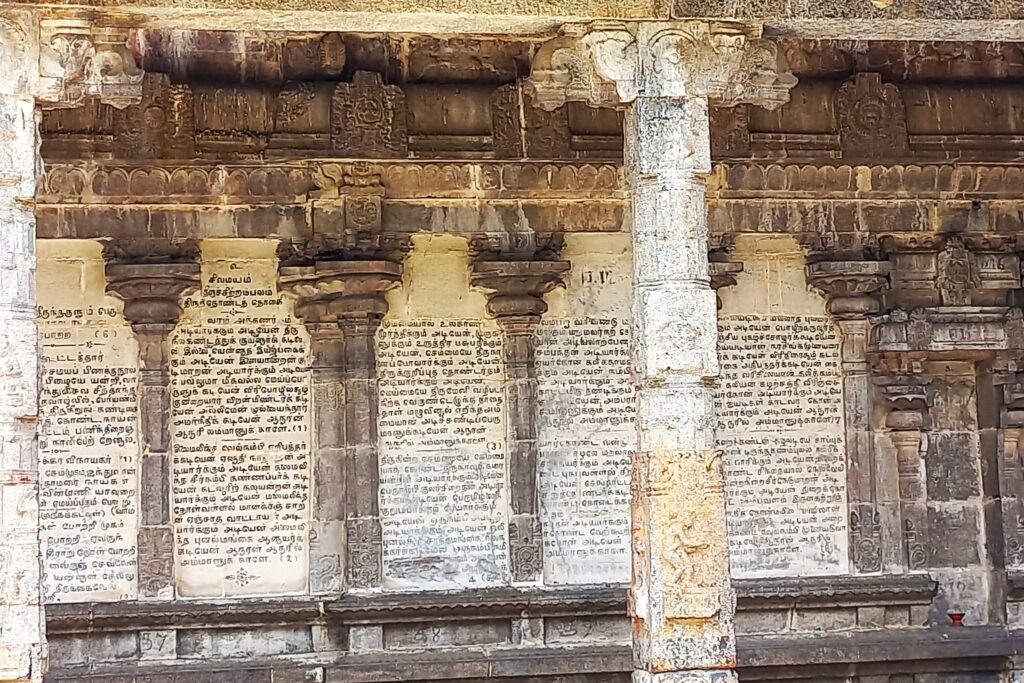
Inscriptions on walls of Ekambareswarar Temple
Here are three legends associated with the Ekambareswarar Temple:
Legend 1.
It is said that Parvati, the consort of Shiva, was once doing penance under Mango tree near the Vedavathi River when Shiva decided to test her devotion by sending fire upon her. Parvati prayed to her brother Vishnu for help, and he came to her rescue by taking the Moon from Shiva’s head and using its rays to cool down the tree as well as Parvati.
But Shiva was not done testing Parvati yet. He then sent the mighty river Ganga to disrupt her penance. Undeterred, Parvati prayed to Ganga and convinced her that they were sisters who should not harm one another. And so, Ganga did not disturb her penance any further.
In the end, Parvati made a Shiva Linga out of sand in order to unite with Shiva. And it is said that the god who appeared before her came to be known as Ekambareswarar, or the “Lord of Mango Tree”, in honor of the sacred tree under which Parvati had meditated.
Legend 2.
Yet another captivating legend of Ekambareswarar Temple I came to know is as follows: It is said that Parvati worshipped Shiva in the form of a Prithivi Lingam, a Lingam made from sand, beneath a mango tree.
According to the tale, the nearby Vedavati River overflowed and posed a threat to the Shiva Lingam. In response, Parvati, also known as Kamakshi, embraced the Lingam to protect it. Touched by her loving gesture, Shiva materialized in person and married her on the spot. This earned him the Tamil moniker Tazhuva kuzhainthaar, which roughly translates to “He who melted in Her embrace”.
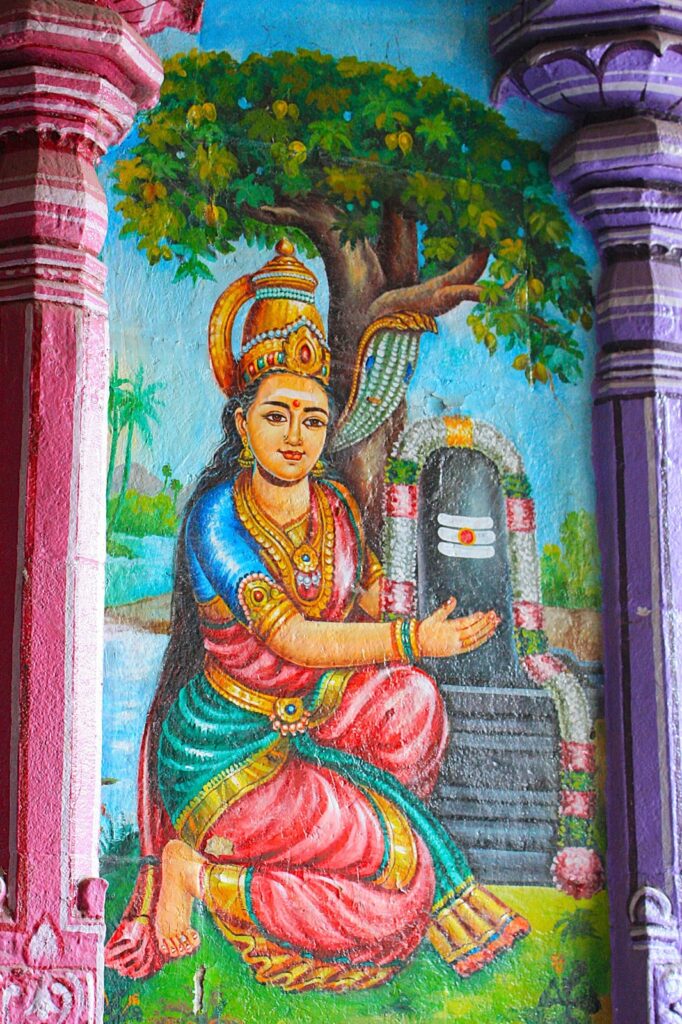
Parvati worshipped Shiva in the form of a Prithivi Lingam a Lingam made from sand
Legend 3.
During my exploration of the temple, I came across another interesting legend, which revolves around Tiurkuripputhonda Nayanar, one of the 63 Shaivite saints known as nayanars. Tiurkuripputhonda Nayanar worked as a washer man in the vicinity of the temple, and was responsible for cleaning the clothes of all the Shaivites.
As the story goes, God Shiva appeared before him disguised as an aged Brahmin and asked him to wash the clothes before dawn. Unbeknownst to the washer man, Shiva made it cloudy and it appeared to be evening instead. Disappointed by the approach of evening, Tiurkuripputhonda Nayanar banged his head against a stone. At that moment, Shiva revealed his true form and blessed his devoted follower.

Door in Ekambaranathar Temple in Kanchipuram, Tamil Nadu
The temple also features on the UNESCO Tentative List of World Heritage Sites under the “Temples of Kanchipuram” nomination. While formal inscription is pending, this recognition affirms its standing as a site of outstanding cultural and spiritual value — not just for Tamil Nadu, but globally.
Festivals and Daily Rituals at Ekambareswarar Temple
The temple operates on two registers simultaneously: the quiet rhythm of daily worship, and the periodic intensity of major festivals. Both are worth understanding before you visit.
Major Festivals
| Festival | When | What Happens |
| Panguni Uthiram | March–April | The most important festival at this temple. Celebrates the divine marriage of Shiva and Parvati, directly tied to the temple’s founding legend. Features grand processions, ritual ceremonies, and large gatherings of pilgrims. The mango tree courtyard becomes a focal point. |
| Maha Shivaratri | February–March | All-night vigil with continuous chanting, fasting, and abhishekam. The temple stays open through the night. One of the most spiritually charged events in the annual calendar. |
| Vaikasi Visakam | May–June | Celebrates the birth star of Lord Murugan and the temple’s broader heritage. Draws both local devotees and pilgrims from across Tamil Nadu. |
| Aadi Pooram | July–August | Festival dedicated to Goddess Parvati (Elamkathir Kuzhalammai). Particularly significant for women devotees seeking blessings. |
| Karthigai Deepam | November–December | Festival of lights observed across Shaivite temples. Lamps are lit in large numbers across the complex. |
Daily Rituals
Daily worship follows a structured schedule from early morning to night. The key ritual sequences are:
- Thiruvanandal (dawn opening) — begins around 6 AM with lamp offerings
- Abhishekam — ritual bathing of the Prithvi Lingam, performed with sandalwood paste and flowers rather than water
- Alankaram — decoration of the deity with flowers and garments
- Deeparadhana — waving of lamps before the deity, accompanied by Vedic chanting
- Artha Jamam — late-night ritual before the temple closes
These sequences repeat across the day, and visiting during any one of them offers a direct experience of living Shaivite tradition.
A Note from Personal Experience
On both my visits — in 2010 and March 2022 — I arrived on ordinary, non-festival days. Even so, the temple was far from quiet. The smell of incense, the sound of nagaswaram (temple pipe music) echoing through the pillared halls, and the steady movement of devotees around the sanctum created an atmosphere that felt both ancient and completely alive.
If you can time your visit around Panguni Uthiram or Maha Shivaratri, the experience will be significantly more immersive. But even a regular weekday morning here, during the abhishekam, is worth the trip.

Shrine in Ekambareswarar Shiva Temple Kanchipuram
Visitor Information: Timings, Entry, and Travel Guide (2026)
Temple Timings
The temple is open twice daily:
- Morning: 6 AM – 12.30 PM
- Evening: 4 PM – 8.30 PM
Note that six formal ritual services (pujas) take place across this schedule, beginning as early as 5:30 AM on some days. If you want to witness the morning abhishekam, aim to arrive by 6:00 AM when the gates open.
On festival days, particularly Maha Shivaratri, the temple remains open through the night. Always verify current timings locally before visiting, as these can change during major events or temple maintenance periods.
Getting There
| Mode | Details |
| By Road | Kanchipuram is 75 km from Chennai. State buses (TNSTC) run frequently from Chennai’s Koyambedu and Broadway terminals. Taxis and cabs are also readily available. |
| By Rail | Kanchipuram Railway Station is the nearest railhead, approximately 2 km from the temple. Direct trains operate from Chennai Egmore. |
| By Air | Chennai International Airport is the nearest airport, roughly 75 km away — approximately 1.5–2 hours by road depending on traffic. |
Best Time to Visit
- November – January: Most comfortable weather for sightseeing. Fewer crowds on regular days. Good for a focused, unhurried visit.
- February – April: Festival season. Maha Shivaratri (Feb 15) and the Panguni Uthiram festival (March–April) both fall in this window. Expect larger crowds but a more immersive experience.
- May – June: Avoid if possible. Summer temperatures in Kanchipuram regularly exceed 38–40°C, making extended outdoor exploration uncomfortable.
Practical Tips Before You Go
- Entry Fee: Free. Donations are welcome at various shrines within the complex.
- Dress Code: Modest, traditional attire is expected. Men should ideally wear a dhoti or full trousers; women in sarees or salwar. Shoulders and legs should be covered.
- Photography: Permitted in the outer courtyards and around the mango tree. Restricted inside the sanctum and during active rituals — follow instructions from temple staff.
- Footwear: Must be removed before entering. Paid storage facilities are available at the entrance.
- Time Required: Budget at least 2–3 hours for a thorough visit — covering the main sanctum, mango tree, Thousand-Pillar Hall, and Sahasra Lingam shrine.
- Mobile Network: Good coverage throughout. The temple has basic facilities including drinking water near the entrance.
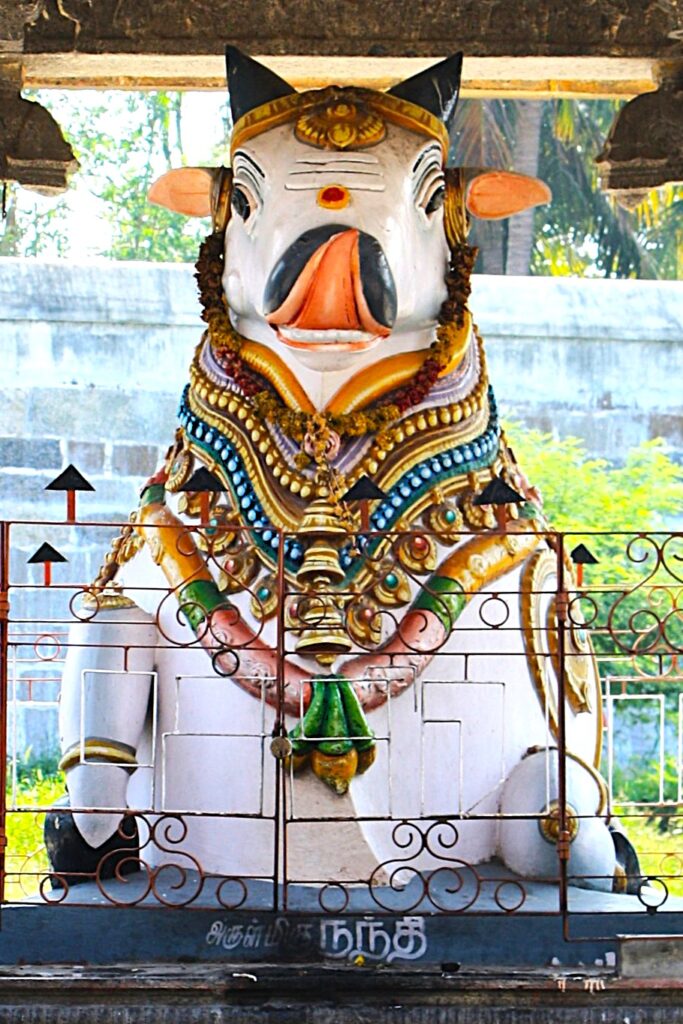
Nandi in Ekambareswar Temple
You can’t miss the gigantic Nandi, the bull just outside the temple but within the temple complex.
Ekambareswarar Temple Information
Address: Arulmigu Ekambaranathar Temple, Car St, Periya Kanchipuram, Tamil Nadu, India, Pin 631502.
49th Divya Desam inside the temple – Nilathingal Thundam Perumal Temple
Nearby Temples: Vaikuntha Perumal Temple, Kanchi Kailasanathar Temple
Key Festivals in 2026
Two festivals are particularly worth planning your visit around:
Maha Shivaratri — February 15, 2026
The Great Night of Shiva falls on a Sunday this year, making it accessible for weekend travellers. The temple stays open all night, with continuous chanting, abhishekam, and prayers across four ritual cycles (prahars). Crowds are large; arrive early or plan for a late-night visit to avoid peak congestion.
Panguni Uthiram Festival — March 2026 (13–14 days)
This is the most important festival in the temple’s annual calendar, directly tied to the significance of the Prithvi Lingam and the tradition that Parvati in the form of Gauri married Shiva at Kanchipuram. The festival runs for approximately 13–14 days during the Tamil month of Panguni (March–April). Key events in 2026 include:
| Event | Approx. Date (2026) |
| Flag Hoisting (Kodiyettram) | Around March 19–20, 2026 |
| Velli Adhikara Nandi Vahanam | Around March 26, 2026 |
| Thirukalyanam (Divine Marriage of Shiva & Parvati) | Early morning, April 1, 2026 (around 4:00 AM) |
| Theerthavari & Closing Rituals | Around April 2–4, 2026 |
Note: Exact dates follow the Tamil lunar calendar. Confirm final timings with the temple or local sources closer to the event.
FAQ about Ekambareswarar Temple, Kanchipuram
What is the significance of Ekambareswarar Temple?
Ekambareswarar Temple is one of the Pancha Bhoota Stalams, representing the Earth (Prithvi) element. The temple’s main deity, Lord Shiva, is worshipped as the Prithvi Lingam, symbolizing stability and fertility.
How old is the Ekambareswarar Temple?
The temple’s origins trace back over 1,000 years, with contributions from the Pallavas, Cholas, and Vijayanagara rulers. Its sacred mango tree is believed to be 3,500 years old, adding to its spiritual heritage.
What is special about the mango tree inside the temple?
The ancient mango tree has four branches, each yielding a different variety of mango. These symbolize the four Vedas — Rig, Yajur, Sama, and Atharva — representing unity in diversity.
Which festivals are celebrated at Ekambareswarar Temple?
The most important festivals are Panguni Uthiram (March–April), celebrating the divine marriage of Shiva and Parvati, and Maha Shivaratri (February–March). Other festivals include Vaikasi and Aadi.
Is Ekambareswarar Temple a UNESCO World Heritage Site?
The temple is part of the UNESCO Tentative List under “Temples of Kanchipuram.” While not yet inscribed, this recognition highlights its global cultural importance.
What is the best time to visit?
- November – January: Pleasant weather, fewer crowds.
- February – April: Festival season, ideal for experiencing rituals.
Avoid peak summer (May–June) due to high temperatures.
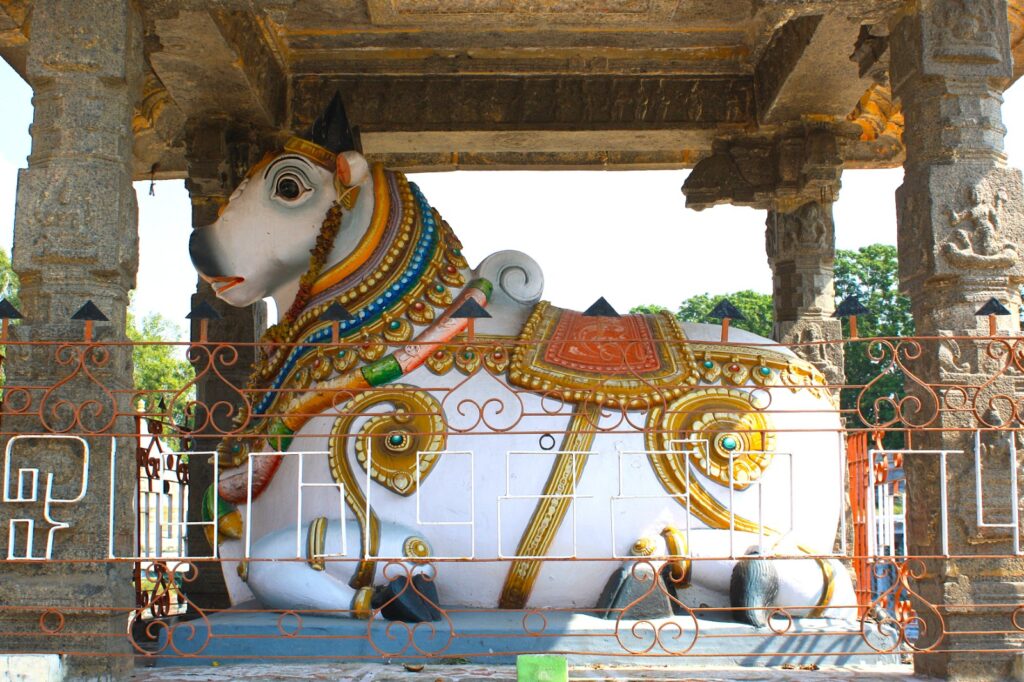
Statue of huge Nandi statue in Ekambeswarar Temple Kanchipuram
Conclusion
Ekambareswarar Temple in Kanchipuram is more than a historic monument — it is a living center of faith, culture, and heritage. As the Earth Element (Prithvi) temple among the Pancha Bhoota Stalams, it continues to inspire devotees with its grounding energy and timeless legends. From the towering Raja Gopuram and the thousand‑pillar hall to the sacred mango tree symbolizing the four Vedas, every corner of the temple reflects centuries of devotion and artistry.
I got easy darshans during my visits in 2010 and 2022. This temple connects past and present, thus satiates pilgrims and heritage site lovers. Whether you come for festivals, rituals, or architectural marvels, Ekambareswarar Temple offers a profound experience that blends spirituality with cultural discovery.
Pin this for later
About the Author
 Indrani Ghose is a cultural travel writer and heritage documentation specialist with over 15 years of experience exploring and writing about temples across India and Southeast Asia. Having visited over 150 sacred sites, she brings both scholarly depth and personal narrative to heritage travel writing.
Her work has been published in Lonely Planet, The National (UAE), Whetstone Asia, Deccan Herald, and various architecture and heritage journals.
Connect with Indrani: Follow Indrani on Instagram | Twitter | Facebook for heritage travel insights, photography tips, and offbeat destination discoveries.






What a beautifully written article! I really enjoyed learning about the rich history, magnificent architecture, and deep spiritual significance of the Ekambaranathar Temple. The way you explained the legends, the sacred mango tree, and the temple’s unique heritage makes the article both informative and engaging. It is a wonderful guide for anyone planning to visit Kanchipuram or wanting to learn more about one of South India’s most revered temples. Thank you for sharing such a detailed and inspiring post.
Beautifully written ?
Just fyi please correct the AM – PM
Ushathkalam at 5.30 AM
Kalasanthi at 8 AM
Ucchikalam at 10 AM
Sayarakshai at 6 AM
Irandamkalam at 8 AM
Ardha Jamam at 10 AM
It is very interesting to know about this beautiful place . I always feel that there is a great difference between North India Temple and South India Temples . We would have to study a lot to know about these structures !!
It’s Very interesting place
Oh, what a surprise: I like very much the gigantic Nandi and the hallway with a thousand pillars but also the other pictures are fantastic!!!
A wonderful and interesting post as always!
🙂
Thanks for sharing!
A wonderful temple, indeed . Loved your photo of the row of Lingams.
But the monument in Kanch that never fails to mesmerise me time and again is The Kailasanathar Temple.
Kanchi is an artlover's delight, but the only irritation is the relentless pestering by "Guides" from Silk shops, who offer to show you around only to drag you to their saree shops and try to force a sale on you.
Very beautiful temple with nice architecture. Very well written with lovely photos.
Beautiful! I am curious about the Shiva Lingams, must google what they are for. They look amazing.
Excellent shots…it exactly brings out Indian tradition. Thanks for sharing…
The Nandi looks really special. I guess the barricade is to prevent vandalism. Love the corridor of pillars too.
You have such an interesting and historic culture.
Hi there,
I love these pictures, especially the one of the hallway and bull. Well done.
Been there minus the camera. Lovely place. A temple every 100 yards it seems over here. And do they allow you to take pictures?
India seems to have temples, more temples and still more temples. Love the Shiva Lingam photo, but don't know what it is – actually all the photos are great.
Truly an interesting world.
Thank you for sharing.
amazing!!!
I always learn something new here. Very interesting post and lovely photos!
Absolutely fantastic – especially the hall of a hundred pillars! Fabulous shots!
A fascinating look at your wonderful country and culture. Your photos are amazing. It is my hope that I will be able to travel to India one day and see some of these incredible sights for myself. Thank you for this view into your world Indrani.
Beautiful shots of the temples. Even I visited around 5 temples for the city with dotted temples.
kancheepuram is a city of temples.. impossible to see all of them in a lifetime…. the ekabaranathar temple is certainly amongst the most important… and its really beautiful! but i am surprised they allowed cameras inside… thanks to you,next time i shall take mine too 🙂
Look at the architecture (and carvings??) They are so exquisite.
Amazing. India has such a rich culture.
Wonderful post. Your land is filled with interesting archetecture and history. Every posts brings new revelations.
another fascinating post. love the corridor image.
Always such marvelous photos and such interesting information! And it is always a real pleasure to visit your blog to see and learn about your world! Thanks for sharing with us, Indrani!
Sylvia
That's amazing how old the tree is. I love the towers and the whole tour for that matter. Your part of the world has so many beautiful and historical places.