The Ultimate Guide to Porto Cathedral (Sé do Porto): History and Architecture
Why Sé do Porto is Porto’s Spiritual and Historical Heart
Is Porto Cathedral Portugal worth visiting? After spending three hours exploring every corner during my October 2024 visit, I can say unequivocally: yes. The Sé do Porto isn’t just Porto’s oldest monument—it’s a multi-layered chronicle of Portuguese history spanning 900 years, from its Romanesque foundations (begun in 1110) to its baroque flourishes added in the 1700s.
This Porto Cathedral Visitor’s Guide focuses on what guidebooks often miss: the interplay between architectural eras, the storytelling power of its Porto Cathedral tiles, and practical insights from first hand experience. Inside, you’ll discover a sacred space that feels both fortress-like and intimate—its granite walls absorbed centuries of prayers, royal weddings (including King John I in 1387), and even served as a military lookout during the Siege of Porto.
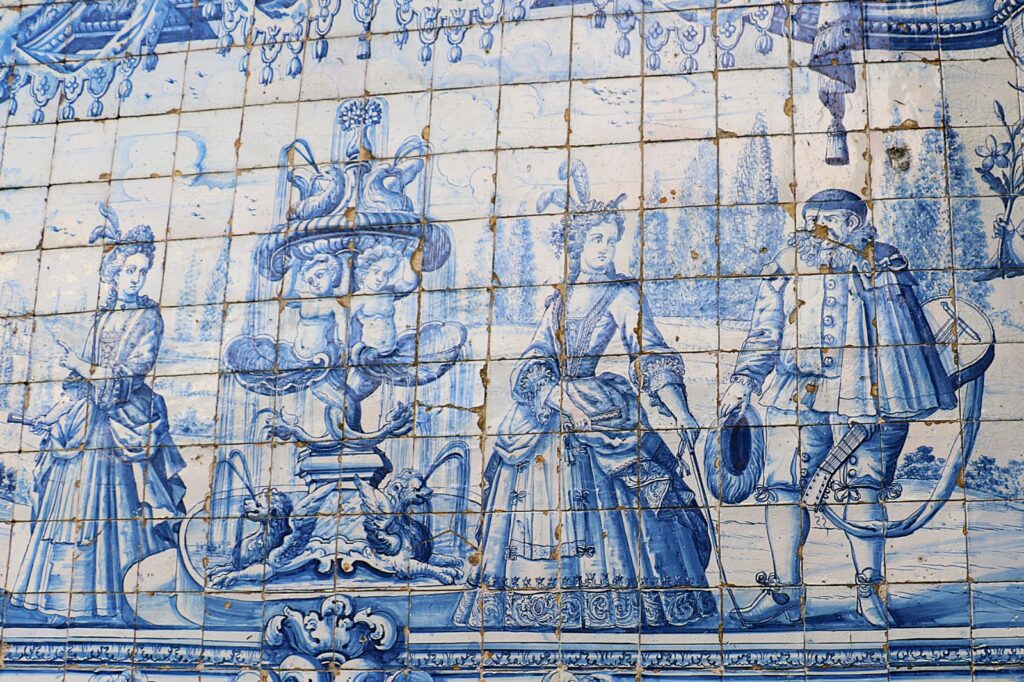
What struck me most was the Gothic cloister’s 18th-century azulejo panels by Valentim de Almeida—depicting the life of the Virgin Mary in approximately 10,000 hand-painted tiles. The blue-and-white tilework catches afternoon light between 3 to 5 PM, creating shadows that emphasize the three-dimensional relief work (a detail I captured in my photos, featured throughout).
The cathedral’s terrace offers the finest panoramic views of the Douro River.
Guide to Porto Cathedral Portugal
A Fortress on the Hill: The Sé’s Strategic Importance
Perched 90m above the Douro on Porto’s highest natural elevation, Porto Cathedral Portugal was engineered as a fortified church-castle (igreja-fortaleza)—a rarity in Portuguese ecclesiastical architecture.
During my visit, I explored the northern tower’s narrow spiral staircase (120 uneven steps—wear proper shoes), which served as a watchtower. From this vantage, guards could survey the old city walls, the river port, and approaching threats from the Atlantic coast 5 km west. The Porto Cathedral history records its use as a refuge during the 1628 Spanish invasion.
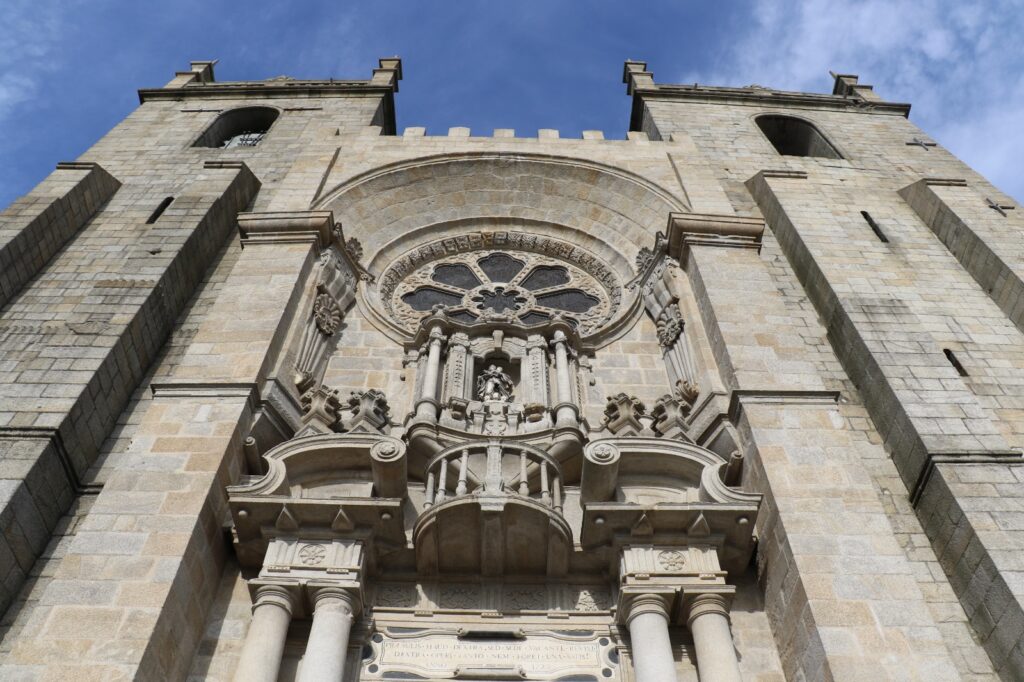
Standing in the Terreiro da Sé plaza, I photographed the façade’s asymmetrical towers—the south tower (rebuilt after the 1755 earthquake) shows baroque influence, while the north retains its Romanesque severity. This architectural “conversation” between eras is visible in few other Portuguese cathedrals.
Pro tip from experience: The best defensive architecture views are from the cloister’s upper gallery—accessible with the €3 ticket—where arrow slits and murder holes remain intact.
File Facts Box
- Official Name: Sé Catedral do Porto (Cathedral of Porto)
- Location: Terreiro da Sé, 4050-573 Porto, Portugal (GPS: 41.14° N, 8.61° W)
- Construction Period: 1110-1737 (multiple phases)
- Architectural Styles: Romanesque (main structure), Gothic (cloister, 14th c.), Baroque (chapel of sacrament, 1717)
- UNESCO Status: Part of Historic Centre of Porto World Heritage Site (1996)
- Must-See Elements:
- Gothic cloister with Valentim de Almeida azulejos (1729-1731)
- Nasoni-designed baroque silver altarpiece (1727)
- Romanesque rose window (restored 2020)
- Entry Fees (2024 rates): Free (main nave); €3 (cloister + museum combo)
- Hours: Mon-Sat 9 AM to 6.30 PM; Sun 2.30 PM to 6 PM
- Best Times:
- Photography: 9 AM to 10 AM (empty nave, soft light)
- Azulejo viewing: 3 PM to 5 PM (cloister sun angle)
- Avoid: 11 AM to 1 PM (tour group peak)
- Nearby (5-min walk): São Bento Station (azulejo panels), Palácio Episcopal, Dom Luís I Bridge viewpoint
Gothic Cloister in Porto Cathedral
The Fascinating History and Architecture of Porto Cathedral
Porto Cathedral history spans nine transformative centuries, making the Sé do Porto one of Portugal’s most architecturally complex monuments. Designated a National Monument in 1910, this isn’t simply a church—it’s a unique mix where Romanesque militarism, Gothic refinement, and Baroque drama coexist in granite and gold. Understanding these layers transforms a casual visit into a journey through Portuguese architectural evolution.
From Romanesque Fortress to Baroque Splendor: A Timeline
1110-1120s: Romanesque Foundations
Construction began around 1110 under Bishop Hugo (first Bishop of Porto, appointed 1113), shortly after Portugal gained independence from León. The original igreja-fortaleza featured 2-meter-thick granite walls, minimal fenestration (narrow slit windows), and twin defensive towers—military necessities during ongoing Reconquista conflicts with Moorish forces to the south.
1333-1386: Gothic Expansion
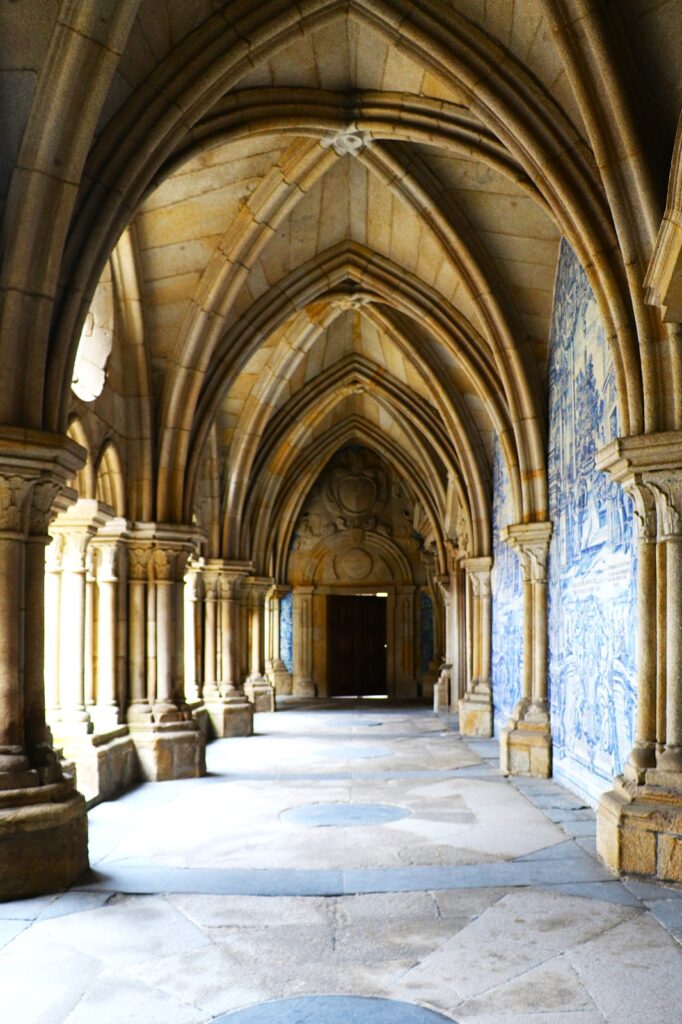
King Afonso IV commissioned the Gothic cloister (1333-1359), replacing an earlier Romanesque version. Its pointed arches, ribbed vaulting, and delicate tracery marked Porto’s embrace of French Gothic style—a contrast to the fortress severity.
1717-1737: Baroque Transformation
Italian architect Nicolau Nasoni—who also designed Porto’s iconic Clérigos Tower—revolutionized the Sé’s interior between 1717-1737. His additions include:
- Baroque loggia (1736) on the north façade with ornamental balustrade
- Chapel of the Holy Sacrament featuring a monumental silver altarpiece (400+ kg of wrought silver, created by Santos Pacheco)
- Gilded talha dourada (golden woodwork) that creates dramatic light contrast against Romanesque stone
Standing in the nave, the visual collision between 12th-century austerity and 18th-century opulence is jarring—the gilded retable literally glows against dark granite.
Sé do Porto Fortress on Hill
The Unmissable Exterior: Twin Towers and the Pelourinho
Approaching from Terreiro da Sé, the cathedral’s asymmetrical twin towers immediately reveal its evolutionary history:
- North tower: Original Romanesque structure (circa 1120) with crenellations, narrow arrow slits, and 40-meter height—built for military surveillance
- South tower: Rebuilt after the 1755 Lisbon earthquake with subtle baroque modifications (rounded merlons, decorative finials)
This architecture style combinations, Romanesque pragmatism beside baroque decoration—is rare in Portuguese cathedrals. For comparison, Coimbra’s Sé Velha (Old Cathedral) maintains purely Romanesque symmetry, making Porto’s hybrid form more historically complex.
The Pelourinho (pillory column) in the plaza’s center dates to the 16th century. This Manueline-style carved stone pillar—approximately 4m tall with twisted rope motifs—served as both judicial punishment site and civic symbol. While grim (criminals were publicly shamed here), it now functions as a historical anchor point, marking where medieval Porto administered justice.
Photography tip: Position yourself at the Pelourinho for symmetrical tower shots (best light: 8 AM to 9 AM). The granite pavement’s geometric pattern—installed during a 2012 restoration—creates leading lines toward the façade, ideal for wide-angle compositions.
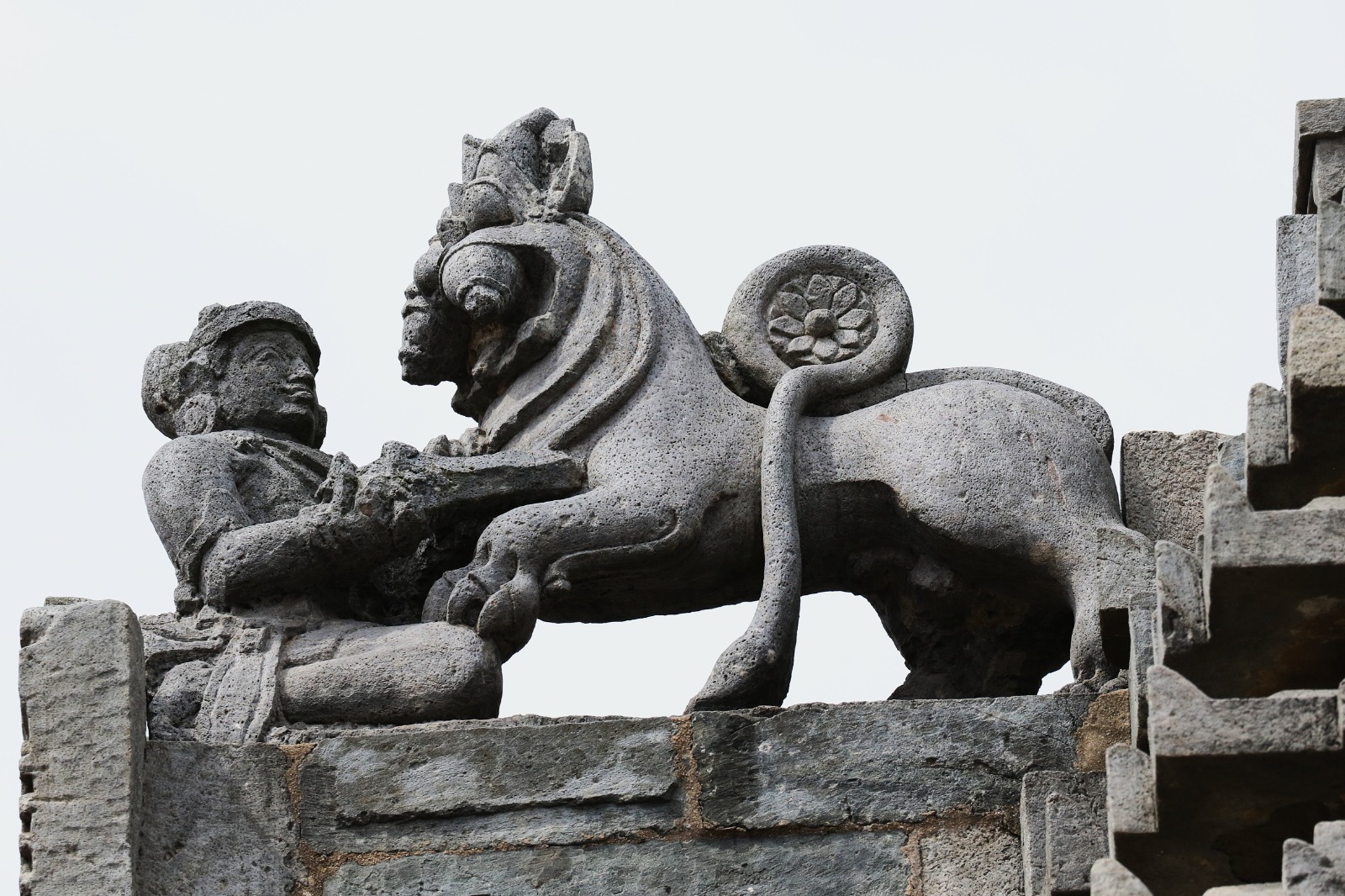
Stone sculpture of the Porto Cathedral
Architectural Timeline:
- 1110-1120: Romanesque construction begins (Bishop Hugo)
- 1333-1359: Gothic cloister added (King Afonso IV)
- 1717-1737: Baroque renovations (Nicolau Nasoni)
- 1729-1731: Azulejo installation (Valentim de Almeida)
- 1755: South tower rebuilt (earthquake damage)
- 1910: National Monument designation
- 1996: UNESCO World Heritage inclusion
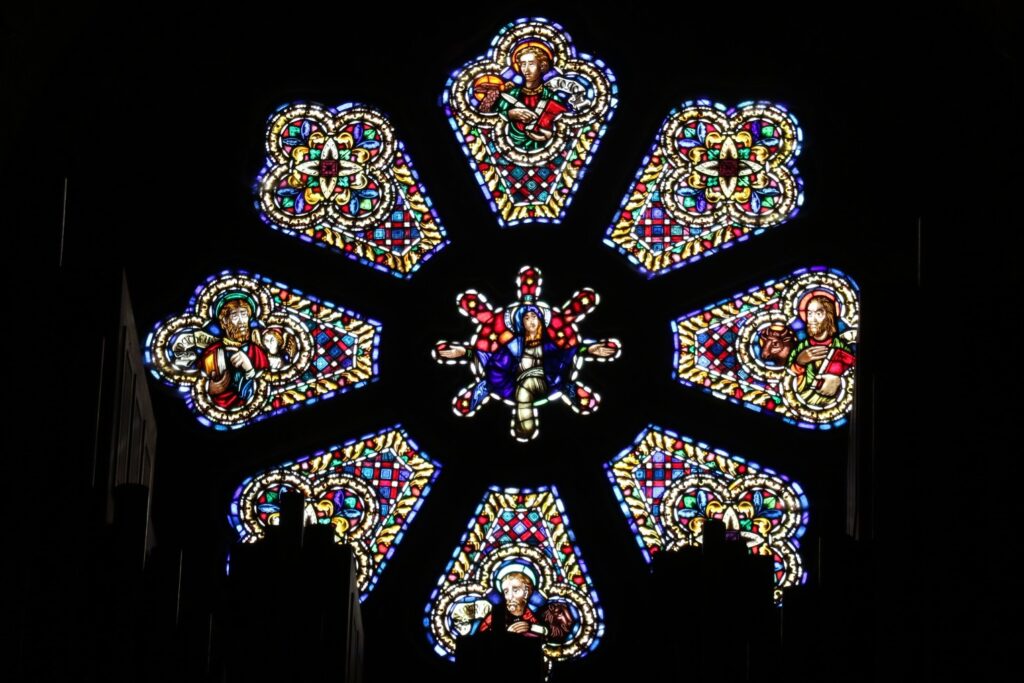
Stained Glass window in Porto Cathedral
Must-See Highlights Inside Sé do Porto
The Cloister: A Masterpiece of Porto Cathedral Tiles
The Gothic cloister (1333-1359) is the Sé’s artistic crown jewel, where 15,947 hand-painted azulejo tiles by master tile-maker Valentim de Almeida (1729-1731) transform stone corridors into a visual Bible. Covering approximately 335 square meters of wall space across 14 arched bays, these cobalt-on-white narratives represent Portugal’s Golden Age of tile artistry.
Key Tile Panels to Seek Out:
- The Life of the Virgin (East Gallery, 8 panels)
The largest cycle depicts Mary’s story from the Annunciation to Assumption. During my visit, I spent 20 minutes studying Panel 4 (the Visitation)—the dimensional shading technique creates 3D depth rarely seen in 18th-century azulejos. Best viewing: 3 PM to 4 PM when sunlight angles through the arches, illuminating the tin-glaze. - Allegory of the Song of Songs (North Gallery, 5 panels)
This poetic sequence interprets Solomon’s love verses through mystical symbolism—look for the enclosed garden (hortus conclusus) in Panel 2, a metaphor for Mary’s purity. The emotional intimacy here contrasts with the military severity of the Romanesque exterior. - Martyrdom of St. Thomas Becket (West Gallery, 3 panels)
The São Tomé de Cantuária panels depict the 1170 Canterbury murder with dramatic intensity. Panel 1 shows the moment four knights strike Becket at the altar—note the blood spatters rendered in diluted cobalt, a rare naturalistic detail. This narrative choice reflects Porto’s medieval ties to English trade routes.
Pro tip from experience: Start your cloister walk in the southeast corner (entrance point) and move counter clockwise. This follows the tiles’ chronological installation order, and the narrative flow makes more sense.
Practical Details:
- Porto Cathedral cloister entrance fee: €3 (includes Chapter House access)
- Combined ticket: €5 (cloister + Episcopal Palace gardens)
- Photography: Permitted without flash; tripods require permission
- Average time: 25-35 minutes for thorough viewing
The cloister also provides access to the Chapter House and upper terrace—don’t skip these less-crowded spaces.
The High Altar and Baroque Silver Altarpiece
Transitioning from the Romanesque nave into Nicolau Nasoni’s Baroque sanctuary (1727-1737) creates intentional sensory shock—gilded talha dourada, Solomonic columns, and theatrical chiaroscuro replace fortress minimalism.
The Silver Altarpiece (Capela do Santíssimo Sacramento)
Positioned in the right transept, this 450-kilogram masterwork by silversmith Santos Pacheco and team (1717-1719) predates Nasoni’s main altar renovations. The frontal panel features:
- High-relief Eucharistic symbols (wheat, grapes, pelican)
- 18 cherub figures in repoussé technique
- Floral cartouches with Rococo asymmetry
During my visit, I learned from cathedral docents that the silver survived two documented theft attempts (1809 during Peninsular War, 1975 post-Revolution turmoil) by being temporarily hidden in the Episcopal Palace vaults. Unlike the melted church silver funding war efforts across Portugal, this piece’s artistic significance granted protection.
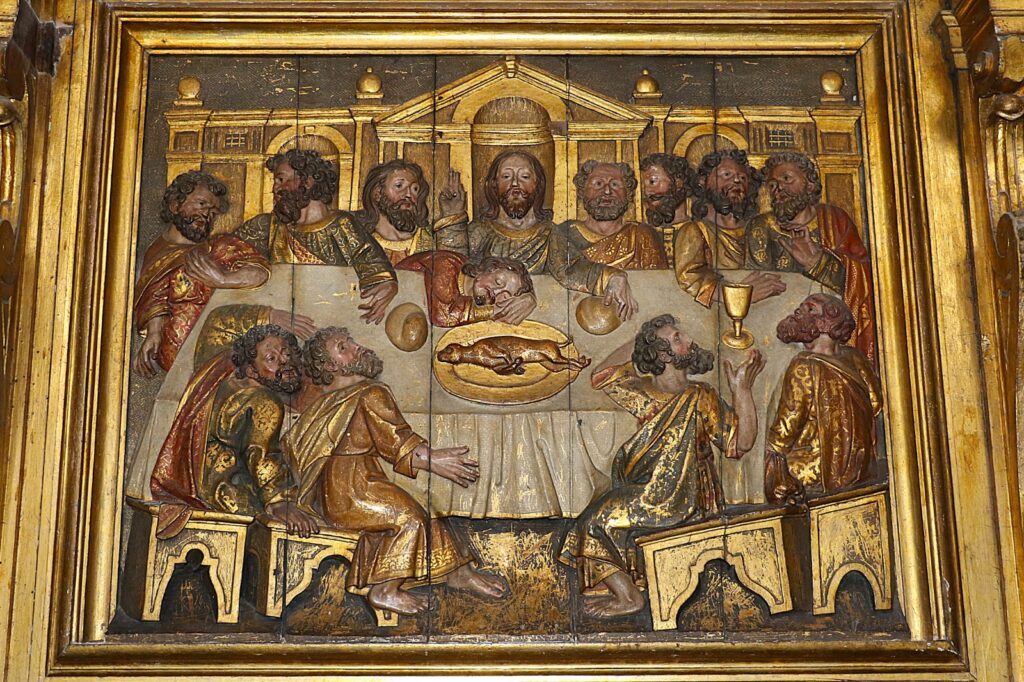
Ornate Depiction of Last Supper inside Porto Cathedral Portugal
Comparative Context:
While São Francisco Church’s gilded interior overwhelms with 100+ kg of Brazilian gold, the Sé’s silver altarpiece maintains liturgical solemnity—it serves worship rather than displays wealth. This restraint reflects episcopal priorities versus Franciscan merchant patronage.
Photography challenge: The Chapel of the Holy Sacrament has strict no-photography rules (security concern).
The Chapter House (Casa do Cabildo) and Cathedral Treasury
The Casa do Cabildo, rebuilt after 1717 fire, now houses the Sé do Porto museum collection—an intimate archive of 900 years of episcopal history.
Collection Highlights (from my visit notes):
- 12th-century reliquary cross (carved wood with ivory Christ figure)—one of Portugal’s oldest surviving liturgical objects
- 16th-century Episcopal vestments in Flemish brocade, showcasing Porto’s textile trade wealth
- Illuminated choir books (15th c.) with gold-leaf initials and marginal grotesques
- Processional monstrance (1731, silver/gold) by Porto silversmith guild
Unlike blockbuster museum displays, the Treasury feels devotional—objects remain in liturgical context, not clinical vitrines. The low lighting (conservation requirement) creates meditative atmosphere, though it challenges photography (ISO 3200+ needed).
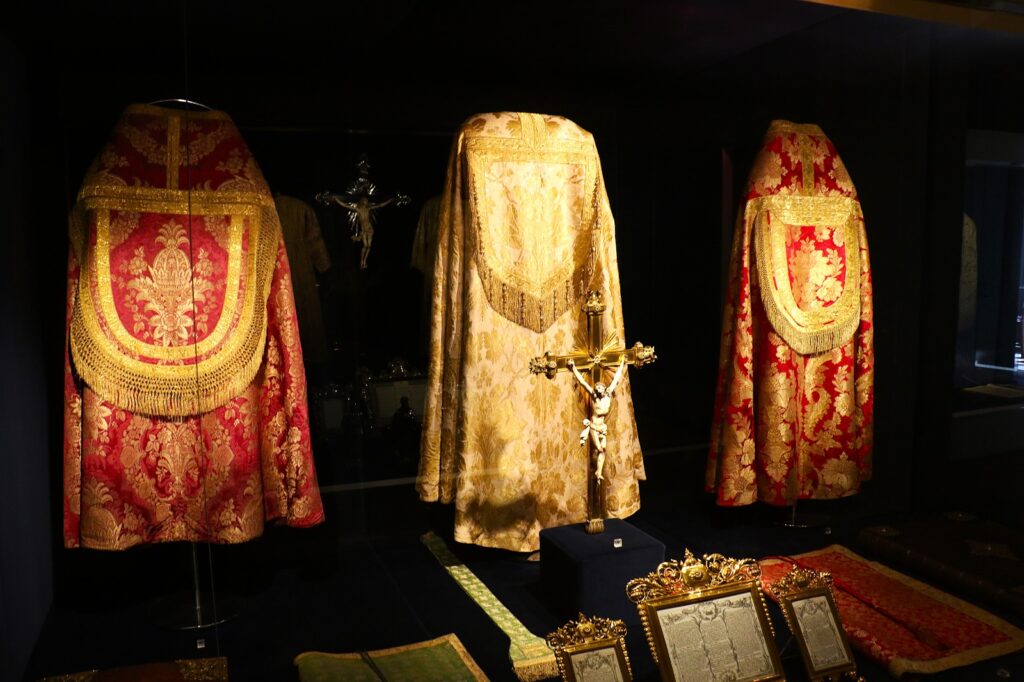
12th-century reliquary cross, religious vestments and artifacts
Visitor Logistics:
- Treasury of Porto Cathedral hours: Daily 9 AM to 6.30 PM (last entry 6 PM); included in €3 cloister ticket
- Guided tours: Portuguese/English, 11 AM daily (€8, includes access)
- Accessibility: Ground floor only; no elevator to upper Treasury rooms
Personal recommendation: Allocate 15 to 20 minutes here. The manuscript room (right side, glass case) contains a 1485 psalter with Porto’s coat of arms—a detail connecting city identity to sacred history.

The Pelourinho (pillory column) in the plaza’s center.
Practical Visitor Information and Insider Tips
Planning your visit to Sé do Porto is easy with a few insider tips. Whether you’re budgeting time or money, this guide covers everything from entry fees to the best time to explore.
Porto Cathedral Tickets and Opening Hours (2025/2026)
The nave of Porto Cathedral is free to enter, making it accessible to all visitors who want to admire its Romanesque grandeur and attend Mass. However, access to the Gothic cloister, Chapter House, and Treasury requires a paid ticket.
- Porto Cathedral ticket price 2025: €3.00 for adults; free for children under 10.
- Opening hours: Daily from 9:00 AM to 6:30 PM (last entry at 6:00 PM).
- Sé do Porto Mass schedule: Regular Mass is held in the nave, typically at 11:00 AM on weekdays and 10:00 AM on Sundays. Check local listings for feast days and special services.
- Porto Cathedral cloakroom policy: There is no formal cloakroom, so travel light. Large bags may be restricted in cloister and treasury areas.
Tickets can be purchased at the entrance or online via local tourism platforms. Arrive early to avoid queues, especially during peak season.
How to Get There and Parking
The cathedral is highly walkable and centrally located in Porto’s historic district.
- Closest metro station to Porto Cathedral: São Bento Station, just 350 meters away.
- Walking from São Bento station to Sé do Porto: A scenic uphill stroll through cobbled lanes takes about 5–7 minutes.
- Best parking near Porto Cathedral: Underground parking is available at Praça da Batalha and Rua das Flores. Street parking is limited and often full during weekends.
If you’re staying nearby, walking is the best option—allowing you to take in the views and explore adjacent landmarks like the Episcopal Palace and Dom Luís I Bridge.
Pro-Tip: When to Visit to Avoid Crowds
The least busy time to visit Porto Cathedral is early morning on weekdays, especially Tuesday or Wednesday. Porto Cathedral on a Sunday vs weekday is a different experience—Sundays are more atmospheric due to Mass but also more crowded.
Visiting Sé do Porto during low season (November to February) offers quieter access and softer light for photography. I visited in late autumn and had the cloister almost to myself—perfect for reflective moments and uninterrupted shots.
Is There a Dress Code for Porto Cathedral?
Yes—modest attire is recommended. Sleeveless tops and short shorts may be frowned upon, especially during Mass. A light scarf or shawl is useful if you’re unsure.
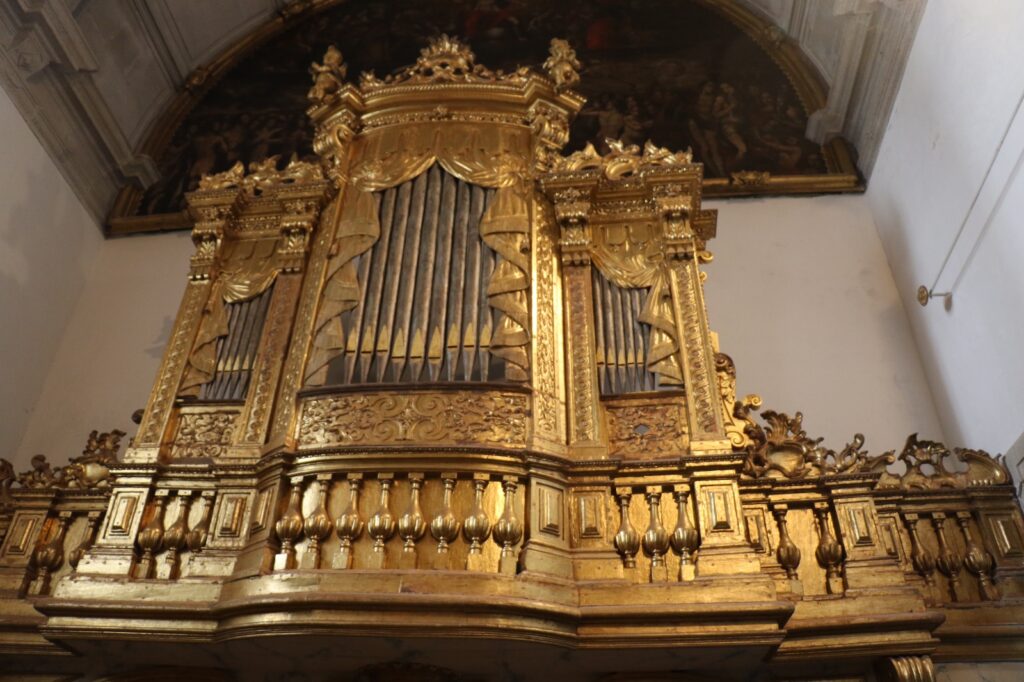
Pipe Organ Se do Porto
The Best Photo Spot: Porto Cathedral Viewpoint
If you’re chasing the “money shot,” head straight to the Sé do Porto viewing terrace—the best viewpoint near Porto Cathedral. Located just behind the cloister, this elevated platform offers sweeping views over the Douro River, the red-tiled roofs of Vila Nova de Gaia, and the iconic Dom Luís I Bridge.
The view of Dom Luís I Bridge from Sé do Porto is especially dramatic at sunset, when the iron arches glow against the golden sky. For sharp compositions, use the terrace’s stone balustrade to frame your shot. My top photo tips for Sé do Porto: arrive early for soft light, use a wide-angle lens, and capture both the cathedral façade and the river panorama.
This Porto Cathedral viewpoint location is easy to access from the cloister exit—don’t miss it before you leave.
What to See Near Sé do Porto (The Local Itinerary)
Quick Stop Itinerary: Near Porto Cathedral
If you have an hour to spare, this 1-hour itinerary near Porto Cathedral offers a rich taste of Porto’s heritage:
- Ribeira District walk from Sé (7 min): Descend through medieval alleys to the riverfront, where cafés and boats line the quay.
- Dom Luís I Bridge (10 min): Cross or photograph this engineering marvel connecting Porto to Vila Nova de Gaia.
- Palácio da Bolsa distance from Sé (8 min): Visit the former stock exchange, famed for its Arabian Room and neoclassical grandeur.
- Clérigos Tower (12 min): Climb this baroque bell tower for another panoramic view of the city.
- São Bento Station (5 min): Admire the azulejo-covered vestibule depicting scenes from Portuguese history.
These things to do near Porto Cathedral are all walkable, making Sé the perfect anchor for your Porto itinerary.
Starting the Camino de Santiago from Sé do Porto
The Camino Português da Costa starting point Porto is none other than Sé do Porto. Pilgrims beginning the Portuguese Coastal Way often gather here to receive their first stamp and blessings.
You can get your Camino stamp in Porto Cathedral at the sacristy or visitor desk—just ask politely. The Pilgrim’s Office near Sé do Porto also provides route maps, credentials, and advice for the journey ahead.
Standing on the cathedral steps with my camera and journal, I watched pilgrims begin their walk with quiet determination. It’s a powerful reminder that Sé do Porto is not just a destination—but a departure point for spiritual adventure.
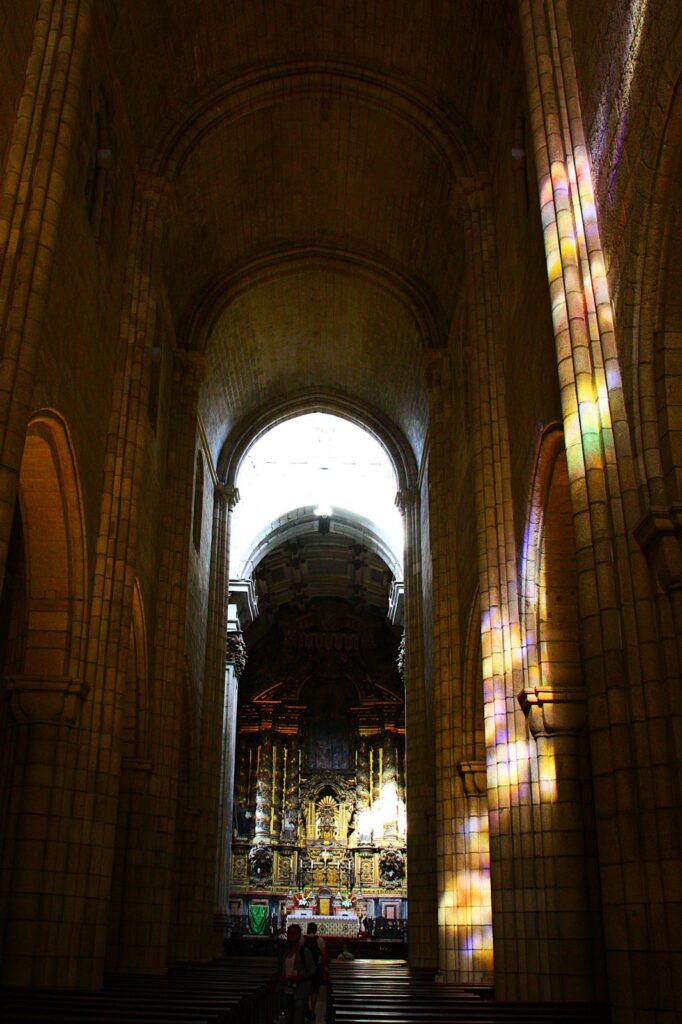
Play of light inside Porto Cathedral Portugal
FAQ Porto Cathedral Portugal
Is the Porto Cathedral worth visiting?
Yes—Porto Cathedral Portugal is one of the city’s most iconic landmarks, offering a rich blend of Romanesque, Gothic, and Baroque architecture. From the Gothic cloister’s azulejo tiles to the panoramic terrace views over the Douro River, it’s a must-see for history lovers, photographers, and pilgrims alike.
How long does it take to visit Sé do Porto?
Plan for 1 to 1.5 hours to fully explore the cathedral, cloister, treasury, and viewpoint. If you’re short on time, a 30-minute visit to the main church and terrace is still rewarding.
Is Porto Cathedral free?
Yes and no. The nave of Porto Cathedral is free to enter, allowing visitors to attend Mass or admire the Romanesque interior. However, access to the cloister, Chapter House, and Treasury requires a ticket (€3.00 as of 2025). This small fee supports the preservation of the site and is well worth it for the art and views.
Can I climb the towers of Porto Cathedral?
No, you cannot climb the towers of Porto Cathedral. While the twin towers are a defining feature of the façade, they are not open to the public. However, the Sé do Porto viewing terrace—accessible via the cloister—offers one of the best viewpoints near Porto Cathedral, with stunning vistas of the Dom Luís I Bridge and Vila Nova de Gaia.
Can I take photos inside Porto Cathedral?
Yes, photography is allowed in most areas, including the Porto Cathedral cloister and viewing terrace, but flash is discouraged. Be respectful during Mass and avoid photographing worshippers. The blue and white tiles Porto Cathedral is known for are especially photogenic—just be mindful of lighting and crowds.
Where is the Porto Cathedral viewpoint located?
The Porto Cathedral viewpoint location is behind the cloister, accessible via the paid entry route. It offers one of the best viewpoints near Porto Cathedral, with a clear view of Dom Luís I Bridge from Sé do Porto and the Douro River valley.
Is Sé do Porto wheelchair accessible?
The main nave is accessible, but the cloister and treasury involve stairs and uneven surfaces. There is no elevator to the viewing terrace, so mobility may be limited in those areas.
Can I attend Mass at Porto Cathedral?
Yes, the Sé do Porto Mass schedule includes daily and Sunday services. Visitors are welcome to attend, but should arrive early and dress modestly. Mass is held in Portuguese, and seating is limited during feast days.
Is Porto Cathedral part of the UNESCO World Heritage Site?
Yes, Porto Cathedral Portugal is within the boundaries of Porto’s historic center, which is a UNESCO World Heritage Site. Its architectural and cultural significance contributes to the city’s global recognition.
Where do pilgrims get their Camino stamp at Sé do Porto?
Pilgrims starting the Camino Português da Costa can get their Camino stamp in Porto Cathedral at the sacristy or visitor desk. The Pilgrim’s Office near Sé do Porto also provides credentials and route information.
Are guided tours available at Porto Cathedral?
Yes, guided tours are offered by local operators and sometimes through the cathedral itself. These tours often include the cloister, treasury, and terrace, and provide deeper insight into the Porto Cathedral history and architecture.
Pin and Save this for Later…
About the author
 Indrani Ghose is a travel blogger and photographer who has explored 15+ European countries across multiple trips. Based in Bangalore, she shares authentic travel experiences to help fellow travelers navigate the world more safely and confidently. You can follow her on her social media handles Instagram, Twitter and Facebook to see the wonderful destinations, beautiful offbeat places and get instant updates about them.








Lovely pics.
What a beauty… It often amazes me how intricate historic architectures are. Great article once again Indrani x
Love that stained glass..Thanks for sharing
The stained glass window…that’s wonderful!
Great write-up, Indrani! Loved reading the details…thanks for taking us through delightful virtual trips with you 🙂
Beautiful pics, as always! Lovely architecture it has.
Beautiful pictures…the cathedral looks marvelous 🙂
It looks like a very interesting and beautiful cathedral.
The cathedrals in Europe are simply so opulent. We won’t be able to build them this way in this era in my opinion.
Worth a Thousand Words
Stunned looking at the photographs of the awesome ancient creations! Good to read the details…
Awesome!
A beautiful Post, Indrani.. Thanks for sharing!
Love the picture of the glass stained windows! Wonderful photo-story.
Beautiful place 🙂
Beautiful art work!
Beautiful
Loved the pics of the stained glass!
Wonderful post!
Marvelous cathedral! Glad they allowed visiting atop to catch on the views around. Beautiful captures
wow nice it is very nice country !
Such a beautiful cathedral!!!
Lovely description of magnificent architecture (especially interior) with wonderful clicks. Great post, Indrani 🙂
Lovely captures of a beautiful cathedral!
Great place and stunning pics.
Gorgeous structure! Particularly love the last few pictures
I love such architectural wonders! Thanks for sharing ?
Sundar aur Shandar.
So rich in history and very ornate looking.
Awesome Cathedral. Beautiful photos.
Beautiful cathedral. Love the photos in the post.
Have a good weekend!
Alexander
It is a spectacular cathedral and your photos are truly marvelous!
What a beautiful building and so old. I love the photos of the altar and the stained glass and thank you for explaining what we are viewing.
it is really beautiful – both inside and out.
Very beautiful Cathedral and nice narration, photos!
Have a Happy Day, Indrani!
Peace 🙂
beautiful cathedral. love the stain glass
So beautiful!
Hello, I love these old cathedral. They are so beautiful, inside and out. The stained glass is just stunning. Wonderful series of photos. Enjoy your day!