Raya Gopura Melukote: History and Movies
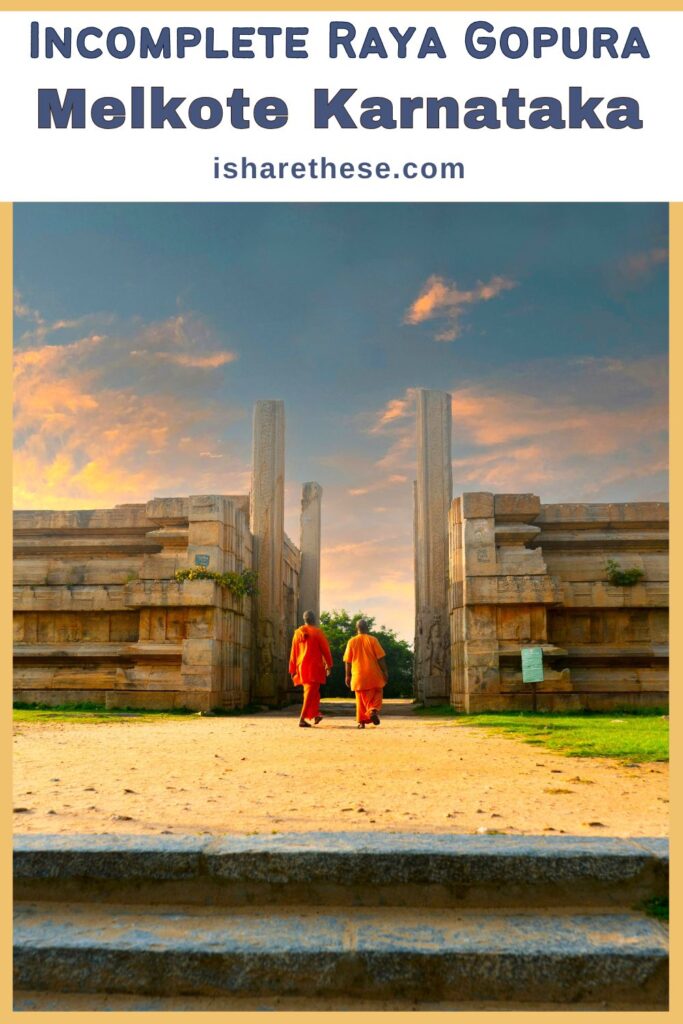
The towering pillars of Raya Gopura in Melkote rise like unfinished giants, framing the sky with timeless grandeur.
Just a short drive from Bangalore or Mysore, Raya Gopuram Melkote is one of Karnataka’s most photogenic heritage sites. This dramatic stone gateway has appeared in countless Bollywood and South Indian films, making it instantly recognizable to movie buffs.
During my visit, I discovered why filmmakers love this spot—the massive pillars against blue skies create stunning visuals. In this guide, I’ll share everything you need to know about visiting Raya Gopura, from its fascinating history to practical tips for your trip.
— Indrani Ghose, travel blogger | Updated Nov 2025

Incomplete Raya Gopura Melukote
What is Raya Gopuram Melkote?
Raya Gopuram is an incomplete 16th-century temple gateway built during the Vijayanagara Empire. Unlike the towering gopurams you’ll see at Madurai or Srirangam temples, this one consists of four massive granite pillars with intricate carvings but no tower structure above them.
The gateway is located in Melkote (also spelled Melukote), a temple town in Mandya district, Karnataka. It serves as the entrance to the Cheluvanarayana Swamy Temple complex, one of the most important Vaishnavite pilgrimage sites in South India.
Why It’s Called an Incomplete Wonder
The structure appears frozen mid-construction. Each pillar stands tall with detailed sculptures, but construction stopped before the traditional pyramid-shaped tower could be built. This gives Raya Gopura its distinctive appearance—four sentinel-like pillars standing against the sky.
Other Names You’ll Hear Locals Use
Depending on who you ask in Melkote, you might hear it called Gopalaraya entrance, Rayagopura, or Kote Vasil. All these names refer to the same monument.
Part of a Rare Architectural Pattern
Raya Gopura isn’t alone in its incomplete state. Similar unfinished gopurams exist at Mahabalipuram in Tamil Nadu and Tadapatri in Andhra Pradesh—all built during the Vijayanagara period. This pattern suggests a coordinated construction effort across the empire that was interrupted, possibly due to political instability or invasion.
Today, Raya Gopura stands as both a cultural landmark and a popular filming location, drawing history enthusiasts and photographers alike.

Raya Gopuram Melkote Wall
History and Legend of Raya Gopuram
The Overnight Construction Legend
Local folklore gives Raya Gopura a supernatural origin story that residents still share with visitors. According to the most popular legend, a master sculptor accepted a challenge to complete the entire gateway—pillars and tower—in a single night. Working through darkness with his team, the sculptor made remarkable progress.
Fearing he would succeed, his rivals hatched a plan. They rang the temple bells at 2 AM instead of the usual 5 AM dawn bell. Believing morning had arrived and thinking he’d failed, the heartbroken sculptor abandoned the project. The incomplete pillars remain to this day as evidence of this ancient deception.
More Than Just One Story
This isn’t the only legend surrounding the site. Some versions claim divine intervention stopped the construction, while others speak of celestial architects who began the work but disappeared before completion.
When I visited, a local guide told me these tales aren’t meant to be historical truth—they’re the community’s way of explaining the unexplainable and keeping the monument’s story alive across generations.

4 incomplete pillars for Raya Gopuram Melkote
Historical Background
Beyond folklore lies documented history. Raya Gopura dates to the Vijayanagara Empire era (14th–16th centuries), though some historians trace its foundation to the Hoysala King Vishnuvardhana who ruled during the 12th century.
Why Construction Actually Stopped
The 14th-century Muslim invasions caused extensive damage across Melkote’s temple complex. This turbulent period likely explains why the gopuram was never finished. Resources, skilled craftsmen, and royal patronage all disappeared during wartime, leaving ambitious projects abandoned.
Modern Preservation Efforts
Recent government restoration work has stabilized the structure, though authorities have deliberately preserved its incomplete character rather than attempting reconstruction.

Elephant figure sculpted on Melukote Raya Gopuram
Architecture and Sculptures of Raya Gopuram
The Four Incomplete Pillars
Raya Gopuram’s four main pillars dominate the landscape at approximately 3,589 feet above sea level. Each pillar is carved from single blocks of granite and rises several stories high. When you stand beneath them, the scale becomes overwhelming—these aren’t decorative columns but massive stone structures designed to support a multi-tiered tower.
What Makes Them Look Abandoned
The pillars show clear evidence of interrupted work. Some sections display finished carvings while others have rough-hewn surfaces where artisans would have continued sculpting.
Intricate Carvings and Sculptures
Despite being incomplete, Raya Gopura showcases exceptional Vijayanagara-era craftsmanship. During my exploration, I spent over an hour examining the detailed sculptures covering the pillars and walls.
The Famous Snake Charmer Sculptures
The most striking carvings depict women handling serpents—likely representing snake goddesses or ritual practitioners. These figures wear elaborate jewelry and traditional hairstyles characteristic of 16th-century South Indian fashion.

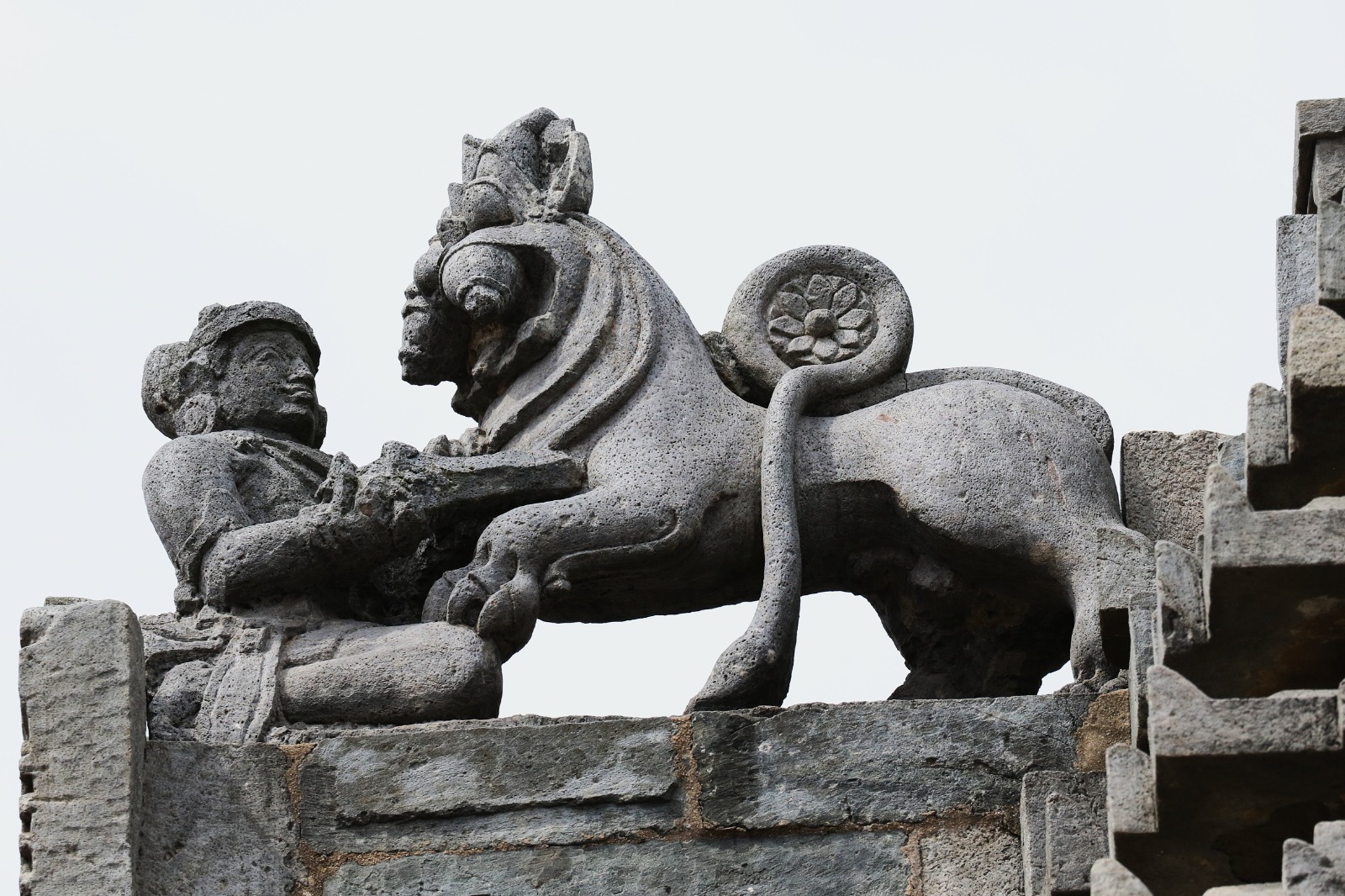
Yali face and geometric patterns on top panel. Notice the snake coiled on left arm of the sculpted figure.
Mythical Creatures and Decorative Elements
I spotted several carvings of makaras—mythical aquatic creatures that appear throughout Hindu temple architecture. Creeper and floral designs run vertically along pillars from top to bottom, creating natural frames for the deity sculptures. These decorative elements blend Hoysala architectural influences with later Vijayanagara styles.
Climbing Access
Stone steps allow visitors to climb partway up the structure for panoramic views of Melkote town. Exercise caution—the steps are uneven and lack railings. The climb is manageable for most adults but challenging for elderly visitors or young children.

Lady Snake Charmer
Why is Raya Gopuram Famous? (The Movie Connection)
More than just an ancient structure, Raya Gopuram Melkote is a celebrity in its own right. Its unfinished stone gateway has become one of the most recognizable backdrops in Indian cinema. From Tamil blockbusters to Bollywood hits, this site has hosted superstars like Rajinikanth, Aishwarya Rai, and Akshay Kumar. For travelers, the movie connection adds an extra layer of excitement—you’re not just visiting a heritage monument, you’re stepping into the frame of iconic film scenes.
Famous Movies Shot at Raya Gopuram
| Movie Title | Language | Notable Scene / Actor |
| Padayappa | Tamil | Rajinikanth’s famous swing scene |
| Guru | Hindi | Aishwarya Rai in the rain dance Barso Re |
| Rowdy Rathore | Hindi | Akshay Kumar action sequences |
| Thalapathi | Tamil | The iconic Rakkamma Kaiya Thattu song |
| KGF Chapter 2 | Kannada | Specific scenes filmed in Melkote vicinity (possibly nearby Raya Gopura) |
| Bhajarangi | Kannada | Key sequences shot at the gateway |
| Mungaru Male | Kannada | Popular romantic scenes |
I’ve personally seen how visitors light up when they recognize these cinematic frames. If you know of more films shot at Raya Gopura Melkote, drop them in the comments—your input helps enrich this guide and builds a stronger community of heritage and movie lovers.
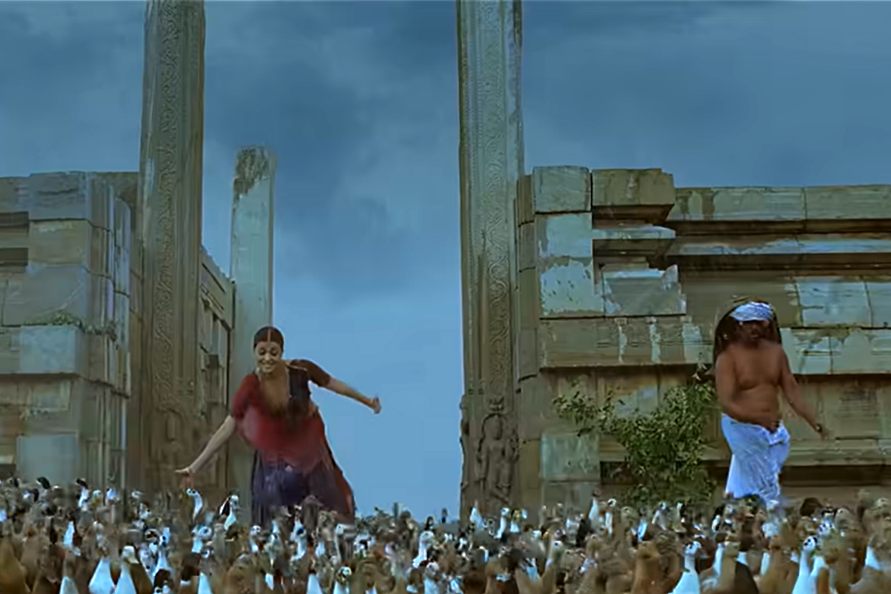
Barso Re song in Guru movie picturised on Aishwarya Rai
Why Filmmakers Love This Location
Unique Visual Appeal – The incomplete pillars create an instantly recognizable silhouette against Karnataka’s bright blue skies.
Natural Lighting and Backdrop – The hilltop location provides excellent natural lighting throughout the day. The scattered boulders add texture and depth to wide shots, while the elevated position offers panoramic views of the surrounding landscape.
Accessibility for Crew – Located just off the main highway with adequate space for equipment trucks, generator vans, and crew parking, Raya Gopura offers practical advantages over remote heritage sites.

Face and Hairstyle of Lady Snake Charmer in Raya Gopuram
Current Filming Status: 2021 Shooting Ban
In 2021, local authorities imposed restrictions on commercial filming at Raya Gopuram due to concerns about monument damage and waste accumulation. Film crews had left behind equipment marks, trash, and minor structural damage from repeated shoots.
This ban reflects growing awareness about protecting heritage sites from commercial exploitation. While restrictions may be relaxed for specific approved projects, casual film shootings are no longer permitted. However, personal photography and videography for non-commercial purposes remain completely allowed.

Intricately carved sculptures on pillar, the topmost one is incomplete.
Visiting Raya Gopuram: Complete Guide
What to Expect at Raya Gopuram
The Climbing Experience
Stone steps lead up to the gopuram structure and continue to elevated viewing platforms. The climb isn’t difficult but requires reasonable fitness. Expect about 80-100 steps with uneven surfaces and no railings in some sections.
I completed the climb in about 10 minutes, taking my time to photograph sculptures along the way. Elderly visitors and those with mobility concerns should assess the steps carefully before attempting the climb.
Views from the Top
The elevated position offers stunning 360-degree views of Melkote town, the Cheluvanarayana Swamy Temple complex, and the surrounding countryside. On clear days, you can see for several kilometers across Karnataka’s plateau landscape.
The temple tank (Kalyani) is visible from this vantage point, as are the colorful rooftops of Melkote’s traditional houses. Bring a camera with zoom capability to capture distant details.
Accessibility Considerations
The site is not wheelchair accessible due to uneven terrain and steps. Parents with strollers will find navigation difficult. Young children can visit but need close supervision near the steps and elevated platforms.

View of Temple from Melukote Raya Gopuram
How to Reach Raya Gopuram Melkote
From Bangalore/Bengaluru: Raya Gopuram is approximately 137-150 km from Bangalore, depending on your starting point in the city. The drive takes 2.5 to 3 hours via NH275 and SH17.
Best Route: Take Mysore Road (NH275) toward Mandya, then turn onto SH17 toward Melkote. The roads are well-maintained, making this an easy weekend drive. I recommend leaving Bangalore by 7 AM to avoid city traffic and reach Melkote by mid-morning.
Entry Fees and Timings
No Entry Fee: Raya Gopuram is completely free to visit. There are no tickets or permits required, making it a budget-friendly heritage site to explore.
Opening Hours: The site is open daily from 6 AM to 6 PM. These timings are strictly followed, and guards close the gates promptly at evening.
Best Times to Visit:
- Early Morning (6 to 9 AM): Cool weather, excellent photography light, fewer crowds
- Late Afternoon (4 to 6 PM): Beautiful sunset lighting, slightly cooler temperatures
- Avoid Midday (11 AM to 3 PM): Intense heat, harsh lighting for photos, no shade available
Best Times for Photography
Golden Hour Magic: Early morning (6.30 AM to 8 AM) and late afternoon (5 PM to 6 PM) provide the best natural lighting.
Blue Sky Contrast: Karnataka’s bright blue skies create stunning contrast against the weathered gray granite. Visit during dry season (October-March) for the clearest skies. Monsoon months (June-September) offer dramatic cloud formations but unpredictable weather.

View of Kalyani from Melukote Raya Gopura
FAQ about Raya Gopura Melukote
Q. Why is Raya Gopuram incomplete?
It was likely left unfinished when Vijayanagara Empire projects were halted by invasions, war, and loss of funding and royal support. Other incomplete gopurams from the same era back this up.
Q. Which movies were shot at Raya Gopuram, Melkote?
Famous films include Guru (Barso Re song), Thalapathi, Padayappa, Rowdy Rathore, Thiruda Thiruda, and Kannada film Melkote Manja.
Q. Where was the “Barso Re” song from Guru shot?
At Raya Gopuram, Melkote, using real monsoon rain to film the scene.
Q. How much time is needed to visit Raya Gopuram?
30–60 minutes. Up to 90 minutes if you take many photos or explore details slowly.
Q. Is Raya Gopuram open every day?
Yes. Daily, 6 AM – 6 PM. No weekly closures.
Q. Can you climb to the top of Raya Gopuram?
You can climb partway up to viewing platforms using 80–100 uneven stone steps. Some sections have no railings—be careful.
Q. Is there an entry fee for Raya Gopuram?
No. Entry is free, no tickets or permits needed.
Q. What is the best time to photograph Raya Gopuram?
Best light: 6.30 to 8 AM and 5 to 6 PM. Avoid 11 AM – 3 PM (harsh light).
Q. Are movie shootings still allowed here?
Commercial filming is restricted since 2021 to protect the monument. Personal photos and non-commercial videos are allowed.
Q. What should I carry when visiting Raya Gopuram?
Carry 1L water/person, sunscreen (SPF 30+), hat, grip-friendly shoes, camera/phone charged, small towel, and light snacks. No facilities on site.
Final Thoughts
Raya Gopuram Melkote stands as one of Karnataka’s most intriguing heritage sites—an architectural mystery that has fascinated visitors for centuries. The incomplete pillars tell stories of interrupted ambitions, legendary challenges, and the rise and fall of empires.
The dramatic stone pillars against bright Karnataka skies create an experience that photography alone cannot capture.During my visit, I spent over an hour exploring every carved detail and absorbing the monument’s quiet grandeur.
For a complete Melkote experience including the main temples, sacred ponds, and hilltop shrines, check out my detailed guide to Places to Visit in Melkote.
Pin this for later
About the Author
 Indrani Ghose is a cultural travel writer and heritage documentation specialist with over 15 years of experience exploring and writing about temples across India and Southeast Asia. Having visited over 150 sacred sites, she brings both scholarly depth and personal narrative to heritage travel writing.
Her work has been published in Lonely Planet, The National (UAE), Whetstone Asia, Deccan Herald, and various architecture and heritage journals.
Connect with Indrani: Follow Indrani on Instagram | Twitter | Facebook for heritage travel insights, photography tips, and offbeat destination discoveries.









I think the story of the builder's challenge is a pretty good explanation of the incomplete look of this place. Your first photo is stunning, and I like the details on the pillar in your second photo. Thanks, too, for sharing the video shot at this place.
Very impressive and what a contrast to this blue sky ! The video clip is very special, love the music too !
Iam always fasinated by such works…one similar incomplete 'rayagopuram' is there next to meenakshi temple in madurai and as always has many folklores around it
Liebe Indrani,
sehr beeindruckend deine Fotos, auch das hier eingestellte Vodeo ist grossartig. DANKE!!!
Liebe Grüsse aus der Schweiz
Hans-Peter
Saw the 1st image and for a minute thought it was Hampi!! beautiful.. have seen shows and pics of Melkote, but yet to visit…
The blue sky provided a beautiful backdrop, great contrast of colors!
There are 3 such Rajagopuras built by Vijayanagar kings , one in melkote ,Mahabalipuram and Tadapatri . And all are incomplete .
and.. so fun to see she dances on the same place as your pictures of the pillars are from! 🙂
Oh Indrani!! =) What a very very beautiful song!! I just love it! And the fascinating nature, absolutely gorgeous!! The waterfall – wow!!!! =)
Thanks for sharing Indrani! 🙂
The lighting is indeed amazing and such beautiful skies!! Great video! Thanks for sharing! Have a great weekend!
Sylvia
I like the way that look against the blue sky. In some way incomplete or damaged structures that are left have their own beauty and poignancy.