Hazarduari Palace: Secret 1000 Doors into Bengal’s Regal Past
Standing majestically on the banks of the Bhagirathi River in Murshidabad, West Bengal, the Hazarduari Palace is a monument that echoes with the grandeur of the Nawabi era. Formerly known as the Bara Kothi, this 19th-century architectural marvel instantly captivates visitors with its name, which literally translates to “a palace with a thousand doors.” However, this is where its first fascinating secret lies. The palace actually has only about 100 real doors; the remaining 900 are masterfully crafted false doors, designed to confuse intruders and create a symmetrical, imposing facade. Know more Interesting Facts Hazarduari Palace.
Commissioned by Nawab Nazim Humayun Jah and built between 1829 and 1837 under the supervision of architect Duncan Macleod, the palace was erected after the old Nizamat Kila was dismantled. Today, this sprawling 41-acre complex is no longer a royal residence but a celebrated national monument and one of India’s most significant site-museums, managed by the Archaeological Survey of India (ASI). Its three-storeyed Greco-Roman structure houses a breathtaking collection of historical artifacts that offer an unparalleled glimpse into the opulent lifestyle and administration of the Nawabs of Bengal.
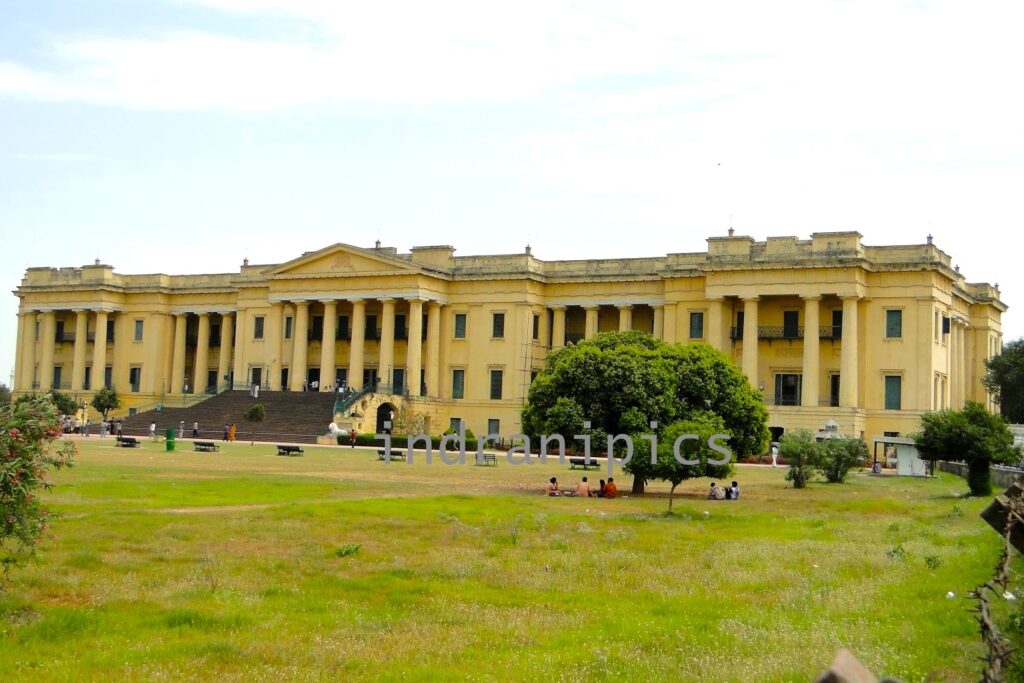
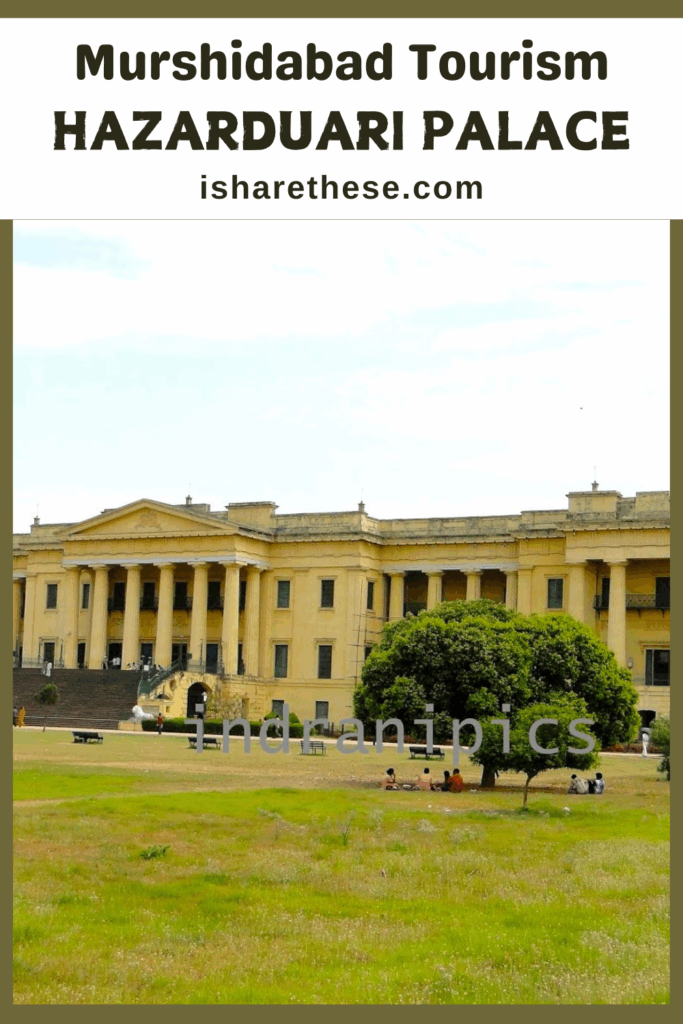
Hazarduari Palace Murshidabad
Interesting Facts Hazarduari Palace
As I stepped inside, I was transported back in time. The palace museum is a veritable treasure trove, showcasing an impressive collection of priceless artworks, gleaming armoury from different eras, exquisite antique furniture, vintage carriages, and rare historical relics. Beyond the main building, the Hazarduari complex includes other significant structures like the towering Clock Tower, the serene Madina Masjid, and the formidable Bacchhawali Tope—a massive cannon that stands as a silent witness to the region’s formidable past.
Join us as we explore the most intriguing facts and hidden stories of this iconic West Bengal landmark.
Road Trip through Places of Attraction in West Bengal – After a night halt at Nabadwip we set set off on our road trip to Murshidabad very early in the morning. Plan was to spend the entire day sight seeing in Murshidabad. Distance of 113km between Nabadwip to Murshidabad was done in 3 hours with one small break in between.
We were on our 3rd day of road trip through top tourist attractions of West Bengal.
Historic Places in Murshidabad – To be honest the city deserves a two day itinerary to do justice to the several historic places worth visiting. My research of the place showed the Kathgola Palace, Adinath Jain Temple, forts and Imambaras are all so beautiful. But 1000 doors / 1000 duari Hazarduari Palace tops the list!

1000 doors famed Hazarduari photo Murshidabad
Flight of stairs one of the biggest in India – This grand flight of stairs has 37 steps of stone that leads up to the palace’s upper portico. Lower most one is 108 feet (33 m) long.
Historical Background to the 1000 Doors Palace
The groundwork for a grand palace in Murshidabad was laid long before its construction. In 1704, Diwan Murshid Quli Khan established the city as the new capital of Bengal, shifting power from Dhaka. A century later, Nawab Nazim Humayun Jah, desiring a residence to rival the grandeur of the British Government House in Calcutta, envisioned a modern European-style palace.
To realize this ambitious vision, the old, decaying Nizamat Kila (the traditional fort of the Nawabs) was dismantled. The Nawab commissioned a Scottish architect, Colonel Duncan MacLeod, to design its replacement. This marked a deliberate shift from a medieval fortress to a magnificent Indo-European palace, creating the iconic Hazarduari as a symbol of the Nawab’s prestige in a rapidly changing Bengal.
“Humayun Jah wanted to make a palace that looked like Buckingham Palace in London,” said Asif Meerza, a descendant of the Nawab family (quoted in Atlas Obscura).
Hazarduari Palace Tour
Well, I expected 1000 doors but in reality there are actually 900 real doors. Remaining 100 fake doors were built to mislead the enemy attackers. The huge pillars, 18ft tall, all around the palace add grandeur to it. Without them probably the European style signature look would be missing. I am forgetting the number of rooms I crossed (there are 114 rooms), and I lost count of the doors too.
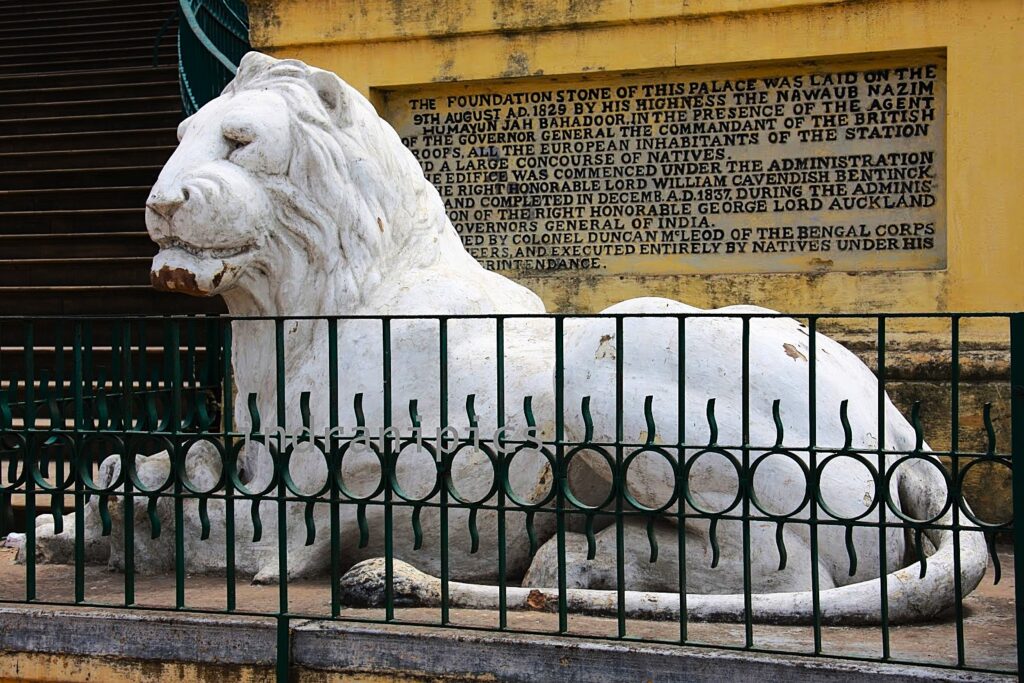
Lion in sitting posture at the foot of the huge flight of stairs, this reminded me so much of European architectures.
There are 114 rooms and each room was spacious and full of old furniture, walls adorned with paintings collected by Nawabs (Muslim rulers), marble statues collected by them and huge library holding rare books and manuscripts. It will take good couple of hours to tour through all the rooms, yet not be satisfied. If you are running short of time you can note the most interesting facts of Hazarduari Palace.
During its heydays this palace was used for daily durbar works, and as residence of Nawabs and many British officials. The colossal pillars, the façade of the building, the lofty dome adorned with stucco ornamentation make the palace look grand! It is a fine example of Indo-European architecture style.
Most unfortunate part was the board displaying the sign “No photography”. Folks there are so strict. They held back our cameras at the ticket counters and we are supposed to collect our cameras while exiting.
Architectural Marvels – Interesting Facts Hazarduari Palace
Neoclassical Design Elements – Crafted by Colonel Duncan MacLeod between 1829 and 1837, the palace combines Italianate and Greek Doric styles, a hallmark of 19th-century neoclassical architecture. Its symmetrical façade features a triangular portico supported by elegant 52 Doric columns.
The Thousand-Doors Myth: Real vs. False – Despite its name—Hazarduari meaning “palace of a thousand doors”—only about 100 are real, while approximately 900 are deliberately false. These faux doors were ingeniously integrated to disorient intruders—a simple yet effective architectural security measure. I was amazed at the similarity of the doors.
Symmetry and Spatial Deception – The palace’s layout is meticulously symmetrical, from its rectangular footprint to its three-tiered structure and balanced colonnade. The use of deceptive false doors enhanced this sense of illusion, creating confusion and giving defenders a tactical advantage—an architectural embodiment of strategic spatial deception.
Materials and Scale of Construction – Built on the grounds of the former Nizamat Kila, Hazarduari spans approximately 41 acres and features a grand stone staircase of 37 steps, the base of which stretches 108 ft wide, flanked by regal lion sculptures. With 114 richly appointed rooms, including the Durbar Hall, library, ballroom, and galleries, the palace’s scale and interior complexity are extraordinary.
Complex Beyond the Palace
1. Nizamat Imambara
There existed a wooden Imambara in this same place till 1846. Sadly during a celebratory function the Imambara caught fire and was reduced to ashes completely. However within a couple of years, by 1848, the Imambara was rebuilt. This Imambara is believed to be the biggest one in whole of India.

Nizamat Imambara Murshidabad- Interesting Facts Hazarduari Palace
2. Madina Mosque
Just close to Nizamat Imambara is the Madina Mosque which miraculously escaped the fire which struck the Imambara. Nawab Siraj ud-Daulah constructed this mosque. It is believed that they brought soil from Mecca and mixed it in foundation soil of this mosque. The idea was to provide an opportunity to the poorer members of the local Muslim community to have an experience of Hajj.
3. Bacchawali Tope
This cannon is placed in the lawns of Hazarduari Palace. What may look like ordinary cannon to you has an interesting story, the reason why I included it in list of interesting facts of Hazarduari Palace!
The two ends of it with different diameters is distinct. This cannon was fired only once because the explosive sound of the firing was so loud that it induced child delivery in most of the pregnant women in vicinity. It was heard within a range of 10miles radius. The name indicates the story – bacchawali – pregnant women or women who delivered, and tope – cannon.
Weight of the cannon is 7657kg and requires 18kg of gunpowder for one shot. Reading the statistic I was glad this cannon was used only once.
4. Zurud Mosque
This mosque is bang opposite to the west gate of Hazarduari Palace and made under orders of Sirajud-Daullah. When I saw in 2013 it had a dull faded white look. Latest reports say it is painted bright yellow and glows in dark.

Zurud Mosque in April 2013
5. Clock Tower
Locally popular as Ghari Ghor, has clocks on all 4 sides; probably built with the intention of helping sailors sailing down the Bhagirath River. It is also popular as Big Ben of Murshidabad. Sagor Mistri, an Indian Bengali assistant of Colonel McLeod, the architect of the palace designed this clock tower.

Big Ben of Murshidabad – Interesting Facts Hazarduari Palace
Rare Artifacts in Hazarduari’s Museum
Manuscripts
At the core of Hazarduari’s museum treasures are its invaluable manuscripts dating back to the 18th and 19th centuries. These ancient documents, many inscribed on palm leaves and delicate papers, provide scholarly insights into the administrative and literary brilliance of the Nawabs.
Extensive collections of oil paintings
The artworks, commissioned by royal patrons, vividly depict the Nawabi lifestyle, portraits of eminent figures, and historical events. (I don’t remember much now, wish they allowed photography) The meticulous brushwork and vibrant colors preserve the visual legacy of a bygone era.
Standout Pieces: Nawabi Swords and Ivory Furniture
Among the museum’s most treasured possessions are the Nawabi swords—each telling a story of valor and nobility – masterpieces of design, symbolizing the power and prestige of their owners. Some were embellished with intricate engravings and precious stones (my eyes popped wide open).
Another highlight is the exquisite ivory furniture collection that reflect the expert artisan skills of the era and illustrate the luxury that defined Nawabi courts. I was lost in the beauty of these rare survivors of a delicate art form.
Crystal Chandelier
Don’t miss the crystal chandelier in the Durbar Hall of the palace. Amidst all the furniture used by the Nawab there is a grand crystal chandelier hung from the ceiling.
The prestige factor associated with it is – This is the second largest chandelier in the world, after one in Buckingham Palace. It was given to the Nawab by Queen Victoria herself. The chandelier was lit by 1001 candles in those days when there was no electricity. Now they use 96 bulbs.
Mirror Magic
Also watch out for two pairs of mirrors in the museum, another of interesting facts of Hazarduari Palace. They are placed at an angle of 90 degrees in such a way that one cannot see one’s own face but others can see. Nawab used this to prevent predators from harming him.
It was cleverly positioned so that the predator cannot see his face and assume it to be just a mirror, while Nawab could and the predator would be caught. Visitors to museum usually experiment this out. It is outside the gallery on the landing area of the staircase which leads to the upper floors.
Fake Doors in Durbar Hall
The Durbar Hall, gallery no. 7, is circular in plan and has four doors at the cardinal points. Some of the doors are fake; find out which of them are.
Interesting collection in Museum in Palace
There are 19 galleries housing precious 2700 collections including British, Indian and even Dutch relics. Then there are furniture, weapons, crockery, paintings, antiques and manuscripts, mute witnesses to Mughal and British rule. But if you are facing time crunch you can rush through and see these artifacts in the galleries mentioned.
- Gallery 1 & 2 – You can see the dagger with which Muhammad i-Beg killed Siraj ud-Daulah.
- In Gallery no. 3 – One of the most renowned objects is an ivory palanquin used by Zebunissa, the daughter of the Mughal emperor Aurangzeb (1658–1707 AD).
- Gallery 8 – The silver throne of the Nawab Feradun Jah and his prized hookah, surrounded on either side by exquisitely carved marble candle stands.
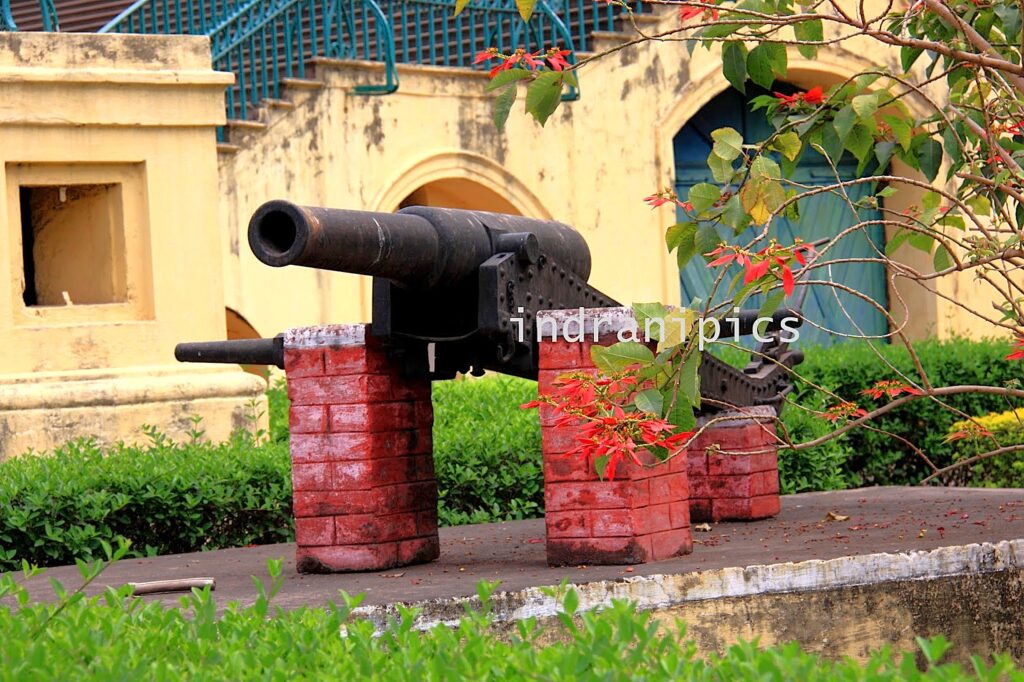
Cannon in Complex
Hazarduari Palace Travel Guide
How to Reach Hazarduari Palace
Located in Murshidabad, West Bengal, the palace is well-connected by road and rail.
- From Kolkata, it’s about 220 km (5–6 hours by car via NH12) or a 4.5-hour train ride to Berhampore Court station, followed by a short drive.
- From Tarapith, the journey is around 2.5 hours (110 km) by road. Regular buses and local taxis make Murshidabad accessible for day trips or inclusion in a longer Murshidabad itinerary.
Entry Timings, Ticketing and Photography Rules
Hazarduari Palace is open Tuesday to Sunday from 9 AM to 5 PM.
Closed on Mondays and national holidays.
Tickets are available at the gate, with discounted entry for Indian nationals and a separate fee for foreign visitors. Tickets also include access to other structures within the complex, such as the Clock Tower and Yellow Masjid.
Photography inside the museum galleries is strictly prohibited to preserve delicate artefacts, though you can capture the palace exteriors and gardens freely.
Best Time to Visit Hazarduari Palace
The most pleasant season is between October and March, when the weather is cooler and ideal for walking through the expansive 41-acre complex. Summers can be very hot and humid, while the monsoon months often bring heavy rain, making travel less comfortable.
Nearby Attractions in Murshidabad
For a complete Murshidabad itinerary, combine your visit to Hazarduari Palace with other heritage landmarks:
- Katra Mosque – Built by Nawab Murshid Quli Khan, known for its austere Mughal style.
- Motijheel – A horseshoe-shaped lake with Mughal-era remnants.
- Jahankosha Cannon – A 17th-century cannon weighing over 7 tons.
- Khoshbagh – The garden tomb of Nawab Alivardi Khan and Siraj-ud-Daulah.
- Nizamat Imambara – Among the largest Imambaras in India, located adjacent to the palace.
Quirky and Hidden Gems at Hazarduari Palace
- Cannon That Would Induce Childbirth – The Bacchawali Tope
- Enigmatic “Mirror Magic”
- Illusionary Doors and Confounding Escape
- Second-Biggest Chandelier in the World
- Library of Wonders – The palace’s towering library holds a hand-scribed Quran weighing about 20 kg, along with thousands of rare manuscripts in Arabic, Persian, and Urdu
- Mythical Echoes and Haunting Whispers
While no tunnels or ghostly apparitions are documented historically—false doors sometimes spark local murmurs of secret escape passages or spectral confusion. There’s also occasional talk of hearing footsteps or whispers in quieter corners—more atmospheric than verified.
Frequently Asked Questions (FAQ) – Hazarduari Palace, Murshidabad
Q: Why were false doors built in the palace?
A: The 900 false doors were strategically designed to confuse intruders and dacoits, making them lose their way while palace guards could catch them easily.
Q: What is the significance of Hazarduari Palace today?
A: Since 1977, Hazarduari Palace has been declared a Monument of National Importance. Initially managed by the Government of West Bengal, it has been administered by the Archaeological Survey of India since 1985 for enhanced preservation.
Q: Is photography allowed inside Hazarduari Palace?
A: Photography is strictly prohibited inside the museum to protect the exhibits. However, visitors can photograph the exterior of the palace and surrounding gardens.
Q: Can I bring mobile phones and cameras inside?
A: Mobile phones and cameras are not allowed inside the museum and must be kept in lockers available beside the ticket counter.
Q: How can I book tickets for Hazarduari Palace?
A: Tickets can be purchased online through official booking portals. E-tickets are non-transferable and non-refundable, and visitors must show photo ID proof at entry.
Q: How much time should I allocate for the visit?
A: Plan for a minimum of 2 hours to fully explore the palace museum and surrounding areas.
Q: What items should I carry for my visit?
A: Visitors must carry original photo identity proof for entry. It’s advisable to carry minimal belongings as storage facilities for cameras and phones are provided.
Q: Are guided tours available?
A: Guided tours may be available, and it’s advisable to inquire at the entrance. The courteous staff can provide information about the palace’s history and collections.
Q: Is there parking available?
A: The palace has ample parking space available for visitors.
Q: What should I know before visiting?
A: Come prepared with valid ID, avoid bringing cameras/phones inside, plan for at least 2 hours, and consider visiting during winter months for the best experience. The palace grounds and surrounding gardens are perfect for leisurely walks after touring the museum.
Pin this for later…
You can save and share this blog on ‘Interesting Facts of Hazarduari Palace in Murshidabad’ with buttons on left of this page. I appreciate each and every share. Thanks!
 Indrani Ghose is an Indian Travel Writer and Blogger based in Bangalore, India. She has written for numerous publications across the globe – including Lonely Planet, The National UAE, Whetstone Asia, Deccan Herald. You can follow her on her social media handles Instagram, Twitter, Pinterest and Facebook to see the wonderful destinations, beautiful offbeat places and get instant updates about them.
You will like these posts:
Sajjangarh Monsoon Palace Udaipur
Athangudi Palace Chettinad
Kondapalli Fort Vijayawada
Kangra Fort in Himachal Pradesh
Tipu Sultan’s Summer Palace Bangalore










Very informative post! I”m curious about the Clock Tower and the Mosque. All the architectures are very English and look preserved but why photos are not allowed?
This is such a gem. Hazarduari palace definitely piques my interest. Even 900 doors is not a bad deal. And that is a smart thing to do – have fake doors to stall the enemy. And largest number of stairs or rather one of them…now that must have been something. I hope I can get there soon. Cheers
IN HAZARIBAGH THERE IS AN SO BIG CROCODILE IN THE TIME OF MUGAL’S IS FREEZED . THE PALKI MADE OF SILVER AND ELEPHANTS TEETH MAKE THIS PALACE WORTHI TO VISIT. LAST BUT NOT THE LEAST THERE ARE MANY OLD WEAPONS WHICH USED IN THE WAR THESE ARE MAKE ME SO ENTEROGIZED . OVERALL THIS IS ONE OF THE BEST PLACES THAT I VISIT
114 rooms? Hazarduari Palace is huge! It would be fun to try out the magic mirrors. What is the purpose of the fake doors in Durbar Hall? I bet the grand flight of stairs is amazing, such a bummer there is no photography.
The story alone about the 900 doors plus 100 fake doors makes the Hazarduari palace worth a visit. Clearly some very creative architects if they also created a 100+ foot step on the stairs. Such cool stats!
That’s a cool story about the fake doors. And I agree it definitely looks like you need two full days there, that place has a lot of history!
Sounds like a maze and fascinating exploration. 900 doors and 100 fake ones to confuse attackers. Really smart! It’s too bad you were not able to capture photos of this impressive palace. Great article, though.
I’m glad they stuck to the name and added an extra 100 fake doors to confuse attackers. Too bad they don’t allow photography inside the building, I’m sure the rooms are stunning. I can’t wait to try out the mirror magic so I can catch my attackers off guard. Or at least my friends! Thanks for sharing!
I love the idea that 100 fake doors were built to confuse and trick enemies, very creative and tactical. The palace looks great, I’d love to see it one day.
900 actual doors and 100 fake ones. So it does have 1000 doors after all…that is fascinating aspect of the architecture of this palace. We have endless wonders in our country, and only a fraction are in public eye.
Good spicy post….and to think of it i thought murshidabad is a dull drab place
Interesting information.. I did not know about this before. Thanx for enriching my knowledge !
this one is interesting .. nice capture !
"No photography allowed" these words are like hell for any photo lover..anyway you managed some nice clicks!
That's a very beautiful and interesting palace.
Yes it does remind of museums in Europe on a afterthought, is it similar to the Chowmohalla palace in Hyd?
Interesting palace.
Wonderful monument,thousand pillars. Thanks for sharing about this place. West Bengal has lot in offer.
Nice post, Great captures.
Thanks for sharing 🙂
This is a very impressive-looking palace. It's a shame you weren't allowed to take photos inside.
You did manage to get some great shots even though they held back your camera for the interiors. Thanks for sharing. cheers.
The building looks European as well. In the style at the end of the 17th century.
Thank you for your comment on my blog about my friend Elizabeth.
Wil, ABCW Team.
So many intriguing stories from Indian history!
The details make true impression on the palace and great photos to go along with it!
It has the look of an English manor house, amazing. Boom & Gary of the Vermilon River, Canada.
I've seen a number of Durga Puja pandals in Kolkata inspired by this palace. Need to visit it sometime!
Beautiful pictures and info. This 1000- duari palace was known to me though I never visited. I also become sad to come across signages reading "No Photography". Murshidabad has many more pre colonial buildings and may be most of them are in ruins.
don't you just hate that sign – NO PHOTOGRAPHY?
Wow, really, the palace looking nice and has an interesting history. such wonderful article…
Looking at the first two pics, i thought they were from your Europe series… Looks like a very well maintained palace.. The third pic resembles B'lore n Mumbai town halls…
Wondrous indeed! Sad though that no photography allowed
Very imposing indeed.But pray tell me what they will do with 114 rooms except by keeping them closd or allowing all and sundry attached to royal family to occupy.
I see no logic in denying photography especially in such beautiful historic monuments.What risks can they pose?
You are lucky in visiting so kmany places of interest and we too in getting to know of them through you.Thanks
Very interesting… Thanks for sharing…
Amazing and beautiful place and terrific captures as always, Indrani! Have a great week!
How sad you were unable to take photos inside! It would be very interesting to see, I'm sure!
900 real doors is impressive!
Looks Like a Interesting Place, Nice Clicks. .
Treasure House INDIA!
Aloha