Kolkata Dakshineswar Kali Temple
Why You Must Visit Dakshineswar Kali Temple in 2026
When I visited Dakshineswar Kali Temple in November 2022, I felt the unmistakable spiritual energy that draws millions of devotees every year.
I knew the temple timings well, but what I didn’t anticipate was the long queue of devotees! They were everywhere there… all bathed, wrapped in wet towel, carrying flowers and other offerings for the Goddess. I thought I was early, but 6 in the morning is not early for Kolkata. By its standards we were late!
– By Indrani Ghose | Last Updated: January 2026
Standing on the banks of the Hooghly River, this sacred shrine dedicated to Goddess Kali (Bhavatarini) radiates devotion and calm that you can feel the moment you step inside.
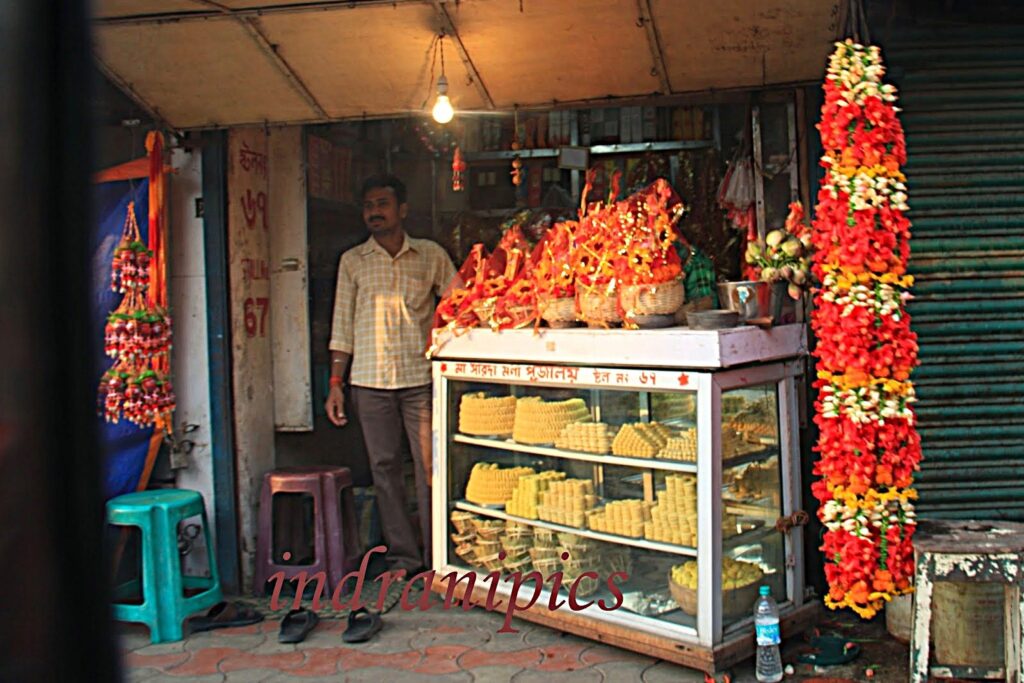
Shop near Dakshineshwar Temple Kolkata
Since my visit, Dakshineswar has undergone notable changes. The most striking addition is the Dakshineswar Skywalk—a modern elevated walkway connecting the temple directly to the nearby railway station and bus terminus. This infrastructure upgrade has transformed the visitor experience. Gone are the chaotic traffic jams and congested narrow lanes that once tested pilgrims’ patience.
By 2026, the Skywalk has become more than just a convenience—it’s an attraction that offers elevated views of the temple complex while efficiently managing crowd flow.
The temple continues to be a place where ancient spirituality meets modern accessibility, making it essential for both pilgrims seeking divine blessings and cultural travelers exploring Kolkata’s heritage.
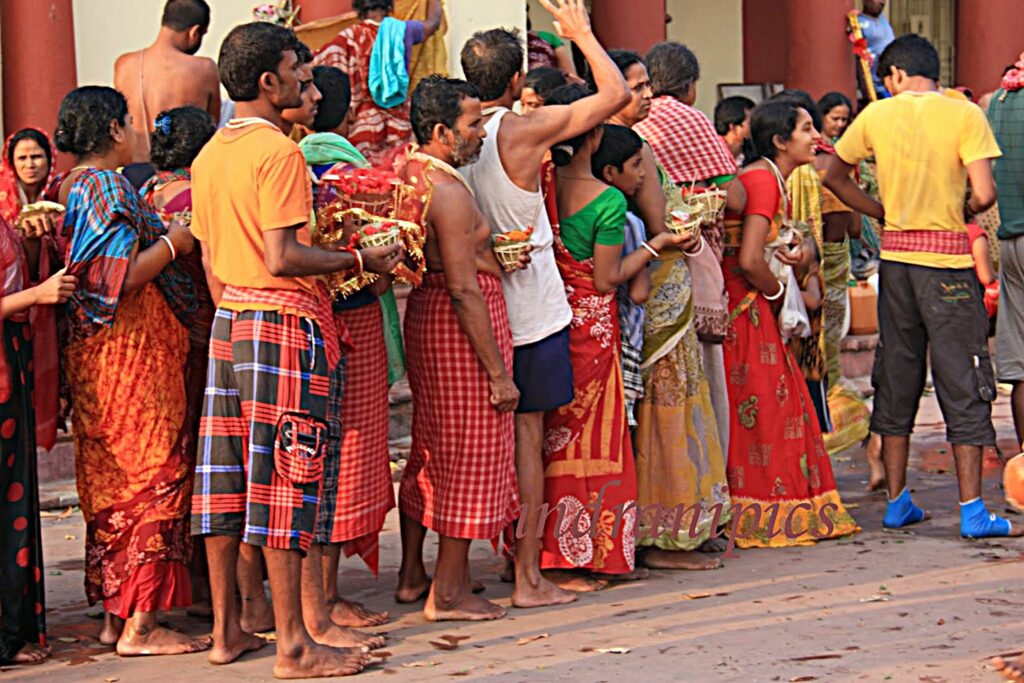
Devotees queue up to visit temple
Planning Your Trip: Timings, Entry, and Best Time to Visit
Dakshineswar Temple Timings Today (Summer vs. Winter)
The temple maintains consistent hours throughout the year:
Morning: 6 AM – 12.30 PM
Evening: 3.30 PM – 7.30 PM
During summer months (March to June), I recommend morning visits when temperatures are cooler and darshan feels more comfortable. Winter evenings (November to February) offer a particularly serene atmosphere—fewer crowds, pleasant weather, and a peaceful ambiance perfect for quiet contemplation.
Entry Fees and Special Darshan
General Entry: Free for all visitors
Special Darshan: No fixed fee, though donations are welcomed
On major festival days like Kali Puja and Durga Puja, expect significantly longer queues and special crowd management arrangements. Temple authorities organize additional darshan counters during these peak periods.
The New Dakshineswar Skywalk: What to Expect
The Dakshineswar Skywalk stretches 400 meters and features escalators and lifts for accessibility. This elevated corridor connects Dakshineswar railway station and the bus stand directly to the temple entrance.
What this means for visitors:
- Hassle-free entry without navigating congested approach roads
- Panoramic views of the temple complex and the Hooghly River
- Improved crowd management during peak visiting hours
- Protection from weather—helpful during Kolkata’s monsoon season
The Skywalk has particularly benefited elderly visitors and families with children, who previously struggled with the crowded lanes leading to the temple.
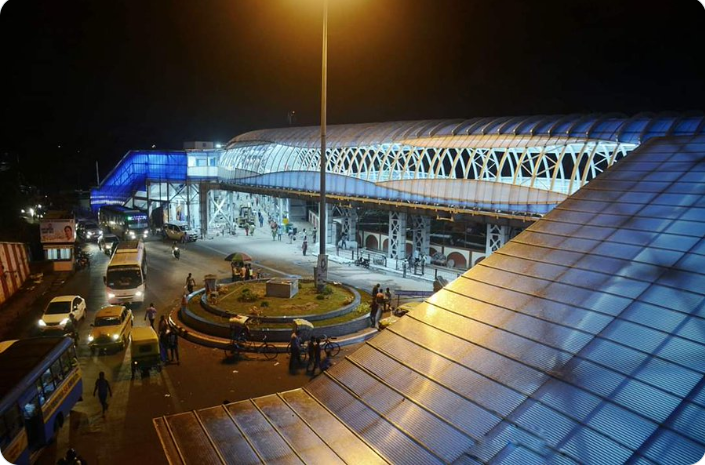
Dakshineshwar Skywalk PC: Twitter
Peak Hours vs. Quiet Hours
| Time of Day | Crowd Level | Best For | Notes |
| 6 AM – 8 AM | Quiet | Peaceful darshan, photography | Ideal for meditation and capturing photos without crowds |
| 9 AM – 12.30 PM | Peak | Daily rituals, devotees | Expect long queues, especially on weekends |
| 3.30 PM – 5 PM | Moderate | Balanced experience | Good option for families with children |
| 5 PM – 7.30 PM | Peak | Evening aarti | Spiritual atmosphere but crowded |
Expert Tip: To avoid crowds, I suggest visiting early morning (right at 6 AM opening) or mid-afternoon around 3.30 PM. During major festivals like Durga Puja and Kali Puja, the temple sees maximum footfall—arrive at least two hours before peak darshan times if visiting during these periods.
Dakshineswar Kali Temple History
The story of Dakshineswar Kali Temple begins with Rani Rashmoni, a remarkable woman who defied social conventions to create one of Bengal’s most important spiritual centres. In 1847, the wealthy widow from Kolkata planned a pilgrimage to Varanasi. On the eve of her journey, she experienced a divine vision in which Goddess Kali instructed her to abandon the trip and instead build a temple on the banks of the Hooghly River, where the goddess would reveal herself.
Rashmoni acted on this vision by purchasing a 20-acre plot in Dakshineswar, then a quiet village north of Kolkata, from an English indigo planter. Construction began in 1847 and continued for eight years. At a cost of nearly nine lakh rupees, she built an extensive temple complex comprising the Navaratna Kali temple, twelve Shiva temples in two rows, a Radha-Krishna temple, pilgrim rest houses, and bathing ghats along the river. The temple was consecrated on May 31, 1855, during Snana Yatra.
However, caste prejudices soon threatened the temple’s future. Orthodox Brahmins refused to serve, as Rashmoni belonged to the Kaivarta community. The crisis was resolved when her son-in-law, Mathur Babu, appointed Ramkumar Chattopadhyay as priest. Ramkumar’s younger brother, Gadadhar—later Sri Ramakrishna Paramhansa—assisted him and eventually became the chief priest after Ramkumar’s death in 1856.
Ramakrishna’s intense devotion and spiritual ecstasies transformed Dakshineswar into a living centre of spiritual experimentation. Between 1856 and 1886, he practiced multiple religious paths to demonstrate the unity of all faiths. His disciples included Narendranath Datta, later Swami Vivekananda, who carried these teachings to the world. Sarada Devi, Ramakrishna’s wife, also lived here and is revered as the Holy Mother.
After Ramakrishna’s passing, the temple remained under the Rashmoni family trust. Today, Dakshineswar welcomes thousands of devotees daily and stands as a symbol of spiritual inclusiveness, social defiance, and enduring faith—where history, devotion, and reform continue to converge.

The Navaratna Architecture
Dakshineswar Kali Temple stands as both a spiritual destination and an architectural landmark of Bengal’s temple-building heritage. Built in 1855 the temple showcases the distinctive Navaratna style featuring nine spires arranged in symmetrical tiers.
The Main Shrine of Maa Bhavatarini
The central temple houses Maa Bhavatarini, a specific form of Goddess Kali representing the divine mother who saves devotees from the ocean of existence. The black stone idol stands on a silver lotus pedestal, symbolizing divine energy emerging from purity. Unlike typical Kali representations, Bhavatarini’s tongue is not extended, giving her a more composed appearance.
During my visits, I noticed devotees maintain remarkable reverence during darshan despite the crowds. The sanctum resonates with continuous chants of “Jai Maa Kali” and the rhythmic ringing of bells during morning and evening aarti ceremonies. The morning aarti (around 8 AM) and evening aarti (around 7 PM) draw the largest gatherings.
The 12 Shiva Temples Along the Hooghly Ghats
Flanking the main Kali temple are 12 identical Shiva temples, each housing a Shiva lingam. These small shrines face the Hooghly River, creating a sacred corridor along the temple’s ghats (riverside steps). The architectural symmetry—six temples on each side—follows traditional Bengali temple design principles.
Pilgrims perform personal pujas at these Shiva temples and often take ritual baths in the Hooghly River, especially during auspicious occasions like Mahashivratri and Shravan month (July-August). The ghats remain active throughout the day, with priests conducting private ceremonies for families.
Sri Ramakrishna Paramhansa’s Room: The Spiritual Heart
The most revered location within the complex is the modest room where Sri Ramakrishna Paramhansa lived and meditated for over three decades (1855-1886). His profound spiritual experiences here transformed Dakshineswar from a local temple into a global center of devotion and philosophical inquiry.
The room is preserved exactly as Ramakrishna used it, with his simple wooden bed, meditation space, and personal belongings displayed behind protective glass. Visitors describe entering this space as crossing into a different atmosphere—quiet, contemplative, and charged with spiritual presence.
Ramakrishna served as the temple priest and spent countless hours in meditation, eventually attaining spiritual realizations that attracted disciples including Swami Vivekananda. His teachings on the unity of all religions and direct experience of the divine continue to influence spiritual seekers worldwide.
The room remains open during temple hours, though photography inside is restricted. I recommend visiting this space during quieter morning hours when you can spend time absorbing the atmosphere without rushing.
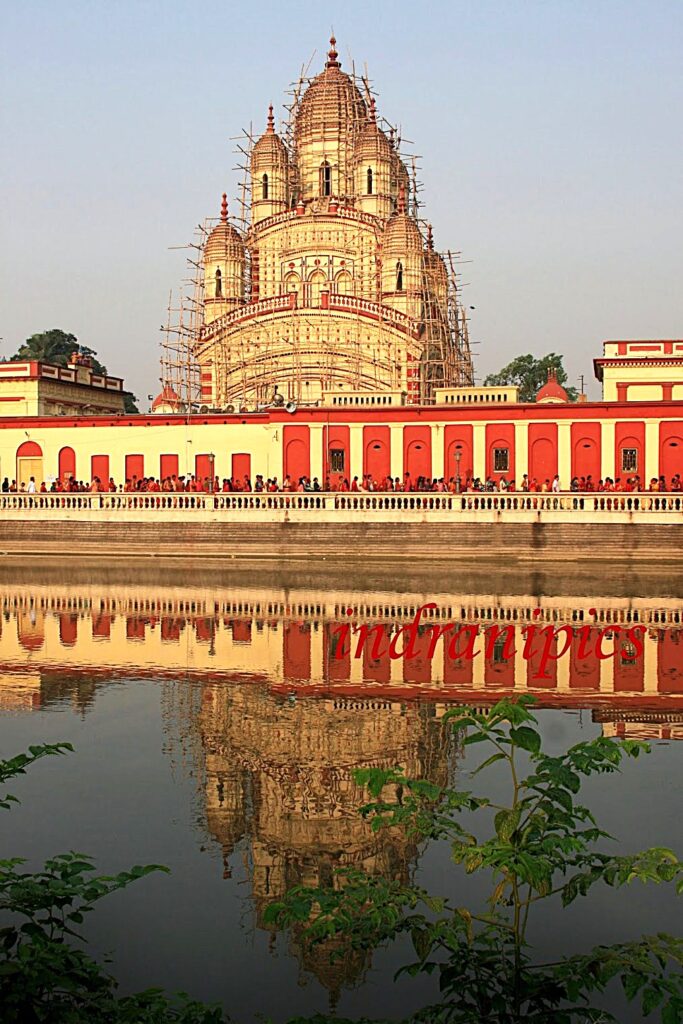
Kolkata Dakshineswar Kali Temple
5 Things Nobody Tells You About Visiting Dakshineswar
Insider tips to save you time and avoid common mistakes.
- Locker Room Strategy: The official locker facility is near the Skywalk entrance. Pro-tip: While the lockers are generally safe, avoid bringing large laptops or bulky electronics; the lockers are best suited for phones and small handbags.
- The Shoe Stand “Trap”: You’ll see many private vendors near the gates offering to keep your shoes if you buy flowers from them. For a hassle-free experience, use the official shoe stand near the Skywalk exit—it’s organized and free of charge.
- Finding the Prasad Counter: Many visitors look for the Bhog (cooked meal) and Prasad (sweets) in the same place. The dry Prasad counter is inside the main courtyard near the Shiva shrines, but the Bhog Coupon Counter is located outside the main gate near the administrative office.
- The Mobile Phone Lockdown: Security is extremely thorough. If a phone is spotted in your pocket near the inner sanctum, you will be asked to leave the line. It’s better to leave it in the locker or your car from the start.
- Navigating Festival Crowds: If visiting during Kali Puja or Amavasya, the queue can stretch onto the Skywalk for over a kilometer. On these days, “peaceful darshan” is rare unless you join the queue by 4 AM.
Best Places to Visit Near Dakshineswar Kali Temple
Maximize your trip by visiting these cultural landmarks nearby.
- Belur Math (The Spiritual Twin): Located directly across the Hooghly River. Don’t take a cab—take the Ferry from Dakshineswar Ghat. It’s a 15-minute breeze-filled ride that costs only ₹11 and offers the best photography angles of the Dakshineswar temple from the water.
- Adyapith Temple: A short 10-minute rickshaw ride (~2 km) away. It is famous for its unique white marble architecture and the “Adya Shakti” idol. It’s significantly quieter than Dakshineswar, making it perfect for meditation.
- The Skywalk Food Trail: The Dakshineswar Skywalk is now a culinary hotspot. Don’t leave without trying the Kolkata-style Telebhaja (deep-fried snacks) and the Nolen Gur sweets (in winter) from the vendors lining the approach road.
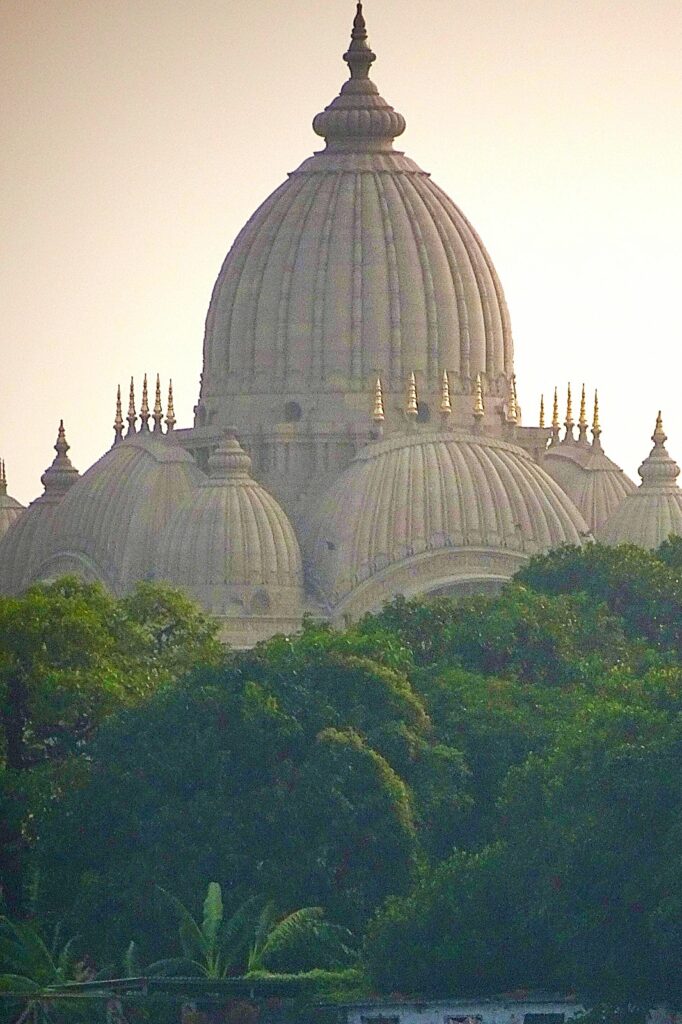
Belur Math Domes Kolkata
FAQ About Dakshineswar Kali Temple
Q1. What are the Dakshineswar Kali Temple timings for 2025?
The temple timings vary slightly by season. For Summer (April to September), the temple is open from 6 AM to 12.30 PM and 3.30 PM to 9 PM. In Winter (October to March), the evening timing changes to 3 PM to 8.30 PM.
- Pro-Tip: Arrive by 5.30 AM to be the first in line for the morning Darshan.
Q2. Is there a dress code for Dakshineswar Kali Temple?
While there is no strict “uniform,” the temple authorities enforce a modest dress code.
- For Women: Saree, Salwar Kameez, or long skirts are recommended. Avoid sleeveless tops or short skirts.
- For Men: Trousers, Dhoti, or Kurta-Pyjamas are preferred. Shorts are strictly not allowed for entry into the main temple area.
Q3. Can I carry my mobile phone or camera inside Dakshineswar Temple?
Photography and mobile phones are strictly prohibited inside the main temple complex. You must deposit your phones, cameras, and leather bags at the dedicated Safe Cloakroom located near the entrance.
- Locker Charges: Approximately ₹3 to ₹8 for mobile phones and ₹10 to ₹20 for bags/luggage.
Q4. How much is the Dakshineswar Kali Temple entry fee?
Entry to the Dakshineswar Kali Temple and the Dakshineswar Skywalk is completely free for all devotees. There are no “VIP Darshan” tickets sold by the temple trust; anyone claiming to sell them is likely a scammer.
Q5. What is the ferry timing from Dakshineswar to Belur Math?
Taking the ferry is the most scenic way to travel. The Dakshineswar to Belur Math ferry operates every 20–30 minutes.
- Ticket Price: ₹11 per person.
- Timing: Usually starts at 7.30 AM, with the last ferry around 7.30 PM.
- Note: It is a one-way ticket; you must buy a new ticket for the return journey.
Q6. How do I reach Dakshineswar Temple by Kolkata Metro?
The easiest way in 2025 is the Blue Line Metro. You can get down at the Dakshineswar Metro Station, which is the terminal station. From there, the temple is just a 5-minute walk via the modern Skywalk, which features escalators and shops.
Q7. Are there food facilities (Bhog) available at the temple?
Yes, you can purchase Bhog Coupons at the temple office if you arrive early (usually before 10 AM). Additionally, there is a food court near the Skywalk entrance serving authentic Bengali vegetarian meals and snacks like Kachori and Mishti.
Q8. Which days are the most crowded at Dakshineswar?
Tuesdays, Saturdays, and Sundays are the busiest days. Special occasions like Amavasya, Kali Puja, and Pana Sankranti (Bengali New Year) attract massive crowds where wait times can exceed 3–4 hours.
Q9. Where can I leave my shoes before entering the temple?
Shoes must be deposited at the official shoe stand near the Skywalk exit. Avoid leaving footwear outside the gates to prevent loss.
Q10. What is the Dakshineswar Skywalk?
The Dakshineswar Skywalk is a 400-meter elevated corridor with escalators and lifts, connecting the railway station and bus stand directly to the temple gates. It reduces congestion and offers elevated views of the temple and Hooghly River.
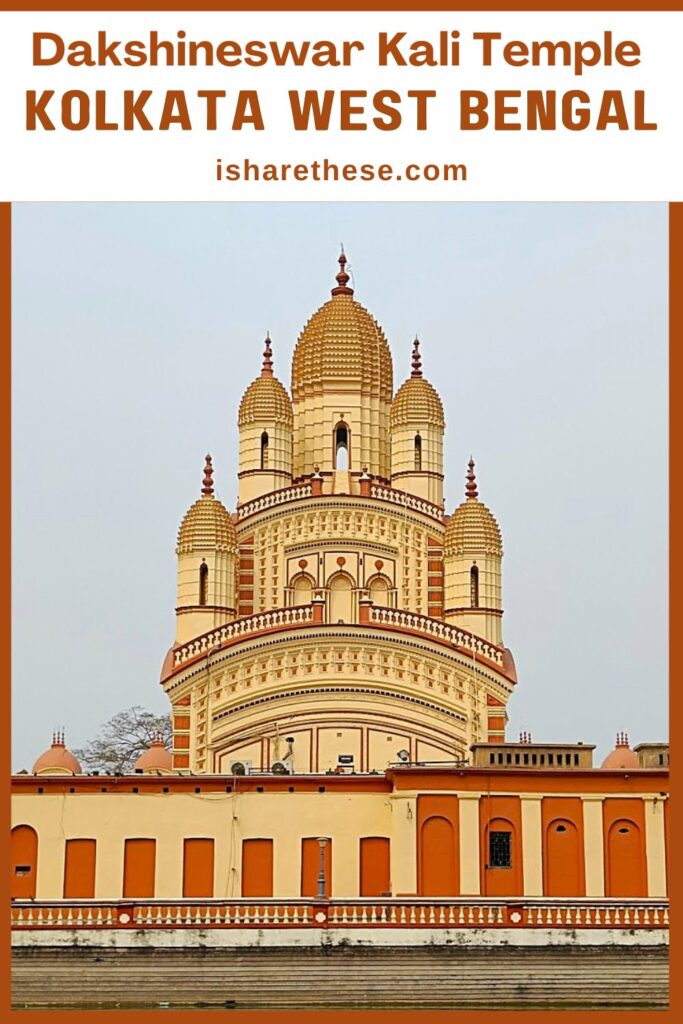
Pin and Save this for Later
About the Author
 Indrani Ghose is an Indian travel writer and cultural storyteller based in Bangalore, India, with deep roots in exploring and documenting India’s rich heritage, festivals, and traditions. With extensive experience covering Indian destinations and cultural celebrations, she has contributed to prestigious publications including Lonely Planet, The National UAE, Whetstone Asia, and Deccan Herald.
Indrani’s cultural insights and travel expertise help readers discover both iconic landmarks and hidden gems throughout India. Follow her adventures and cultural discoveries on Instagram, Twitter, and Facebook for inspiring destinations, offbeat Indian experiences, and real-time updates from her travels across the country.









How did you manage to get these pics. Photography is not allowed inside. Anyway excellent captures
I had visited this temple. Amazing place. Next time plan properly and have the Darshan of Kali Maa.
@manipurna~ lyancha toh Tarapeeth e .
beautifully captured..the mood , the vibrancy . great job
Wonderful captures of a holy place about which I have read in books 🙂 Nice post Indrani!
Nice photos….missing pictures of those famous 'lyangchas' …
Wow! Amazing cliks…Incident might help u anticipate better next time 😉
The temple pic is amazing Indrani. Six was late….i wonder how early the other devotees queued up for the 'darshan'.
Indrani, Important Templeas & paces of interest always have looong queues. Waiting is tough, at the cost of sightseeing, as you have rightly shared.
Wow massive ques indeed. Loved the reflection photograph at the end.Looks very vibrant
Almost a decade back, I was there and got Darshan fortunately.In fact, I wanted to be there where Sri Ramakrishna did his sadhanas and part his divine knowledge to the devotees..Thanks for sharing!
Hari OM
Oh yes those temple crowds – too many to count!!! The last shot is outstanding. YAM xx
Beautiful captures of the ambiance!
Fantastic reflection.
A great series of photos and the reflection is amazing!
You got some wonderful shots from the outside.
Never mind Indrani, try again maybe. Such are bodies so wrapped in a religion belief, superb.
Beautiful photos :)Third picture is amazing 🙂
It looks undergoing a big renovation! But i love your picture of it, i also wish i can visit at least a temple in India. I've just been there once, in Ooty, but there's no temple in the vicinity!
Great photos of Dakhineshwar Kali Temple. Thanks for sharing.
Who'd have thought 6 a.m. was LATE? Well, now you know. :))
Beautiful photos!
That is a long line at 6:00 AM…
This Amazing place eludes me still. How long did it take for you to have darshan?
Wow, sorry the lines were so long.. It is a beautiful temple. I love the last shot..Have a happy weekend!
Maybe this is the way to ensure you visit Kolkata again very soon to go inside the temple 🙂
What an incredible shot! The reflection of the temple is beautiful.
It does indeed look like a big celebration! Great captures for the day as always! Thanks for sharing, Indrani, enjoy what remains of your weekend!!
Amazing place!