Church of Bones Evora Portugal: History, Tickets and Travel Tips
In today’s post I am taking you on a virtual eerie tour! This is Church of Bones in Evora! This is definitely a must visit spot for all of you who are brave during your visit to Evora, Portugal. We visited this after our tour of Cathedral of Evora.
– By Indrani Ghose, travel writer | updated in Nov 2025
Church of Bones (Capela dos Ossos) in Evora
When I was preparing my itinerary for Evora, in May 2015, I stumbled on this Capela dos Ossos in Evora, which I thought was just another tourist attraction with an exaggerated name. Reading the intro of the place I knew this was an extraordinary chapel, officially known as the Chapel of Bones. I was sure I had to add this Portugal’s most unique and haunting religious sites to my itinerary.
Located within the Royal Church of Saint Francis (Igreja Real de São Francisco) in Evora’s historic center, the Capela dos Ossos is exactly what its name suggests – a chapel entirely decorated with human bones and skulls. But this isn’t some macabre Halloween display. This is a profound 16th-century meditation on mortality, created by Franciscan monks as both a practical solution to overcrowded cemeteries and a spiritual reminder of life’s fragility.

Interior of Church of Bones Evora Portugal
My daughters, aged 16 and 12, were both curious and unsure about the place. This small chapel is one of Evora’s most photographed attractions, and recognized as UNESCO World Heritage city.
The chapel serves as a functioning part of the larger Church of Saint Francis, where regular religious services still take place just meters away from this bone-adorned sanctuary.
During my time inside, I watched visitors from different cultures and backgrounds all share the same awed silence.
Plan a visit:
Evora University, Cathedral & Bones Chapel — SkipLine + Wine
Évora: Private walking tour with tickets to main monuments
History of Capela dos Ossos Evora
I was amazed at the remarkable circumstances that led to its creation. The story begins in 16th century Evora, when this city was experiencing unprecedented growth and prosperity.
The Capela dos Ossos wasn’t built on a whim or as some medieval curiosity. It emerged from a very real urban planning crisis that required both practical wisdom and spiritual insight to resolve. During my research before visiting, I discovered that this unique solution reflects the ingenuity of Franciscan monks who saw an opportunity to address overcrowding while creating something profoundly meaningful.
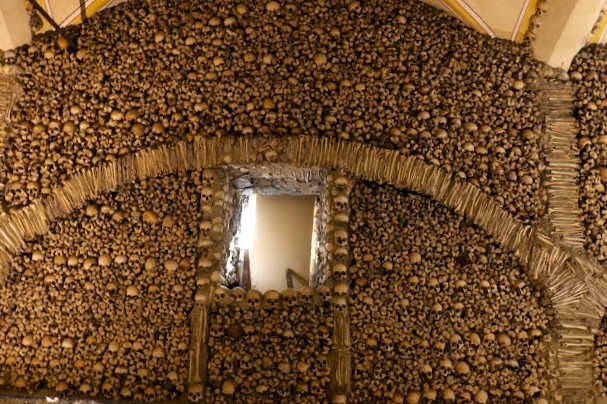
Wall with Bones – overall effect is rhythmic and harmonious rather than chaotic or frightening
The Franciscan Monks’ Vision (1460-1510)
The Franciscan monks weren’t just religious men – they were educated problem-solvers who understood both the spiritual needs of their community and the practical challenges of rapid urban growth. The Franciscan order has always emphasized humility, poverty, and meditation on mortality.
When I spoke with local historians during my visit, they explained how these monks saw the cemetery crisis as an opportunity to create something that embodied their core beliefs. The construction period, spanning from 1460 to 1510, represents nearly fifty years of careful planning and execution.
The monks weren’t simply trying to shock or create a spectacle. Instead, they designed a space for quiet contemplation where visitors would be confronted with the reality of death in a way that was both respectful and transformative.
Memento Mori
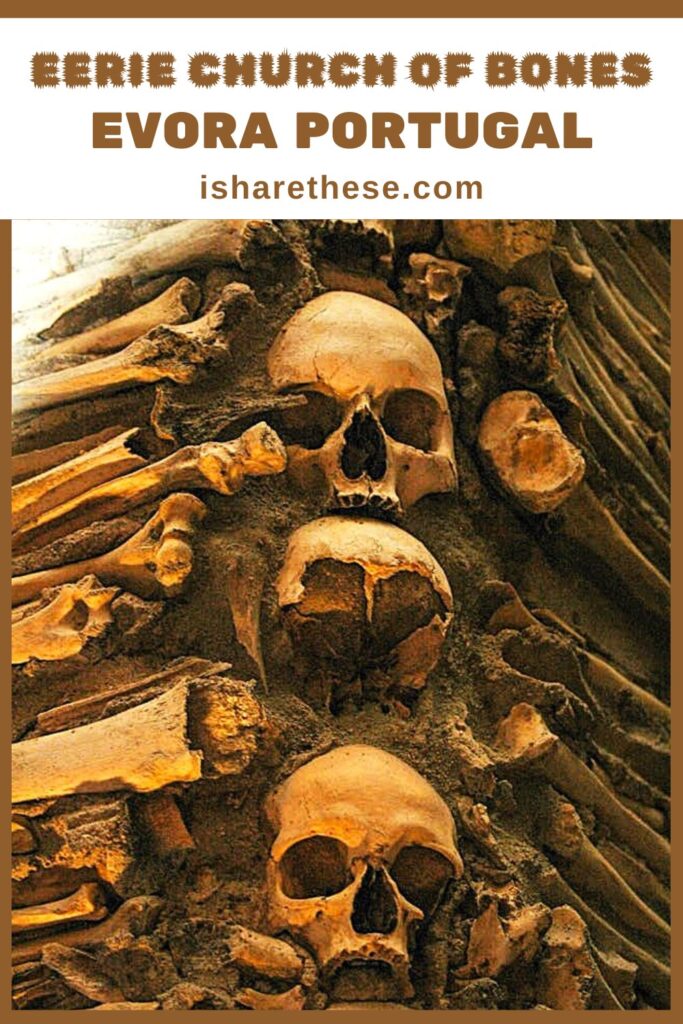
The monks who conceived this project belonged to a tradition that valued memento mori – artistic reminders of mortality designed to encourage spiritual reflection. During my visit, I noticed how the bone arrangements aren’t random or haphazard. Every skull, every femur, every decorative element has been carefully positioned to create patterns that are simultaneously beautiful and meaningful.
These Franciscan visionaries understood that death is the great equalizer. Rich or poor, noble or commoner, all human remains look essentially the same once stripped of worldly possessions and social status. This egalitarian message resonated strongly with Franciscan teachings about humility and the temporary nature of earthly concerns.
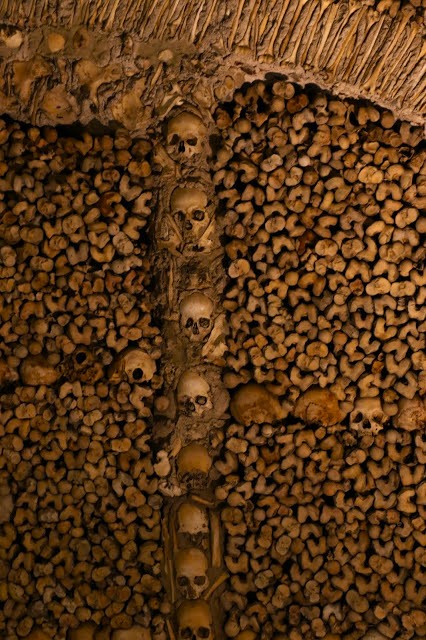
Human remains look essentially the same
Cemetery Consolidation Project
The practical challenge that sparked the creation of Capela dos Ossos was staggering in scope. When I researched the historical records available in Evora’s municipal archives, I discovered that the city had accumulated forty-three different cemeteries by the early 16th century.
These cemeteries weren’t small family plots. They represented centuries of burials from a growing population, and they occupied valuable land that the expanding city desperately needed for housing, commerce, and agriculture. But simply moving the graves wasn’t an option – both religious doctrine and social custom demanded that the dead be treated with respect and dignity.
I learned that the monks carefully exhumed remains from all forty-three cemeteries, transporting thousands of skeletons to the Church of Saint Francis. This wasn’t a quick process – it took decades to complete and required the cooperation of families, city officials, and church authorities.
Trust me, you too will be amazed to learn about the selection criteria for bones used in the chapel’s decoration. The monks chose bones based on their condition, size, and suitability for the architectural patterns they wanted to create. Other remains were respectfully reburied in a consolidated cemetery behind the church.
I read that detailed records were kept throughout this process of construction. Families could request that their ancestors’ remains be included in the chapel rather than the consolidated cemetery – a request that many considered an honor. Capela dos Ossos wasn’t seen as macabre by contemporary residents, but rather as a dignified and innovative solution to a serious urban problem.
The project also reflected broader changes happening in 16th century Europe, where cities were grappling with population growth, public health concerns, and land use challenges. The Evora solution became a model that influenced similar projects in other Portuguese cities, though none achieved the artistic sophistication of the Capela dos Ossos.
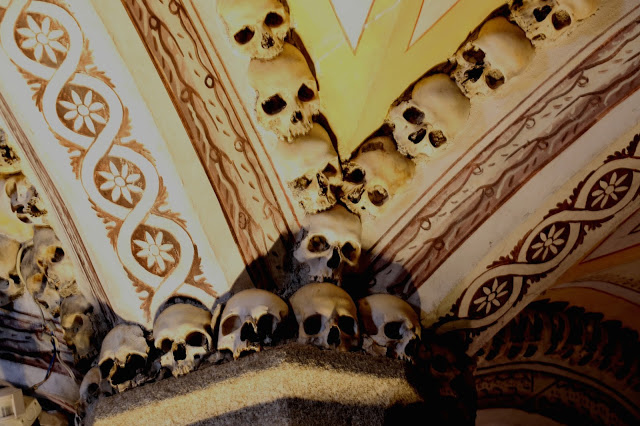
Architectural Details of Capela dos Ossos
What to Expect Inside the Church of Bones Evora
Nothing could have prepared me for that first moment stepping into the Capela dos Ossos. Despite seeing countless photographs online, the reality of being surrounded by thousands of human-remains arranged in intricate patterns was both overwhelming and deeply moving. The atmosphere inside is unlike anything I’ve experienced in decades of travel – a perfect blend of art and contemplation.
The first sensation that strikes you isn’t visual but atmospheric. The chapel maintains a cool, quiet environment that seems to naturally encourage whispered conversation by tourists around. Natural light filters through small windows, creating shadows that dance across the bone decorations and give the space an almost ethereal quality.
As my eyes adjusted, I began to appreciate the incredible artistry involved in creating this space. The layout guides visitors through the space in a way that builds emotional impact while maintaining respect for the human remains on display.
The Bone Decorations and Architecture
The monks who designed this space understood both engineering and artistry, creating structural elements from human remains that are both functional and beautiful. The architectural sophistication is incredible. The bones aren’t simply attached to existing walls – they form integral parts of the chapel’s architecture.
Observe the pillars created entirely from stacked human bones. These aren’t crude constructions but carefully engineered supports that have maintained their structural integrity for over 500 years. It is indeed praise-worthy how the monks solved the engineering challenges of creating load-bearing elements from such unconventional materials.
The overall effect is surprisingly rhythmic and harmonious rather than chaotic or frightening.
One detail that particularly impressed me was the treatment of the ceiling. Rather than covering it with bones, the monks left it plain, creating a sense of openness that prevents the space from feeling claustrophobic.
The chapel also includes several artistic elements that transcend mere decoration. Arched doorways are framed entirely with bones, creating dramatic transitions between spaces. These bone arches required sophisticated understanding of structural engineering, as they need to support weight while maintaining their decorative function.
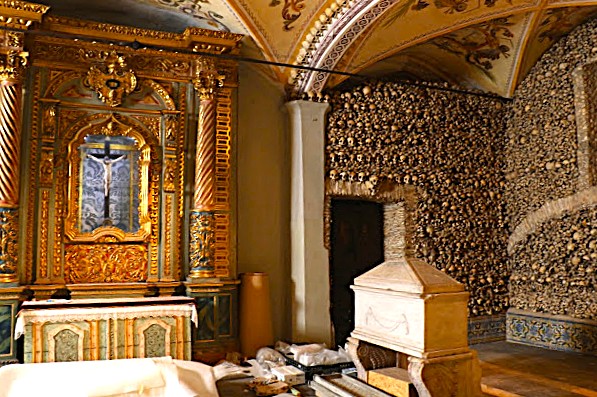
The white box has bones of the monks who made this chapel
The bones of the monks who made this chapel are not on display. They are kept in a small white coffin. Notice the box in middle left of the picture above.
Famous Inscription: “Our Bones Wait for Yours”
The most chilling moment of my visit came when I encountered the famous inscription above the chapel entrance. Written in Portuguese, Nós ossos que aqui estamos pelos vossos esperamos translates to “We bones that are here wait for yours.” These ten words encapsulate the entire philosophical purpose of the Capela dos Ossos in a way that stops visitors in their tracks.
I watched dozens of other visitors read this inscription during my time in the chapel, and the reaction was always the same – a moment of stunned silence followed by more thoughtful, quieter movement through the space.
The monks positioned it at the entrance where it serves as both welcome and warning. Reading these words before entering the chapel completely changes how you experience the space – you become aware that you’re not just observing someone else’s mortality but confronting your own.
The directness of the inscription struck me the most. The bones are waiting. Your bones will join them. Doesn’t this blunt acknowledgment of death’s inevitability reflect both Franciscan spirituality and Portuguese cultural attitudes toward mortality?
I later read up, similar inscriptions appear in other European bone churches, but none achieve the poetic power of the Evora version. The Portuguese language lends itself particularly well to this kind of memento mori, with its combination of musicality and gravity.
The 5,000 Human Remains in Church of Bones Evora
The sheer scale of human remains incorporated into the Capela dos Ossos becomes apparent only gradually. My initial impression focused on the artistic arrangements and architectural elements, but as I spent more time in the space, I began to grasp the staggering number of individuals represented here. Current estimates suggest that bones from approximately 5,000 people were used in the chapel’s construction – roughly equivalent to the entire population of a medieval town.
Walking through the chapel, I tried to imagine the lives these people lived. The remains span several centuries and include individuals from all social classes and walks of life. Nobles and peasants, merchants and craftsmen, young and old – all are represented equally in death. This democratic aspect of the chapel reinforced the Franciscan message about the temporary nature of worldly distinctions.
Two complete bodies that hang from chains near the altar – one adult and one child shocked us a bit. Unlike the other remains, these bodies were mummified rather than reduced to bones, creating an even more direct confrontation with mortality. Local tradition suggests these may be the remains of individuals who were cursed or excommunicated, though historical records don’t confirm this interpretation.
The preservation of these remains over 500 years is remarkable. The cool, dry environment of the chapel has protected the bones from decay, while their incorporation into architectural elements has prevented damage from handling or environmental factors. During my visit, I noticed that conservation efforts continue today, with careful monitoring of temperature, humidity, and visitor impact.
Evora’s history is in these anonymous bones, the physical remains of 5000 individuals who built this city, raised families here, and contributed to the community that created one of Portugal’s most remarkable cultural treasures. The Capela dos Ossos serves not just as a meditation on mortality but as a monument to the countless ordinary people whose lives made Evora what it is today.
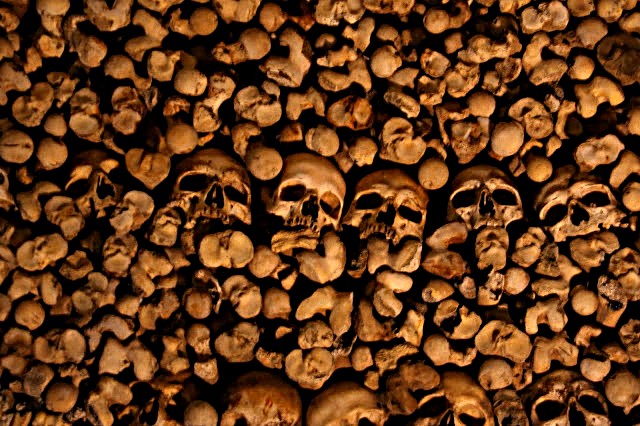
Evora History in bones of 5000 people in Church of Bones Evora
How to Reach Church of Bones Evora
Capela dos Ossos (Chapel of Bones) is located within the Igreja de São Francisco (Church of St. Francis) in the heart of Évora, Portugal. This UNESCO World Heritage city is compact and pedestrian-friendly, making it easy to explore on foot.
Walking from Évora City Center
If you’re staying in central Évora, Capela dos Ossos is just a short walk away. From Praça do Giraldo (the main square), head southeast along Rua 5 de Outubro.
Public Transportation
Buses and taxis are available that take you direct to historic centre of Evora. The church is walking distance from here.:
- Bus Line 33: This bus service trips between Hospital do Patrocínio to Rua da República, which is approx 6 minutes away from the Church of Bones. Buses run regularly at 30 minutes intervals from Monday to Saturday.
- Taxi: A taxi ride from the city center to the church costs around €5–€7.
Driving from other cities
Capela dos Ossos is at a distance of 134 km, about a 1.5-hour drive from Lisbon, take the A6 motorway towards Évora. Upon entering Évora, follow signs to the city center. We drove in from Elvas via A6 motorway, the distance 83.9 km done in approx. 1 hour.
Parking facilities
Parking is available near Praça do Giraldo, from where it’s a short walk to the chapel.
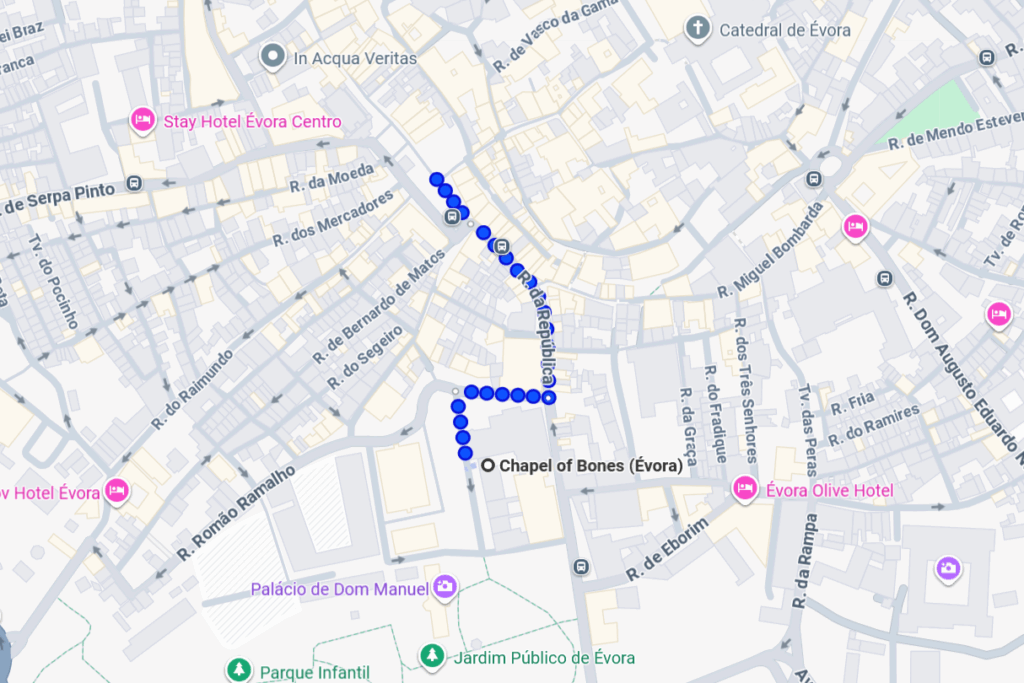
Google Map walking route from Historic Centre to Church of Bones Evora
Church of Bones Evora Tickets and Pricing
Admission Prices
Tickets to the Chapel of Bones and church’s museum: €5.
Children under 12 go free
Where to buy tickets:
You can buy tickets to the church at the entrance. However, it is advisable to buy tickets in advance to avoid disappointment and delays in your Evora sightseeing plans.
Combo Tickets with Other Evora Attractions
You can buy combo tickets for the Church of Bones (Capela dos Ossos) and other attractions in Évora at the ticket office on-site. Alternatively you can buy tickets through online platforms and tour operators.
Note: All prices and timings are subject to change. Please verify the official website before your visit.
Opening Hours and Best Time to Visit
Current Opening Times and Seasonal Variations
Timings: It opens daily – 9 AM to 5 PM in winter, 6.30 PM in the summer.
Best time to visit Évora: Spring (March to May) and autumn (September to November)
Time to tour: less than an hour
Crowd Avoidance Tips
During peak hours and the busy season, you may have to wait 15 to 30 minutes to enter.
Frequently Asked Questions About the Church of Bones Evora
Here are the most common concerns and curiosities about visiting the Church of Bones in Evora:
Is the Church of Bones suitable for children?
Lot depends entirely on your child and your family’s approach to discussing mortality. Children under 10 often view the bone decorations more as an interesting curiosity than something frightening. Some teenagers found the experience more disturbing than their younger siblings. However, children who are already anxious about death or have recently experienced loss in the family might find the experience overwhelming.
I’d recommend preparing children beforehand by explaining that this is a special kind of church where people from long ago are remembered in a unique way.
How long does a visit to the Capela dos Ossos take?
Most visitors spend between 15 to 30 minutes inside the Chapel of Bones itself. I recommend allowing at least an hour for your entire visit to fully appreciate both the chapel and the larger Church of Saint Francis complex.
Are photographs allowed inside the Church of Bones?
Yes, photography is permitted inside the Capela dos Ossos, though there are important guidelines to follow. Flash photography is strictly prohibited to protect the historical remains and maintain the contemplative atmosphere. Avoid taking selfies with the bone decorations or treating the space like a Halloween photo opportunity.
Is the Church of Bones wheelchair accessible?
Unfortunately, the Capela dos Ossos has limited accessibility for visitors with mobility challenges. There are several steps to enter the Church of Saint Francis, and the Capela dos Ossos itself has a raised threshold. The pathways inside the chapel are narrow, and there are no ramps or wheelchair-friendly entrances.
Contact the church directly before your visit if you have specific accessibility needs. Staff members may be able to suggest alternatives or provide assistance that isn’t immediately obvious to casual visitors.
What’s the best time of day to visit to avoid crowds?
Plan your visit early morning (within the first hour of opening) for a peaceful experience. Late afternoon, about an hour before closing, will be a good idea too. I’d strongly advise avoiding midday during summer months (July and August) when tour buses arrive most frequently. Weekends tend to be busier than weekdays. If you’re visiting during peak season, consider purchasing your tickets online in advance to skip any entrance queues.
Are there any dress code requirements?
The Capela dos Ossos is located within an active Catholic church, so modest dress is both required and respectful. For both men and women, shoulders should be covered – no tank tops, halter tops, or strapless clothing. Shorts and skirts should reach at least knee-length.
I always recommend bringing a light scarf or shawl if you’re unsure about your outfit.
Can you attend regular church services at the Church of Saint Francis?
Yes, regular Catholic masses and services do take place in the main Church of Saint Francis, though not specifically in the Chapel of Bones itself. The bone chapel serves more as a meditation space and historical site rather than an active worship area.
Keep in mind that if you visit during a scheduled service, access to certain areas including the Chapel of Bones might be restricted or require waiting until the service concludes.
How does the Church of Bones compare to similar sites like the Paris Catacombs?
They offer quite different experiences despite both featuring human remains as decorative elements. The Evora bone chapel is much smaller and more intimate – you can see everything in one room rather than walking through extensive underground tunnels.
The artistic approach is also different. While the Paris Catacombs feature walls of stacked skulls and bones creating almost abstract patterns, the Capela dos Ossos incorporates bones into architectural elements like pillars and arches.
Is it worth combining with other Evora attractions?
Absolutely! The city is designated as a UNESCO World Heritage Site, and the bone chapel represents just one of many remarkable attractions within walking distance of each other.
I suggest a walking route that includes the bone chapel, cathedral, Roman temple, and University of Evora, with stops for coffee and pastéis de nata at local cafés. This combination provides a comprehensive overview of Evora’s layered history from Roman times through the medieval period to the present day.
Pin this for later
 Indrani Ghose is an Indian Travel Writer and Blogger based in Bangalore, India. She has written for numerous publications across the globe – including Lonely Planet, The National UAE, Whetstone Asia, Deccan Herald. You can follow her on her social media handles Instagram, Twitter, Pinterest and Facebook to see the wonderful destinations, beautiful offbeat places and get instant updates about them.
Please note: This post may contain affiliate links which means I may earn a commission if you make a purchase by clicking a link on this post. This will be at no additional cost to you. Affiliate links help me keep this website up and running. Thanks for your support!










Thanks for the info! I can’t find a way to buy tickets online without a tour. Can you post a link?
I have updated with a link now. Please check. https://gyg.me/UaIoX3kQ
Have been here Indrani. Was amazing. Great narration and pictures.
Indrani, I have always been intrigued about this chapel of bones ever since I read about it a few years back. I gives me goosebumps and here I see it here in your post.
This is the most impressive and interesting post of the day! On the otherhand it’s also very eerie and spooky.
Thank you for showing all those great photos.
Have a wonderful week, Indrani!
Wil, ABCW Team
Hmmm. It kind of gives me the creeps! 😉
Creepy beauty!!!!!!!!!!!Thanks for the lovely pics of this place.
Never heard of something like this. Fascinating! Gosh can’t imagine walking into a place with so many skeletons…
This place has a character of its own. Unique!
Grand even. Thank you for the sights in here. I’m glad I didn’t miss this post.
I’m curious — do they still have services in there?
Quite unsettling. I bet it needs the nerve to spend a night inside the chapel…ALONE…
Great pictures, Indrani…
Did you sleep well that night? What is that scaffold doing in there? Are they adding a few more bones or carrying out regular maintenance work … replacing a few broken bones maybe!
Yikes! I do not want to be stranded there alone at night 🙂
Oh my……….! Interesting!
Absolutely terrific! Incredible idea to preserve all their bones and what really wonder was people dying to get into the Chapel.
Glad u able to venture this skeletal palace 🙂
Beautiful photos of this interesting chapel!
It gives an eerie feeling…
I have heard about this Chapel earlier.
Amazing photos.
Thanks.
This was truly eerie, but so interesting. Thanks for sharing dear 🙂
Yes! 🙂
Interesting Tale! You said braves are them who have scrolled down to the last picture. But I wonder how brave you were amidst those bones capturing each of them.
I am very brave Anupam, not scared of such dead stuffs. Invisible things and sources of sounds scare me though. 😛 🙂
Spooky Indrani, I am not sure I will like to visit!
Given a chance I would love to visit again Mridula. 😀
Great virtual tour Indrani Ji with Beautiful shots of the chapel. Interesting sculptural work.
These are real skulls Yogi ji!
Oh My God! This place gives me the creeps. Your pictures are fantastic.
Nothing to be scared Rachna. 🙂
Interesting history.Nice captures.How do you manage to go there?
Very Disturbing scene.
Now this is what we call beauty with horror 😉
Amazing!! Your captures are also amazing!!!!
Thank you Sylvia!
Ahhhhhh this one scared me in pictures, I wonder what have an actual done to me!! But sooo interesting Indrani!
Breathtakingly beautiful place… I would love to visit the it some times!
You are brave to find this place beautiful! 🙂
whoa… How do they preserve these? How long you managed to stay inside ;)? Yes these places remind us in the end nothing matters.
They seemed to be well preserved. No clue how though.
We hung around the place for around 15mins.
Thanks Arun for the comment.
my god… this was eerie… I wouldn’t have visited this one for sure In :-p
That is why I got the pics for you Archana. 🙂
Oh my lord. This is quite disturbing scene for me.
Oh! So sorry for that.
Beautiful shots of the chapel. Interesting sculptural work.
Those are real skulls Rajesh!
One helluva deep bones, excellent photos.
Thanks Bob!