Alcobaça Monastery Tombs: Portugal’s Most Romantic Gothic Masterpiece
The Tombs of D. Pedro I and D. Inês de Castro
My curiosity about the story of tombs of Pedro and Ines within Alcobaca monastery made me add it to the itinerary of Portugal tour. Most monasteries have stories within their mighty walls, some known some unknown. There are some more that are charming while some dramatic and gruesome.
Alcobaca monastery is one such monastery that has all history, charm, drama, a sad and romantic story! I researched about the place before my visit and I read this gripping story of this Portuguese King Pedro, a lover. Alcobaca Monastery went into my itinerary in bold letters. Read on to know more about these legendary ill fated Portuguese lovers.
(Modified with verified facts and figures in October 2025.)
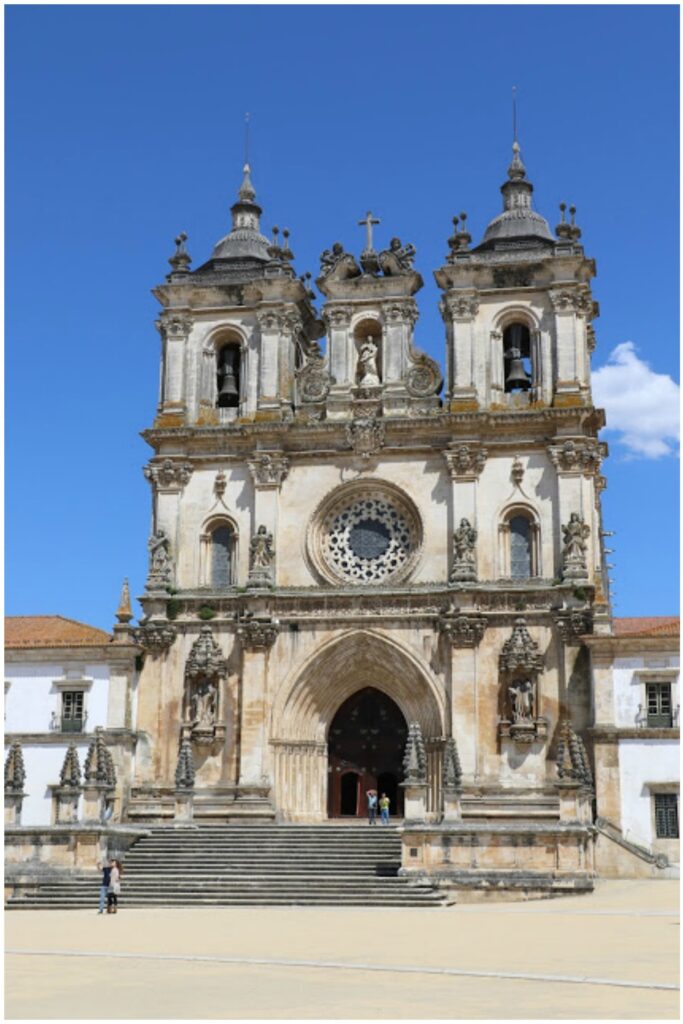
Alcobaca Monastery – impressive example of Cistercian and Gothic architecture
Quick Facts About Alcobaca Monastery Tombs
Location: Transept of the Monastery Church, Alcobaça, Leiria District, Central Portugal (105 km north of Lisbon)
Constructed: between the years 1358 to 1367 (commissioned by King Pedro I)
Monastery Hours:
- October to March: 9 AM to 6 PM
- April to September: 9 AM to 7 PM
- Last admission: 30 minutes before closing
- Closed: January 1, May 1, December 25, Easter Sunday
Entry Fees:
- Church nave and royal tombs: FREE
- Cloister, chapter house, and monks’ dormitory with audio guide: €6 (€3 reduced)
UNESCO Status: Designated World Heritage Site since 1989
Architectural Style: Portuguese Gothic (14th century), featuring Ançã limestone with intricate sculptural programs
Best Visiting Strategy: Arrive at opening time (9 AM) to photograph the tombs in natural light without crowds. The morning sun illuminates the south transept tomb (Inês) beautifully between 9.30 AM to 10.30 AM.
Distance from Major Cities:
- Lisbon: 120 km (1 hour 20 minutes via A8/A1)
- Porto: 210 km (2 hours via A1)
- Coimbra: 90 km (1 hour via A1)
Historical Significance: Houses the most celebrated funerary monuments in Portuguese Gothic art, representing the pinnacle of 14th-century Iberian stone carving.
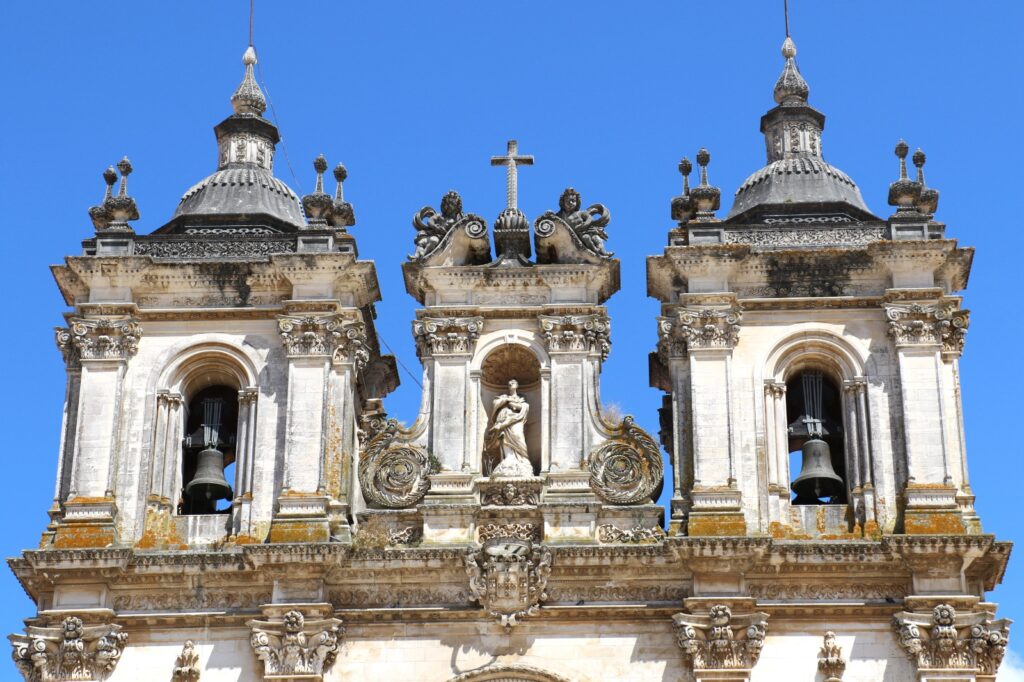
Alcobaca Monastery-Designated World Heritage Site since 1989
The Definitive Guide to the Tombs of Pedro and Inês de Castro
History of Alcobaca Monastery
King Afonso in 1138 AD built this monastery to commemorate his victory of Santarem from Moorish control. It was completed in 1223 AD.
(This reminded me of Kirti Stambh in Chittorgarh, Rajasthan. Rawal Kumar Singh (1179-1191) built this for the glory of Jainism. King Rana Kumbha built Vijay Stambh in 1448 to commemorate
his victory over the combined armies of Malwa and Gujarat led by Mahmud Khilji.
Probably building commemoration monuments was the order of the day then.)
The Tragic Love Story Behind the Tombs
When I first entered Alcobaça’s vast transept in the early morning light, the positioning of the two royal tombs immediately struck me—placed foot-to-foot across the transept’s width, approximately 15m apart. This wasn’t the typical side-by-side arrangement of medieval royal couples. After consulting with the monastery’s guide and later researching period documents, I learned this unique orientation embodies Pedro’s belief that on Judgment Day, when the dead rise, he and Inês would first see each other’s faces.
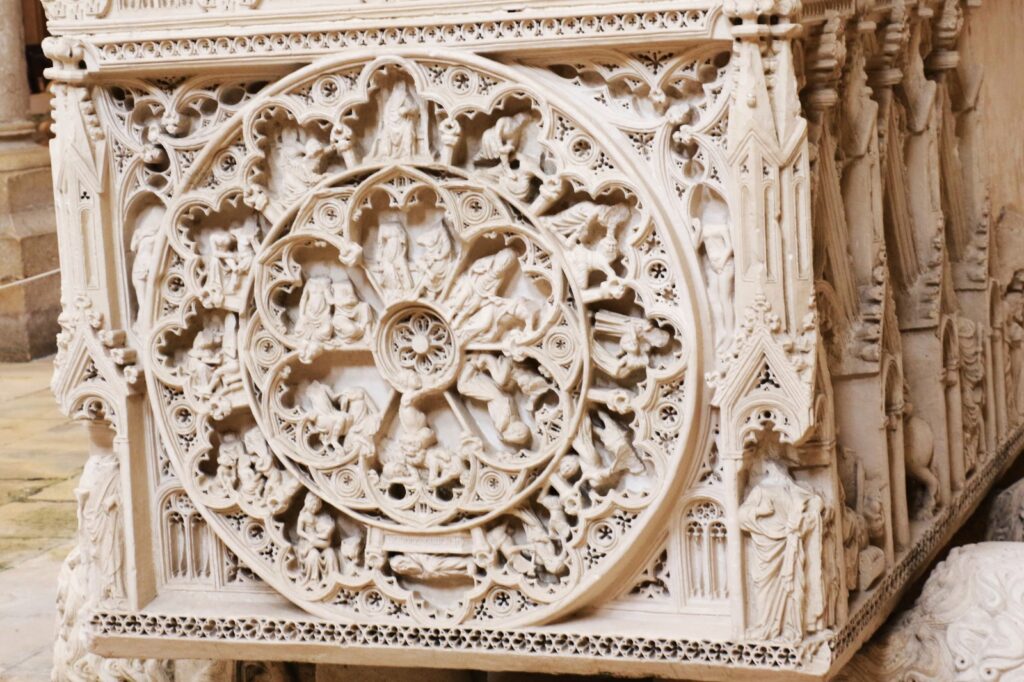
Iberian Stone Carving on Tomb
The Historical Account
The tombs commemorate one of medieval Europe’s most documented royal love affairs, reconstructed from 14th-century Portuguese chronicles, particularly those of Fernão Lopes (1380s-1460).
Pedro I (1320-1367), heir to the Portuguese throne, fell deeply in love with Inês de Castro (c. 1325-1355), a Galician noblewoman serving as lady-in-waiting to his wife, Constança Manuel. Despite his 1339 arranged marriage to Constança, Pedro’s attachment to Inês intensified. After Constança died in childbirth in 1345, Pedro openly lived with Inês in Coimbra, and they had four children together.
King Afonso IV, Pedro’s father, viewed Inês’s Castilian family connections (the powerful Castro clan) as a dangerous threat to Portuguese sovereignty during the turbulent Iberian conflicts of the 1350s. On January 7, 1355, acting on counsel from his advisors, Afonso IV ordered Inês’s execution. She was murdered at the Quinta das Lágrimas (Estate of Tears) in Coimbra, allegedly in front of her children.
Historical accounts suggest three noblemen—Pero Coelho, Álvaro Gonçalves, and Diogo Lopes Pacheco—carried out the killing.
Pedro’s Retribution and Coronation of the Dead
When Pedro ascended to the throne in 1357 after his father’s death, he pursued brutal vengeance. He captured two of the three assassins (Pacheco escaped to Castile) and, according to chronicles, had their hearts torn from their bodies—one through the chest, one through the back—while he watched during a feast at Santarém.
Pedro then made an unprecedented declaration: he had secretly married Inês before her death (historians debate whether this ceremony actually occurred). In 1361, he ordered Inês’s body exhumed from her tomb in Coimbra’s Santa Clara-a-Velha monastery and transported to Alcobaça in a torchlit procession.
Inês was posthumously crowned Queen of Portugal in a ceremony where, according to some chronicle accounts, courtiers were compelled to pay homage by kissing her hand—though the state of decomposition after six years makes this detail historically disputed.
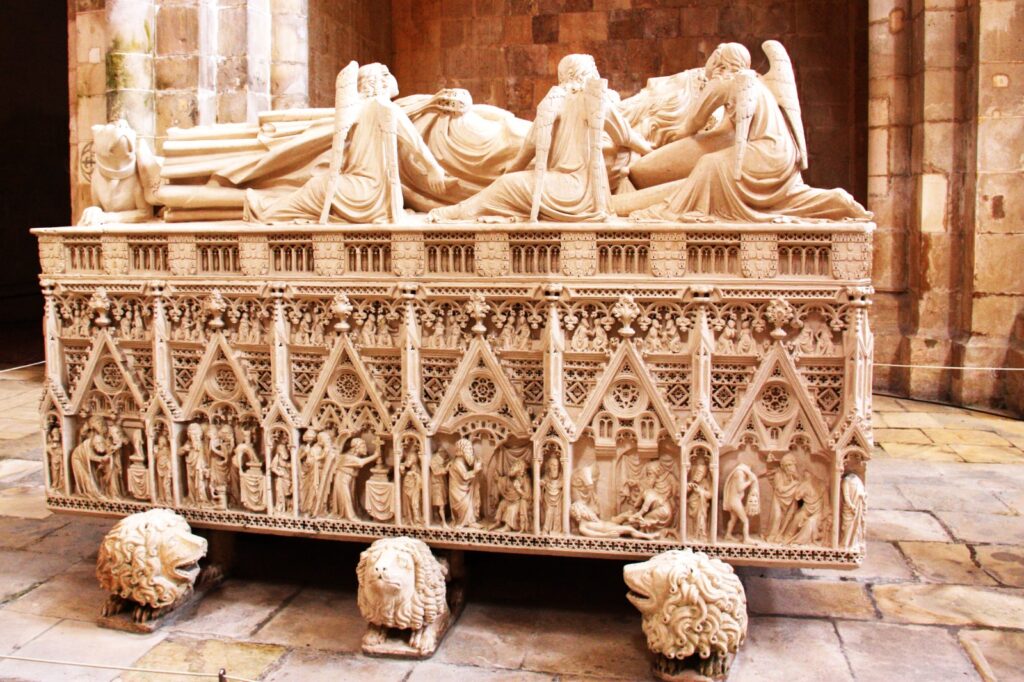
Tomb of Pedro I in Alcobaca Monastery
Experiencing the Tombs Today
Most visitors (including me) instinctively move toward these tombs upon entering the transept, and I’ve noticed an unspoken courtesy among photographers—people wait for others to finish before stepping into frame. This respectful silence feels appropriate given the monuments’ emotional weight.
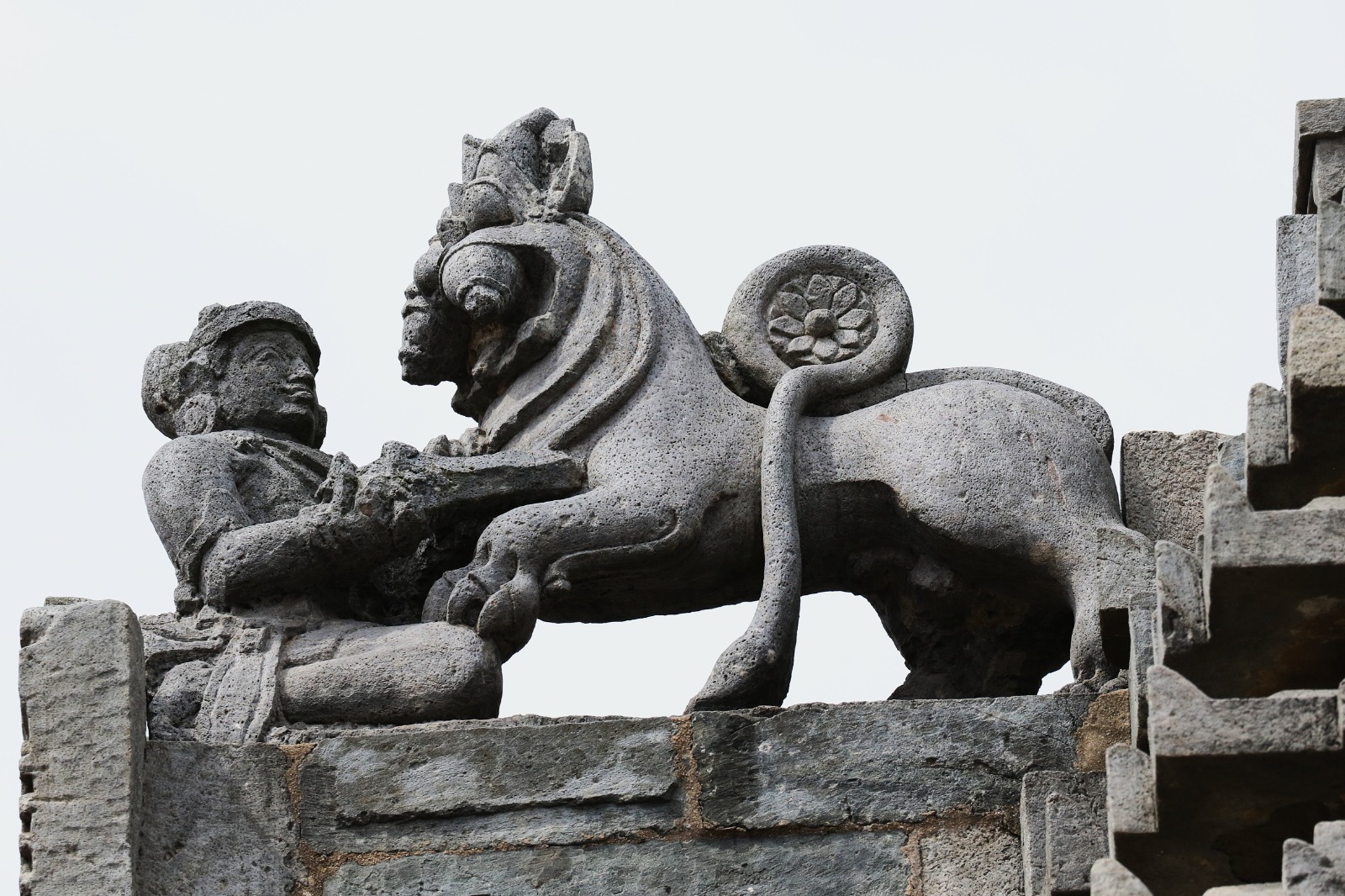
The tombs themselves are carved from fine-grained Ançã limestone and represent masterworks of 14th century Portuguese sculpture. Each sarcophagus measures approximately 2m in length and rests on sculptured lions (Pedro’s tomb) and hybrid creatures (Inês’s tomb).
Pedro’s tomb (north transept) features his recumbent effigy in royal regalia, surrounded by detailed reliefs depicting scenes from the Life of Saint Bartholomew, his patron saint. The level of detail is extraordinary—individual facial expressions on dozens of figures, flowing drapery, and architectural elements all carved with precision.
Inês’s tomb (south transept) is considered the more artistically accomplished of the pair. Her effigy shows her crowned as queen, with six angels supporting her head and body. The tomb’s sides display a sculptural narrative of the Last Judgment, the Crucifixion, and scenes from the life of Christ. The Wheel of Fortune motif—particularly poignant given her tragic fate—appears prominently.
What struck me most during my visit was the extraordinary preservation of detail after 650+ years: the feathered wings of angels, the expressions of grief on mourning figures, and the delicate Gothic tracery that frames each scene.
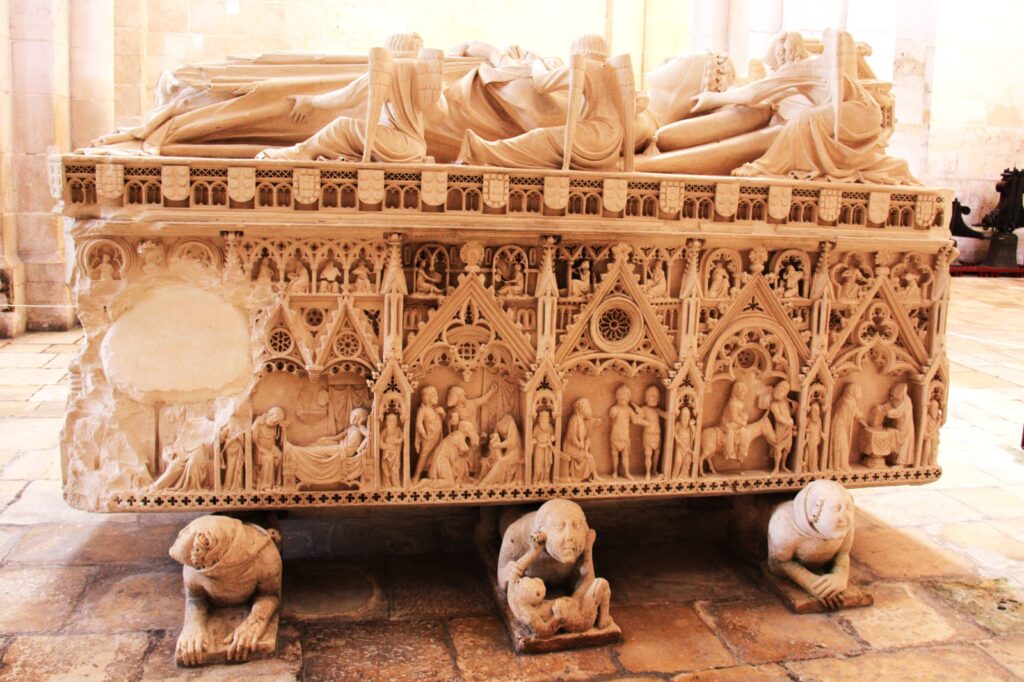
Inês’s tomb inside Alcobaca Church
Where Are the Tombs Located in Alcobaça Monastery?
The tombs of King Pedro I and Inês de Castro occupy the north and south arms of the church transept, positioned perpendicular to the nave at the crossing.
Location Details (my approximate observations from my visit):
- Pedro I’s tomb: North transept (left side when facing the altar), approximately 3m from the transept wall
- Inês de Castro’s tomb: South transept (right side when facing the altar), directly opposite Pedro’s tomb
- Distance between tombs: Approximately 15m across the transept width
- Orientation: Both effigies lie with feet pointing toward each other (east-west alignment)
- Platform height: Each tomb sits on a raised stone platform approximately 1m high
The transept’s soaring Gothic arches rise 20m above the tombs. Imagine the dramatic vertical space right above. Three large windows in each transept arm provide natural illumination, though the south-facing windows (illuminating Inês’s tomb) admit more consistent light throughout the day.
It took me some time to figure out the vantage point to photograph the tombs. If you intend to visit the Alcobaca Monastery, note that, the best vantage point is from the church crossing, where you can capture both tombs’ positioning. Use the morning hours (9 AM to 11 AM) for optimal natural lighting without flash, which is prohibited to preserve the limestone carvings. I got late by couple of hours here and missed the good lighting.
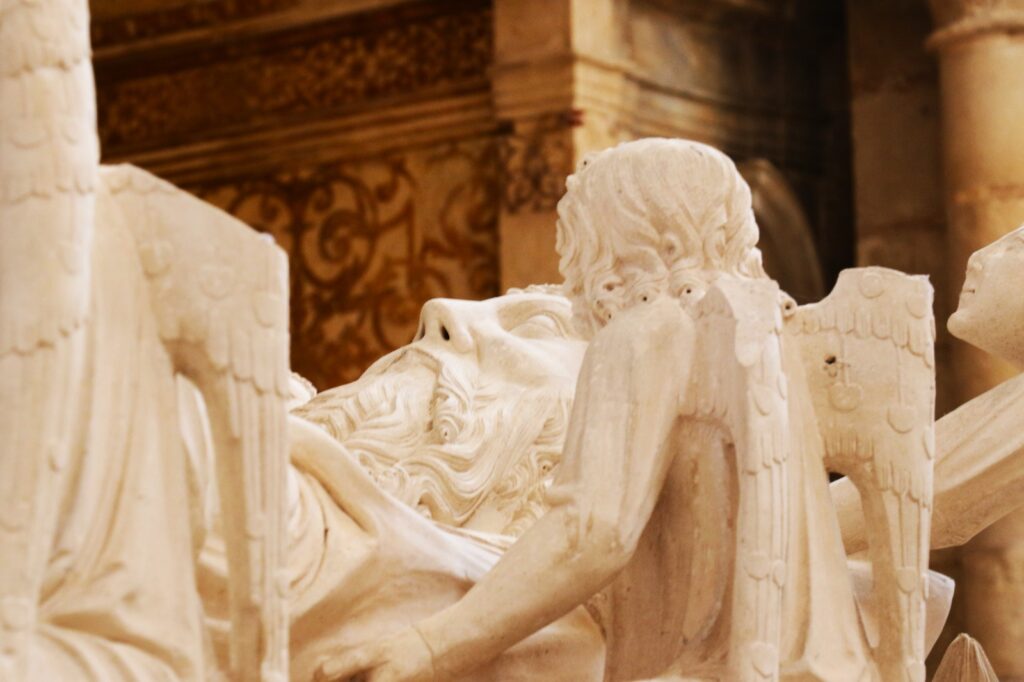
Six angels cradle the King’s Head and Feet
The Tombs of Pedro and Inês: Artistic Features and Symbolism
Standing before these limestone monuments, I’m struck by how the stone seems to breathe with life despite being carved over 650 years ago. They narrate stories through every chisel mark, every angel’s expression. Let me walk you through what makes these tombs extraordinary artistic achievements and what their intricate details actually mean.
What Do the Carvings on Alcobaça’s Royal Tombs Mean?
It won’t be wrong to say here that the tombs function as medieval graphic novels carved in stone. Pause and try to grasp the visual language revealed through layers of meaning.
Pedro’s Tomb: A King’s Spiritual Journey
Pedro’s sarcophagus in the north transept unfolds like a stone manuscript, capturing the drama of faith, suffering, and redemption. The main frieze portrays:
- Martyrdom of Saint Bartholomew—his patron saint—mirroring Pedro’s own violent past
- Six angels cradle the king’s head and feet, their faces carved with distinct emotion, as if offering personal guardianship
- Beneath, six lions—symbols of royal power and resurrection—stand sentinel
- Around the edges, delicate trefoils and quatrefoils frame miniature Passion scenes, each no larger than a palm.
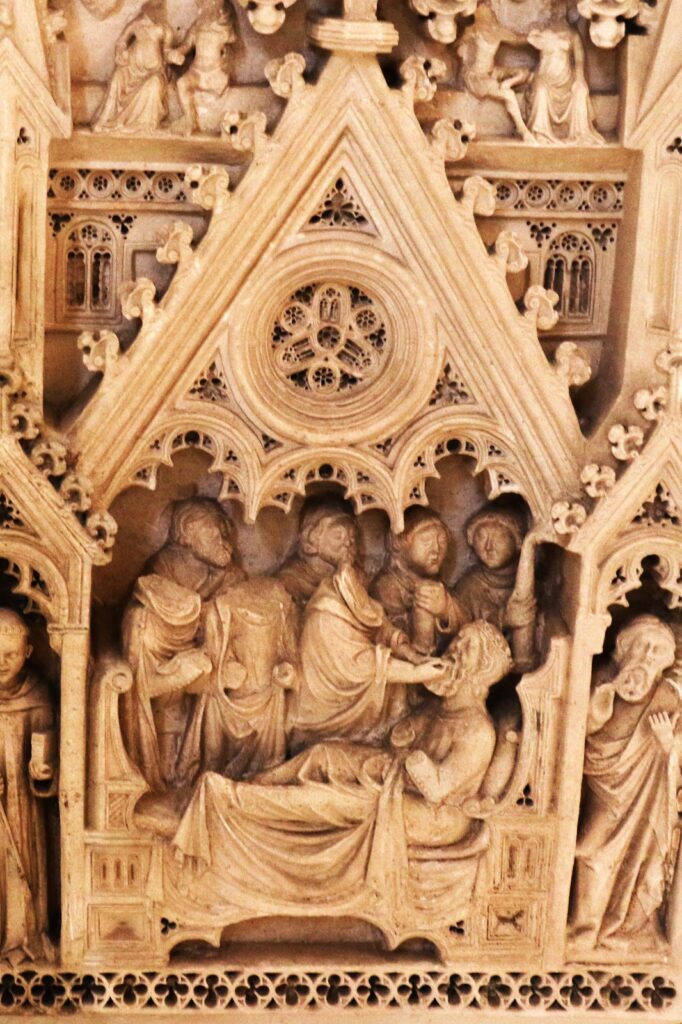
Scene of Suffering on Tomb
Inês’s Tomb: Queenship and Redemption
Inês’s tomb in the south transept is the more refined of the pair, marked by the Wheel of Fortune—a striking symbol of fate’s turns, echoing her journey from lady-in-waiting to murdered queen. When I observed this detail, I was moved by its brutal honesty about power’s instability.
The narrative panels have carvings that depict love, loss, and transcendence:
- Scenes from the Last Judgment, reflecting Pedro’s hope of reunion in the afterlife
- Along the sides, the Wheel of Life and Death trace the stages of existence with exquisite realism
- Beneath her effigy lie hybrid guardians—half lion, half human—mirroring her liminal place between disgrace and sanctity.
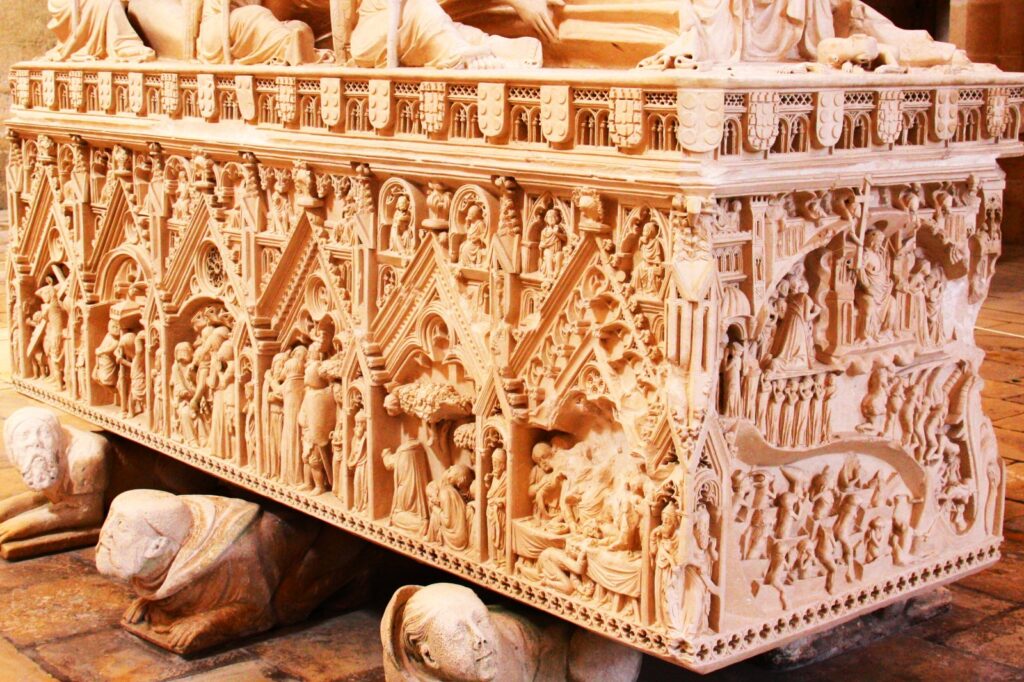
Hybrid guardians—half lion, half dragon
Shared Symbolic Language
Both tombs employ an incredibly detailed floral vocabulary. Intertwined vines of grape, oak, and rose create borders that aren’t merely decorative:
- Grapes and vines: Eucharistic symbols representing Christ’s blood and the promise of resurrection
- Oak leaves: Strength, endurance, and nobility—appropriate for royal tombs
- Roses: Martyrdom and divine love, but also romantic love (a rare secular intrusion in sacred space)
The angels flanking each effigy deserve special attention. Unlike the stiff, hieratic angels of earlier Romanesque art, these figures have individualized faces, realistic drapery, and natural poses.
Why the Tombs Face Foot-to-Foot
Every visitor asks this question, and every guide has a romantic answer ready. But the full story involves theology, medieval belief systems, and one king’s literal interpretation of resurrection.
The Traditional Explanation (And Why It’s True)
Pedro ordered the tombs positioned with feet facing each other so that on Judgment Day, when the dead rise from their graves, the first thing he and Inês would see is each other’s face. This isn’t just romantic legend—it’s documented in contemporary Portuguese chronicles and reflects authentic medieval eschatology (theology concerning death and resurrection).
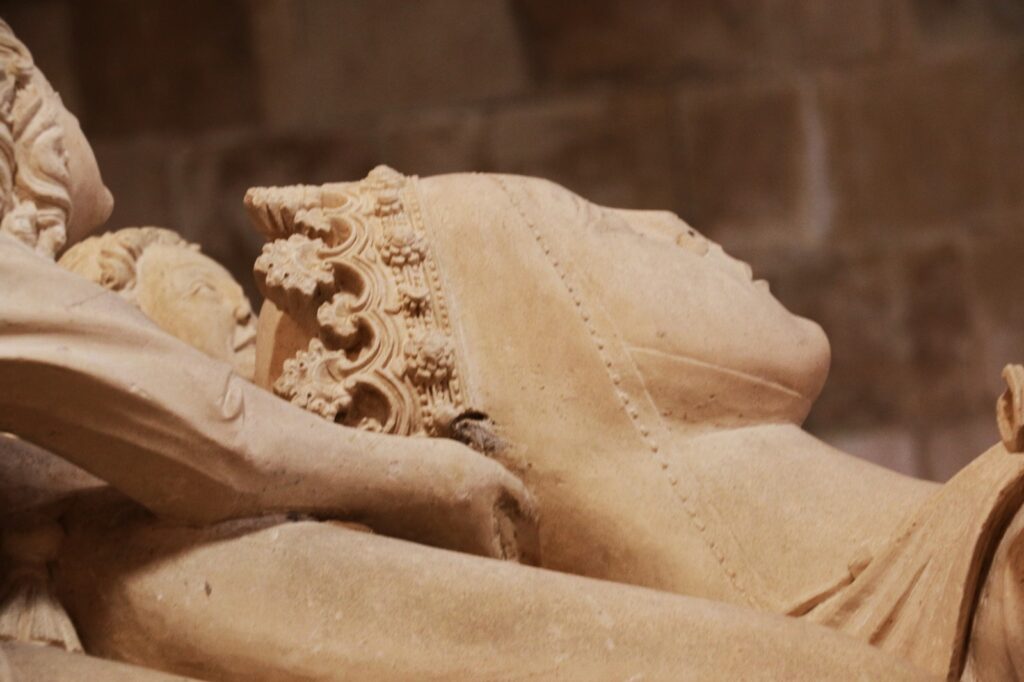
Inês face sculpted on tomb
Alternative Theories (Less Convincing)
Some art historians have suggested the positioning was simply about symmetry and aesthetics—the transept arms were perfect spaces for monumental tombs, and facing them inward created visual balance. Others point to space constraints, arguing the transept simply didn’t have room for two tombs placed side by side.
I spent a few moments at this midpoint. The geometry creates an odd intimacy; you’re participating in a 650-year-old spatial arrangement designed for an event its creator believed was inevitable. Whether you share Pedro’s theological certainty or not, the commitment to love that this arrangement represents is genuinely moving.
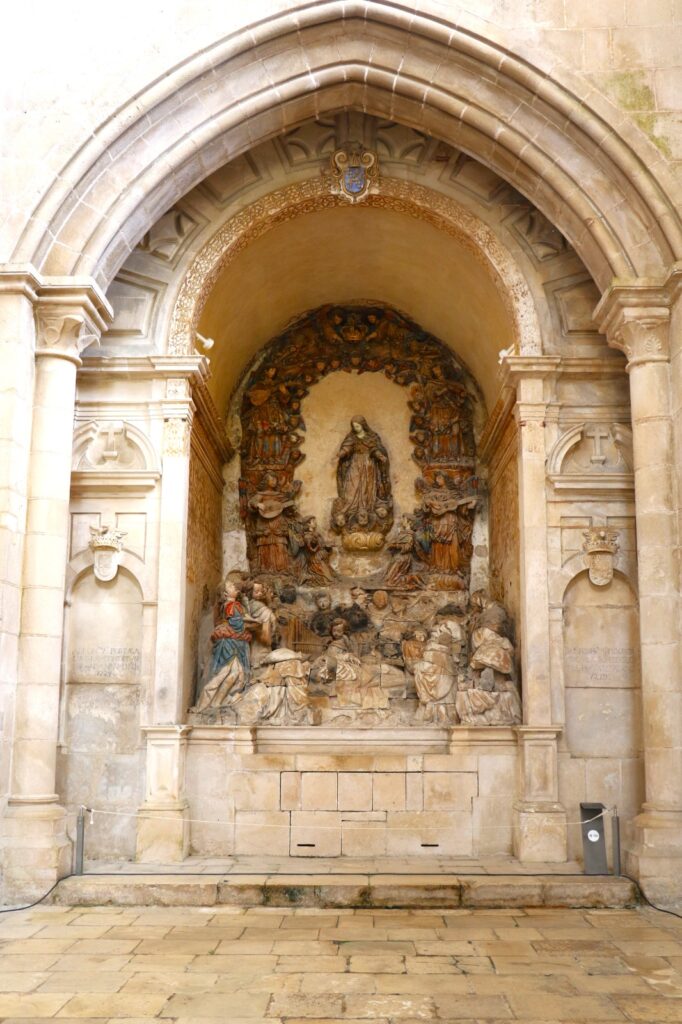
Sculpture of St. Bernard’s Death inside Alcobaca Monastery
Interior of Alcobaca Church
Alcobaca is famous because of the monastery. It is a beautiful medieval structure, the facade has designs like icing on a cake, only they looked old and worn out. During 17th and 18th centuries the original Gothic facade was altered. Time for a new facelift I guess. The doorway and rose window exist from the time it was built.
Interior is even more impressive with many parts to tour. I explored some important parts like the cloisters, seven dormitories, a library, and a huge kitchen. The kitchen is most noteworthy here. And the gigantic tiled chimney in center too is impressive. Some of the cloister rooms are open to public.
There is a story of a thin door on one wall: the monks apparently had to fit and pass through in order to gain access to the dining room. Don’t miss to see it and assess yourself may be!
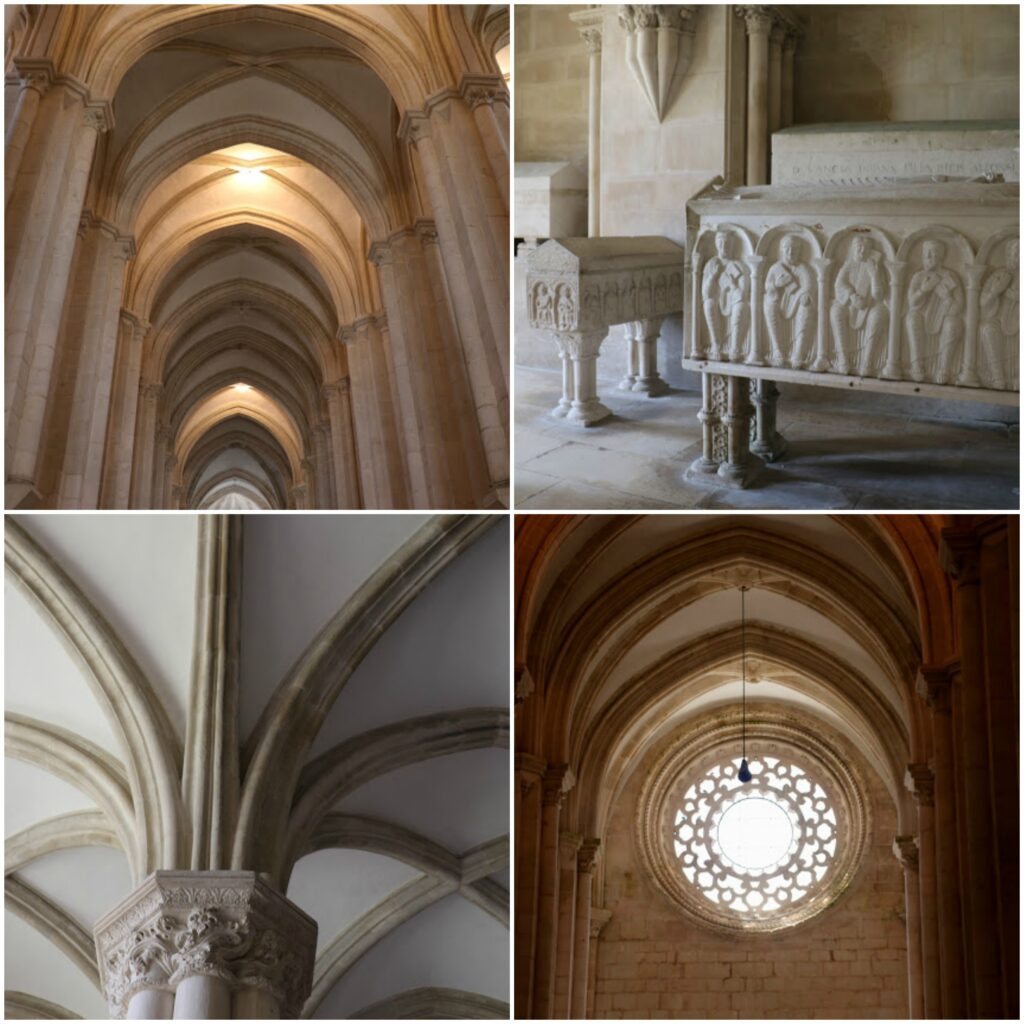
Alcobaca monastery church interiors
Use of Alcobaca Monastery
The monastery is an impressive example of Cistercian and Gothic architecture. The whole building is intact. It is the burial place of many Portuguese kings and queens. Monks resided here from 1178 AD and dedicated their lives to religious meditation, creating illuminated manuscripts.
There are magnificent carvings on the stone coffins with many angels and carvings of human and animal figures, each with detailed features. The near perfect figures of the angels around the statues of king and queen is most touching!
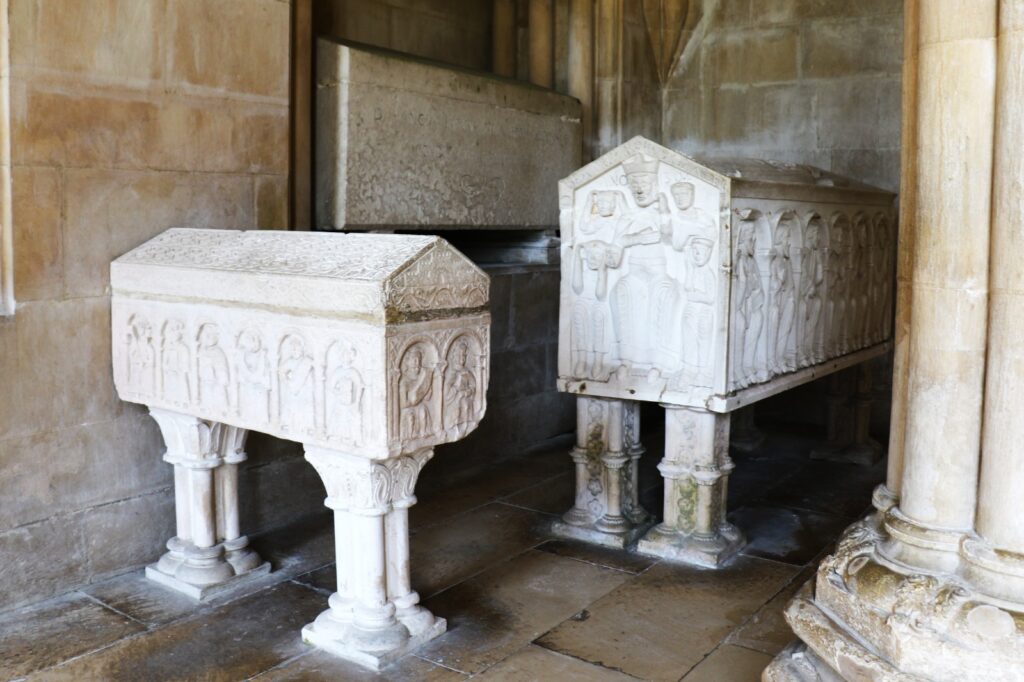
Alcobaca Monastery-Burial place of many Portuguese Kings and Queens
Conservation and Restoration History
These tombs have survived six and a half centuries of war, weathering, vandalism, and well-meaning but damaging restoration attempts. Their current condition—remarkably good, considering—is the result of both luck and modern conservation science.
The Napoleonic Violation (1810-1811)
The tombs’ most dramatic damage occurred during the Napoleonic invasions. In 1810, French troops under General Masséna occupied Alcobaça and used the monastery as a barracks. Soldiers reportedly pried open both sarcophagi looking for treasure, scattering skeletal remains and damaging the lids.
Observe the tomb lids closely, you can see crude chisel marks along the edges where they were forced open, distinct from the refined tool marks of the original carvers.
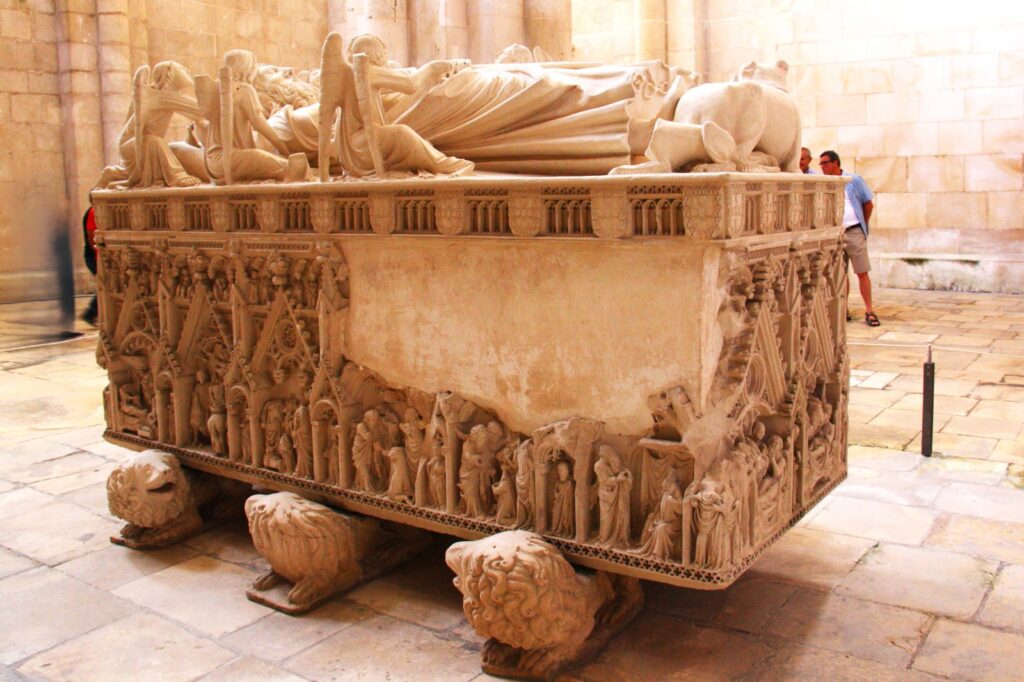
Damaged side of Pedro’s tomb
19th Century: Romantic Rediscovery and Harmful Interventions
After the Napoleonic destruction, the tombs fell into neglect during Portugal’s political upheavals. The 1834 dissolution of monasteries left Alcobaça abandoned, and the church became vulnerable to weathering and vandalism.
The Romantic movement of the 1840s-1860s rediscovered Pedro and Inês as tragic heroes, making the tombs pilgrimage sites for artists and writers.
UNESCO Designation and Modern Conservation (1989-Present)
The monastery’s 1989 designation as a UNESCO World Heritage Site brought international attention and funding for proper conservation.
Heritage records show that monitoring of environmental conditions is still limited, and conservation reports flag relative humidity and groundwater problems as active threats to the limestone fabric of the site
What You Can See Today in Alcobaca Monastery
The tombs show remarkable preservation considering their age, thanks to ongoing conservation efforts by Portuguese heritage authorities. Modern protective measures include climate monitoring, visitor barriers, and restrictions on flash photography. The monastery’s UNESCO World Heritage status ensures continued international oversight of preservation standards.
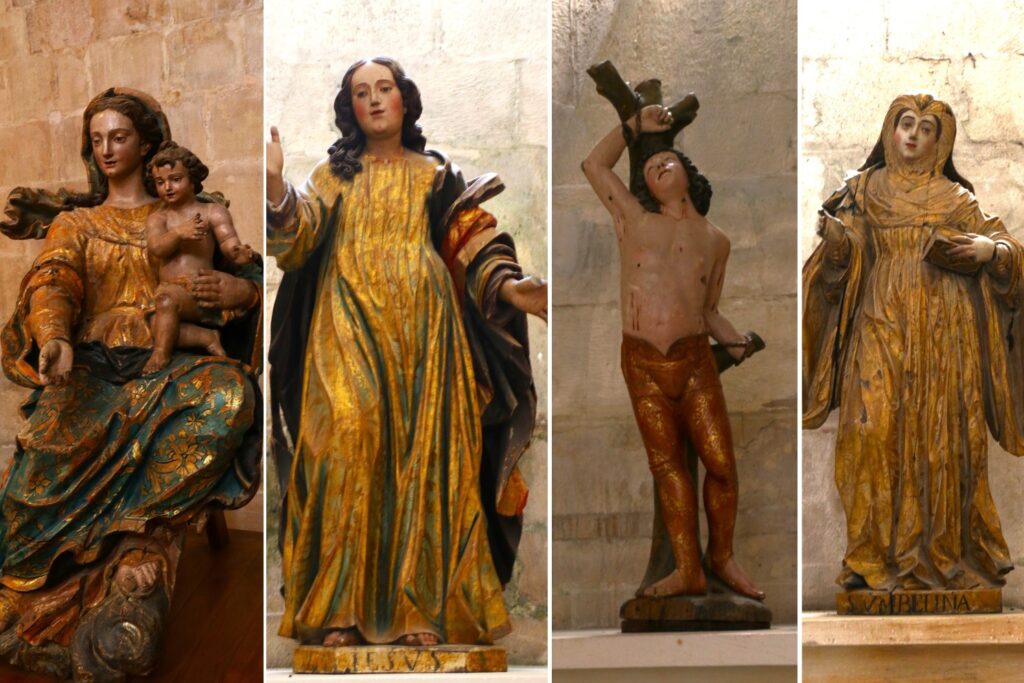
Polychrome painted wooden statues – Mother Mary, Saint Joseph, Christ, Saint Umbeline
Alcobaça vs Batalha: Which Portuguese Monastery is Right for Your Trip?
Forget the idea that if you’ve seen one Portuguese monastery, you’ve seen them all. Alcobaça and Batalha are UNESCO neighbors, yet they offer two dramatically different experiences. I’ve visited both and can tell you that the right choice depends entirely on what you’re looking for.
Are you drawn to the chilling austerity and raw history of the Cistercians? Then you’ll be captivated by Alcobaça, the first great Gothic church in Portugal, where the tragic romance of Pedro and Inês still echoes.
Or, does your heart beat faster for ornate, triumphant architecture that celebrates a hard-won national victory? In that case, Batalha—a flamboyant masterpiece of Manueline design—is your must-see.
In this section, I’ll walk you through the key differences in architecture, atmosphere, and history, helping you decide which of these magnificent monuments deserves the top spot on your itinerary.
Planning Your Visit: Alcobaça Monastery Tickets, Hours, and Day Trip Itineraries
Alcobaça is, in my opinion, the most emotionally resonant of the central Portuguese monasteries, but it can be tricky to plan a seamless visit. I’ve worked out the practicalities so you don’t have to stress about the logistics.
Tickets and Hours: Beat the Crowds
The first rule of Alcobaça is to prioritize the tombs of Pedro and Inês. The church itself is free to enter, but to truly explore the monastery’s medieval core—the stunning cloisters, the massive kitchen (complete with a fountain basin and chimney that’s worth the price of admission alone!), and the Hall of Kings—you’ll need a ticket.
- Ticket Tip: If you plan on visiting Batalha and Tomar as well, always buy the Combined Ticket (often called the Rota dos Monasteries). It saves you time and money.
- Hours Hack: Alcobaça is open year-round, typically from 9 AM (the exact closing time changes seasonally, so double-check the official site). My personal advice? Arrive 15 minutes before opening. The sheer scale and solemnity of the empty cloisters is an unforgettable experience you won’t get later when the tour buses arrive.
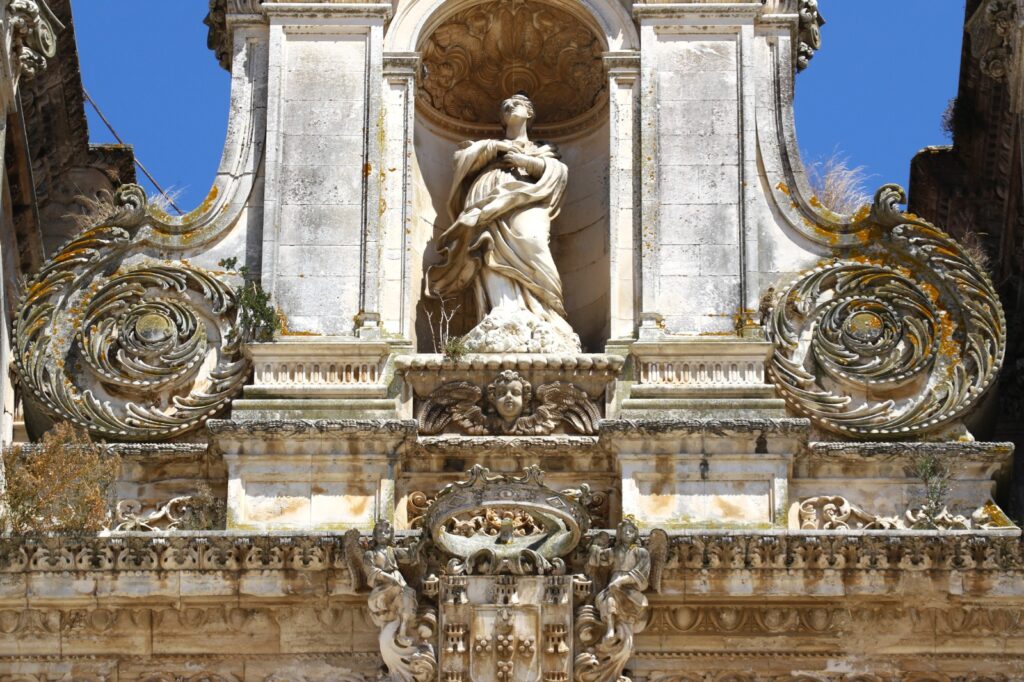
Alcobaca Monastery Facade
The Perfect Day Trip Itinerary (My Preferred Route)
Alcobaça is an ideal anchor for a day trip from Lisbon or a stopover between Lisbon and Porto/Coimbra. You should budget 1.5 to 2 hours for a thorough visit.
| Option | Ideal For | Key Stop |
| Cultural Explorer | History buffs with a rental car. | Alcobaça (Morning) → Batalha (Afternoon) |
| Coastal Lover | Those seeking history and surf culture. | Alcobaça (Morning) → Nazaré (Lunch & Giant Waves) |
| Romantic Getaway | Travelers who love medieval towns. | Alcobaça (Morning) → Óbidos (Afternoon & Evening) |
How to Combine Alcobaça, Batalha, and Tomar Monasteries in One Trip
The “Three Monasteries Challenge” is a pilgrimage for serious Portuguese history lovers. The good news? You can absolutely visit the Monastery of Alcobaça, Batalha, and the Convent of Christ in Tomar in a single, well-paced day trip, provided you have a rental car (public transport makes this nearly impossible).
We tried to be more adventurous and added Sintra to the tour. In the process we got delayed to visit Tomar, which we visited the next day.
Here is my suggested, aggressive-but-doable itinerary, designed to capture the best of all three UNESCO sites (just the monasteries) in one day:
- Stop 1: Tomar (8.30 AM – 10.30 AM)
- Focus: The Convent of Christ (Knights Templar). This site is large and requires the most walking, so tackle it first with fresh energy.
- Expert Move: Go straight to the famed Manueline Window and the cloisters.
- Stop 2: Batalha (11.15 AM – 1.15 PM)
- Focus: Gothic/Manueline architecture, the Royal Cloister, and the Unfinished Chapels. Batalha is spectacular and worth a full two hours.
- Experience: Have lunch at one of the small, family-run restaurants right across from the monastery for a quick, authentic Portuguese meal.
- Stop 3: Alcobaça (2 PM – 4 PM)
- Focus: The austere church, the tombs of Pedro and Inês, and the incredible Monastic Kitchen. This is a very compact visit compared to Tomar, making it the perfect final stop before heading home.
- Logistics: The drive between Batalha and Alcobaça is the shortest, making this transition easy.
This route works because it puts the biggest driving segments at the beginning and end of the day, with the three stunning sites clustered relatively closely in the middle. Are you ready to take on the challenge?
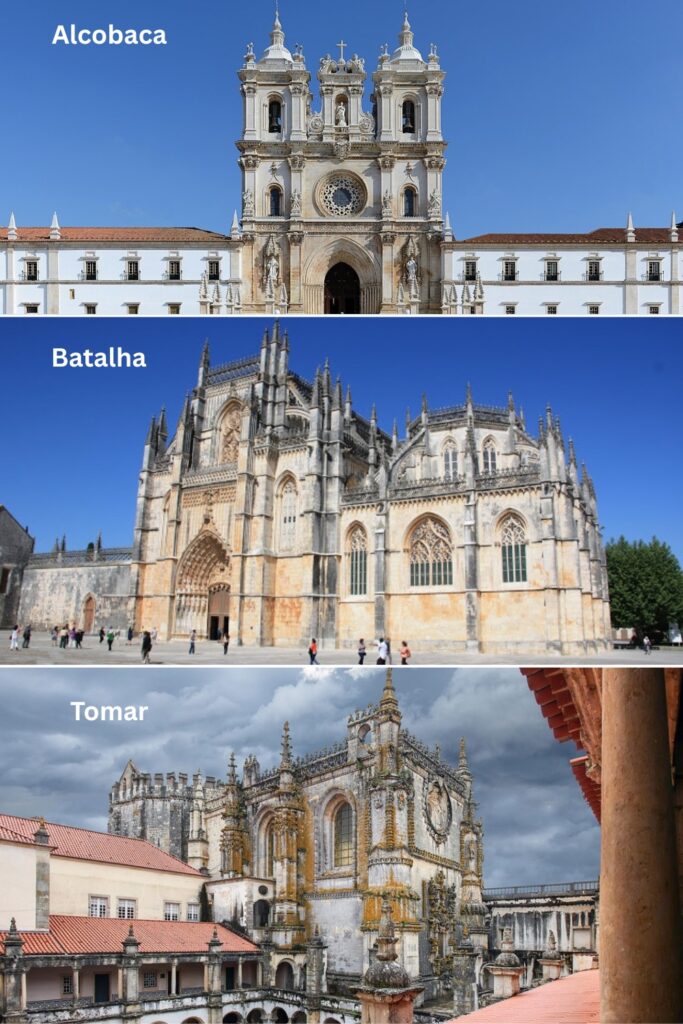
3 Monasteries Challenge in a Day
FAQ: Alcobaça Monastery History, Architecture and Tombs
The Basics and History
Q. When was the Alcobaça Monastery founded and why?
A. The monastery was founded in 1153 by Portugal’s first king, Afonso Henriques, as a gift to the Cistercian Order and a fulfilment of a vow he made after conquering the city of Santarém from the Moors. Its founding was part of the early Portuguese monarchy’s strategy to assert Christian authority and colonize new territories.
Q. What religious order built and occupied Alcobaça?
A. It was a Cistercian Abbey. Following the principles of St. Bernard of Clairvaux, the Cistercians favored a stark, austere architectural style focused on spirituality over ornamentation, which is evident in the church’s minimalist interior.
Q. What is the significance of the monastery to Portuguese history?
A. Alcobaça was one of the most powerful and influential abbeys in Portugal, holding vast tracts of land and maintaining a close relationship with the monarchy for centuries. It served as a royal pantheon and an important center of learning.
Architecture and Atmosphere
Q. What is the predominant architectural style of Alcobaça?
A. Alcobaça is celebrated as the first entirely Gothic building in Portugal. Its earliest sections, including the massive church and the Cloister of Silence, follow the simple, grand, and monumental design of Early Cistercian Gothic, characterized by unadorned walls, soaring height, and simple vaulting.
Q. Where can I see other architectural styles?
A. While the interior of the church is purely Gothic, later additions showcase different periods:
- The Façade has a prominent Baroque style due to an 18th-century remodel.
- The Upper Cloister and the Sacristy entrance feature intricate Manueline (Portuguese Late Gothic) elements added during the reign of King Manuel I.
Q. What is a unique architectural feature to look for inside the monastery?
A. The magnificent Monastic Kitchen is a must-see. It features a colossal chimney supported by eight cast-iron columns and a working water channel diverted from the Alcoa River, a truly innovative medieval hydraulic system.
The Tombs of Pedro and Inês
Q. Who are the famous occupants of the tombs in the Alcobaça Church?
A. The tombs belong to King Pedro I (Peter) and his true love, Inês de Castro. Their tragic medieval romance and the gruesome story of Inês’s murder and posthumous coronation are central to Portuguese legend.
Q. Why are the tombs placed opposite each other?
A. Legend states that King Pedro I arranged for the tombs to face one another in the transept of the church so that, on the Day of Judgment, the first thing they would see upon rising would be each other’s face, fulfilling his promise to be with her “until the end of the world.”
Q. What is unique about the carving and decoration of the tombs?
A. The tombs are considered masterpieces of Gothic funerary sculpture. King Pedro’s tomb is supported by carved lions and depicts scenes from the life of Saint Bartholomew and his own life. Inês’s tomb is supported by fantastic beast-human hybrids and is decorated with scenes from the life of Christ, including the Last Judgment.
Conclusion
Alcobaca monastery forms a part of the triangle of UNESCO heritage sites in that region of Portugal. I visited Batalha Monastery and Tomar Monastery too.
Pin and Save this for Later
 About the author: Indrani Ghose is a travel blogger and photographer who has explored 15+ European countries across multiple trips. Based in Bangalore, she shares authentic travel experiences to help fellow travelers navigate the world more safely and confidently. You can follow her on her social media handles Instagram, Twitter and Facebook to see the wonderful destinations, beautiful offbeat places and get instant updates about them.









The love story of the king buried in this monastery reminds me of the story behind the Taj Mahal. However, the details are a bit crazy…. The tombs of the two lovers are so beautifully carved, the details on them are so elaborate and perfect.
Another wonderful church from Portugal! Some of these sculptures look so alive that can almost see them moving. A pretty morbid story but I like it… just my kind of morbid… he he
This is hell of a beauty. I would love to visit this place when I travel to Lisbon next month. It was not in my list but now after reading this is certainly going to it. Cheers
That was a crazier story than I expected with a decomposing Queen and all. It kind of sounds like mental illness was involved because that’s really out there. Those carving do look amazing so I can see why everyone beelines to them.
Wooh.. The story is interesting! All in the name of love… The architecture and the ceilings are too good. I really like that no one can get into others photo frame. How I wish people have the same unsaid rule everywhere.
I feel like that church resembles so many around Europe. They all look the same to me haha. I like how you always include all the specs to each place on how much it costs etc!
Oh My God! What a heart touching story. This is the actually insane example of love. The architectures are really beautiful and you have presented the whole picture in a perfect way. I will surely love to visit it someday myself.
Interesting, thats love. I wonder how you got all these as I truly admire you for that, its amazing to know some other parts of Portugal and its way more interesting. Your photos captured the best there is.
Wow, the monastery is so gorgeous and intricate, and I love that you included the back story of it. I’d love to get to Portugal in the next couple years, and will add this to the list. Beautiful design and architecture!
I couldn’t visit this monastery when I was in Portugal. The tombs are actually quite unique. What a gruesome and sad love story.
The monastery’s exterior alone is so nice. How much more the inside. And i can see why people fall in line just to take a photo of the tomb. The details are very intricate. How did you know about this place btw? We dont have monasteries here but im sure each place is deifferent.
I would love to spend some time in Portugal! The story of waking up facing each other is so romantic! And the intricate detail on those tombs is amazing!!!
It’s nice to read the backstory about that. I’m not sure if we have monasteries here in this country. We have churches though which can’t compare to the grandoise of Alcobaca. I’m thoroughly impressed with its architecture and design. Thanks for sharing.
In Catalonia we have many cistersian monasteries so I would visit it for the tombs of Pedro and his lover! The inside looks very beautiful but in my opinion the new facade designers spoiled the monastery external appearance.
This post brought back great memories of my visit to this triangle of UNESCO sites. It truly is an amazing site to behold. Up to today, even though it has been years since my visit, I am still in awe at the grandeur of that kitchen! Alcobaca is definitely a must visit when in Portugal.
This is a really beautiful and elaborate structure! But what struck me the most was the story of King Pedro and Ines de Castro. I was heartbroken just reading it! so sad. I wish I could go to Portugal one day. It’s so gorgeous and fascinating, and the language is also very beautiful! I lived in Macau for 6 months and Macau has a large Portuguese influence, and a lot of Portuguese were living there at that time and I would hear them speak. It’s lovely!
Enjoyed reading about the story…presented very well by you. Nice Pics!
I can imagine that Portugal has several monasteries and churches like this one. They do add a nice touch to the landscape, usually due to their high towers sticking up in the skyline. Not to mention the history they add to an area. 🙂
The church is so beautiful! And as for the story, it’s truly a tragedy. I’m currently planning a trip to Portugal and i’ll try not to skip this place.
Wow! Talk about undying love. The monastery is indeed very beautiful and intricate- but what makes it interesting for me is the story behind it. It made the place more alive for me. King Pedro and Ines’ “love” story is so intense that no Hollywood script can hold a candle. It’s almost as if Nicholas Sparks and Stephen King collaborated to make a movie. :p But seriously, thanks for sharing – by far one of the most fascinating historical tales I’ve heard in a while. Hoping I could visit Portugal too so I can see it for myself.
Not so intrigued with the story but rather intrigue with the architecture of the monastery. Our last photo trip, which I organized focused on the heritage churches on Cebu. Its an unusual feeling when you’re into a place that witnessed stories from centuries ago. I cant imagine myself being in this monastery.
I was recently in Portugal but just for a week so not nearly enough time to explore. I alao love visiting UNESCO sites so will save these three cities for next time.
I have mentioned many times that I love architecture! I must say that this monastery are one of the beautiful ones I see on the internet! That’s thanks to you! I so love the intricate carvings on the tombs, it must have taken a lot of hard work and focus to come out so beautifully! From the outside facade to its interiors, I love how this monastery turned out!
So, do you think the story is true? If it is, could it be as gruesome as how it was told centuries later?
On one hand, it is possible that the story is absolutely not true. Even when retelling stories from one child to another in a classroom, isn’t it the story ends up being different from the first one?
But here, we are talking about events that happened centuries ago.
On the other hand, it the truth is anything near the story as it is told today, then Pedro was, indeed, madly in love with Ines. Perhaps that love was so great that her murder drove him to madness.
Woah. First of all I love how the Monastery looked! I don’t know where I could find a place like that here in the Philippines. Secondly, the Architectural structure is on point! I can see how well maintained this monastery was. Lastly. Wow. That backstory was a big “wow” for me. I guess the saying is right, “If you are destined for each other, you’ll end up together” though they had a sad ending… but their love for each other is a wow!
Oh my at the time that must’ve been spent carving those tombs. Years and years, I bet…I have never heard about anyone being buried feet to feet. It is amazing to me the thought and planning that went into the deaths of the important. The fact that she became Queen posthumously is quite amazing too…
Wow this monastery is so intricately beautiful! The story is a sad and interesting bit of history that adds some good context. We hope to see this one day.
When we visit a specific church, we always get the feeling of taking a photograph of a certain object or the most photograph one. This church looks mysteriously beautiful to me. In the Philippines, we also have some old and big churches that are mostly visited by tourists even locals. I love the love story. Even after life, they still want to be with each other.
The history of the monastery is fascinating and the story was kind of tragic. Although, the monastery is absolutely stunning. The details in the sculptures and walls is a must see and is absolutely lovely.
Aww you’ve been to Portugal too. The church’s architecture is really stunning and I really love seeing gothic structures. It gives me an impression of hard work and elegance in detail plus the rich history that it covers. Great post!!
Great architecture & beauty !
Such intricate work!
I loved the architecture here, agree with what UNESCO said ?
Such an interesting place. Enjoyed reading about the monastery and captivating pictures, as always 🙂
I can see why the tombs of King Pedro and his Queen are the most photographed. Lovely write up…
Marvelous Architecture.. Well presented, Indrani!
Beautiful architecture and as always your bful photography adds charm to the monastery 🙂
Brilliant pictures…Looks so regal. 🙂
vow wonderful!!
Lovely interior, Indrani. Another great account on monument in Portugal 🙂
beautiful place In… and the pictures are terrific…
Nice piece of information dear.. Thanks for sharing 🙂
The tombs look beautiful.
Nice, beautiful work by whoever built the monastery. Good captures!
wow. incredible detailed work. i love the arches, too.
What a great idea to go visiting the UNESCO World Heritage sites. Then you should visit our windmills in Kinderdijk too. You can stay at my place!
Have a wonderful bright month of December.
Wil, ABCW Team
The story moves me… wow, amazing intricate on the tombs! The church looks simply marvelous on both the sides.
Love is crazy after all…a great read indrani di 🙂
wow superb post 🙂
So erect palaces and fort after victory was not limited in India , it was in Europe also !! you said right that Kirti stambh and Vijay stambh was made after victory in Chittorgarh. Good Historical place to visit with great pictures Indrani ji .
I am in love with UNESCO World Heritage too! If I visit Portugal, I am interested in visiting the monastery you have presented here, Tomar and Batalha. Fingers crossed that I can go next year.
Wonderful photos. Indrani! I particularly enjoyed the first one with the azure skies.
Have a Beautiful Day!!
Peace 🙂
Fascinating post and photographs.
That is certainly a beautiful monastery, excellent photos.
What a lovely craze to have visiting UNESCO World Heritage sites – such a smart move, love this idea and might just copy you for a fabulous edition to my bucket list – how many do you get to in a year?!
Love the contradiction of your craze to visit many World Heritage sites and your calmness on getting there, walking down the nave.
Great post Indrani!
Wren x
Wonderful heritage structure with amazing architechture ! Fascinating love story of the King is the reminder of our ancient history where the Kings had to struggle.
Such stunning shots and sights.
Amazing , Wonderful photos.
Thank you Indrani
Nice place with beautiful sculptural work. To me also it reminded the the resemblance to Indian history.
This story proves that a king’s life is not always a happy one.
A terrific post for the day, as always, and such fascinating history!! I love the detail of the cathedral and you’ve captured it so beautifully,. as always!! I hope you have a great new week, Indrani!!
Oh God what love! Where do you get all these ? Portugal has its fair share of crazy history huh 😀
Hello Indrani, I do enjoy your travels. You see the most interesting places and do wonderful posts and photos. Great shots of the Monastery and the tombs. Happy Monday, enjoy your new week!