A Complete Guide to Lakshmi Devi Temple, Doddagaddavalli Hassan
A Lesson in Light at Doddagaddavalli
Most travelers visit the Lakshmi Devi Temple in Doddagaddavalli to witness the dawn of Hoysala architecture. I went for the 900-year-old stone carvings, but I left with a story about a light bulb.
While exploring the ancient, moss-covered shrines on my way to Chikkamagalur, I experienced something no guidebook prepares you for: The priest refused to offer my prayers. As I stood before the deity of Mahalakshmi, the pujari handed me kumkum and prasad, but shook his head at the ritual. “It is too dark in here,” he whispered, gesturing to the shadowy corners of the Garbhagriha. “The temple needs a bulb. Perhaps on your next visit?”
It wasn’t a demand; it was a humble observation of a living monument struggling with the mundane needs of the modern world. My mind raced, when will the next visit be possible? The need is genuine and urgent and I felt I had to do something. That moment transformed my trip from a standard sightseeing tour into a personal mission.
Two days later, returning via the same route from Hassan, I walked back into that cool, stone sanctum with four simple LED bulbs for the four shrines. Now it was pujari’s turn to be stunned. He humbly said:
I had casually mentioned about the need…
I didn’t expect you to take it seriously…
you shouldn’t have spent so much money… and on he went.
Needless to say he was very happy.
Earlier he had only one bulb of low wattage which he would keep fixing and re-fixing shrine to shrine for the puja.
The look of stunned gratitude on the priest’s face—and his immediate urge to “clean the clutter” now that he could finally see it—was more rewarding than any sunset view.
– By Indrani Ghose | Last Updated: January 2026

Guide to Lakshmi Devi Temple of Doddagaddavalli Hassan – only surviving example of the Chatuskuta architecture style
Lakshmi Devi Temple at Doddagaddavalli in Hassan
The Lakshmi Devi Temple at Doddagaddavalli in Hassan district, Karnataka, is the first major Hoysala temple built in the early 12th century. Unlike the more famous UNESCO-listed sites at Belur and Halebidu, this temple remains a hidden gem—quiet, less crowded, and deeply rewarding for heritage travelers.
Constructed in 1113 CE under the patronage of Kullahana Rahuta and his wife Sahaja Devi, it represents the earliest phase of Hoysala architecture, offering insights into how the dynasty’s temple-building tradition began.
In this guide, I’ll take you through the breathtaking Chatuskuta architecture of this 1113 CE marvel, but more importantly, I’ll show you why Doddagaddavalli is more than just a relic of the past—it’s a living, breathing space that still relies on the heartbeat of its visitors.
Why Doddagaddavalli is Different: The Rare Chatuskuta Style
The Lakshmi Devi Temple at Doddagaddavalli is the only surviving example of Chatuskuta architecture in Hoysala temple design.
Chatuskuta means four shrines, and here four sanctums are arranged around a central hall, each facing a cardinal direction—an extremely rare layout that sets this temple apart from the more common Ekakuta (single shrine) and Trikuta (three shrine) plans seen at Belur and Halebidu.
The main sanctum is dedicated to Goddess Lakshmi, while the other three house Kali, Vishnu, and Shiva, reflecting the inclusive religious vision of the Hoysalas.
Unlike later Hoysala temples, Doddagaddavalli does not have a Jagati (raised platform). Visitors step directly into the prayer hall, making the temple feel more grounded and accessible compared to the ceremonial elevation seen at Belur and Halebidu.
Architecturally, the temple features Kadamba Nagara shikhara—simple, pyramid-shaped towers inherited from the Kadamba dynasty. These stand in sharp contrast to the ornate, star-shaped towers of later Hoysala temples, clearly marking this site as a transitional phase in Hoysala architecture.
For those comparing Doddagaddavalli vs Belur and Halebidu, this temple offers a rare glimpse into how Hoysala architecture evolved before reaching its iconic form.
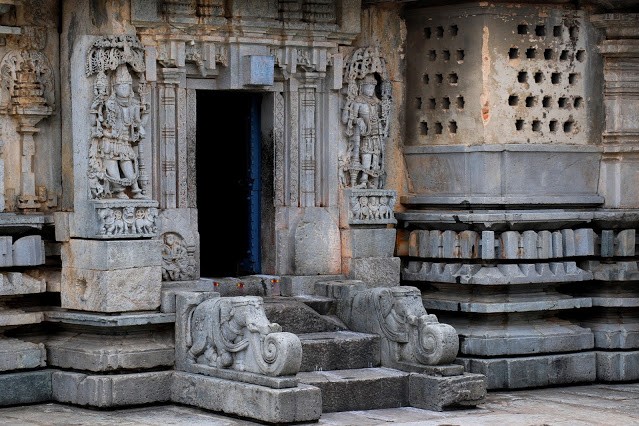
Unique Hoysala Temple with no Jagati
The Visionaries: History and Origins
The Lakshmi Devi Temple at Doddagaddavalli was built in 1113 CE during the reign of King Vishnuvardhana, the Hoysala ruler who ushered in a golden age of temple construction. However, what makes this temple truly fascinating is that it was not commissioned by the king himself.
Instead, the patrons were a wealthy merchant named Kullahana Rahuta and his wife Sahaja Devi. Their decision to fund this temple highlights the important role of local elites and traders in shaping the cultural landscape of the Hoysala period.
By financing a temple of such scale and architectural uniqueness, Kullahana Rahuta and Sahaja Devi demonstrated both religious devotion and considerable social influence. Their choice of the rare Chatuskuta architecture style suggests a deliberate attempt to create something distinctive, perhaps to establish a lasting legacy in the region.
This human element—prosperous citizens contributing to exceptional monuments—sets Doddagaddavali apart from purely royal projects like Belur and Halebidu.
For travelers and history enthusiasts, understanding that this temple emerged from merchant patronage adds meaningful context to the visit. It shows that early Hoysala temples in Hassan were not only about royal ambition but also about community devotion, where individuals like Kullahana Rahuta and Sahaja Devi played visionary roles in preserving faith and artistic traditions.
Architectural Deep Dive: Soapstone and Kadamba Towers
The Lakshmi Devi Temple is built primarily from chloritic schist, commonly known as soapstone. This material became the signature of Hoysala architecture because of its softness when quarried and its ability to harden over time.
Soapstone allowed artisans to carve intricate details with precision, which is why later temples like Belur and Halebidu are celebrated for their ornate sculptures. At Doddagaddavalli, however, the carvings are simpler and more restrained, reflecting the early experimental stage of working with this medium.
The Kadamba Nagara Shikhara: A Pre-Hoysala Evolution
One of the most distinctive features of Doddagaddavalli is its Kadamba Nagara shikhara architecture—a tower style inherited from the earlier Kadamba dynasty.
Unlike the star-shaped, heavily ornamented towers of later Hoysala temples, these shikharas are straight, pyramid-like structures with minimal decoration. Their presence demonstrates how the Hoysalas blended older architectural traditions with emerging innovations.
For architecture enthusiasts, this temple offers a rare opportunity to see the evolutionary bridge between Kadamba simplicity and Hoysala grandeur—a transitional phase visible in few other surviving monuments.
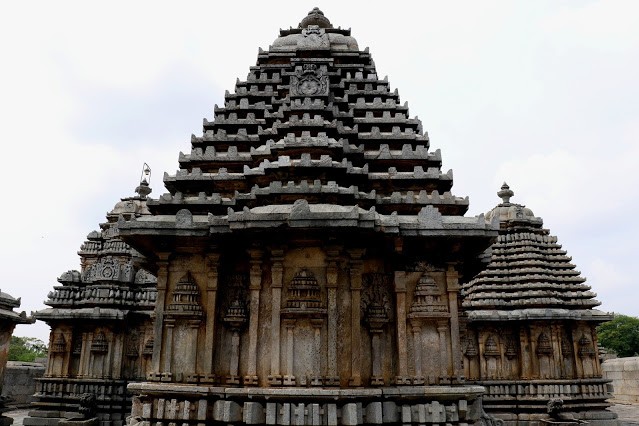
Kadamba Nagara shikhara architecture
Lathe-Turned Pillars and Intricate Ceilings
Inside the temple, visitors will notice lathe-turned pillars, a technique that became a signature of Hoysala craftsmanship. These polished, symmetrical pillars provide both structural support and visual appeal. The ceilings, though less elaborate than those at Belur, feature geometric and floral motifs that hint at the artistic development of the period.
Another key distinction is the absence of elaborate friezes along the outer walls. Later Hoysala temples are famous for their horizontal bands of sculpted narratives—depictions of epics, animals, and dancers covering the exterior. This simplicity is not a limitation but a marker of its early construction date, showing how the Hoysala style was still taking shape.
When I visited, standing beneath the Kadamba Nagara shikhara architecture and running my hand along the smooth soapstone pillars felt like witnessing a prototype—a temple that carried the foundational elements of future masterpieces. It is this combination of early experimentation and lasting devotion that makes Doddagaddavalli essential viewing for anyone tracing the development of Hoysala architecture.
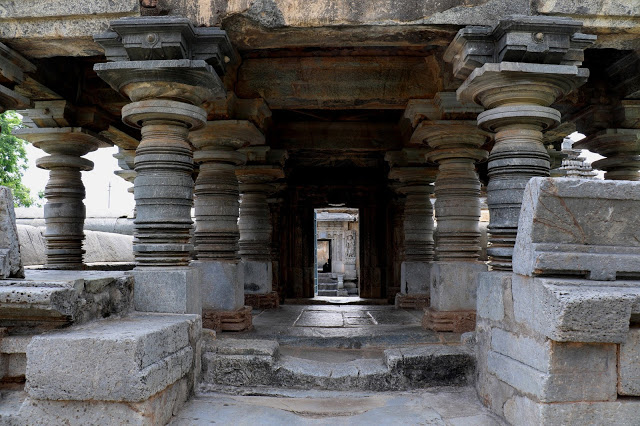
Lathe-turned pillars inside the Hoysala Temple Hassan
Doddagaddavalli Village
Doddagaddavalli is a typical village untouched by the modern infrastructure of cities. The houses look bright and lively. This Temple is their pride. You halt at any place in the village, they know you have come to see the temple and give directions even without being asked.
If you pause for some more time, they will ask: yaavu uruu… meaning… you are from which place?
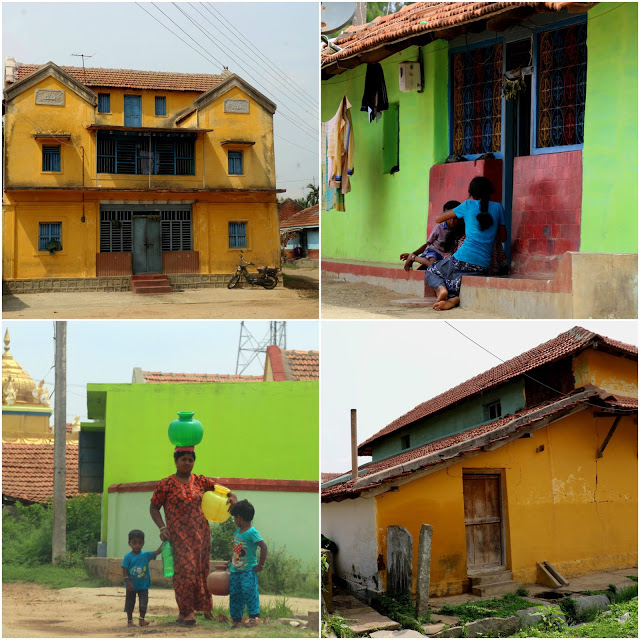
Houses of Doddagaddahalli
The main landmark is a huge lake besides the temple which was completely dried up when we were there in May 2016. A sturdy boundary wall runs around the temple and inside is very well maintained. (You need to leave your footwear outside).
Inside the Sanctum: The Four Deities of Doddagaddavalli
Stepping inside the Lakshmi Devi Temple at Doddagaddavalli reveals its rare Chatuskuta architecture style, with four sanctums arranged around a central hall. Each shrine faces a cardinal direction and houses a distinct deity, making the temple a living example of religious inclusivity in early Hoysala temples in Hassan.
Mahalakshmi (East): The eastern shrine is dedicated to Goddess Mahalakshmi, the presiding deity. Her idol, approximately three feet tall, is carved in soapstone and radiates serenity. She is depicted seated, holding the conch and discus—symbols of divine power—while her other hands carry a rosary and a kalasha (pot of abundance). This form emphasizes her role as the goddess of wealth and prosperity, and devotees today still consider this shrine the spiritual heart of the temple.
Shiva/Boothanatha (West): The western sanctum houses Lord Shiva, worshipped here as Boothanatha. His presence balances the temple’s Vaishnava and Shakta elements, reflecting the Hoysalas’ syncretic approach to faith. The shrine is simpler in ornamentation, but its spiritual significance remains strong.

Lord Shiva worshipped in Lakshmi Narasimha Temple
Vishnu (South): The southern shrine is dedicated to Lord Vishnu. The original idol was stolen in the past, and the current one is a replacement. This detail adds a significant layer to the temple’s history, highlighting the challenges heritage sites face over centuries. Despite this loss, the shrine continues to be revered, demonstrating the resilience and continuity of worship at Doddagaddavalli.
Kali (North): The northern sanctum is perhaps the most striking, dedicated to Goddess Kali in her fierce form. She is depicted with expressive features, embodying both destruction and protection. Around her shrine are sculptures of Vetalas (demonic corpses)—rare and dramatic motifs that emphasize the temple’s uniqueness. This shrine offers insight into the protective aspects of Hindu belief, rarely featured so prominently in other Hoysala temples.

Shrines inside Lakshmi Narasimha Temple
The shrine of Kali is at one end of the oblong hall. The other names of this goddess are Aadhi Shakthi, Maha Shakthi, and also called Soumya Kali in somber mood after killing the demon Shumbha Nishumbha.
Together, these four shrines make Doddagaddavalli a rare architectural and spiritual ensemble, blending devotion, diversity, and artistry in one sacred space.
All this was explained by the guide Yogesh.
Bhoota and Preta idols Inside Lakshmi Narasimha Temple
He kept highlighting the architectural details and sculptures inside the temple with his torch. At the entrance to Kali’s shrine we were taken aback when Yogesh the guide flashed his torch on two human sized skeletons on either side. We were told they are Bhoota and Preta guarding the deity!
Naked, life sized, protruding tongue, stooping posture, distinct rib cage, a slain human head in left hand and a sword in right; the image can haunt you! It took me while to compose the shot framing those in poor light there.

Bhoot Preta inside Lakshmi Narasimha Temple Doddagaddavalli
Update Nov 27 2020
The main idol has been damaged. The ‘miscreants’, who struck rather aptly on ‘Tipu Jayanti’, only had to jump the outer walls on the fateful day – the inner doors we are told were left completely unlocked. Read more – Doddagaddavalli – A Requiem for Kalamma
Logistics: Planning Your Visit in 2026
Visiting the Lakshmi Devi Temple, Doddagaddavalli is straightforward, but some planning helps you get the most from the experience. Here’s a practical guide:
| Category | Details |
| Location | Doddagaddavalli village, Hassan district, Karnataka, India |
| Distance | ~16 km from Hassan city; ~200 km from Bengaluru |
| Best Time to Visit | October–March (pleasant weather, ideal for heritage exploration) |
| Temple Timings | 6 AM – 6 PM daily (check locally for festival variations) |
| Entry Fee | Free (no tickets required) |
| Photography | Allowed in outer areas; restricted inside sanctum |
| How to Reach | – By road: Via NH75 from Bengaluru to Hassan – By train: Hassan Railway Station, then taxi/auto – By bus: KSRTC buses connect Hassan to nearby villages |
| Combine With | Belur (38 km), Halebidu (45 km), Shravanabelagola (90 km) |
| Facilities | Limited shops near temple; carry water and snacks. Restrooms available in Hassan town. |
| Travel Tip | Visit early morning for best light and fewer crowds |
| Accessibility | Ground-level temple with minimal steps; elderly visitors can access main hall easily. No wheelchair ramps currently available. |
| Guide Availability | Local guides occasionally available at site; alternatively, hire from Hassan city (~₹500-800 for half day) |
| Best Photography Time | 8 AM – 10 AM for soft morning light on soapstone carvings |
| Mobile Network | Good coverage (Airtel, Jio, Vi) for navigation and bookings |
| Language | Temple priests speak Kannada; basic English understood. Hindi less common. |
When I visited Doddagaddavalli on a Tuesday morning in May, its quiet setting stood out—unlike the bustling tourist hubs of Belur and Halebidu, this temple offers a peaceful, focused experience. I had the temple almost entirely to myself. The lighting was ideal for appreciating the architectural details allowing unhurried photography.
If you’re comparing Doddagaddavalli temple vs Belur and Halebidu, make this your first stop to understand the origins of Hoysala architecture before experiencing its grander evolution at the more famous sites.
The temple is relatively accessible for elderly visitors, with only a few steps leading to the main hall. However, there are no wheelchair ramps currently in place.
Local guides are sometimes available at the temple, but it’s more reliable to arrange one through your hotel in Hassan or contact the Hassan District Tourism Office in advance.
Best Time for Cultural Experience
While the temple is open year-round, visiting during specific festivals offers a richer cultural experience. The annual Rathotsava (chariot festival) typically occurs in March-April, when the temple comes alive with processions and special rituals. Navaratri (September-October) is another significant period, especially for the Kali and Lakshmi shrines, with elaborate decorations and increased devotional activities.
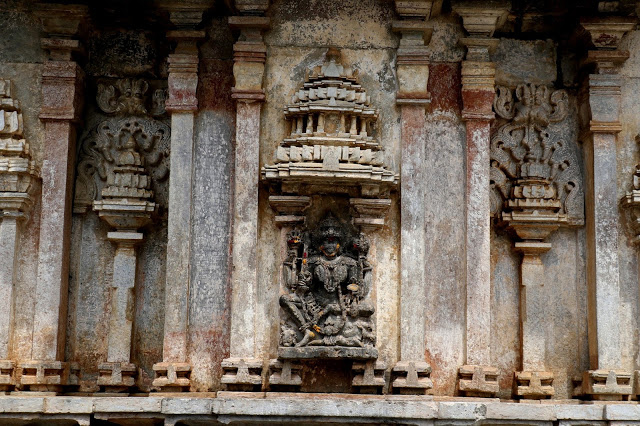
Sculpted walls of Lakshmi-Devi-Temple-of-Doddagaddavalli
FAQ about Lakshmi Devi Temple, Doddagaddavalli
Q1. What makes the Lakshmi Devi Temple at Doddagaddavalli unique?
It is the first major Hoysala temple (built in 1113 CE) and the only surviving example of the Chatuskuta (four-shrine) style.
Q2. Who built the temple?
Lakshmi Devi Temple in Doddagaddavalli was commissioned by merchant Kullahana Rahuta and his wife Sahaja Devi, not directly by the Hoysala king.
Q3. Which deities are worshippedin Lakshmi Devi Temple Doddagaddavalli?
The four shrines house Mahalakshmi, Shiva (Boothanatha), Vishnu, and Kali, making it a rare multi-deity complex.
Q4. How is it different from Belur and Halebidu?
Unlike the ornate UNESCO-listed temples, Doddagaddavalli has simpler soapstone carvings, Kadamba Nagara towers, and no Jagati platform.
Q5. Is the Lakshmi Devi Temple Hassan still active?
Yes, it remains a living shrine, with regular worship and village participation.
Q6. Are there food options near the temple?
No restaurants or cafes are located at the temple site. Doddagaddavalli is a small village with minimal commercial facilities. The nearest food options are in Hassan city, 16 km away.
Q7. What should I wear when visiting?
Wear modest clothing covering shoulders and knees. Avoid shorts, sleeveless tops, or revealing outfits. You’ll need to remove shoes before entering the main hall, so wear footwear that’s easy to slip on and off.
Q8. Can I visit all three temples (Doddagaddavalli, Belur, Halebidu) in one day?
Yes, it’s possible but rushed. Doddagaddavalli to Belur is 38 km (45 minutes), Belur to Halebidu is 16 km (20 minutes). Start at Doddagaddavalli by 8 AM, move to Belur by 10 AM, and reach Halebidu by 2 PM. This gives adequate time at each site.
Q9. How much time should I spend at Doddagaddavalli temple?
Plan for 45 minutes to 1 hour. This allows time to explore all four sanctums, examine the lathe-turned pillars and soapstone carvings, walk around the exterior to view the Kadamba towers, and spend a few moments by the temple tank.
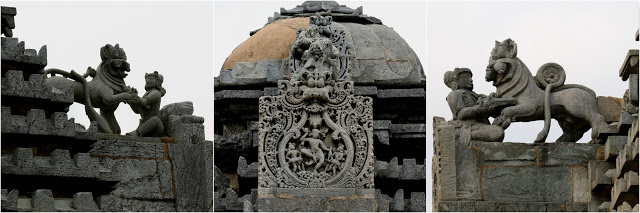
Hoysala Architectural details of Lakshmi-Devi-Temple-of-Doddagaddavalli
Final Thoughts
The Lakshmi Devi Temple at Doddagaddavalli is more than just an architectural curiosity—it is a window into the beginnings of Hoysala art and devotion. Its rare Chatuskuta plan, Kadamba-inspired towers, and merchant patronage make it a story of experimentation, faith, and community vision.
For travelers in 2026, visiting Doddagaddavalli offers a chance to step away from crowded tourist hubs and experience a hidden gem that shaped Karnataka’s temple heritage. If Belur and Halebidu are the grand showcases, Doddagaddavalli is the prototype that started it all—quiet, authentic, and unforgettable.
Visit Doddagaddavalli not because it’s lesser-known, but precisely because it deserves to be better known. This unsung masterpiece has waited 900 years in patient grace—it can wait a little longer for you to discover it.
Temples with Hoysala Architecture
I visited 3 Hoysala Temples on my trip to Chikmagalur. The other two were at:
All can be done on a day trip from Chikamagalur. These are lesser known Hoysala Temples are smaller in size and remotely located. The access isn’t difficult, but the final part, the last couple of kilometers is through narrow lanes, not even roads. But I am glad I took the effort to trace them out and visit them, a great sense of satisfaction lingers on after the visit.
Pin this for later…

About the Author
 Indrani Ghose is a cultural travel writer and heritage documentation specialist with over 15 years of experience exploring and writing about temples across India and Southeast Asia. Having visited over 150 sacred sites, she brings both scholarly depth and personal narrative to heritage travel writing.
Her work has been published in Lonely Planet, The National (UAE), Whetstone Asia, Deccan Herald, and various architecture and heritage journals.
Connect with Indrani: Follow Indrani on Instagram | Twitter | Facebook for heritage travel insights, photography tips, and offbeat destination discoveries.






I think he was just joking when he asked you about the bulbs. I think that if my boyfriend and I were in your place during that visit, we would also be looking for bulbs. It is because we don’t know if we can come back again. I have been always interested in visiting temples. And I would love to visit this Lakshmi Devi Temple in the future.
Can’t believe you came back with the bulbs…that is just absolutly amazing, you are a great person! =)
Ps. The temple looks really cool and a tad scarry^^
That was really nice of you to get those bulbs for the temple.
The temple looks very beautiful. I have visited the ones on Halebid but this one is surely worth a visit
The temple is awe-inspiring! Loved the photos, and honestly would love to do a tour of all the temples in the area, even if it does sound like a difficult endeavor.
The temple looks so nice! I love visiting places that are less popular with tourists.
I hope to visit India again in March so I will add this place to my travel list. Thank you for discovering a new place to me.
That temple’s beautiful. Its a really great reminder to all of us why we love to travel so much! Great photos!
This is a very interesting place and the temples still standing proudly. I wish that the modern architectures are like before, wherein it lasts for centuries. Great reading!
Loved the architecture of Lakshmi Devi Temple. The monument looks so beautiful and thanks for sharing about your trip with us!
The temple is truly glorious. I agree that it is in good shape for its age. How nice that the locals are so proud of their town’s treasure.
These temples look amazing. It is great news that because of you, these can now be enjoyed by others in full light! Great story.
I love that you brought back bulbs – how wonderful! You helped out and it made for a great story 🙂
I LOVE your response to the Pujari! Good going on that.. you get the experience you are looking for and you get to help them out. That is awesome.
It’s was so good of you to return with bulbs, I know your kindness was helpful to future travelers who would want to offer prayers. Is the Lakshmi temple named after Queen Rani of Jhansi? I recently read Rebel Queen by Michelle Moran, and the temple reminded me. Great post
Hahah the bulbs 🙂 the temple is stunning and I love the details carved into the figures. The more I read about India and see how beautiful it is, the more I want to go 🙂
Hassan district is known for it’s temples. Nice pictures and thanks for the history behind this temple. Will definitely refer your blog when we plan to visit this place.
I love the temple architecture of Karnataka. I have been here twice before, but since I was way too small my parents decided not to opt for temples . Now that I am old enough perhaps I will make a trip soon.
What a strange incident with the bulbs:) One more reason to say “It happens only in India” 🙂
Honestly, I don’t even know where Karnataka is located. I do love the information and photos about the temples. I have seen many different temples and one never looks like another.
I am always amazed to see the how diverse India is. There’s an accumulation of history that makes for a beautiful final combination. I love your pictures and your story on the post (and the history of the place), waiting for the next trip you take to another temple of the region!
This is s lovely and the colours in the pictures stand out so nicely. I love it that the people greet with friendliness and know you are there for the temple and are so welcoming in showing that part of their culture.I learn so much about India from reading. One day I will get to see it myself. This is very impressive!
The temple looks amazing and i was impressed reading your story with the light bulbs. I have visited India and I have always been asked for an “offer” (donation) every time I went to a temple. It’s good to know that there are people who don’t think about money all the time.
Another part of India I knew nothing about! But then there are probably thousands of these temples around India and we may not be able to see them all. I’m not sure when I’ll be able to so for now, I’ll content myself with the photos you’ve shared.
Those Indian templates are just amazing. India has been on my bucket list for years and I can’t wait to travel there. Thanks so much for sharing your experience!
Nice post. I had visited this place about 3 years back , I think, on the way back from Shringeri… Actually was looking for Veera Naraya temple. But , on asking for directions people led us to this temple (not that I regretted). I liked the Temple.
Bhuta and the Preta, guarding the Kali’s shrine probably indicate that , Kali is the ruler of all the worlds including the underworld ! None can bypass her !
Beautiful temple. I chuckled at the light bulbs too. I wonder how many other people heard his request, but for whatever reasons couldn’t come back with the bulbs. Thanks for linking up. I’m slow getting around this week. Listening to and marking 100 final English presentations 🙂 #TPThursday
Such a lovely story Indrani! I liked the story about the bulbs. Good that you went back with bulbs.
And the Bhoota Preta duo must be looking supernatural in that poor light.
Very interesting and unusual temple. I like the story about the light globes you brought back.
Wow you actually went back!! a true devotee you are….
I also visited the smaller hoysala temples on my work trip in karnataka and was mesmerized by them!!
This temple is wonderful and lovely sculptures!!
What a lovely and serene place ! Hoysala architechture and sculpture is so unique and impressive . Beautiful green surrounding !
You done the right offer, indeed, by giving bulbs to the temple! Truly remarkable temple complex and impressive architecture… I also liked the colourful village atmosphere out there.
Intricate rock carvings here
The tongue out reminds me of my favourite emoji.
Sydney – City and Suburbs
Indrani, I enjoyed your post but I enjoyed the story about the light bulbs even more. Show how we can help other even if it is in a small way (it may seem small to us but can mean the world for another person).
I loved the stone temple and those “skeletons” are beautifully carved, although I understand your surprise!
That’s one beautiful temple complex; easy to understand why it’s the pride of the village. I love the amazingly detailed stone work
You must have brightened his day (in more ways than one) when you returned with the light bulbs! Beautiful post about such an amazing temple – and village!
Yet another great post on Karnataka’s unexplored temples. Thanks for share Indrani :). It was really sweet of you to provide the bulbs for the temple. Little gestures like these makes your travel worthwhile.
That was a very warm gesture Indrani! Lovely post!
Very thoughtful of you to gift the bulbs to this architecture marvel…looks like the lawns outside are also well maintained.
Normally, the Garbhagruha or sanctum sanctorum of all temples are dark and the lighting up of the camphor (now banned in many temples in TN) in the big brass lamps lightens up the idol’s face and features which is considered sacred and holy but nowadays that tradition is gone with many modern temples having chandeliers and other decorations that gives the temple a five star look:)
I can definitely make the purchase and hand over the bulb. So, on my return trip I handed over 4 bulbs for the four shrines. Now it was pujari’s turn to be stunned. He politely said:
I had casually mentioned about the need…
I didn’t expect you to take it seriously…
you shouldn’t have spent so much money… and on he went.
Needless to say he was very happy.
It was true worship Indrani ji . I never visited Karnataka but yes , have a future plan . I always noticed that in our old temples each and every brick has some specific intricate art . This always attracts me and make me proud for our culture.
Very nice pics, good to know bringing bulb and cleaning the place.
So so beautifully written! Going through the post was like déjà vu for me. And yea, the Bhoota-Preta do look supernatural, especially since the light is poor inside. Hope to visit after the rains, to see the countryside green in full glory.
(And having met the Bhat-Jai, I can very well imagine him telling you to get few bulbs for the temple. A stern but friendly person!)
Such a beautiful temple with some brilliant architecture and still they have to struggle for bulbs! That’s really sad!
Amazing pictures Indrani and I am really intrigued with the Bhoota Preta one. Something which I have never seen till date!
Awesome pictures. I like the way you narrate things about the temple.
Why bhoota and preta are guarding the temple. Is there any story behind it?
There is no particular story but almost all temples have dwarpalikas… meaning guards. This being Goddess Kali her guards are bhoot and pret. Thank you for the visit Alina Jack. Very sorry to reply so late.
Wow! Beautiful temple and wonderful pictures too!
The story of your gifting the bulbs and bringing light and joy to the priest is indeed marvelous! Good on you!
nice post
Ah, one will never be able to visit all the wonderful temples in India in one lifetime, methinks.
Another splendid temple…I love to visit temples, especially those like this one that are very old…I always imagine all the other people who walked there way back when….
The bulb incident is very funny. The poojari must be shocked.
I’m also surprised to see the Boota idol. In Hoysala temples which I have visited I could not find any such Boota idols are.