Melkote Places to Visit: A Complete Travel and Food Guide
Why Melkote Deserves Your Attention
If you think temple towns are all the same, Melkote will prove you wrong in the very first glance. Melkote is a living heritage site where 900 years of history meet everyday devotion. Located 51 km from Mysuru in Karnataka’s Mandya district, the various places to visit in Melkote draws pilgrims and travelers for good reason.
During my November 2018 visit, I climbed 500 stone steps to ancient shrines, photographed 12th-century temple architecture, and discovered why Melkote remains underrated compared to busier Karnataka destinations.
— Indrani Ghose, travel blogger | Updated Nov 2025
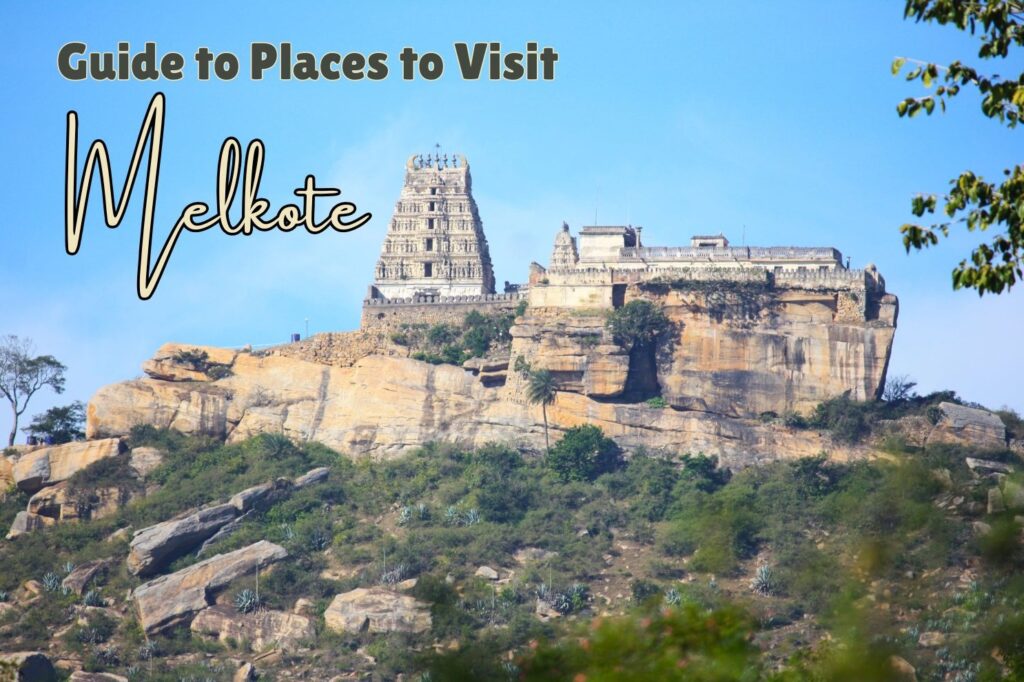
Yadavagiri Hilltop Yoga Narasimha Swamy Temple – Melkote Places to Visit, a Guide
What Makes Melkote Special
Two major temples anchor this town: the Cheluvanarayana Swamy Temple with its Vijayanagara-era gopuram, and the hilltop Yoga Narasimha Temple offering panoramic valley views.
But Melkote’s appeal goes deeper. The Kalyani stepwell reflects Hoysala craftsmanship. The annual Vairamudi Festival (March-April) draws 400,000+ visitors. And the puliyogare served at temple counters follows recipes unchanged since Sri Ramanujacharya’s time in the 1100s.
Save this Guide
This guide covers 10+ verified locations with practical details to plan a day trip from Bengaluru (135 km, 3 hours) or a photography expedition to Melkote, a cultural stop between Mysuru and Srirangapatna.
I’ve included temple timings, entry fees, parking locations, and honest assessments of what’s worth your time. Expect road-tested advice from someone who navigated the confusing route to Thondanur Lake and found the best breakfast spot locals won’t tell you about.
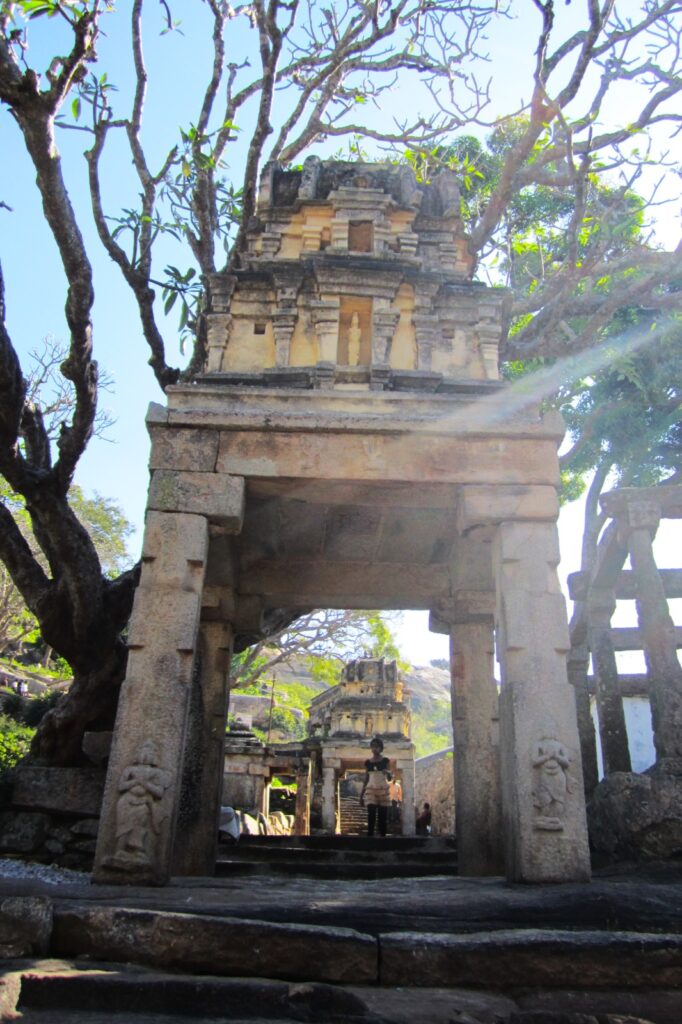
Way up Yadavagiri Hill – Melkote Yoga Narasimha steps
Quick Facts: Melkote, Karnataka
- Location: About 50 km from Mysuru, 130 km from Bengaluru
- Famous For: Cheluvanarayana Swamy Temple, Yoga Narasimha Temple, Kalyani (temple pond), Vairamudi Festival
- Best Time to Visit: October to March (pleasant weather, festival season highlights)
- Ideal Duration: Half-day to full-day trip
- Nearby Attractions: Mysuru Palace, Srirangapatna, Ranganathittu Bird Sanctuary
- Local Specialty: Puliyogare (tamarind rice) served in temple kitchens
- Photography Highlights: Hilltop temple views, stone-carved architecture, serene water bodies
- Travel Tip: Wear comfortable shoes for temple climbs; mornings are less crowded
The town offers a calm and unadulterated green environment. A road trip, 135km, from Bangalore to Melukote will prove the contrast between the 2 places.
Other names of Melukote Temple Town
The temple town is known by other names: Narayanadri, Vedadri, Yadavadri, Yathishaila and Tirunarayanapura. Every dynasty (Hoysalas, Vijaynagar Kings and Wodeyars) that ruled over this land, revered and worshiped the temples here.
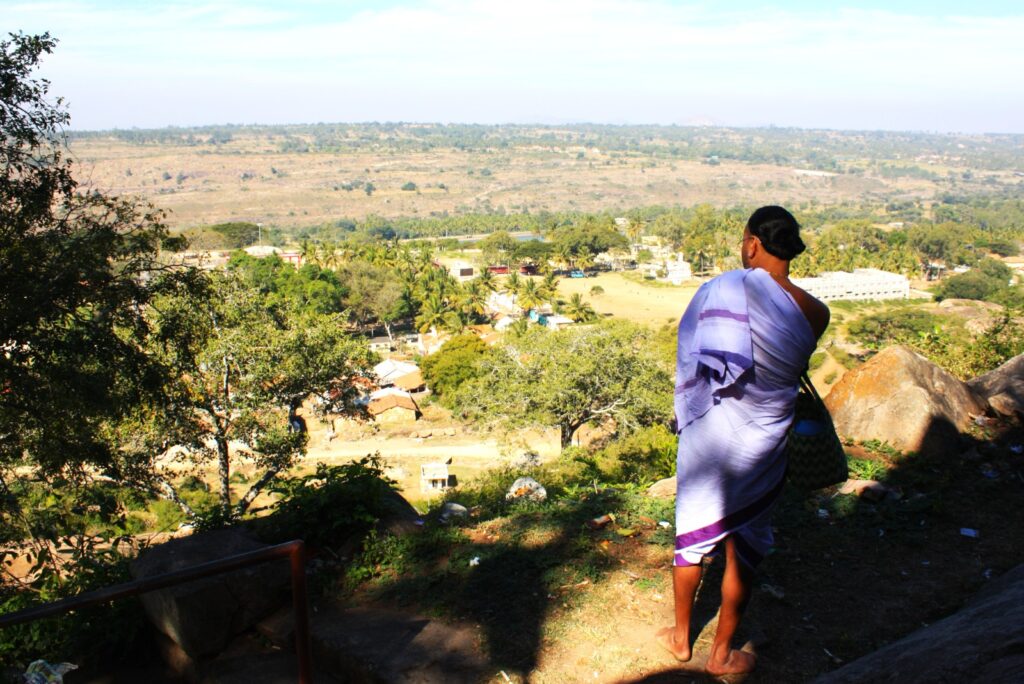
View of Melkote Town from hill top
Top Melkote Places to Visit
Cheluvanarayana Swamy Temple
Why This Temple Matters
The Cheluvanarayana Swamy Temple is Melkote’s top attraction and a major Vaishnava shrine in Karnataka. Built in the 12th century when Sri Ramanujacharya made Melukote a spiritual centre, this Vishnu temple is over 900 years old.
When I walked through its stone entrance in November 2018, I noticed inscriptions from the Hoysala and Vijayanagara periods—proof of royal patronage spanning centuries.
What You’ll See
The architecture follows Dravidian and Vijayanagara styles. The main sanctum sits within a series of pillared mandapas (halls) featuring intricate stone carvings. The 7-tiered Raja Gopuram (temple tower) dominates Melkote’s skyline. I spent time examining the detailed sculptures on the outer walls—deities, mythological scenes, and geometric patterns that show remarkable craftsmanship.
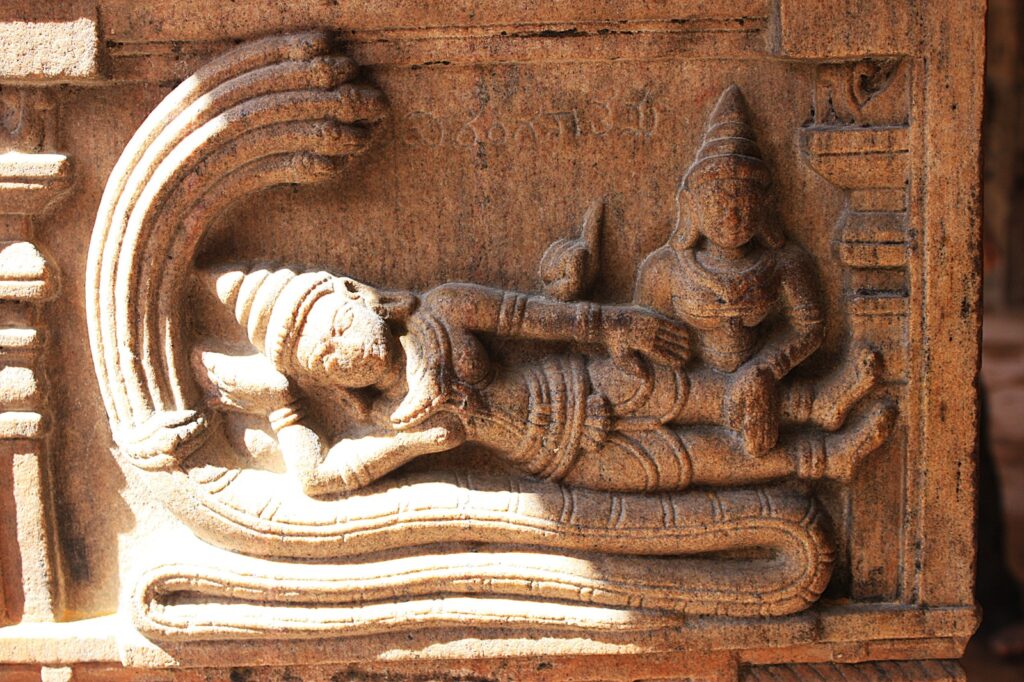
Stone carving of Bhagwan Vishnu with his consort Lakshmi
The Vairamudi Festival
Every March-April (exact dates vary with the Tamil calendar), the temple hosts the Vairamudi Utsavam. The deity wears a diamond-studded crown brought from Mysuru, drawing 400,000+ pilgrims over 10 days. Regular days are calmer but still active with devotees and daily poojas at 6 AM, 12 PM, and 7 PM.
The Melkote Vairamudi festival in 2026 is scheduled for February 27, 2026
Practical Visit Information
Dress code: No shorts or sleeveless tops. Remove footwear at the entrance (free locker available).
Photography: Allowed in courtyards, prohibited inside the sanctum.
Duration: Plan 60-90 minutes for a thorough visit.
The temple’s location in the town center makes it the logical first stop when exploring Melkote.

Cheluvanarayana Swamy Temple in Melkote
Yoga Narasimha Swamy Temple
The Hilltop Experience
Located atop Yadavagiri Hill, the Yoga Narasimha Swamy Temple requires climbing approximately 500 stone steps—a 20-minute ascent for most visitors. I made the climb at 7.30 AM and stopped in between, not for rest but to photograph the expanding view of Melkote’s terracotta rooftops and the valley stretching toward Mandya district.
The Deity’s Unique Form
Unlike typical fierce Narasimha depictions, this deity sits in a meditative yogic posture (padmasana), symbolizing contemplation over aggression. The shrine itself is modest—a simple sanctum with minimal decoration—which reinforces the temple’s emphasis on inner reflection rather than external grandeur.
Visitor Tips
Access options: Climb the steps or drive partway up (parking available mid-hill).
Timing: Temple opens at 6 AM; arrive before 8 AM to avoid midday heat (temperatures hit 35°C+ in summer).
What to bring: Water bottle, hat, and sturdy sandals (you’ll remove them at the temple entrance, not during the climb).
Crowds: Significantly quieter than Cheluvanarayana Temple—I encountered maybe 15-20 people during my hour-long visit.
The panoramic valley view alone justify the climb, making this hilltop temple worth the effort for any visitor.
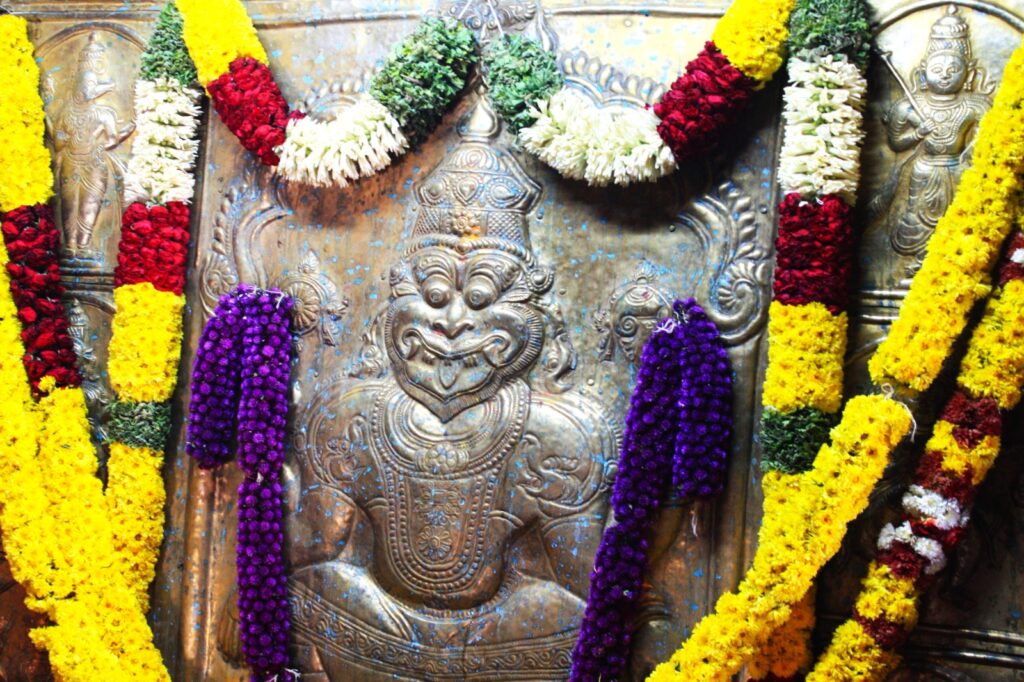
Meditative yogic posture (padmasana) of Narasimha
Kalyani Pushkarini (Sacred Pond)
Architectural Significance
The Kalyani is a 12th-century stepped tank (pushkarini) has symmetrical stone steps descending from all four sides. When I visited, the geometric precision was striking—each step perfectly aligned, creating visual patterns that photographers and filmmakers have used extensively. The structure shows Hoysala influence in its precise stonework.
Religious and Community Role
Historically, this pond supplied water for temple rituals and served as a public bathing space. During the Vairamudi Festival, devotees still perform ceremonial dips here before entering the temple. On regular days, it’s where locals gather—I saw women washing clothes on the steps and children playing nearby, offering a window into everyday Melkote life.
Photography Guidelines
Best light: Early morning (6-7 AM) or late afternoon (4-6 PM) for reflected light on water.
Angles: Shoot from the surrounding elevated platforms for symmetry; get close to capture step details.
Restrictions: Photography allowed; swimming prohibited for safety and religious reasons.
The Kalyani sits just 200m from the main temple, making it an easy 5-minute walk. Budget 20-30 minutes here.
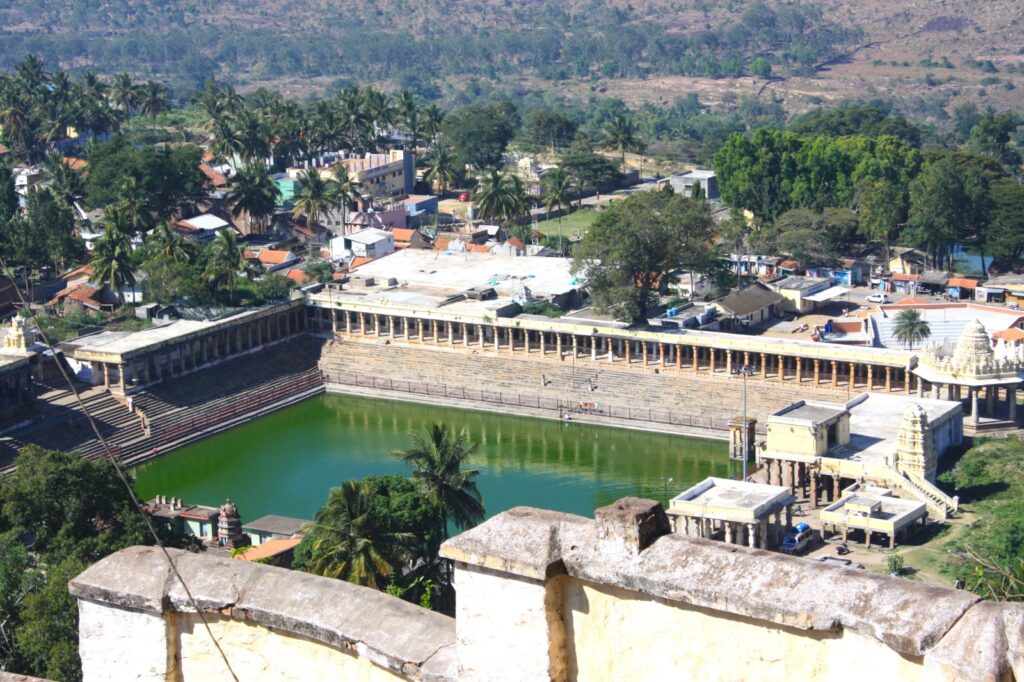
Kalyani Pushkarini – Melkote Places to Visit
Melkote Temple Wildlife Sanctuary
What Makes It Special
The 49.82 sq km sanctuary wraps around Melkote’s eastern and southern sides, protecting dry deciduous forest on rocky granite hills. Established in 1974, it’s one of Karnataka’s few sanctuaries focusing on Indian grey wolf conservation—home to an estimated 15-20 wolves, though sightings are rare.
The forest shelters 200+ bird species including painted spurfowl and yellow-throated bulbul. The landscape itself—granite outcrops dotted with thorny acacias—offers stark beauty that contrasts with the temple architecture.
Visit Logistics
Entry: Permission required from Forest Department office near Cheluvanarayana Temple (₹25 for Indians, ₹200 for foreigners).
Best season: November-February when migratory birds arrive and temperatures stay below 28°C.
What to bring: Binoculars, field guide, water, and sun protection.
Raya Gopura – Melkote Places to Visit
Vijayanagara’s Unfinished Monument
The Raya Gopura stands as Melkote’s most photographed structure—a 16th-century gateway that was never completed. When I walked beneath its massive granite pillars in November 2018, the scale was overwhelming: columns reaching 12+ meters high, each carved from single stone blocks weighing several tons.
Built during Krishnadevaraya’s reign (1509-1529), the gopura was intended as the main entrance to the Cheluvanarayana Temple complex but construction stopped abruptly, likely due to the empire’s decline.
Best visit time: 6-7 AM for soft light on the granite, or 5-6 PM for golden hour photography.
Duration: 15-20 minutes unless you’re photographing details.
I’ve covered this monument extensively in a separate detailed guide, so I’ll keep this overview brief.
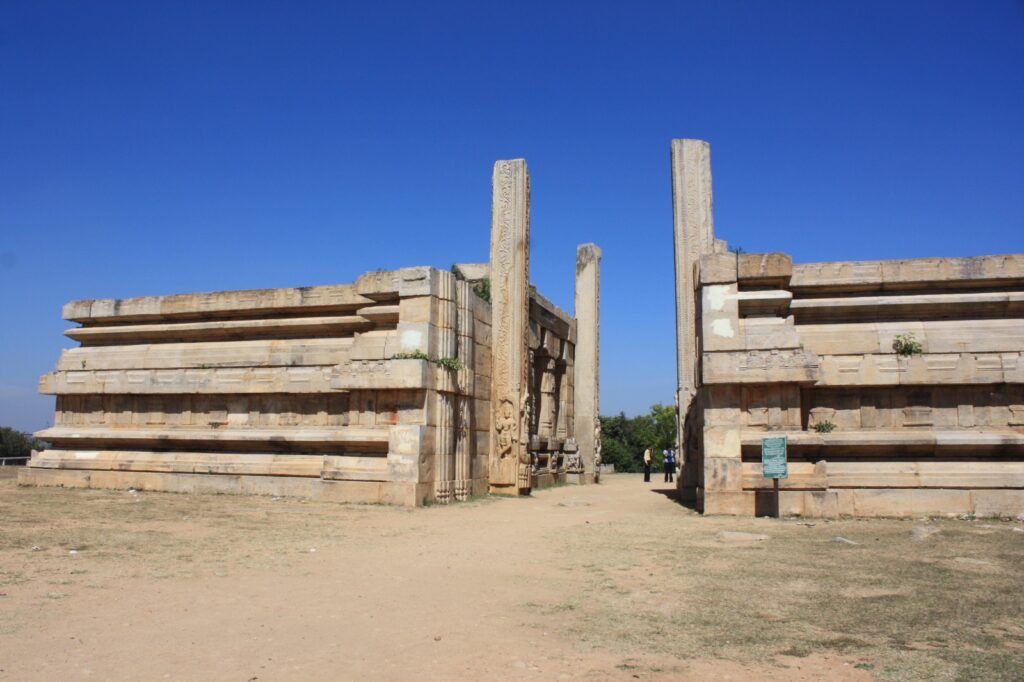
Raya Gopura Gateway – Melkote Places to Visit
Akka-Thangiyara Honda (Twin Tanks)
Twin Water Reservoirs with Local Legend
The Akka-Thangiyara Honda are matching stepped tanks built approximately 50m apart near the Cheluvanarayana Temple. The names translate to “elder sister” and “younger sister” tanks, connected to a local legend about two siblings who dedicated themselves to temple service.
Architectural Features
Each tank measures roughly 30m × 20m with symmetrical steps descending on three sides. I was told, one tank traditionally held potable water while the other served ritual washing purposes—a common dual-system in South Indian temple towns.
The stone balustrades show weathering but remain structurally sound. During festivals, locals still use the tanks for ceremonial purposes.
Visitor Information
Location: 300m northeast of main temple
Entry: Free, open access
Best for: Architecture enthusiasts, photographers interested in geometric patterns
Caution: Steps can be slippery after rain
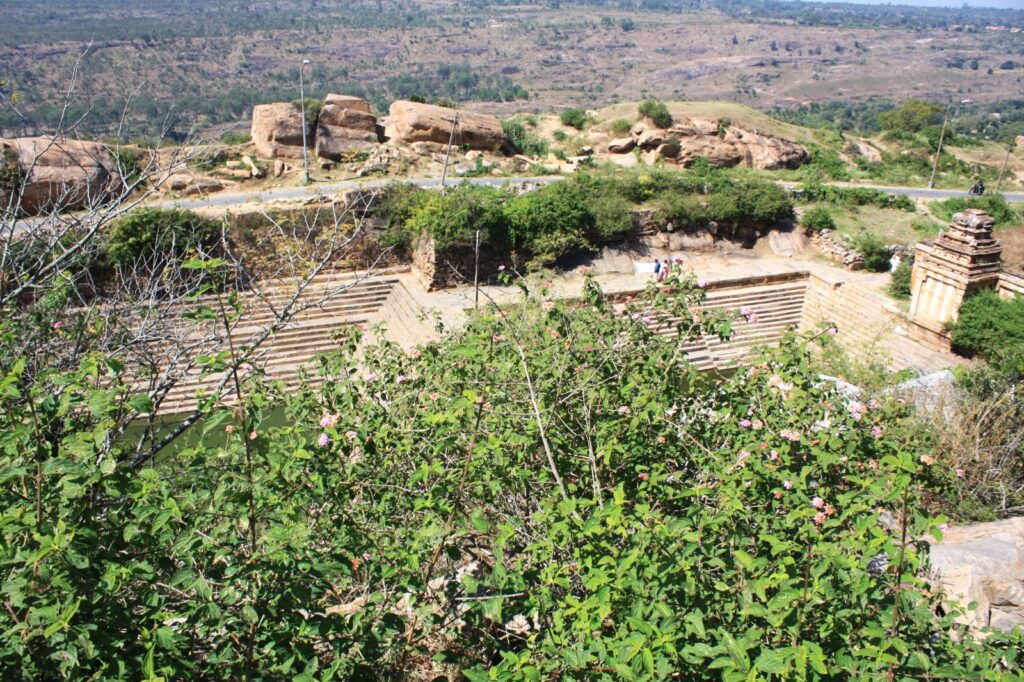
Akka-Thangiyara Honda Water Tanks
Academy of Sanskrit Research Melkote
Preserving Manuscript Traditions
Established in 1977, the Academy of Sanskrit Research maintains over 11,000 palm-leaf and paper manuscripts, making it one of Karnataka’s significant repositories of Vedic and philosophical texts. While I haven’t personally visited the academy, its catalog includes rare commentaries on Sri Ramanujacharya’s works and unpublished Vaishnava theological texts dating to the 14th-16th centuries.
What Scholars and Visitors Find Here
The academy of Sanskrit Research offers manuscript viewing by appointment (researchers get priority). For general travelers, the small museum section displays sample manuscripts with translations, showing how texts were preserved across centuries. Staff occasionally conduct guided sessions explaining traditional manuscript conservation methods.
Planning Your Visit
Timings: Monday-Friday, 10 AM – 5 PM (closed weekends and holidays)
Entry: Free; prior appointment recommended for manuscript access
Best for: Academic visitors, students of Indian philosophy, those interested in textual heritage
This stop appeals to travelers seeking intellectual depth beyond temple visits, showing Melkote’s continuing role as a center for traditional learning.
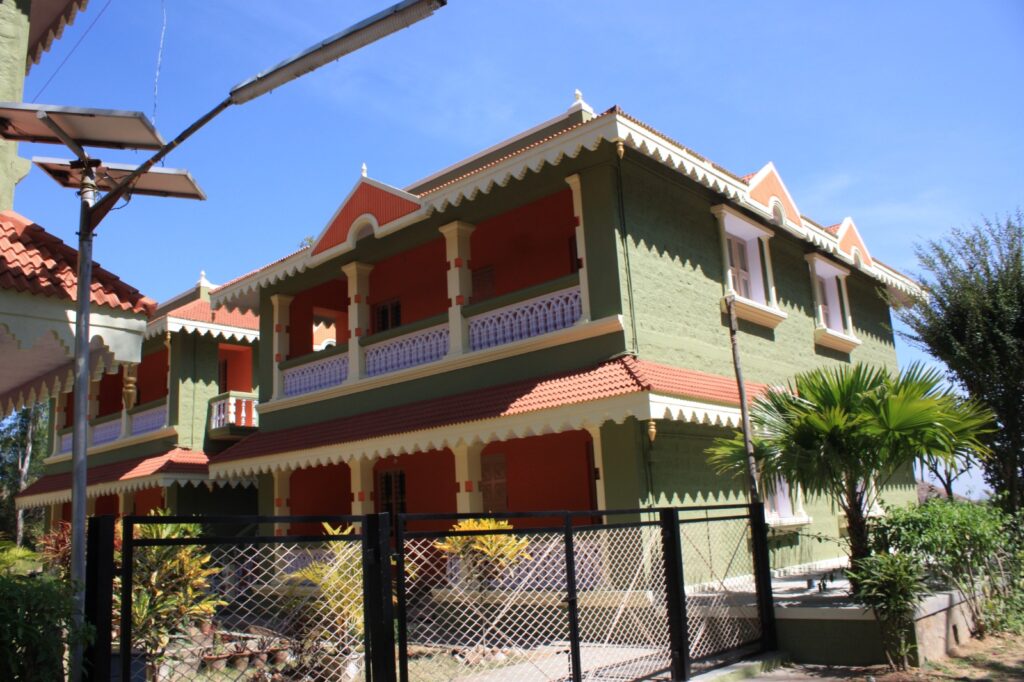
Academy of Sanskrit Research – Melkote Places to Visit
Dhanushkoti
Mythological Rock Formation
Dhanushkoti (distinct from Tamil Nadu’s Dhanushkodi) is a rock-cut site on Melkote’s outskirts where legend claims Lord Rama created a water spring by shooting an arrow into stone—dhanush means bow, koti means edge. The natural cleft in the granite does channel rainwater into a small pool, though geological rather than mythological forces created it.
I haven’t visited this location, but pilgrimage groups include it as part of broader Ramayana circuit walks. For travelers interested in how mythology intersects with landscape, Dhanushkoti offers a minor detour (15-20 minutes) with local storytelling value.
Location: Approximately 2 km from town center
Melukote Falls
Seasonal Cascade Near Town
Melukote Falls flows only during monsoon months (July-September) from runoff cascading down granite slopes about 3 km southwest of town. The drop is modest—roughly 15-20 meters—but the surrounding scrubland transforms into temporary greenery during wet months, attracting locals for short hikes.
I couldn’t visit due to timing (my November visit was post-monsoon), but seasonal travelers report it as a 1-hour detour suitable for families. The approach involves a 20-minute walk from the nearest vehicle access point.
Best months: August-September when water flow peaks
Facilities: None; carry water and snacks
The Melkote Food Guide: Where to Eat
Temple-Style Meals Define the Experience
Food in Melkote reflects Sri Vaishnava culinary traditions—no onion, no garlic, vegetarian-only. After a morning exploring temples and heritage sites, expect simple satvik meals that have remained largely unchanged for centuries. Dining options are limited (3-4 main spots), so manage expectations accordingly.
Subbanna Mess: The Local Favorite
Located 100m from Cheluvanarayana Temple, Subbanna Mess has served the same menu since 1978. When I ate here in November 2018, the puliyogare (tamarind rice) lived up to its reputation—properly tangy with roasted groundnuts and curry leaves, served warm on banana leaf. The sakkare pongal (sweet rice with jaggery and ghee) balances the tang perfectly. Cost: ₹40-60 per plate.
Timing strategy: Arrive before 12.30 PM or after 2 PM. Between 12.30-2 PM, the place fills with pilgrims and tour groups—expect 15-20 minute waits for seating.
Iyengar’s Mess: Reliable Alternative
Iyengar’s Mess, 200m past the main temple, offers similar fare with faster turnover. Their curd rice is particularly good—well-tempered with mustard seeds and fresh curry leaves. Slightly less crowded than Subbanna. Cost: ₹50-70 for full meals.
Street Food Options
Small stalls near Kalyani serve bajji (₹10-15), vada (₹5-10), and strong filter coffee (₹15-20). Cash only everywhere—no UPI acceptance as of my last visit.
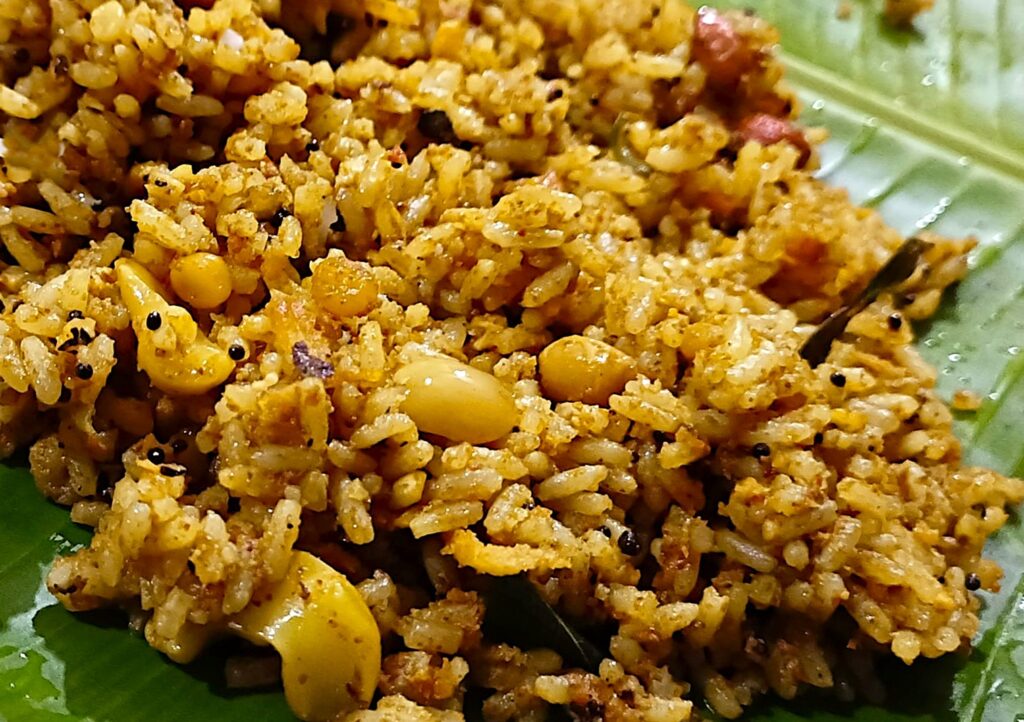
Tamarind rice
How to reach Melkote from Bangalore?
Melkote is about 150 km from Bangalore and is best reached by road. The fastest route is Bangalore → Mysore Road (NH275) → Mandya → Pandavapura → Melkote, taking 2.5 to 3 hours by car.
There are no direct trains, but you can take a train to Pandavapura and hire an auto or taxi for the remaining 25 km.
KSRTC buses also run from Bangalore to Mandya/Pandavapura, from where you can take a local bus or cab to Melkote.
Melkote One-day Itinerary
One-Day Plan from Bangalore/Mysuru
7 AM: Depart Bangalore
9 AM: Arrive Melkote; start with Yoga Narasimha Temple (climb before heat builds)
10.30 AM: Descend, visit Cheluvanarayana Swamy Temple during morning pooja
12.00 PM: Lunch at Subbanna Mess (beat the rush)
1.15 PM: Kalyani Pushkarini (20 minutes for photos)
1.45 PM: Raya Gopura quick stop (15 minutes)
2.15 PM: Twin Tanks if interested
2.45 PM: browse temple street shops
3.30 PM: Academy of Sanskrit Research (if open)
5 PM: Melukote Falls for sunset views
6 PM: Depart for Bengaluru
Unique Cultural Experiences in Melkote
Melkote is not just a sightseeing spot; it is a living museum of traditions that have survived for nearly a millennium. To truly experience the town, you need to look beyond the architecture and understand the customs that shape daily life here.
Ramanujacharya’s Living Legacy
Your list of Melkote places to visit is incomplete without understanding the man who built this town’s identity. In the 12th century, the philosopher Sri Ramanujacharya lived here for 12 years. He didn’t just renovate the Cheluvanarayana Swamy Temple; he revolutionized society.
He introduced the concept of inclusive worship long before it was modern practice. When you visit, you will notice that the temple kitchens still follow his community dining principles. They serve the famous Iyengar Puliyogare (tamarind rice) and Sakkare Pongal (sweet rice) as prasadam to everyone, regardless of caste. This isn’t just food; it is a 900-year-old tradition of equality on a plate.
Sri Vaishnava Traditions and Vairamudi
Melkote is the heart of Sri Vaishnavism in Karnataka. The town wakes up to the sound of Sanskrit chants and the smell of camphor. If you are planning your trip between March and April, check the dates for the Vairamudi Festival.
The Melkote Vairamudi festival in 2026 is scheduled for February 27, 2026
During this massive event, the deity is adorned with a legendary diamond crown (Vairamudi) that is strictly kept in government custody the rest of the year. Even on regular days, watching the priests perform rituals in their traditional attire offers a glimpse into an ancient lifestyle that most cities have lost.
Why Melkote Does Not Celebrate Diwali
One historical fact often surprises visitors: Melkote is perhaps the only town in India that does not celebrate Diwali.
The History (1790):
On the day of Naraka Chaturdashi in 1790, the army of Tipu Sultan attacked the town. Historical records indicate that hundreds of Mandyam Iyengars (the local Brahmin community) were massacred.
The Tradition Today:
Instead of lighting fireworks, families here observe a period of mourning. They light a single lamp to honor ancestors lost centuries ago. For a traveler, this is a powerful reminder of how deeply history is etched into the town’s collective memory.
Essential Visitor Guidelines
To respect the local culture and ensure a smooth visit, keep these actionable tips in mind.
Dress Code and Etiquette
- Clothing: Melkote is conservative. Men are strictly required to remove their shirts and vests before entering the main sanctum of the Cheluvanarayana Swamy Temple. Women should dress modestly (sarees or churidars are preferred).
- Photography: You can take photos of the architecture, but photography is strictly prohibited inside the inner sanctums.
Rituals to Watch
Try to visit during the morning Abhishekam (ritual bath) at 9 AM or the evening Mahamangala Aarti. The evening atmosphere particularly peaceful, as the temple glows with oil lamps and the crowds from Bangalore have usually dispersed.
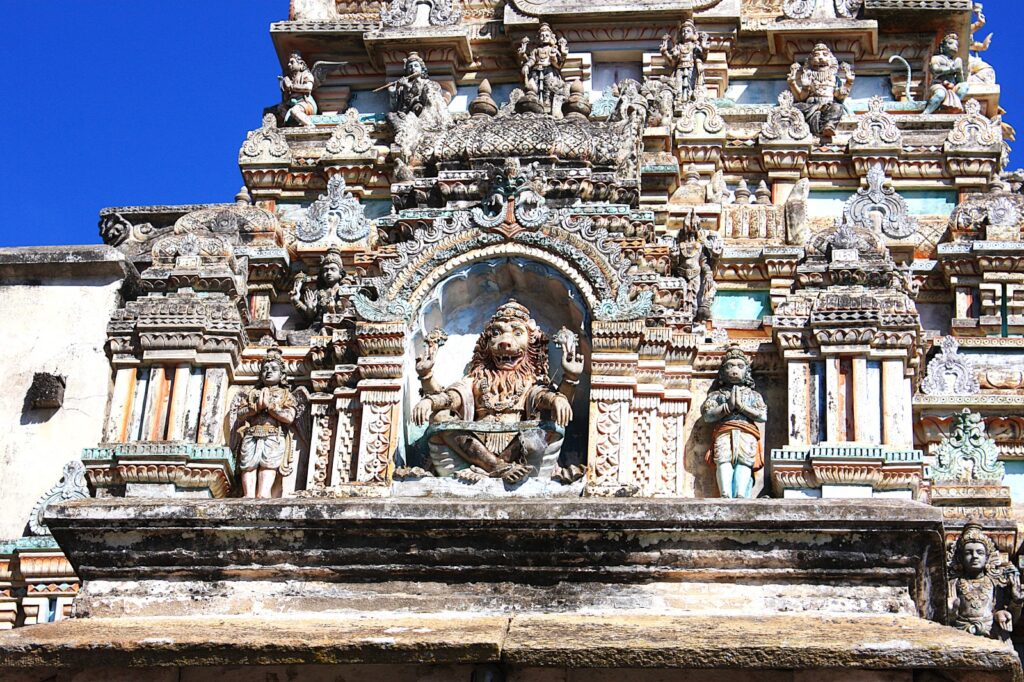
Yoga Narasimha Swamy on Entrance arch
FAQ about Melkote
Planning Your Visit
Q. Is Melkote worth visiting for a day trip?
Yes, especially if you’re in Bangalore or Mysuru. The town’s compact size (main sites within 2-3 km radius) makes it ideal for day visits. Discover Melkote Places to Visit: major temples, the Kalyani, and Raya Gopura in 4-5 hours. The drive from Bangalore takes approximately 3 hours via Mysore Road.
Q. What is the best time to visit Melkote?
October through February offers the most comfortable weather (20-28°C). Avoid March-May when temperatures exceed 35°C, making the 500-step temple climb exhausting. The Vairamudi Festival (March-April) attracts massive crowds—visit only if you specifically want that experience, otherwise expect 2-3 hour temple queues.
Q. How many days do I need for Melkote?
One day suffices for most travelers. A typical visit covers the two main temples, Kalyani Pushkarini, Raya Gopura, and a meal at Subbanna Mess within 5-6 hours. Add the Wildlife Sanctuary and you’ll need 7-8 hours total. Overnight stays make sense only if combining with Srirangapatna or attending the Vairamudi Festival.
Getting There and Around
Q. How do I reach Melkote from Bangalore?
Drive via NH275 (Mysore Road) for 135 km—takes 2.5-3 hours depending on traffic. KSRTC runs 4-5 daily buses from Bangalore’s Kempegowda Bus Station (₹150-200). No direct trains; nearest railway station is Mandya (28 km away).
Q. Is parking available near the temples?
Yes. Free parking exists 200m from Cheluvanarayana Temple (walk the rest). For Yoga Narasimha Temple, you can drive halfway up the hill—parking available mid-slope, reducing the climb to 250 steps instead of 500.
Practical Information
Q. Are there ATMs in Melkote?
Two ATMs near the main temple, but they frequently run out of cash during festivals. Carry sufficient cash from Bangalore or Mysuru.
Q. What should I wear when visiting temples?
Traditional attire or modest clothing—no shorts, sleeveless tops, or short skirts. You’ll remove footwear at temple entrances (free lockers available). Carry socks if you’re uncomfortable walking barefoot on hot stone surfaces.
Q. Can I take photographs inside temples?
Photography allowed in outer courtyards and mandapas but prohibited inside the main sanctum (garbhagriha). The Kalyani, Raya Gopura, and exterior architecture have no restrictions. Be respectful during active prayer times.
Q. Where can I stay in Melkote?
Accommodation options are extremely limited. The Jeeyar Mutt provides free basic dormitory-style lodging (advance booking required, donations expected). Most visitors stay in Mysuru (50 km) or Mandya (28 km) where hotels range from ₹800-3000 per night.
Q. Is Melkote safe for solo female travelers?
Yes, it’s a small pilgrimage town with minimal safety concerns. The main temple areas stay busy until evening. Stick to well-populated areas, and avoid isolated spots after dark. Temple staff and locals are generally helpful.
Final Thoughts
Melkote is a destination where history, devotion, and culture come together. From the grandeur of the Cheluvanarayana Swamy Temple and the hilltop Yoga Narasimha Swamy Temple to the serene Kalyani Pushkarini and the iconic Raya Gopura, every site tells a story.
Add to this the unique traditions shaped by Ramanujacharya, the absence of Diwali celebrations rooted in history, and the authentic Puliyogare at Subbanna Mess, and you have a place that blends heritage with living culture.
To me, Melkote offers the perfect mix of spiritual connection and easy exploration. I’ve come here for rituals, photography, local food, and quiet moments spent soaking in Karnataka’s deep heritage—and, it feels worth the journey. If you ask me, Melkote truly earns a place on any travel bucket list.
Have you visited Melkote? Share your experiences in the comments, ask questions, or suggest hidden gems. Your insights help fellow travelers plan better trips.
Pin and Save this for Later
About the Author
 Indrani Ghose is a cultural travel writer and heritage documentation specialist with over 15 years of experience exploring and writing about temples across India and Southeast Asia. Having visited over 150 sacred sites, she brings both scholarly depth and personal narrative to heritage travel writing.
Her work has been published in Lonely Planet, The National (UAE), Whetstone Asia, Deccan Herald, and various architecture and heritage journals.
Connect with Indrani: Follow Indrani on Instagram | Twitter | Facebook for heritage travel insights, photography tips, and offbeat destination discoveries.






The detail and the depth and texture of this incredible temple blows my mind. It must have taken a very long time and many busy hands to create such a wonder.
A very beautiful temple and a clear blue sky in no 2.
Best wishes to you for 2012:-)
A beautiful temple!
From the source of Cool Blogs
Getting in to New Avatar
Actor Ajith and Me(Vijay)
fantastic shots! happy new year to you as well!
thanks for dropping by @ explorerminded.com
Such a beautiful place Indrani 🙂
I want to wish you
a FANTASTIC GREAT LOVELY HEALTHY
and special for you
a wonderful travel year 2012 🙂
Hugs for you
🙂
I love seeing photos of the many many temples in India and reading about their history.
I enjoyed all your posts this year. Thanks and have a wonderful new year.
With such a beautiful building I forget to look at the sky !
The sky is a beautiful backdrop to the artistic architecture of the temple. Happy New Year.
Gorgeous shots…beautiful temple
Hugs
SueAnn
Arquitetura maravilhosa!!!
Que 2012 traga novos sonhos e novas alegrias!
Beijinhos.
Brasil
¨¨¨¨¨¨¨¨¨/¸.¤ª“˜¨˜“¨
¨¨¨¨¨¨¨¸.¤ª“˜¨¨˜“¨
¨¨¨¨¨¨¤ª“˜¨¨ª“˜¨
¨¨¨¸.•°` BOAS FESTAS!!!
¸.•°`♥✿⊱╮FELIZ 2012!!!
Beautiful temple located majestically atop a hill.
Indrani, it is a lovely temple. Great shots, thanks for sharing. Happy Skywatching and I wish you a very Happy New Year!
Very beautiful temple. nice shot.
Beautiful pictures, I like that perspective, a magnificent temple, an architectural gem.
beautifully captured!
Love this place .
Very nice.. Melkote is one of my favourite places..Beautiful and serene place..
Our family deity (kuladeivam in Thamizh). My paternal grandfather was from Melkote. The roads… couldn't believe the roads when I went this year, used to be *terrible* when I was a kid. Decades ago that was! Looking forward to the promised post 🙂
A beautiful palace and yoga, I love them all. Great photos.
Incredibly beautiful temple, gorgeous blue skies and what a terrific post for the day, Indrani!! Hope your week is going well!
Sylvia
Wow a very beautiful place. Happy Thursday!
Fantastisch liebe Indrani…
Ich wünsche Dir und Deiner Familie von ganzem Herzen en guete Rotsch is Neu Joor 2012. Mögen Euch Gesundheit, Glück und Wohlergehen beschieden sein.
Herzlichst und liebe Grüsse aus der Schweiz
Hans-Peter
It's a wonderful temple….good shots.