Guimaraes Castle Guide: Birthplace of Portugal Explored
Continuing my journey from Bom Jesus do Monte, Braga, I am now at Castle of Guimaraes. “The exact spot where Portugal was born.” Few places carry this kind of weight. Guimaraes Castle Portugal, known as the Cradle of Portugal, sits in the Braga district as living proof of how a fortress shaped a nation.
2025 Travel Alert: Major preservation works are currently restricting access to the interior walls and Keep. I’ll show you what remains open to visitors and share what normally lies behind those closed doors—based on my 2015 visit when the castle was fully accessible.
— Indrani Ghose, travel blogger | Updated Nov 2025
This guide covers why the Guimaraes UNESCO designation matters, how the Old Town connects to the fortress, and what sets this apart from other Portuguese castles. Whether you’re mapping out Braga district attractions or researching medieval architecture, you’ll find practical visiting information alongside historical context that explains why this castle matters to Portugal’s story.

Castle of Guimaraes Portugal
Quick Facts About Guimaraes Castle
Built: 10th century (968 AD)
UNESCO Status: World Heritage Site since 2001
National Recognition: Named one of Portugal’s 7 Wonders (2007)
Monument Status: Declared National Monument in 1881
Location: Guimaraes Old Town, Braga district, Northern Portugal
Best Visiting Season: Spring (April–June) and Autumn (September–October) for mild weather and smaller crowds.
A Quick History: Why is Guimarães the “Cradle of Portugal”?
The Role of Countess Mumadona Dias
Guimaraes Castle Portugal starts with one woman’s decision in 968 AD. Countess Mumadona Dias controlled vast territories across the Braga district and needed to protect her monastery from Moorish and Norman raids.
Her solution was strategic, not just defensive. The fortress she commissioned created a secure zone that drew settlers, merchants, and military forces. Within decades, a thriving settlement grew around those walls.
I had just visited the Sintra Castle, but standing here feels different. Mumadona’s choice to build on this specific hill in northern Portugal set off a chain reaction that would create a nation. The Cradle of Portugal began with her vision.
The Castle and the Formation of the Kingdom
By the 11th century, this fortress had evolved into a political powerhouse. Count Henry of Burgundy established his base near the castle in the 1090s, and his son Afonso Henriques grew up in its shadow.
The castle’s Keep and defensive walls didn’t just protect—they symbolized authority. When Henriques came of age, he used Guimaraes as his launching point to challenge León and Castile’s control over the region.
The location mattered. Positioned in what’s now a key cluster of Braga district attractions, the castle once controlled trade routes and agricultural lands. Control of Guimaraes meant control of northern Portugal’s resources.

Steps leading to Guimaraes Castle
The Battle of São Mamede (1128)
June 24, 1128 changed everything. Just beyond the castle walls at São Mamede, Afonso Henriques faced forces loyal to his mother, Teresa of León, who wanted to maintain ties with the Spanish kingdoms.
Henriques won decisively. That victory gave him the military credibility and political leverage to declare himself Prince of Portugal. While formal independence came later (1143), historians mark São Mamede as the true turning point.
When I guide readers through this Guimaraes UNESCO site, I stress this: you’re not just seeing medieval architecture. You’re standing where Portugal’s first leader claimed his authority.
Why Guimaraes is Called “Berço da Nação”
The phrase Berço da Nação (Cradle of the Nation) appears throughout Guimaraes Old Town—on buildings, monuments, even manhole covers. It’s not marketing hype. The title reflects documented history.
The castle, the Palace of the Dukes, and the Old Town together form the physical evidence of Portugal’s founding. The UNESCO designation recognizes this collective significance, not just the fortress alone.
The castle, the Old Town, and the surrounding monuments together tell the story of Portugal’s independence. Walking through Guimaraes Old Town, you see plaques, museums, and guided tours that reinforce this identity. For travelers, it means you’re experiencing Portugal’s origin story firsthand—not reading about it in a museum display case somewhere else.
That’s why this castle ranks among Portugal’s 7 Wonders and why serious history travelers prioritize it over more famous Portuguese castles.
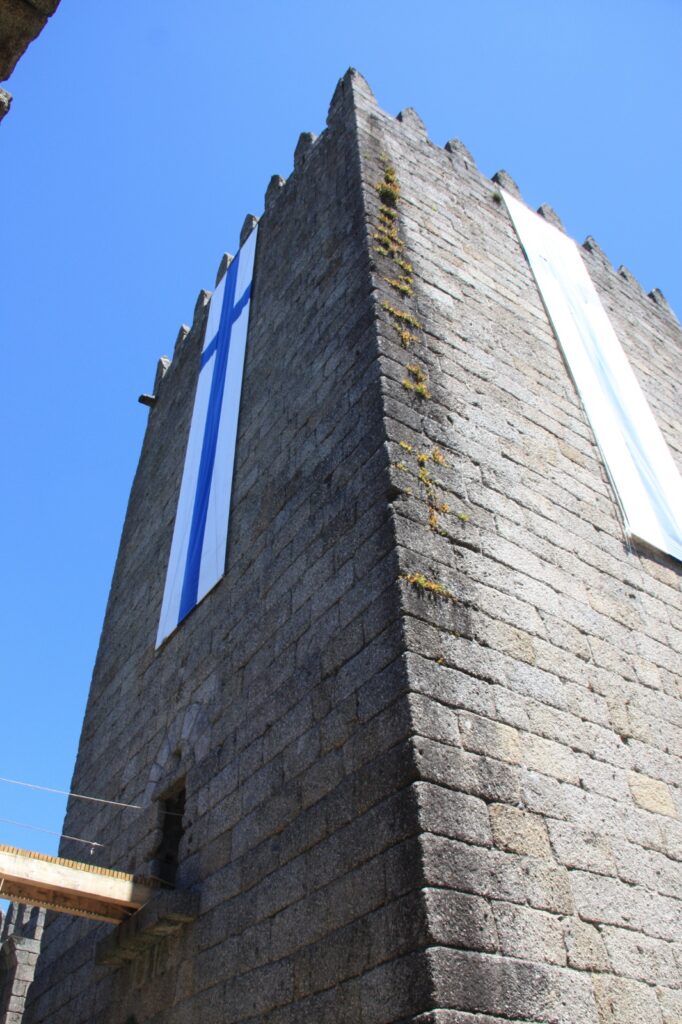
Right angled Tower wall of the Medieval Castle of Guimaraes
Visiting Guimaraes Castle in 2025: What to Expect
The Castle Layout and Design
Guimaraes Castle Portugal has a distinctive pentagonal shield shape with eight rectangular towers. The granite construction combines Romanesque military engineering with later Gothic updates—a design evolution you can read in the stonework itself.
The angled walls weren’t decorative. They deflected projectiles and made scaling difficult. The towers provided 360-degree surveillance of approach routes.
Walking the perimeter in 2015, I noticed how builders anchored sections directly into natural granite outcrops. They didn’t just build on the hill—they made the hill part of the fortress. That integration of geology and military architecture sets this apart from other Portuguese castles I’ve explored.
The Keep (Torre de Menagem)
The 27-meter Keep dominates the castle’s center. Its quadrangular tower cuts a sharp profile against the sky—on clear days, it photographs beautifully. (A keep refers to the inner part of a castle.)
During my 2015 visit, I climbed interior levels to the rooftop terrace. The views extend across Guimaraes Old Town to the surrounding Braga district hills. You could see why commanders chose this location: complete visual control of the valley and approach roads.
The Keep wasn’t just a lookout post. It represented political power. When Afonso Henriques controlled this tower, he controlled northern Portugal.
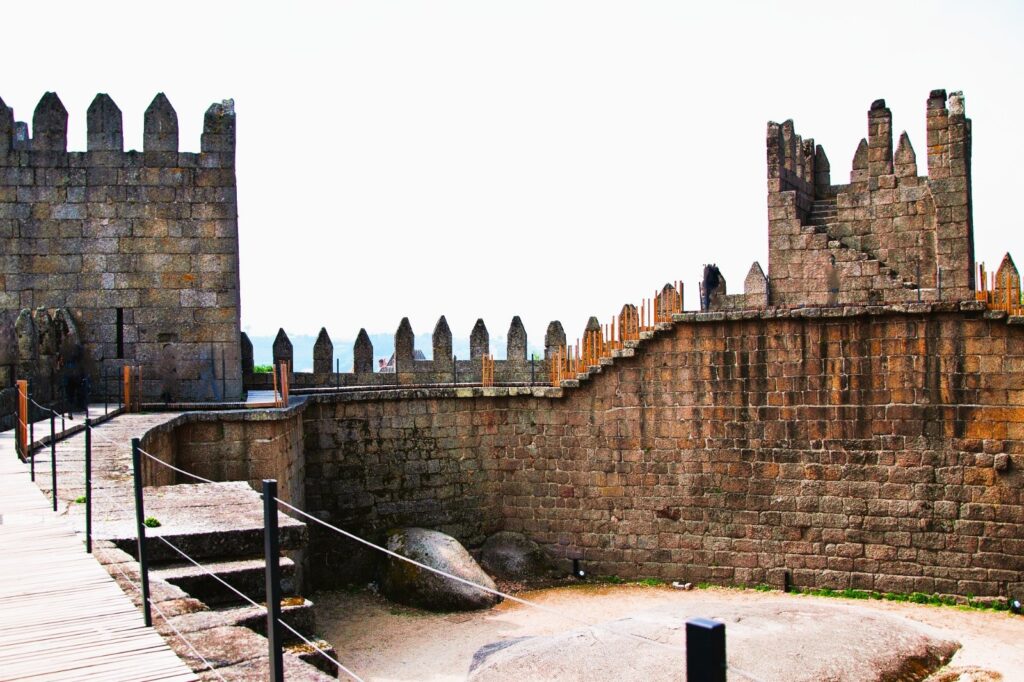
The Ramparts and Defensive Features
Soldiers patrolled the wall-walk (adarve) along the ramparts, watching for threats from elevated positions. The strategic placement on a granite hill gave defenders natural height advantage before adding a single stone.
The walls follow the terrain’s contours rather than forcing geometric perfection. Medieval engineers worked with the landscape, curving defenses around rock formations. As you explore, notice how different sections use varying stone sizes—evidence of construction phases spanning centuries.
This adaptive design explains why the castle survived while other Braga district attractions from the same period crumbled.
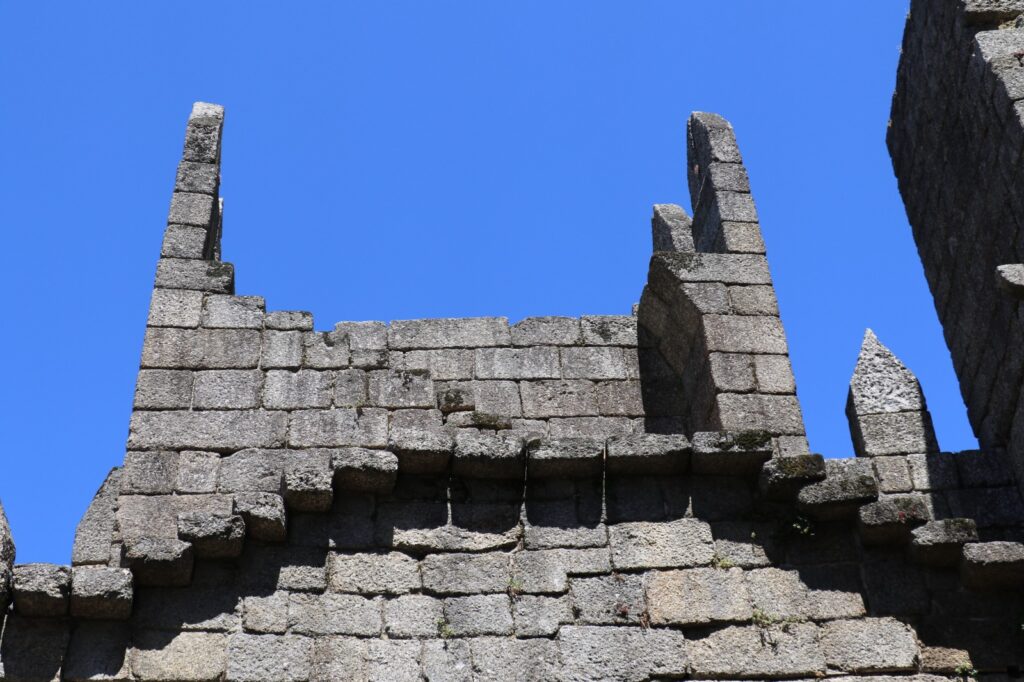
Ramparts of Guimaraes Castle
2025 Access Restrictions and What You Can Still See
Critical 2025 Update: Ongoing preservation works have closed the Wall Walk (Adarve) and Keep (Torre de Menagem) for safety. These closures are temporary but currently have no confirmed reopening date.
What remains accessible: the Place of Arms, the inner courtyard where medieval troops assembled. You can still appreciate the fortress’s scale, photograph the exterior walls, and walk the grounds.
Budget tip: During construction phases, the castle has sometimes offered free or reduced entry. Policies change frequently, so check on arrival—you might save €5-8 per person.
Even with restricted access, the castle’s exterior and courtyard deliver the essential Guimaraes UNESCO experience. I’d still prioritize it over many fully-open Portuguese castles because of its historical significance.
The “Afonso 360” VR Experience
The new “Afonso 360” Virtual Reality experience (approximately €6) compensates for the closed towers. You wear VR headsets to witness the 1128 Battle of São Mamede in a digital reconstruction.
The experience places you on the battlefield where Afonso Henriques fought for control. The medieval landscape reconstruction includes the castle as it appeared in the 12th century—showing features now lost to time.
Since tower access is currently impossible, this VR option provides the immersive perspective you’d normally get from the Keep’s rooftop. It’s particularly effective for understanding why this site earned the title Cradle of Portugal—you see the actual geography where independence was won.
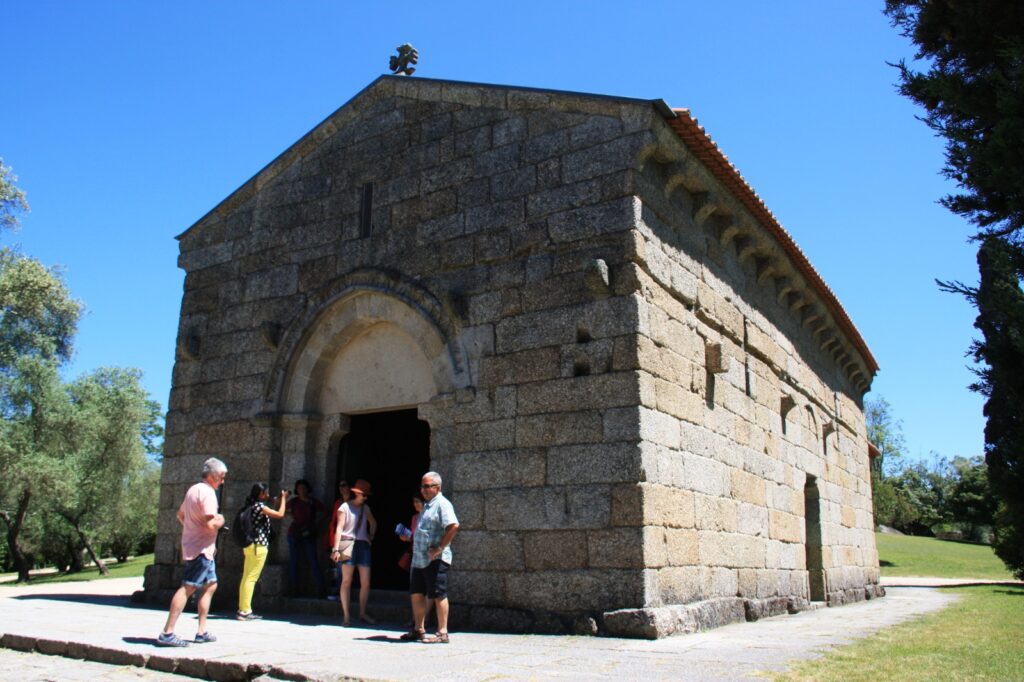
Church of San Miguel do Castelo
This (pic below) is the Romanesque Church where according to tradition King Afonso Henriques was baptized. It has served as royal chapel and parochial church.
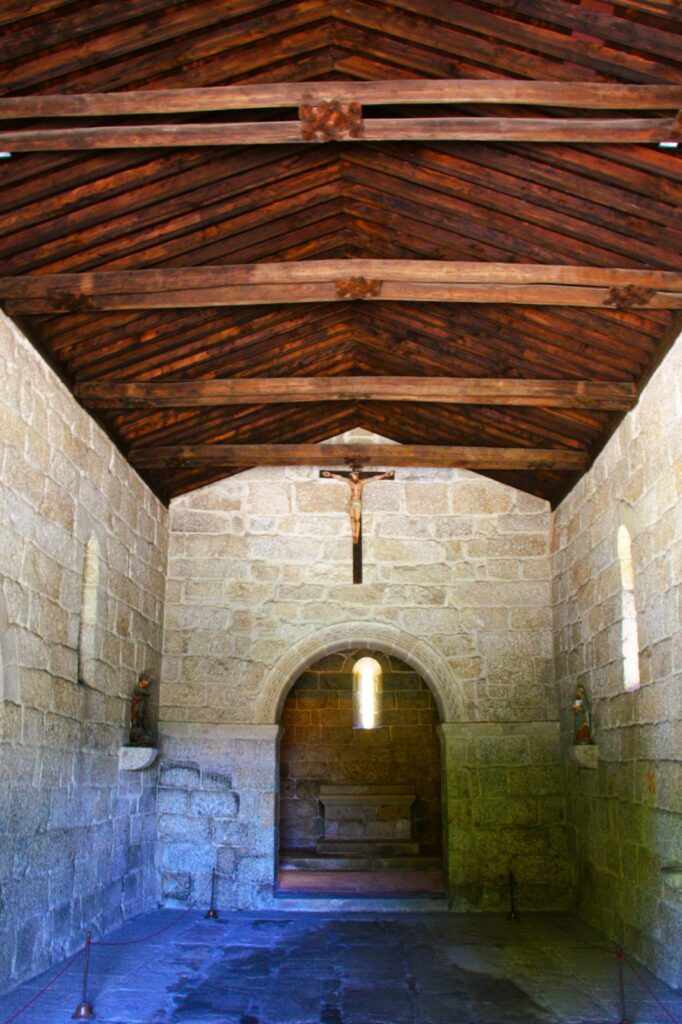
Romanesque Church where King was Baptized
Essential Visitor Information
| Detail | Information |
| Opening Hours | Typically 10 AM to 6 PM (verify locally during 2025 renovation works), (Last entry 5:30 PM). |
| Ticket Price | ~€5.00 (Standard), Free (during specific renovation phases—check ahead). Tickets can be purchased online or at the castle; “Afonso 360” VR experience ~€6 |
| Location | Rua Conde Dom Henrique, Guimaraes Old Town, Braga district, Northern Portugal |
| Accessibility | Steep cobblestone hill; not wheelchair accessible. VR room has mobility adaptations. |
| Tours | Guided tours available in English and Portuguese; combine with Palace of the Dukes for fuller context |
| Photography | Permitted throughout exterior and courtyard areas |
Pro tip: Even with restricted tower access, budget 45-60 minutes for the castle grounds plus VR experience. The combination gives you both physical and digital perspectives on this Cradle of Portugal site.
How to Get to Guimaraes from Porto
By Train: Direct trains depart from Porto’s São Bento or Campanhã stations to Guimaraes hourly. The journey takes approximately 75 minutes through northern Portugal countryside. Ticket prices run €3-4 each way, making this the most budget-friendly option for reaching Braga district attractions.
By Bus: Multiple operators connect Porto and Guimaraes in about 75-90 minutes. Buses arrive near the city center, putting you within 10-15 minutes walking distance of Guimaraes Old Town and the castle.
By Car: Driving takes roughly 50 minutes via the A3 and A7 motorways. Parking near Guimaraes Castle Portugal is limited—your best option is the parking area near the lower town or fairgrounds, then walk uphill (10 minutes).
During my 2015 visit, I found street parking close to the castle entrance, but don’t count on it. The medieval streets narrow quickly, and manoeuvring rental cars through tight turns tests your skills. If you’re visiting multiple Portuguese castles on a road trip, Guimaraes works well as a northern anchor before heading to Braga or further into Minho region.
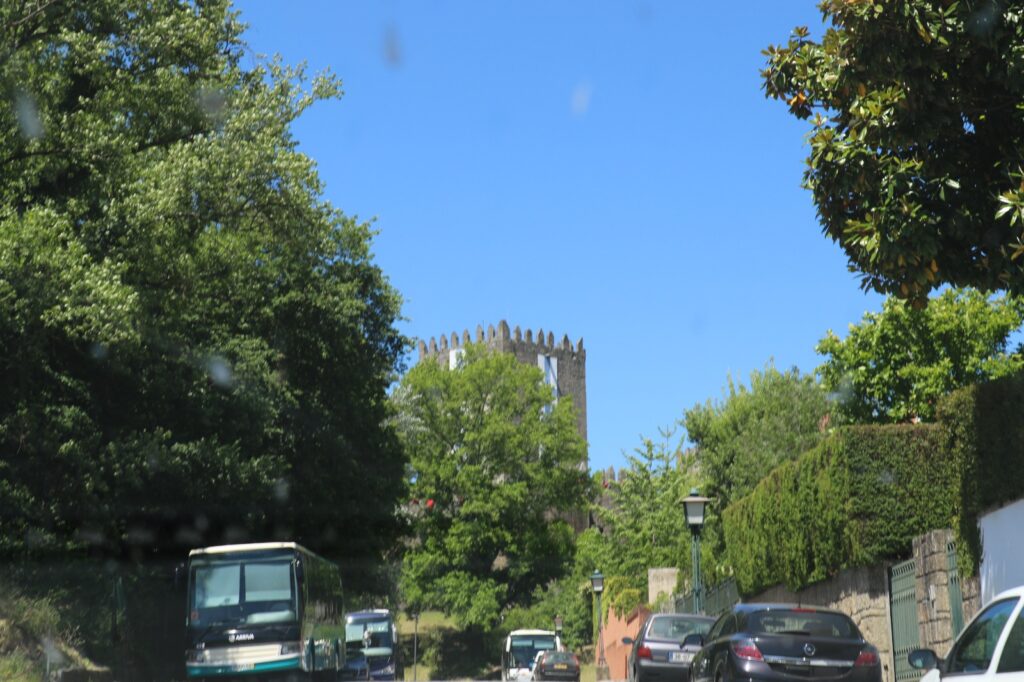
Parking near Guimaraes, walk uphill from here
Practical Visitor Tips
- Timing Your Visit: Spring (April–June) and autumn (September–October) are ideal. The weather is mild, and crowds are smaller compared to peak summer.
- Entry Fees: During the ongoing renovation, entry is often free or discounted. Confirm locally before you go.
- Accessibility: The Place of Arms courtyard is the main accessible area in 2025. Wear comfortable shoes—the granite paths can be uneven.
- Photography: Even with restricted access, the outer towers and walls make excellent photo subjects. Early morning light highlights the granite textures beautifully.
- Combine Experiences: Don’t miss the “Afonso 360” VR experience. It’s a smart way to understand the Battle of São Mamede while the Keep remains closed.
Exploring Guimarães Old Town
The castle sits at the edge of Guimarães Old Town, a UNESCO World Heritage Site. Strolling through cobbled lanes, you’ll find medieval squares, traditional houses with iron balconies, and lively cafés. Largo da Oliveira and Praça de Santiago are two must-see squares that connect history with modern life.
Other things to see around in Guimaraes
Paço dos Duques de Bragança (Ducal Palace): Just steps from the castle, this 15th-century palace showcases Gothic architecture and a collection of tapestries, weapons, and furniture.
Santo Antonio dos Capuchos Convent – a convent built in the 17th century. Casa da Misericordia installed a hospital in the mid-19th century in this convent. You can take a tour, entrance fee is 2€.
Convent of Santa Clara – the current town hall of Guimaraes since 1975. It was built in 16th century and reputed to be a very important and rich convent. The nuns of this convent prepare typical sweets and cake of Guimaraes. Explore around, you can buy these pastries in a few shops in the city.
Timing: 9 AM – 5.30 PM Free admission.
Rua Santa Maria, Guimaraes – one of the important streets of Guimaraes since medieval times and still retains that medieval look. Located close to convent of Santa Clara, came straight down from the Ducal Palace, a street where famous people of the time lived.
Visit the City Walls – some vestiges of the walls from medieval times exist very close to the end of Rua Santa Maria. This street ends in the center of Guimaraes. Don’t miss the inscription that reads “Portugal Was Born Here”.
Braga City: About 25 km away, Braga offers the famous Bom Jesus do Monte Sanctuary, one of Portugal’s most photographed religious sites.
Citania de Briteiros: An archaeological site north of Guimarães with Iron Age ruins, giving context to the region’s pre-Roman heritage.
San Miguel do Castelo Guimaraes
FAQ: Guimaraes Castle Planning
How much time do you need for Guimarães Castle?
With the current renovations, 30-45 minutes. If fully open + the VR experience, plan for 1.5 hours.
Can you walk the walls of Guimarães Castle?
Currently no. The wall walk is closed for safety works as of early 2025.
Is Guimarães worth visiting?
Yes, it is a UNESCO World Heritage site and one of the most well-preserved medieval cities in Portugal.
Can you go inside the castle?
Yes, but with limitations in 2025. The Place of Arms courtyard is open, while the Keep (Torre de Menagem) and Wall Walk (Adarve) remain closed for preservation works.
Is the castle accessible for people with mobility issues?
The castle hill is steep and cobblestoned, making it difficult for visitors with mobility challenges. However, the VR “Afonso 360” room has adaptations for accessibility, offering an alternative way to experience the site.
Are guided tours available?
Yes. Guided tours are offered in both Portuguese and English. They provide historical context about the Battle of São Mamede, the role of Countess Mumadona Dias, and the castle’s UNESCO significance.
What’s the difference between the castle and the Palace?
The castle is a 10th-century military fortress, built for defense and symbolizing the Cradle of Portugal. The Paço dos Duques de Bragança (Ducal Palace), located nearby, is a 15th-century residence showcasing Gothic architecture, tapestries, and noble heritage.
Is photography allowed?
Yes. Photography is permitted throughout the accessible areas.
Where can I eat near the castle?
Guimarães Old Town offers plenty of dining options within walking distance. Traditional taverns serve bacalhau (codfish dishes) and francesinha (Porto-style sandwich).
What does Guimarães mean in Portuguese history?
Guimarães is often called the Berço da Nação—the Cradle of the Nation. It was here that Afonso Henriques won the Battle of São Mamede in 1128, paving the way for Portugal’s independence.
Guimaraes Castle Top
Conclusion: Why Guimaraes Castle Matters
Guimaraes Castle isn’t just another medieval fortress on your Portugal itinerary. It’s the documented birthplace of an entire nation—the physical place where Portugal’s independence story began in 1128.
Even with 2025’s restricted access to the Keep and ramparts, the castle delivers what matters most: standing where Afonso Henriques launched a kingdom. The Guimaraes UNESCO designation recognizes this collective heritage—the castle, the Old Town, and the battlefield together form Portugal’s origin narrative.
When I first climbed the Keep in 2015, looking across the Braga district from those 27-meter heights, the strategic importance clicked into place. Today’s VR experience and accessible courtyard still convey that significance.
Ready to visit the Cradle of Portugal? Check current access policies before you go, combine your visit with the Palace of the Dukes, and budget extra time for wandering Guimaraes Old Town’s medieval streets.
Have you visited Guimaraes Castle? Drop your experience in the comments below—especially if you’ve seen it both before and during the renovations. Your insights help fellow travelers plan better trips.
Like this castle? Pin and save for later.
About the Author
 Indrani Ghose is a travel blogger and photographer who has explored 15+ European countries across multiple trips. Based in Bangalore, she shares authentic travel experiences to help fellow travelers navigate the world more safely and confidently. You can follow her on her social media handles Instagram, Twitter and Facebook to see the wonderful destinations, beautiful offbeat places and get instant updates about them.








I love exploring old buildings and forts. A castle would be great to see and since it is free it is definitely my cup of tea.
Free of charge when touring a certain place is all good! Tho, you have to explore on your own which is also a good thing. The castle looks historic. Like the ones on movies and animated films!
This castle in Portugal has really an interesting story. It is so huge, and beautiful. I loved your shot of the castle and will love to explore it some day.
Looks like a beautiful castle. Ancient and robust. I have read some other posts also on your blog related to architectural landmarks in Portugal. And all these seem to be wonderful
The castle looks wonderful. May be it’s because of the Portuguese architecture, I felt that this castle resemebles a few forts of Goa!
It is so lovely! I’d love to go to Portugal, I’ve heard lots of interesting things to do and visit. Moreover, I do love castles, last summer in Scotland I visited several ones and they do inspire and have a particular atmosphere.
Wow, the birthplace of Portugal and so beautiful. We can’t wait to see the Castle of Guimaraes for ourselves. Thanks for covering it. It’s on our Portugal itinerary for sure.
Guimarães looks really intriguing. I am always fascinated by heritage structures, they have so many stories to tell, one has to but listen carefully. No doubt the castle has many a thrilling story to tell, stories of love and treachery and the birth of a nation.
Thanks for this virtual tour. The castle looks amazing! would love to visit someday! Cheers!
The true magnitude of the castle is seen in the first picture. Those people look so small! Impressive!
Great fortress and although look alike built with hollow blocks, I am sure it must be pretty strong to stand for centuries and birth reason of Portugal! Fantastic perspective
Impressive Green Door and the Castle is a beauty.
Thanks to your posts on Portugal, I’m learning something new everytime I come here. Looking forward for more 🙂
I love a castle, and Guimaraes looks like a classic!
Quite a nice place!
Lovely information.. Thanks for sharing 🙂
Those crenellated walls are magnificent and so large too.
Looks like you have explored every church, castle and building in Portugal… 🙂
The castle is huge and majestic. Seems it was a lovely day on your visit, Indrani. Great shots against the azure skies.
Interesting historical reminder.
An amazing country with so much incredible history and beauty. Thank you for sharing your photos.
Hello, the church and castle are beautiful. I would love to tour and explore these historical sites. Great post. Have a happy day!