Things to Do in Amazing Coimbra Portugal
If you’re searching for the best things to do in Coimbra, Portugal, expect more than historic landmarks — this is a city of living stories, where ancient architecture meets vibrant student life.
Perched gracefully on the banks of the Mondego River, Coimbra is where youthful energy meets centuries of wisdom. Once the medieval capital of Portugal (1139-1255) and now home to one of Europe’s oldest universities, founded in 1290, this city radiates intellectual charm and quiet grandeur. As I write this I am reminded of our tour through its cobbled lanes.
— Indrani Ghose, travel blogger | Updated Nov 2025
Affiliate Disclaimer: This article may contain affiliate links. We may earn a small commission if readers clicks through and make a purchase.
Whether you’re drawn to baroque libraries guarded by colony bats, riverside strolls beneath willow trees, or panoramic hilltop views over terracotta rooftops, Coimbra offers a rich experiences often overlooked by travelers rushing between Lisbon and Porto.
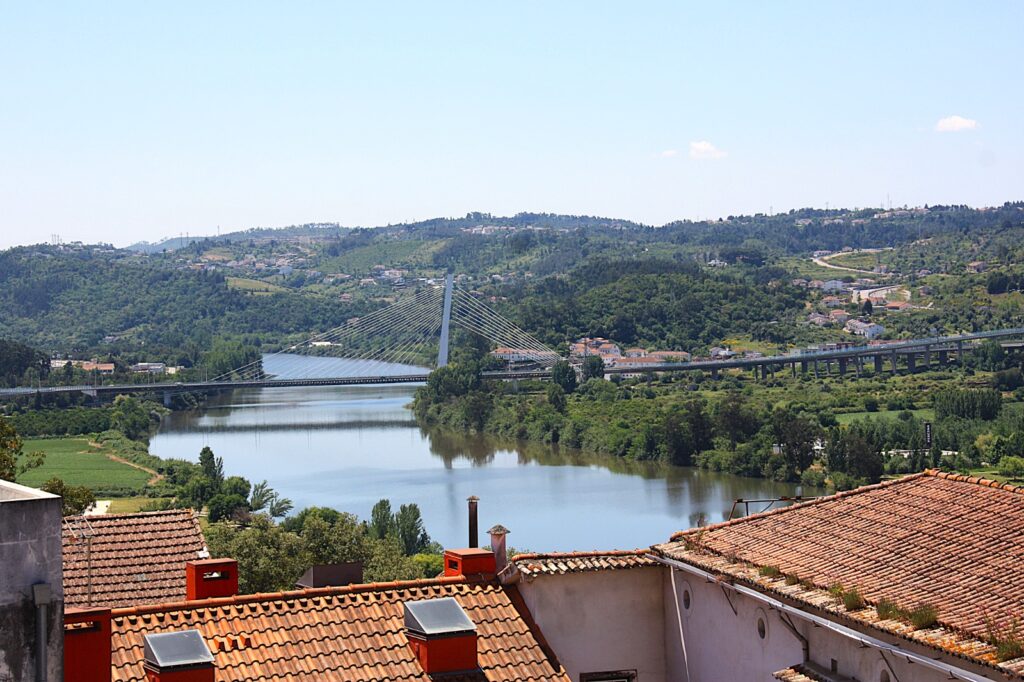
Ponte Rainha Santa Isabel Coimbra
Top Coimbra attractions to include in your itinerary:
- University of Coimbra – A UNESCO World Heritage Site and the city’s beating heart since 1537
- Biblioteca Joanina – An 18th-century baroque masterpiece where bats protect ancient tomes
- Old Cathedral (Sé Velha) – Portugal’s finest Romanesque building, dating to 1184
- Monastery of Santa Clara-a-Velha – Atmospheric 13th-century ruins revealing Gothic foundations
- Quinta das Lágrimas – Gardens where the tragic love story of Pedro and Inês unfolded in 1355
For hassle free rich experience I recommend to join tours:
- Coimbra University: Private walking tour with tickets. Discover the University of Coimbra on a private guided tour. Visit the most popular spots on campus as well as some lesser-known ones.
- Coimbra: Guided tour with a local student. Join a history student of the University of Coimbra on a walking guided tour and learn about the student’s traditions, the history of the University and the old history of the city itself.
Quick Tips: Why Visit Coimbra
While planning my Portugal itinerary in May 2015, I discovered Coimbra’s strategic location between Lisbon (195 km) and Porto (120 km) — making it an ideal stopover that deserves more than just a rushed visit.
We were self-driving with family along the A1 motorway, but train travel is equally convenient: regional trains from Porto take 1 hour 15 minutes (€12-15), while intercity services from Lisbon reach Coimbra in under 2 hours (€20-25), with departures every 1-2 hours.
The best time to visit Coimbra is spring (April–June) or autumn (September–October), when temperatures hover comfortably between 15-25°C, the riverside gardens bloom with jacaranda and wisteria, and academic ceremonies fill the streets with cape-clad students.
Summer (July-August) brings warmth (often 30°C+) and the vibrant Festas da Rainha Santa in early July, featuring processions and fireworks.
Coimbra is more than monuments — it’s a place of sensory moments. I regret missing a fado de Coimbra performance at Fado ao Centro, but it’s my priority for my next visit. This unique fado tradition, sung exclusively by male students, is hauntingly different from Lisbon’s version.
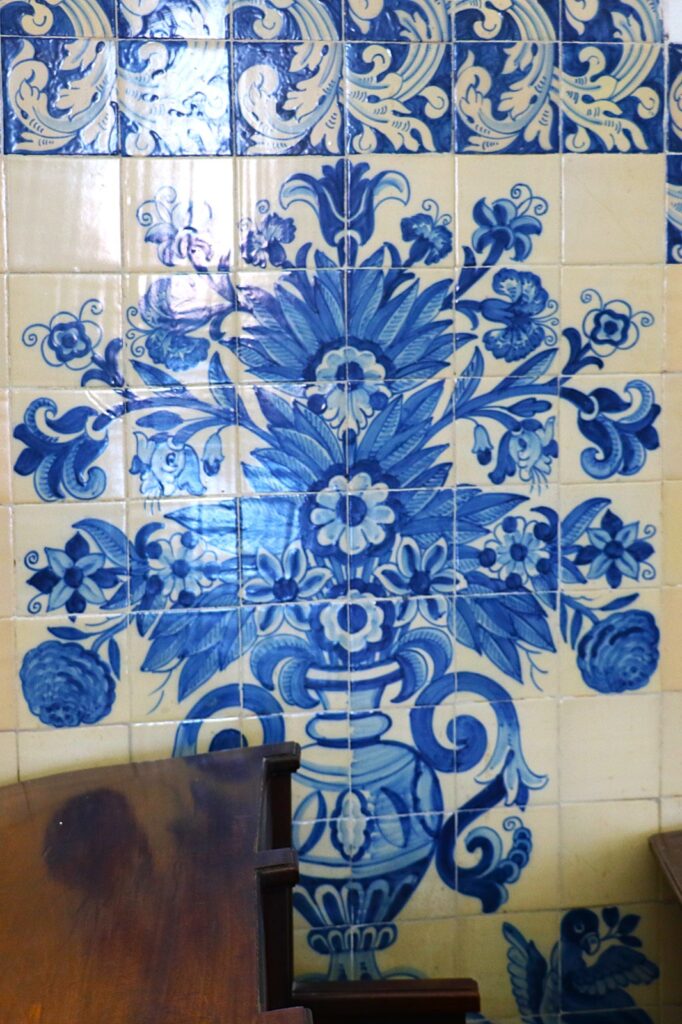
Azulejos with floral design
Fact File for Coimbra Visit
Location: Central Portugal, on Mondego River; 195 km north of Lisbon, 120 km south of Porto
UNESCO Site: University of Coimbra – Alta and Sofia (inscribed 2013)
Famous For: Fado de Coimbra (male-only academic tradition), medieval architecture, Portugal’s oldest university (1290)
Ideal Visit Duration: 1-2 days (day trip possible but rushed)
Best Time to Visit: April–June & September–October (mild weather, 15-25°C)
Transport: Train (frequent from Porto/Lisbon), car (A1 motorway), bus; Coimbra-B (main station) + Coimbra (city center)
Must-See: Joanina Library, Sé Velha, Botanical Gardens, Quinta das Lágrimas, Santa Clara-a-Nova
Local Specialty: Pastéis de Santa Clara (almond-filled pastries), Chanfana (goat stew)
Currency: Euro (€)
Language: Portuguese (English widely spoken in tourist areas)
Coimbra’s Top Icons: The Unmissable Must-Sees
University of Coimbra – Alta and Sofia
No list of things to do in Coimbra, Portugal is complete without visiting the University of Coimbra, the city’s intellectual crown and a UNESCO World Heritage Site since 2013. Founded in 1290 and permanently established here in 1537, it’s one of Europe’s oldest continuously operating universities and remains Portugal’s most prestigious academic institution.
The Alta and Sofia areas form its historic core — a maze of Manueline-Gothic halls, sunlit courtyards where students in black capes still gather.
During my May 2015 visit, I entered through the Porta Férrea (Iron Gate) into the Paço das Escolas courtyard, where the rhythmic chiming of the clock tower marked each hour. Climbing the narrow spiral stairs of the 18th-century University Tower (Torre da Universidade), I caught my breath at the 360-degree views — the Mondego River snaking through green valleys, the white monastery of Santa Clara catching afternoon light.
Insider tip: Book your university ticket online (€12.50, includes library access) to skip the often 30-45 minute queues, especially during summer months.
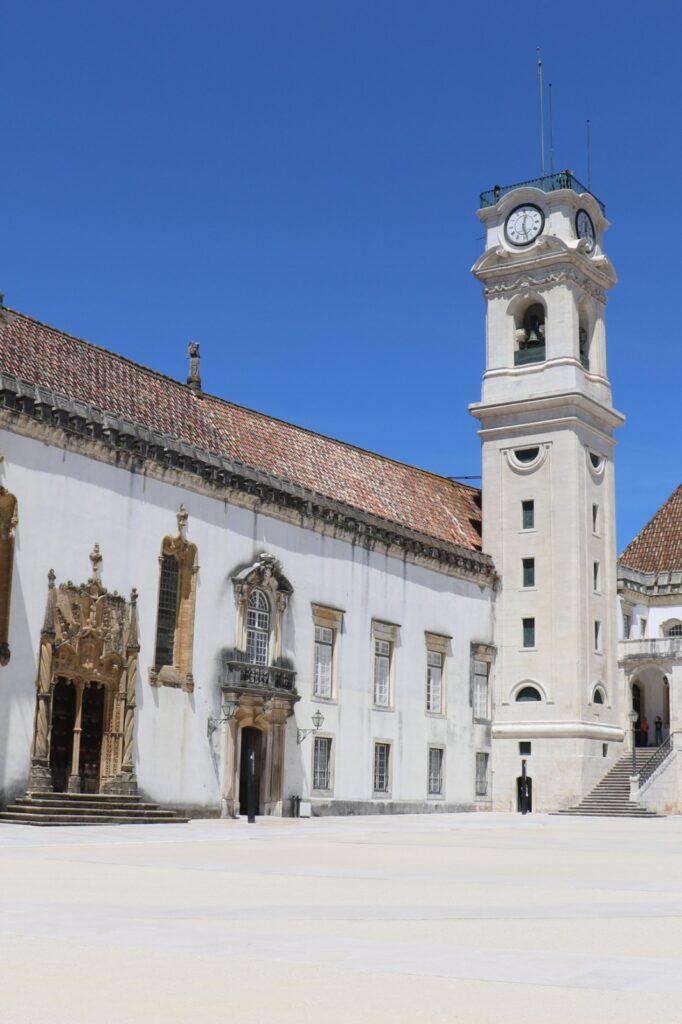
Coimbra University with Tower
Biblioteca Joanina (Joanina Library)
Tucked inside the university complex, the Biblioteca Joanina ranks among Europe’s most beautiful libraries and is the crown jewel of Coimbra attractions. Built between 1717-1728 under King João V (hence “Joanina”), this Baroque masterpiece stuns visitors with three interconnected rooms featuring gilded chinoiserie woodwork, trompe-l’oeil ceilings, and over 60,000 leather-bound volumes dating from the 12th to 18th centuries.
When I visited in May 2015, the silence felt sacred — only 60 visitors are allowed in at once.
A colony of common pipistrelle bats emerges nightly to feast on book-eating insects, a natural preservation method maintained for over 300 years. Staff cover tables with leather sheets each evening to protect against bat droppings.
Note: Photography strictly prohibited; timed entry slots fill quickly.
Sé Velha (The Old Cathedral)
Rising from Coimbra’s hillside since 1184, Sé Velha de Coimbra is Portugal’s finest surviving Romanesque cathedral and one of the best things to do in Coimbra for architecture enthusiasts. Its fortress-like façade, complete with crenelated towers and arrow-slit windows, reflects its origins during the Reconquista.
Inside, I was struck by the contrast between severe Romanesque simplicity and later Gothic additions. The main altarpiece, crafted by Flemish masters in the 1500s, glowed gold in the filtered sunlight streaming through narrow windows.
Unlike many Portuguese churches, Sé Velha escaped Baroque remodelling, preserving its medieval character. Entrance costs just €2.50, making it exceptional value among Coimbra’s attractions.
Don’t miss: The Arab-influenced tile work and carved choir stalls.

Old Cathedral of Coimbra
Diving into Coimbra’s Deep History and Culture
Machado de Castro National Museum
Beyond the university attractions, the Machado de Castro National Museum reveals Coimbra’s archaeological DNA. Descend to the Roman cryptoporticus beneath the former bishop’s palace — walk through the remarkably intact 1st-century underground galleries, you can hear your own footsteps echo off vaulted stone ceilings.
Named after sculptor Joaquim Machado de Castro (1731-1822), the museum houses Portugal’s finest medieval sculpture collection. The 14th-century limestone Pietà and the jewel-studded processional crosses that once traveled Coimbra’s streets during religious festivals are worth seeing.
The rooftop terrace café is a favorite Coimbra viewpoint of many tourists, I have read. One can sip galão while watching university towers pierce the skyline across terracotta rooftops. Entry: €6 (free first Sunday monthly).
Mosteiro de Santa Cruz (Santa Cruz Monastery)
In Coimbra’s bustling Praça 8 de Maio, Santa Cruz Monastery holds Portugal’s founding story within its 12th-century walls. This is where the nation’s first two kings, Afonso Henriques (d. 1185) and Sancho I (d. 1211), lie in elaborately carved Renaissance tombs.
If you arrive at opening time (9 AM) you can have the churchto yourself (almost). The royal tombs, redesigned by French sculptor Nicolau Chanterene in 1520, depict the battle scenes and heraldic shields carved into white limestone. The Manueline portal outside, added during King Manuel I’s reign, explodes with maritime motifs — twisted ropes, coral, and armillary spheres.
The Claustro do Silêncio (Cloister of Silence), decorated with 18th-century azulejo panels depict Christ’s Passion. The silence here offered unexpected tranquility meters from downtown traffic.

Monastery of the holy cross
A Baixa (The Downtown Area)
Coimbra’s Baixa (lower town) pulses with daily Portuguese life between Santa Cruz Monastery and the Mondego River. This is where history meets modernity in Coimbra’s commercial heart.
During my 2015 visit, I drove through Rua Ferreira Borges. The main pedestrian artery was lined with Art Nouveau façades, pastelarias selling pastéis de Santa Clara, and university students debating over bicas (espresso). I caught glimpses of street performers outside the wrought-iron Mercado Municipal D. Pedro V (1867), where vendors sold queijo da serra cheese wheels. Interesting street scenes, worth framing in lens, only glitch was I didn’t have the time.
The geometric patterns of Praça do Comércio’s Portuguese pavement (calçada portuguesa) leads towards the riverfront, where locals jogged along tree-shaded paths. This everyday rhythm — not the tourist sites — defines authentic Coimbra!
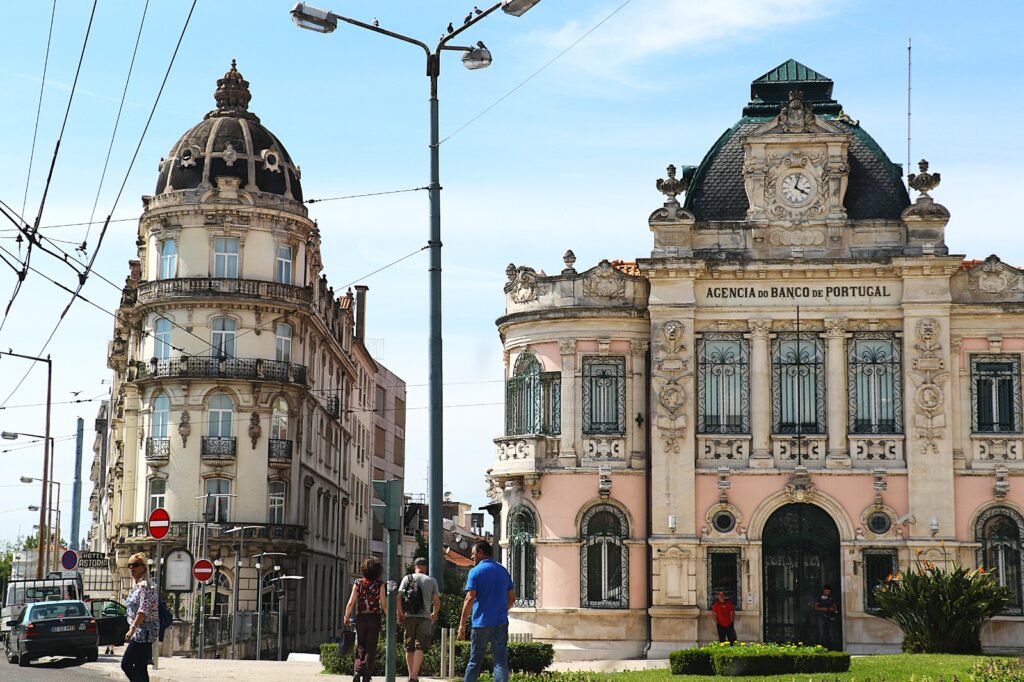
Agência do Banco de Portugal located in the Baixa district of Coimbra
Coimbra’s Green Spaces: Parks and Outdoors
Jardim Botânico (Coimbra Botanical Garden)
Cascading down 13 hectares of hillside, the Jardim Botânico da Universidade de Coimbra ranks among Europe’s oldest botanical gardens (founded 1773) and is one of the best green spaces in Coimbra. Managed by the University of Coimbra as both research facility and public park, it houses over 1,200 plant species from five continents.
During my May 2015 visit, I regrettably ran short on time and could only glimpse its entrance gates near the 18th-century aqueduct. Fellow travelers later told me about the stunning bamboo forest, century-old Ginkgo trees, and greenhouse collection—now firmly on my return itinerary. Local Coimbra residents consistently recommend this as the city’s most peaceful outdoor attraction.
Visitor tip: Entry costs just €2; access via upper gate (Calçada Martim de Freitas) or lower entrance near São Sebastião aqueduct.
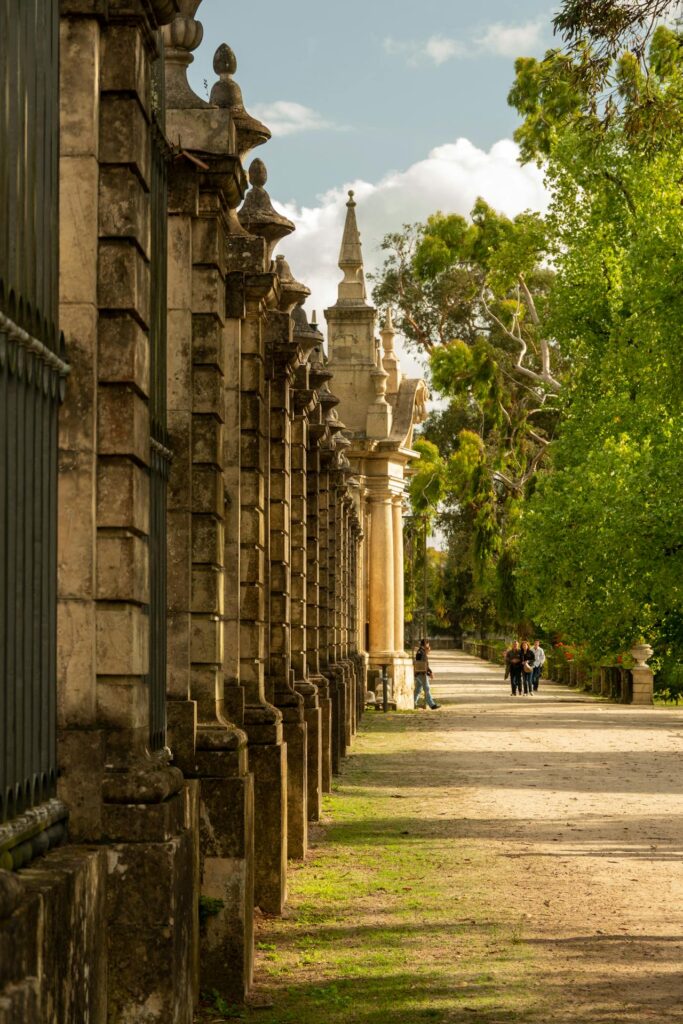
Wall of Botanical Garden in Coimbra, Portugal
Parque Verde do Mondego
Stretching along both banks of the Mondego River through central Coimbra, Parque Verde do Mondego has transformed former industrial areas into the city’s premier outdoor recreation space. This riverside linear park offers jogging paths, cycling lanes, children’s playgrounds, and grassy areas where locals gather for picnics and sunset-watching.
For visitors seeking outdoor activities in Coimbra beyond historic monuments, this free-access park provides authentic local atmosphere. Rent bikes from nearby shops or simply walk the riverside promenade connecting key attractions.
Mosteiro de Santa Clara-a-Velha
Rising from the Mondego’s left bank, the Gothic ruins of Santa Clara-a-Velha monastery tell Coimbra’s story through stone and persistence. Founded in 1314 for Poor Clare nuns, chronic flooding from the Mondego River eventually forced abandonment in 1677, leaving the structure buried under sediment for three centuries.
During my 2015 visit, I viewed these haunting ruins from across the river—their partial walls and empty Gothic windows creating striking silhouettes. Though I couldn’t tour the interior archaeological site and interpretation center (€4 entry), I learned the excavation revealed intact medieval floor tiles, nun’s cells, and the original cloister layout.
This remains high on my Coimbra return list for its unique blend of medieval architecture and riverside setting.
Best for: History enthusiasts and photographers seeking atmospheric Coimbra attractions.
Quinta das Lágrimas and Fonte dos Amores
Within Quinta das Lágrimas estate’s romantic gardens (€3-5 entry), the Fonte dos Amores marks where Inês de Castro was murdered in 1355 by order of King Afonso IV. Legend claims the fountain ran red with her blood, while nearby Fonte das Lágrimas sprang from her tears.
Though I missed these gardens during my 2015 visit, this off-the-beaten-path Coimbra attraction is essential for romantics. The story concludes at Alcobaça Monastery, where I visited Pedro and Inês’s magnificent Gothic tombs—arguably Portugal’s most moving historical site (see my Alcobaça guide). Pedro’s macabre devotion—exhuming and crowning his dead beloved—created Portugal’s most enduring love legend.
Best for: History enthusiasts planning multi-day Portugal itineraries connecting Coimbra, Batalha, and Alcobaça.
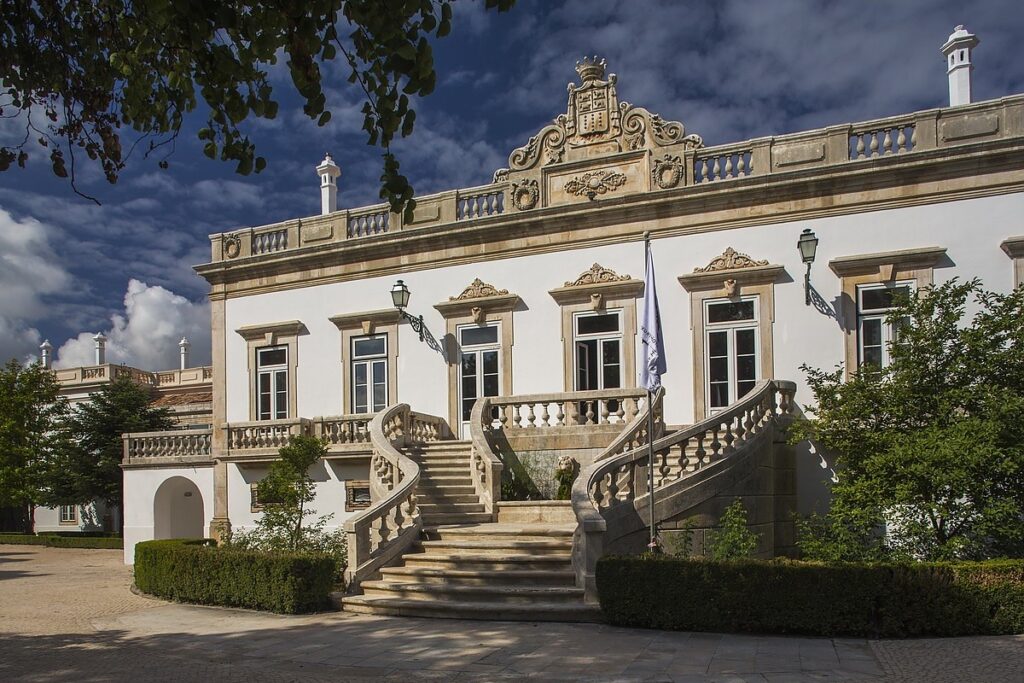
Quinta das Lágrimas and Fonte dos Amores Coimbra https://www.quintadaslagrimas.pt/en/
Unique Coimbra Experiences: Music, Food, and Festivals
Fado de Coimbra
Unlike Lisbon’s melancholic tavern fado, Fado de Coimbra represents an exclusively male academic tradition dating to the 1800s, performed by university students in traditional black capes (capa e batina) beneath moonlit archways and historic squares.
During my May 2015 visit, I heard snippets of practice sessions echoing through university corridors but regrettably missed a formal performance—now my top priority for returning. The distinctive style features complex Portuguese guitar arrangements and poetic lyrics celebrating love, saudade (longing), and Coimbra itself.
Authentic venues include Fado ao Centro (Rua Quebra Costas) and À Capella (converted chapel), with performances typically 9:30 PM (€10-15). This UNESCO-recognized Intangible Cultural Heritage offers Coimbra’s most soulful experience.
Tip: Academic year (October-May) offers more authentic student performances.
Queima das Fitas Festival
Every May, Coimbra transforms during Queima das Fitas (Burning of the Ribbons), Portugal’s largest and oldest student festival celebrating graduating seniors since 1899. For one intense week, colored ribbons representing each faculty (medicine=yellow, law=red, letters=blue) flood the streets during the massive Cortejo da Lata parade featuring decorated floats and thousands of cape-clad students.
My 2015 visit occurred just days after the festival concluded—I witnessed exhausted locals recovering and decorations still hanging from buildings! The week-long celebration (typically first or second week of May) includes the Serenata Monumental (fado concert at stadium), nightly concerts, and the ceremonial ribbon-burning symbolizing academic completion.
Planning note: Book accommodation 2-3 months ahead; prices surge and availability drops during festival week.

My daughters with University of Coimbra students in traditional black capes — a living symbol of centuries-old academic pride and tradition.
Student Traditions and Academic Ceremonies
Beyond festivals, Coimbra’s daily student life offers fascinating cultural glimpses. Watch for groups of cape-clad students (traditionally worn for 7 years—one per undergraduate year) gathering in República student houses (self-governed communal residences dating to medieval times) or participating in praxe (hazing-style academic traditions involving challenges and songs).
The annual Latada Parade welcomes freshmen each October, while thesis defenses remain public events held in historic university halls. During my 2015 visit, I observed students rushing between classes in their distinctive black attire—a living link to medieval scholarly traditions that makes Coimbra feel like Hogwarts’ Portuguese cousin.
Respectful viewing: Students appreciate quiet observers; avoid disrupting academic ceremonies.
Where to Eat in Coimbra: Local Cuisine and Sweet Treats
Coimbra’s culinary identity reflects its Mondego River location and Beira region heritage. Must-try dishes include chanfana (red wine-braised goat stew from Miranda do Corvo, traditionally cooked in clay pots), leitão da Bairrada (impossibly crispy roast suckling pig), and seasonal arroz de lampreia (lamprey rice, January-April only).
The city’s sweetest legacy comes from convent kitchens: Pastéis de Santa Clara, delicate almond-filled pastries wrapped in thin dough, following 17th-century Poor Clare nuns’ recipes. I sampled these at Pastelaria Briosa (established 1910) near Santa Cruz Monastery, paired with a strong bica.
Other authentic experiences: Zé Manel dos Ossos (rustic tavern with communal tables, no reservations), Mercado Municipal D. Pedro V (Saturday mornings for queijo da serra cheese), and riverside cafés serving petiscos (Portuguese tapas).
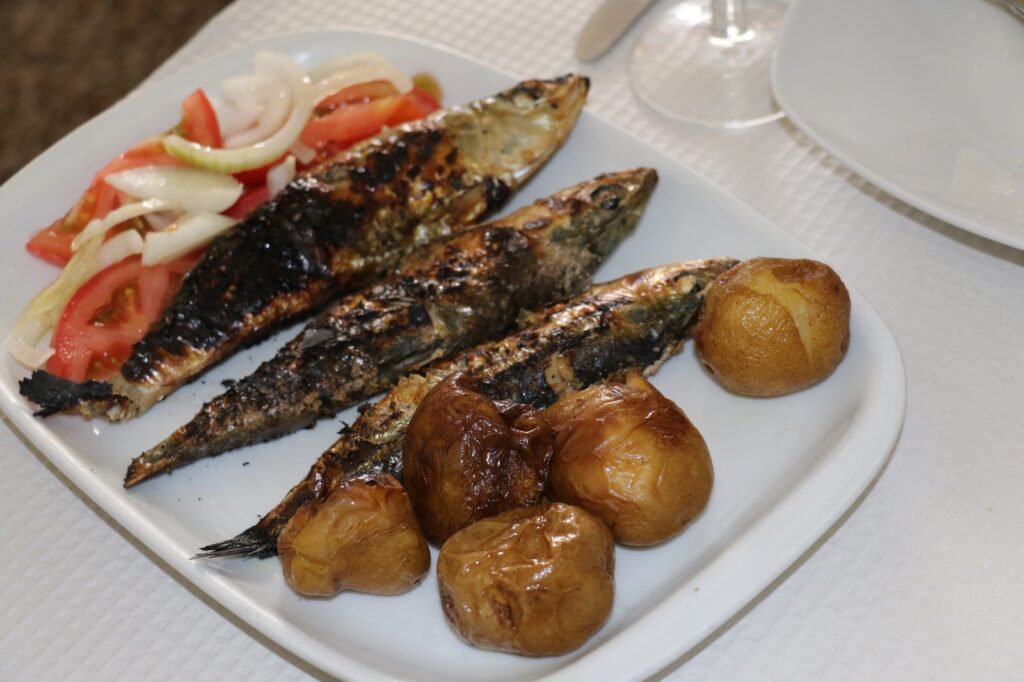
Traditional Portuguese dish Coimbra Lunch – The dish includes grilled sardines, roasted potatoes, and a side salad with tomatoes and onions.
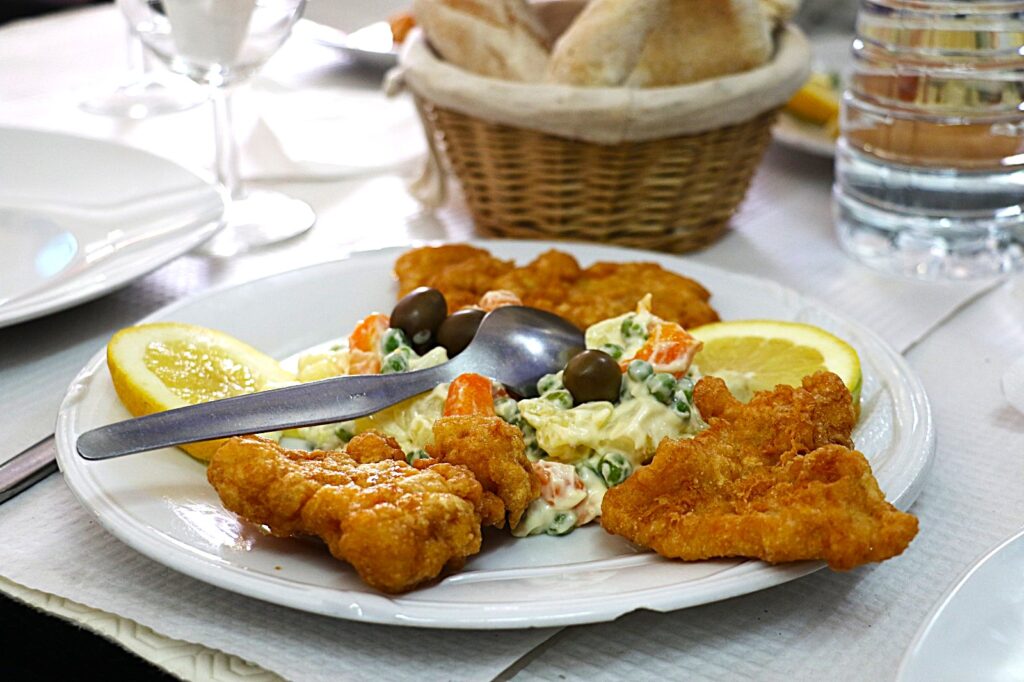
Salads and Fries, Olives and lemon slice adds a Mediterranean touch.
Where to stay in Coimbra
Though I visited Coimbra as a day trip in May 2015, I’ve researched accommodation options for future overnight stays. Based on traveler reviews and location analysis, I recommend three areas:
Alta (University Quarter) for atmosphere near attractions like Biblioteca Joanina—try the highly-rated Hotel Oslo or budget-friendly Serenata Hostel
Baixa (Downtown) for dining and flat terrain near Coimbra-A station
Quinta das Lágrimas for luxury in the legendary gardens.
Book early for May’s Queima das Fitas festival when rates surge. Most recommend staying near Coimbra-A (city center) rather than Coimbra-B station, which sits 2km outside town.
Insider Accommodation Tips:
Book accommodations near Coimbra-A station (Estação Coimbra), not Coimbra-B—the latter is 2km outside the center. May’s Queima das Fitas festival causes 30-50% rate increases and sells out months ahead. For longer stays, consider university-area guesthouses where students’ families run charming residenciais with local character.
Check out these hotels rated high in several sites:
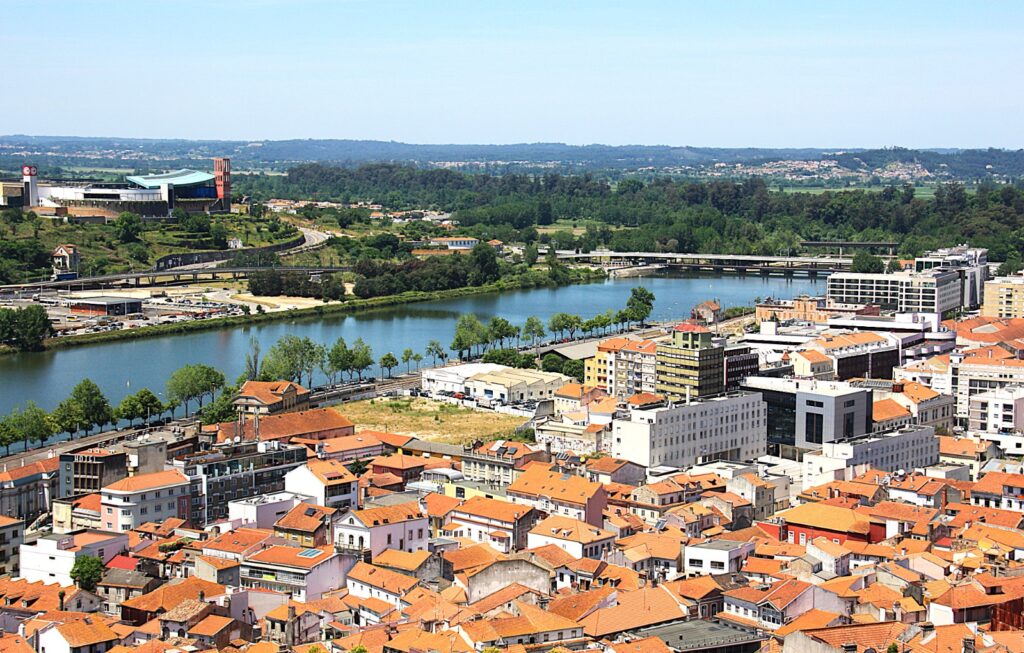
Mondego River view from Coimbra University Tower
FAQ: Things to Do in Coimbra Portugal
What are the top historical sites to visit in Coimbra?
Coimbra is rich in heritage. Must-see historical sites include the University of Coimbra, Biblioteca Joanina, Sé Velha (Old Cathedral), Santa Cruz Monastery, and the Machado de Castro Museum. Each offers a unique glimpse into Portugal’s academic, religious, and artistic legacy.
Is Coimbra worth visiting on a Portugal itinerary?
Absolutely. Coimbra is a perfect stop between Lisbon and Porto. With its blend of UNESCO landmarks, student traditions, and romantic legends, it offers a soulful experience that’s both educational and scenic. I visited in May 2015 and found it unforgettable.
How much time do you need to explore Coimbra?
A full day allows you to see the main attractions like the university, Joanina Library, and downtown. Two days are ideal if you want to explore museums, attend a fado de Coimbra performance, and enjoy the Botanical Gardens or Convento de São Francisco.
What is unique about fado in Coimbra?
Unlike Lisbon’s fado, fado de Coimbra is performed exclusively by male university students and is more poetic and melancholic. It’s often sung at night in historic courtyards — a tradition I missed in 2015 but plan to experience next time.
Where can I find art and culture in Coimbra?
Visit the Machado de Castro Museum for sculpture and Roman ruins, and the Convento de São Francisco for concerts and exhibitions. Both venues showcase Coimbra’s evolving cultural scene.
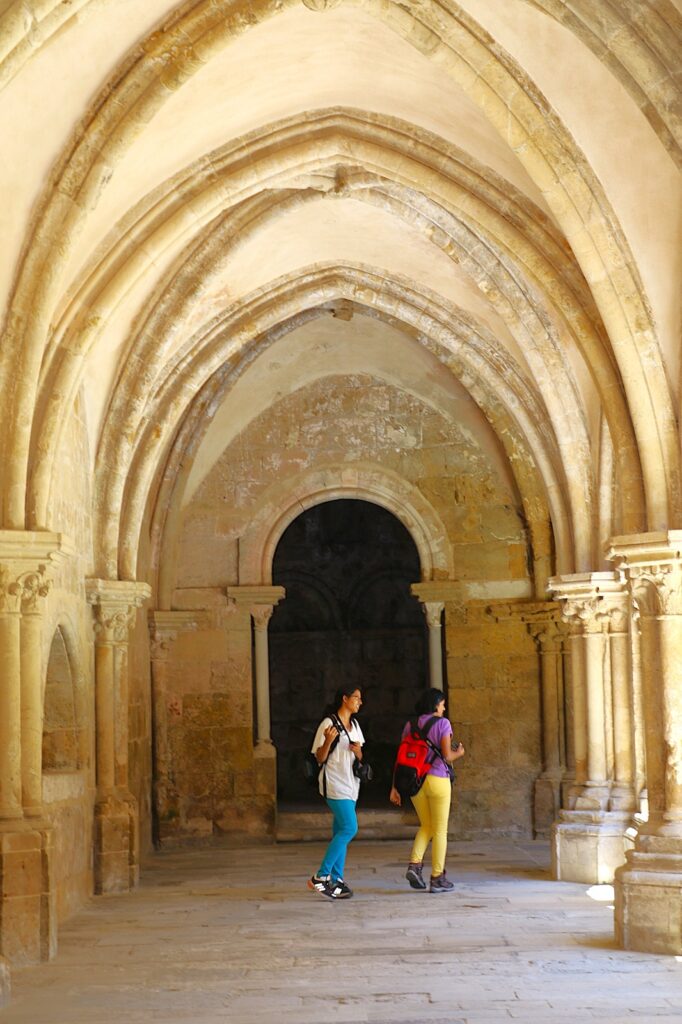
Gothic Cloister of Se Velha de Coimbra
Final Thoughts
Coimbra may not always make the loudest noise on Portugal’s travel map, but it gently, persistently stays with you. During my visit in May 2015, I missed many of its treasures — the gardens, the riverside paths, even a night of fado — yet the city still left a quiet imprint on my heart. That’s the magic of Coimbra: it invites you back.
Whether you come for history, music, legends, or slow river sunsets, Coimbra rewards you with moments that feel both intimate and timeless. And if you’re planning your own list of things to do in Coimbra, Portugal, I hope this guide helps you explore the city more fully than I could the first time — and maybe inspires you to return, just as I plan to.
Did you like this travel blog on Things to do in Coimbra Portugal?
With this long list of top Coimbra attractions I have answered your query – Is Coimbra worth visiting? If you have liked this post on things to do Coimbra Portugal please do consider saving and sharing the post to plan a trip to Coimbra Pt later.
Pin and Save this for later…
 About the author: Indrani Ghose is a travel blogger and photographer who has explored 15+ European countries across multiple trips. Based in Bangalore, she shares authentic travel experiences to help fellow travelers navigate the world more safely and confidently. You can follow her on her social media handles Instagram, Twitter and Facebook to see the wonderful destinations, beautiful offbeat places and get instant updates about them.








We had only one day in Coimbra so I was interested to see what all we missed on our visit. Unfortunately the university was holding its graduation ceremonies when we were there so it was impossible to really tour it. I definitely would have liked to visit the Botanical Garden. Getting a walking tour from a student sounds like a great idea!
That meal looks tempting 🙂 I have read your other articles on Coimbra and this one sums it up nicely x
Nice taking a brief on the place of interest in Coimbra! If you have visited that botanical garden, hope u make beautiful post on it 🙂 Love to take a stroll along the beautiful pathway
Interesting ideas to know Coimbra, lovely pictures!
I’ve enjoyed all your posts on Coimbra. Wonderful pictures with an even better commentary!
Stunning architecture. Walking is the best way to explore I agree! 🙂
You fanned the embers of my longing to visit Portugal again with this post.
Coimbra seems like a lovely place to visit and the food looks so sumptuous. Thanks for sharing dear! 🙂
Stunningly beautiful architechture ! Wonderful pictures .A walk in the botanical garden has to be an experience to remember !
I feel the cathedrals and the gardens would please me ☺️
Wonderful pictures!!!
Love your Portugal posts. Great local perspective.
Nice list of places to visit. Thanks.
Wonderful photos! Thank you for the tour and advice (my favorite is “Walk & Eat!).
University Architecture is looking very beautiful !!
Wow, must be so good to get out and get lost… Such a lovely post. Need to add Portugal to that bucket list.
Interesting architecture. Even the walkway is fancy!
Hey, Indrani, I’ve read so many posts of yours on Portugal. Why don’t you assemble these in a ebook on Portugal tourism regarding what to visit, why to visit and when to visit with your amazing clicks? Just a thought 🙂
Great idea Ravish. Thanks for inspiring me to think in that direction. 🙂
I am going to think on it.
I agree with Ravish. Your posts are a mine of information and that too in depth. Indrani, it will make an amazing travelogue with all the awesome pictures you have clicked.
That’s a great idea from Ravish. All of your beautiful pictures and narration would be of great help to the tourists want to visit Portugal… 🙂
Nice pictures, great architecture!
I think you had a nice trip in that place, it seems to be a good one for a visit
Beautiful pictures!
The cathedral looks great. x
That platter is so awesome 🙂
Amazing pictures.
Great, So beautiful pics.
nice pathway! beautiful cathedral!
Lisbon is one of the places I’d love to visit. It looks so warm and enchanting.
I bet the Botanical Garden would be a wonderful place to enjoy nature.
I really liked that walking path and fence. That’s a neat mosaic pattern in the walkway. – Lots of wonderful buildings there as well.
Wonderful shots.
That looks sooooo good.
Hello Indrani, Coimbra looks like a beautiful place to visit. Lots of pretty place to visit and eat. Thanks for sharing! Have a happy day!