My Coimbra University Tour: Discovering Portugal’s Oldest University
Step Inside the Oldest University in Portugal
Stepping into the University of Coimbra feels like entering a living archive of European academia. In May 2015, I embarked on a memorable Coimbra University tour, exploring its centuries-old halls and soaking in Portugal’s brightest academic traditions.
Coimbra holds the distinction of being Portugal’s 7th oldest university in continuous operation in the world—older than Oxford’s established colleges.
In 2013, UNESCO inscribed the University’s Alta and Sofia complex as a World Heritage Site, recognizing its exceptional testimony to over 700 years of continuous academic tradition. The campus embodies a unique blend of architectural styles spanning Gothic, Manueline, Baroque, and Neoclassical periods.
— Indrani Ghose, travel blogger | Updated Nov 2025
Affiliate Disclaimer: This article may contain affiliate links. We may earn a small commission if readers clicks through and make a purchase.
Coimbra University is worth visiting for the Joanina Library—with its gilded baroque woodwork and resident bat colony that protects rare manuscripts. You’ll also discover the Royal Palace where Portuguese kings once resided, the acoustically remarkable Chapel of São Miguel, and panoramic views from the 18th-century clock tower.
I’d really recommend booking this University of Coimbra Walking Tour as it is conducted by guides who studied and worked here. Learn all about the incredible history and hidden gems of this university.

University of Coimbra Facade
Planning Your Coimbra University Tour: Tickets and Timing
Strategic planning transforms a good Coimbra University visit into an exceptional one. The campus spans multiple historic buildings, and capacity restrictions—particularly for the Joanina Library—make advance preparation essential.
The Critical Ticket Breakdown: What to Book and When
The university offers two primary ticket options through its official portal:
Palace of Schools Ticket (Paço das Escolas): Includes the Royal Palace, Joanina Library, Chapel of São Miguel, Academic Prison, and University Tower. This core ticket requires timed entry for the library, with final admission at 4.40 PM.
Complete University Ticket: Adds the Science Museum (with its impressive natural history and physics collections), the Mathematical Museum, and access to several historic faculty buildings. Best suited for visitors dedicating 5+ hours/full day.
2025 Pricing (verified March 2025):
- Adults: €12.50 (Palace), €15 (Complete)
- Students/Youth (13–25 with ID): €7–€9
- Children under 12: Free with adult
- Seniors (65+): €9.50
- Family tickets available: €32 (2 adults + 2 children)
Critical booking tip: Purchase tickets 3–7 days ahead for weekends, holidays, or May–September visits. The official University of Coimbra Tourism Office website processes bookings directly. Avoid third-party resellers charging markups.

University of Coimbra entrance
How Long Does the Coimbra University Tour Take?
Based on visitor flow studies published by the university’s tourism office and personal experience:
Express tour (2–2.5 hours): Palace of Schools essentials—Joanina Library, Royal Palace, Chapel, and Tower. Suitable for cruise ship visitors or those with limited mobility.
Standard tour (3.5–4 hours): Above plus leisurely exploration of courtyards, the Academic Prison, and time for photography. This represents the optimal balance for most visitors.
Comprehensive tour (5–6 hours): Complete campus including the Science Museum’s three floors, Mathematical Museum, and historic faculty buildings like the Law Faculty’s impressive reading room.
Full immersion (full day): Add surrounding Alta district exploration, including the Sofia galleries, Medieval Wall, and student republics (historic communal houses).
I spent half a day here and still felt I missed nuances. The architecture rewards slow observation—Manueline stone carvings, 17th-century azulejo tile panels, and vaulted ceilings contain details easily missed when rushed.
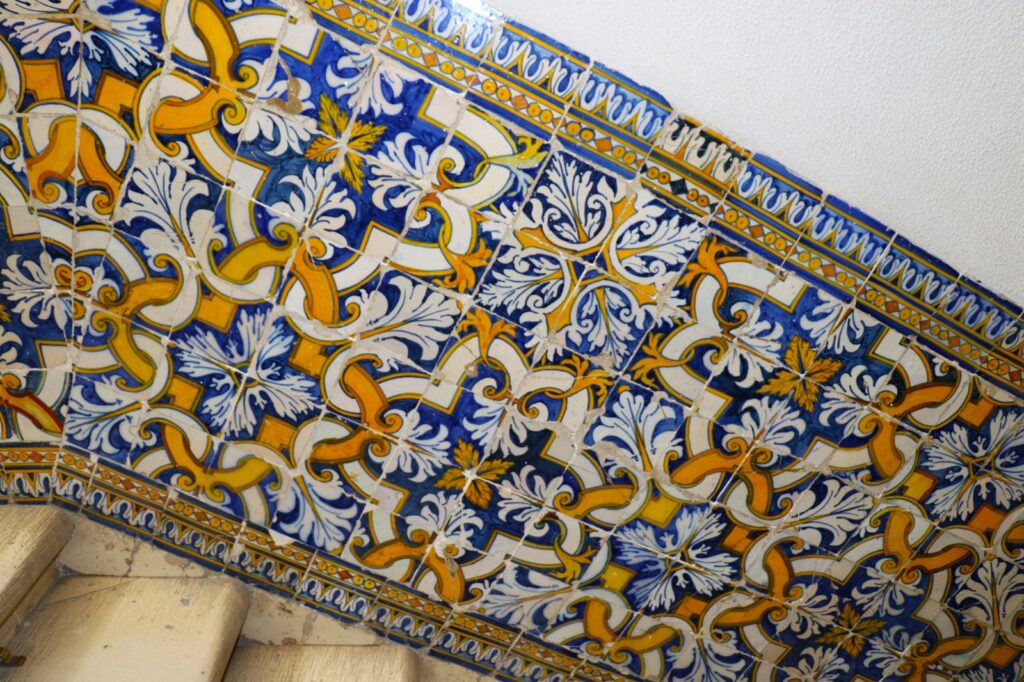
Azulejos lining staircase wall in University of Coimbra Tour
The Essential Coimbra University Tour Stops
Walking the Paço das Escolas
The Paço das Escolas (Palace of Schools) forms the ceremonial heart of Coimbra University—a UNESCO-protected hilltop complex. This former royal palace, transferred to the university in 1537 by King João III, contains five essential monuments that together tell Portugal’s intellectual story.
My visit in May 2015 revealed extraordinary baroque craftsmanship and medieval curiosities. Recent restorations and improved visitor access have made the experience even more immersive, which I would like to see first hand when I get to visit Coimbra again.
The University tour follows a logical circuit through interconnected spaces. You’ll enter through the Porta Férrea (Iron Gate), emerge onto the ceremonial courtyard, then proceed through timed stops including Portugal’s most photographed library, a functioning 18th-century tower, and a chapel that witnessed centuries of academic ceremonies.
This section provides specific routing guidance, updated access information as of 2025.
Pro tip: Begin with the Biblioteca Joanina (your timed entry slot determines this), then explore the remaining sites in any order. The circuit takes 90–120 minutes at a comfortable pace, longer if you climb the tower or attend the chapel’s brief organ demonstrations.
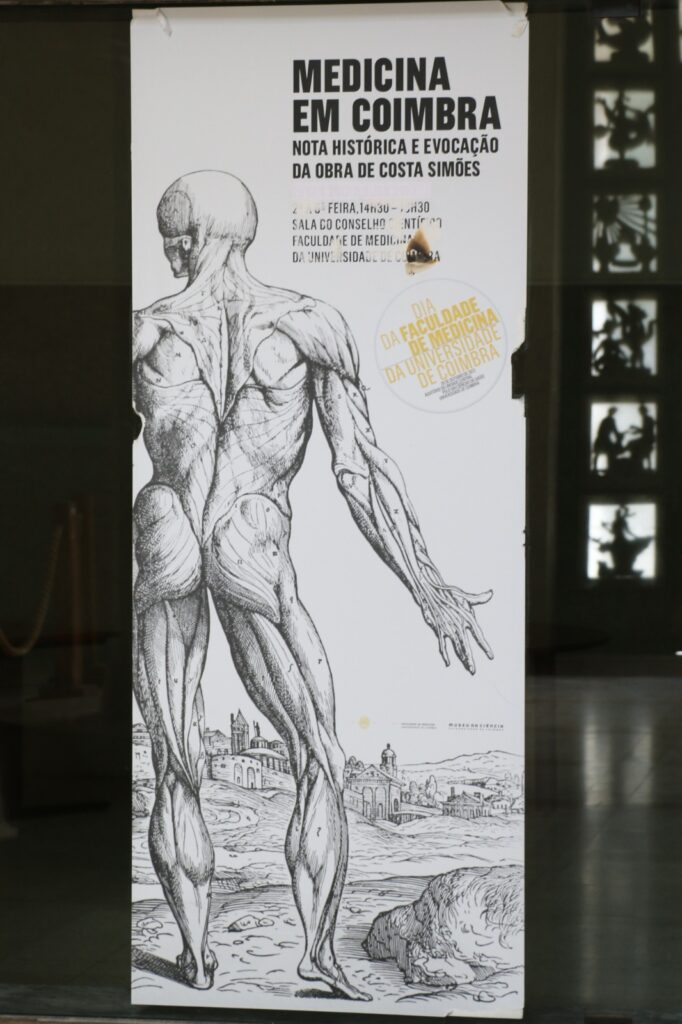
Medicana Classes Coimbra University
The Biblioteca Joanina: Portugal’s Baroque Masterpiece
A highlight of the Coimbra University tour is the breathtaking Biblioteca Joanina, an 18th-century library filled with rare volumes and stunning Baroque architecture. Commissioned by King João V and constructed between 1717–1728, this three-room treasure represents Portugal’s Age of Discovery wealth translated into intellectual ambition.
The interior showcases exotic Brazilian jacaranda, rosewood, and ebony carved into floor-to-ceiling bookcases that hold over 60,000 volumes—including rare 16th-century scientific texts, illuminated manuscripts, and first-edition philosophical works.
The famous bat colony: Common pipistrelle bats (Pipistrellus pipistrellus) roost in the library by day and hunt book-damaging insects at night—a natural pest control system documented by the university’s biology department since at least 1800. Staff cover tables with leather sheets nightly to protect against bat guano.
Current visit protocols (2025): 10-minute maximum occupancy per group, no photography (preservation of light-sensitive pigments and gilt), temperature controlled at 18–20°C year-round. These restrictions, implemented progressively since 2012 and standardized in 2018, represent conservation best practices recommended by ICCROM (International Centre for the Study of the Preservation and Restoration of Cultural Property).
The library connects directly to the Academic Prison below—accessible via the same ticket.
The Academic Prison (Prisão Acadêmica)
Directly beneath the Biblioteca Joanina’s ornate floors lies the Prisão Acadêmica—a functioning university jail from the medieval period through 1834. This stone-walled facility embodied Coimbra’s unique legal status: the university maintained autonomous jurisdiction over students, operating its own courts, police force (archeiros), and detention system.
Students faced imprisonment for infractions including examination fraud, unauthorized dueling, disturbing the peace after curfew (enforced by the tower bell), and “crimes against academic dignity.”
Following Portugal’s 1834 Liberal Revolution, which curtailed university judicial powers, the prison was repurposed to store illuminated manuscripts from dissolved monasteries—a function it served until the late 20th century.

University City Grounds Coimbra
Sala dos Capelos (Great Hall of Acts)
The Sala dos Capelos served as Portugal’s throne room before King João III relocated the royal court to Lisbon in 1537 and donated the palace to the university.
The coffered wooden ceiling (mudéjar-influenced, completed 1654) features geometric patterns and the royal coat of arms. Portrait galleries line the walls: Portuguese monarchs on one side (from Afonso Henriques through the constitutional monarchy), university rectors on the other—a visual dialogue between political and academic power spanning eight centuries.
Today, this hall hosts doctoral degree conferrals (the “Acto de Doutoramento”), where candidates defend dissertations before faculty panels seated in carved wooden chairs.
The ritual maintains elements from medieval academia: Latin phrases, ceremonial robes, and the ring-conferring ceremony symbolizing admission to the scholarly community.
2025 access improvement: New multilingual touchscreen panels (Portuguese, English, Spanish, French, German) detail the hall’s architectural evolution and explain academic ceremonies. Visitors may observe doctoral ceremonies on select dates—check the university’s public events calendar.
The crimson velvet furnishings and elevated rector’s platform create formidable atmosphere. Standing here, you occupy space where kings made law and scholars defend knowledge—a 700-year continuum.
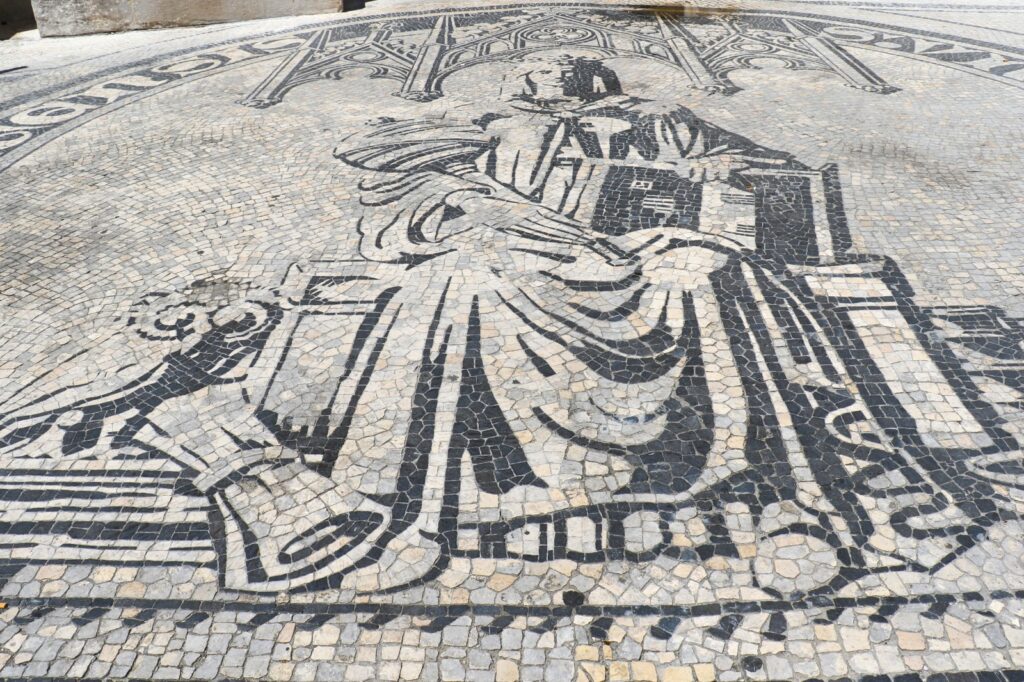
Mosaic art work in Coimbra University
The University Tower (Torre da Universidade)
The university’s tower viewing platform provides panoramic views that are a must-see on any Coimbra University tour. Rising 33 m above the Paço courtyard, the Torre da Universidade—nicknamed “a cabra” (the goat) for reasons lost to history—has regulated university life since 1733.
Kids today can share timings with smartphones, but those days the students depended on this baroque tower that houses a bell mechanism controlling the academic day’s rhythm.
It still rings daily, maintaining tradition despite modern scheduling systems. Local legend claims students who hear the bell during exams will pass—a superstition with no academic support but considerable persistence.
Climbing the tower, we got panoramic views of Coimbra, the Mondego River, and the terracotta rooftops of Alta. A huge statue of King João III in the courtyard is unmissable – he’s the guy that founded the university over 700 years ago.
Accessibility note: No elevator access. The climb requires moderate fitness and isn’t recommended for those with mobility limitations or severe vertigo. Tower access occasionally closes during academic ceremonies—confirm availability when booking.

View of Coimbra city – 1 and 2 – see the Mondego River, the longest river that flows entirely over Portugal. Pic3 – Baroque façade of the new cathedral
Capela de São Miguel (Royal Chapel of St. Michael)
I was lucky to explore this chapel. Lucky because I have read tourists mentioning unexpected closure of chapel to visitors for functions like funerals. The Capela de São Miguel (Chapel of Saint Michael) is a jewel box of Manueline architecture.
Built in the 16th century, it blends Gothic structure with Renaissance and Baroque embellishments.
The chapel’s limestone portal showcases intricate stonework: nautical ropes, armillary spheres (King Manuel’s personal symbol), and organic forms evoking coral and seaweed—carved references to Portuguese maritime exploration.
This doorway alone represents one of Portugal’s finest Manueline compositions, comparable to Belém’s Jerónimos Monastery.
For comprehensive coverage of the chapel’s architectural significance and Manueline details, see my dedicated article Chapel of São Miguel: Coimbra’s Manueline Jewel.
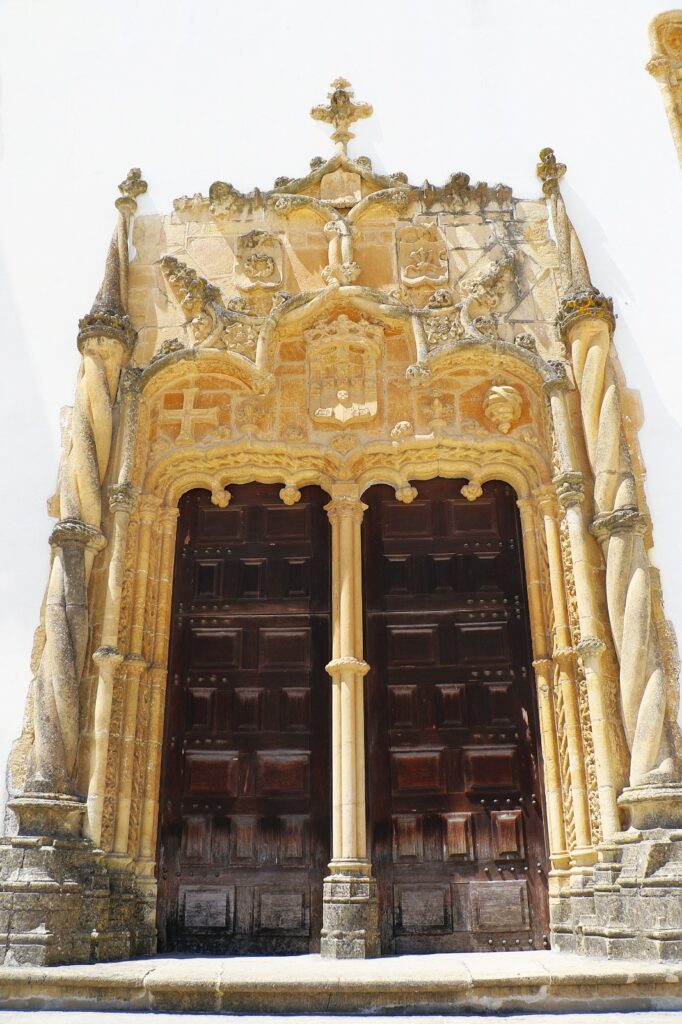
Manueline work on door frame of Chapel of Saint Michael.
Classrooms of University
During the Coimbra University tour, visitors can even sit in historic classrooms decorated with intricate tiled walls, offering a glimpse into the student life centuries ago. The University of Coimbra has 8 faculties. What we did not see is more than what we saw. The ground floor and first floor has several classrooms. When we toured none of the classes were on, so we could visit each classroom. My daughters had a great time posing as students. They sat on the benches of the classrooms, just to get a feel of the university. The best part was the tiled decorations on the walls of the classrooms!

University Classrooms Coimbra
Examination Room of University
University of Coimbra’s grand examination room is a sight to see! Old style and charming too. It is the site for university’s major academic ceremonies such as oral exams and graduations. In the original plan this was the throne room of the royal palace. The ceiling has some amazing patterns with Indo-Portuguese themes. If you are there when any of their ceremonies are on you can see the brass band at the back which punctuates the ceremonies with music, there is no clapping during the events.

University hall Coimbra
Beyond the Palace: The University’s Wider Campus
While the Paço das Escolas concentrates Coimbra’s most iconic monuments, the extended campus reveals the university’s scientific legacy, botanical research, and living student culture. These sites require the Complete University Ticket (€15 adults) and add 2 to 3 hours to your visit.
During my initial 2015 visit, time constraints forced me to skip these locations—a regret that has remained with me till date. I have added notes from my research about the place for my next visit to Coimbra University some day soon.
Critical planning note: These sites occupy different campus zones. The Botanical Garden sits downhill toward the Mondego River (10-minute walk from Palace), while the Science Museum occupies the former Colégio de Jesus (5-minute walk). The Natural History collections require climbing stairs in a historic building with limited accessibility modifications.
Jardim Botânico da Universidade de Coimbra
The University Botanical Garden, established in 1772, spans 13.5 hectares of terraced landscapes descending toward the Mondego River.
It ranks among Europe’s oldest continuously operating academic gardens, alongside similar institutions in Padua (1545) and Leiden (1590).
Today the garden maintains approximately 3,500 documented species organized into thematic collections: medicinal plants, Mediterranean flora, endemic Portuguese species, bamboo forest (over 30 varieties), and greenhouse tropical specimens from former Portuguese territories.
Though I missed it in 2015, recent visitors praise its biodiversity and peaceful ambiance. It’s a perfect spot to unwind after the intensity of the Palace tour.
Access: Separate entrance on Calçada Martim de Freitas (10-minute downhill walk from Palace). Open daily 9 AM to 5.30 PM (winter) / 9 AM to 8 PM (summer). Allow 45–60 minutes for a thorough visit.
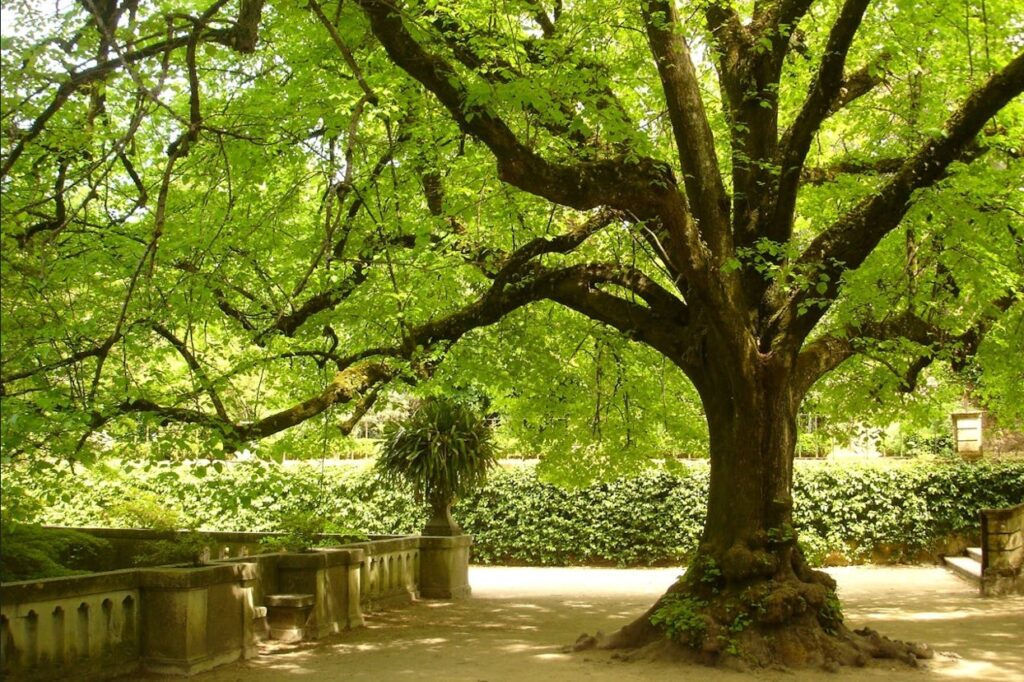
Majestic Tree in Coimbra Botanical Garden
The Science Museum: Chemistry Laboratory and Physics Cabinet
The Science Museum (Museu da Ciência) occupies the restored Colégio de Jesus, a 16th-century Jesuit college transformed into Portugal’s Enlightenment-era scientific hub during Pombal’s 1772 reforms. The collection spans 250,000 objects across multiple disciplines—though core visitor circuits focus on two exceptional galleries.
1. Laboratório Chimico (Chemistry Laboratory): Preserves Portugal’s first academic chemistry facility, established 1773. Original workbenches, distillation equipment, balance scales, and glass apparatus document 18th-century experimental methods. Particularly notable: a complete set of platinum laboratory ware commissioned by the Portuguese crown—platinum being a recent discovery from Brazilian mines at that time.
2. Gabinete de Física (Physics Cabinet): Houses 800+ scientific instruments from the 1700s–1800s: telescopes, microscopes, pneumatic pumps, electrical demonstration devices, and mechanical models illustrating Newtonian physics. The Nairne electrical machine (c. 1780) and precision astronomical instruments from London makers represent state-of-the-art Enlightenment technology.
3. The Natural History Collections include geological specimens, botanical samples, zoological taxidermy, and anatomical models that served medical training—essentially a Cabinet of Curiosities preserving how universities taught empirical science before specialized laboratories.
Practical details: Included in Complete Campus ticket. Open Tuesday–Sunday 10 AM to 6 PM. Guided tours available in English (weekends, 2 PM, included in admission). Photography permitted without flash. Allow 90 minutes minimum; STEM enthusiasts could easily spend 2–3 hours.

Wall painting-Coimbra University Tour
Plan Your Coimbra University Tour to see Student Traditions
Understanding Coimbra’s Living Academic Culture
Coimbra’s student traditions remain vigorously alive, not preserved as tourist spectacle. The capa e batina—the black cape and suit worn since medieval times—appears daily during academic terms, particularly at formal university events, Fado performances, and during Praxe (freshman orientation rituals governed by student-written codes).
Fado de Coimbra differs markedly from Lisbon’s Fado: performed exclusively by male students (historically), with acoustic guitars and poetic lyrics about academic life, unrequited love, and saudade (Portuguese melancholic longing). Authentic performances occur in student republics and certain traditional venues, not tourist restaurants.
Queima das Fitas (Ribbon Burning), held annually in May since 1899, celebrates graduating students over eight days of concerts, parades, and the symbolic burning of ribbons representing their faculties. An extraordinary cultural event if your visit coincides.
Experiencing student culture authentically: Visit during academic terms (avoid July–September when students are absent), attend public Fado performances at the Fado ao Centro cultural center (authentic, non-touristy), and simply observe campus life in the late afternoon when students gather in the courtyard and library steps.
If you are keen to enjoy live Fado show I’d recommend this: Coimbra: Live Fado Show with Glass of Port Wine. Embark on a journey through the unique sounds of Fado de Coimbra and learn about the most important moments in its history.

Experience the unique sounds of Fado de Coimbra, Enjoy an intimate setting, Taste local Port wine.
FAQ: Coimbra University Tour
What is included in the Coimbra University Palace of Schools ticket?
The Palace of Schools ticket for Coimbra University tour includes access to the Joanina Library, Royal Palace (Sala dos Capelos), Chapel of São Miguel, and the Academic Prison. Timed entry is required for the library, and tickets can be booked online or at the entrance. Discounts are available for students, youth, and seniors.
How long should I plan for a full Coimbra University campus tour?
For a complete Coimbra University campus tour itinerary, set aside 2–3 hours for the Palace of Schools and up to 6 hours if you plan to visit the Science Museum, Botanical Garden, and surrounding colleges. A full day allows time to explore the Alta and Sofia quarters nearby.
Can I visit the Biblioteca Joanina without a guided tour?
Yes, you can visit the Biblioteca Joanina during a self-guided Coimbra University tour, but guided tours offer deeper insights and often include skip-the-line access. Photography is prohibited inside, and entry is strictly timed to preserve the interiors.
What are the best skip-the-line guided tours for Coimbra University?
Several providers offer skip-the-line guided Coimbra University tours that include the Joanina Library, Royal Palace, and student traditions. Tours are available in English, Portuguese, and Spanish, and typically cost €18–€25 per person.
Is the Coimbra University Botanical Garden worth visiting?
Absolutely. The Jardim Botânico da Universidade de Coimbra tour experience includes 13 hectares of exotic and native flora, bamboo groves, and medicinal plant beds. It’s a peaceful retreat and part of the full campus ticket.
What student traditions can I witness during a Coimbra University visit?
During your Coimbra University cultural tour, you might see students in traditional black robes (capa e batina), hear Fado de Coimbra sung near the Porta Férrea, or catch the Queima das Fitas festival in May—an iconic celebration marking graduation.
Are there any museums included in the Coimbra University tour ticket?
Yes. The Coimbra University tour with museum access includes the Chemistry Lab, Cabinet of Curiosities, and the Science Museum. These showcase Portugal’s Enlightenment-era scientific heritage and are part of the full campus ticket.
Is Coimbra University a UNESCO World Heritage Site?
Yes, the Coimbra University UNESCO World Heritage designation was granted in 2013 for its historical and architectural significance. The Alta and Sofia complex reflects over 700 years of academic and cultural evolution.

A joyful moment — my daughters wearing the traditional black capes given by the students for posing with them, capturing the timeless spirit of Coimbra’s university life.
Final Thoughts: Why Coimbra University Deserves a Spot on Your Itinerary
I still think back to my 2015 Coimbra University tour with awe—and a touch of regret for the sights I missed. University of Coimbra reflects Portugal’s intellectual and cultural soul. From the gilded grandeur of the Biblioteca Joanina to the quiet wisdom of the Botanical Garden, every corner of this campus tells a story.
If you are planning a trip to Portugal, especially with kids, a Coimbra University tour is an unforgettable journey through history, academia, and culture—one not to be missed.
Whether you’re a heritage traveler, a curious student, or a lover of architecture, this tour offers depth, beauty, and insight. And if you’re building a Portugal itinerary, don’t forget to pair Coimbra with nearby gems like Conímbriga’s Roman ruins or the medieval streets of Óbidos.
Ready to plan your visit? Have questions or want help crafting your own Coimbra route? Drop a comment or reach out—I love helping fellow travelers uncover hidden layers of history.
Let Coimbra’s legacy inspire your next adventure. And when you go, walk slowly. The stones have stories to tell.
Pin and Save this for Later
 About the author: Indrani Ghose is a travel blogger and photographer who has explored 15+ European countries across multiple trips. Based in Bangalore, she shares authentic travel experiences to help fellow travelers navigate the world more safely and confidently. You can follow her on her social media handles Instagram, Twitter and Facebook to see the wonderful destinations, beautiful offbeat places and get instant updates about them.








What a lovely building for a university- majestic and breathtaking. Actually, the college where I studied was no less than a wonder in itself. It was built by late Sir MV and with high ceilings and red paint, it is over 100 years old now. Your post brought back memories from my college days.
What a thrill it must be to sit on one of those benches and be an alumini of the oldest university of Portugal. Epic right? And it is so beautiful I mean, the architecture and the classrooms , so well done and well maintained. We should take a leaf out of their book on this 🙂
Wow. What a beautiful university. The architecture is amazinggggg. ??? Thank you so much for sharing.
If I ever got a chance to rewind my life a bit and study again, I would love to go to this university. Besides the world class facilities here, the beautiful town around would also be one of my reasons to study here. What a find Indrani!
A university tour, how very interesting. But then again why not, when the place looks so beautiful. I wish I had a chance to study in a school with such a gorgeous view. I’d probably be inspired to go to school everyday hahaha… It’s interesting to see that they allow guests to visit the university and even sit in in some of the classes. I don’t know of a university in my country that allows it.
I think it is such a privilege to study at such a prestigious and old university. The architecture of the entire campus looks so beautiful. I can imagine how inspiring it is to study in such classrooms.
This makes me reminisce about my university. I would also like to witness and be part of a conference, debates or festivals held in some universities. Back in the school days, I used to.
Touring a university is a great way to see the architecture in a region. I’d love to swing by Coimbra during one of those student parades and see how Portuguese students let loose!
Always love the university towns. They have a special character and vibrancy to them. Coimbra looks so classic and cultured. It seems to be steeped in the heritage and culture of Portuga.
I am hoping to get there next year. Going to hold on to this. The parade sounds interesting and now I am curious to see it.
Looks like it’s an original spot! Great stuff! We love your pictures too!
Ah, Coimbra! I visited for just one day when extremely jetlagged and exhausted, so I can see now that I really missed out. This university seems like it should be at the top of any visitor’s list to the town. Love that ceiling!
Interesting. Although I’m done with my studies it’s always fascinating to see educational institutions around the world and this one is quite picturesque and magnificent
That is a nice tour. Love the ambiance of the place. You got some really nice pics there.
What a stunning place to study. So great you could wander the grounds. Universities in the UK and Europe really are a world apart from those we have at home. The gorgeous buildings and grounds like this one you found and what a great view of the town!
Thanks for sharing, great post! Portugal is such a great place, this guide makes me want to go back!
We had the opportunity of visiting Coimbra while in Porto last year, but unfortunately had to pass. There is so much to see in Portugal, once you start seeing the country, you don’t want to miss any spot.
You have captured each and every thing beautifully. Though it is the oldest university, they have maintained it so well..
Thank you so much for the visit and yes it has been a long time since i have done my blog trying to get back into it,
again your photos are so well captured it reminds me how much i enjoyed seeing them , will try to keep up. Have a very nice day
Very well captured the academic glory!
Beautiful pictures. The university looks great 🙂
Those lights are so pretty!
While reading this post, a phrase popped in my mind “Indranipedia – Info with amazing clicks.” 🙂
What a cool name! 😀
Thanks Ravish! 🙂
How lucky are you to visit all this! Keep exploring and keep unfolding to us.
Just came across your blog. Impressive pictures and what an amazing place to be at.
Hello Indrani, what a beautiful university. Thanks for sharing your visit. Happy Friday, enjoy your weekend!
Thank you Indrani ji for taking us to the one of oldest university of Europe . Very well written and pictures are really very impressive .
Must feel great visiting such a prestige educational institution! Impressive campus and superb capture on the royal class rooms…
Wow – that is so gorgeous!
Wow..what a place man! Wonderfully captured!!
A beautiful and grand place for a classroom. A place with deep history roots.
The examination room looks stunning!
Kaash! Main yahan padh paati 😉
Those are some classrooms to teach in!
Looks much ostentatious
The university looks nice.
I love architectural structures in white and this one is gorgeous. Beautiful pics Indrani.
Nice photo tour
How magnificent the university looks ! The architechture is superb .
You have captured them too well Indrani..
It’s appears less of a University and more of a tourist attraction.
What an expansive campus and impressive architecture… 🙂
Amazing, Great photos.
It’s a magnificent looking university and you’ve got some great photos of it.
Impressive University. Great views, lovely fences and ornate classrooms.
I like the architecture! How awesome that the university has been there for nearly five centuries!
Marvelous pictures of student life.
Fabulous place Indrani. Thank you for sharing it. I enjoy my travels with you 🙂
What a beautiful university!!! Superb captures and a great post for the day, as always, Indrani!! I have you have a wonderful weekend!!
What wonderful architecture! A higher place of learning with deep historic roots in a beautiful setting would be heaven for any student. But they probably take it in stride. 🙂
wow! stunning! both the buildings and the views!