My Visit to Ginkakuji: Why the “Silver” Pavilion Stole My Heart
I visited Ginkakuji on an early November morning in 2023, and what stays with me most is the walk through its immaculately maintained gardens. The combination of raked sand, still water, and deep green moss is unlike anything else in Kyoto. I had expected another grand temple — another landmark to photograph and move on from. What I found instead was quieter and far more affecting.
The so-called Silver Pavilion carries no metallic shine, yet its weathered timber, its stillness, and the way the whole complex settles into the surrounding hillside left a deeper impression than any gold-leafed façade could. Of all my Kyoto experiences, this one lingered longest.
By Indrani Ghose | Last Updated: June 2026
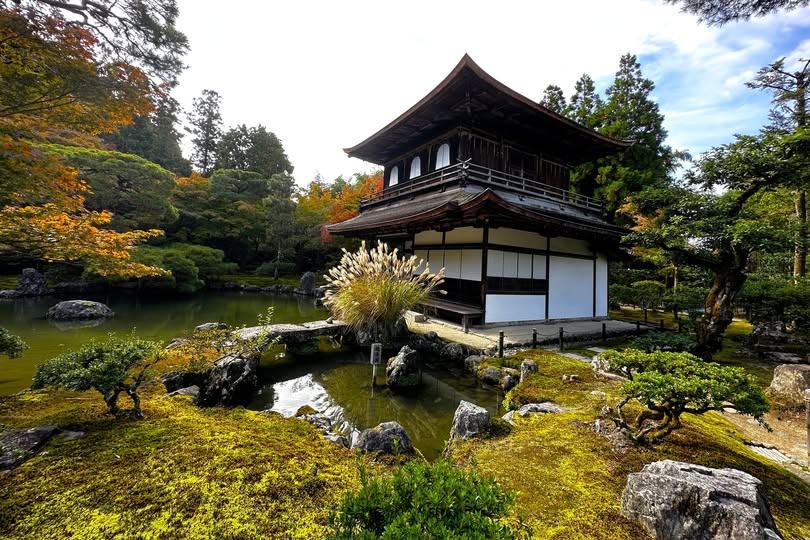
Ginkaku-ji Kyoto UNESCO Site – Kannon-den or “Kannon Bodhisattva Hall”
Making last minute plans for Kyoto? Don’t worry we have you covered with these suggested tours:
Kyoto: Full-Day Best UNESCO and Historical Sites Bus Tour
Kyoto: Heritage Highlights Full-Day Tour
What Is Ginkakuji? Beyond the Silver Name
Ginkakuji, officially known as Jishō-ji (Temple of Shining Mercy), is one of Kyoto’s most recognised Zen temples — and one of its most misunderstood. Many visitors, including me, arrive expecting a silver-clad structure to match its famous golden counterpart across the city. What they find is something far more restrained, and for many, far more rewarding, something that stole my heart.
The temple was built in 1482 by Ashikaga Yoshimasa, the eighth shogun of the Muromachi shogunate. Yoshimasa originally planned to cover the pavilion in silver foil, mirroring the gold-leaf exterior of Kinkakuji, which his grandfather had built. That plan was never completed — historians debate whether the Onin War, personal taste, or financial constraints were to blame.
What resulted instead was a structure that became the defining symbol of wabi-sabi, the Japanese aesthetic philosophy that finds beauty in imperfection, restraint, and the passage of time.
That philosophy shapes every corner of the temple grounds. The Ginshadan, or Sea of Silver Sand, is a meticulously raked expanse of white sand designed to reflect moonlight. The surrounding moss garden layers dozens of varieties of moss across stone, soil, and slope, creating a living, seasonal landscape that changes from month to month.
Ginkakuji is also the cultural birthplace of Higashiyama culture — the aesthetic movement that gave rise to the Japanese tea ceremony, ikebana (flower arrangement), Noh theatre, and the principles of garden design still practised today. Understanding this context transforms a visit from a sightseeing stop into something genuinely meaningful.
This guide is based on my visit in November 2023, not a repackaged overview. I have both the cultural background and the practical detail you need to get the most from your time here in this guide.
Quick Facts: Ginkakuji Temple Kyoto Guide
| Official name | Jishō-ji (慈照寺) |
| Also known as | Ginkakuji, Silver Pavilion |
| Location | 2 Ginkakujicho, Sakyo Ward, Northern Higashiyama, Kyoto |
| Founded | 1482, by Ashikaga Yoshimasa |
| Temple type | Rinzai Zen |
| UNESCO status | World Heritage Site (1994) |
| Philosophy | Wabi-sabi, Higashiyama culture |
| Key highlights | Silver Pavilion (Kannon-den), Ginshadan sand garden, Kogetsudai cone, moss garden, hilltop viewpoint, Togudo hall |
| Best time to visit | Mid-to-late November (autumn foliage); late March–early April (cherry blossom) |
| Nearby | Philosopher’s Path, Honen-in Temple, Nanzenji Temple |
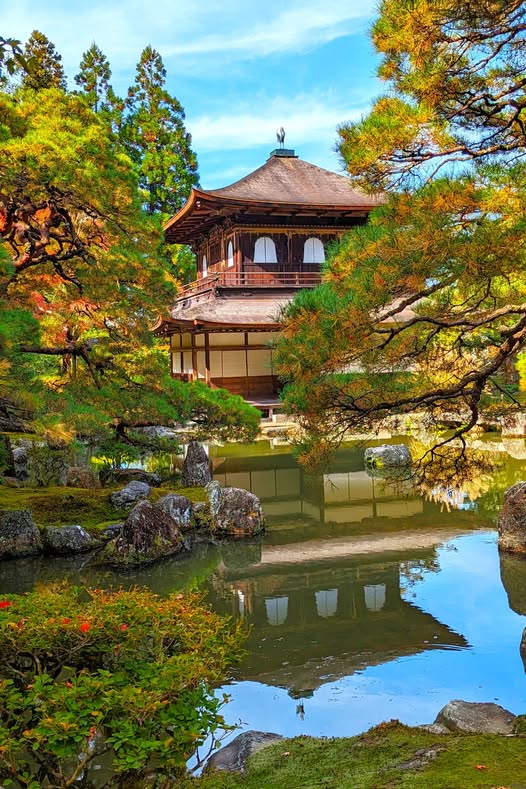
Ginkakuji-Silver Pavilion Kyoto
Walking the Higashiyama Route
Approaching Ginkakuji along the Higashiyama route is part of the experience itself. I got off the bus at the Ginkakuji-michi stop and walked the final ten minutes on foot, passing stone-paved lanes, small craft shops, and the occasional tofu restaurant tucked between old wooden facades.
The closer I got to the temple gate, the quieter the street became. The noise and pace of central Kyoto gave way to something slower — a residential calm punctuated only by birdsong and the soft footsteps of other early visitors. By the time I passed through the main gate, I was already in a different frame of mind.
The temple complex sits at the base of the Higashiyama mountains in Kyoto’s Sakyo Ward. It is part of the Historic Monuments of Ancient Kyoto, a UNESCO World Heritage designation the complex has held since 1994.
The grounds cover several distinct zones, each reflecting a different dimension of the Higashiyama culture that flourished here in the late 15th century. This was not just Yoshimasa’s retirement estate — it was the cultural engine of an era, the place where the Japanese tea ceremony, ikebana, Noh theatre, and the principles of Zen garden design were refined into the forms still practised today.
Walking through in November
The seasonal timing added another layer. The maple trees along the path were deep red and amber. The air was cool and clear. Autumn foliage at Ginkakuji peaks in mid-to-late November. Photographs hardly do justice while capturing the warmth and colors of the gardens in that window. Eyes read the moss, the sand, the water, and the autumn leaves very differently — more textured, more alive.
The route through the grounds follows a loose circuit: you enter past the Ginshadan sand garden and the Silver Pavilion, move into the moss garden and pond path, then climb the hillside trail to a viewpoint above the entire complex. Allow at least 60 to 90 minutes.
Just one piece of advice: Slow down when you are here so that you don’t miss the details that make Ginkakuji worth the visit.
The Silver Pavilion Building (Kannon-den)
The Kannon-den, or Silver Pavilion, is a two-storey wooden structure that has stood on this site since 1482. It is one of only two original buildings to survive a fire that swept through the temple complex in 1550 — a fact that makes it genuinely rare among Kyoto’s historical structures.
Its exterior is dark, unadorned timber. There is no silver leaf, no gilding, no ornamentation of the kind that defines Kinkakuji across the city. What it has instead is proportion, age, and setting. The building sits at the edge of a still pond, and on calm mornings its reflection in the water creates an almost perfect symmetry — the kind of image that feels composed but is entirely natural.
I stood in front of it for longer than I expected to. The weathered wood absorbed the low November light in a way that made the structure look both ancient and settled, as though it had grown from the hillside rather than been built on it. That quality — unhurried, undemonstrative — is exactly what the wabi-sabi aesthetic describes. The Kannon-den arrests your attention.
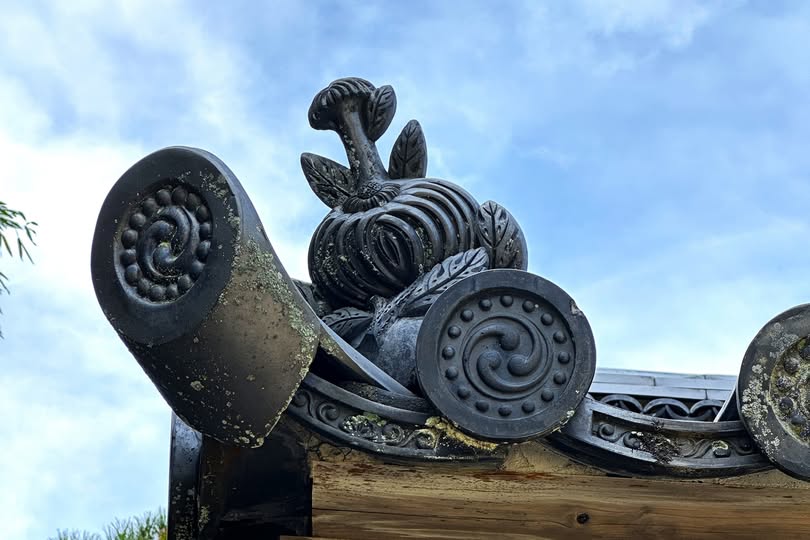
Close-up view of Japanese Kawara roof tiles, featuring intricate spiral patterns
The Ginshadan Sand Garden and the Kogetsudai Cone
The Ginshadan, or Sea of Silver Sand, is the first major feature you encounter after entering the grounds. It is a large, meticulously raked expanse of white sand that extends in front of the Silver Pavilion. The raking creates parallel lines across the surface, representing ocean waves.
In certain light — particularly in the low morning sun of November — the sand takes on a pale luminescence that explains the moonlight theory: the idea that Yoshimasa designed this garden to be viewed after dark, when reflected moonlight would give the sand its silver quality.
Beside the Ginshadan stands the Kogetsudai, a truncated cone of compacted white sand standing approximately 180 cm tall. It is shaped to represent Mount Fuji and is one of the most photographed elements in the entire complex. In November’s crisp light, its clean geometric form cast a shifting shadow across the surrounding sand as the morning progressed. The contrast between the cone’s sharp edges and the soft raked lines around it is deliberate — a study in Zen design that pairs structure with flow.
Together, the Ginshadan and Kogetsudai demonstrate how Ginkakuji’s designers used simple materials — sand, geometry, light — to create a garden that functions as both visual art and philosophical statement.
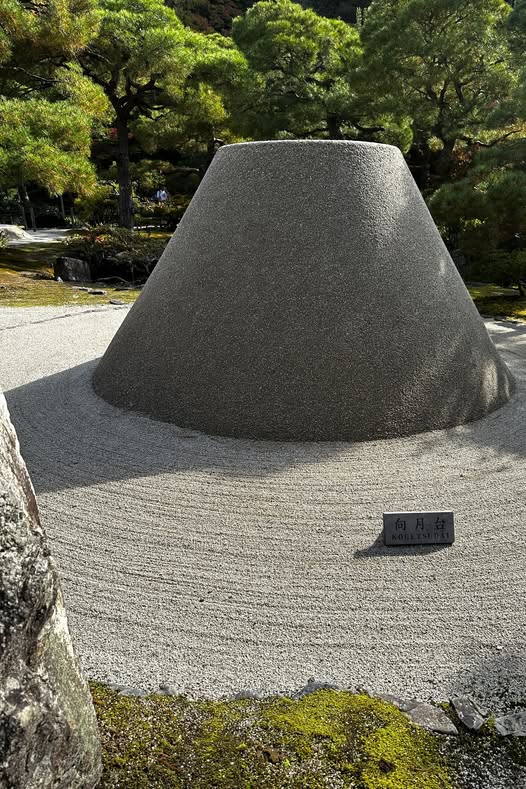
The Kogetsudai Cone is a perfect 2-meter-tall sand mound in the dry Zen garden of Ginkaku-ji (the Silver Pavilion) in Kyoto, Japan
The Moss Garden and Pond Circuit Path
The moss garden is the part of Ginkakuji that I remember the most. It covers the hillside behind the sand garden and extends around a central pond, with a walking path that loops through the entire area. The garden contains dozens of moss varieties, and in November the combination of deep green ground cover and vivid autumn maples overhead creates a colour contrast that is striking without being overdone.
I followed the circuit path slowly. The pond reflected the surrounding trees — reds, oranges, and yellows layered above the green moss bank — and small details kept drawing my attention: a stone lantern half-overtaken by moss, fallen maple leaves resting on the water’s surface, ripples spreading from a point where a leaf had just landed.
The moss garden embodies the Zen concept of impermanence — the idea that beauty is inseparable from change. What you see in November is not what visitors see in April or July. That variability is what gives the garden a quality that no single photograph can fully capture.
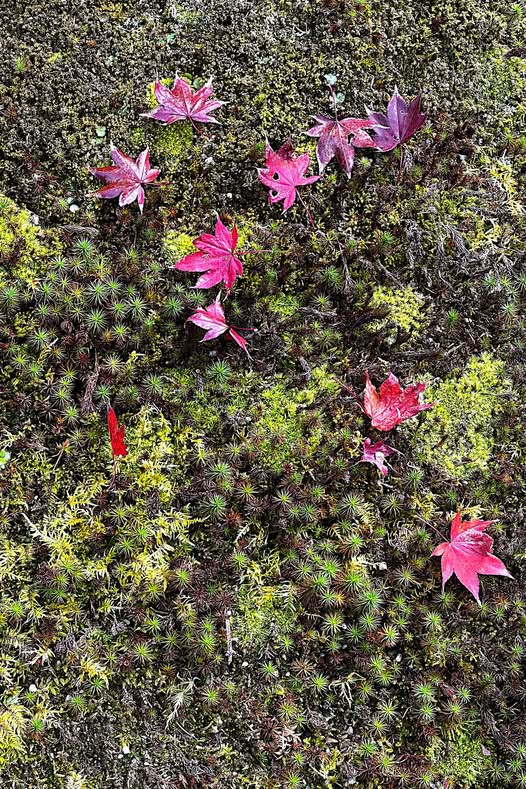
Fallen Maple leaf on Green Moss
The Togudo Hall — Yoshimasa’s Personal Chapel
The Togudo is the second original structure to survive the 1550 fire. Built as Yoshimasa’s private chapel and place of Buddhist practice, the hall contains the Dojinsai — a four-and-a-half tatami mat room. This is credited to be the world’s oldest surviving purpose-built teahouse.
The room is small by any measure. The Dojinsai established the spatial template for the Japanese tea ceremony — the principle that the ritual demands an intimate, stripped-back environment where rank and status are left at the entrance. Yoshimasa’s choice to practice tea ceremony in a space this size, within a temple this restrained, was itself a philosophical statement about the nature of beauty and the value of simplicity.
The Togudo is less visited than the pavilion and sand garden, hence more quiet. Spend time here to fully understand the contemplative side of Higashiyama culture. It is the most instructive corner of the entire complex.
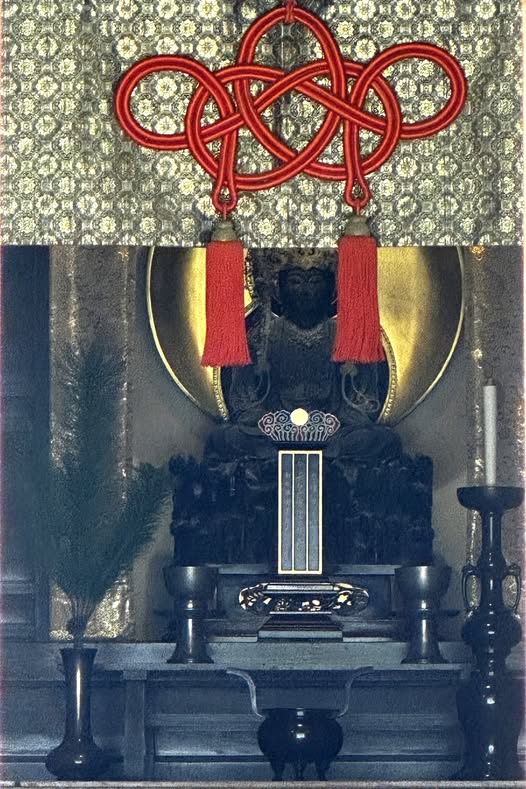
Red decorative knot with tassels for auspicious symbolism. This photograph was taken from a visitor area where photography was permitted; photography is not allowed within the altar area itself.
When to Visit Ginkakuji — Season by Season
Ginkakuji is worth visiting in any season. The grounds, the gardens, and the quality of light all change significantly through the year, and each season offers a genuinely different experience.
Spring (late March – early April)
The approach path and the Philosopher’s Path are lined with cherry trees that form a near-continuous canopy at peak bloom. This is Kyoto’s busiest tourist season overall, and Ginkakuji reflects that — expect queues at opening time and crowds throughout the day. Visiting on a weekday and arriving at 8.30 am gives you the best chance of a quieter circuit.
Summer (June – August)
The moss garden is at its most intensely green during the rainy season and into summer. Humidity is high, but foreign visitor numbers drop noticeably, and the grounds feel more spacious. Early morning visits in summer offer some of the best photography conditions of the year — saturated colours and few people in frame.
Autumn (mid-October – late November)
This is the season I visited, in November 2023. The maple trees turn deep red and amber, the foliage reflects in the pond, and the contrast between warm leaf colour and cool moss green is at its sharpest. Autumn is also the most crowded season. Arrive at opening time or visit in the final hour before closing for quieter conditions and better light.
Winter (December – February)
Snow falls rarely in Kyoto, but when it does, the Ginshadan sand garden becomes a study in white on white — one of the most striking and least photographed versions of the temple. Even without snow, winter is the quietest season by a significant margin. Note that opening hours shift to 9 am from December through February.
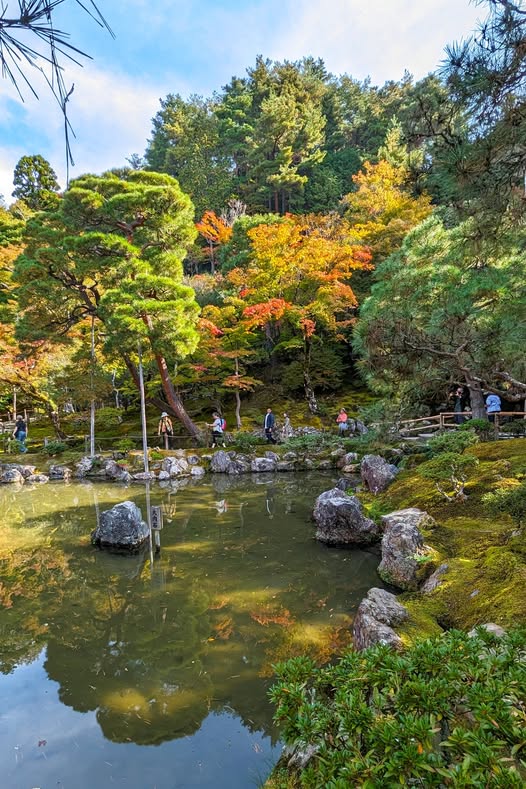
My favorite frame from my visit: Pond Circuit Path Ginkakuji
Ginkakuji Temple — Essential Visitor Information (2026)
Location: 2 Ginkakujicho, Sakyo Ward, Kyoto 606-8402. Northern Higashiyama district, at the northern end of the Philosopher’s Path.
Opening hours:
- March to November: 8.30 am – 5 pm
- December to February: 9 am – 4.30 pm
- Last entry 30 minutes before closing. Open daily.
Admission:
- Adults: ¥500
- Students (elementary through high school): ¥300
- Cashless payments accepted at the ticket counter.
Verify current hours and prices at the official temple website before your visit, as these can change during public holidays or special events.
How to get there:
- From Kyoto Station: Take city bus 5, 17, or 100 to the Ginkakuji-michi stop (approximately 35–40 minutes). Walk 10 minutes to the temple entrance.
- On foot: Walk north along the Philosopher’s Path from the Nanzenji area (approximately 25 minutes).
How long to allow: 60 to 90 minutes covers the pavilion, sand garden, moss circuit path, hilltop viewpoint, and Togudo hall at a comfortable pace.
Practical tips:
- Visit within the first 30 minutes of opening to avoid tour groups, especially during November foliage season.
- Morning light produces the best pond reflections for photography. Tripods are not permitted.
- Wear shoes with grip — the garden paths are uneven and can be slippery after rain or in wet autumn conditions.
- Combine with the Philosopher’s Path walk to Nanzenji for a full Higashiyama half-day.
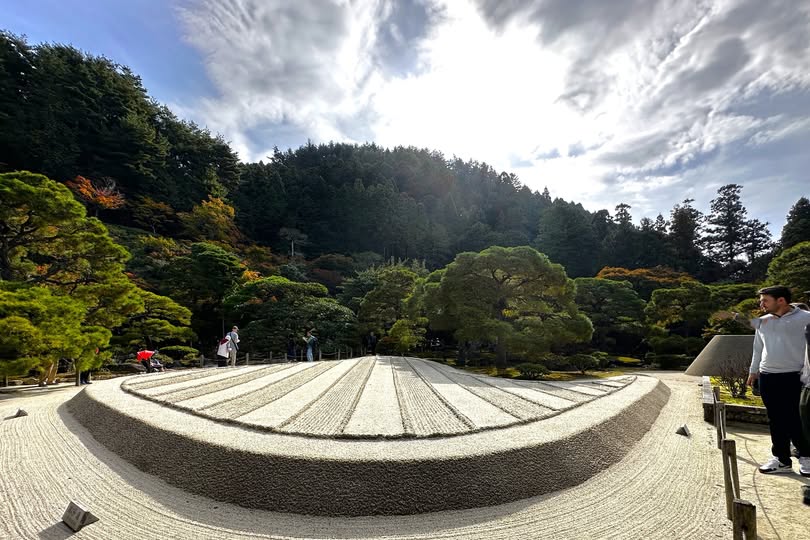
Ginshadan sand pattern representing the sea, Ginkakuji zen garden, Kyoto, Japan
Ginkakuji vs Kinkakuji — Which Should You Visit?
Both temples are on most Kyoto itineraries, and both are worth visiting if time allows. But they are genuinely different experiences, and knowing that difference helps you set the right expectations before you arrive.
| Ginkakuji (Silver Pavilion) | Kinkakuji (Golden Pavilion) | |
| Location | Northern Higashiyama, Sakyo Ward | Kita Ward, northern Kyoto |
| Built | 1482 | 1397 |
| Visual character | Dark timber, restrained, unadorned | Gold-leaf exterior, highly reflective |
| Grounds | Moss garden, sand garden, hilltop trail, pond circuit | Single pond garden, limited walking circuit |
| Philosophy | Wabi-sabi, Higashiyama culture | Kitayama culture, aristocratic grandeur |
| Crowds | Heavy in peak season, manageable early morning | Consistently very crowded throughout the day |
| Cultural depth | High — birthplace of tea ceremony, Noh, garden design | Moderate — primarily architectural landmark |
| Time needed | 60–90 minutes | 30–45 minutes |
| Best for | Atmosphere, cultural context, garden appreciation | Iconic photography, first impression of Kyoto |
My take:
I visited both temples during the same Kyoto trip. Kinkakuji is immediately striking — the gold-leaf reflection in the pond is one of the most visually arresting things I have seen in Japan. But the visit moves quickly. The viewing circuit is short, the crowds are dense, and once you have the photograph, there is not much reason to linger.
Ginkakuji works differently. The moss garden, the sand cone, the hilltop viewpoint, the Togudo hall — each element requires you to slow down and look more carefully. I spent nearly twice as long there without noticing the time passing.
If you can visit only one, the answer depends on what you want. For a dramatic, unmistakable Kyoto image: Kinkakuji. For a more complete understanding of Japanese aesthetics and a quieter experience: Ginkakuji. For most travelers with a genuine interest in culture rather than just sightseeing, Ginkakuji is the stronger choice.
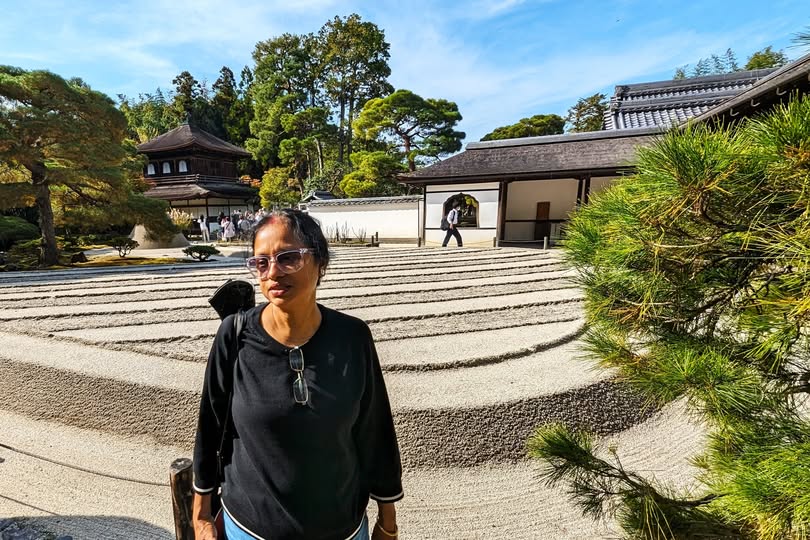
That is me posing in front of Sea of Silver Sand
Photography Tips for Ginkakuji
Ginkakuji rewards patient photography more than fast, wide-angle shots. A few specific approaches work well here.
Sand garden: Shoot the Ginshadan from a low diagonal angle to emphasise the depth of the raked lines. Early morning light — within the first hour of opening — gives the sand a pale glow without harsh shadows. The Kogetsudai cone reads best in side-light, which makes its three-dimensional form clear.
Pond reflections: The Silver Pavilion reflected in the pond is the classic shot. Frame it with autumn foliage on either side if visiting in November. The reflection is sharpest before other visitors disturb the water’s surface — another reason to arrive early.
Moss garden: Work close. The texture of the moss, a stone lantern edge, a maple leaf resting on the surface — these details communicate the garden’s character better than wide establishing shots.
Hilltop viewpoint: Bring a wider lens for the elevated view across the full complex and the Kyoto skyline beyond. This angle is underused and gives a strong orientation shot for any travel post.
Practical rules: Tripods are not permitted anywhere in the grounds. Avoid midday visits for photography — the overhead light flattens the sand garden and washes out the moss. Photography inside the Togudo hall and the pavilion building itself is restricted; check signage on arrival.
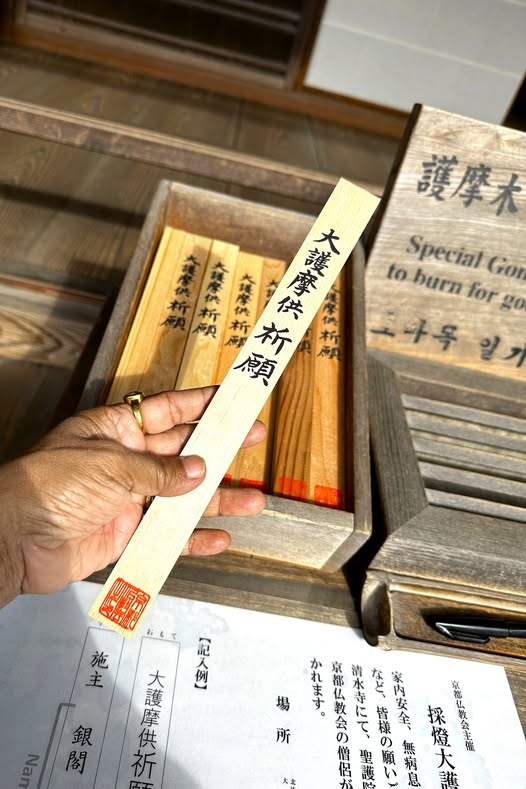
Special Gomagi wood strip to burn for good wishes
FAQ: Visiting Ginkakuji Temple Kyoto
What is the best time to visit Ginkakuji?
Mid-to-late November is the most popular time, when the maple trees turn deep red and amber and the foliage reflects in the pond. Late March to early April offers cherry blossoms along the approach path and the Philosopher’s Path. For either season, weekday mornings — arriving at opening time — give the quietest conditions and the best light for photography.
How long should I spend at Ginkakuji?
Allow 60 to 90 minutes to walk the full circuit at a comfortable pace. This covers the Silver Pavilion, the Ginshadan sand garden, the Kogetsudai cone, the moss garden pond path, the hilltop viewpoint, and the Togudo hall. Rushing through the circuit in 30 minutes means you miss the details that make the temple worth visiting.
Is Ginkakuji worth visiting?
Yes — and for most travelers with an interest in Japanese culture, it is the more rewarding of Kyoto’s two pavilion temples. The moss garden, sand garden, and Togudo hall offer genuine cultural and aesthetic depth. Unlike Kinkakuji, where the visit centres on a single viewpoint, Ginkakuji draws you through a sequence of spaces that takes time to fully appreciate.
Why is the Silver Pavilion not actually silver?
The shogun Ashikaga Yoshimasa originally planned to cover the pavilion exterior in silver leaf when he built it in 1482, mirroring the gold-leaf finish of Kinkakuji. The project was never completed — likely due to the disruption of the Onin War and a shift in Yoshimasa’s aesthetic values toward restraint and simplicity. The name Silver Pavilion was coined later, during the Edo period, as a counterpart to the Golden Pavilion.
Is Ginkakuji less crowded than Kinkakuji?
Generally yes. Kinkakuji consistently draws larger crowds throughout the day due to its visual impact and its position on most organised tour itineraries. Ginkakuji attracts serious visitors rather than passing tour groups, which means the atmosphere is quieter even at peak times. Arriving within the first 30 minutes of opening reduces crowds further at either temple.
Can you combine Ginkakuji with Nanzenji in one day?
Yes — this is one of the most practical full-day routes in Kyoto. Start at Ginkakuji at opening time, then walk south along the Philosopher’s Path (approximately 2 km, 25–30 minutes on foot) to reach Nanzenji. The path passes Honen-in Temple and the Eikando pagoda viewpoint, both worth a short stop. The full route from Ginkakuji to Nanzenji takes a comfortable half-day.
Is photography allowed inside Ginkakuji?
Photography is permitted throughout the temple grounds, including the gardens, the pavilion exterior, and the hilltop viewpoint. Interior spaces — including the Togudo hall — are restricted. Tripods are not permitted anywhere in the complex. Morning visits offer the best conditions: the pond reflection is sharpest before other visitors disturb the water, and the low light suits both the sand garden and the moss textures.
What nearby attractions can I combine with a Ginkakuji visit?
The most natural additions are the Philosopher’s Path, Honen-in Temple, Eikando (Zenrin-ji), and Nanzenji — all connected by the same walking route heading south from the temple gate. For a broader Higashiyama day, Heian Shrine and the covered shopping lanes of Ninenzaka and Sannenzaka are reachable by bus or a longer walk. See the full guide to Kyoto’s best places to visit for a complete itinerary.

Souvenir shop in Ginkakuji Temple complex
Final Thoughts
Ginkakuji was the Kyoto temple I did not expect to like most — and the one I think about most often now that I am home. The Silver Pavilion carries none of the visual drama of its golden counterpart across the city, but that is precisely the point. The moss, the sand, the weathered timber, the stillness of the pond on a November morning — none of it announces itself. All of it stays with you.
If you are building a Kyoto itinerary, northern Higashiyama deserves more than a half-hour stop. Walk the full circuit, climb to the hilltop viewpoint, and give the Togudo hall the attention most visitors walk past. Then continue south along the Philosopher’s Path toward Nanzenji and let the day unfold at that pace.
Ginkakuji does not reward rushing. It rewards showing up early, moving slowly, and paying attention to small things. That is a reasonable definition of travel done well.
Pin and Save this for Later
 Indrani Ghose is an Indian Travel Writer and Blogger based in Bangalore, India. She has written for numerous publications across the globe – including Lonely Planet, The National UAE, Whetstone Asia, Deccan Herald. You can follow her on her social media handles Instagram, Twitter, Pinterest and Facebook to see the wonderful destinations, beautiful offbeat places and get instant updates about them.
Please note: This post may contain affiliate links which means I may earn a commission if you make a purchase by clicking a link on this post. This will be at no additional cost to you. Affiliate links help me keep this website up and running. Thanks for your support!
RELATED POSTS