Legend of Bibi Nachiyar: Why a Muslim Princess is Worshipped in Srirangam
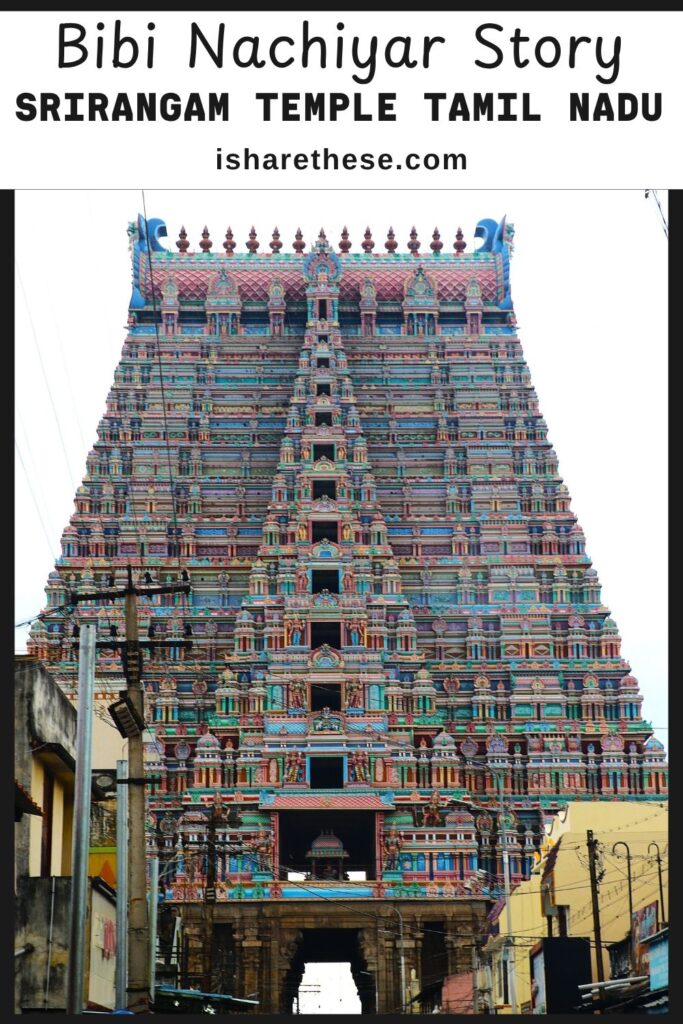
Standing amidst the sprawling seven enclosures of Srirangam, it’s easy to get lost in the sheer scale of the architecture. The Rajagopuram towers over you like a mountain of colored granite, and the air is thick with the scent of jasmine and burning camphor. But as I’ve learned from years of documenting heritage sites, the most profound stories aren’t always found in the tallest towers — they are tucked away in the quiet corners where history and legend blur into something beautiful.
In this blog, I tell you the story of Bibi Nachiyar — a Muslim princess who walked into a Hindu temple and never truly left.
– By Indrani Ghose | March 2026
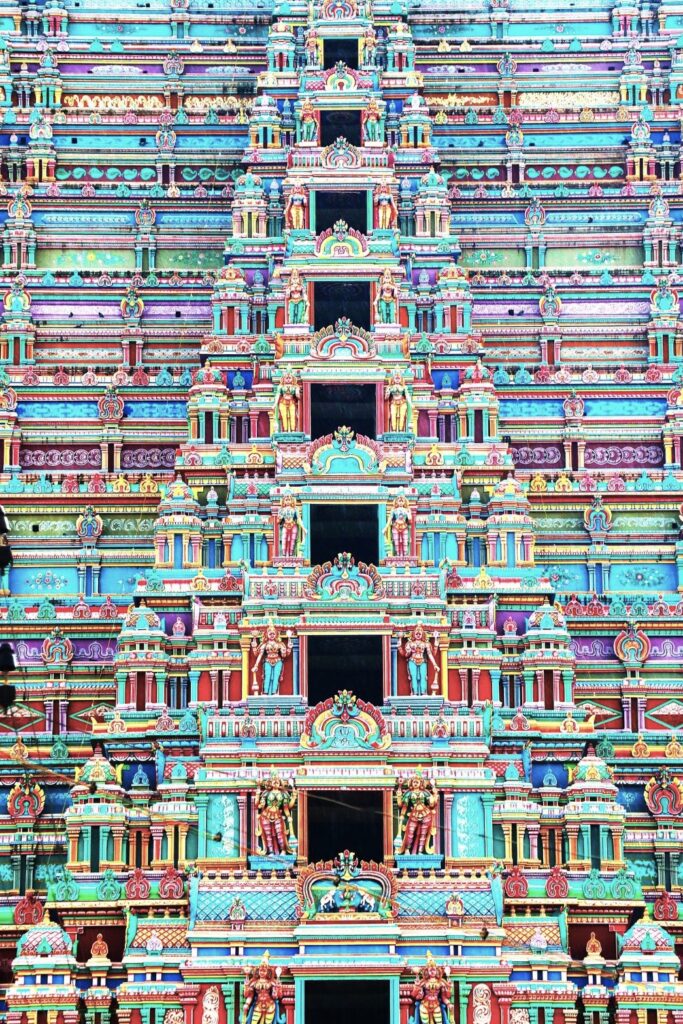
Majestic Rajagopuram of Srirangam
Who is Bibi Nachiyar?
It was a small detail that first caught my attention: a mention of a deity being offered roti and butter in a temple famous for its traditional South Indian prasadam. The deity is none other than Bibi Nachiyar, a Muslim princess. In the heart of one of the world’s most significant Vaishnavite shrines, there is this sanctuary dedicated to a Muslim princess. How and Why? Isn’t it intriguing?
Commonly known as Thulukka Nachiyar — the “Turkic Consort” — her presence here is a rare and moving testament to religious syncretism. She isn’t represented by a traditional stone idol, but by a delicate wall painting: a nod to Islamic traditions that avoid graven images.
Her story is one of the most compelling “lost” narratives of the Deccan, a 14th-century tale of a love that transcended borders, religions, and even the physical realm.
Two Names
She goes by two names, and both are telling. At Srirangam, she is called Thulukka Nachiyar — “Thulukka” being a Tamil-Telugu term for Turkic or Muslim, and “Nachiyar” meaning noble lady or consort. In broader popular usage, she is called Bibi Nachiyar — “Bibi” being a Persian and Urdu honorific for a woman of high birth.
The Legend of Thulukka Nachiyar: From Delhi to Srirangam
To understand why a Muslim princess is enshrined in a Hindu temple, you have to look back at the turbulent history of the 1300s. As I traced the historical timeline through the temple’s inscriptions and oral traditions, the legend began to piece itself together.
The Looting of the Idol — 1311 AD
The story begins with the invasion of the Delhi Sultanate. During the raids led by Malik Kafur, the Utsavar — the processional gold idol of Lord Ranganatha — was seized and carried back to Delhi as a trophy of war. For years, the deity remained in the Sultan’s treasury, far from the banks of the Kaveri.
The Princess and Her “Doll”
Legend has it that the Sultan’s daughter, Surathani, found the idol among the spoils of war. Unaware of its divine significance, she was captivated by its beauty and began to treat it as a beloved companion — some say a doll, others say a spiritual lover. She became inseparable from the golden image, showering it with the same affection and rituals she would a living prince.
The Retrieval and the Ultimate Sacrifice
Back in Srirangam, the devotees were heartbroken. A group of sixty dedicated temple singers and dancers eventually traveled to Delhi, performing for the Sultan and winning his favor. As a reward, they asked for the return of the idol. The Sultan agreed — but when the princess discovered her “doll” was gone, her grief was inconsolable.
She set out on a grueling journey from Delhi to Srirangam to reclaim her beloved. However, by the time she reached the temple gates, the idol had been safely reinstalled. The legend reaches its climax here: upon reaching the sanctum, the princess did not find a statue. She simply collapsed and merged into the light of the deity, attaining moksha — liberation.
To honor this devotion, the temple priests did not cast her story aside. Instead, they recognized her as a consort of the Lord — ensuring that even today, she remains an eternal part of the Srirangam tradition.
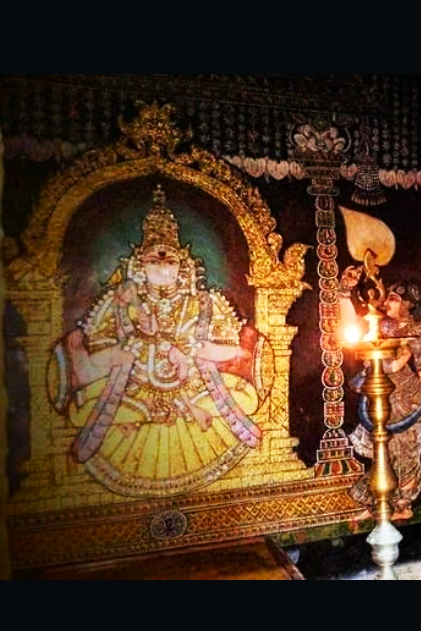
Bibi Nachiyar painting at Srirangam temple – The Muslim princess and consort of Lord Ranganatha in South Indian temple tradition.”
Namperumal: The Lord Who Traveled to Delhi
To understand how this legend fits into the physical reality of the temple, there is a technical distinction that every heritage lover should know. The deity that was carried away to the Sultanate was not the massive, immovable reclining form of Aranganathar (the Moolavar) who resides eternally in the inner sanctum.
Instead, it was Namperumal—the Utsavar, or processional idol.
Namperumal literally translates to “Our Lord,” a name given by the devotees who refused to let him go. While the main sanctum remained a silent witness to the invasions, it was this smaller, golden form that made the arduous trek to the North and back.
The return from Delhi was not a swift one. The idol is said to have rested at several temples along the long route south, some of which still celebrate this association in their own festival calendars. By the time Namperumal reached Srirangam and was reinstalled on the banks of the Kaveri, the journey had taken on the quality of a pilgrimage in reverse.
Seeing Namperumal in procession today, draped in silks and surrounded by chanting crowds, it is hard not to think of him as a seasoned traveler who finally found his way home—and brought a princess back with him.
Unique Rituals in Srirangam
Roti and Lungi
Of all the ways Srirangam honors Bibi Nachiyar, two stand out.
The first is the food.
Every day, in a temple where the standard prasadam is pongal, tamarind rice, and sweet pongal prepared according to Agamic tradition, a separate offering of wheat roti, butter, and sugar is prepared and placed before the Thulukka Nachiyar mural.
It is cooked in the Mughalai style — not as an approximation, but as a faithful replication of the food she would have eaten in Delhi. The offering is made before the main prasadam distribution begins, preserving a subtle hierarchy: she is fed first.
The second is the clothing.
On designated days — particularly during the Panguni Uthiram festival and certain other observances — Lord Ranganatha himself is dressed not in the traditional white or silk dhoti of a Vaishnava deity, but in a coloured lungi.
The lungi is associated with everyday Muslim male dress in South India. The priests do not explain it. It is simply done, as it has been done for centuries, because the tradition holds that the Lord dresses this way out of affection for her — the way a person might adopt the habits of someone they love.
The Princess’s Place: Why Panguni Uthiram is Her Most Sacred Day
The most vivid expression of her place in the temple calendar comes during Panguni Uthiram, the major spring festival celebrated in the Tamil month of Panguni (March–April). While this is the day of the famous Serthi Seva—the grand reunion of the Lord and Goddess Ranganayaki—Thulukka Nachiyar is formally honored alongside the other consorts.
On this day, her roti and butter offering is made with special ceremony, and her status within the temple hierarchy is publicly affirmed. For one day each year, the theological question the temple refuses to answer directly is answered through ritual: she belongs here.
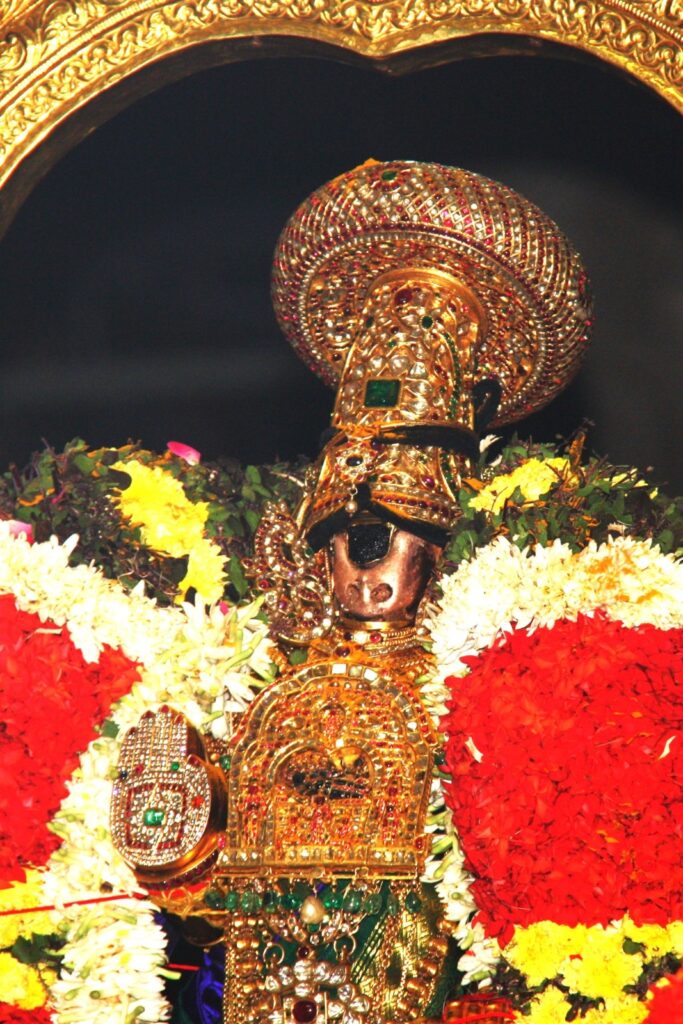
Detailed close-up of the Namperumal Utsavar idol at Srirangam Temple, showing the intricate craftsmanship and shiny golden surface of the processional deity.
Srirangam vs. Melkote: Two Versions of the Same Story
During one of my travels through the heritage corridors of South India, I discovered that the legend of the Sultan’s daughter isn’t unique to Srirangam. About 300 kilometers away, at the hilltop Cheluvunarayana Swamy Temple in Melkote, Karnataka, a strikingly similar story exists — though the way she is honored in each location reflects the distinct local traditions and the different eras in which these legends were crystallized.
At Melkote, the retrieval of the idol is attributed not to a band of temple performers, but to the philosopher-saint Sri Ramanujacharya himself, who according to tradition journeyed to Delhi to recover the utsava-murti of Lord Cheluvunarayana.
The princess — known here most commonly as Bibi Nachiyar or Beevi Nachiyar — is said to have followed him all the way back to Karnataka. She collapsed and merged with the deity the moment she saw the reinstalled idol, and to this day her small bronze form rests at the feet of Lord Cheluvunarayana — where, uniquely, the priest waves the lamp before her first, before proceeding to worship the main deity.
| Feature | Srirangam — Ranganathaswamy Temple (Tamil Nadu) | Melkote — Cheluvunarayana Swamy Temple (Karnataka) |
| Local Name | Thulukka Nachiyar (“Turkic Consort”) | Bibi Nachiyar / Beevi Nachiyar (also: Sultani Naachiyaar) |
| Physical Form | A wall painting — honouring Islamic traditions against graven images | A small bronze idol, placed at the feet of the main deity |
| Ritual Precedence | Roti and butter are offered to the Nachiyar first, then to Lord Ranganatha | The lamp is waved before Bibi Nachiyar’s idol first, before worship of the main deity proceeds |
| Food Offerings | Wheat roti, butter, and sugar — cooked Mughalai style; offered on Ekadasi and new moon days | Chapati, butter, and traditional North Indian food — mirroring the Srirangam practice closely |
| Deity’s Attire | Lord Ranganatha wears a coloured lungi instead of the traditional white dhoti on designated days | On special occasions, Lord Cheluvunarayana is also dressed in a lungi and Muslim-style regalia |
| Historical Link | Associated with Malik Kafur’s invasion of 1311 AD and the looting of the Srirangam idol | Associated with Ramanujacharya’s journey to Delhi to retrieve the stolen Melkote utsava-murti (see note below) |
A Historical Note on the Melkote Legend:
The tradition at Melkote links the idol’s retrieval to Sri Ramanujacharya, who is believed to have lived approximately 1017–1137 CE. However, the Delhi Sultanate — from whose treasury the idol was allegedly recovered — was not established until the early 13th century. Scholars have noted this as a well-known anachronism within the legend.
Similar Tulukka Nachiyar stories appear across multiple Vaishnava temples in South India — including the Meenakshi Amman Temple complex in Madurai, where a comparable tradition of honoring a Muslim woman’s devotion exists.
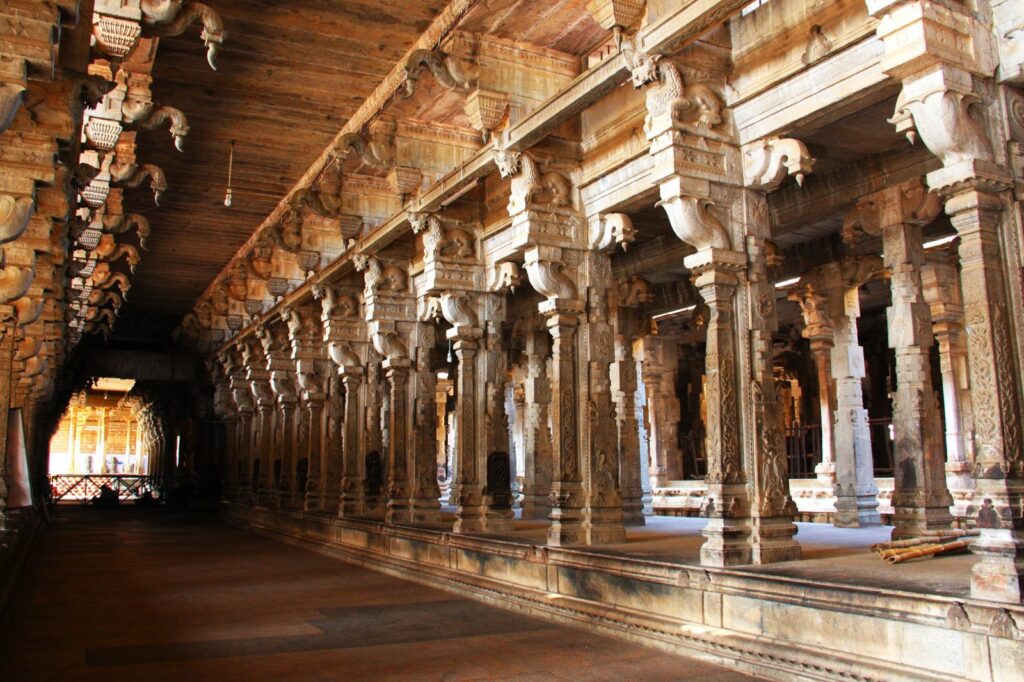
Walking through the second enclosure of Srirangam toward the sanctum where legend of Bibi Nachiyar unfolds
Practical Visitor’s Guide — 2026 Edition
Navigating the world’s largest functioning temple can be overwhelming. Here are the essential logistics, fact-checked and current for 2026.
Timing Your Visit
The temple is generally open from 6 AM to 9 PM, but the sanctum follows a rhythm of ritual closures throughout the day. The four darshan windows are as follows:
- Dawn (Best for serenity): Viswaroopa Seva, 6 AM – 7.15 AM. Tickets are ₹100 per person, limited, and available at the temple counter. The deity is ceremonially awakened with drum beats and hymns — the most spiritually charged moment of the day. Arrive by 5.30 AM on weekdays to secure a ticket.
- Morning break: The inner sanctum closes 7.15 AM – 9 AM for exclusive rituals, then reopens for general darshan from 9 AM to 12 PM.
- Midday closure: The inner sanctum closes again from 12 PM to 1.15 PM for the afternoon pooja, then reopens from 1.15 PM to 6 PM. Afternoon darshan on weekdays is generally the most crowd-free window after the dawn seva.
- Evening glow: 6.45 PM – 9 PM. The illuminated gopurams are beautiful at this hour, though crowds peak on weekends.
Entry Fees and Darshan Tickets
General darshan is free. For those wishing to avoid long queues, the temple offers paid sevas: the Viswaroopa Seva is ₹100 per person, the Quick Seva (priority darshan) is ₹250 per person, and the Mangala Harthi (lamp-lighting ceremony) is ₹500. Tickets can be booked online through the official TNHRCE portal at srirangamranganathar.hrce.tn.gov.in — online booking is recommended, especially during festival season.
Dress Code
Men should wear a dhoti or veshti; women should wear a saree or salwar kameez. Shorts, jeans, and sleeveless outfits are not permitted in the main sanctum. Traditional attire can be rented at the temple premises if needed.
For Foreign and Non-Hindu Visitors
Srirangam is deeply welcoming but maintains sacred boundaries. Non-Hindus are not permitted to enter the sanctum sanctorum, and entry is typically restricted to the second enclosure. The outer prakarams contain extraordinary architecture — the Thousand Pillar Hall, the Garuda Mandapam, and the Rajagopuram itself are all accessible. Budget at least 45 minutes for the Thousand Pillar Hall alone — no two pillars carry the same carving.
Finding Bibi Nachiyar
She is not in a typical stone shrine and easy to miss. Her mural is located within the inner corridor enclosures. Ask a temple guide or a priest to point you toward the Thulukka Nachiyar shrine, as the exact passage can change depending on which poojas are in progress. Look for the small lamp and the distinctive daily offering of roti and butter placed on a brass plate — a quiet, unmistakable departure from the temple’s usual prasadam.
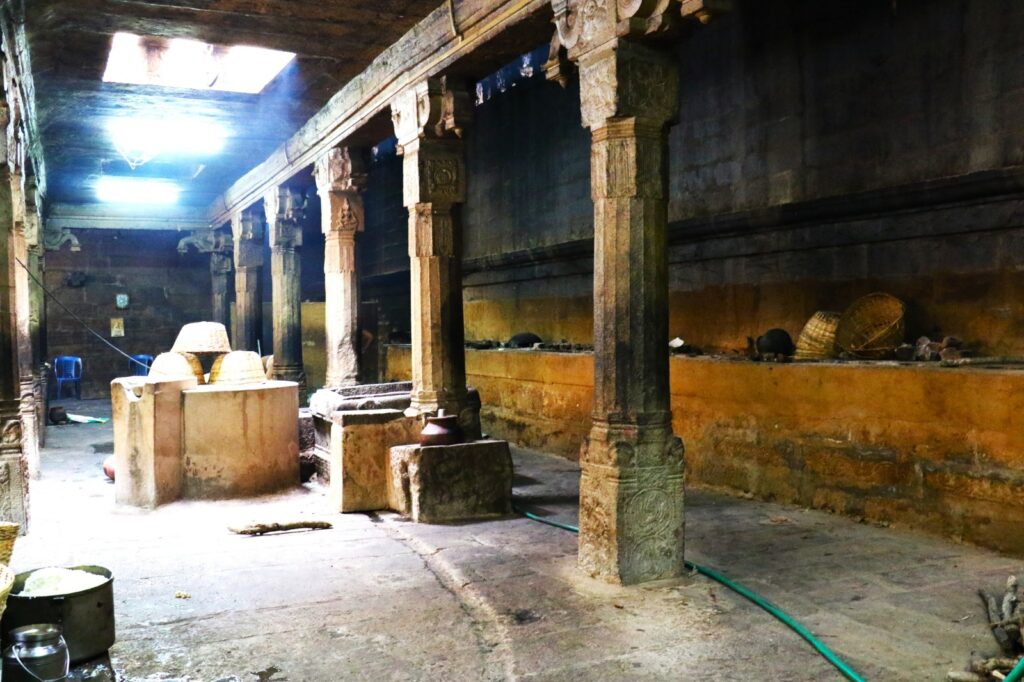
Kitchen inside Srirangam Temple
FAQ on Bibi Nachiyar Srirangam
Is there an entry fee?
General entry to the temple complex is free. The Quick Seva (priority darshan) costs ₹250, and the Viswaroopa Seva ₹100. Free darshan is also available, but queue times of 2–4 hours are common on weekends and festival days.
Can I take photos?
Photography and videography are strictly prohibited inside the temple. Mobile phones must not be used for photography near the sanctum. Footwear must be deposited outside, at a cost of approximately ₹5. Photography of the outer gopurams and mandapams from the enclosure grounds is generally permitted.
How do I get here?
The temple is 1 km from Srirangam Railway Station and 9 km from Tiruchirappalli (Trichy) Junction. Note that only selected trains stop at Srirangam station itself — most travelers arrive at Trichy Junction. Buses run to the temple from Trichy every few minutes throughout the day. Uber and Ola operate in Trichy for a fixed-price auto or cab ride to the temple.
Is the temple accessible for senior citizens?
The temple administration maintains separate, shorter queues for senior citizens and the differently-abled at the main darshan counters — ask at the Southern Rajagopuram entrance. For any specific mobility aid arrangements, it is advisable to confirm directly with the temple at 0431-243-2246, as these can vary by day.
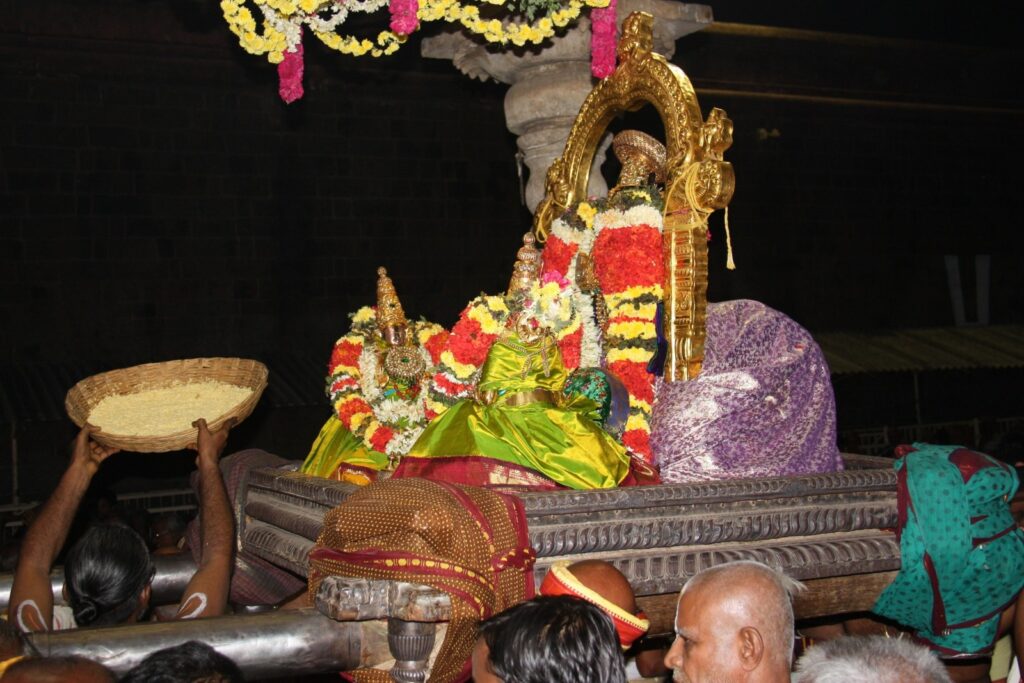
Wide-angle view of the Namperumal deity during a festival procession at Srirangam Temple, surrounded by crowds of devotees in the historic temple corridors.
Final Thoughts
Srirangam is a temple that has survived invasions, the rerouting of rivers, and seven centuries of dynasties. And yet, what has endured most stubbornly within its walls is not the gold or the granite—it is a story about a girl who loved something so completely that the universe had no choice but to make room for her.
Bibi Nachiyar doesn’t fit neatly into any single religious narrative, and that is precisely why she matters. When you stand before her mural and watch the roti and butter being laid out, you realize that some prayers don’t need a translation. They just need to be felt.
Have you ever stumbled upon a legend that felt more ‘real’ than the history books? I’d love to hear about the hidden stories you’ve discovered in your travels—let’s talk in the comments below.
Pin and Save this for Later
About the Author
 Indrani Ghose is a cultural travel writer and heritage documentation specialist with over 15 years of experience exploring and writing about temples across India and Southeast Asia. Having visited over 150 sacred sites, she brings both scholarly depth and personal narrative to heritage travel writing.
Her work has been published in Lonely Planet, The National (UAE), Whetstone Asia, Deccan Herald, and various architecture and heritage journals.
Connect with Indrani: Follow Indrani on Instagram | Twitter | Facebook for heritage travel insights, photography tips, and offbeat destination discoveries.