Multi-Dynastic History of Bhoganandishwara Temple: Tracing 1,000 Years
Standing at the foothills of Nandi Hills, the Bhoganandishwara Temple isn’t just a monument—it’s a palimpsest of South Indian dynastic ambition, spiritual continuity, and architectural evolution spanning over a millennium.
During my first visit in March 2023, I realized this temple could eloquently narrate the rise and fall of empires if stones could speak. Drawn by its unspoken words, I revisited in October 2025. As a travel writer and cultural explorer who’s documented over 150 temples across India, I’ve learned that understanding the multi-dynastic history of Bhoganandishwara Temple isn’t just enriching—it’s essential to appreciating what makes this site extraordinary.
From the Nolamba and Bana dynasties (9th century) to the Cholas, Gangas, Hoysalas, and finally the Vijayanagara rulers (16th century), every ruling power added a new dimension — making Bhoganandishwara one of the most evolved examples of Dravidian temple construction in Karnataka. Unlike temples built by a single dynasty, this complex tells a collaborative story where each era honored the past while adding its own architectural signature.
This is Part 2 of our comprehensive Bhoganandishwara Temple series. New here? Start with our Complete Visitor Guide for practical information and temple overview.
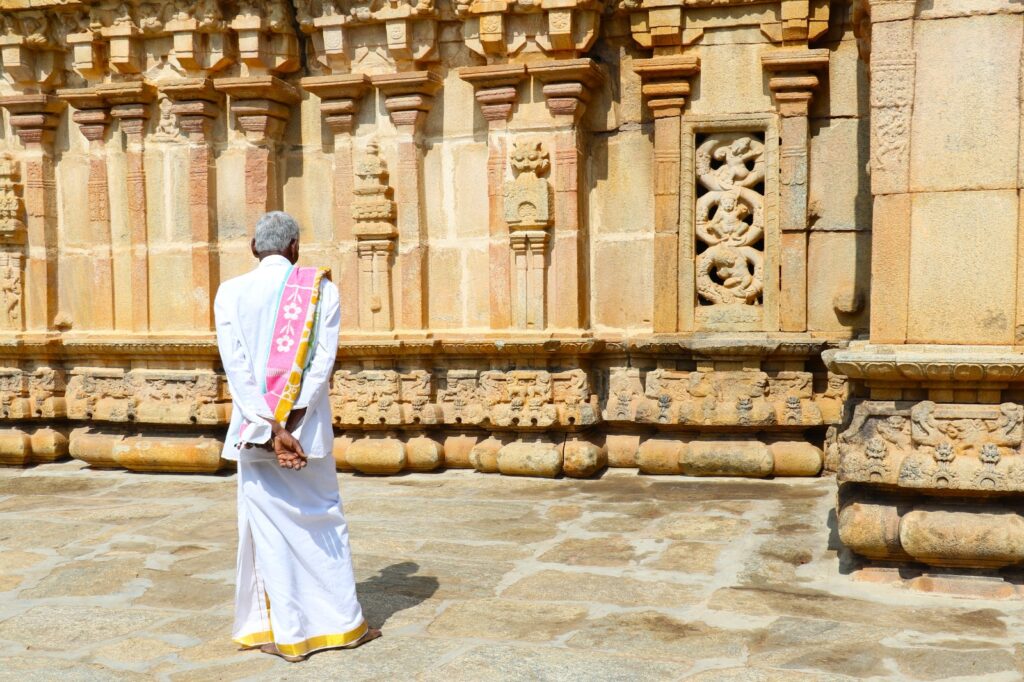
Understanding Bhoganandishwara Temple History
Understanding Multi-Dynasty Temple Evolution
Before diving into specific periods, it’s worth understanding what makes multi-dynasty temples historically significant.
Why This History Matters:
- Most temples are products of a single dynasty (like Thanjavur’s Brihadeeswarar = purely Chola)
- Multi-dynasty sites are rare because conquerors often demolished predecessors’ structures
- Bhoganandishwara’s collaborative evolution across seven centuries is exceptional
- Each layer can be “read” architecturally — different carving styles, construction techniques, materials
According to the Archaeological Survey of India’s documentation, Bhoganandishwara represents one of Karnataka’s best-preserved examples of architectural continuity, where successive rulers expanded rather than erased their predecessors’ contributions.
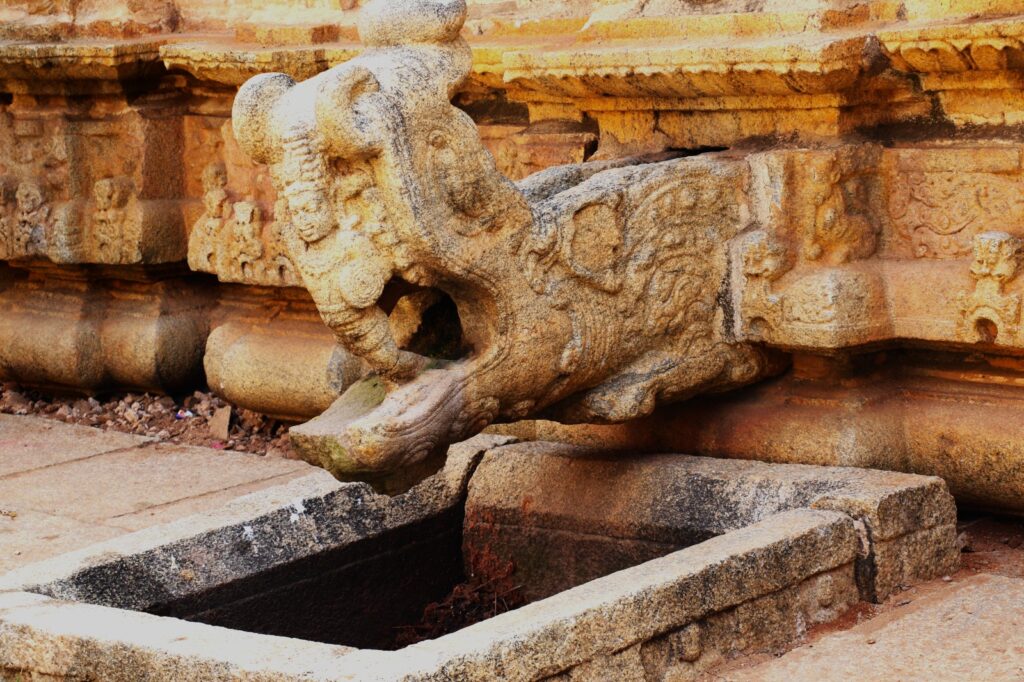
Makara Pranala (drain) – Dravidian temple construction in Karnataka
The Foundational Era (9th Century): Nolamba and Bana Dynasty Origins
The Temple’s Birth Under Nolamba Patronage
The Bhoganandishwara Temple history begins in the 9th century CE under the Nolamba dynasty, who ruled this region as vassals of the mighty Rashtrakutas. The Nolambas were devout patrons of Shaivism (worship of Lord Shiva), and it was during their reign that the original sanctum of Bhoganandishwara was constructed.
According to inscriptions documented by the Archaeological Survey of India, the adjoining Bana dynasty, ruling from their nearby strongholds around the Nandi Hills region, also played a significant role in temple endowments and expansion. While the Nolambas provided the spiritual vision, the Banas contributed resources and territorial protection that allowed the temple to flourish.
Architectural Characteristics of the Nolamba Period
The early phase reflects classic Dravidian simplicity:
Structural Features:
- Solid granite walls (locally sourced from Nandi Hills region)
- Square sanctums (garbhagrihas) with thick walls for structural stability
- Restrained ornamentation — focus on geometric precision over decorative excess
- Simple pyramidal vimanas (towers) with minimal sculptural embellishment
- Basic mandapas (halls) with sturdy, adorned pillars
Design Philosophy: Unlike the later decorative additions, these initial structures were austere, focusing on symmetry, proportion, and sacred geometry rather than surface ornamentation. The Nolamba builders prioritized permanence and spiritual essence over artistic showmanship.
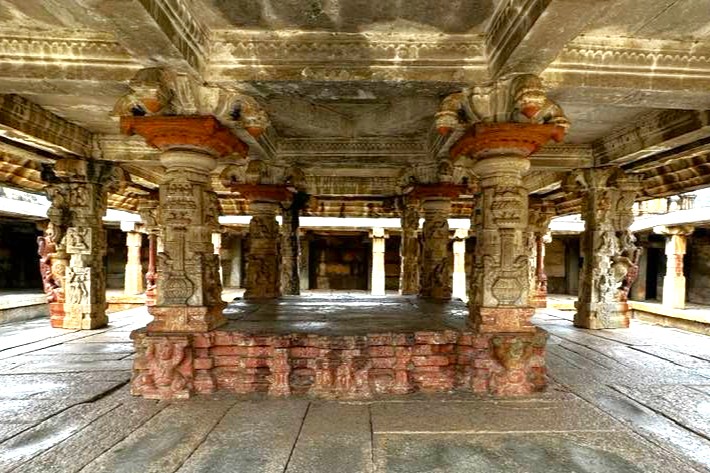
Mandapa with adorned pillars – History of Bhoga Nandeesvara Temple
A Personal Encounter with the Oldest Sections
When I first traced my fingers along those weathered granite blocks at the temple’s oldest section during my March 2023 visit, I could immediately feel the difference in texture compared to later additions — rougher, more honest, less concerned with ornate flourishes. The stone felt ancient under my palm, worn smooth by centuries of monsoons and countless devotees’ touches.
Yet, even in this restraint, one can sense the grandeur of intent — a sacred geometry designed to echo the permanence of faith. The local guide who accompanied me that day mentioned that these foundation walls have survived earthquakes, invasions, and centuries of weathering precisely because of their robust, no-nonsense construction.
Historical Context: The 9th century was a period of relative stability in the region under Rashtrakuta overlordship, allowing vassal dynasties like the Nolambas to invest in religious architecture. Their temple-building reflected both devotion and political legitimacy — constructing a Shiva temple established their authority as righteous rulers.

Nandi Shrine inside Bhoganandishwara Temple
The Chola and Ganga Influence: Artistic Refinement (10th to 11th Century)
Chola Architectural Precision Arrives
By the 10th and 11th centuries, the Cholas extended their influence into the Karnataka region as their empire expanded northward from Tamil Nadu. Known for their mastery in temple architecture (as magnificently evidenced in Thanjavur’s Brihadeeswarar Temple, a UNESCO World Heritage Site), the Cholas brought a new level of artistic sophistication to Bhoganandishwara.
Chola Contributions:
- Intricate stone carvings: Lotus medallions, narrative friezes depicting mythology
- Yali motifs: Mythical lion-like creatures that became signature Chola elements
- Refined vimanas: Taller, more elaborately tiered towers with sculptural detailing
- Bronze iconography: Introduction of bronze casting techniques for deity representations
- Precision in proportion: Mathematical accuracy in architectural ratios
The outer walls and sub-shrines of Bhoganandishwara began to reflect this Chola precision. Where Nolamba walls were plain, Chola artisans added bands of lotus medallions. Where earlier pillars were simple, Chola sculptors carved mythological narratives and decorative scrollwork.
Western Ganga Dynasty: Ritual and Spatial Expansion
Around the same period, the Western Ganga dynasty (not to be confused with the Ganges River region) contributed to the temple’s ritual and structural enrichment from their base in southern Karnataka. The Gangas were particularly interested in creating communal religious spaces.
Ganga Contributions:
- Open mandapas: Large pillared halls for congregation and ceremonies
- Water management: Early development of the temple tank system
- Processional pathways: Circumambulatory corridors (pradakshina paths)
- Subsidiary shrines: Smaller shrines for associated deities
This era marked the beginning of Bhoganandishwara’s transformation from a simple shrine to a complex of interconnected shrines, courtyards, and water tanks — the temple was becoming a social and spiritual hub, not just a place of private worship.
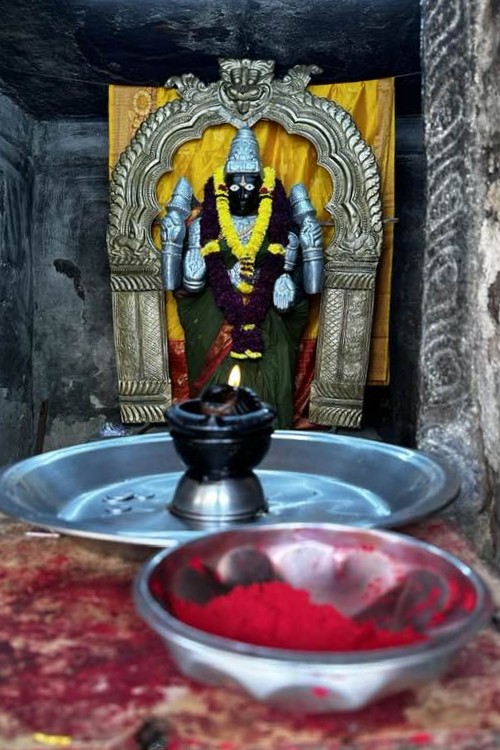
Apita-kuchamba Shrine in Bhoganandishwara Temple
Reading the Architectural Layers
During my October 2025 visit, a pujari there pointed out how you can literally “read” the walls chronologically — the simpler Nolamba base stones at ground level, the intricate Chola additions at mid-height with their characteristic lotus patterns, and the later Hoysala embellishments crowning the structures.
It’s like an architectural family tree etched in stone. Standing before these layered walls, I was reminded of tree rings (dendrochronology) — each dynasty adding another ring of growth, each retaining the integrity of what came before. This visible stratigraphy is what makes Bhoganandishwara invaluable for architectural historians.
Comparative Context: This period (10th to 11th century) was the golden age of Chola power. While they were building their grandest temples in Tamil Nadu, they simultaneously enhanced existing temples in their northern territories, spreading their architectural innovations across South India.
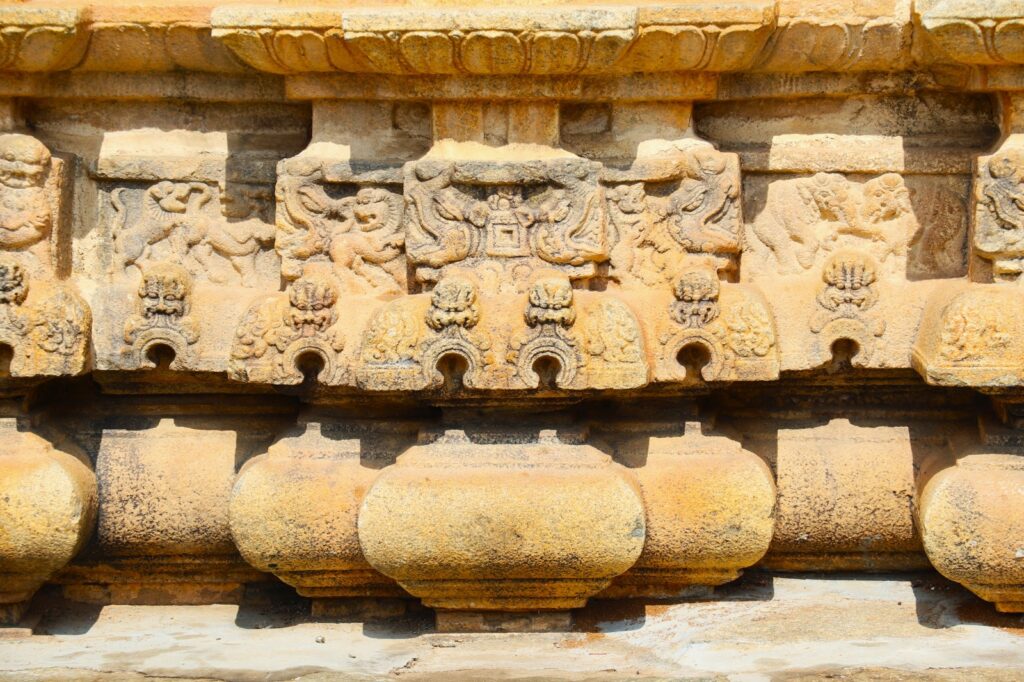
Multi dynasty architectural layers in Bhoganandishwara Temple
Hoysala Period Masterpiece: The Golden Age (12th to 13th Century)
When Craftsmanship Became Art
The Hoysala dynasty (12th to 13th century CE) ushered in what many consider the golden age for Bhoganandishwara Temple architecture. Renowned for their intricate craftsmanship seen across Belur’s Chennakeshava Temple, Halebidu’s Hoysaleswara Temple, and Somnathpur’s Keshava Temple (all now UNESCO-recognized), the Hoysalas expanded the Bhoganandishwara complex with their signature style.
Hoysala Architectural Innovation:
- Soapstone artistry: Softer stone allowing for incredibly fine detailing
- Lathe-turned pillars: Pillars shaped with such precision they appear machine-made
- Sculptural storytelling: Every surface narrates mythological tales
- Bracket figures: Madanikas (celestial maidens) supporting ceiling beams
- Star-shaped platforms: Complex geometric temple bases
The Kalyana Mantapa: A Hoysala Masterpiece
Their most celebrated addition to Bhoganandishwara is the Kalyana Mantapa (marriage pavilion), which remains the architectural highlight of the entire temple complex even today.
Architectural Features:
- Ornate lathe-turned pillars: So precisely carved they appear turned on a modern lathe
- Celestial dancers (apsaras): Carved in exquisite detail with flowing garments and jewelry
- Floral scrollwork: Intricate vine patterns covering ceilings and beams
- Divine union scenes: Symbolic representations of Shiva and Parvati’s eternal bond
- Yali pillars: Lion-like mythical creatures displaying exceptional sculptural detail
The Yali motifs on the pillars display exceptional craftsmanship typical of Hoysala aesthetics, and even today, they glisten softly when sunlight filters through the stone lattice at certain hours.
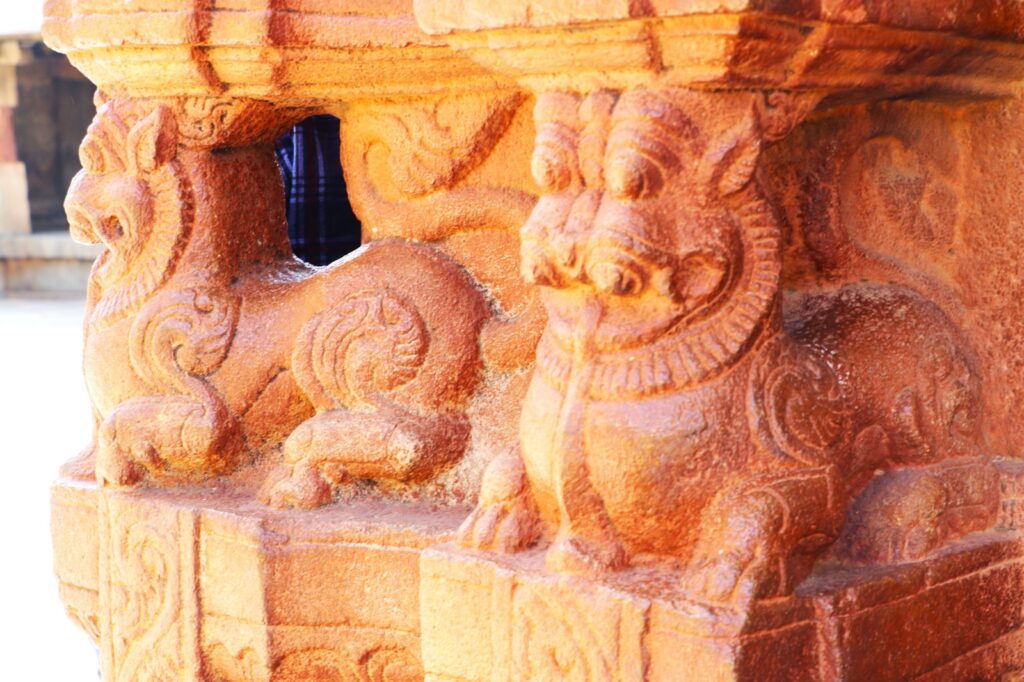
Hoysala Yali Sculptures
A Ritual Witnessed: History Comes Alive
During my March 2023 visit, I witnessed the temple pujaris conducting a homam (fire ritual) and yagna for a family function inside the Kalyana Mantapa. Standing close to the ancient pavilion, I could see the intricate carvings up close — each fold of a dancer’s garment, each petal of the lotus motifs carved with a precision that made me wonder about the artisans who spent months, perhaps years, perfecting these details.
The priests explained that the Kalyana Mantapa is still used for marriage ceremonies today, just as it was designed for centuries ago. Watching the sacred fire burning beneath those 800-year-old carvings, seeing modern families participating in rituals in a space built for the same purpose eight centuries prior — it was profoundly moving.
It’s one thing to read about Hoysala craftsmanship in textbooks; it’s another to stand beneath it, hear the Sanskrit chants echoing off intricately carved ceilings, and feel humbled by human dedication across time.
Historical Context: The Hoysalas ruled during a period of relative peace and prosperity in Karnataka (12th-13th century), allowing them to focus on artistic pursuits. Their rulers were great patrons of arts, and their court included master sculptors and architects whose work set standards for South Indian temple architecture.
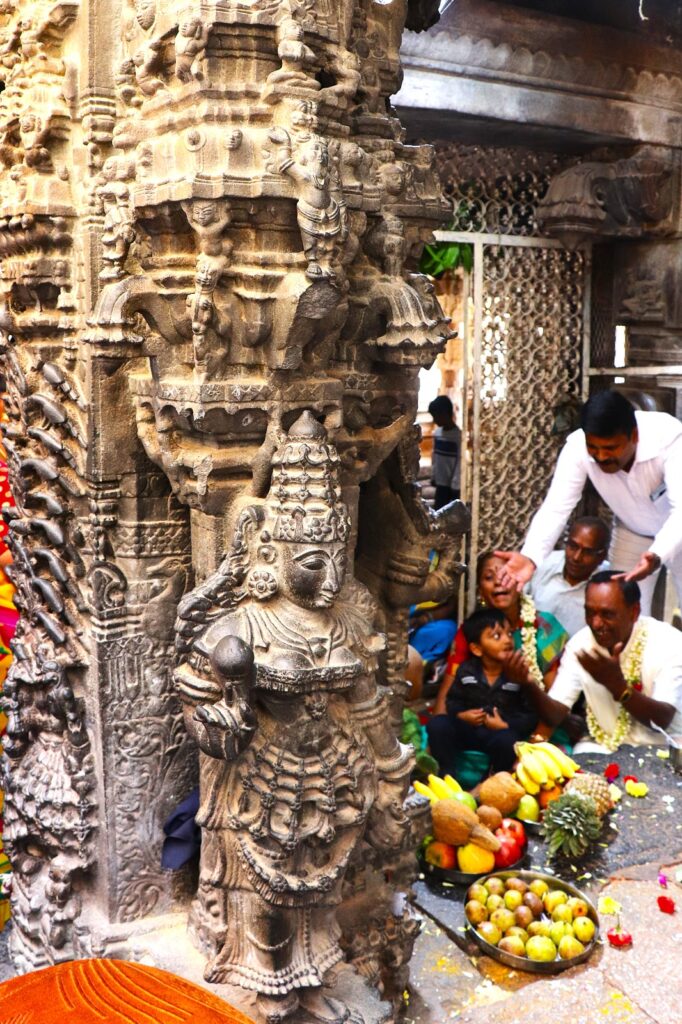
Rituals in Kalyana Mantapa
Vijayanagara Legacy: Monumental Scale (14th to 16th Century)
The Final Major Dynasty
By the 14th to 16th centuries, the Vijayanagara Empire had risen to become one of South India’s most powerful states, and Bhoganandishwara Temple entered yet another phase of transformation. The rulers of this era were known for their monumental vision (as magnificently demonstrated in the grand ruins of Hampi, their capital and now a UNESCO World Heritage Site).
Vijayanagara Contributions:
- Grand courtyard: Spacious open areas for large congregations
- Gopurams (entrance towers): Tall gateway structures with multiple tiers
- Pillared corridors: Long colonnades connecting various sections
- Temple tank expansion: Enhancement of the sacred pushkarini
- Fortification elements: Protective walls and structures
- Vasantha Mantapa: Open pavilion near the water tank
Architectural Characteristics
The Vijayanagara gopuram, though simpler and more modest than those in Hampi or Lepakshi, reflects a refined balance of scale and proportion. Its tall, tapering tiers and stucco figures add a sense of grandeur as one enters the temple complex.
Within the complex, the open courtyards and the sacred pushkarini (temple tank) align perfectly with traditional Vastu Shastra principles, ensuring both aesthetic harmony and spiritual balance. The Vijayanagara rulers were particularly devoted to water management and ceremonial spaces, reflecting their empire’s administrative sophistication.
Design Philosophy: Unlike earlier periods that focused on intimate devotional spaces, Vijayanagara architecture emphasized scale and spectacle — befitting an empire that saw itself as successor to ancient Hindu kingdoms. Their additions made Bhoganandishwara feel more like a royal temple complex than a village shrine.
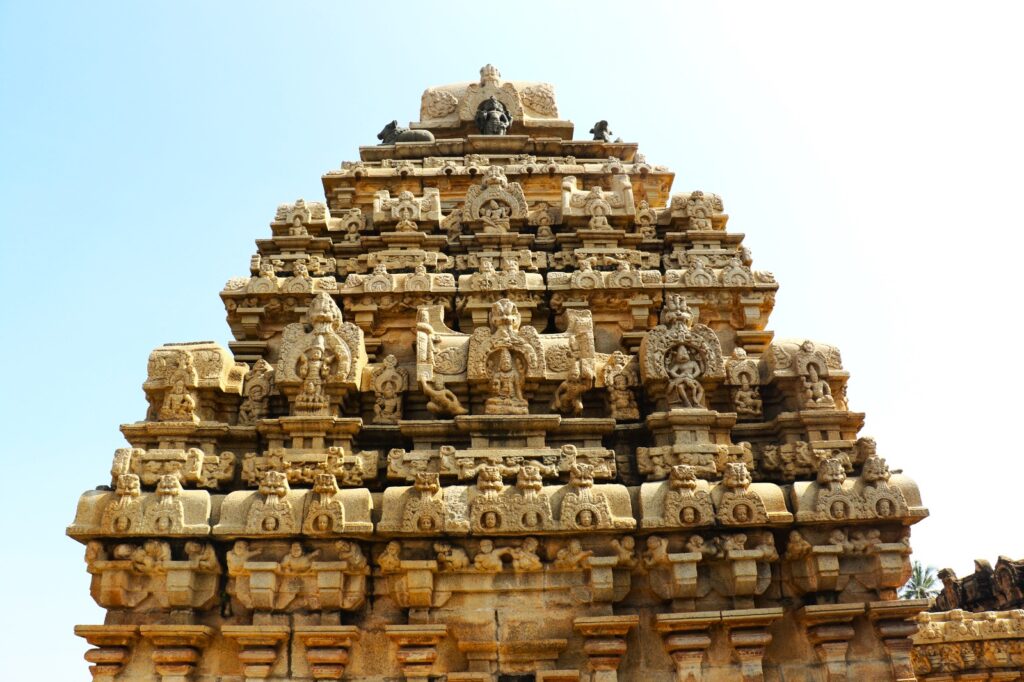
Bhoganandishwara Temple Vimana
The Sacred Pushkarini: Seasons and Ceremonies
During my first visit in March 2023, we sat on the steps of the pushkarini, dipping our feet in the cool water. The fish in the pool kept nibbling at our feet — a surprisingly meditative experience. At one side, a pre-wedding photoshoot was in progress, the couple’s vibrant silks contrasting beautifully against the ancient stone backdrop.
But when we returned during the monsoon in October 2025, the pushkarini was filled to the brim, submerging all the steps we’d sat on months earlier — a vivid reminder that this temple is still very much alive, responding to seasons and ceremonies just as it has for centuries.
The temple tank serves multiple purposes even today:
- Ritual bathing before worship
- Reflection pool creating visual symmetry (mirrors the vimanas beautifully)
- Water source for temple ceremonies
- Ecological habitat supporting fish and aquatic plants
- Community gathering space for festivals and social events
Historical Context: The Vijayanagara period (14th-16th century) was the last great Hindu empire of South India before colonial disruption. Their temple patronage across Karnataka and Andhra Pradesh represented both religious devotion and political consolidation — enhancing temples reinforced their legitimacy as Hindu rulers.
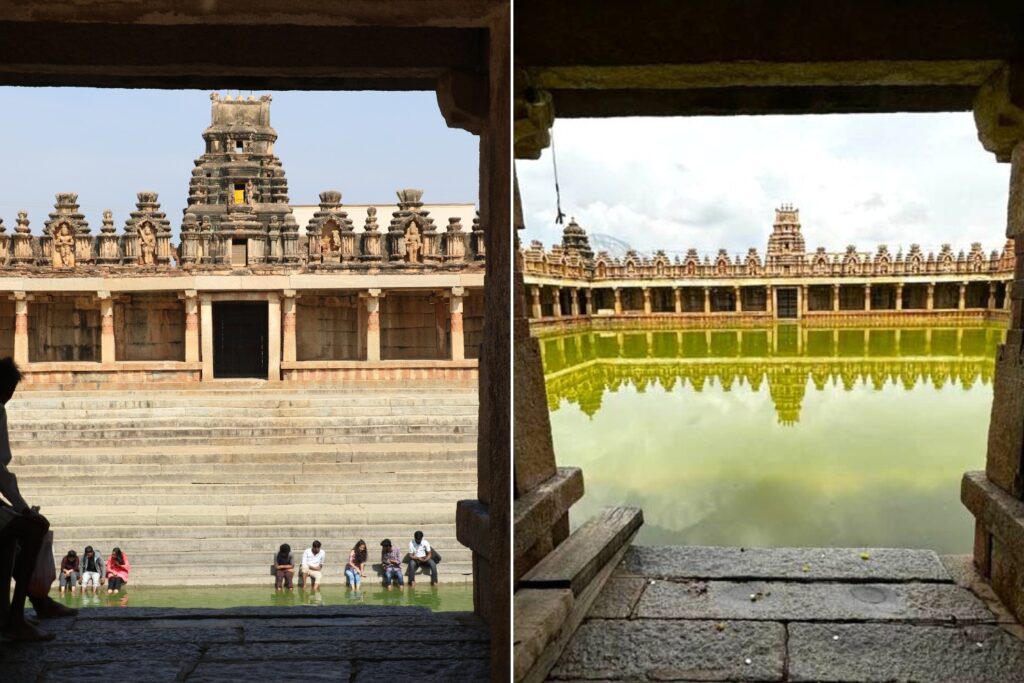
Sacred Pushkarini filled to the brim, submerging all the steps we’d sat on months earlier
Why This Multi-Layered History Matters
More Than Just an Old Temple
Understanding the Bhoganandishwara Temple history and architecture means recognizing it as a living textbook of South Indian architectural evolution. This isn’t just about appreciating pretty carvings — it’s about understanding how civilizations build upon each other’s achievements.
Each era — from the Nolambas and Cholas to the Hoysalas and Vijayanagara rulers — left a distinct architectural fingerprint.
The Rare Spirit of Collaborative Continuity
Each dynasty didn’t demolish and rebuild (as often happened elsewhere) — they added, embellished, and honored what came before. This collaborative spirit across centuries is remarkably rare in Indian temple architecture, where conquerors typically destroyed predecessors’ monuments.
That’s what makes Bhoganandishwara so architecturally significant — it’s not frozen in a single time period; it’s a dialogue between eras, a conversation in stone that has continued unbroken for over a millennium.
A Personal Reflection
On my first visit, I was struck by this sense of quiet continuity. The temple doesn’t feel like a museum relic of the past — it feels alive. The stone walls bear the marks of different artisans from different centuries, yet their work connects seamlessly. That harmony, achieved across dynasties, reflects India’s remarkable ability to blend heritage with transformation.
Walking through the complex, camera in hand, I realized I wasn’t just photographing a temple — I was documenting a conversation between dynasties, a visual record of how human creativity evolves while honoring tradition.
Modern Relevance: In our current age of rapid change and frequent disruption, Bhoganandishwara offers a lesson in building upon rather than replacing what came before. It’s a model of sustainable cultural evolution that remains relevant today.
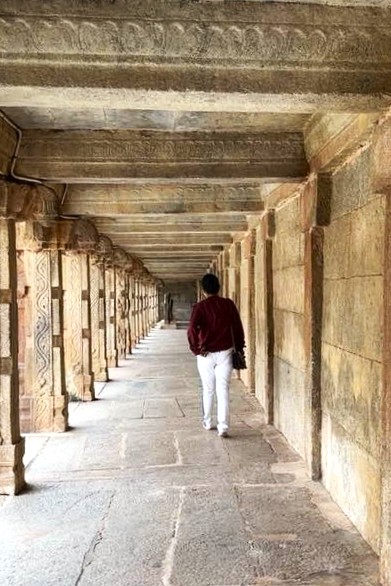
Corridors around the Bhoga Nandisvara Temple
The Timeline at a Glance
1,000+ Years of Evolution in One Complex
| Period | Dynasty | Key Contributions | Architectural Style |
| 9th Century | Nolamba and Bana | Original shrines, foundation walls, basic vimanas | Simple Dravidian, austere granite construction |
| 10th-11th Century | Chola and Western Ganga | Intricate carvings, refined vimanas, mandapas, sub-shrines | Chola precision, decorative sophistication |
| 12th-13th Century | Hoysala | Kalyana Mantapa, lathe-turned pillars, sculptural masterpieces | Elaborate soapstone artistry, maximum ornamentation |
| 14th-16th Century | Vijayanagara | Gopurams, grand courtyard, temple tank enhancement, pillared corridors | Monumental scale, public ceremonial spaces |
What This Timeline Reveals
Understanding this chronology helps decode:
- Why the temple has twin shrines: Bhoganandishwara (youth) and Arunachaleshwara (maturity) — representing different aspects of Shiva’s life, likely added in different periods
- How rituals and layout evolved: From private devotion (Nolamba) to communal worship (Vijayanagara)
- Why different sections look stylistically distinct: Each reflects its era’s aesthetic preferences
- What makes it potentially UNESCO-worthy: Exceptional example of multi-period architectural preservation
Visual Reading Guide
When you visit, look for these chronological markers:
- Ground level, inner sanctums: Original Nolamba granite (9th century)
- Mid-height wall carvings: Chola lotus medallions and yali motifs (10th to 11th century)
- Kalyana Mantapa pillars: Hoysala lathe-turned precision (12th to 13th century)
- Entrance gopuram, outer courtyard: Vijayanagara monumental scale (14th to 16th century)
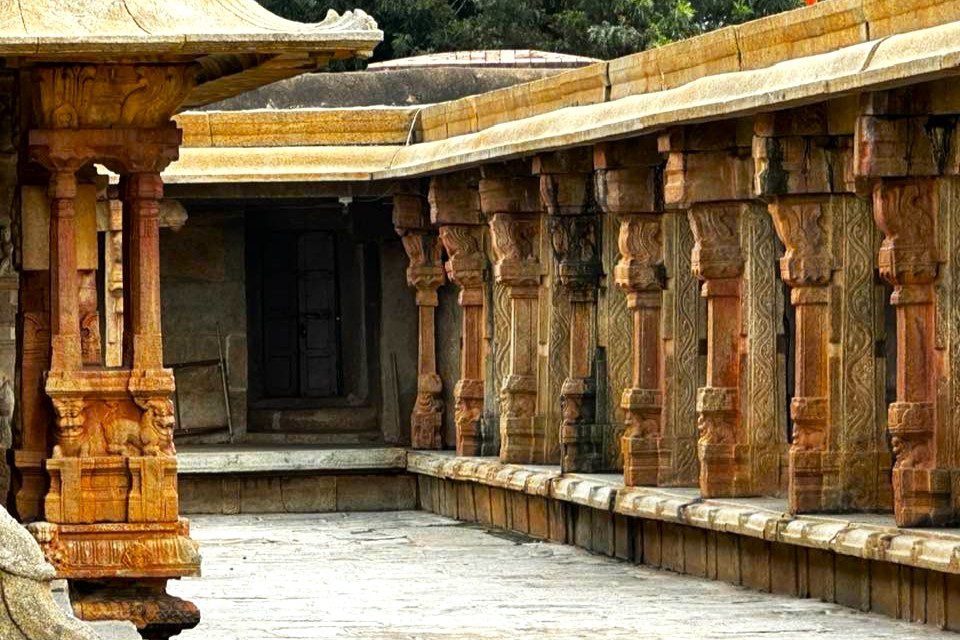
Courtyard surrounded by corridors in Bhoganandishwara Temple
Historical Significance in Broader Context
Why Historians and Architects Study Bhoganandishwara
Academic Importance:
- Architectural Timeline Study: Shows evolution of Dravidian style across seven centuries in one site
- Dynastic Patronage Patterns: Demonstrates how each ruling power approached temple enhancement
- Construction Technique Evolution: Reveals progression from rough granite to refined soapstone work
- Cultural Continuity: Proves religious sites could transcend political changes
- Regional Architectural Identity: Exemplifies Karnataka’s unique temple tradition (distinct from Tamil Nadu or Kerala)
Comparative Context:
- Thanjavur Brihadeeswarar: Single-dynasty masterpiece (Chola only) — more stylistically pure
- Hampi temples: Primarily Vijayanagara — grander scale but less architectural diversity
- Belur/Halebidu: Primarily Hoysala — exquisite detail but single-period
- Bhoganandishwara: Multi-dynasty evolution — greatest chronological range
UNESCO Candidacy: While not yet listed, Bhoganandishwara has been discussed by heritage experts as a potential World Heritage Site candidate due to its exceptional demonstration of architectural continuity and multi-dynastic collaboration — qualities UNESCO specifically values.
Connecting History to Your Visit
Recommended Approach:
- Start at the inner sanctums (oldest Nolamba sections) — feel the foundation
- Move to outer walls (Chola additions) — see the decorative evolution
- Spend time at Kalyana Mantapa (Hoysala masterpiece) — appreciate peak craftsmanship
- Walk the outer courtyard (Vijayanagara expansion) — understand the final scale
This chronological exploration brings the Bhoganandishwara Temple history to life in a way that random wandering cannot.
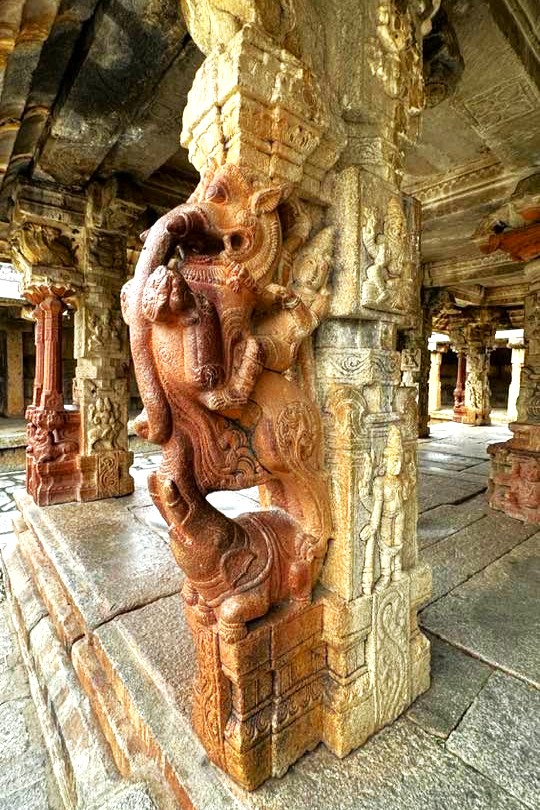
Yali Sculpted Pillars in Bhoganandishwara Temple
History FAQ: Common Questions Answered
Q1. Which dynasty originally built Bhoganandishwara Temple?
The Nolamba dynasty in the 9th century CE constructed the original shrines during their rule as vassals of the Rashtrakutas. The adjoining Bana dynasty also contributed to early temple endowments. These foundations still form the core sanctums visible today.
Q2. Why did successive dynasties enhance rather than replace the temple?
Several factors contributed:
- Religious sanctity: Destroying a Shiva temple was considered spiritually dangerous
- Legitimacy: Enhancing predecessors’ temples showed continuity of righteous rule
- Economics: Building on existing structures was more cost-effective than starting anew
- Cultural tradition: South Indian temple patronage emphasized expansion over replacement
This collaborative approach is rare but not unique — some Tamil Nadu temples show similar multi-period evolution.
Q3. How can I identify which sections were built by which dynasty?
Visual identification tips:
- Nolamba (9th c.): Rough granite, simple square garbhagrihas, minimal ornamentation, thick walls
- Chola (10th to 11th c.): Lotus medallions, refined proportions, narrative friezes, yali motifs
- Hoysala (12th to 13th c.): Lathe-turned pillars, soapstone carvings, intricate detail, bracket figures
- Vijayanagara (14th to 16th c.): Gopurams, large courtyards, monumental scale, pillared corridors
Hiring a knowledgeable local guide helps tremendously — they can point out specific dynastic markers that untrained eyes miss.
Q4. Is there any historical documentation or inscriptions at the temple?
Yes. The Archaeological Survey of India (ASI) has documented several inscriptions at Bhoganandishwara:
- Stone inscriptions on pillars and walls (in Kannada and Sanskrit)
- Donor records mentioning contributions by various dynasties
- Religious endowment details
- Some inscriptions date construction phases
These inscriptions provide crucial historical evidence supporting the multi-dynasty timeline. Some are visible to visitors (with ASI placards), while others are catalogued in ASI archives.
Q5. How does Bhoganandishwara’s history compare to other famous Karnataka temples?
Comparison:
- Belur and Halebidu: Primarily 12th century Hoysala — single-period masterpieces with unmatched sculptural detail
- Hampi temples: 14th to 16th century Vijayanagara — grand scale, political symbolism
- Pattadakal: 7th to 8th century Chalukya — UNESCO site, earlier period
- Bhoganandishwara: 9th to 16th century multi-dynasty — longest evolutionary timeline, best demonstrates architectural continuity
Bhoganandishwara’s strength is breadth across time rather than depth in a single style.
Q6. Were there any major restoration efforts that altered the original structures?
The temple has undergone conservation work by the ASI, but efforts have focused on preservation rather than alteration:
- Structural stabilization of weakening sections
- Cleaning of sculptural surfaces
- Water damage prevention
- Documentation of inscriptions
The ASI follows strict conservation ethics that prohibit adding new elements or significantly changing original structures. What you see today is largely authentic to each period, though some weathering has occurred naturally over centuries.
Q7. Why isn’t Bhoganandishwara as famous as Hampi or Belur?
Several factors:
- Location: More remote than Hampi; less accessible than Belur
- Tourism infrastructure: Limited compared to UNESCO sites
- Publicity: Less promoted by Karnataka Tourism
- Scale: Smaller than Hampi’s sprawling complex
- Photography appeal: Less “Instagram-famous” than Hampi’s ruins
However, this relative obscurity is actually an advantage for thoughtful visitors — you can explore peacefully without massive crowds, experiencing the temple more authentically.
Q8. What historical events took place at Bhoganandishwara Temple?
While specific historical events are not well-documented, the temple likely:
- Witnessed dynastic transitions as power shifted between ruling families
- Hosted royal ceremonies (marriages, coronations) given the Kalyana Mantapa’s grandeur
- Served as a pilgrimage center attracting devotees from across South India
- Survived regional conflicts between Cholas, Hoysalas, and later sultanates
- Continued functioning through colonial period under British rule
The temple’s survival through all these periods is itself historically remarkable.
Q9. Are there any historical figures specifically associated with the temple?
Rajendra Chola is directly associated — a sculpture of this famous Chola emperor (who ruled 1014-1044 CE) stands inside the Bhoganandishwara shrine, indicating his patronage. This is relatively rare; most temples don’t feature royal sculptures within inner sanctums.
Various Hoysala rulers are indirectly associated through their dynastic patronage of the Kalyana Mantapa, though specific names are not prominently documented at the site.
Q10. How does understanding the temple’s history enhance my visit?
Dramatically. With historical context:
- You’re not just seeing “old carvings” — you’re witnessing a millennium of artistic evolution
- Each section tells a dynasty’s story in stone
- You appreciate why certain elements look different (they’re from different centuries)
- You connect with human creativity across time — artisans from nine centuries ago speaking to you through their work
- You understand the temple’s national architectural significance
Many visitors spend 30 minutes, snap photos, and leave. With historical understanding, you could easily spend 2-3 hours deeply engaged with what you’re seeing.
Continue Your Bhoganandishwara Journey
Explore More in Our Series:
Start Here: Bhoganandishwara Temple: Complete Visitor Guide — Practical information, how to reach, timings, and overview (Perfect for first-time visitors).
For Architecture Lovers: Dravidian Engineering Marvel: Architecture Deep-Dive — Technical analysis of passive cooling, acoustics, Kalyana Mantapa mastery, and structural genius.
Planning Your Visit? Complete FAQ: 16 Visitor Questions Answered — Comprehensive practical guide covering every aspect of your temple visit.
Pin and save this for later
Enjoyed this historical deep-dive? Share it with fellow history enthusiasts, or leave a comment about your own Bhoganandishwara experience!
 About the Author: Indrani Ghose is a cultural travel writer and heritage documentation specialist with over 15 years of experience exploring South Indian temple architecture. Having visited and documented over 150 temples across India and Southeast Asia, she brings both scholarly research and personal narrative to her writing.
Her work has been published in Lonely Planet, The National (UAE), Whetstone Asia, Deccan Herald, and numerous heritage journals. Indrani specializes in Dravidian temple architecture and has conducted field research across Karnataka, Tamil Nadu, and Andhra Pradesh.
This historical analysis of Bhoganandishwara Temple draws from multiple visits (March 2023, October 2025), extensive consultation with local guides and temple authorities, ASI documentation review, and comparative study of contemporary temples across South India.
Connect with Indrani: Follow Indrani on Instagram | Twitter | Facebook for heritage travel insights, photography tips, and offbeat destination discoveries.
Keywords: Bhoganandishwara Temple history, Nolamba dynasty temples, Hoysala architecture, Vijayanagara temple heritage, Dravidian architectural evolution, Karnataka temple dynasties, South Indian temple history, multi-period temple architecture, Chola temple Karnataka
Last Updated: October 2025 | Historical information verified through ASI documentation and scholarly sources