Nara Japan One Day Itinerary: Ultimate Guide
Planning a one day Nara itinerary is easier than you think. With iconic temples, freely roaming deer, and a compact walking route, Nara packs serious history and charm into a single day. This guide blends my firsthand experience with practical tips to help you make the most of every hour.
After a memorable time sightseeing Nara, we have crafted this ultimate Nara one day itinerary which you will be eager to claim as your own! This comprehensive Nara travel guide ensures hassle free experience while visiting Nara Japan. Feel free to make it yours!
By Indrani Ghose | Last Updated: June 2026
Why Nara Deserves a Full Day in Your Japan Itinerary
Every new city can leave us feeling a bit disoriented, and Nara Japan was no exception for us. Questions like: What to see in Nara? What are the main Nara attractions to be covered in a day? What are the best things to do in Nara in one day? flooded our minds while visiting Nara Japan.
Nara may be smaller than Kyoto, but it earns a full day in any Japan itinerary. On my November 2023 visit, I was struck by how much history and culture is packed into this compact city. From the grandeur of Todai-ji Temple — housing Japan’s largest bronze Buddha — to the stone lantern-lined paths of Kasuga-Taisha Shrine, Nara’s landmarks are not just photogenic. They’re deeply immersive.

Visitors petting a deer in front of Todaji Shrine – Nara One day Itinerary
About Nara Japan
Nara brims with sights, experiences, and attractions. What stayed with me was the balance between heritage and everyday life. Walking through Naramachi District, I found preserved Edo-period merchant houses sitting alongside modern coffee shops. That contrast makes Nara feel alive, not just historical.
Unlike Kyoto, where major temples are spread across several districts, Nara’s highlights sit within easy walking distance of each other. You can move from Kofukuji to the deer-filled Nara Park in minutes, making it especially well-suited for first-time visitors.
The city is a treasure trove of cultural experiences, from traditional tea ceremonies to vibrant festivals like the Omizutori held at Nigatsu-do Hall.
Interacting with the deer is a highlight, but it also comes with a lesson in respecting local customs — more on that later. For visitors interested in Japan’s oldest Buddhist architecture, a short side trip to Horyu-ji adds real depth to the day.
When comparing Nara vs Kyoto for a day trip, Nara wins on walkability, crowd levels, and sheer atmospheric ease. One day here feels complete — and still leaves you wanting more.
Nara, a UNESCO Site
Nara is worth visiting for its rich historical legacy as Japan’s first permanent capital. Its heritage is embodied in the UNESCO World Heritage Sites that adorn the city, including the iconic Todai-ji Temple, home to the Great Buddha, and the picturesque Kasuga Taisha Shrine with its thousands of vermilion torii gates.
Nara’s artistic heritage is well preserved at the Nara National Museum, showcasing exquisite Buddhist art and artifacts.
Nara’s proximity to Kyoto and Osaka makes it an accessible day trip destination, making it an ideal addition to any itinerary in the Kansai region.

Nara Attractions
If you are running short of time for a complete one day Nara trip here are some helpful links:
- Nara: Private Tour with Guide – Explore the best of Nara with a private guide on a 4 or 6-hour tour. Enjoy the full freedom and flexibility of customizing your own itinerary.
- Nara Full-Day Private Tour Osaka/Kyoto departure with Government-Licensed Guide
- Nara World Heritage Todaiji Visit and Naramachi Tour
Things to Do in Nara in One Day
The city has umpteen number of things to see, do and experience, but time, the eternal governing factor of what we see and do during our travels limit them. This blog lists the best things to do in Nara in one day, in the few hours when the sites are open. After the sites are closed by 5 PM you can explore Nara city. You can use this list if you are making a day trip to Nara from Osaka or Kyoto.
How to Explore Nara in one day
This blog on the Nara1-day itinerary assumes you are already in Nara and ready to explore first thing in the morning after a good breakfast. Nara attractions can be segregated to two parts. The part in the south-west of Nara has Horyuji Temple as the main attraction. We suggest you complete touring this first and then proceed to the northeast side of Nara which has a good concentration of major tourist attractions of Nara including the Deer Park.
Horyuji Temple Nara Japan
Horyuji Temple is the first UNESCO site of Japan but besides that one major compelling reason for me to visit this temple is that it is topmost in the list of oldest wooden buildings in the world.
The temple’s roots trace back to 607 AD, when Prince Shōtoku fervently prayed to Yakushi Nyorai for his father, Emperor Yomei’s recovery from illness. Over 1,300 years ago, the temple underwent reconstruction, preserving its sacredness through centuries. Standing before the Kondō, the main hall that is widely recognized as the world’s oldest wooden building, we were awestruck. This venerable wooden structure holds the title of the world’s oldest, a testament to enduring craftsmanship. As I gazed upon it, I sensed the same wonder that countless devotees and visitors experienced throughout the ages.
Tour time required: around 2 hours
Tickets: The tickets to Horyuji Shrine cost 1500Y per adult
Timings: 8 AM to 5 PM

Horyuji Pagoda
Iconic Todai-ji Temple Nara
Historically Todaji Temple is significant because Tōdai-ji was the chief temple in the Kokubun-ji system. From ancient times Toda-ji Temple was a center for rituals for the peace of the nation and the prosperity of the people. The temple served as a centre for the training of scholar monks who studied Buddhist doctrine. Toda-ji Temple complex has many of the buildings are reconstructions of the Edo period (1603-1868), the pagoda in particular is awe-inspiring.
And oh! the best-known relic that you shouldn’t miss at Todaiji Temple is its Daibutsu. The 15m high statue is the world’s largest gilded bronze Buddha. It is housed in an all-wood building, the Daibutsu-den. At 48m high this is the largest wooden building in the world. Stunning statistics, isn’t it?!
At Kamakura we had seen the 13 m high bronze statue of Buddha out in the open. Read here: Best Things to Do in Kamakura.
The temple’s serene ambiance, set amidst Nara’s tranquil surroundings, offers a moment of introspection and spiritual contemplation. The accompanying museum houses invaluable artifacts and treasures, which helps understanding of Japan’s cultural tapestry better.
We were so immersed admiring the sculptures and buildings belonging to ancient times, three hours simply whizzed by. And that is when it struck, we have so much more to strike off our list of things to do in Nara in one day.
Pro Tip: focus on the Daibutsu-den Hall, the Sangatsu-do Hall (Hall for the March Rite), and the Kaidan-in (Ordination Hall) for a quick visit. You need 4 to 5 hours for detailed viewing.
Tickets: A joint ticket Combined ticket for the Great Buddha Hall at Todaiji and the Todaiji Museum cost 800 Y. Ticket to enter the Great Buddha Hall cost 500 Y.
Timings: 8 AM to 4.30 PM daily from November to March and 7 AM to 5.30 PM April to October.

Great Buddha
Lunch in Nara
There are plenty of options to have lunch in Nara. Since we were on a walking tour of Nara, the next destination after the Toda-ji Shrine was Kasagu Taisha shrine. We halted at Kasuga Ninai Jyaya,
garden cafe Restaurant which is about a 5-minute walk from the Kasuga Taisha Omote Sando bus stop. It is near the main gate to the Manyo Botanical Garden.
Time required: less than an hour

Lunch in Nara
Kasuga-Taisha Nara
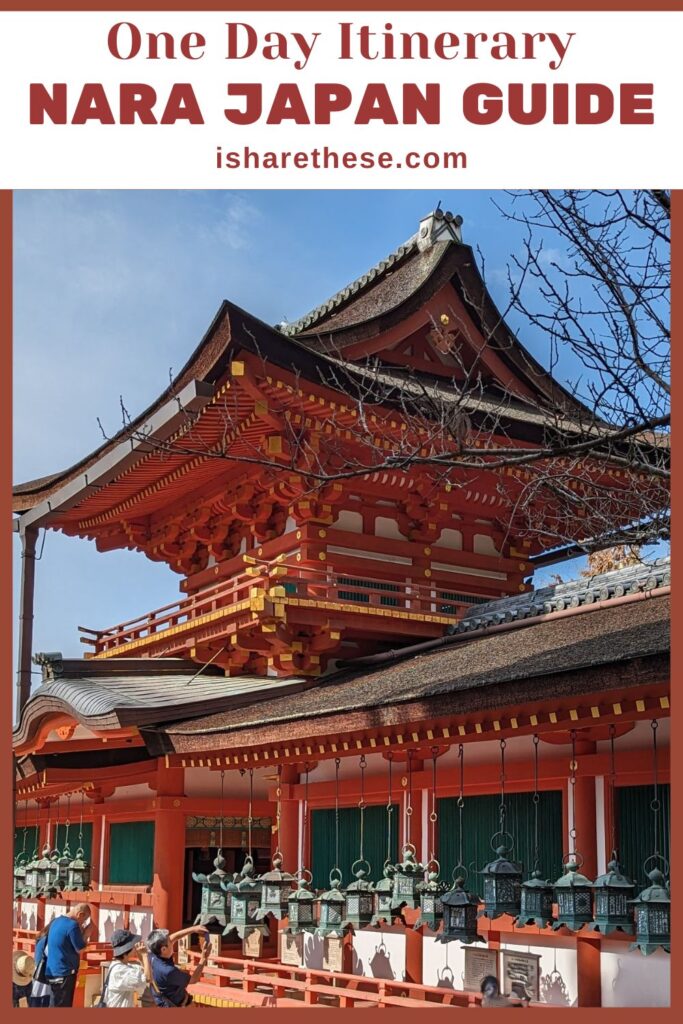
Kasuga Taisha shrine is the shrine of the Fujiwara family. We read that there are 2000 stone lanterns and 1000 bronze lanterns in the shrine. Most of the stone ones were moss covered, the bronze ones lined up really looked good worth taking pictures.
My reasons to visit Kasuga-Taisha were:
- This is Nara’s oldest and most famous shrine
- It is a beautiful UNESCO World Heritage Site
- thousands of stone and bronze lanterns line the paths and buildings in Kasuga-Taisha shrine
- Brilliant vermilion columns surrounded by lush green trees
Kasuga Taisha provides insights into Shinto beliefs, rituals, and practices. We found the Kasuga Taisha shrine the most beautiful one among the different temples and shrines we saw in Nara. This shrine is highly recommended to be added to your Nara one day itinerary.
If you can increase your pace, maybe you will have time enough to explore the nearby Kasuga Taisha Museum. It offers deeper insights into the shrine’s history and cultural significance.
Tickets: The tickets to Kasuga Taisha shrine cost 500¥
Timings: 6.30 AM to 5.30 PM

Bronze lamps Kasuga Taisha shrine
Kofukuji Shrine in Nara Japan
Kofuku-ji Shrine is one among the eight UNESCO sites of Nara Japan, which include five Buddhist temples, one Shinto shrine, one Palace and one primeval forest. Kofukuji Shrine is conveniently located near Nara Park and other attractions like Todai-ji Temple and Kasuga Taisha Shrine, making it easily accessible and a perfect addition to a day of exploration in Nara.
We found the pagoda here truly unique. The Five-Story Pagoda, built in 1426, is one of the tallest pagodas in Japan at 50m high.
Another highlight within the temple complex is the Central Golden Hall, built in 1415. The Central Golden Hall is famous for housing the Yakushi Nyorai statue, meaning “Medicine Master”, the Buddha associated with healing. Many pilgrims visit seeking spiritual and physical healing.
Tickets: The National Treasure Museum – ¥600, The Eastern Golden Hall – ¥300, combined ticket for the two – ¥800.
Timings: 9 AM to 5 PM.

Kofukuji Shrine in Nara Japan
Deer Park Nara
We thoroughly enjoyed our visit to Deer Park in Nara. Hundreds of Sika deer, such gentle creatures, roam freely throughout the area. It wasn’t just about encountering friendly deer, but rather an immersive experience that combines nature, culture, and a sense of wonder. Even the briefest visit here will leave you with cherished memories of their time spent amidst these gentle creatures and serene surroundings.
Deer Park is a fantastic destination for families with children. We saw some brave tiny kids feeding and petting the deer and the deer too seemed quite at ease.
My walk here through the Nara Deer Park is closest to my heart. At one point when I had run out of crackers, a deer approached me expectantly. Suddenly a co-tourist appeared from nowhere and passed on a cracker to me to feed the deer. A happy me was watching the happy deer munching on it from my hand. I mean, he could have fed the deer himself yet he gave me the chance.
Located near Nara’s city center, the park is easily accessible on foot from major attractions and transportation hubs, making it a convenient addition to any Nara itinerary.

Deer Park Nara Japan
Nara Koen (that’s the Japanese name for the park) is free to enter. It is open all 24 hours.
A pack of 10 crackers for deer cost 150 Y.
Places I Missed (But You Might Want to Add)
Manyo Botanical Garden
The Manyo Botanical Garden, also known as the Kasuga Taisha Garden, is a small garden with ponds, some sets of stone tables and seats and with lots of shade almost tempting you to have an impromptu picnic. If by chance you are visiting during months April-May, a narrow three week period, you will find wisteria in full bloom making the entire experience magical.
Tour time required: Less than an hour
Tickets: 500¥ for adults, 250¥ for children. You are given maps of the garden along with the tickets.
Timings: The gardens are open from 9 AM to 4.30 PM. between March and October and 9 AM to 4 PM from November to February.
Read more: Oldest Wisteria Vine from Amboise France.
Isui-en Garden
Isuien Garden is an attractive Japanese garden very close to Todaiji Temple’s Nandaimon Gate. Isuien means “garden founded on water”, and as the name implies the garden’s name is derived from the fact that its ponds are fed by the small adjacent Yoshikigawa River.
A bonus experience you get here, included in the ticket, is a visit to a small museum with a decent collection of pottery, seals, mirrors and other artifacts from ancient China and Korea. They belong to the family that owns Isuien.
Nara National Museum
Before stepping in it is worth taking a moment to appreciate the museum itself. The building is a historical and architectural gem, designed in a traditional Japanese style. The Nara National Museum hosts historic, cultural, and artistic treasures, national treasures include Buddhist and Bodhisattva sculptures, age old images and documents, artefacts including one of the largest Buddha statues in the world.
The permanent collection is modest but the ones on special display are unique, the entry to the special exhibitions in the museum come at an extra cost. Special exhibitions feature rare artifacts not regularly displayed. The museum is located in Nara Park, where most of the Nara city attractions can be found.
Tickets: 600 Y for adults and 300 Y for college students
Timings: 9.30 AM to 5 PM.
Walk around Naramachi District
If you are done with all the shrines, gardens and museums mentioned above you can extend your Nara experience by wandering through the Naramachi district in the neighborhood. Naramachi is worth adding to your Nara 1-day itinerary as it retains the nostalgic charm of old Japan, offering a glimpse into the traditional merchant district’s atmosphere.
The preserved historic buildings, narrow streets, and traditional machiya (wooden townhouses) create an authentic setting from the Edo period. Explore the local markets, quaint shops, and artisanal boutiques to stumble on a variety of traditional crafts, local specialties, handmade goods, and souvenirs, making it an excellent place to pick up unique gifts or sample regional delicacies.
Practical Logistics: Getting to Nara & Getting Around
Getting to Nara from Kyoto or Osaka is straightforward, and the costs are reasonable.
Getting There
- From Kyoto: The JR Nara Line from Kyoto Station takes around 45 minutes (¥720). JR Pass holders can ride this for free — a useful saving if you’re already carrying one.
- From Osaka (Namba): The Kintetsu Nara Line is the fastest option — roughly 35–40 minutes (¥680), though not covered by the JR Pass.
- From Tokyo: Take the Shinkansen to Kyoto or Osaka, then connect to Nara via one of the above routes. Budget around 3–3.5 hours total.
- Tip: Download Google Maps and the Navitime Japan app before you travel. Both offer reliable real-time train schedules and walking directions — essential for first-timers navigating JR vs Kintetsu lines.
Getting Around Nara
Most visitors searching for a Nara walking route map are pleasantly surprised: the city barely needs one. The core attractions — Todai-ji Temple, Kasuga-Taisha Shrine, Kofukuji, and Nara Deer Park — are all within a 20–30 minute walk of Kintetsu Nara Station.
- Walking is the best way to explore. Paths are well-signposted in English, and you’ll encounter deer at almost every turn.
- Rental bikes are available near the station if you prefer to cover ground faster. Expect to pay around ¥1,000–¥1,500 for a full day.
- Taxis are an option for reaching Horyu-ji or if time is tight, but rarely necessary within the main park area.
Budget snapshot: Local train tickets run ¥500–¥800 one way. Temple entrance fees average ¥500–¥1,000 per site. If you’re adding Horyu-ji, factor in an extra ¥800 for the train and ¥1,500 for entry — worth every yen for architecture enthusiasts.

Nara One Day Itinerary
Travel Tips for Visiting Nara Japan
- Dress appropriately: As with most temples in Japan, visitors are expected to dress modestly.
- Wear comfortable shoes as a lot of walking is involved.
- There are a number of restrooms and vending machines too
- There is a free drinking water tap too. We saw one near Kasuga Taisha shrine.
- Maps with highlights of the ‘place of visit’ are given along with tickets. We found them very helpful.
- Don’t visit Nara in the summer. It’s simply too hot. The shoulder season is ideal.
Where to stay in Nara?
If you are not intending to do the day trip to Nara from Kyoto or Osaka and instead intend to stay in Nara for a night there are plenty of options.
We stayed in Comfort Hotel Nara and the stay was indeed comfortable as the name suggests. It is located 220m from Nara Station, at a walking distance of 3 minutes.
Another option is Nara Hotel,a 4 star hotel. Address: 1096 Takabatakecho, Nara, 630-8301, Japan. It is located 2.2 km from Nara station.
FAQ about Visiting Nara
Is Horyu-ji worth the trip from Nara?
Yes, for most visitors it is. Horyu-ji is home to some of the world’s oldest surviving wooden structures and holds UNESCO World Heritage status. It sits about 12 minutes by train from Nara (JR Yamatoji Line from Nara Station). If early Buddhist architecture or Japanese history interests you, it’s a worthwhile detour. Budget at least 90 minutes on-site.
Can you see all major sites in one day?
Yes. With Nara’s compact walking route, you can comfortably cover Todai-ji, Kasuga-Taisha, Kofukuji, the Deer Park, and Naramachi District in a single day. Adding Horyu-ji is manageable if you start early — by 8.30–9 AM — and keep temple visits to around 60–90 minutes each.
How do you feed Nara deer responsibly?
Purchase official shika senbei (deer crackers) from licensed vendors in the park — they cost around ¥200 per pack. Avoid offering human food, plastic wrappers, or any items not sold as deer feed. Hold crackers flat in an open palm, stay calm, and don’t tease or withhold food once the deer approach. Bowing back to a bowing deer is a popular tradition, but keep your distance from deer with fawns.
Nara vs Kyoto day trip: which is better?
It depends on your priorities. Kyoto offers greater scale, more temple variety, and iconic districts like Gion and Arashiyama — but it requires more planning and covers more ground. Nara is more relaxed, entirely walkable, and its key sites are clustered within a short radius. For first-time visitors or those short on time, Nara delivers a richer experience per hour.
Is Nara suitable for solo travelers?
Absolutely. Nara is one of Japan’s most solo-friendly destinations. The city is safe, well-signposted in English, and its attractions are tightly clustered around a central walking route. You won’t need taxis or complex transport planning for the main sites.
Final Thoughts: Is One Day Enough?
One day in Nara is genuinely enough to experience what makes the city worth visiting — ancient temples, the Great Buddha, freely roaming deer, and a well-preserved merchant district. The compact layout works in your favour: unlike many Japanese heritage cities, Nara rarely leaves you feeling like you’ve missed the best parts because you ran out of time.
That said, if you have flexibility, a second half-day opens up Horyu-ji and some of Nara’s lesser-known shrines and seasonal festivals. Autumn foliage in November and the Omizutori fire festival in March are two moments worth planning around specifically.
For planning the wider trip, my related guides can help:
- Best Places to Visit in Kyoto — how Nara fits into a Kansai route
- Horyu-ji Temple Nara Guide — a detailed walkthrough if you decide to extend your day
- Top 15 Places to Visit in Japan — for building a balanced multi-city itinerary
Used together, these guides give you a practical framework for comparing destinations and deciding how long to spend in each.
Pin and Save this Itinerary for later
About the Author
 Indrani Ghose is an Indian Travel Writer and Blogger based in Bangalore, India. She has written for numerous publications across the globe – including Lonely Planet, The National UAE, Whetstone Asia, Deccan Herald. You can follow her on her social media handles Instagram, Twitter, Pinterest and Facebook to see the wonderful destinations, beautiful offbeat places and get instant updates about them.