Shyama Raya Temple Bishnupur: Pancharatna Terracotta Masterpiece & Travel Guide
The Ultimate Guide to Shyama Raya Temple, Bishnupur: Terracotta Masterpiece
If you think terracotta is just a pottery style, one visit to the Shyama Raya Temple in Bishnupur will permanently change your mind.
Built in 1643 by Malla King Raghunath Singha, the Shyama Raya Temple is one of Bengal’s finest surviving examples of temple architecture. Its Pancharatna (five-towered) design and walls covered in detailed terracotta carvings make it unlike anything else in India.
This temple is an essential stop for all history enthusiasts, architecture lovers, or first-time visitors on a Bishnupur temple tour. The Raslila panels alone — depicting Krishna’s divine dance — are worth the journey.
By Indrani Ghose | Last Updated: May 2026

Pancharatna style terracotta temple Bengal – SHYAMA RAYA MANDIR Bishnupur
History of Shyam Rai Mandir: The Malla Dynasty Legacy
King Raghunath Singha and the 1643 Dedication
The Shyama Raya Temple was commissioned in 1643 by Malla King Raghunath Singha, one of the most consequential rulers in Bishnupur’s history. His reign marked a defining cultural shift: the Malla kings had embraced Gaudiya Vaishnavism, the devotional tradition rooted in the teachings of Chaitanya Mahaprabhu in the 16th century. This religious turn directly shaped the temple’s visual identity.
The terracotta panels covering its walls depict the Raslila — Krishna’s circular dance with the gopis — alongside episodes from the Mahabharata and the Ramayana, making the Shyama Raya Temple both a place of worship and a visual scripture in brick.
Bishnupur Terracotta Art
What makes Bishnupur’s temples architecturally distinctive is not just their style, but their material. Unlike the granite and sandstone temples of South India or Rajasthan, the temples here were built entirely from locally fired brick and terracotta.
The picture below is from the online gallery of British Library.

Pic of Shyama Raya Mandir Bishnupur in abandoned state taken by photographer Walter Campbell around 1869
The reason is straightforward: the alluvial plains of Bengal offered no natural stone, but an abundance of fine clay. Local craftsmen, known as kumors, developed highly refined techniques for firing terracotta bricks and sculpting decorative panels that have survived centuries of monsoon, heat, and humidity.
The Shyama Raya Temple, with its Pancharatna style — five shikhara towers rising from a single platform — represents the peak of this craft tradition in Bengal.
The temple’s construction also signals the growing confidence of the Malla kingdom. By the mid-17th century, Bishnupur was a prosperous regional power, and its rulers used temple-building as both an act of devotion and a statement of political legitimacy. Investing in terracotta art and architecture allowed the Malla kings to patronise local artisans while creating enduring monuments to their reign.
Today, the Shyama Raya Temple anchors the Bishnupur temple tour itinerary and stands as a cornerstone of Bengal’s architectural and cultural heritage — recognised by the Archaeological Survey of India as a protected monument of national importance.

Arch – Shyamaraya Mandir with Terracotta Murals
Decoding the Pancharatna Architecture and Terracotta Art
The Five Pinnacles: The Pancharatna Style Explained
The Shyama Raya Temple is one of the finest surviving examples of the Pancharatna style terracotta temple tradition in Bengal. The design follows a square plan with a central sanctum topped by a tall, octagonal shikhara, flanked by four smaller towers rising from each corner of the roof. These five towers — one central and four corner — give the temple its name: Pancha-ratna, meaning “five jewels” in Sanskrit.
What makes this structure visually distinctive is how it blends two architectural styles:
- the towers draw from the North Indian rekha deul (curvilinear spire) tradition
- while the curved, sloping rooflines of the lower sections echo the chala style — a form derived directly from Bengal’s traditional thatched-roof village hut.
Standing in front of the temple, our guide drew our attention to the jagati — the raised platform on which the entire structure sits. He explained: not only it protects the brickwork from ground moisture during Bengal’s heavy monsoon seasons but also it marks the threshold between ordinary space and sacred ground.
The symmetry of the five-tower arrangement, viewed from the front or any of the four cardinal directions, conveys a sense of balance and order that is central to Vaishnava temple design. For anyone studying Bishnupur terracotta art and architecture, the Shyama Raya Temple’s structural logic is as instructive as its surface decoration.

Bheeshma on bed of arrows – Shyamaraya Mandir with Terracotta Murals
Krishna Leela and Raslila Terracotta Panels
The exterior walls of the Shyama Raya Temple function as a continuous visual narrative. Every available surface — the arched facade panels, the pilaster strips, the cornice registers — carries scenes from Krishna’s life, with the Raslila carvings of the Shyam Rai temple being the most celebrated among them.
The panels are arranged in a deliberate hierarchy:
At the base, wide friezes show processions of elephants and cavalry horses — images associated with earthly power and the protection of the kingdom.
Moving upward, the narrative shifts into the devotional: Krishna dancing in the circle of gopis, Krishna playing the flute in the forest of Vrindavan, and Krishna enacting the many lilas (divine pastimes) described in the Bhagavata Purana.
Having stood before these panels myself, I was amazed how the artisans rendered flowing movement, layered figures, and emotional expression in fired clay. That too on a material that, once set, allows no correction. The quality of these carvings is consistent across registers, evidence of a highly organised workshop tradition backed by sustained royal patronage.

Krishna romancing the gopikas
Secular Themes: Hunting Scenes and Royal Processions
Not all of the Shyama Raya Temple’s terracotta art is devotional. A significant portion of its panels depicts scenes from the secular life of 17th-century Bishnupur — and these are just as historically valuable as the religious imagery.
Royal hunting scenes appear prominently, showing mounted archers and foot soldiers pursuing deer and other game through stylised forest settings. In the context of Malla kingship, the hunt was not merely recreation — it was a demonstration of royal courage and authority.
Besides being a place of worship, these secular panels serve as a visual record of Bishnupur’s social and political life in the mid-17th century — a chronicle in clay that no written document from that period fully replicates.
This is what gives Bishnupur terracotta art and architecture its rare dual value: it is simultaneously devotional art and historical documentation. For visitors planning a Bishnupur temple tour itinerary, understanding this mix of the sacred and the secular is key to appreciating what you are looking at.

Shyamaraya Mandir with Terracotta Murals
Shyama Raya Temple Architecture
Typical Bengal architectural features like octagonal minarets, curved cornices, richly decorated walls made of bricks can be seen in this temple.
The temple structure is of squarish configuration and each side measures about 11.4m and is 10.7m in height. Entire surface area of the temple is covered with terracotta murals. Just imagining the planning, effort and execution of such minuscule designs on the wall surface gave me goosebumps.
Not just this Shyama Raya Temple but all terracotta temples of Bishnupur are Bengal Architectural wonders! One can’t satiate the desire to see Bengal heritage temples just by seeing one.

A pillar richly decorated with terracotta panels in ShyamaRaya Temple Bishnupur
Inside the Sanctum: What Most Photographers Miss
Stepping inside the Shyama Raya Temple reveals details that most casual visitors walk past without noticing. The entry arches are narrow and staggered, creating a layered compression of space that makes the sanctum feel deeper than its actual dimensions.
Natural light enters only through small openings, keeping the interior noticeably dim even at midday — and that dimness is part of the design, not a limitation.
What this low light does is change how the terracotta surfaces read. When a shaft of sunlight shifts across the interior walls, fine incised lines and raised textures catch the light in ways that flat midday illumination completely obscures.
The sanctum walls carry carvings of dancing gopis and musicians arranged in rhythmic, repeating sequences — a continuation of the Raslila themes on the exterior, but rendered at a smaller, more intimate scale.

Rasamandala – Krishna with Gopis
On my visit, I spent time looking closely at the depictions of musicians along the inner walls. The instruments — mridanga drums, flutes, and hand cymbals — are carved with a precision that seems almost unnecessary given how poorly lit these corners are. That deliberate care, speaks highly about the craftsmen’s intent. It was devotional work, their dedication to art for devotion was genuine.
For photographers, this section of the temple is the hardest to document well. Without a fast prime lens or a small portable light, much of the interior detail will be lost. I gave up after failing to focus with lens instead decided to slow down here. The sanctum with Bishnupur’s terracotta art rewards patient observation more than any exterior panel.

I found this one very interesting; a huge bird trying to eat an elephant and it is surrounded by many elephants. The picturisation has a top view kind of effect.
Practical Guide: Timings, Entry Fees, and Photography Tips
Best Time to Visit and Ideal Photography Lighting
Opening Hours and Entry
- The Shyama Raya Temple is open daily, generally from 6 AM to 6 PM
- The site is maintained by the Archaeological Survey of India (ASI); a composite entry ticket covering multiple Bishnupur monuments is available at the ASI ticket counter near the Bishnupur temple complex — confirm current Shyam Rai Mandir entry fee and timings at the counter on arrival, as these can be revised periodically
- Separate entry fees may apply for foreign nationals
Best Time to Visit
- Early morning (6–9 AM) and late afternoon (3.30–5.30 PM) offer the best natural light for photography — the low-angle sun brings out the warm ochre tones of the terracotta and creates shadow depth in the carved panels
- Avoid 11 AM–2 PM: flat overhead light flattens surface detail and makes photography unrewarding
- October to February is the most comfortable season — clear skies, cooler temperatures (15–25°C), and good visibility; this window also aligns with the Bishnupur Mela (usually held in late November/December), which adds cultural context to any visit
- Monsoon (June–September): the terracotta takes on deeper colour tones, which can be visually striking, but humidity and intermittent rain make extended outdoor photography difficult
Photography Tips
- Use a wide-angle lens (16–24mm) to capture the full Pancharatna tower arrangement from the forecourt
- A macro or short telephoto lens (90–105mm) works well for isolating individual Raslila carvings and frieze details on the exterior walls
- Inside the sanctum, a fast prime lens (f/1.8 or f/2) is more practical than a tripod — tripods are generally not permitted inside
- Shoot the west-facing facade in the afternoon when the light falls directly on the most densely carved surface
- Carry a small LED panel or phone torch to illuminate interior carvings for close inspection — flash tends to wash out terracotta texture
How to Get to Bishnupur from Kolkata
By Train (Recommended)
- Bishnupur is approximately 145 km from Kolkata (Howrah)
- The Rupashi Bangla Express (Train No. 12883/12884) is the most popular direct service from Howrah, with a journey time of approximately 3.5 to 4 hours
- Other trains serving the Howrah–Bishnupur route include the Aranyak Express and various passenger services — check current schedules on the IRCTC website before travel, as timings change with seasonal timetable revisions
- Bishnupur Railway Station is centrally located and within easy reach of the main temple sites
By Road
- Drive via NH16 to Durgapur, then NH14 toward Bishnupur — total journey time approximately 4 to 5 hours from central Kolkata depending on traffic
- The route passes through Dankuni and Durgapur; avoid weekend morning departures from Kolkata, which can significantly extend travel time
- Private taxis and cab services (Ola, Uber for the Kolkata leg) are available; no direct bus service of note runs on a reliable schedule
Local Transport in Bishnupur
- Auto-rickshaws are the most practical option for moving between temple sites — negotiate a half-day or full-day rate upfront (rates are informal)
- Cycle rickshaws are available for shorter distances within the town
- For a structured Bishnupur temple tour itinerary, combine the Shyama Raya Temple with nearby sites including Jor Bangla (Keshta Raya) Temple, Madan Mohan Temple, and Rasmancha — all within 2–3 km of each other and coverable in a single day

Multi-sided pillar holding arch of the Shyamaraya mandir
Beyond Shyama Raya: Crafting Your Bishnupur Temple Circuit
The Shyama Raya Temple is the centrepiece, but Bishnupur’s full temple circuit tells a richer story — one that spans nearly a century of Malla patronage and architectural experimentation.
The oldest stop on any Bishnupur temple tour itinerary is the Rasmancha, built by King Bir Hambir around 1600. Its stepped pyramidal roof sits above a series of pillared verandahs running along all four sides — a design purpose-built for displaying idols during the Ras festival, when devotees could circumambulate and view the deities from the surrounding corridors. There are no terracotta panels here; the architecture itself is the statement.
The Jor Bangla Temple (1655), built just twelve years after the Shyama Raya Temple, takes its form from two traditional do-chala (double-hut) structures placed side by side and merged into a single shrine. Its terracotta panels are among the most densely detailed in Bishnupur, with scenes from the Ramayana and Mahabharata covering nearly every exterior surface.
Compared to the Shyama Raya Temple’s devotional focus on Krishna, the Jor Bangla leans more heavily into epic narrative — making the two temples natural complements on a single visit. A half-day covers all three comfortably, with time left for the Madan Mohan Temple if you want to extend into the afternoon.
How Shyama Raya contrasts with other prominent temples in the area
| Feature | Shyama Raya Temple | Jor-Bangla Temple | Rasmancha |
| Architectural Style | Pancharatna (5 Pinnacles) | Shikhara / Do-Chala blend | Unique Pyramid-style stage |
| Primary Imagery | Epic Raslila & Mahabharata loops | Intense war & social life scenes | Minimal panels; focused on lighting arches |
| Year Built | 1643 | 1655 | ~1600 |
| Key Distinction | Oldest structural Pancharatna in Bengal | Intricate double-roof design | Oldest standing brick structure in Bishnupur |
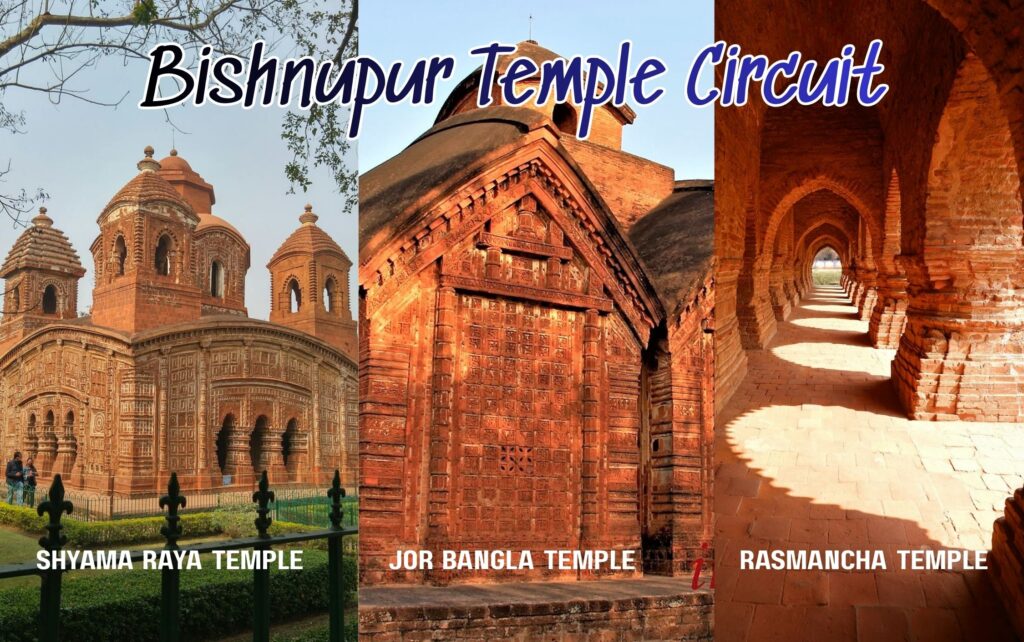
Bishnupur Temple Circuit by Indrani Ghose
Frequently Asked Questions
Are tripods allowed inside the ASI complex?
Tripods are generally not permitted inside temple sanctums but are allowed in the open courtyards of the ASI complex. Rules can vary by site and are enforced at the discretion of on-site guards. Always ask before setting up, particularly inside enclosed structures.
Which wall has the most intact Ramayana carvings?
The southern exterior wall of the Shyama Raya Temple preserves the clearest Ramayana narrative panels, including scenes from the battle between Rama and Ravana. These are among the better-maintained friezes on the structure and worth examining closely.
What is the entry fee for Shyama Raya Temple?
The temple is maintained by the Archaeological Survey of India. Entry is typically covered under an ASI composite ticket valid for multiple Bishnupur monuments. Fees are revised periodically — confirm the current Shyam Rai Mandir entry fee and timings at the ASI ticket counter near the complex on arrival.
How much time should I allow for the Shyama Raya Temple?
Allow a minimum of 45 minutes to one hour for the Shyama Raya Temple alone — more if you intend to photograph the terracotta panels systematically. For a full Bishnupur temple tour itinerary covering Rasmancha, Jor Bangla, and Madan Mohan as well, plan for a full day.
How does the terracotta tradition connect to craft today?
The craft lineage is still active. Panchmura village, roughly 8 km from Bishnupur, is home to artisans who continue to produce terracotta horses, elephants, and decorative pottery using techniques closely related to those used in the temple panels. It is a practical and worthwhile extension to any heritage visit — and a good place to buy directly from the craftspeople.
Is Bishnupur suitable for a day trip from Kolkata?
Yes, but a day trip is tight. The train journey from Howrah takes approximately 3.5 to 4 hours each way, which leaves limited time for the temples. An overnight stay in Bishnupur is strongly recommended if you want to cover the main circuit without rushing and take advantage of early morning light for photography.
Final Thoughts
The Shyama Raya Temple stands as mute evidence of what the Malla kings and their craftsmen achieved when devotion, patronage, and material skill aligned. Built in 1643 by Malla King Raghunath Singha, the panels clearly express Bishnupur’s identity as a centre of terracotta art and architecture — a place where clay was not a compromise for the absence of stone, but a medium mastered on its own terms.
To benefit maximum from the visit, slow down and look closely — at the sanctum interiors, the secular friezes, the musicians carved into dim corners. This is not just decorative work, but a complete cultural record, pressed into brick and fired to last.
The Shyama Raya Temple gives Bishnupur its place among India’s most significant heritage sites. Pair it with Rasmancha and Jor Bangla, extend to Panchmura for the living craft tradition.
Pin and save this for later…

About the Author
 Indrani Ghose is a cultural travel writer and heritage documentation specialist with over 15 years of experience exploring and writing about temples across India and Southeast Asia. Having visited over 150 sacred sites, she brings both scholarly depth and personal narrative to heritage travel writing.
Her work has been published in Lonely Planet, The National (UAE), Whetstone Asia, Deccan Herald, and various architecture and heritage journals.
Connect with Indrani: Follow Indrani on Instagram | Twitter | Facebook for heritage travel insights, photography tips, and offbeat destination discoveries.






Wow! Love the colour.
And the work is very attractive.
All the photos clearly portray the intricate details of the artistry and they are indeed telling the story of that age. Have visited all these places during my school excursion days – this post brought back my happy memories from past. Thanks.
The carvings are so beautiful and you have captured them so well !
Lovely
One day I will this all. One day.
Amazingly beautiful work
…wonderfully captured!
Thats some heavy duty terracotta work. Its amazing how they did not let the scarcity of stones hinder their creativity and built wonders with clay instead.
You seriously discover places we have had never heard of and they are so so beautiful.
Thank you friends for you comments.
Thank you Kokila for the appreciation and interest. I take most photos with my Canon EOS 450D, 200mm lens.
Serious and profuse thanks Indrani for sharing such amazing wonderful and so beautifully captured frozen art!Even I am intrigued by the size of that bird …was the artist familiar with huge birds at that time or simply imagined? The Krishna Ras leela was outstanding and outstandingly captured by you. What's your gear Indrani> Amazing. wishing you more such journeys , Love, Kokila
Its a stunning temple Indrani. Glad you introduced me to it. 🙂
krishna leela work is really awesome…loved it sooo much…perfect…and when i read that this treasure is well maintained, I felt very happy.
Beautiful pics and text..!
Such intricate carvings! I marvel at the skill of those people.
Amazing and a detailed capture.
Amazing terracotta work! Bishnupur is a treasure.
Imagining what these sculptures have kept stored in from the past for us to know… beautiful pics!!!
Such intricacies in terracotta. unbelievable!
Beautiful captures. I am always amazed at the patience that must have been shown for completing such intricate work. Thanks for sharing.
Brilliant art works!
Extraordinary designs!
No words to express how much I am impressed with the detailing.
The detail is mind-boggling. I wonder if anybody anywhere still takes time to do such things.
These are remarkable works.
Taking good care of the temple shows immense respect. I think it makes a huge difference for how visitors act when they are there.
The details on this temple are exquisite. It's nice to hear that the temple is so very well maintained and cared for.
Thrilling complexity!
Aloha
A magnificent place and I thank you so much for sharing it with us. I love to travel around the world through photos and yours are fantastic!
love it when it's well taken care.
I have enjoyed seeing this series so much, Indrani!! Like the others, I'm awed by the incredible detail and you have captured it so beautifully!! Thanks as always for sharing the beauty! Have a great new week!
Beautiful, just beautiful.
just such impressive detail, once again.
Marvelous series of pictures and fascinating details Indrani! Glad to hear they put enough effort to maintain the grace of temple.
Beautiful! The details are amazing.