Galo de Barcelos: The Legend, Symbolism, and Souvenir from Portugal
Rooster of Barcelos – Another animal figurine souvenir collected during my travel to Portugal.
Almost every souvenir shop I crossed in the different cities of Portugal I found these roosters, in all sizes and colors, staring back at me. It didn’t take long to figure out that Barcelos Rooster is one of the most common symbols of Portugal. Chatting up with a souvenir seller helped satiate the initial curiosity. He said in Portuguese people consider rooster as the embodiment of their love of life. It symbolizes faith, good luck and justice.
— Indrani Ghose, travel blogger | Updated Nov 2025

Traditional hand painted clay figurines – Rooster of Barcelos – souvenir from Portugal
The Enduring Legend of the Galo de Barcelos
Such a popular symbol will have its own story of origin. And I was right. A simple google search with rooster of Portugal threw up n number of sites rich with info. But as it happens, the story has passed down generations after generations thus bringing several variations to it, but I decided the following story is the best.
The Pilgrim, the Judge, and the Crowing Rooster
It is believed the legend related to the rooster takes place in 15th century in Barcelos. An unsolved crime in the town of Barcelos kept all its citizens anxious and petrified. During this phase of fear all around, an impoverished pilgrim was passing through Barcelos to fulfil a promise he made during a Pilgrimage to Santiago de Compostela.
Despite his explanation for being in Barcelos he was arrested, accused of the crime and condemned to hang. He refused to go quietly and asked to be taken to the judge who sentenced him to death. The authorities granted his wish and brought him to the magistrate’s house where the magistrate was having a banquet with friends.
The pilgrim swore his innocence and pointed to a cooked rooster on the table. He claimed that the rooster would crow at the hour of his hanging as proof. The statement caused a large amount of laughter and mockery. The judge ignored the statement of innocence, but still set aside the rooster as he had lost his appetite.
When the time for execution came, the pilgrim went to the gallows to accept his punishment.
Classic Barcelos figurine
Right before the executioner could deliver his judgment, the roasted Barcelos rooster sprang to life, stood upon the table in front of the crowd and crowed just as the pilgrim had predicted.
Taken aback, the judge realized the mistake he had made and rushed to save the pilgrim. Meanwhile the noose was not correctly tightened, so the innocent pilgrim could be saved from his death sentence.

The Cross of the Lord of the Rooster (O Cruzeiro do Senhor do Galo)
Later, the pilgrim returned to Barcelos. He sculpted a cross in honor of the Virgin Mary and St. James, who he felt was responsible for saving him with the miracle of the rooster. Today, this cross is referred to as the Cross of the Lord of the Rooster. This statue is still in existence in the Archaeological Museum of Barcelos.
Ever since Portuguese Rooster is said to symbolize faith, honesty, justice, love of life and luck.
Why the Rooster Became Portugal’s National Symbol
The Rooster of Barcelos, or Galo de Barcelos, is more than a colorful souvenir—it’s a powerful emblem of Portuguese culture, justice, and faith. The tale of divine justice for Galician pilgrim en route to Santiago de Compostela resonated deeply with the Portuguese people.
Over centuries, the rooster evolved from regional folklore into Portugal’s unofficial national symbol, embodying core Portuguese values: honesty in the face of injustice, resilience through hardship, and unwavering faith in divine protection.

Family of Roosters
The Role of Domingos Côto and the Clay Figurines
In the early 1950s, local artisan Domingos Côto (1890-1963) transformed the Rooster of Barcelos from oral legend into tangible art. Working from his modest workshop in Barcelos, Côto hand-molded distinctive clay figurines adorned with bold polka dots, hearts, and floral patterns in brilliant primary colors.
Côto’s figurines gained national attention after being featured in Portuguese folk art exhibitions during the 1950s. These hand-painted roosters were unique due to their artisanal creation. Soon, these figures became iconic representations of Portuguese folk art.
By the 1960s, the rooster had found its place in homes, markets, and souvenir shops across Portugal. Today, authentic Côto-style roosters remain prized collectibles. Local artisans continue the traditional techniques, keeping this cultural artifact alive across generations.
António Salazar and the National Propaganda
During the Estado Novo dictatorship (1933-1974), Prime Minister António Salazar strategically adopted the Rooster of Barcelos as a unifying symbol of national identity. Beginning in the late 1930s, his government promoted the rooster through state-sponsored tourism campaigns. They presented it as a symbol of Portugal’s rural authenticity. It was also linked to the country’s Catholic faith and traditional values.
The Secretariado da Propaganda Nacional (National Propaganda Secretariat) incorporated the rooster into tourism posters, cultural exhibitions abroad, and official merchandise. This elevation from regional folklore to national icon served dual purposes: it reinforced Portugal’s image internationally as a nation of tradition and piety while subtly supporting the regime’s political narrative domestically.
After the 1974 Carnation Revolution that ended the dictatorship, the rooster successfully transcended its propaganda origins, retaining its status as a cherished symbol of Portuguese heritage while shedding its political associations.
A Deep Dive into Barcelos: The True Home of the Galo
Nestled in the verdant Minho province of northern Portugal, approximately 55 km north of Porto, Barcelos sits majestically along the banks of the Cávado River. This medieval town of roughly 20,000 residents is the birthplace of the legendary rooster and an essential destination for travelers seeking authentic Portuguese culture.
Barcelos is a living museum where cobbled streets wind past whitewashed houses adorned with azulejo tiles, Romanesque churches with centuries-old bells, and the atmospheric ruins of the 15th-century Paço dos Condes (Palace of the Counts).
Visitors can trace the complete history of the Rooster of Barcelos through the legendary Cruzeiro do Senhor do Galo (a stone crucifix featuring the original rooster legend), artisan workshops where potters still hand-mold figurines using 500-year-old techniques, and public sculptures scattered throughout the historic center.

Huge family of roosters -souvenir from Portugal
Visiting the Town of Barcelos and the Famous Market (Feira de Barcelos)
Every Thursday from dawn until early afternoon, Barcelos transforms as the Feira de Barcelos takes over the sprawling Campo da República and surrounding streets. Established in 1412 by royal charter, this is one of Portugal’s largest and oldest open-air markets.
The market is a sensory explosion: the aroma of freshly baked broa (corn bread) mingles with sizzling chouriço, while vendors call out prices in the distinctive Minho accent. Vendors and visitors from across the Minho region visit the fair.
Hundreds of stalls offer handcrafted ceramics (including authentic Galo de Barcelos figurines ranging from €5 for small pieces to €50+ for large artisan works), embroidered linens that showcase traditional Portuguese needlework, wicker baskets, fresh produce from local farms, aged cheeses, and regional wines.
Travel tips: Arrive early—by 8 AM—for the best selection and to watch local farmers setting up their produce displays.
Look for pieces with slightly irregular shapes and hand-painted details—these indicate genuine artisanal work rather than mass-produced souvenirs.
Bring cash, as many vendors don’t accept cards, and don’t hesitate to politely negotiate on larger purchases.
Finding the Original: The Barcelos Pottery Museum
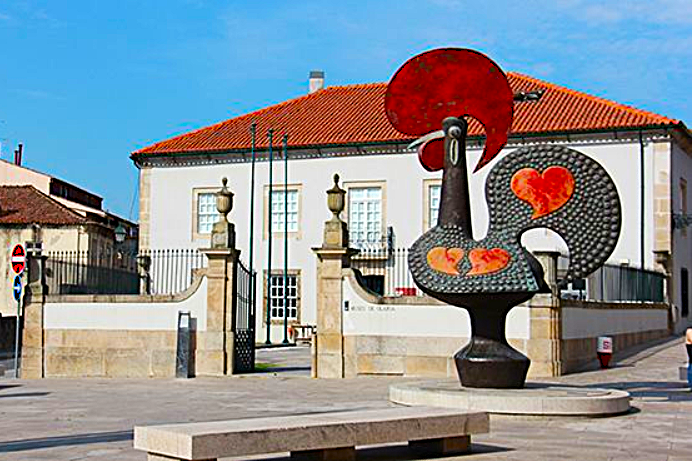
To truly understand the artistic soul of Barcelos and the evolution of the Galo, visit the Museu de Olaria de Barcelos , (Barcelos Pottery Museum) housed in a restored 17th-century building at Rua Cónego Joaquim Gaiolas. This institution, established in 1963, is dedicated to preserving and showcasing the Minho region’s rich ceramic heritage spanning five centuries.
The museum houses an extensive collection of over 6,000 pieces, including rare early 20th-century renditions of the Galo de Barcelos, some created by Domingos Côto himself. Live demonstrations by resident artisans—typically held on weekday mornings—offer fascinating insight into the hand-molding, painting, and kiln-firing processes that bring these cultural icons to life.
The museum is open Tuesday through Sunday, 10 AM to 5.30 PM (closed Mondays and major holidays). Admission is €2 for adults, with discounts for students and seniors. Plan for 60-90 minutes to explore the collection thoroughly.
The museum shop sells museum-quality pieces and books on Portuguese folk art, making it an excellent alternative to market shopping for those seeking authenticated works with historical documentation.
The Rooster of Barcelos as a Souvenir (Galo de Louça)
For travelers exploring Portugal, the Rooster of Barcelos—known locally as Galo de Louça (clay rooster)—ranks among the most iconic and culturally significant souvenirs available. Whether purchased at the bustling Feira de Barcelos or from certified artisan shops across the country, these ceramic figurines serve as vibrant tokens representing Portuguese values of luck, justice, and cultural resilience.
During my travels through Portugal in May 2015, I encountered Barcelos roosters in nearly every souvenir context imaginable—from the authentic hand-molded clay pieces at artisan workshops to mass-produced glossy versions lining airport gift shops.
Prices vary dramatically based on authenticity and craftsmanship: expect €5-€15 for small tourist-grade pieces, €20-€50 for quality artisan work, and €75-€200+ for collector’s items from master craftspeople or vintage Côto-style roosters.
The rooster’s ubiquity has made it a staple in gift shops, online marketplaces like Etsy, and even international Portuguese specialty stores. However, the most authentic pieces remain those crafted in Barcelos itself, where multi-generational artisan families continue shaping and hand-painting each rooster using techniques passed down since the 1950s.
When purchasing, consider that buying directly from Barcelos artisans not only guarantees authenticity but also directly supports the preservation of this UNESCO-recognized intangible cultural heritage.
Understanding the Different Types and Colors
The traditional Rooster of Barcelos is instantly recognizable by its distinctive color palette and symbolic patterns. The classic design features a black body adorned with decorative hearts, flowers, and polka dots in red, yellow, green, and blue.
Each color carries specific symbolic meaning rooted in Portuguese folklore: black represents dignity and the original roasted rooster from the legend, red evokes passion and divine justice, blue symbolizes faith and loyalty, yellow signifies generosity and prosperity, while green represents hope and renewal.
These patterns are not arbitrary decorations—they reflect regional Minho pottery traditions dating back centuries.
Traditional roosters crafted from terra-cotta clay with minimal glazing showcase the raw, earthy craftsmanship of authentic Portuguese pottery. These rustic pieces, often left partially unpainted, appeal to collectors seeking historical accuracy. In contrast, the vibrantly glazed tourist editions feature high-gloss finishes and simplified patterns designed for mass appeal and durability during travel.
Both styles honor the legend, but understanding their origins and production methods helps discerning travelers select souvenirs with deeper cultural significance and appropriate price expectations.
Authentic vs. Tourist: Buying Tips
How to Spot a Genuine Barcelos Piece? Distinguishing authentic Barcelos roosters from mass-produced imitations requires attention to specific details.
- Genuine pieces typically bear the “Artesanato de Barcelos” certification label or stamp, which guarantees the rooster was handcrafted by a recognized local artisan using traditional clay-molding and hand-painting techniques.
- Many genuine roosters include the artisan’s signature, initials, or workshop stamp on the base, along with “Barcelos” or “Portugal” etched into the clay before firing.
- Look for slight asymmetries, minor color variations, and small imperfections—these “flaws” are hallmarks of authentic handwork, not defects.
- The paint should show subtle brush strokes rather than uniform spray-applied color.
- Weight matters too: authentic clay pieces feel substantial and cool to the touch, while plastic or resin imitations are noticeably lighter.
- Avoid mass-produced versions with perfectly uniform patterns, smooth plastic finishes, or suspiciously low prices (under €8 for pieces larger than 10cm).
- Purchase from reputable sources: artisan stalls at Thursday’s Feira de Barcelos, the Museu de Olaria shop, or certified ceramic studios in Barcelos like Olaria de Barcelos or Cerâmica Artística Rosa Ramalho.
Supporting these certified creators ensures you acquire an authentic cultural artifact. This way you contribute directly to the economic sustainability of Portuguese traditional crafts and the livelihoods of artisan families who have preserved these techniques for generations.

How the Rooster of Barcelos is Used Today
Beyond the traditional ceramic figurines, the rooster’s unique shape now appears in many modern settings. It shows how Portugal’s identity is changing while retaining a strong link to the country’s history.
The Rooster of Barcelos tattoo has emerged as a popular motif, particularly among Portuguese youth, diaspora communities in Brazil and North America, and travelers marking meaningful Portuguese experiences.
I am not surprised to see that social media hashtags like #GaloDeBarcelos reveal thousands of tattoo variations, demonstrating the symbol’s resonance across generations. Here are some usages:
- street artists incorporate it into urban murals across Lisbon and Porto
- graphic designers create abstract geometric versions for branding
- sculptors produce large-scale installations for public spaces
- during regional festivals, especially Barcelos’s annual Festas das Cruzes each May, the rooster adorns parade floats, traditional costumes, and event merchandise
- hand-painted azulejo tiles feature rooster motifs in kitchen textiles, wall art, and designer tableware
Whether expressed through body art, festival celebrations, or home design, the Rooster of Barcelos remains a vibrant, evolving emblem of Portuguese cultural identity in the 21st century.
Quick Facts: Rooster of Barcelos and Portugal Travel Tips
Portugal Rooster symbol Facts
- Originates from a medieval legend in Barcelos, northern Portugal.
- Symbolizes justice, faith, and good luck in Portuguese culture.
- Commonly crafted in ceramic (Galo de Louça) with vibrant colors.
- Popular souvenir found in markets, especially in the Minho region.
- Recognized as a national icon during the Estado Novo regime.
- Certified artisan pieces bear the “Artesanato de Barcelos” label.
- Traditional versions are unpainted clay; tourist versions are brightly glazed.
Barcelos Portugal Travel Tips
- Visit Barcelos on a Thursday to experience the Feira de Barcelos market.
- Museu de Olaria offers deep insight into Portuguese pottery traditions.
- Look for local workshops to purchase authentic crafts and support artisans.
- Minho region is ideal for cultural immersion and folk art exploration.
- Rooster motifs appear in festivals, home décor, and modern tattoos.
- Learn basic Portuguese phrases—locals appreciate the effort!
- Spring and early autumn offer pleasant weather and fewer crowds.
FAQs: Rooster of Barcelos and Travel Planning
What does the Rooster of Barcelos symbolize?
Portugal rooster represents justice, faith, and good fortune—rooted in a legend of miraculous salvation.
Where can I buy authentic Rooster of Barcelos souvenirs?
At the Feira de Barcelos market or certified artisan shops in the Minho region. Look for the “Artesanato de Barcelos” label.
What’s the difference between traditional and tourist rooster figurines?
Traditional ones are unpainted clay with handmade details; tourist versions are colorful, glazed, and mass-produced.
Is the Rooster of Barcelos used in modern Portuguese culture?
Yes! It appears in tattoos, festivals, home décor, and contemporary art across Portugal.
What day is the Barcelos market held?
Every Thursday. It’s one of Portugal’s largest and oldest open-air markets.
Can I visit the pottery museum in Barcelos?
Absolutely. The Museu de Olaria showcases traditional and modern Portuguese ceramics, including rooster figurines.
Is Barcelos worth visiting for cultural travelers?
Definitely. It’s the birthplace of the rooster legend and a hub for folk art, history, and authentic Portuguese experiences.
Pin and Save this for later

About the author
 Indrani Ghose is a travel blogger and photographer who has explored 15+ European countries across multiple trips. Based in Bangalore, she shares authentic travel experiences to help fellow travelers navigate the world more safely and confidently. You can follow her on her social media handles Instagram, Twitter and Facebook to see the wonderful destinations, beautiful offbeat places and get instant updates about them.






I actually bought these as gifts when I visited Lisbon but I didn’t know about their name or the backstory! That legend is a memorable one, and I was always curious about whether these colorful roosters were a symbol of Lisbon vs all of Portugal. It’s interesting to know that they can be found everywhere!
I love love love the whole story of the Rooster of Barcelos! A few years back I walked the entire Camino Frances route of the famous Pilgrimage to Santiago. But after I spent time in Oporto to reflect and loved my time in Portugal! In recent years, I met and married the love of my life, Darcee. During our wedding she devoted us to Our Lady of Fatima and thus I have been trying to convince her to walk the Camino Portuguese Route to Santiago as it is shorter and will take us by Fatima to renew our devotion.
When we walk I definitely will add a stop at Barcelos to see the Cross of the Lord of the Rooster to witness the art that was inspired by a miracle of faith!
This was so beautiful, thank you for sharing this with me.
I always wonder about where the origin of popular souvenirs comes from. I thought it was interesting that many other artisans began copying Coto’s work. I’m actually a rooster on the Chinese calendar so this would be a great souvenir for myself:)
What an interesting story! Thanks to Domingos Coto, now tourists can bring home the rooster souvenirs home. They look so colorful, I would like to bring some home, too.
I love the story you picked, where the person being sent to the gallows was saved by the rooster at the last second. The rooster souvenirs are very bright and colourful, I can see why tourists would want to take one of these back home as a keepsake to place somewhere in the house (within the feng shui rules of course).