Guide to Pillayarpatti Karpaga Vinayagar Temple, History and Secrets
A 1,600-Year-Old Rock-Cut Wonder
When I visited Pillayarpatti Karpaga Vinayagar Temple, I understood why devotees travel hours to reach this small town near Karaikudi in the Chettinad region. This is one of Tamil Nadu’s oldest and most revered rock-cut cave temples — a 1,600-year-old shrine carved directly into a granite outcrop and dedicated to Lord Ganesha.
The presiding deity is known as Karpaga Vinayagar — the divine wish-fulfilling tree — and his reputation draws pilgrims from across South India. Unlike temples built with stacked stone and towering gopurams, Pillayarpatti preserves something rarer: a sanctum that nature itself provided, shaped by ancient hands into a place of worship.
By Indrani Ghose | Last Updated: Feb. 2026
For travelers on the Madurai–Karaikudi–Chettinad temple circuit, this stop is not optional — it’s essential. The temple delivers on two fronts simultaneously: deep spiritual significance and genuine architectural heritage. If you’re planning a visit, set aside more time than you think you’ll need. This place rewards those who slow down.
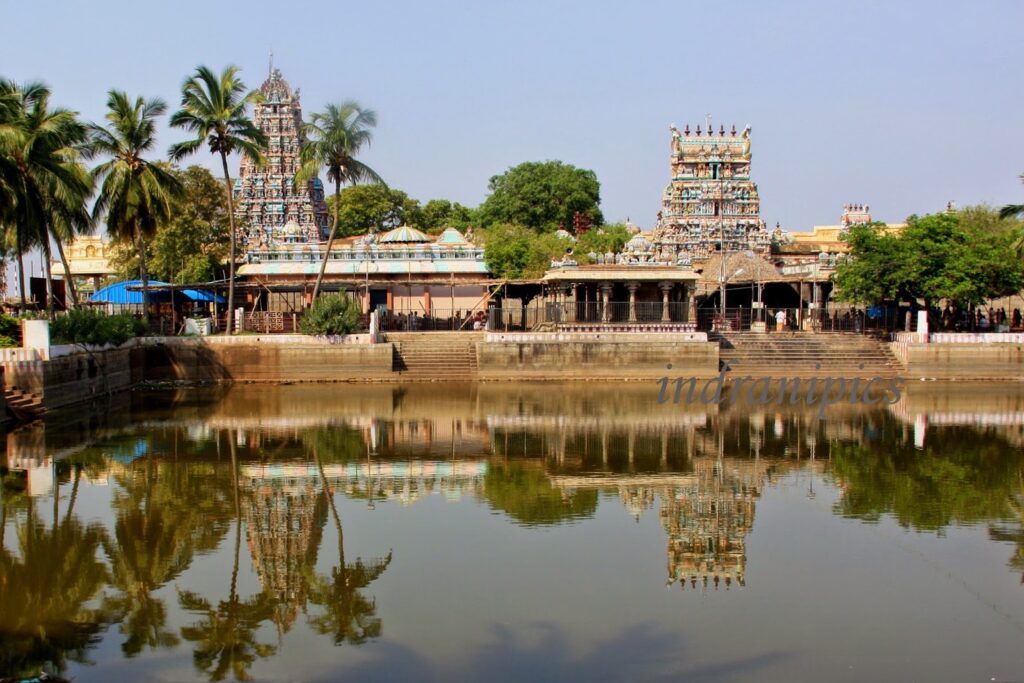
Karpaga Vinayagar Temple – Undisturbed reflections of the gopuram (gates) of the temple looked good.
My First Glimpse of the 6-Foot Valampuri Ganesha
When I stood before the deity in the sanctum at Pillayarpatti, I noticed the fragrance before anything else — camphor smoke and fresh flower garlands layered into the cool, still air of the cave interior. It immediately signals that you have crossed into a different kind of space.
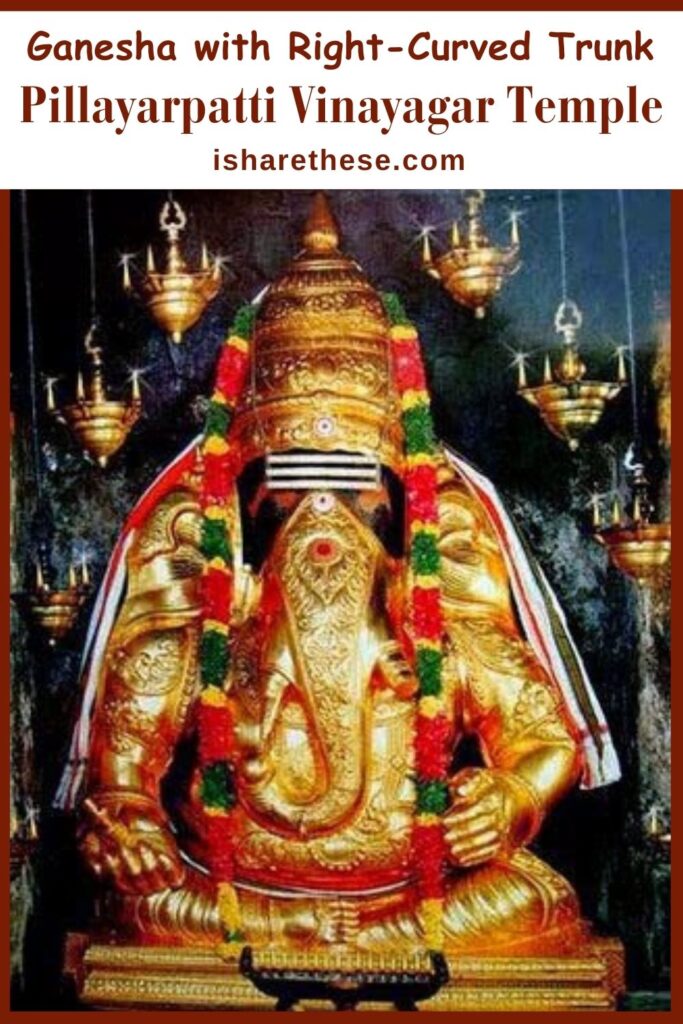
The main deity, Valampuri Vinayagar, stands approximately six feet tall — an imposing, gold-plated form of Lord Ganesha with his trunk curving to the right. This right-curved trunk, known as valampuri, is considered especially auspicious and is far less common than the left-curved form found in most Ganesha temples across India. That distinction alone makes this idol significant in Hindu iconographic tradition.
The temple walls reverberate with Vedic mantras recited by students throughout the day. When I reached I felt slightly disappointed about the long queue to enter it. But it moved fast. Most eye-catching feature of the idol is the golden trunk. I could stand long enough to grasp it in my eyes and mutter a silent prayer.
The figure is carved from the living rock of the cave itself — not installed, but born from the same stone that forms the walls and ceiling around it. Under the warm glow of oil lamps, the gold-covered surface shimmers with a depth that my photographs could never capture – even if I was permitted to take one.
The Hidden Chronicles: Why Pillayarpatti is an Architectural Anomaly
Most visitors see a gold-covered Ganesha, but as a traveler with an eye for detail, you likely noticed that this isn’t a standard modern temple. It is a 7th-century rock-cut marvel (though some inscriptions date back even earlier to the 4th century).
-
The Mystery of the Two-Armed Ganesha
In almost every temple in India, Lord Ganesha is depicted with four arms. However, the Karpaga Vinayagar is unique:
- The Iconography: He has only two arms, a characteristic of the earliest Ganesha idols in South India. Ganesha idol is featured with 4 arms in later temples.
- The Trunk: Unlike most idols where the trunk turns left (Edampuri), here it turns to the right (Valampuri).
- The Posture: He sits in a semi-meditative pose without his usual vahanas (vehicles) or elaborate ornaments carved into the base rock, signifying an ancient, primal form of the deity.
- Lord Ganesha is seen seated without Angusapasam. He is seen with his legs folded and stomach not touching the Asanam (seat) in the form of “Artha Padma” Asanam.
-
The “Desi Vinayagar” Inscriptions
Inside the cave, look for the ancient Tamil-Brahmi inscriptions. One specific inscription refers to the deity as “Ekkattur Koon Peruparanan.” These stone records are vital for historians because:
- They prove the temple was carved during the Early Pandya period.
- They identify the sculptor as Ekkattur Koon, one of the few instances in ancient India where the master craftsman’s name is immortalized on the sanctum itself.
-
Alignment with the Cosmos
The temple is north-facing, which is rare for Ganesha temples. During specific times of the year, the architecture allows for natural light to hit the rock-cut carvings in a way that highlights the “glow” of the granite.
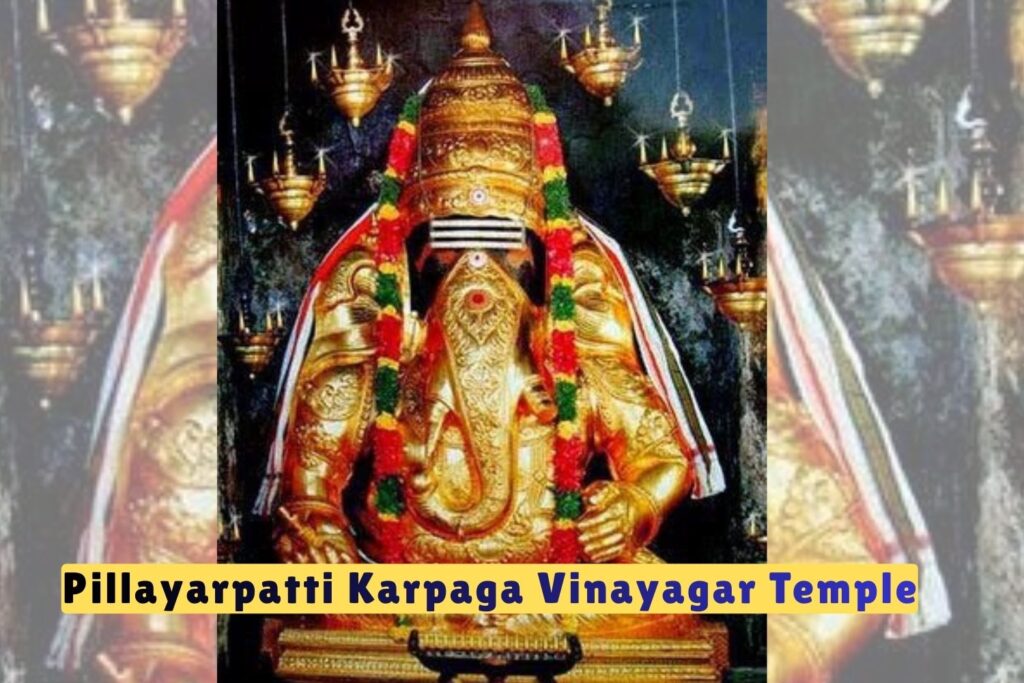
Pillayarpatti Karpaga Vinayagar Temple
The Mystery of the Cave Inscriptions
Among Pillayarpatti’s most compelling — and least-discussed — features are its ancient cave inscriptions. Carved into the temple walls, these archaic Tamil-Brahmi scripts are among the earliest forms of written Tamil found at any active place of worship in the state.
What the Inscriptions Tell Us
- They are believed to date to the early Pandya period, reinforcing the temple’s claim as one of Tamil Nadu’s oldest rock-cut shrines.
- The inscriptions reference the temple’s patrons and hint at the rituals practiced centuries ago.
- Significantly, they have not been fully deciphered — which means they remain an open area of historical inquiry, not a closed chapter.
For epigraphers and historians, these markings are primary-source material on early Tamil language and religious practice. For devotees, they are silent testimony to centuries of unbroken worship.
During my visit, I paused at these faded carvings. I couldn’t read a word — but standing there, it was clear that the walls themselves were a form of record-keeping, faith pressed into stone by hands that worked here long before any written history of this region existed.
Planning Your Visit to Pillayarpatti Temple
Here is what you need to know before you go:
Temple Timings (Pillayarpatti Temple timings 2026)
- Open approximately 6 AM – 1 PM and 4 PM – 8.30 PM daily.
- Six pujas are conducted each day at fixed intervals; the early morning Thiruvanandal puja draws the most devoted crowd.
- Timings shift during major festivals — confirm current schedules directly with the temple trust before visiting.
- For a quieter darshan, arrive by 7 AM on weekdays.
Dress Code
- Modest clothing is required. Traditional attire — saree, dhoti, or salwar — is preferred.
- Shorts, sleeveless tops, and revealing clothing are not permitted inside the complex.
Pro-tip from my trip: Wear socks as the stone floors get hot in the afternoon.
Photography
- Permitted in the outer courtyard and gopuram areas.
- Strictly prohibited inside the sanctum sanctorum.
Offerings and Facilities
- Standard offerings — coconuts, flowers, camphor — are available at stalls near the entrance at reasonable prices.
- Drinking water, prasadam counters, and shaded waiting areas are available on-site.
- The complex also houses smaller shrines dedicated to Shiva and other deities, worth a quiet walk-through after the main darshan.
How to Reach Pillayarpatti from Karaikudi, Madurai, and Trichy
Pillayarpatti is well-connected and easy to reach from the main cities in the Madurai–Karaikudi–Chettinad belt.
By Road
- From Karaikudi: 12 km, approximately 20 minutes. Local buses, autos, and taxis are readily available.
- From Madurai: Around 90 km via NH38, roughly 1.5–2 hours by road. Taxis and buses operate this route regularly.
- From Trichy: Approximately 120 km, around 2–2.5 hours. NH336 connects Trichy to Karaikudi with reasonable road conditions.
- Signboards to “Pillayarpatti Temple” appear on approach roads — navigation is straightforward.
By Rail
- Nearest station: Karaikudi Junction, connected to Chennai, Madurai, Trichy, and Coimbatore.
- Autos and taxis outside the station cover the 12 km to the temple in under 30 minutes.
By Air
- Nearest airport: Madurai International Airport, with daily flights from Chennai, Bengaluru, and Mumbai.
- From the airport, hire a taxi directly to Pillayarpatti (approximately 90 km) or travel to Karaikudi and arrange local transport.
Travel Tip: Karaikudi is your natural base for this trip. From there, you can combine the temple visit with Chettinad heritage mansions, antique street markets, and a proper Chettinad meal — all within a half-day circuit.
Beyond the Temple: Exploring the Surroundings
Pillayarpatti works best as an anchor point for a wider circuit. The Chettinad–Karaikudi region surrounding the temple is one of Tamil Nadu’s most culturally layered travel destinations — and it rewards a full day rather than a quick stop.
Chettinad Heritage
- The Nagarathar mansions of Kanadukathan and nearby villages are architectural landmarks in their own right — grand courtyards, hand-carved teak pillars, Belgian mirror inlays, and the distinctive handmade Athangudi floor tiles that Chettinad is famous for.
- Several mansions are open to visitors; a guided walkthrough adds significant context to what you see.
Karaikudi
- The town’s antique street markets carry everything from colonial-era furniture to bronze vessels and old Chettinad doors.
- For food, a proper leaf-service Chettinad meal — with its layered spice profile and rarely-found regional dishes — is non-negotiable.
Nearby Temples
- Kundrakudi Murugan Temple, about 10 km from Pillayarpatti, sits on a hillock and is a natural addition to any morning circuit.
- 9 Chettinad Temples associated with 9 clans in Chettinad community are famous in Chettinad region
- Madurai’s Meenakshi Amman Temple, 90 km away, is a logical endpoint for a two-day itinerary.
The Chettinad Spiritual Loop — My 1-Day Itinerary
This is the itinerary I followed, and it covers the essentials without feeling rushed:
- 6.30 AM — Pillayarpatti: Arrive early for the morning Abhishekam. The sanctum is calmer, the rituals more accessible, and the light inside the cave shrine is at its best.
- 9 AM — Kundrakudi Murugan Temple: A short 10-minute drive. The hillock setting makes for a pleasant, unhurried visit after the intensity of Pillayarpatti.
- 11.30 AM – 1 PM — Karaikudi: Settle in for a full Chettinad leaf-service lunch. Don’t rush this — it’s part of the experience.
- Afternoon — Athangudi and Kanadukathan: Visit the Athangudi tile factories to watch the hand-pressing process, then walk through the Chettinad mansions at Kanadukathan. A guide is worth hiring here.
This loop runs approximately 60 km in total and is entirely manageable as a self-drive day trip from Karaikudi or Madurai.
Belief about Lord Ganesha’s Trunk
Have you ever noticed the lovable elephant headed God is always depicted with His trunk curved towards left?
Popular belief is that: left side of our body symbolizes the feminine side of our personality and is cool and composed by nature. The right side is masculine and is considered hot fiery and aggressive. So, it is believed that Lord Ganesha depicted with His trunk turned to left, is in good mood and easy to please.
No strict rules need to be followed while worshiping this idol.
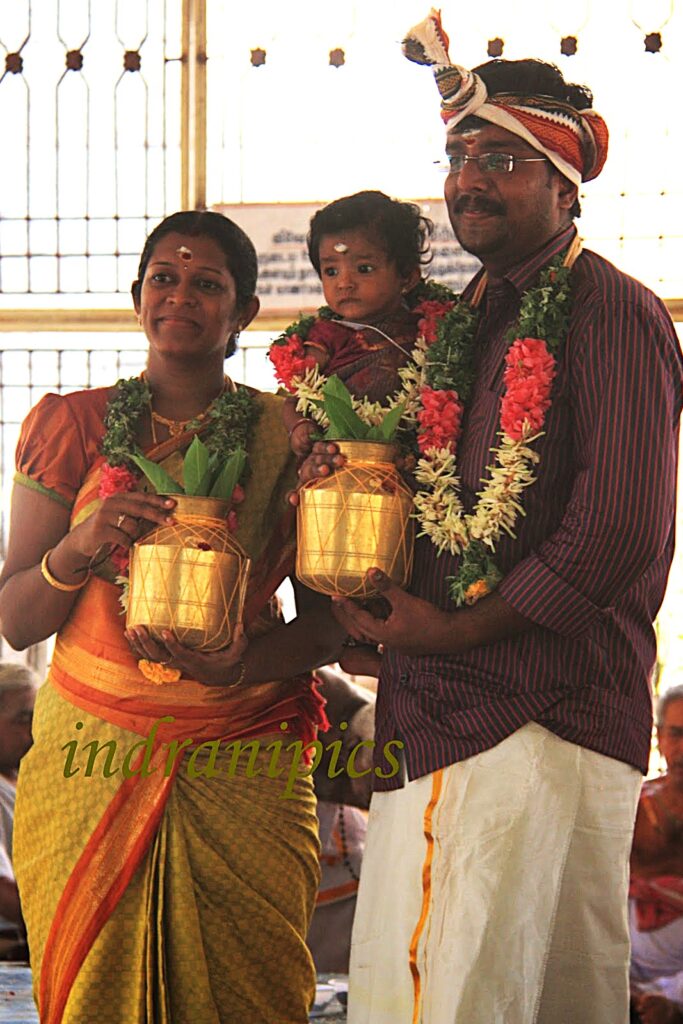
Devotees at Karpaga Vinayagar Kovil
FAQs about Pillayarpatti Karpaga Vinayagar Temple
What is the best time to visit Pillayarpatti Karpaga Vinayagar Temple?
The best time to visit is during the early morning hours (6 AM to 8 AM) or late evening to witness the Deeparadhana. For a peaceful experience, visit on a weekday. Tuesdays and Sankashti Chaturthi are considered highly auspicious, but expect significantly larger crowds.
Is there a specific dress code for the temple?
Yes, like most traditional temples in Tamil Nadu, a modest dress code is strictly followed.
- Men: Dhoti or formal trousers (avoid shorts/lungis).
- Women: Saree, half-saree, or Chudidhar with a dupatta (avoid sleeveless tops or ripped jeans).
How long does the Darshan usually take?
On a regular weekday, you can complete the Darshan in 30 to 45 minutes. However, during festival days like Vinayaka Chaturthi, wait times can extend from 3 to 5 hours. There is usually a “Special Entrance” ticket (around ₹50 – ₹100) available for a faster queue.
Are there any restrictions on photography?
While you can take beautiful photos of the Raja Gopuram (entrance tower), the temple tank (Oorni), and the outer corridors, photography is strictly prohibited inside the inner sanctum and the rock-cut cave area. Please respect the temple staff’s instructions.
Can I find good accommodation near Pillayarpatti?
There are basic guest houses managed by the Pillayarpatti Nagarathar Trust near the temple. For more luxury or comfortable boutique stays, I recommend staying in Karaikudi (about 12 km away), which offers beautiful Chettinad heritage mansions converted into hotels.
What is unique about the Vinayagar idol here?
The idol is a 6-foot tall, gold-plated rock-cut carving. Unlike most Ganesha idols, this one is Valampuri (trunk turns to the right) and has only two arms instead of four, proving its ancient 7th-century origin.
What are the temple timings in 2026?
The temple generally follows these timings:
- Morning: 6 AM to 1 PM
- Evening: 4 PM to 8.30 PM
(Note: These timings may extend during the 10-day Vinayaka Chaturthi festival.)
Pin and Save this for Later
About the Author
 Indrani Ghose is a cultural travel writer and heritage documentation specialist with over 15 years of experience exploring and writing about temples across India and Southeast Asia. Having visited over 150 sacred sites, she brings both scholarly depth and personal narrative to heritage travel writing.
Her work has been published in Lonely Planet, The National (UAE), Whetstone Asia, Deccan Herald, and various architecture and heritage journals.
Connect with Indrani: Follow Indrani on Instagram | Twitter | Facebook for heritage travel insights, photography tips, and offbeat destination discoveries.






These temples are always so colorful and fascinating to explore especially when you get a chance to witness the rituals and elaborate flowers and costumes involved, its all wonderful.
That is a very curious and unique Ganesha. 2 hands, its direction and the fact it does not sit on the asanam. Definitely a place that I need to visit and see for myself. Lovely pictures you have captured, especially that of the family waiting for the Pooja
We often saw Ganesh in Sri Lanka but I never knew about the left and the right side for the trunk and what it meant! Thanks for sharing.
Ganesha temples dot the length and breadth of India. More of course in the south. But what is really amazing is that each one has something unique and never fails to pull in hordes of faithful devotees. The Pillaiyarpatti Vinayagar Temple seems to be unique in many ways with respect to the idol. Have not visited this part of the country though, would love to visit this temple when in those parts.
Beautiful! I love the details on the sculptures. I have heard very little about this temple and now I am excited to see it!
I have heard about this temple but never got a chance to visit it. Awesome post as always! By the way, I think , Karpaga is alluding to Kalpavriksha and has the property of fulfilling wishes. This Vinayaka is supposed to have the same property to his devotees. Of course I could be wrong . Black in Tamil is Karuppu.
I so love the South Indian Temples – they are so colorful and have such an intricate and interesting sculptures on them. Karpaga Vinayagar Kovil is really beautiful especially its views across the lake. I had my first trip to South India 2 years ago, but I missed Tamil Nadu — seeing this temple and spending more time in the South part of India would be a great reason to return.
I’d be interested in seeing the exterior of the temple close up, especially since you say it is a cave temple. It’s kind of nice when photography is restricted in some places I think. It allows you to have a more “in the moment” experience at least, even if the line is pretty long. 😉
I really love all the care and attention you put into describing the details of the statue – I’m sure a lot of people would miss most of what you noticed.
What an interesting post, Ingrain! I’m not Hindu, but I’ve always been fascinated by it as the symbolism never fails to amaze it. I do appreciate the fact that there are no photographies inside the temple as somehow taking pictures can disturb the sacredness of the place.
Lord Ganesha here is with two arms, else where in other temples Ganesha idol is featured with 4 arms. Nice information about the sacred place .
How very interesting! I am not Hindu but, after living in India, off and on, for over a year now, I am beginning to know your gods and Ganesha is special to me. I always pray to him to help me overcome any obstacles to my return to this country that I love.
I wish I could visit this temple. There are still so many places in India that I want to go but my retirement pension barely covers flying here and back!! I live vicariously through your wonderful posts.
Very interesting post. I did not know about Ganesha's trunk. But in your photo, is his trunk turned to 'our' left or to his 'right'? Would it be pointing to the masculine or feminine side in your photo?
Informative. Loved that photo of the family offering the Pooja.
There is so much to learn about India, fortunately there are many bloggers from your country, who tell about the Indian deities. Thanks!
Wil, ABCW. Team.
It's really interesting. I often find Ganesha statues or profiles on so many place here, but I have never known the history. Thank you for sharing.
Lovely photos and very interesting read! You have taught me many new things through this post!
Lovely reflection in the second photo. Ah, now I will look for Ganesh's trunk facing the right!
Great post, I love the elephant and the pretty temple..The family shot is beautiful. Thanks for sharing, have a happy day!
Nice to know about this temple. 2nd picture is simply amazing. Thanks for sharing
Nice photos Indrani and thanks for the information provided…never heard of this temple before…
Very interesting about the trunk! I get the fiery, masculine side is less tolerant of mistakes!! 😀
Interesting … never heard abt this temple …my parents love all religious places and they will be happy to know abt this temple …thanks indrani for sharing 🙂
Interesting observation on the Idol there! Beautiful capture on the temple and nice reflection
Enjoyed the informative post, Indrani! And nice pictures, as always.
How very interesting. In London, where I normally live, the archeologists find lots of these terracotta images in the Thames when they carry out archeological digs. We have a lots of Hindu Londoners who perform their ancient rituals in the Thames, which I think is a lovely blending of the East with the West. The temple in Tamil Nadu looks amazing. Beautiful photos. Thank you for sharing them. All the best, Bonny
Before reading your post I didn't even notice that the trunk was curved to a side! Now I will always see which side it is curved towards and will remember this post!
Tuesday in Maharashtra is celebrated as the day of Siddhi Vinayaka and today is Tuesday and you shared this post and the picture of Lord Ganesh. I consider this a good Omen. Thank you Indrani. You made my day auspicious.
I loved to read the post and the info in it. The pictures were beautiful.It is amazing how much richness does our country hold.
That was a very informative post. Many hindu idols display feminine side in the idols. Shiv-linga has an entire right side is feminine while Lord Krishna idols wear nose ring.
It is said that the lord is not complete without being feminine
I just noticed that you have written 1000+ posts. Hats off to you.
Nice pictures. I always why these temples don't clean the pond inside the temple. 🙂
Stunning architecture doubly beautiful when reflected as in your photograph.
Thank you for another beautiful, interesting and informative post about your world!! I do enjoy them so very much, Indrani!!
very interesting. i'm quite fascinated by the hindu gods.
thanks for the education on the lord ganesha depictions!
Wonderful shots and interesting post.
Hi Indrani, your photos are marvelous and this was a very interesting post. Thank you so much.