Taj-ul-Masajid: A Complete Guide to India’s Largest Mosque in Bhopal
Standing in the heart of Bhopal, the Taj-ul-Masajid — literally meaning “Crown of Mosques” — is both a place of active worship and one of the most significant examples of Indo-Islamic architecture in India. Recognised as the largest mosque in India, it defines Bhopal’s skyline with its distinctive pink sandstone façade, twin minarets, and a courtyard large enough to hold thousands of worshippers.
For travellers, historians, and architecture enthusiasts, the mosque offers a direct connection to the legacy of the Bhopal Begums — the remarkable female rulers who shaped the city’s cultural and architectural identity.
When I visited in March 2021, the sheer scale of the complex was immediately striking, as was the calm that persisted despite its size. I was excited about visiting Taj-ul Masajid because most Indian mosques are out of bounds for women.
By Indrani Ghose | Last Updated: Mar. 2026
Whether you want to understand who built it and why construction took nearly a century, know if non-Muslims can visit, or find the best time for photography — this guide covers it all.

Taj-Ul-Masajid, Bhopal – Crown of the mosques, largest mosque in India
Quick Facts and Significance about Taj-ul-Masajid
No changes needed. The bullet points are accurate, well-structured, and scan-friendly. I’d only suggest adding one line for visitor context:
- Location: Bhopal, Madhya Pradesh
- Title: Taj-ul-Masajid means “Crown of Mosques”
- Status: Largest mosque in India, among the biggest in Asia
- Architecture: Indo-Islamic style with Mughal influences
- Area covered: The mosque complex covers an area of 400,000sqm
- Patronage: Built under the Bhopal Begums, especially Shah Jahan Begum
- Highlight: Popular for photography at sunrise and sunset
- Visiting Hours: Open to non-Muslim visitors outside prayer times (verify locally before visiting)

The 3 stark white bulbous domes enhances the beaty of the mosque, Taj-ul-masjid
The History of Taj-ul-Masajid: From Shah Jahan Begum to 1985
The story of the Taj-ul-Masajid is inseparable from the ambition of the Bhopal Begums. Construction began in 1871 under Shah Jahan Begum, one of Bhopal’s most influential rulers, who envisioned a mosque that would rival Delhi’s Jama Masjid in both scale and grandeur. Her goal was clear: to build a structure that would reflect Bhopal’s importance as a centre of Islamic culture in central India.
Progress, however, was slow. Financial constraints repeatedly interrupted construction, and after Shah Jahan Begum’s death, her daughter Sultan Jahan Begum continued the effort — but political changes and dwindling resources brought work to a standstill. For decades, the unfinished domes and minarets became a familiar feature of Bhopal’s skyline, and the mosque earned the informal title of “the 100-year mosque.”
Completion finally came in 1985, driven by renewed community funding and the efforts of religious organisations that took up the cause. Eastern gate to this mosque was renovated grandly using ancient motifs from old Syrian mosques. This was majorly funded by the contribution of the Emir of Kuwait.
Walking through the courtyard during my visit, that long arc of history felt genuinely present — in the stonework, the scale, and the quiet sense of something finally made whole.

Old Crystal Filials which were placed on domes
Architecture of Taj-ul-Masajid
The Taj-ul-Masajid is one of the finest examples of Indo-Islamic architecture in India, combining Mughal-era design principles with local craftsmanship and materials. Its scale is immediately apparent — from the broad courtyard that can hold tens of thousands of worshippers, to the arched gateways, marble domes, and detailed stonework that cover nearly every surface. The overall effect is one of controlled grandeur: imposing in size, but precise in its detailing.
The mosque’s construction reflects the Bhopal Begums’ clear ambition to create something that could stand alongside the great mosques of Delhi and Agra. That ambition is visible in the quality of materials used, the consistency of the design language, and the way the building holds its presence against the open sky.

Madrasa in Taj-ul Masajid Bhopal
The Pink Façade
The exterior of the Taj-ul-Masajid is defined by its pink sandstone construction, which gives the mosque a warm, distinctive tone that shifts noticeably depending on the light. In the early morning and at sunset, the walls take on a deeper, golden-pink colour that makes the mosque especially striking for photography.
The façade features pointed arches, recessed panels, and carved detailing that follow Mughal design conventions while incorporating regional influences.
The overall effect is refined rather than ornate — the decoration enhances the structure without overwhelming it.
The Minarets
Two tall minarets flank the main prayer hall, each rising to approximately the height of an 18-storey building — making them visible from considerable distances across the city. Built on octagonal bases, the minarets taper upward and are crowned with marble finials.
Their verticality provides a strong visual counterpoint to the broad horizontal sweep of the courtyard and the rounded profile of the domes. In form and proportion, they closely follow the tradition of Mughal-era minarets, though the scale here is particularly commanding.
The Domes
The mosque is topped with three large white marble domes, the central one being the most prominent. The contrast between the pink sandstone walls and the white marble domes is one of the mosque’s most recognisable visual qualities.
The domes follow the bulbous Mughal form and are finished with clean, smooth marble that reflects sunlight throughout the day. Up close, the transition from sandstone to marble at the roofline is one of the more finely detailed aspects of the construction.
The Zenana Gallery
In keeping with the Bhopal Begums’ tradition of supporting women’s participation in public and religious life, the mosque includes a designated section for women worshippers.
This area, sometimes referred to as the Zenana section, features latticed screens that allow worshippers to participate in prayers while maintaining the privacy conventions of the time.
It is a relatively rare feature in mosques of this era and scale, and reflects the distinct character of Bhopal’s female-led patronage of religious architecture.

Architectural Details – The Zenana Gallery
Entrance to Taj-ul Masajid
Main entrance to this mosque is from Kaiser Embankment is 74ft high, a flight of stairs lead up to this entrance. This monumental flight of stairs is modeled on Buland Darwaza of Fatehpur Sikri. It is an impressive double storied entrance with 4 archways. Times Passion Trails group sat on the steps here and had a group photo clicked.
The mosque plays the role of Madrassa too. It is a modern madrasa where they teach English and Mathematics in addition to their teachings in Koran.
Prayer Hall
The prayer hall is in the western side of the complex, you can now get your geographical orientation based on this. It has 9 arched entrance doors supported by pillars. The roof has 27 hollow domes (big and small), which amplify the sound and enhance the acoustics of the building.
Three of them are prominent. White shiny onion shaped domes from outside, they form a wonderful outline to the monument. Domes of the prayer hall are crowned with crystal finials.

Prayer hall in the western side of the complex
11 arches adorn the Quibla wall of the prayer hall. Inside, the red sandstone pillars are heavily patterned with petals of flowers and intricate designs. Ceilings too are richly decorated with floral patterns and designs by skilled artists. The prayer hall can accommodate 1000 people at a time.
The Story of Crystal Floor Tiles
Interesting part of the history of architecture of Tajul Masjid is that crystal slabs were procured from England to be used as slabs for flooring the entire courtyard where people would perform namaz. However, the Ulama objected to the use of these crystal glass slabs because the polished surfaces would reflect images of the worshipers and this was not acceptable according to their religious norms. All slabs went waste!
The guide said, 7 lakh rupees were invested in these crystal glass slabs. And 7 lakhs was not a less amount in those days. This was one of the reasons why the mosque could not be completed. One of those crystal slabs is kept in the library of the mosque. Now the flooring is of white marble.

Crystal Floor Tiles
Is Taj-ul-Masajid Bigger than Jama Masjid? A Comparison
The comparison between Taj-ul-Masajid and Delhi’s Jama Masjid comes up often, and for good reason — both are landmark mosques with significant historical weight. But in terms of sheer scale, the Taj-ul-Masajid is considerably larger.
Side-by-Side Comparison
| Feature | Taj-ul-Masajid, Bhopal | Jama Masjid, Delhi |
| Worshipper Capacity | Up to 175,000 (estimated) | Approx. 25,000 |
| Construction Period | 1871–1985 | 1644–1656 |
| Primary Material | Pink sandstone & white marble | Red sandstone & white marble |
| Built By | Bhopal Begums | Mughal Emperor Shah Jahan |
| Architectural Style | Indo-Islamic, Mughal-influenced | Mughal |
The difference in capacity is significant. Jama Masjid, built by Emperor Shah Jahan in the 17th century, is rightly celebrated as a jewel of Mughal architecture and remains one of India’s most visited religious sites. But the Taj-ul-Masajid’s footprint is larger, its courtyard more expansive, and its total worshipper capacity — by most estimates — nearly seven times greater.
For visitors interested in Indo-Islamic architecture, both mosques are worth experiencing. They represent different eras and different patrons, but the Taj-ul-Masajid’s scale makes it the clear answer to the question of which is India’s largest mosque.

Masajid model of Taj-ul Masajid Bhopal
How to Visit Taj-ul-Masajid: Timings, Entry Fees, and Rules
Visiting the Taj-ul-Masajid is straightforward, but a little planning goes a long way. The mosque is open daily and entry is free for all visitors. Non-Muslims are welcome outside of active prayer times, though access to the inner prayer hall may be restricted during Friday prayers and on significant Islamic festival days such as Eid. It is always worth checking locally before your visit, as timings can vary.
The mosque opens early in the morning for Fajr (dawn prayer) and remains open through the day, closing after Isha (night prayer). The quietest windows for a visit are mid-morning on weekdays or late afternoon before the evening prayer.
When I visited in March 2021 on a weekday morning, the atmosphere was calm and unhurried. The staff were welcoming, and there was no sense of restriction for non-Muslim visitors as long as basic etiquette was observed. The scale of the courtyard only becomes apparent once you are standing in it — photographs do not fully prepare you for it.
Taj-ul-Masajid Entry Fee and Timings
| Detail | Information |
| Entry Fee | Free for all visitors |
| Opening Hours | Dawn to late evening (prayer-time based) |
| Friday Restrictions | Inner hall may be closed to non-Muslim visitors during Jumu’ah prayer (typically 12.30–2 PM) |
| Best Days to Visit | Weekdays (fewer crowds) |
| Best Time of Day | Early morning or late afternoon |
Note: Timings are subject to change during Ramadan, Eid, and other religious observances. Confirm locally before visiting.
Photography at Taj-ul-Masajid — Best Times and Tips
The Taj-ul-Masajid is one of the most photogenic landmarks in Madhya Pradesh, and the light makes a significant difference to the quality of images you can capture.
Sunrise is the most rewarding time. The pink sandstone façade catches the early light and takes on a warm, deep tone that shifts quickly as the sun rises higher. The courtyard is also at its quietest at this hour, which makes it easier to photograph the architecture without large crowds in frame. I arrived just after sunrise during my March 2021 visit and had stretches of the courtyard almost entirely to myself.
Sunset is the second best option. The marble domes reflect the golden evening light well, and the contrast between the sandstone walls and the sky deepens as the light fades. For wider shots of the full façade and minarets, the late afternoon also gives you cleaner shadows and better depth.
A few practical photography tips:
- Avoid using flash inside the prayer hall or during prayers — this is both respectful and practically unnecessary given the natural light available.
- A wide-angle lens is useful given the scale of the courtyard and the height of the minarets.
- The reflection pool in the courtyard, when filled, offers good foreground interest for symmetrical shots of the main entrance.
Dress Code and Etiquette
The Taj-ul-Masajid is an active place of worship, and visitors — regardless of faith — are expected to dress and behave accordingly.
For clothing, modest dress is required. This means covered shoulders and full-length trousers or skirts for both men and women. If you arrive underprepared, modest coverings are sometimes available at the entrance, but it is better not to rely on this.
Tips to Visit Taj-ul Masajid
- Even though they allow photography please be mindful of the students attending the madrassa classes and Imams around.
- Follow rules and be respectful.
- Footwear is strictly not allowed inside the complex.
- Food and drinks not allowed inside. However we got the taste of piping hot Sulaimani tea just outside the complex near the library.
- Best time to visit would be mornings and evenings. Personally I would avoid midday visit and summers here.
What to See Near Taj-ul-Masajid: The Bhopal Heritage Circuit
The Taj-ul-Masajid sits within a city that rewards slow, attentive exploration. Bhopal has a distinct architectural identity shaped by its Begum rulers, and several landmarks within a short distance of the mosque are worth combining into a half-day or full-day heritage circuit.
Gohar Mahal Built around 1820 by Qudsia Begum — the first female ruler of Bhopal — the Gohar Mahal is one of the city’s most interesting palaces. Its architecture blends Mughal and Hindu design elements in an unusually direct way, reflecting the political and cultural balancing act of its era. The palace is located near the Upper Lake and is a short distance from the mosque.
Moti Masjid Constructed by Sikandar Begum in the mid-19th century, the Moti Masjid (Pearl Mosque) is smaller than the Taj-ul-Masajid but elegantly proportioned. Its white marble finish and red sandstone detailing draw frequent comparisons to Delhi’s Moti Masjid within the Red Fort complex.
Shaukat Mahal and Sadar Manzil This pair of buildings in the old city area represents one of the more unusual architectural combinations in India. The Shaukat Mahal blends Indo-Islamic and European Gothic styles in a way that is genuinely distinctive — it was designed with the involvement of a French architect. The adjacent Sadar Manzil served as the Hall of Public Audience for the Bhopal rulers.
Upper Lake (Bada Talab) One of the oldest man-made lakes in India, the Upper Lake offers a natural contrast to the city’s built heritage. It is a good spot for an evening walk, boat rides, and open views of the Bhopal skyline. The lakefront area is well-maintained and popular with locals.
Bharat Bhavan A multi-arts centre designed by architect Charles Correa and opened in 1982, Bharat Bhavan hosts visual art, theatre, and tribal and folk art collections. It has partially reopened after fire damage in 2012 and remains one of the more culturally significant venues in central India. Check current opening status before visiting.
Together, these sites make a coherent heritage circuit that goes well beyond a single landmark. Bhopal is genuinely underrated as a travel destination, and the area around the Taj-ul-Masajid is a good starting point for understanding why.

Darul Uloom at Taj-Ul-Masajid, Bhopal
Other Interesting Places Nearby
Library of Tajul Masajid
Just outside the mosque complex, to the west that is almost behind there is library with several Islamic books, which also houses several old artefacts and antiques which were used earlier in the mosque. I am glad we could get to go there.
And if you too get to go there do see the crystal floor tile, the miniature version of the mosque, the crystal filial… absolutely amazing! Just take care not to disturb the readers there.
While you are there check out the Koran holder made of Belgium glass.

Koran holder in Belgium glass in library of Taj-ul Masajid Bhopal
Dhai Seedi Mosque
Dhai Seedi translates to two and half, and the place is just that small. Just 16sqm! It has place for 4 to 5 people at a time. This mosque is the first mosque of Bhopal and the smallest mosque in world. The mosque was built in 1720s by Dost Mohammed Khan.
Taj Mahal Palace
This palace was built for Sultan Shah Jahan Begum of Bhopal. For a long time this was left uncared and the beautiful palace deteriorated to ruinous condition. Though now the local authority seems to have woken up and is undergoing major renovations. You can have a glimpse of this from the northern gate of Tajul Mosque. There are plans to convert it to heritage hotel.

Taj Mahal Palace Bhopal
FAQ About Taj-ul-Masajid
Is Taj-ul-Masajid the biggest mosque in India?
Yes. It is the largest mosque in India by area and worshipper capacity, accommodating an estimated 175,000 people. It is also among the largest mosques in Asia.
Who built Taj-ul-Masajid?
Construction was begun by Shah Jahan Begum, ruler of Bhopal, in 1871. Her daughter Sultan Jahan Begum continued the work after her death. The mosque was finally completed in 1985 with community support.
Why did Taj-ul-Masajid take 100 years to build?
Repeated financial constraints and political changes stalled construction for decades. Work resumed and was completed in 1985, nearly a century after it began — giving it the informal title “the 100-year mosque.”
Can non-Muslims visit Taj-ul-Masajid?
Yes. Non-Muslim visitors are welcome outside of prayer times. Access may be restricted during Friday prayers (roughly 12:30–2:00 PM) and on Eid. Entry is free.
What is the dress code for Taj-ul-Masajid?
Modest clothing is required — covered shoulders and full-length trousers or skirts. Women should carry a scarf to cover their head inside prayer areas. Shoes must be removed before entering.
What are the visiting hours?
The mosque is open from dawn to late evening, aligned with the five daily prayer times. Weekday mornings are the least crowded. Timings may vary during Ramadan and festivals — confirm locally before visiting.
Is there an entry fee?
No. Entry to Taj-ul-Masajid is free for all visitors.
What is the best time to visit Taj-ul-Masajid for photography?
Sunrise is ideal. The pink sandstone façade catches warm early light, and the courtyard is at its quietest. Sunset is the second best option for golden reflections on the white marble domes.
How far is Taj-ul-Masajid from Bhopal railway station?
The mosque is approximately 3–4 km from Bhopal Junction railway station, roughly a 10–15 minute drive depending on traffic.
Is Taj-ul-Masajid bigger than Jama Masjid Delhi?
Yes. Taj-ul-Masajid can accommodate an estimated 175,000 worshippers compared to Jama Masjid’s approximately 25,000 — making it significantly larger in both area and capacity.
Is parking available at Taj-ul-Masajid?
Yes, parking space is available near the mosque. It is more easily accessible on weekdays. On Fridays and festival days, the surrounding streets can get congested, so arriving early is advisable.
What is the meaning of Taj-ul-Masajid?
The name is Arabic and Urdu in origin. Taj means crown, ul means of, and Masajid means mosques. Together it translates as “Crown of Mosques.”

Team Times Passion Trail at Taj-ul Masajid
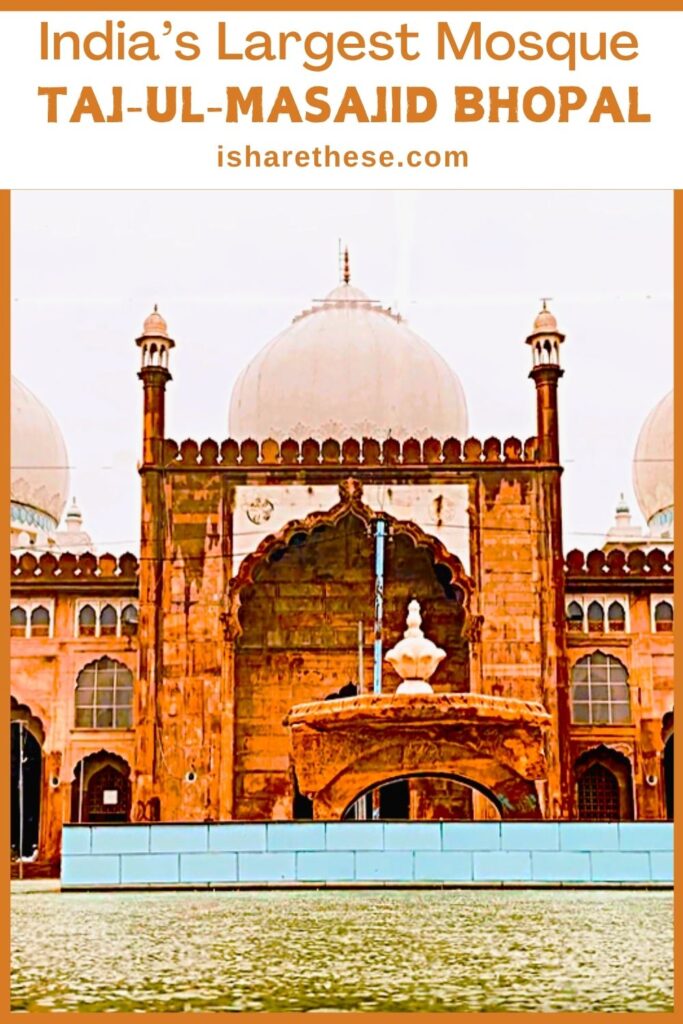
Pin this for later…
If you have liked this post you can save and share this post. I appreciate each and every share, thanks!
About the Author
 Indrani Ghose is a cultural travel writer and heritage documentation specialist with over 15 years of experience exploring and writing about temples across India and Southeast Asia. Having visited over 150 sacred sites, she brings both scholarly depth and personal narrative to heritage travel writing.
Her work has been published in Lonely Planet, The National (UAE), Whetstone Asia, Deccan Herald, and various architecture and heritage journals.
Connect with Indrani: Follow Indrani on Instagram | Twitter | Facebook for heritage travel insights, photography tips, and offbeat destination discoveries.






This mosque is huge! I can’t believe it’s the third-largest one in the world and I never heard of it. I’m amazed at how long it took to complete this mosque and the information about the Crystal Floor Tiles is crazy. I can’t believe all that money was spent just to be told later that the slabs couldn’t be used.
It’s a beautiful mosque with incredibly intricate and beautiful details. I’m surprised that it’s bigger than the one in Delhi because that was huge. I hope I get to visit India again one day.
wow, 400,000 Square Metres? That is gigantic! We went to Casablanca in Morocco and saw the Hassan II Mosque which we were told is the largest on the entire African Continent. But if I recall it was only 100,000 square metres so the Tajul Masajid of Bhopal is 4x bigger which is wild!
I do love how the Tajul Masajid does seem a bit more detailed with slight ornamental carvings. Though I am catholic, which our churches are always decorated, I am always fascinated to see & learn about the Muslim faith and traditions. I always find their mosques to be simple, plain, and clean which is great but I do love a bit of art in dedication to the faith from a personal aspect.
I love the fact that this mosque was the brainchild of women. I have not gotten to a mosque and this would be a perfect one to start in.
We’ve never been to India and the only mosques we’ve entered are those in Xinjiang province. And also the one in Paris, where we used to go to enjoy a cup of hot tea. We’d love to visit this one someday and especially see the library. Good to know that it’s beat to avoid going there during midday.
What an amazing mosque and what an amazing history. And to think it was completed only relatively recently.
What a shame to see all of those gorgeous crystal tiles go to waste! I’m sure they could be sold on to someone for another project somewhere. I think this mosque would be all the more special because of it’s feminine ties in such a masculine world.
This happened in early 1900. Nobody knows how the tiles (crystal slabs) got distributed. Only 2 tiles are left, one of which is in the library of the mosque.