The Ultimate Chamundeshwari Temple Guide: History, 1000 Steps, & Pro-Tips (2026 Update)
Essential Guide to Chamundeshwari Temple, Mysuru
If Mysuru is the cultural heart of Karnataka, Chamundeshwari Temple is its spiritual crown. Perched atop Chamundi Hills at an elevation of about 1,065 metres, this ancient shrine draws pilgrims, trekkers, and history enthusiasts from across India and beyond. The temple dedicated to Goddess Chamundeshwari — the fierce, triumphant form of Durga — has stood as Mysuru’s most revered landmark for centuries, blending myth, living tradition, and panoramic natural beauty in one place.
I’ve visited twice — once in 2008 and again in March 2017 — and what strikes you both times is how the experience layers itself: the physical effort of the climb, the dense spiritual atmosphere near the sanctum, and the sweeping views of Mysuru city stretching out below. It’s one of those rare temples where the journey to reach it is as meaningful as the darshan itself.
By Indrani Ghose | Last Updated: Mar. 2026
In 2026, the temple is better equipped for visitors than ever — with online ticketing for special darshan, improved crowd management during peak seasons like Mysore Dasara, and clearer signage along the 1,000-step route. Whether you’re a first-time visitor or returning after years, this guide covers everything you need: temple history, trekking the steps, darshan timings, ticket booking, and practical tips for making the most of your visit.

Chamundeshwari Temple Mysore
Quick Summary
| Feature | Details |
| Location | Chamundi Hills, ~13 km from Mysuru city centre |
| Deity | Goddess Chamundeshwari (a fierce form of Durga) |
| Temple Age | Origins traced to the 12th century; expanded through the 17th–18th centuries |
| Famous For | Mahishasura legend, Mysore Dasara rituals, 1,000-step trek |
| Accessibility | Trek via 1,000 steps or drive/bus uphill |
| Darshan Timings | 7.30 AM – 2 PM and 3.30 PM – 6 PM and 7.30 PM – 9 PM (verify seasonally) |
| Best Season | October (Dasara); year-round for sunrise views |
| Entry Fee | Free general darshan; paid tickets for special/VIP darshan |
| Nearest City | Mysuru (Mysore), Karnataka |
Note: Timings can change during festivals and government holidays. Always verify on the temple’s official notice board or Karnataka tourism sources before your visit.
Key Highlights
- Mahishasura Statue — The towering, colourfully painted statue of the demon king stands near the hilltop and is one of Mysuru’s most photographed landmarks. It symbolises Goddess Chamundeshwari’s victory of good over evil — the legend at the heart of the entire Dasara festival.
- Nandi Monolith — Carved from a single granite block and standing roughly 5m tall, this impressive Nandi bull sits midway along the 1,000-step climb. It dates to 1659 and is a natural rest point and a significant sculpture in its own right — worth pausing at, not just passing by.
- 1,000 Steps Trek — The stepped path up Chamundi Hills is one of the most rewarding short treks in South India. The climb takes 30–45 minutes at a moderate pace and rewards you with progressive views of Mysuru, the Lalitha Mahal Palace, and the surrounding plains. Early mornings offer the best light and cooler temperatures.
The Legend of Mahishasura Mardini: Why This Temple Matters
Most temples in India carry mythology. Chamundeshwari Temple is the mythology. The legend tied to this hilltop doesn’t just explain the temple’s origins — it explains the name of the city below it, the festival that defines Karnataka’s cultural calendar, and the reason millions of devotees make this climb every year.
The Mythological Origin: The Victory of Dharma
According to the Skanda Purana, Chamundi Hills was originally known as Mahabaladri. The legend centres on Mahishasura — a demon king and shape-shifter who could take the form of a buffalo. Having secured a divine boon that no man could defeat him, he unleashed destruction across the three worlds, displacing the gods from the heavens themselves.
In response, the combined cosmic energies of the Trinity — Brahma, Vishnu, and Shiva — converged to manifest Goddess Chamundeshwari, a fierce, all-powerful form of Durga. Ascending these very hills, she fought Mahishasura for nine days in a relentless battle. On the tenth day, she slew him — a victory commemorated every year as Vijayadashami, the final day of the Navratri festival.
This is not incidental mythology. The name “Mysuru” derives directly from Mahishuru — literally, “the land of Mahisha.” When you stand before the towering, vibrantly painted Mahishasura statue at the hilltop today — the demon depicted holding a sword and a cobra — you are looking at a physical marker of that ancient victory embedded into the city’s identity.
From my visits: In both 2008 and 2017, I noticed that most tourists photograph the Mahishasura statue quickly and move on. Spend a moment reading the legend boards nearby — the context makes the statue, and the entire temple visit, significantly more powerful.

Mahisasur in Chamundi Hills Mysore. The region Mysore of yesteryear gets its name from the demon Mahisasura.
A Sacred Shakti Peetha: The Krouncha Pitham
For spiritually inclined visitors, the significance of Chamundeshwari Temple extends well beyond regional mythology. The temple is revered as one of the 18 Maha Shakti Peethas — sacred sites across the Indian subcontinent where, according to Puranic tradition, body parts of Goddess Sati fell to earth after Lord Shiva carried her lifeless form in grief following the Daksha Yagna.
At this site, it is believed that the hair of Goddess Sati fell on these hills. In Vedic texts, the location is referred to as Krouncha Puri, and accordingly, the temple holds the designation of the Krouncha Pitham among the Shakti Peethas.
Chamundeshwari Temple thus ranks within a pan-Indian network of sacred feminine power sites that span from Kamakhya in Assam to Kanyakumari in Tamil Nadu. For Shakta pilgrims — devotees of the goddess tradition — this is not just a regional temple. It is one of the most important pilgrimage sites in South India.
Other Shakti Peethas I have been to – Biraja Temple in Jajpur, Kankalitala in West Bengal, Tarapith Temple, Mahishmardini Temple Bakreshwar, Danteshwari Temple.
Architectural Evolution: From 12th Century to 2026
The spiritual energy at Chamundeshwari Temple may be ancient, but the structure you see today is the result of over a millennium of construction, expansion, and renovation across successive dynasties — each leaving a distinct architectural imprint.
| Era | Dynasty / Ruler | Contribution |
| 12th Century | Hoysala Kings | Construction of the original modest shrine |
| 17th Century | Vijayanagara Empire | Early expansion of the temple structure and tower |
| 1659 | Dodda Devaraja Wodeyar | Commissioned the 1,000 steps and the monolithic Nandi sculpture |
| 1827 | Krishnaraja Wodeyar III | Built the iconic 7-tier Raja Gopuram with 7 golden Kalashas |
| 2026 | PRASHAD Scheme (Govt. of India) | Infrastructure upgrades for sustainable pilgrimage and heritage conservation |
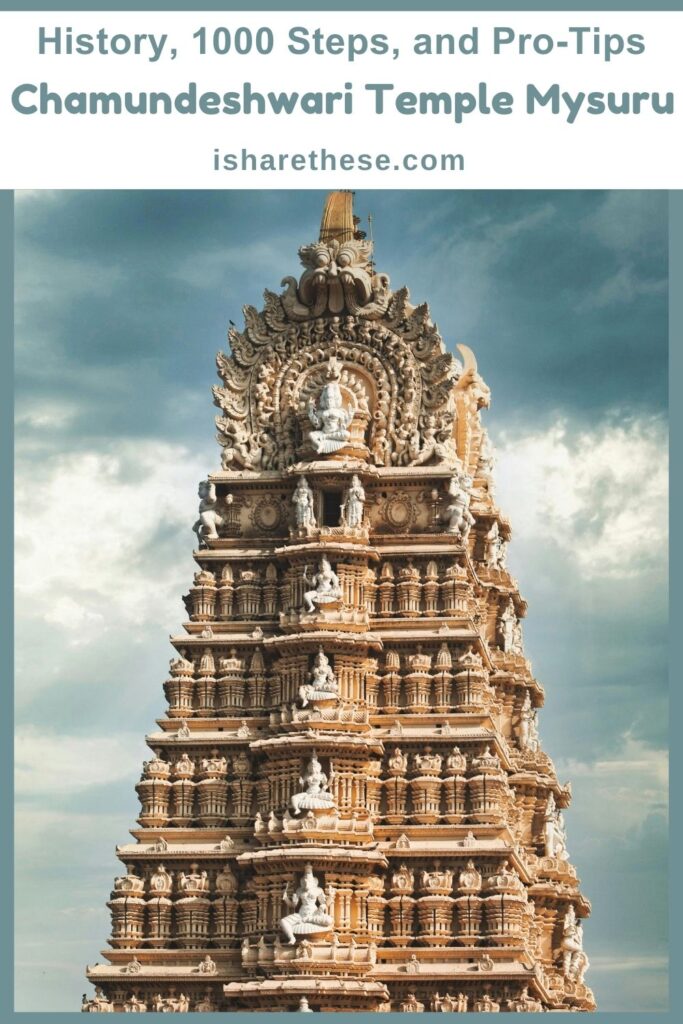
The Raja Gopuram — the seven-tiered entrance tower topped with seven golden Kalashas — is the architectural centrepiece most visitors photograph. Built in the Dravidian style, it follows the same principles of temple architecture seen across Tamil Nadu and Karnataka, with intricate stucco sculptures depicting deities, celestial beings, and mythological narratives across each tier.
The temple’s exterior gold-plated Vimana (the tower directly above the sanctum) was added and refined over multiple centuries. Stepping in, I found the inner sanctum a visual grandeur that contrasts with the relatively compact prayer hall beneath it.

Chamundeshwari Temple Mysore facade
The “Eight Hills” Connection
Most visitors focus entirely on the main Chamundeshwari shrine — and miss a layer of history that places this hilltop in a much older sacred geography.
In antiquity, Chamundi Hills was part of a sacred cluster known as Trimuta Kshetra, situated within a symbolic circle of eight hills. The presence of the Mahabaleshwara Temple on the same hill — a Shaivite shrine that pre-dates the Chamundeshwari structure and traces its origins to the Ganga dynasty era — confirms that this hilltop has functioned as an active centre of worship for well over 1,500 years.
The Mahabaleshwara Temple is rarely mentioned in standard tourist literature, but it sits close to the main shrine and is worth a brief visit. On both my trips, I found it noticeably quieter than the main temple — a small, atmospheric space that gives you a real sense of how ancient this hilltop’s sacred history truly is.
We were told that there is a separate set of equestrian steps carved in the rocks especially for the Kings using horses. I could not trace out those steps though.

Chamundeshwari Temple Mysore HMT Clock on the Facade
Planning Your Visit: Darshan Types, Online Booking, and Sevas
The Sri Chamundeshwari Development Authority manages one of the busiest temple complexes in Karnataka, and in recent years it has moved decisively toward digital-first visitor management. Whether you’re a pilgrim planning a quick darshan or a traveller wanting to combine the 1,000-step trek with a full temple visit, understanding the ticketing system and timings in advance will save you significant time on the day.
Updated Temple Timings (2026)
The temple follows a strict schedule to accommodate rituals (Abhisheka) and public viewing.
- General Darshan: Morning: 7.30 AM – 2 PM
- Afternoon: 3.30 PM – 6 PM
- Evening: 7.30 PM – 9 PM
- Abhisheka Timings: 6 AM – 7.30 AM and 6 PM – 7.30 PM (Fridays start earlier at 5 AM).
- Best Time to Visit: Arrive by 7 AM to beat the city heat and the heavy tourist buses that usually arrive after 10 AM.
Important: These timings can change during festivals, government holidays, and Navaratri. Always verify on the official temple portal at chamundeshwaritemple.in before your visit. Do not rely solely on third-party travel sites, including this one, for same-day planning.
How to reach Chamundeshwari Temple
The Chamundeshwari Temple is located on Chamundi Hills in Mysore. Mysore is 215km from Kempegowda International airport of Bangalore and 279km from Mangalore airport. There are lot of public state transports and private cabs that will drop you at the top of the hill.

Hanuman Idol inside a small shrine in Chamundeshwari Temple Mysore. Picture taken in 2008 when photography rules weren’t very strict.
Darshan Tickets and Costs (Verified 2025–26)
Correction to widely circulated information: Several travel blogs list a ₹1,000 “VIP Darshan” ticket for Chamundeshwari Temple. This is inaccurate — the ₹1,000 special darshan ticket belongs to Tirumala Tirupati (TTD) in Andhra Pradesh, not Chamundeshwari. Always verify ticket prices at the official temple portal.
There are three darshan options at Chamundeshwari Temple: free general darshan, a ₹30 ticket for slightly faster access, and a ₹100 VIP/Special Darshan. The ₹100 darshan includes one laddu as prasadam per person.
| Darshan Type | Price (Per Person) | What to Expect |
| Free / General Darshan | ₹0 | Standard queue; wait times of 90–120 minutes on weekends and festivals |
| Special Entry | ₹30 | Moderately faster queue; no prasadam included |
| VIP / Special Darshan | ₹100 | Fast-track entry; includes 1 Laddu and Kumkum prasadam |
On Fridays, Saturdays, Sundays, public holidays, and festival days — especially during Navaratri — crowds are significantly higher, and wait times in the free queue can stretch considerably. On these days, the ₹100 ticket is worth the modest cost.
From my visits: Even on a quiet Tuesday morning in March 2017, the general queue took about 45 minutes. On a weekend or during Dasara, budget for considerably longer unless you have the ₹100 ticket.
How to Book Online
Bookings for sevas and darshan tickets can be made through the official portal at chamundeshwaritemple.in, managed by the Sri Chamundeshwari Development Authority. The process involves selecting your seva or darshan type, choosing a date and time, filling in devotee details, and completing payment online — after which you can download your ticket.
Step-by-step:
- Go to Official Temple E-Portal chamundeshwaritemple.in
- Click “Seva Booking” in the top menu
- Select your darshan type or seva
- Choose date and available time slot
- Enter devotee details (name, ID proof details, number of persons)
- Pay online (UPI, debit/credit card, net banking accepted)
- Download and save your e-ticket
A printed copy of your online booking is mandatory for entry — a screenshot on your phone may not be accepted at all counters, so print it in advance.
Seva and Saree Booking: Saree offerings (the seva of draping a saree on the goddess) are bookable only for the current month. Slots for the following month open just 5 days in advance — so plan accordingly and check the portal regularly if this seva is important to you.

Devi’s (Goddess’s) feet inside Chamundeshwari Temple
Essential Visitor Protocols
Dress Code The Sri Chamundeshwari Kshetra Development Authority enforces a modest dress code at the temple entrance. Men are expected to wear dhotis, formal trousers, or kurta-pyjamas. Women should wear sarees, salwar-kameez, or churidars. This is enforced consistently, not just during festivals.
No-Plastic Zone Chamundi Hills has been designated a no-plastic zone. Visitors are not permitted to bring plastic bags or disposable plastic items onto the hill. Security checks at the base entry points may confiscate them. Carry a cloth bag and a reusable water bottle.
Accessibility Battery-operated cars are available for senior citizens and visitors with mobility limitations, at approximately ₹30 per person. These operate between the parking area near the hilltop and the temple entrance — they do not run from the base of the 1,000 steps. If you are travelling with elderly family members who cannot manage the temple complex on foot, inquire about this service at the hilltop bus stand on arrival.
Monkeys The hilltop area has a significant monkey population. They are known to snatch food, open bags, and grab anything that looks edible. Keep snacks, offerings, and bags zipped and close to your body. Do not try to feed or photograph them at close range.
Photography You may photograph the exterior — the seven-tier Gopuram, the Mahishasura statue, and the hilltop views are all fair game. Photography inside the inner sanctum is strictly prohibited. Respect this rule; it is enforced by temple staff.
Dasoha: Free Meals for All Visitors
The temple’s Dasoha (free meal) programme serves devotees three times daily: morning from 7.30 AM to 10 AM, noon from 12 PM to 3.30 PM, and evening from 7.30 PM to 9 PM. This is open to all visitors regardless of darshan type or religion. The meals are simple, nutritious, and served in large numbers — a genuinely inclusive tradition worth experiencing if your visit timing allows.

Lord Ganesha on Facade.
Climbing the 1,008 Chamundi Hills Steps: A Spiritual Trek to Chamundeshwari Temple
For many visitors, reaching Chamundeshwari Temple feels more meaningful when done on foot. The historic stone stairway, built during the Wadiyar Dynasty era in the 17th century, offers a quiet, meditative climb through the forested slopes of Chamundi Hills.
Chamundi Hills Steps – Quick Facts
- Total Steps: 1,008 stone steps to reach Chamundeshwari Temple
- Climb Time: 30–60 minutes for most visitors
- Difficulty: Moderate (steeper in the first half)
- Key Landmark: Nandi Statue Mysore around the 700th step
- Best Time to Start: Before 6 AM for cooler weather and sunrise views
- Elevation Gain: About 840 feet up Chamundi Hills
The Trek at a Glance
- Total Steps: 1,008 (locals often say slightly more including summit stretches)
- Elevation Gain: ~840 feet
- Difficulty: Moderate — the first 600 steps are the steepest
- Average Time: 30–60 minutes depending on pace and photo stops
After the 600-step mark, the climb becomes noticeably easier.
Best Time to Climb
Start early if you want the best views.
- Ideal start: 5.30 AM
- Sunrise views: Around 6.15 AM you’ll see the city light up, including Lalitha Mahal Palace and the Mysore Race Course.
- Crowds: After 9 AM the steps become busy and the heat rises quickly.
Safety note: Avoid climbing after dark. The forest around Chamundi Hills is protected habitat where wildlife movement increases in the evening.

View of Mysore City from Chamundi Hills
The Nandi Monolith (Around Step 700)
Two-thirds of the way up stands the famous Nandi Statue Mysore — locally called Dodda Nandi.
- Carved in: 1659 from a single block of black granite
- Size: 16 ft high and 24 ft long
- Significance: One of the largest monolithic Nandi statues in India
Recent conservation has cleaned layers of ritual oil deposits, revealing the stone’s natural grey-black granite surface.
Tip: Remove footwear before stepping onto the platform. Behind the statue is a small Shiva cave shrine that many visitors miss.

Flower seller outside Chamundeshwari Temple Mysore – The lady was selling flower baskets for puja, and also took up the responsibility of safe keeping of foot wears.
FAQs about Chamundeshwari Temple
Planning a visit to Chamundeshwari Temple often comes with practical questions. Here are clear, fact-based answers that will help you prepare for a smooth experience in 2026.
Q1. What are the temple timings and darshan hours?
The temple generally opens early in the morning and closes by evening, with short breaks in between. Timings may vary during festivals like Mysore Dasara, so it’s best to check the official schedule before your visit.
Q2. How can I book Darshan tickets online?
Tickets are available through the Karnataka Muzrai Department’s official portal and at authorized counters in Mysuru. Online booking ensures shorter queues and confirmed slots, especially during peak season.
Q3. How many steps are there exactly?
There are exactly 1008 steps
Q4. Is the 1000 steps trek suitable for beginners?
Yes, but it requires moderate fitness. The climb takes 30–45 minutes, with shaded areas and the famous Nandi statue halfway up. Carry water and start early to avoid the midday sun.
Q5. What is the best time to visit Chamundi Hills?
Sunrise offers spectacular views of Mysuru city. October, during Dasara, is culturally vibrant, while weekdays are quieter for darshan.
Q6. Is photography allowed inside the temple?
Photography is restricted inside the sanctum but permitted in the outer areas, including the Mahishasura statue and hilltop viewpoints.
Q7. What to wear?
Temple authorities strictly insist Traditional and Modest attire. Shorts, sleeveless tops, miniskirts, and torn or distressed clothing will result in denial of entry.
Conclusion
Chamundeshwari Temple in Mysuru is more than a pilgrimage site—it’s a blend of spirituality, history, and adventure. From the legendary tale of Goddess Chamundeshwari defeating Mahishasura to the panoramic views after climbing the 1000 steps, every aspect of the temple offers something unique.
My visits in 2008 and 2017 showed me how timeless its appeal is, and with modern facilities in 2026, the experience is even more accessible. Whether you’re seeking darshan, trekking for fitness, or exploring Mysore Dasara traditions, this temple remains a must-visit destination.
Plan ahead, respect local customs, and you’ll find your journey to Chamundi Hills both enriching and unforgettable.
Pin this for later
About the Author
 Indrani Ghose is a cultural travel writer and heritage documentation specialist with over 15 years of experience exploring and writing about temples across India and Southeast Asia. Having visited over 150 sacred sites, she brings both scholarly depth and personal narrative to heritage travel writing.
Her work has been published in Lonely Planet, The National (UAE), Whetstone Asia, Deccan Herald, and various architecture and heritage journals.
Connect with Indrani: Follow Indrani on Instagram | Twitter | Facebook for heritage travel insights, photography tips, and offbeat destination discoveries.






Nice and informative. Thks
What a magnificent temple! I wish I could visit there myself.
this was a wonderful post. i think the mist wrapping the temple adds to the mystery and creates a mood.
wow reading this post is like taking a holiday with u as a guide. thanks!
This is just so fascinating, again.
Wow what an amazing place!
That’s where we went for our honeymoon :-))) Mysore and
remembering going up Chamundeswari hills.. We loved it.
Learnt more about it in your descriptive blog.
Awaiting the Nandi bull blog soon
-Deepavali release?
Mysore famous for Sandalwood too.
India is one place I would love to visit someday. And Mysore would be on top of my list now that I’m so into my yoga practice. Great shots!! So colorful 🙂
cookie
Pics are too good. Less crowd too.Last time i had been there, i could not enter the temple as we were getting late for Dasara and the tample was jamm packed with tourists.
Had been there long back. Remember a tea vendor who used to be more informed and communicative than the actual guide hanging around there!
Those are terrific photos. I love the amazing details on the structures. Your photos are so rich of colors. Thanks for sharing this interesting culture.
Thanks Marcia, ECL, RAJI, MILETTE, Carver, Lakshmi and Mysorean.
Mysorean, I will be posting on Nandi Bull soon. :)It deserves a post dedicated for it alone.
Any description of Chamundi Hills is not complete without the magnificient bull, Nandi, sitting 3/4 ways up the Hills on the steps on the way to the Temple. The beauty of the Hills is lost if one takes the road to the Hills. Climbing the steps has always been the ideal way of savouring the beauty of the Hills, and at the end of the journey one is rewarded with the blessing of the Goddess. Standing near the Nandi and looking at the expanse of Mysore, identifying the landmarks like Mysore Palace, Mysore Railway Station, Lalithamahal etc.. had been the favourable past time of many Mysoreans including mine.
Goddess Chamundeshwari for Mysore Maharajas was what Lord Ananthapadmanabha was to Maharajas of Travancore (their familiy deity). It was not coincidence that after exquisite compositions on Chamundeshwari, the late Muthiah Bhagavathar went to Swathi Tirunal College of Music to continue his creative work there.
Unfortunately, I hear from my friends who are residents in the Hills for generations, that the Temple is not managed well and the last late Maharaja’s son
is requesting the government to transfer the manangement responsibility to him. Hope the government agree to this request to preserve the beauty and history of Chamundi Hills.
I would even suggest transferring the management of the Temple to NRN who in his younger and college days was so much devoted to the Hills and the Goddess.
Bonjour !
Tu as vraiment des photos “étranges”…
Sommes-nous dans un temple ?
love mysore..i feel so much at home there ..
Those are beautiful shots. Very interesting post and I’d love to see that sometime.
Very nice. Been there nearly 20 years ago on a guided tour, where the guide knew even less than we did!
So thanks for the info about the idols!
i love the architectures.
my ws entry is here. hope you can take a peek. thanks.
The temple is beautiful and magnificent! I love visiting such places to know another race’s culture.
that was so colorful and pretty thank you for sharing that lovely site so many of us could see no other way. and wow what an elephant shot below