Sasivekalu and Kadalekalu Ganesha Temple Hampi
Some statues impress you; Sasivekalu Ganesha disarms you—with charm carved straight from stone. In the southern foot of Hemakuta Hills of Hampi there are 2 temples dedicated to the Elephant headed God – Ganesha. Sasivekalu Temple and Kadaleku Temple – They have different manifestations of Lord Ganesha.
Sasivekalu Ganesha Temple in Hampi
Sasivekalu Temple dates back to 15th century. A very simple open shrine, it has just the roof supported by several square pillars. The idol is a massive 8 feet tall monolithic image of Lord Ganesha.
Why is it called Sasivekalu Ganesha
The belly here has a near spherical shape resembling the seed of mustard, hence the name.
Lord Ganesha has 4 arms, each holding a broken elephant tusk, a gada (mace), a noose and a modak. There is a snake carved around the belly.
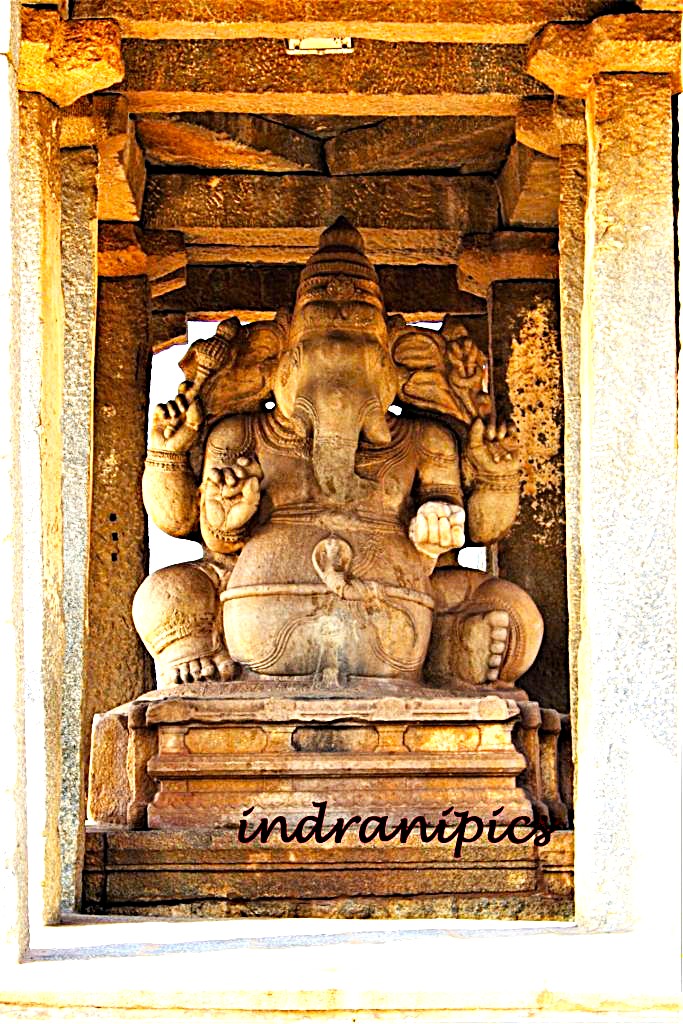
Sasivekalu Ganesha idol
Highlights of Sasivekalu Ganesha Temple, Hampi
- Sasivekalu Ganesha is a monolithic Ganesha statue in Hampi, named because Ganesha’s rounded belly resembles a sasivekalu (mustard seed) in Kannada.
- The statue is east-facing and located on the south-eastern slope of Hemakuta Hill, one of Hampi’s prime heritage zones.
- It represents the Vijayanagara architectural style, with the idol carved from a single block of stone.
- The monolith stands 2.4 metres (8 ft) tall and is housed inside a 16-pillared mantapa.
- The mantapa features granite pedestals, columns, beams, and roof slabs, with a brick-and-mortar crown in the Indo-Saracenic style.
- The supporting pillars are plain and uncarved, highlighting the simplicity and strength of the structure.
This is one of Hampi’s most photographed monuments for its architectural charm, historical value, and scenic hilltop setting.
Sasivekalu Ganesha: Fact File
Location: South-eastern slope of Hemakuta Hill, Hampi, Karnataka
Deity: Lord Ganesha (Monolithic statue)
Height of Statue: Approx. 2.4 metres (8 feet)
Year of Construction: 1506 AD, built in memory of King Narasimha II (ruled 1491–1505 CE)
Builder / Dynasty: Vijayanagara Empire
Entry Fee: Free
Timings: Open all day (best visited early morning or late afternoon)
Nearby Attractions:
- Kadalekalu Ganesha (described below)
- Hemakuta Hill temples
- Virupaksha Temple
- Hampi Bazaar

My Experience of Seeing the Sasivekalu Ganesha
When I first stepped into the Mantapa, Sasivekalu Ganesha’s chubby, gentle form arrested my attention. Standing nearly eight feet tall, he looks both majestic and endearing at the same time. His crown sits lightly on his head, his simple ornaments adding to the quiet dignity of the sculpture.
As I walked up the steps, I could see the familiar symbols in his hands—the modak, the broken tusk, the goad, and the noose—each detail carved with remarkable precision considering this entire idol was shaped from a single rock.
I was curious about the tightly coiled serpent around his waist. The guide beside me shared the popular legend: Ganesha once ate so much that his belly was about to burst, and in a moment of quick thinking, he tied a serpent around himself to hold everything in place.
Looking at the sculpture, that story suddenly felt alive.

Lord Ganesha pot belly resembling mustard seed
Not an Active Temple
Sasivekalu Ganesha sits quietly on his pedestal, sheltered by a simple 16-pillared Mantapa. An inscription nearby mentions that this shrine was built in 1506 AD in memory of the Vijayanagara king Narasimha II.
Standing there, surrounded by history, I felt a little pang of sadness too—no rituals or poojas are performed here anymore, the damages on the idol making it unfit for ceremonial worship. Yet, despite that, the place holds a gentle sacredness, as if Ganesha continues to watch over the hill in silence.
Kadalekalu Ganesha Temple Hampi
Very close to Sasivekalu Temple is the Kadalekalu Temple. It is on the north-eastern slope of Hemakuta Hill. This shrine is an enclosed one with more beautifully sculpted pillars.
Highlights of Kadalekalu Ganesha Temple, Hampi
- Iconic Monolithic Statue: Home to one of the largest monolithic Ganesha idols in Hampi, standing nearly 4.6 metres (15 feet) tall, carved from a single granite boulder.
- Name Derived from “Bengal Gram”: The temple gets its name Kadalekalu (Kannada for Bengal gram) because the deity’s rounded belly resembles a gram seed.
- Impressive Dravidian Mantapa: The pillared hall features slender lathe-turned columns, characteristic of the Vijayanagara architectural style, with intricate floral and mythological carvings.
- Panoramic Hilltop Location: Perched on the slopes of Hemakuta Hill, the temple offers sweeping views of Hampi’s boulder-strewn landscape and the Virupaksha Temple complex.
- Religious Significance: The statue represents Ganesha in a meditative seated posture, making it a key stop for pilgrims exploring Hampi’s sacred circuit.
- Historic Legacy: Built during the Vijayanagara era, the complex reflects the empire’s artistic finesse and devotion, with inscriptions hinting at royal patronage.
- Photographer’s Favourite: The tall interior hall, soft natural lighting, and the monumental scale of the idol make it a perfect spot for dramatic wide-angle shots.
- Easy Accessibility: Located close to the Hampi Bazaar and Virupaksha Temple, it’s one of the most convenient sites to include in a Hampi walking itinerary.
Kadalekalu Ganesha – Fact File
Location: Eastern slope of Hemakuta Hill, Hampi, Karnataka
Monument Type: Monolithic Ganesha statue inside a stone Mantapa
Height of the Idol: ~4.6 meters (15 feet)
Material: Carved from a single boulder
Name Origin: “Kadalekalu” in Kannada means Bengal gram; the idol’s belly resembles the shape of a Bengal gram seed
Period of Construction: Vijayanagara Empire, 1500 AD
Architectural Style: Vijayanagara with pillared hall (Mantapa)
Orientation: Faces east
Worship Status: The idol is not actively worshipped today
Best Time to Visit: Golden hour (early morning or late evening) for dramatic shadows on the stone surface
Entry Fee: Free
Timings: Open all day (best visited early morning or late afternoon)
It was quite dark inside the shrine so I had to use flash for the picture.

Kadalekalu Ganesha Monolithic statue
My Experience at Kadalekalu Ganesha Temple
By the time I reached the steps of Kadalekalu Ganesha, evening had already slipped quietly into night. The sky was a deep indigo, the boulders around Hemakuta Hill turning into soft silhouettes. I had just come from Sasivekalu Ganesha—his chubby form glowing warmly in the last traces of daylight—and I thought I knew what to expect from another monolithic Ganesha. I was wrong.
Inside the mantapa, it was almost pitch dark. Only the tall pillars outside caught the sunlight and reflected definite shapes. I switched on my flashlight, a single beam slicing through the darkness, and walked slowly toward the idol.
And then he emerged.
Kadalekalu Ganesha looked larger, calmer, and far more imposing in the dim light. The beam from my torch skimmed across his massive belly—the “gram-sized” curve that gives him his name—then across his trunk and broad shoulders. In the silence of the hall, the idol felt both intimate and majestic.
My ordinary human mind started comparing Kadalekalu Ganesha with Sasivekalu Ganesha whom I had seen just minutes earlier. Sasivekalu, felt approachable and almost playful in his open mandapa. Kadalekalu, however, carried a different aura. Enclosed within this pillared chamber, he felt more regal, more meditative—less a deity on display and more a presence you quietly discover.

Kadalekalu Temple Hampi
I moved the flashlight gently, the shadows shifting across the stone. Every chisel mark, every curve, every recess seemed amplified in the low light. There was something deeply personal about seeing him this way—no crowd, no sunlight, no distractions. Just stone, silence, and a single cone of light revealing centuries of craftsmanship.
Outside, the night breeze carried the faint echoes of temple bells from Virupaksha. From the doorway, I looked out at Hampi—just outlines now—temple silhouettes and palm fronds swaying against the dusk. It was peaceful in a way that only Hampi after sunset can be.
Walking back down the hill, I realised something: Kadalekalu Ganesha isn’t just a monument you check off a list. He’s an experience—quiet, grounding, and deeply personal. And long after you leave Hampi, it’s this gentle giant in stone who stays with you.

Kadalekalu Ganesha idol
Sunset in Hampi Sasivekalu Ganesha Temple
The Sun never pauses along its path, yet like a snail I moved on through the busy market lanes. Darkness waiting to takeover and at that final moment of the day I managed to capture the setting sun between the pillars of Sasivekalu Ganesha Temple. The fake sense of victory pleased me.

Sunset in Hampi Sasivekalu Ganesha Temple Karnataka
Interested to see Lord Ganesha on a hill top? Check here: Lord Ganesha in Dholkal Chhattisgarh
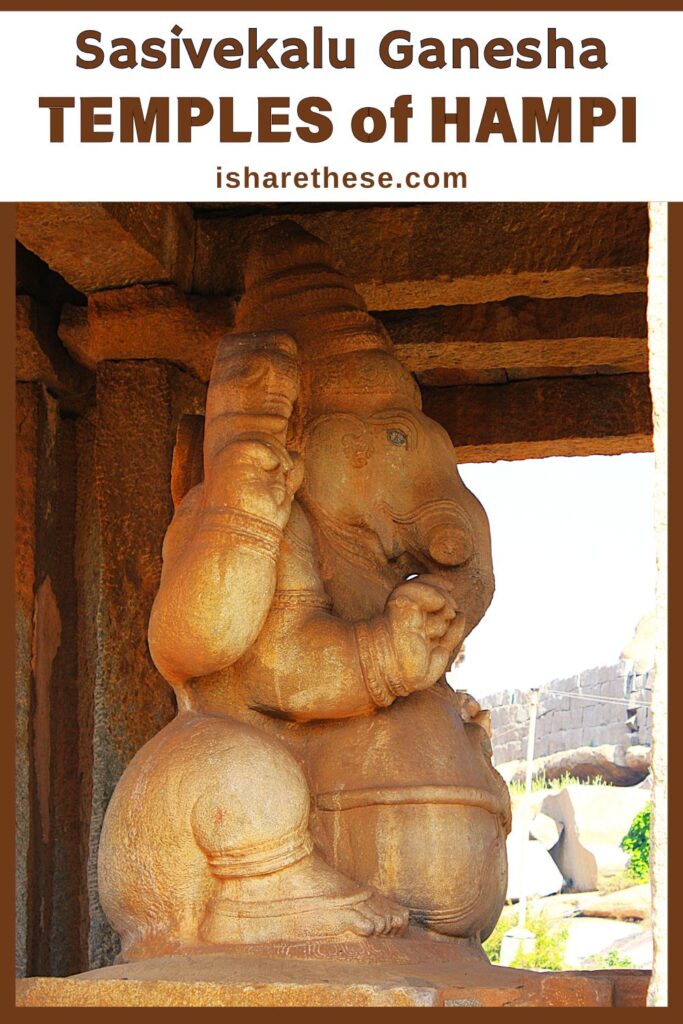
Pin this for later…
About the Author
 Indrani Ghose is a cultural travel writer and heritage documentation specialist with over 15 years of experience exploring and writing about temples across India and Southeast Asia. Having visited over 150 sacred sites, she brings both scholarly depth and personal narrative to heritage travel writing.
Her work has been published in Lonely Planet, The National (UAE), Whetstone Asia, Deccan Herald, and various architecture and heritage journals.
Connect with Indrani: Follow Indrani on Instagram | Twitter | Facebook for heritage travel insights, photography tips, and offbeat destination discoveries.







Beautiful image!! have yet to write about my hampi trip:(
Gorgeous!! I would like to sit there, to watch the sunset, to philosophize…. 🙂
Beautiful! The words, as well as the pic.
more photos?
Your victory was far from fake, gorgeous capture! Congrats on the POTW mention.
a wonderful photo.
Happy to meet you through Hillary.
Gorgeous! Congrats on POTW!
Great capture!
Congratulations on Hilary's Post of the Week Award!
Perfect shot. What a great capture.
Darryl and Ruth : )
Stunning composition……….i feel any picture clicked in glorious Hampi comes out great !!! 🙂
It's a nice composition, though i don't know anything abt photography to use these heavy words!
and why fake sense of victory? Our victories may be minute, but that doesn't make them fake, no?
Love the sunset lighting!!! Great pic of a great place!!!
Mohanur Temple Tour – Part 2
Stunning!
Wonderful
A very real sense of victory, because you captured this wonderful photo. Good work, Indrani!
— K
Kay, Alberta, Canada
An Unfittie's Guide to Adventurous Travel
This is a wonderful and magical photograph. I love it!
Short and sweet post!!! Thanks for reminding me of my wish to re-visit the place as an adult 🙂
What a poetic shot, it's gorgeous.
The sun peeking between the columns is so stunning and thinking about sipping coconut water sounds so exotic and romantic.
Oh, what a wonderful sunset through the pillars! Very nice!
I don't think I would call this beautiful photo a 'fake' victory. It's a marvelous capture. It looks as if the past is about to come alive with the setting of the sun.
Really beautiful! The monument makes it look magical.
Extra ordinary snap. The setting Sun seen through the pillars is really amazing. I believe to do justice to this place one needs atleast three days. Thanks.
Nice photo. I think you maybe captured the essence of the place.
Superb sunset at Hampi! You mentioned Hampi when we met. Ok, I'll keep this wonderful place in mind when I'm in Karnataka next:)
Just made my 1st trip to Hampi and was blown away by the beauty of all structures and monuments…
love the shot!!
wow, perfect timing! i love it!
awesome shot
happy SWF
Indrani, your post makes me feel jealous! Ever since my teen-age years I've wished to visit Hampi during the winter festival and till date it has lived within me as a dream unfulfilled.
While I write this comment I know there are artists at Humpi who are getting ready to perform and stun the audience tonight…But yet again I wish I was there…
Your picture prompts me to make a promise to myself that I shall be a part of the mersmerised audience at humpi next winter… 🙂
Lovely photo of the sun setting. Have a nice weekend.
You must have the patience of a saint to wait for the exact moment to take this image. Impressive!
Joyce M
Gorgeous!
My Sky shots, have a great weekend!
Perfect timing indeed and what a breathtaking moment it had to be! Your photo is superb as always. Such stunning colors! Have a lovely day and a great weekend!
Sylvia
What a great photo. What timing. What a moment. Thanks.
Its sooooo beautiful 🙂
Amazing sight! Happy Friday!
Sky Watch
Wow…this is great Indrani.
greetings, Joop
Oh my.. what a stunning image. Beautifully done, Indrani!
Wow fantastic angle!
Thank you for sharing
Happy SWF weekend.
Skywatch Friday"