Guide to Whispering Gallery of Gol Gumbaz Bijapur (Vijayapura)
They call it the echo that never ends. Standing inside Gol Gumbaz Bijapur (Vijayapura), I watched my whisper travel 38 m across the dome and return amplified. Built in 1656 as Muhammad Adil Shah mausoleum, this monument isn’t just another Deccan Sultanate history site—it’s an Indo-Islamic engineering marvel that defies gravity and time.
The second largest dome in the world rises above you, constructed from dark grey basalt without a single supporting pillar. This unsupported dome spans 44 m, creating the perfect chamber for what architects call Whispering Gallery acoustics. The interlocking pendentives transfer weight invisibly, leaving space where sound becomes spectacle.
— Indrani Ghose, travel blogger | Updated Dec 2025
While Ibrahim Rauza nearby earns the title “Taj Mahal of the Deccan” for its elegance, Gol Gumbaz captivates through scale and science. Here, Adil Shahi architecture meets physics: eleven echoes circle the dome, each whisper transforming into a conversation with the past that refuses to fade.

Gol Gumbaz Bijapur
The Science of the Whispering Gallery Acoustics
How the 11-Fold Echo Works
Inside Gol Gumbaz, sound obeys rules most buildings ignore. The unsupported dome creates a hollow sphere 44 m high—no pillars interrupt the acoustic pathway. When I whispered against the wall, the sound waves traveled along the smooth basalt curve, bouncing between surfaces like a pinball locked in perfect motion.
The magic lies in the dome’s engineering. Interlocking pendentives—curved triangular sections—transition from the square base to the circular dome, distributing massive weight outward. This Adil Shahi architecture innovation left the interior column-free, creating an unobstructed resonance chamber.
Sound reflects continuously: one clap becomes eleven distinct echoes, each slightly fainter than the last. The phenomenon happens because curved surfaces focus sound waves, much like satellite dishes concentrate signals.

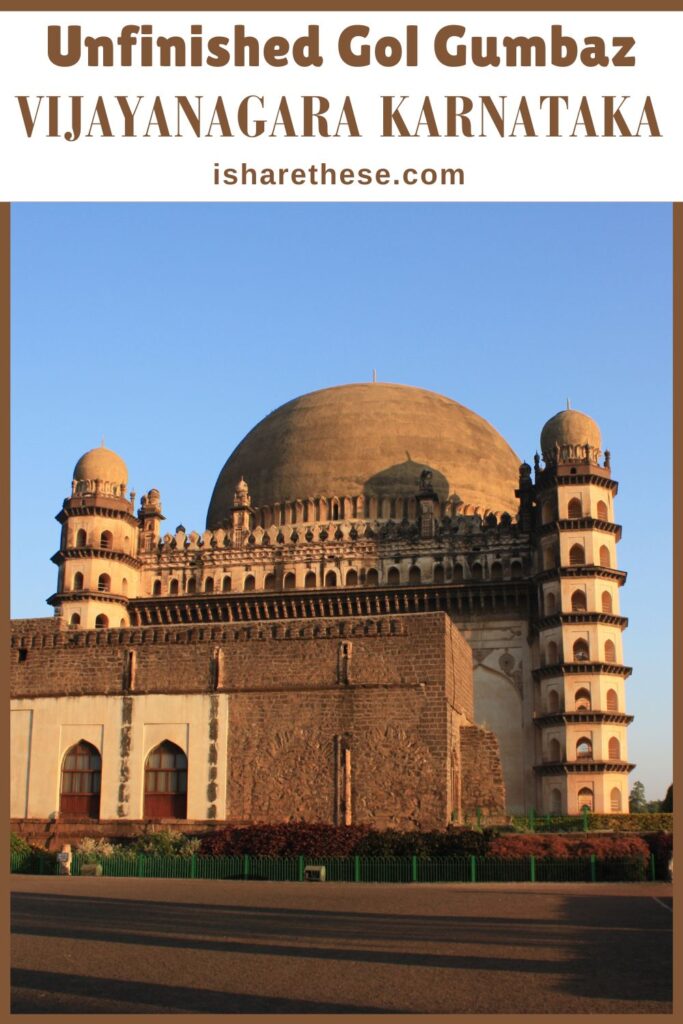
Facade of Gol Gumbaz
Inside the Mausoleum: More Than Just an Echo
On entering the massive structure we were surprised to see that it was a single huge room. The entire floor area we were told was 1700sqm, in the center were the cenotaphs of the Mohammad Adil, his two wives, his mistress Rambha, his daughter and grandson. The hugeness and hollowness of this single room is unfathomable from outside. The Gumbaz, meaning the dome, was high up at a height of 51 m.
We climbed the stairs of one of the minarets, seven floors, to reach the Gumbaz. In fact we hurried through the stairs to reach the whispering gallery. The whispering gallery of Gol Gumbaz is famed for the clear echoes of the faintest whistle, not once but more than nine times. There has to be pin drop silence to hear that.
The Gumbaz opens at 6 AM; we were there even before that. There was one more family of three members and we had an unspoken understanding to maintain pin drop silence. When one member made a sound the rest of us listened and counted in silence the echoes. We could very clearly hear seven echoes, then the fainter ones too.

Cenotaphs of the Mohammad Adil, his two wives, his mistress Rambha, his daughter and grandson.
Best Spots to Experience Cross-Dome Whispers
The Whispering Gallery circles the dome’s perimeter at its base. Ishani, my elder daughter, and me positioned ourselves at any point along this gallery, face the wall, and whisper softly. Arundhati, my younger daughter, with Arunabha stood diametrically opposite—roughly 38 meters across. They heard every syllable clearly. The curved basalt acts as an acoustic highway, carrying your voice across the void.
I found the sweet spots near the octagonal minaret staircases. At these junctions, wall geometry creates focused sound channels. Even during busy hours, positioning at these corners lets you hear whispers cutting through ambient noise. The experience feels supernatural.
Children had fun exchanging whispers. Awed completely by the acoustical wonder we sat there in darkness marveling at this treasure of India.

Windows of Gol Gumbaz Bijapur minaret reflecting Sun’s rays
Soon it was morning; local crowd started trickling in, with of course no spoken or unspoken understanding. Each of them wanting to hear his own echo, and then there was total cacophony. We then walked along the gallery around the base of the dome, its width just about 3.54m peeping down at the tombs down below. Any accidental fall from there would mean sure…
Outside the dome, the petals like structures were reflecting the red glow from the sun’s rays. The monument stood high and mighty to face one more day. If this was the marvel in its incomplete state I wonder what it would have been, if it was completed!
The 11-Echo Phenomenon: Testing the Limits
Most visitors capture seven clear echoes with a sharp clap. But wait for afternoon lulls when crowds thin. In these quiet moments, the full eleven echoes emerge—sound stretching across six seconds, each repetition fainter but distinct. This acoustic phenomenon exists nowhere else at this scale, making Gol Gumbaz’s dome unique among global Indo-Islamic engineering achievements.
Golden Hour Strategy for Pure Acoustics
Arrive at 6 AM when gates open. We experienced Gol Gumbaz at dawn—empty galleries, silent city, just us and centuries-old acoustics. Morning light filtered through eastern windows, illuminating dust particles dancing in the dome. Every whisper carried perfectly; every echo rang pure. This golden hour transforms the Whispering Gallery from tourist attraction into meditation chamber, where Deccan Sultanate history whispers back.
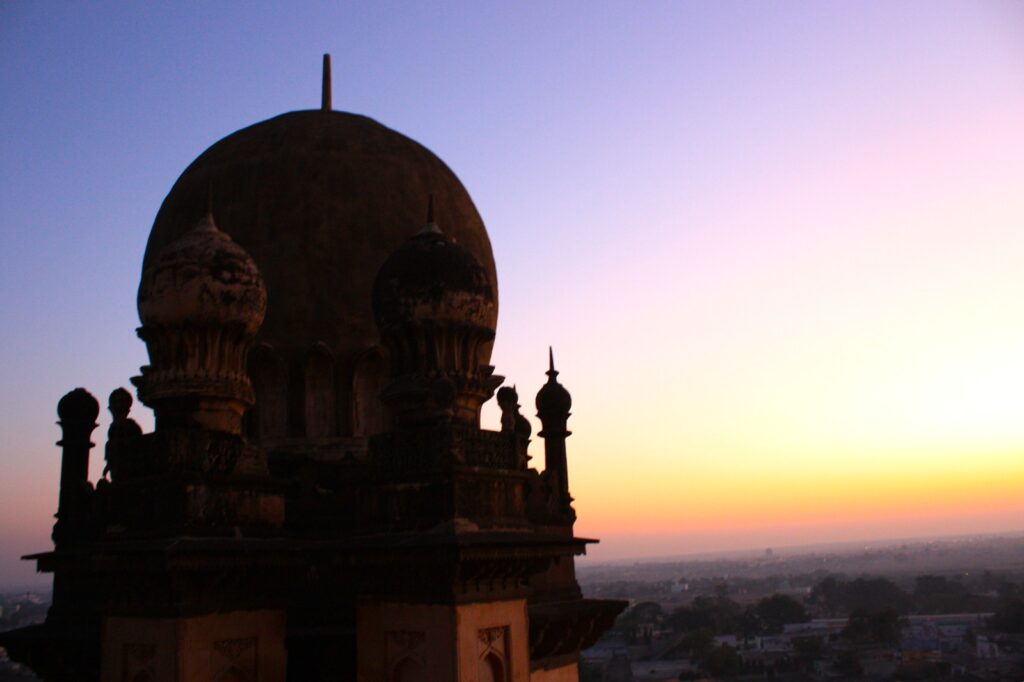
Dome of minaret against morning skies
History of the Adil Shahi Dynasty and Muhammad Adil Shah
The Adil Shahi dynasty controlled Bijapur (present-day Vijayapura) from 1490 to 1686, transforming the Deccan region into an architectural powerhouse. Their monuments showcase Persian, Turkish, and indigenous Deccan influences—a fusion defining Indo-Islamic architecture across Karnataka.
Sultan Muhammad Adil Shah, the seventh Adil Shahi ruler, commissioned Gol Gumbaz in 1626 as his final resting place. Unlike his predecessors who favored intricate decoration, Adil Shah pursued monumental scale. He envisioned a mausoleum dome rivaling Rome’s Pantheon—the second largest dome in the world—declaring Bijapur’s supremacy across the Deccan Sultanate territories.
Construction spanned three decades under architect Yaqut of Dabul. The project pushed engineering boundaries: creating an unsupported dome spanning 44m without interior columns, achieving perfect Whispering Gallery acoustics through mathematical precision, and sourcing massive dark grey basalt blocks from local quarries.
Then Muhammad Adil Shah died in 1656. Construction halted abruptly. The structural marvel stood complete—dome, gallery, octagonal minarets—but ornamental phases never materialized. Planned marble inlays, intricate calligraphy panels, and decorative stone carvings remained unexecuted. Compare this austerity with Ibrahim Rauza nearby, celebrated as the “Taj Mahal of the Deccan” for its delicate ornamentation, and the contrast sharpens.
Yet standing inside, I realized something profound: this “incompleteness” became Gol Gumbaz’s strength. Stripped of decoration, the monument reveals pure architectural geometry. The bare basalt surfaces enhance acoustics rather than compete for attention.
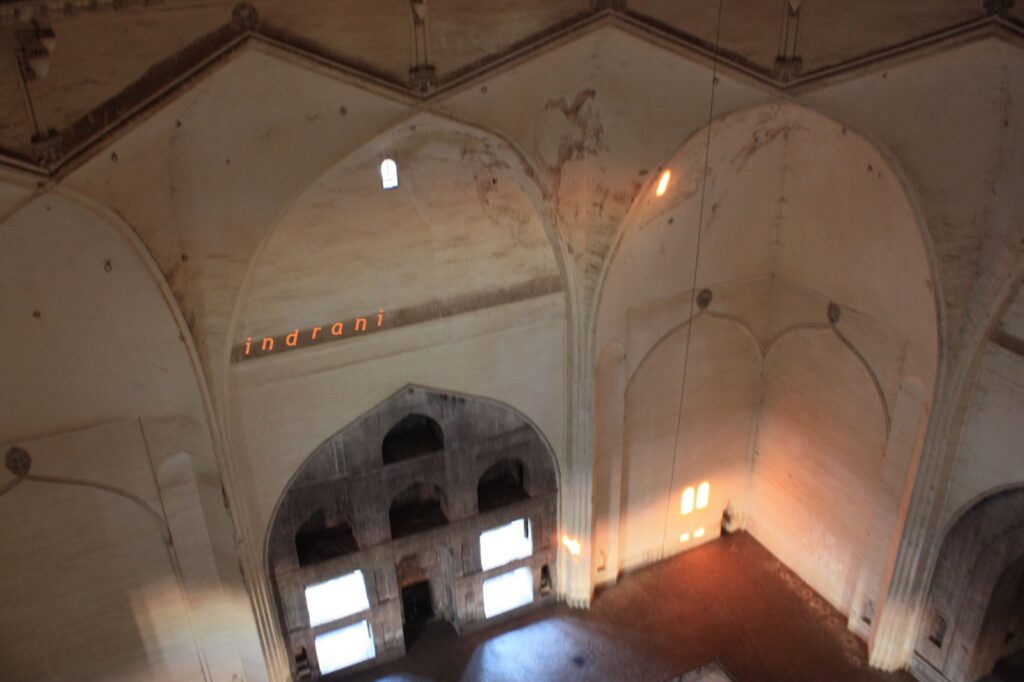
View inside from the Gallery-41 metre depth
The Architecture of an “Incomplete” Masterpiece
Why Gol Gumbaz Remains Unfinished
Muhammad Adil Shah’s death in 1656 froze construction mid-vision. Royal patronage evaporated instantly—without the Sultan’s financial backing and artistic direction, craftsmen abandoned decorative work. The dome and Whispering Gallery stood structurally complete, but artisans never added planned elements: carved floral motifs across basalt walls, Quranic calligraphy bands circling the gallery, marble inlay work mimicking Mughal aesthetics, and gilded finishes for the entrance portals.
This explains Gol Gumbaz’s stark appearance. Unlike the ornate Ibrahim Rauza with its delicate minarets and perforated stone screens, this mausoleum presents raw power—vast dark grey basalt surfaces meeting sky, geometry over decoration.
Engineering the Second Largest Unsupported Dome
The architectural achievement lies beneath surface simplicity. The dome rises 51 meters externally (44 meters internally), spanning 37.9 meters in diameter—second globally only to Rome’s Pantheon among unsupported domes. This Indo-Islamic engineering marvel required revolutionary thinking.
Architect Yaqut of Dabul employed interlocking pendentives—four massive curved triangular sections bridging the square hall to the circular dome base. These pendentives don’t just support; they redistribute the dome’s enormous weight laterally toward eight intersecting arches built into corner walls. This weight distribution eliminated internal column requirements, creating the unobstructed acoustic chamber that makes the Whispering Gallery possible.
Standing beneath, I traced these pendentive curves with my eyes. The mathematical precision felt almost alien—how did 17th-century engineers calculate load distribution without computers?
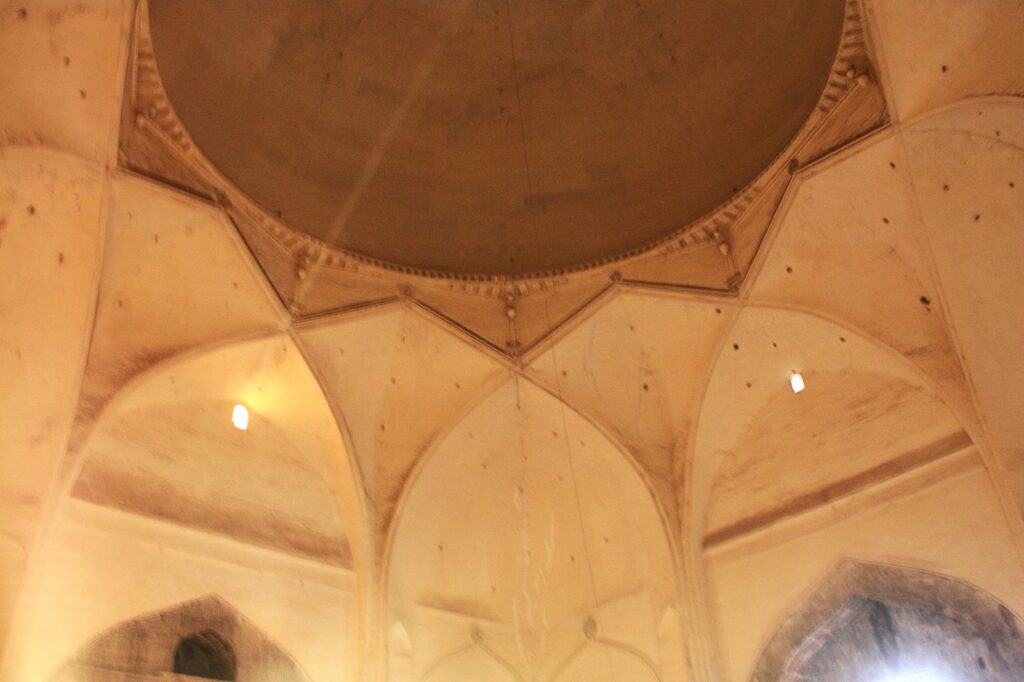
Whispering Gallery at the top
Materials: Dark Grey Basalt and Lime Plaster
Builders sourced dark grey basalt from Deccan volcanic formations—dense, durable, locally abundant. This volcanic stone provided compressive strength supporting the dome’s weight while its smooth texture aided sound reflection. Lime plaster coating brightened interiors and created the reflective surface enabling acoustic phenomena.
Though unfinished, Gol Gumbaz remains a masterpiece. Its sheer size, innovative design, and whispering acoustics make it one of the most extraordinary monuments of the Adil Shahi dynasty. For travelers, it is not just a tomb but a living classroom in architecture, history, and physics.
Comparison: Gol Gumbaz vs. Ibrahim Rauza
When Muhammad Adil Shah commissioned Gol Gumbaz Bijapur, he deliberately chose ambition over refinement—creating a monument opposing his father’s legacy at Ibrahim Rauza. The “Taj Mahal of the Deccan,” Ibrahim Rauza captivates through delicate stone latticework, symmetrical Persian gardens, and intricate calligraphic panels. It whispers elegance.
Gol Gumbaz shouts power. Where Ibrahim Rauza measures beauty in carved details, Gol Gumbaz measures it in cubic meters—the second largest dome in the world rising 51 meters, an unsupported span defying gravity. The Whispering Gallery acoustics at Gol Gumbaz have no equivalent at Ibrahim Rauza. One monument invites contemplation through artistry; the other overwhelms through scale and Indo-Islamic engineering innovation.
| Feature | Gol Gumbaz | Ibrahim Rauza |
| Built For | Muhammad Adil Shah (son) | Ibrahim Adil Shah II (father) |
| Defining Feature | Second largest unsupported dome, Whispering Gallery | Intricate stone carvings, symmetrical design |
| Architecture Style | Monumental, minimal decoration | Ornate Persian-Deccan fusion |
| Dome Height | 51 meters externally | Modest scale, twin structures |
| Acoustics | 11-fold echo phenomenon | Standard acoustics |
| Completion Status | Structurally complete, decoratively unfinished | Fully finished with detailed ornamentation |
| Legacy | Engineering triumph, acoustic marvel | Artistic masterpiece, “Taj of Deccan” |
Gol Gumbaz Interesting Facts and Figures
- A civil engineering marvel
- Second largest dome in World
- It stands without support of pillars, making it an architectural wonder
- It covers an area of 1700 sqm, diameter of 44 m
- Any small whisper gets amplified, echoes back and can be heard at least seven times after across a distance of more than 40 meters in the vast dome
- Built in 1656 it took 30 years to complete the construction
- The mausoleum was designed by Yaqut of Dabul
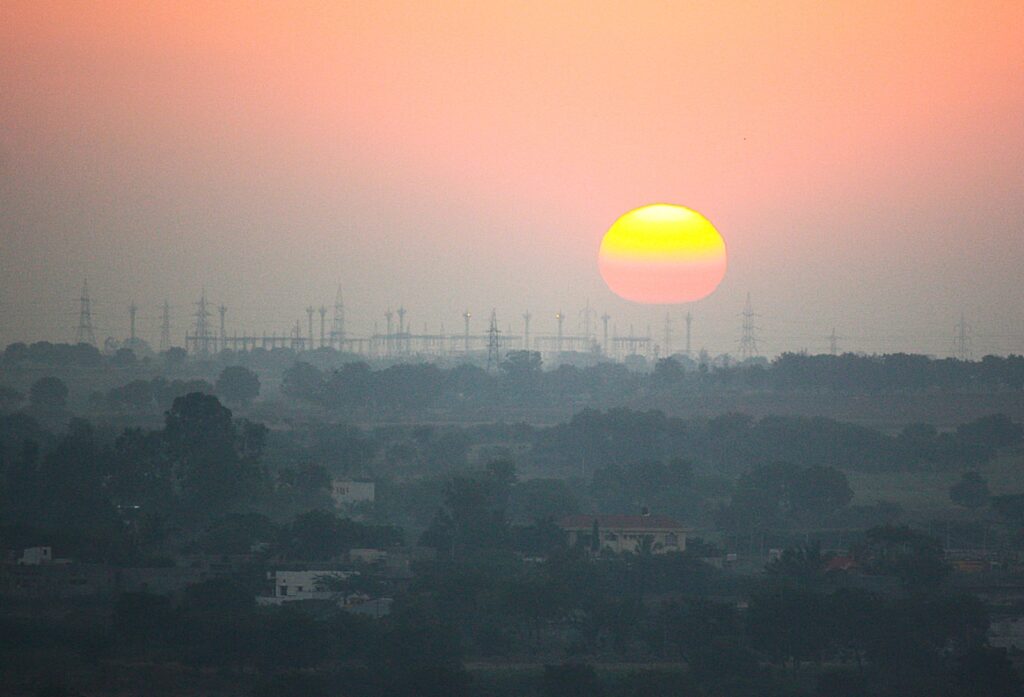
Vijayanagara Skyline from Gol Gumbaz
Practical Tips for 2025-2026 Visitors
Planning your Gol Gumbaz Bijapur (Vijayapura) visit requires strategy. Gates open at 6 AM—arrive precisely then. Morning hours between 6-8 AM offer empty galleries where Whispering Gallery acoustics perform undisturbed. By 10 AM, tourist groups flood the monument, drowning echoes in conversation.
Prepare physically for the climb. Seven floors spiral upward through narrow octagonal minaret staircases—steep, dimly lit, sometimes claustrophobic. The gallery itself measures just 3.54m wide, creating bottlenecks during peak hours. Wear rubber-soled shoes for grip on smooth basalt steps. Hold railings continuously; several sections lack adequate lighting.
Photography peaks at golden hour. Position yourself on the gallery’s eastern side as sunrise illuminates the dome’s exterior petal structures. The dark grey basalt glows amber against blue Karnataka skies—Instagram gold. From gallery height, capture panoramic Vijayapura skyline views including Ibrahim Rauza in the distance.
Respect monument rules: no loud noise (ironic, I know), no climbing on parapets, no littering. The Archaeological Survey of India monitors visitor behavior. Guards will ask disruptive tourists to leave, protecting this Indo-Islamic engineering marvel for future generations.
- Go there early, preferably on weekdays for fewer crowds to fully enjoy your whispering gallery experience
- Avoid the intense summer heat from March to June
- Witnessing winter sunrise from the whispering tomb would be a great experience
- Good parking facilities
- No eateries within the complex
Caution: This is not a place for handicapped and those with weak knees. The steps to climb to the dome are very big and steep. You have climb seven floors to reach the dome, that is round 100 steps to climb one way.
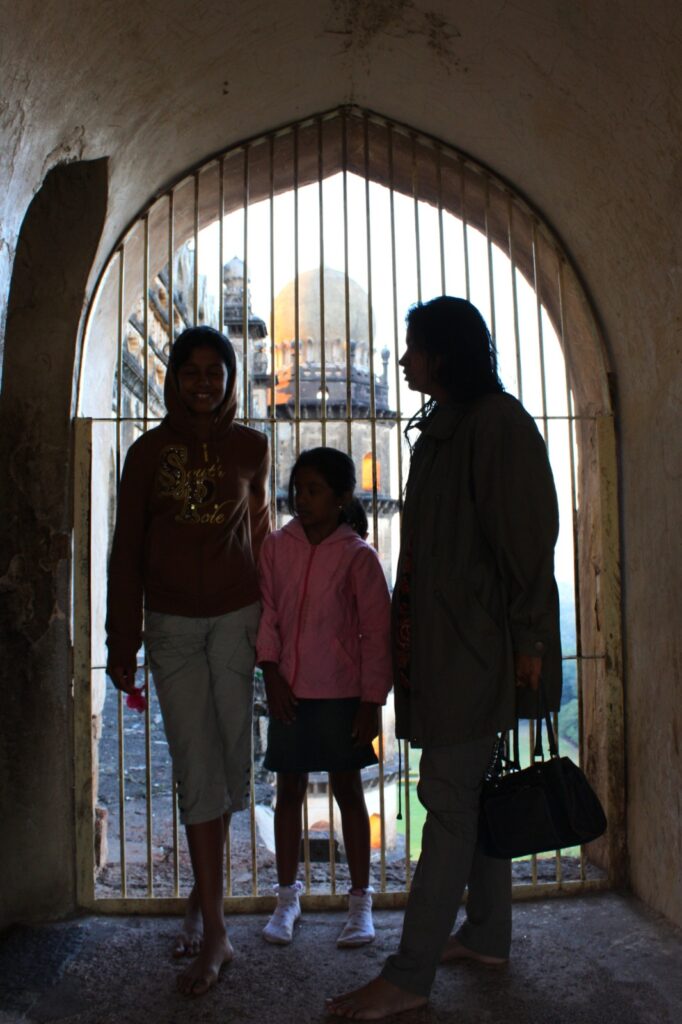
Echoes in Gol Gumbaz
Essential Visitor Information (2025-2026 Updates)
Timings and Entry Fees
Gol Gumbaz opens daily 6 AM to 6 PM (extended hours implemented 2024). Entry tickets cost ₹40 for Indian nationals, ₹600 for foreign tourists. Students with valid ID receive ₹10 discount. Children under 15 enter free. Purchase tickets at the main gate counter—digital booking through ASI’s official portal recommended for weekend visits when queues lengthen.
How to Reach Vijayapura (Bijapur)
By Train: Vijayapura Junction railway station sits 2 km from Gol Gumbaz. Direct trains connect from Bengaluru (10 hours), Hyderabad (8 hours), Mumbai (12 hours), and Pune (7 hours). Auto-rickshaws from station to monument cost ₹50-80.
By Road: NH50 and NH218 highways link Vijayapura to major Karnataka cities. KSRTC operates frequent buses from Bengaluru (530 km), Hubli (165 km), and Bagalkot (95 km). Private cabs available via Ola/Uber within city limits.
Nearest Airport: Belgaum Airport (205 km) offers limited connectivity; Kalaburagi Airport (220 km) provides better options.
Top 5 Things to See Near Gol Gumbaz
A trip to Gol Gumbaz is best paired with nearby monuments that showcase the Deccan Sultanate history.
- Ibrahim Rauza: Known as the Taj Mahal of the Deccan, this tomb and mosque complex is admired for its symmetry and intricate carvings. It reflects Sultan Ibrahim Adil Shah II’s refined taste.
- Bara Kaman: An unfinished mausoleum project, its massive arches stand as haunting reminders of ambition cut short. The skeletal remains of the structure make it one of Bijapur’s most atmospheric sites.
- Malik-e-Maidan: This colossal cannon, cast in bronze, is among the largest medieval guns in the world. Standing beside it, you sense the military might of the Adil Shahi dynasty.
- Jami Masjid: A grand mosque with a vast courtyard and elegant arches, still used for worship today.
- Asar Mahal: Once a royal court, it is said to house relics of the Prophet, adding spiritual depth to the city’s heritage.
Together, these sites create a cultural circuit that makes Vijayapura more than just a stop—it’s a journey into the heart of Indo-Islamic architecture.
Here is a list of places to see in Bijapur: Things to Do in Bijapur
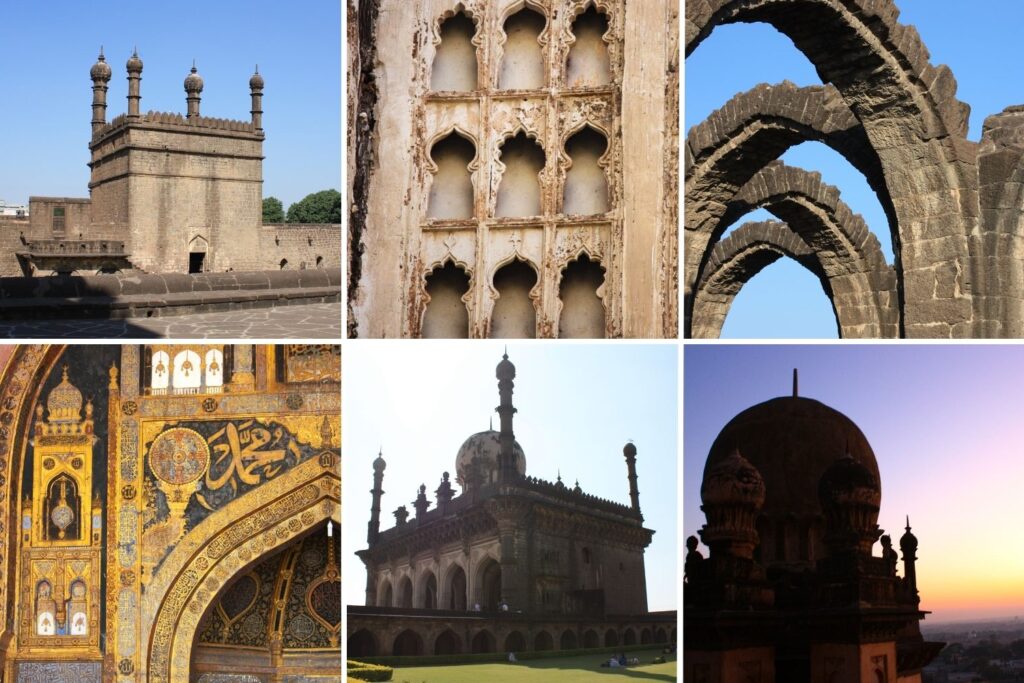
Things to Do in Bijapur
FAQ about Gol Gumbaz Bijapur
Q1. Is Gol Gumbaz bigger than the Taj Mahal?
Gol Gumbaz in Bijapur (Vijayapura) is not taller than the Taj Mahal, but its unsupported dome is larger in diameter. At 51m high and 38m across, it is the second largest dome in the world, making it an engineering marvel of the Adil Shahi dynasty.
Q2. Why is Gol Gumbaz famous?
It is renowned for its Whispering Gallery acoustics, where a single whisper can travel across 38 meters and echo up to 11 times. This unique phenomenon makes it one of the most extraordinary Indo-Islamic monuments in India.
Q3. Who built Gol Gumbaz and why?
Sultan Muhammad Adil Shah commissioned Gol Gumbaz in the 17th century as his mausoleum. His vision was to outdo his father’s tomb, the Ibrahim Rauza, often called the “Taj Mahal of the Deccan.”
Q4. Is Gol Gumbaz unfinished?
Yes. The Sultan’s death in 1656 left the monument incomplete. Decorative elements were never added, leaving the structure stark yet monumental.
Q5. What materials were used in Gol Gumbaz?
The dome and walls are built of dark grey basalt, finished with lime plaster. These materials not only provided strength but also enhanced the acoustics of the gallery.
Q6. How long does it take to visit Gol Gumbaz?
Plan 2-3 hours for a complete Gol Gumbaz visit. This includes: 20-30 minutes exploring the ground floor mausoleum chamber, 15-20 minutes climbing to the Whispering Gallery, 45-60 minutes experiencing the acoustics and enjoying panoramic views, and 10-15 minutes descending.
Q7. Is photography allowed inside Gol Gumbaz?
Yes, photography is allowed throughout Gol Gumbaz including inside the Whispering Gallery.
Q8. What does Gol Gumbaz mean?
“Gol Gumbaz” translates to “round dome” in Urdu/Persian (gol = round, gumbaz = dome). The name directly describes the monument’s defining architectural feature—its massive circular dome visible from across Vijayapura.
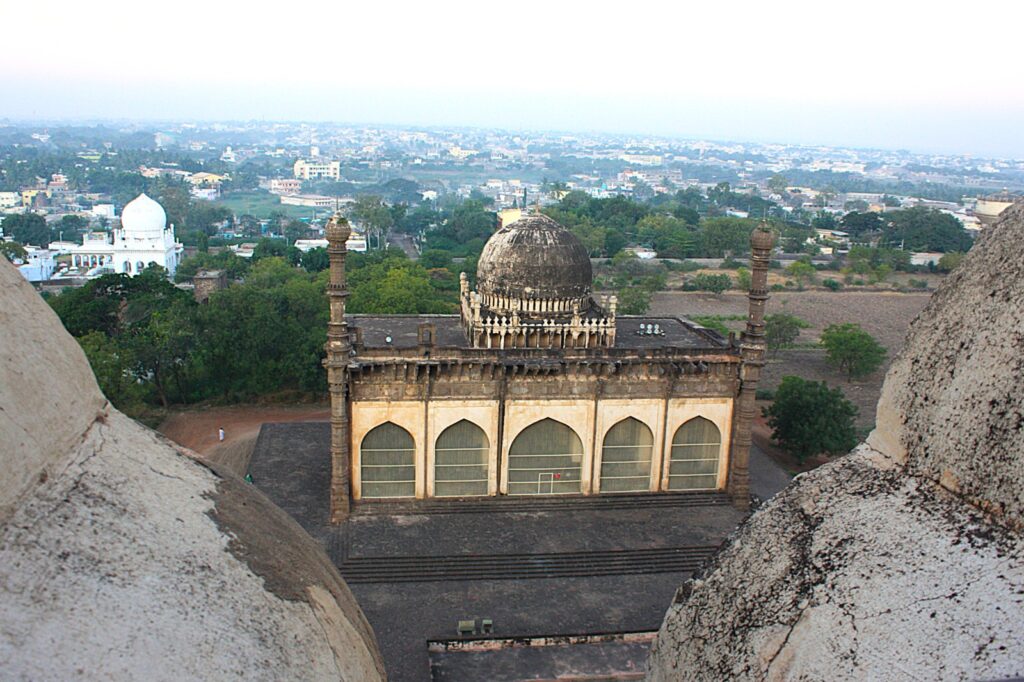
The Naqqar Khana (Trumpeters’ Hall) in Bijapur (now Vijayapura) is a historic building within the majestic Gol Gumbaz complex, converted into the Archaeological Museum of Vijayapura
Final Thoughts: Why Gol Gumbaz Deserves Your Visit
Gol Gumbaz Bijapur transcends typical tourist monuments. This isn’t just about checking off the second largest dome in the world from your bucket list—it’s about experiencing physics as poetry, witnessing how Muhammad Adil Shah’s unfinished dream became an accidental masterpiece.
The whisper amplifies across 38 meters of empty space, proving that engineering can be as moving as art. The unsupported dome rising above you, held by invisible forces calculated centuries before computers, reminds you that human ambition often achieves its greatest heights through bold simplicity.
I’ve visited monuments across India, but few create such visceral connection between past and present. When you hear your voice echo eleven times through that dark grey basalt chamber, you’re not observing history—you’re participating in an acoustic phenomenon the Sultan’s courtiers experienced 370 years ago. That continuity feels rare and precious.
Vijayapura rewards the curious traveler. Beyond Gol Gumbaz, the city holds layers of Deccan Sultanate history waiting to be explored—Ibrahim Rauza’s ornate beauty, Bara Kaman’s mysterious arches, Malik-e-Maidan’s massive cannon. But start with the dome. Start with that 6 AM golden hour when silence lets the architecture speak.
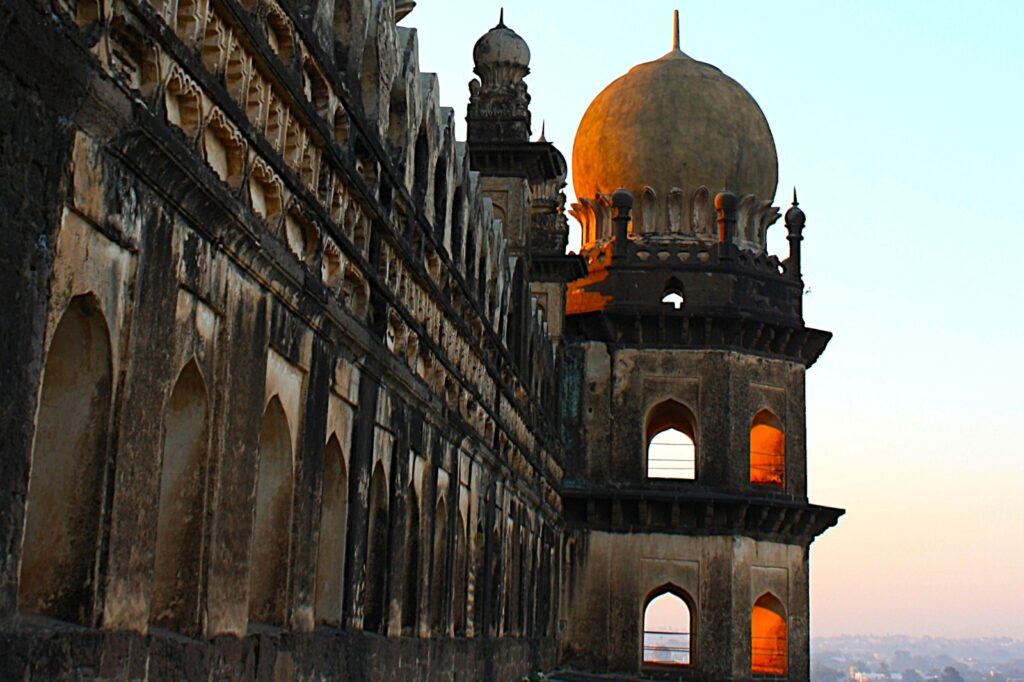
Windows reflecting Sun’s rising rays
Ready to Experience the Echo?
Plan your Gol Gumbaz visit now:
- Book early morning entry through the ASI portal to secure your golden hour slot
- Download offline maps—Vijayapura’s old city streets can confuse GPS
- Wear comfortable walking shoes for the seven-floor climb
- Bring a companion to test the cross-dome whispers (half the magic is sharing it)
- Allow time for Ibrahim Rauza afterward to complete the Adil Shahi architecture experience
Have you visited Gol Gumbaz? Share your Whispering Gallery experience in the comments below. Did you catch all eleven echoes? Your insights help fellow travelers plan better visits.
Planning a Karnataka heritage trip? Gol Gumbaz pairs perfectly with Hampi’s ruins (330 km), Badami’s cave temples (120 km), and Aihole’s ancient structures (130 km). Consider a 4-5 day Deccan heritage circuit to maximize your journey through Karnataka’s architectural treasures.
Found this guide helpful? Bookmark it for your trip planning, share it with fellow history enthusiasts, or subscribe to our newsletter for more off-beat India travel guides that go beyond surface-level tourism.
The echo is waiting. Make 2026 the year you hear it yourself.
Pin this for later
About the Author
 Indrani Ghose is a cultural travel writer and heritage documentation specialist with over 15 years of experience exploring and writing about temples across India and Southeast Asia. Having visited over 150 sacred sites, she brings both scholarly depth and personal narrative to heritage travel writing.
Her work has been published in Lonely Planet, The National (UAE), Whetstone Asia, Deccan Herald, and various architecture and heritage journals.
Connect with Indrani: Follow Indrani on Instagram | Twitter | Facebook for heritage travel insights, photography tips, and offbeat destination discoveries.











Namaskara! Chenagi deera? Bijapur looks awesome! I just discovered your blog this evening. I spent 4 weeks in Bengaluru in February on a Rotary GSE exchange program. Dhanyavadagalu
Kind regards from EAGAN daily photo in Minnesota, USA
i have heard and read so many interesting things about bijapur….it seems to be an enchanting place…..the pics of gol gumbaz are very nice and am sure from ur post that it was a very memorable journey for you…
hey indrani..mebbe you should pen a book on forts of india.. i have not seen the gol gumbaz yet!! so it was quite interesting..
What an awesome post, and thanks for sharing the pictures.
Indrani
Thank you for taking us through a fascinating tour of the Gol Gumbaz. Exquisite photographs – highlights the marvelous architecture and romance of the Gumbaz !
Definitely one of the great wonders of Mughal Architecture. Must plan a visit sometime in the near future.
Very nice account. And to think you went early to experience the echoes before the crowd poured in.
Hi Indrani! I need to 'share' this that you have frozen the moments in amazing way!! very inspiring, innovative, creative, wonderful and lovely ( running out of adjectives! 🙂 ) camera work. i need to spare more time here on your blogs and I will!
All the best to you!
Been to this place, Everything except the heat is wonderful 🙂
Nicely written, will join the trip 🙂
What a fantastic post – the writing and the pictures are just too good. I remember "learning" about the Gol Gumbaz in history class in school, but what we were taught was such dry-as-dust stuff, with not a picture in sight! Thanks for this!
Wow what an incredible place and it seems you were there at just the right time to truly hear the echos in otherwise silence. The sun reflecting so beautifully and your wonderful angles and perspectives show it's incredible beauty. Nicely told.
Indrani, it's interesting to know that Gol Gumbaz is the second largest dome in the world. It's a magnificent monument indeed, with great architecture, situated in a charming scenery. I've really enjoyed these wonderful images.
Wonderful writing. Waitng to hear the echoes must be awesome.
Amazing, I'm getting useful information about a place by simply reading your posts in your blog.
Keep writing…
I always have ambivalent feelings about these monuments Great Men leave to themselves…of course, the emotional response of those who came after is to the structure itself, and most usually not to the greatness of the powerful man for whom it was built.
Wonderful place 🙂
I had visit Rome in 2007,
I had seen the big basilica!!
Beautiful architecture
and old history.
Very interesting post,
nice and good written 😉
Incredible, to visit such a place. A very educational post and fantastic photographs. Thank you for sharing them.
A wonderful post with so much beauty and pathos in th story.
While all of these are splendid photos… I feel last one's composition is exceptional. Beautiful historic place and great information.
I have seen this structure and heard about it so many times in books and on television, but today saw in with you and almost heard the echos as you described it. Simply marvellous narration, this time the narration is better than the pictures.
Amazing architecture! And I'm particularly interested in the "seven echoes" 🙂 That is so cool!
wow! thank you for the wonderful images and commentary. excellent!
Very interesting ! what an impressive monument !!
What a fantastic place. Do you think it's one of the biggest rooms in the world? Great photos.
Indrani, if there is anything that marvels me, it is none other but your Intelligence as reflected in the orderliness and organization of your thoughts that You Shared with Us. That explains the title of your blog.
In my opinion, I think, even if there is a huge hallowness inside the premise of this beautifully architectured Gumbaz, it is the fact that the design outside is compact and could be the factor for its echoing Accoustics.
Another yet magnificent and excellent contribution to the blogosphere from your end.
Loved the way you have narrated the history and the details. The snaps are beautiful as usual.
What an amazing place.. Love the details in the writing.. and in the photographs…
Oh how I wish.. I could be there..
Thanks for the virtual tour Indrani. It's a delight to view magnificent edifices. I would love to listen to the echo of my whistle too. Happy Tuesday!
Wonderful post. Your world is always so interesting and beautiful. Love reading about the echo.
That was unbelievable to read, this must be one of the places I would put on my short list to visit. Thanks for showing all the beautiful pictures!
What an amazing place. Love the soft echos you were able to share, quietly, at least for a while.
I was in a building in California once where the acustics were like that and it was magical.
Such an interesting post and really informative…
What beautiful architecture and captures!!
What smooth cool beauty there is in those interior walls!
Awesome pictures! Interesting history too. The place is so majestic as it is.
What a fascinating post about another beautiful site. I've been to a whispering wall at the Temple of Heaven in Beijing. It's a fascinating place as well.
I wonder, too, what it would have looked like if completed. The acoustics in the Whisper Gallery sound amazing. I'd love to listen to the seven echoes.
Great photos and tour.
Just so magnificent a virtual journey through another place in time.
a most magnificiant structure…it is indeed a massive structure if its size rivals saint peters. beautiful architectural details.
so enjoyed the post and the whisper detail.
have a lovely week.
Wonderful place. Simply breath taking, I can imagine how fun it would be to photograph.
I also enjoy very much your posts and photos Indrani. This was another interesting one!
Another marvelous and interesting post! What a beautiful place and your narrative is fascinating as always. Your photos are always superb! Have a great week, Indrani!
I'm impressed you got there that early! I imagine it must've been quite eery being alone in that huge building just around dawn.
What a beautiful place. Your posts are always so interesting and I love learning about the architecture and history of places like this that you feature.
One day is not enough to truly enjoy all that this place has to offer. Thanks for your beautiful shots and informative reporting.
I am enjoying this trip with you. The Dome is such a magnificent building. The structures on the sides almost look like the Pisa (not that I have seen it in person) in pictures. Indeed an interesting post.