Ultimate Guide to Batalha Monastery, Portugal: History, Architecture, and Your Perfect Visit
Stepping Back to the Golden Age of Portugal
Batalha Monastery in Portugal is an incomplete monastery, yet in its incomplete state the monastery is incredible and features in the prestigious list of UNESCO Heritage sites. My obsession for UNESCO sites and the possibility of adding it to my road trip through Portugal were the main reasons to add the halt at Batalha after visit to Alcobaca Monastery.
Knowing the history associated with this monastery and the sculpted carvings are outstanding, I couldn’t resist the urge to take a peep at the remains of the golden age of Portugal. I slotted two hours to tour the monastery.

Batalha Monastery Portugal
Quick Facts about Batalha Monastery
Location: The Monastery of Batalha (Mosteiro da Batalha) is a Dominican convent in the municipality of Batalha, historical Beira Litoral province, in the Centro of Portugal. (Coordinates: 39.65°N 8.82°W)
Other names: Monastery of Saint Mary of the Victory (Mosteiro de Santa Maria da Vitória)
Constructed: between the years 1386 to 1517
Monastery Hours:
- October to March: From 9 AM to 6 PM
- April to October: From 9 AM to 6.30 PM
- Last admission: 30 minutes before closing
- Closed: 1 January, Easter Sunday, 1 May and 25 December
Entry Fees: 15 €
UNESCO Status: Designated World Heritage Site since 1983
Architectural Style: Original, national Gothic style, profoundly influenced by Manueline art. Ornately decorated chapels and the Royal Cloister.
Best Visiting Strategy: Arrive at opening time (9 AM) to photograph in natural light without crowds.
Distance from Major Cities:
- Lisbon: 122 km (1 hour 33 min via A1/N1)
- Fatima: 20.8 km (25 min via EN356)
- Coimbra: 86.5 km (57min via A1)
- Porto: 196 km (1 hr 57 min via A1)
Historical Significance: The Monastery of the Dominicans of Batalha was built to commemorate the victory of the Portuguese over the Castilians at the battle of Aljubarrota in 1385.
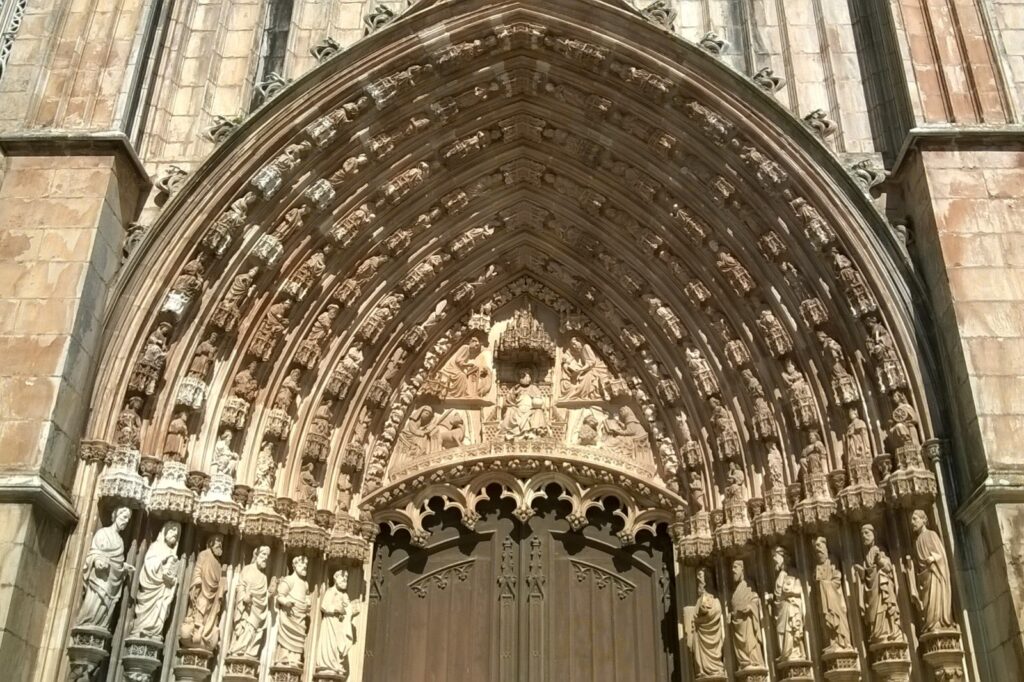
Door of the Batalha Monastery in Portugal
Batalha Monastery: A Personal Glimpse and Why It Stole My Heart (Experience)
The first thing that struck me at Batalha Monastery was the light. Sunlight streamed through the stained-glass windows, scattering across the limestone walls like a thousand jeweled reflections. Reds, blues, and golds shimmered as if the ancient stone had momentarily come alive. It was pure magic—an interplay of light and architecture that turned devotion into art. I captured those fleeting gems of color in my camera, knowing no photograph could ever truly hold the wonder of that moment.
The story of the Batalha Monastery, Portugal, is as luminous as its stained glass. Officially known as Mosteiro de Santa Maria da Vitória, it was commissioned by King João I in gratitude for Portugal’s victory at the Battle of Aljubarrota in 1385. What began as a royal vow soon became one of the greatest architectural achievements of medieval Europe.
Walking through its vast cloisters and chapels, you witness the evolution of Portuguese Gothic into the flamboyant Manueline style. The stone seems to twist, breathe, and bloom. Every arch, rib, and pinnacle tells a story of faith and craftsmanship. The monastery took over a century to complete, with generations of master builders adding their vision to its design.
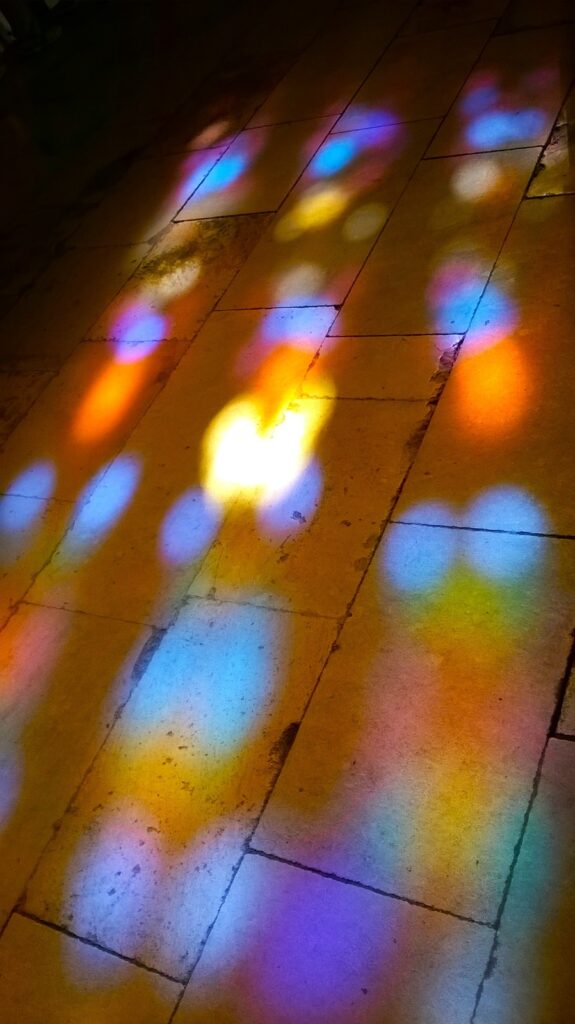
Sunlight streamed through the stained-glass windows
Built on Victory: The History of the Battle of Aljubarrota (1385)
The Mosteiro de Santa Maria da Vitória owes its origin to a royal promise. In 1385, King João I of Portugal made a solemn vow to the Virgin Mary: if Portugal triumphed over Castile in the impending battle, he would build a magnificent church in her honor. The victory at the Battle of Aljubarrota, fought on 14 August 1385, not only secured Portugal’s independence but also fulfilled the King’s pledge.
Construction began the following year, in 1386, and continued for nearly two centuries, spanning the reigns of seven monarchs. The project employed some of the finest stonemasons and architects of the time, many influenced by English Gothic styles introduced through the King’s alliance with England—cemented by his marriage to Philippa of Lancaster.
Built primarily from local limestone, the monastery complex grew to include the church, Royal Cloister, chapter house, dormitory, refectory, and later, the Founders’ Chapel—the resting place of King João I and Queen Philippa. The Dominican Order oversaw the monastery’s spiritual life until the 19th century.
The Royal Cloister stands as a masterpiece of harmony—its delicate tracery letting sunlight dance in geometric patterns. And then there are the Unfinished Chapels (Capelas Imperfeitas), open to the sky, where time itself seems to pause. Even in incompletion, they speak of ambition and beauty that defied centuries.
Recognized as a UNESCO World Heritage Site in 1983, Batalha Monastery remains one of Portugal’s finest expressions of Gothic and early Manueline art—a physical testament to faith, victory, and the enduring relationship between religion and nationhood.

Batalha Monastery Architecture
The Manueline Masterpiece: A Chronicle of Architectural Styles
High Gothic Elegance: The Initial Phase and the Main Church
As I stepped into the main nave of Batalha Monastery, I immediately sensed its High Gothic soul—tall, slender columns soaring upward, ribbed vaults unfolding like stone canopies, and light filtering through stained glass in hushed reverence. I felt like a tiny creature!
The earliest phase, begun under Afonso Domingues, reflects a strong influence of English Gothic, especially the Perpendicular style that emphasized verticality and light. The nave—stretching 80m long and nearly 32m high—is simple yet monumental, its pale limestone emphasizing clarity and structure. The pointed arches and ribbed vaults direct the eye heavenward, while the lack of excessive ornamentation in the main church maintains a calm, meditative atmosphere.
When I photographed the light streaming through the upper windows, I understood how the Gothic builders here balanced spiritual symbolism and engineering precision—a combination that still feels fresh, even six centuries later.
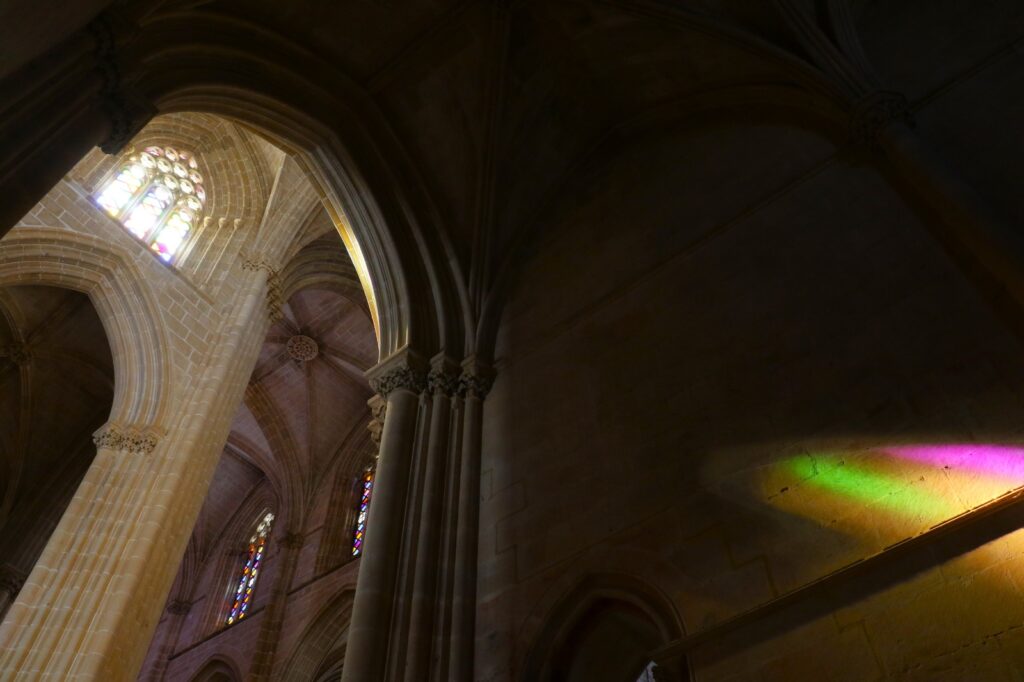
Light streaming through the upper windows in Batalha Monastery
The Birth of the Manueline: Batalha as the Cradle of a Portuguese Style
Yet, what truly sets Batalha apart is how it evolved beyond Gothic purity. Over the decades, as construction continued, new artistic influences emerged—culminating in the Manueline style, Portugal’s own contribution to European architecture. Often described as Portuguese Late Gothic, this style merged flamboyant ornamentation, nautical motifs, and religious symbolism, mirroring the Age of Discoveries that followed.
Batalha became the cradle of Manueline architecture in Portugal. The later additions, especially the Founder’s Chapel (Capela do Fundador) and the Unfinished Chapels (Capelas Imperfeitas), showcase this stylistic transition. Here, I could see delicate carvings of ropes, coral, armillary spheres, and botanical patterns—echoes of Portugal’s seafaring glory.
Standing before the Unfinished Chapels, open to the sky, I failed to decide whether to appreciate what remains or regret what could not be completed. The fusion of faith, exploration, and artistry makes Batalha one of the most important monuments in the story of Manueline architecture in Portugal.

Founders’ Chapel—the resting place of King João I
Architectural Highlights: Must-See Features Inside the Monastery
The Founder’s Chapel (Capela do Fundador)
This chapel is the heart of Batalha Monastery, commissioned by King João I as both a dynastic mausoleum and an expression of gratitude to the Virgin Mary for his victory at Aljubarrota. At the centre of this octagonal chapel lies the joint tomb of the royal couple—João I of Portugal and Philippa of Lancaster , their hands clasped together in eternal union. I found this gesture deeply moving; it’s one of the earliest examples in European tomb sculpture of such intimate human connection.
Surrounding them are the tombs of their sons, including Prince Henry the Navigator, connecting this serene space to Portugal’s Age of Discoveries.

Batalha Monastery Architectural details
The Royal Cloister (Claustro Real)
A harmony of light and stone: The Royal Cloister of Batalha represents the height of Manueline stonework, often called “lace in stone” for its intricate carvings. As I walked its arched corridors, I marvelled at the delicate tracery—marine ropes, flowers, and armillary spheres—all chiseled with impossible precision.
Originally built in Gothic style by Afonso Domingues, it was later embellished under King Manuel I with ornate motifs reflecting Portugal’s maritime triumphs. This fusion of Gothic symmetry and Manueline exuberance makes the cloister feel alive, as though the stone itself breathes light.
Best time to visit: Step in around mid-morning when the sun hits the arches at an angle—the shadows enhance the carvings’ depth beautifully for photographs.
The Iconic Unfinished Chapels (Capelas Imperfeitas)
Despite the name, the Unfinished Chapels of Batalha are among the monastery’s most astonishing sights. Commissioned by King Duarte I as a family pantheon, they were never completed—partly due to changing architectural tastes and funding redirections after his death. Standing within this open-air, octagonal structure, I felt enveloped by grandeur.
The vaulted portal leading into the chapels is an explosion of Manueline creativity—spirals, pinnacles, and carvings of kings, saints, and angels. Even without a roof, the space feels infinite, a cathedral to the sky. Their unfinished state somehow enhances their beauty.
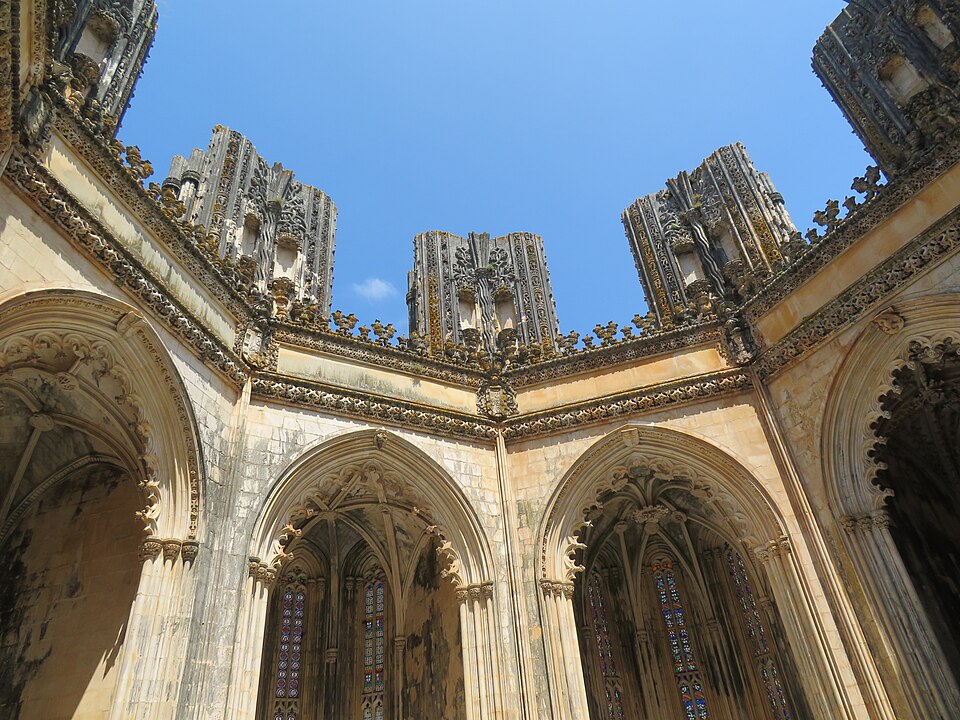
By Kyle Magnuson from Los Angeles, United States – Unfinished Chapels of Batalha Monastery 20, CC BY 2.0, https://commons.wikimedia.org/w/index.php?curid=73785827
The Chapter House (Sala do Capítulo)
Engineering genius: The Chapter House of Batalha features one of the most impressive vaulted ceilings in Gothic Europe—a single-span structure with no central support. Standing beneath it, I could hardly believe that this daring design dates back to the 15th century.
Today, the chamber also holds the Tomb of the Unknown Soldier, added in 1921 to honour Portuguese soldiers who fell during World War I. Two guards stand vigil beside the tomb, adding solemn dignity to the space. The blend of medieval architecture and modern remembrance gives this hall an emotional depth—it’s both a triumph of engineering and a quiet memorial to courage.

The impressive facade of Batalha Monastery
Planning Your Visit to Batalha Monastery: Essential Visitor Information
Batalha Monastery Opening Hours and Ticket Prices
Opening Hours:
- Summer (April–October): 9:00 AM – 6:30 PM
- Winter (November–March): 9:00 AM – 6:00 PM
- Closed: January 1, Easter Sunday, May 1, December 24–25
Ticket Prices:
- Adults: €6
- Senior Citizens / Students: €3
- Children under 12: Free
- Joint Ticket (Highly Recommended!): €15 — valid for Batalha, Alcobaça, and Tomar Monasteries (UNESCO World Heritage sites forming the Monastic Triangle of Portugal).
Pro-Tip: If you’re exploring central Portugal, buy the combined monastery ticket — it’s valid for several days and saves both money and time in queues.
Where is Batalha and How to Get There?
Batalha is a charming town in the Leiria District, about 120 km north of Lisbon and 230 km south of Porto.
By Car:
- From Lisbon: Take the A8 motorway toward Leiria, then the IC2 to Batalha (approx. 1 hour 30 minutes, 120 km).
- From Porto: Follow A1 to Coimbra, then A17 toward Leiria and IC2 to Batalha (approx. 2 hours 30 minutes).
Free parking is available near the monastery complex.
By Bus:
- Direct buses operate from Lisbon’s Sete Rios terminal to Batalha (around 2 hours).
- Alternatively, take a bus to Leiria, then a short connecting ride (15–20 minutes) to Batalha.
Best Time to Visit (My Personal Tip!)
If you can, visit early in the morning just as the monastery opens — the sunlight filters through the stained glass and paints the walls in shifting hues of ruby and sapphire. It’s quieter too, perfect for slow exploration or photography.
Spring (April to June) and early autumn (September to October) are ideal for pleasant weather and fewer crowds.
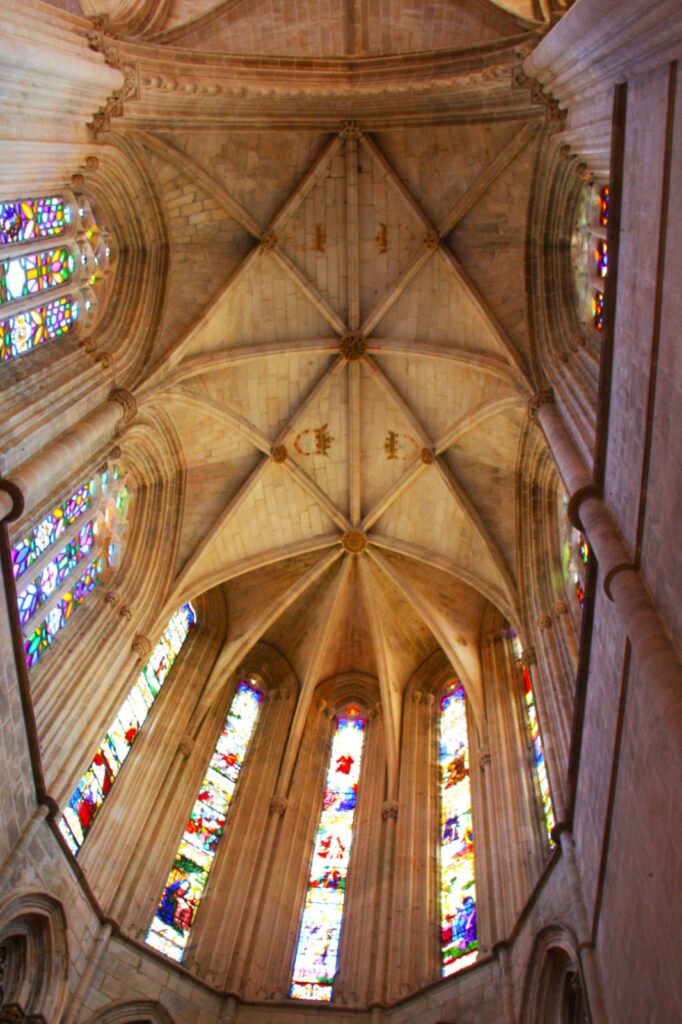
Impressive vaulted ceiling in Batalha Monastery
What to See Nearby within 50 km
- Fátima: Just 20 km (25 minutes) away, Fátima is one of the most important Marian pilgrimage sites in the world. Its grand sanctuary complex and evening candlelight processions are deeply moving, even for non-pilgrims.
- Alcobaça Monastery: Located 25 km (30 minutes) southwest of Batalha, this monumental abbey houses the legendary tombs of Pedro and Inês de Castro, a love story that shaped Portuguese medieval history.
- For art lovers, the Museu da Comunidade Concelhia da Batalha (MCCB) offers excellent insights into the town’s local history and architecture.
How much time is required to see Batalha Monastery
This really depends on how much time one wants to spend exploring the site! Basic visit, like we made, will take around two hours. You can cover main features of the building such as the main chapel, the cloisters, and the Royal Pantheon. I did some quick photography of the monastery and set off for Tomar, the next part of our road trip through Portugal.
But the luckier ones among you readers with ample time in hand take your time to explore the intricate details and decorations of the monastery; it can take up to 3 to 4 hours. Batalha Monastery is an impressive and large structure with a lot of things to explore.
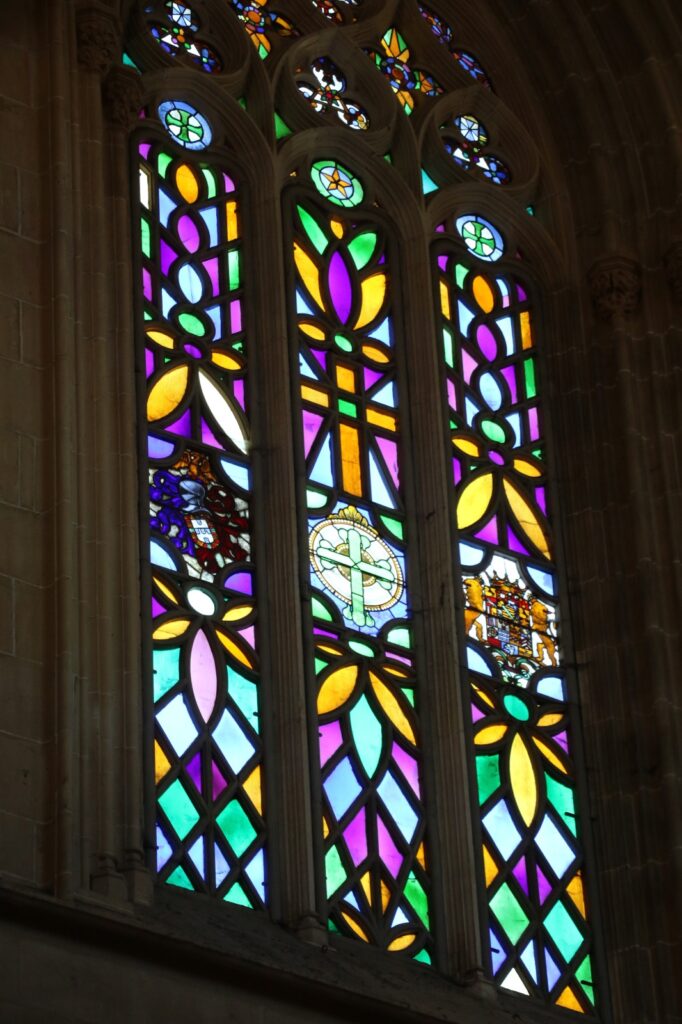
Stained Glass window in Batalha Monastery
What else to see in Batalha
Besides being famous for the monastery, Batalha has other interesting places to visit. Here is a list of tourist attractions in Batalha:
- The 14th century Royal Palace of Batalha: this had served as a residence for the Portuguese monarchy. It is located next to the monastery, open to the public not as a palace but as a museum.
- The Battle of Aljubarrota Visitor Centre: dedicated to the Battle of Aljubarrota, which was fought in the 14th century between Portugal and Spain. It features interactive exhibits and a short film about the battle.
- The Batalha Cultural Centre: If your visit is timed well you can see events conducted here. This cultural center hosts a variety of exhibitions, events, concerts, plays, and art shows throughout the year.
- The Batalha town centre: features a variety of restaurants, cafes, and shops where visitors can explore and discover the local culture. We explored the little shops for souvenirs.
Batalha Monastery FAQ (Frequently Asked Questions)
Q. How long does it take to visit Batalha Monastery?
A. You should allocate 90 minutes to 2 hours to fully explore Batalha Monastery, including the Main Church, the Royal Cloister, the Chapter House, and the Unfinished Chapels. If you are a photography enthusiast, plan for closer to 3 hours.
Q. Is there parking available near the monastery?
A. Yes, there is free designated parking (both street parking and small lots) available within a very short walking distance of the monastery entrance. The town of Batalha is small and easy to navigate.
Q. Should I visit Alcobaça and Tomar on the same day as Batalha?
A. While geographically close, visiting all three (Batalha, Alcobaça, and Tomar) in one day is challenging and rushed. I recommend dedicating a full day (or a long afternoon) to Batalha and Alcobaça, and visiting Tomar the following morning. Alternatively, purchase the joint ticket and spread the visits over two days for a more relaxed experience.
Q. Can I take photographs inside Batalha monastery?
A. Yes, photography is generally permitted throughout the complex, but flash photography is strictly prohibited in all chapels and enclosed areas, especially around stained-glass windows and tombs. Be respectful of other visitors and ongoing religious services.
Final Thoughts
Why Batalha is a Testament to Portugal’s Soul
Standing inside the Batalha Monastery, it’s impossible not to feel the pulse of Portugal’s past. Every ribbed vault and sculpted arch tells a story — of resilience after the Battle of Aljubarrota, of artistic ambition that gave birth to the Manueline style, and of a nation that carved faith into stone.
For me, the most moving part is the quiet dialogue between light and limestone — how the changing sun turns the Gothic interiors into a living, breathing artwork. It’s history illuminated, quite literally.
Have you visited the Mosteiro da Batalha? I’d love to hear your impressions — share your favourite detail or memory in the comments below!
Pin this for later
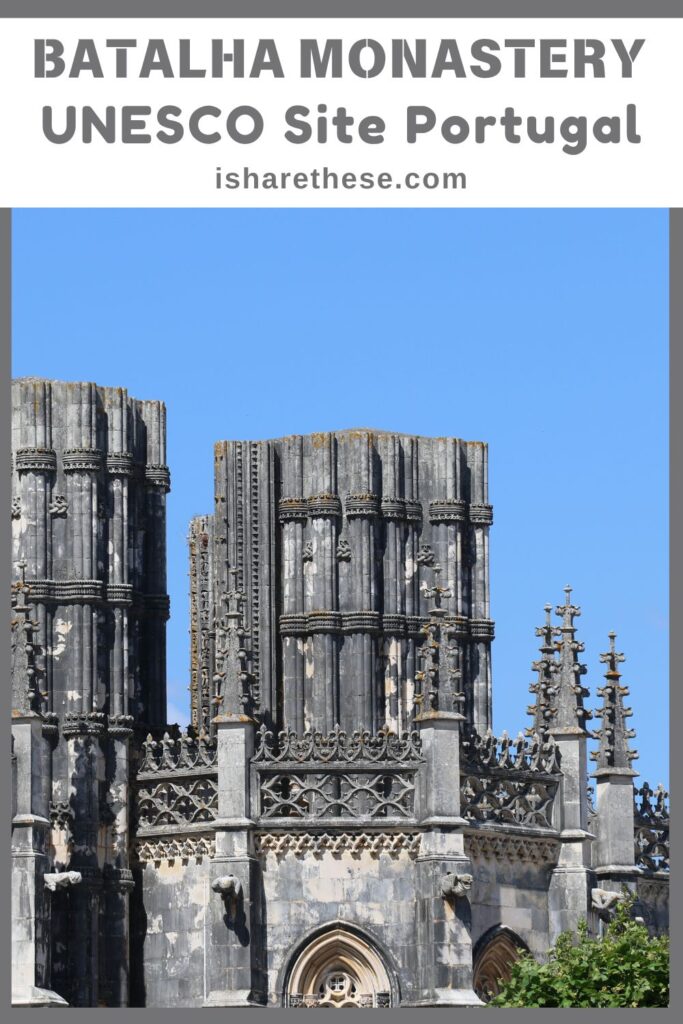
Here is a pinnable image for Batalha Monastery of Portugal. You can save it to your collections for making a good plan to visit it.
 About the author: Indrani Ghose is a travel blogger and photographer who has explored 15+ European countries across multiple trips. Based in Bangalore, she shares authentic travel experiences to help fellow travelers navigate the world more safely and confidently. You can follow her on her social media handles Instagram, Twitter and Facebook to see the wonderful destinations, beautiful offbeat places and get instant updates about them.











Truly incredible! 2 centuries were petty long time and the thing itself make feel how remarkable the structure has to be. The detail on the arched gateway and many other aches were spellbinding
Magnificent! Wonderful photos!
Lovely arches.. I love the amalgam of the two styles. 🙂
Gorgeous monastery! I love all the details.
Gorgeous details!
I’m not surprise the construction went on for two centuries, it’s huge!
Wren x
Great capture, Indrani.
I know a person who never completes any building. He always left some part incomplete. Someone told him that the day he’ll complete all his buildings, his work on earth will be over. He is in education business. He built many colleges but some portions are unfinished in each one.
By looking at the pictures it gave me a feel of Gothic style. Then I read the article, & I was right! 🙂
And I love stained glasses, anywhere. 🙂
Interesting article. The architecture is lovely.
This incompleteness looks beautiful. So idea is to visit it on Sunday 🙂 Thanks for lovely post !
Hello, I can not imagine it being unfinished. It is just beautiful. A beautiful monastery. Thanks for sharing your visit. Enjoy your new week ahead!
Really interesting architecture,explains the time taken
Can’t even guess which part is incomplete, it looks so compelling!
The sculpted ceilings and arches are just beautiful. Lovely account of the same.
two centuries and incomplete…kahi iska tender humare India ke Pwd department ko toh nahi diya tha!!! LOLS
seriously, this incomplete structure looks magnificent!!
Ha ha that was hilarious Sushmita 🙂
The monastery looks so beautiful. A great post 🙂
Magnificent !! The monastery and its architechture unbelievable ! The interiors and carvings too besutiful..
Wonderful Gothic architecture. Nice frames, Indrani.
Very old but beautiful one 🙂
Beautiful shots..
Your posts are making me want to make a trip to Portugal. Seriously. Will make you plan my itinerary as well 🙂
Beautiful arches. Nice blending of the two styles.
Amazing place. Anything that’s take centuries to build is beyond imagination. Beautiful pictures.
This is a beautiful one… can you believe I have never visited one?
Looks beautiful. The couple tomb sounds unique.
Beautiful place..
It is AWESOME!! And your captures are superb as always, Indrani!! An incredible place that I would love to visit!! Thank you so much — as always — for sharing the wonder, the beauty and the history with us today!! Have a great week!
Fabulous!
Amazing, Beautiful photos