Architecture of Bhoganandishwara Temple: A Dravidian Engineering Marvel
The Bhoganandishwara Temple architecture is one of Karnataka’s finest examples of Dravidian temple design, where engineering precision and devotional art coexist seamlessly. But what struck me most during my visits in March 2023 and October 2025 wasn’t just the beauty — it was the architectural intelligence embedded in every element.
From natural ventilation systems carved in stone to acoustic properties in the mandapas, this temple reveals how ancient builders were also master engineers. Standing before those perforated jali screens or beneath the single-stone chatra, I marveled at the combination of artistic skill with scientific understanding that rivaled modern engineering principles.
Having explored the temple’s multi-dynastic history in our previous post, I now delve into the architectural elements that make this complex a masterclass in Dravidian design. As someone who studied electrical engineering before becoming a travel writer, I regret not pursuing architecture — temples like Bhoganandishwara make me wish I could have dedicated my career to understanding these stone marvels technically rather than just documenting them journalistically.
This is Part 3 of our comprehensive Bhoganandishwara Temple series. New here? Start with our Complete Visitor Guide for practical information, then explore The Multi-Dynasty History to understand how this architectural complexity evolved over 700 years.
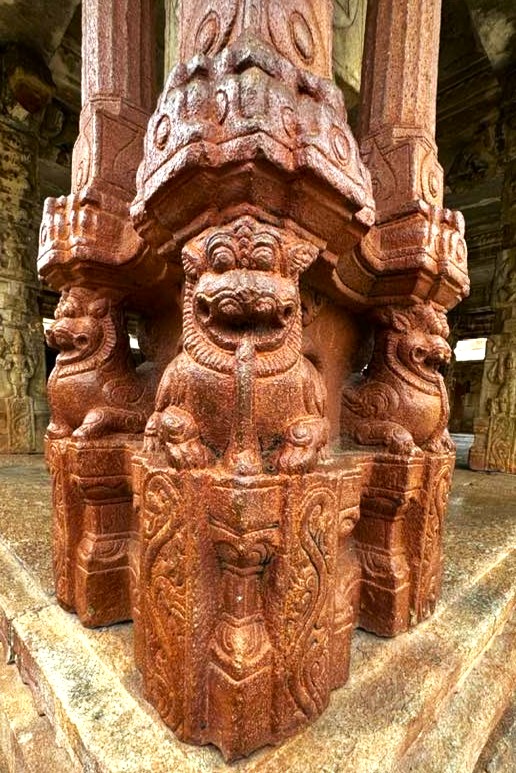
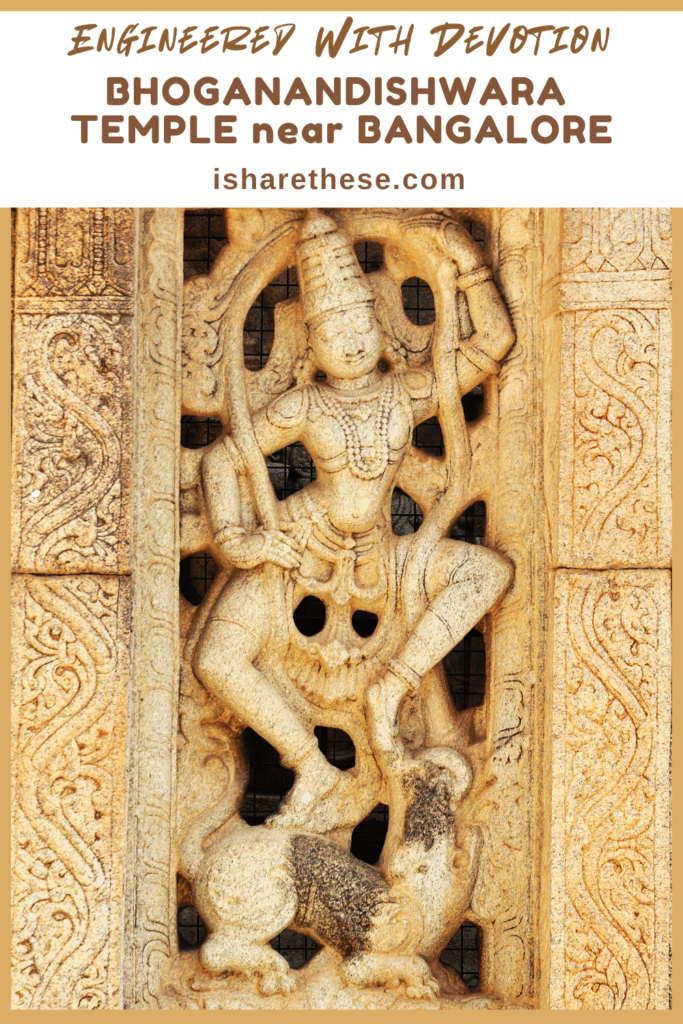
Yali sculptures in Navaranga Mantapa of Bhoga Nandeeshwara Temple
The Philosophical Architecture: A Temple That Tells Shiva’s Life Story
The Trinity of Shrines as Spatial Narrative
Unlike typical single-shrine layouts, Bhoganandishwara presents a unique architectural concept: three shrines representing three life stages of Lord Shiva:
- Arunachaleswara (childhood/dawn of life)
- Bhoganandishwara (youth/prime of life)
- Uma Maheshwara (divine union/culmination)
Our architect ancestors have very intelligently intertwined this philosophical concept with spatial planning. The three shrines are positioned in a progressive layout — you physically walk through Shiva’s life journey as you move through the temple complex. According to temple pujaris I talked to, this narrative sequencing is rare in South Indian temples, which typically focus on a single deity’s manifestation.
During my October 2025 visit, the priest explained that devotees traditionally circumambulate all three shrines in sequence (pradakshina) — a ritualistic movement that mirrors life’s progression from innocence to experience to transcendence. Standing in the central courtyard with all three vimanas visible simultaneously, I realized the entire complex functions as a three-dimensional mandala, a sacred geometric pattern usually rendered in two dimensions.
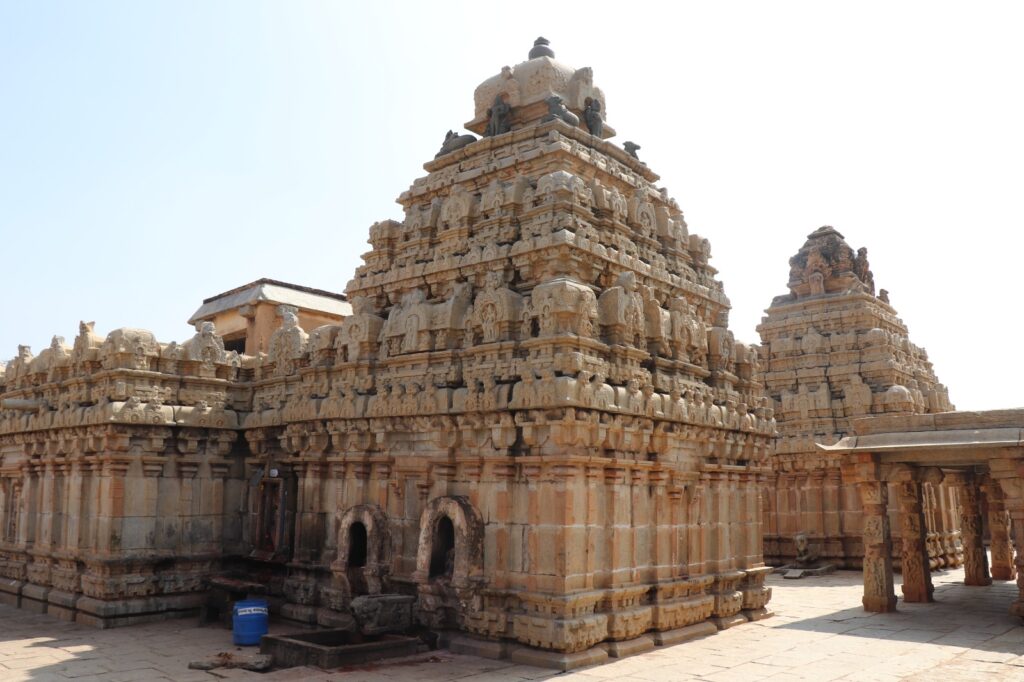
Trinity of Shrines – Architecture of Bhoganandishwara Temple
Architectural Significance as explained to me: This spatial narrative demonstrates
- Processional pathways guide movement chronologically
- Visual axes connect the three shrines meaningfully
- Proportional relationships between shrines reflect life stage symbolism
- The layout creates psychological journey through sacred space
This architectural storytelling approach influenced later temple complexes across Karnataka and Tamil Nadu, though few executed it as coherently as Bhoganandishwara.
Engineering Marvels Hidden in Plain Sight
1. Perforated Stone Windows (Jalis): Sophisticated Passive Cooling
The jalis (perforated stone screens) along the outer walls aren’t merely decorative — they’re a sophisticated passive climate control system that would impress modern sustainable architects.
How They Work:
These geometric lattices perform multiple environmental functions:
- Filter harsh sunlight into diffused, softer patterns (reducing glare and heat gain)
- Create cross-ventilation through precisely calculated perforation ratios
- Reduce internal temperature by 3-5°C compared to external ambient heat
- Cast moving shadows that mark time progression (functioning like natural sundials)
- Prevent rain penetration through angled perforations during monsoons
The jalis also feature sacred symbols carved within the perforations — conch shells (shankha), lotus flowers (padma), and miniature deity figures — proving that functionality and artistry were never separate concerns for Dravidian architects. This integration of engineering and aesthetics is what modern sustainable architecture strives to achieve but ancient builders accomplished intuitively.
Similar jali systems appear in Mughal architecture (like Fatehpur Sikri), but Bhoganandishwara’s examples predate them by centuries, demonstrating that passive cooling wasn’t a Mughal innovation but a pan-Indian architectural tradition.
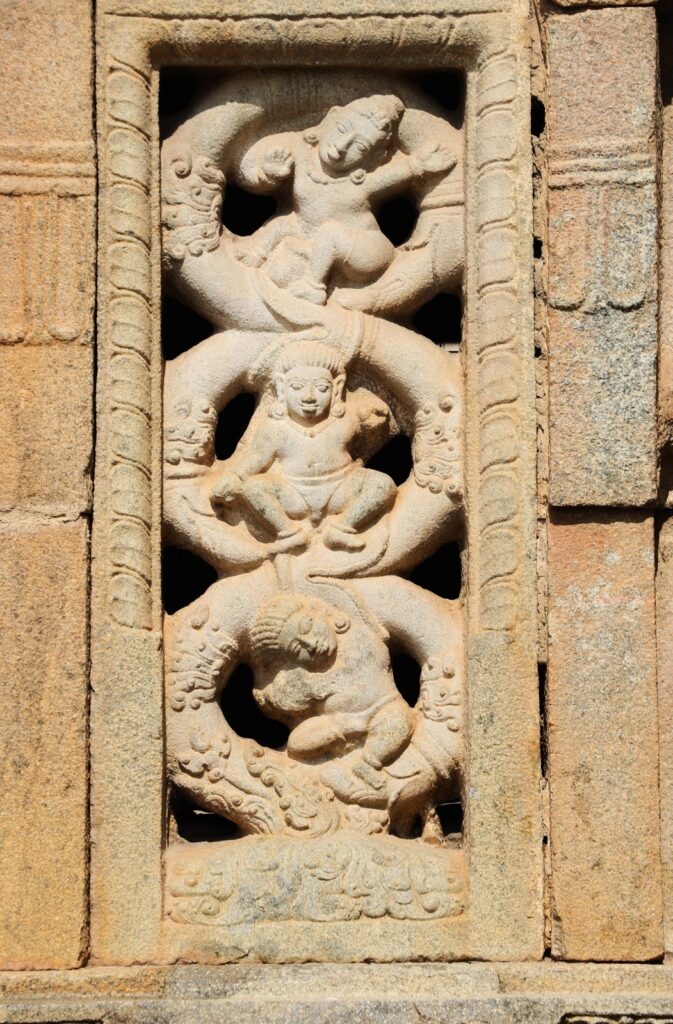
Perforated Stone Window – Jaali, Architecture highlight in Bhoganandishwara Temple
2. Acoustic Engineering in the Navaranga Hall
One architectural feature rarely discussed in temple guides: the acoustic properties of the Navaranga hall (nine-square hall). The pillared mandapa is designed to naturally amplify chanting and temple music without artificial amplification.
When there’s not much rush, the pujari performs a small aarti for every group of visitors who arrive. During one such aarti I attended in March 2023, the priest’s Sanskrit chants reverberated through the hall with remarkable clarity — no microphones, no electronic amplification, yet no echo distortion either. The sound was clear, full, and enveloping.
How It’s Achieved:
The hall essentially functions as a natural reverb chamber; hall dimensions follow ancient Shilpa Shastra proportions. Sound waves bounce off the polished granite surfaces at angles that reinforce rather than cancel each other, creating amplification without feedback. The dome focuses sound energy downward toward the congregation area, similar to how whispering galleries work in European cathedrals.
I’ve noticed similar acoustic design in Hampi’s Vittala Temple (the famous musical pillars that produce different notes when struck). Bhoganandishwara’s subtler application suggests the technique was widespread in Karnataka temple architecture, not just a Vijayanagara innovation. The difference is that Vittala Temple’s pillars are instruments; Bhoganandishwara’s hall is an auditorium.
Contemporary architects studying temple acoustics have found that these natural amplification systems outperform many modern concert halls in terms of clarity and even sound distribution. The knowledge seems to have been lost after the medieval period and is only now being rediscovered.
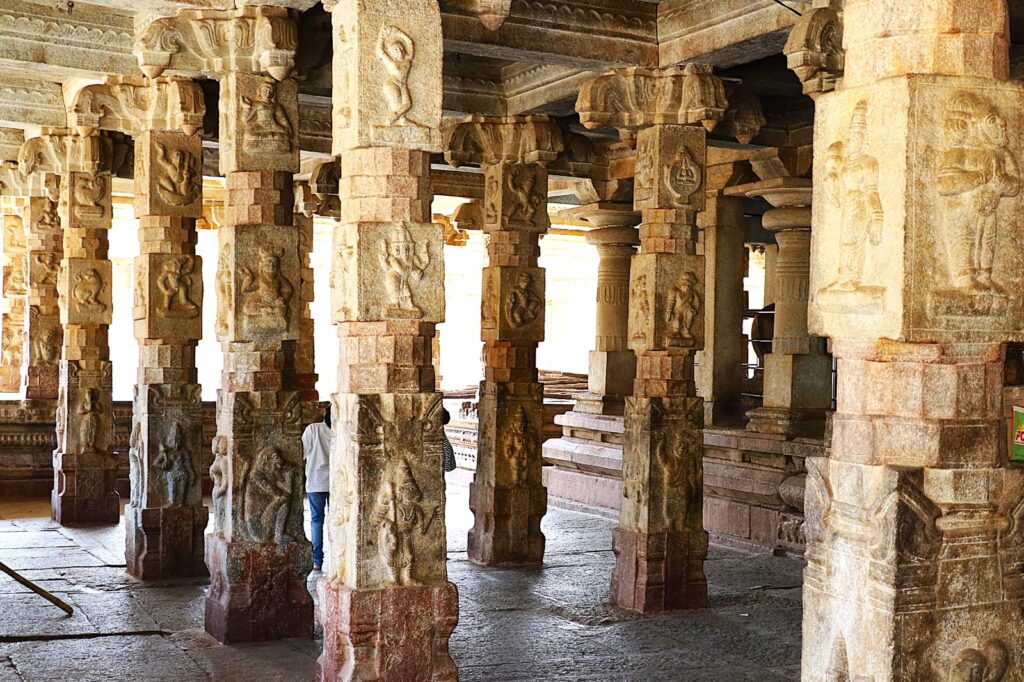
Pillared Mandapa in Hall
3. The Single-Stone Chatra (Umbrella): Defying Structural Logic
Among all architectural elements at Bhoganandishwara, the stone umbrella (chatra) carved from a single granite block remains the most technically astonishing. Here’s why it fascinates engineers:
Technical Challenge:
Granite is notoriously difficult to carve due to its hardness (6-7 on Mohs scale — harder than most steel tools).
Standing beneath it, zooming my camera into the carved details, I noticed the umbrella’s inner surface features symmetrical decorative patterns — lotuses, concentric circles, floral scrollwork. This raised a fascinating question: How did the sculptor work on it?
Did they:
- Carve it while lying on scaffolding beneath? (incredibly difficult, working against gravity)
- Carve it flat and then erect it? (but how to lift such weight without modern cranes?)
- Use a combination of rough carving flat, then detailed finishing in place?
The local guide I spoke with had no definitive answer, but mentioned that similar single-stone architectural elements (like monolithic pillars) were sometimes carved horizontally in quarries, then transported and erected using elephants, wooden rollers, and complex pulley systems.
The guide also mentioned that during the 2001 Bhuj earthquake (though he may have meant a different South Indian tremor, as Bhuj’s primary impact was in Gujarat), while some newer structures in Nandi village developed cracks, the chatra remained completely intact. This single-stone construction proved more earthquake-resistant than multi-piece assemblies.
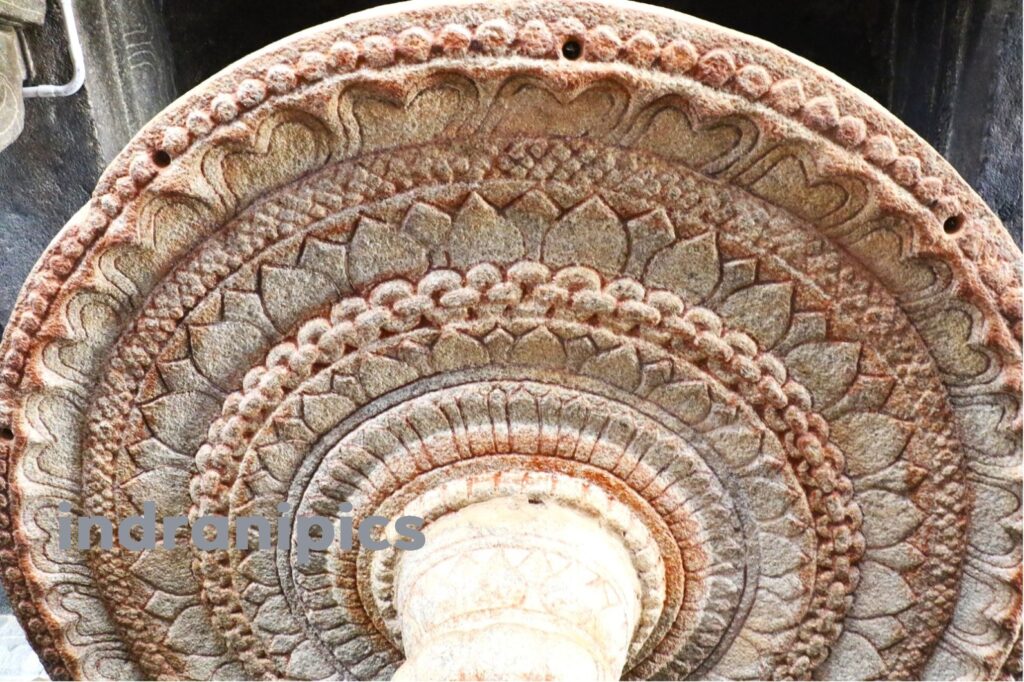
Intricate patterns on Granite Chatra in Bhoga Nandishwara Temple
Symbolic Architecture: Form Follows Meaning
4. Twin Nandi Mandapas: Architectural Symmetry with Ritual Purpose
The presence of two separate Nandi Mandapas (one for each main shrine — Bhoganandishwara and Arunachaleswara) is architecturally unusual. Most Shiva temples across India have a single Nandi facing the primary sanctum. Twin Nandi mandapas is rare and architecturally distinctive.
Do notice the mathematical accuracy: both Nandi sculptures are positioned at exact 90-degree angles to their respective garbhagrihas (inner sanctums), and the distance between each Nandi and its sanctum is identical.
Sculptural Mastery: The Bhoganandishwara Nandi, in particular, arrested my attention for a long time. Carved from a single block, it showcases life-like detailing:
- Muscular structure: Anatomically accurate bovine musculature
- Gentle curves: Soft, naturalistic forms (not rigid or stylized)
- Serene expression: The face conveys peaceful devotion
- Surface texture: Polished to a sheen that makes stone appear almost alive
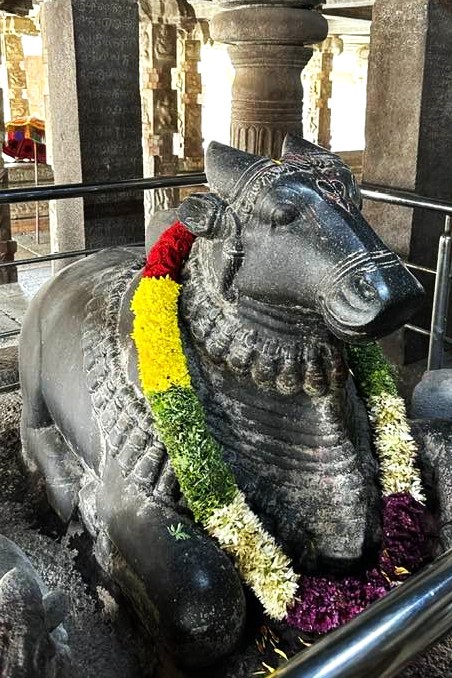
Nandi in front of Bhoganandishwara Shrine
5. The Kalyana Mantapa: Crown Jewel of Hoysala Artistry
Architectural Masterpiece of the Marriage Pavilion
Among all the architectural marvels at Bhoganandishwara, the Kalyana Mantapa (marriage pavilion) stands as the undisputed masterpiece. Built during the 12th to 13th century reign of the Hoysala dynasty, this pavilion transformed the complex into one of Karnataka’s finest examples of sculptural architecture.
The Lathe-Turned Pillars: Engineering Meets Art
The most striking architectural feature of the Kalyana Mantapa is its pillars — columns that appear to have been shaped on a giant lathe machine, despite being carved entirely by hand with chisels over a thousand years ago.
Comparative Context: Similar lathe-turned pillars appear in Belur’s Chennakeshava Temple and Halebidu’s Hoysaleswara Temple, but Bhoganandishwara’s examples are particularly well-preserved, with many still retaining their original polish after 800+ years.
Narrative Friezes: Stories in Stone
The walls and frieze panels of the Kalyana Mantapa tell visual stories, transforming the architectural space into a mythological narrative.
Divine Marriage Scenes:
- Shiva and Parvati wedding: Central theme, showing various stages of the divine marriage
- Ganesha’s birth: Story of how Parvati created Ganesha
- Kartikeya tales: Adventures of Shiva-Parvati’s second son
- Celestial witnesses: Gods and goddesses attending the divine wedding
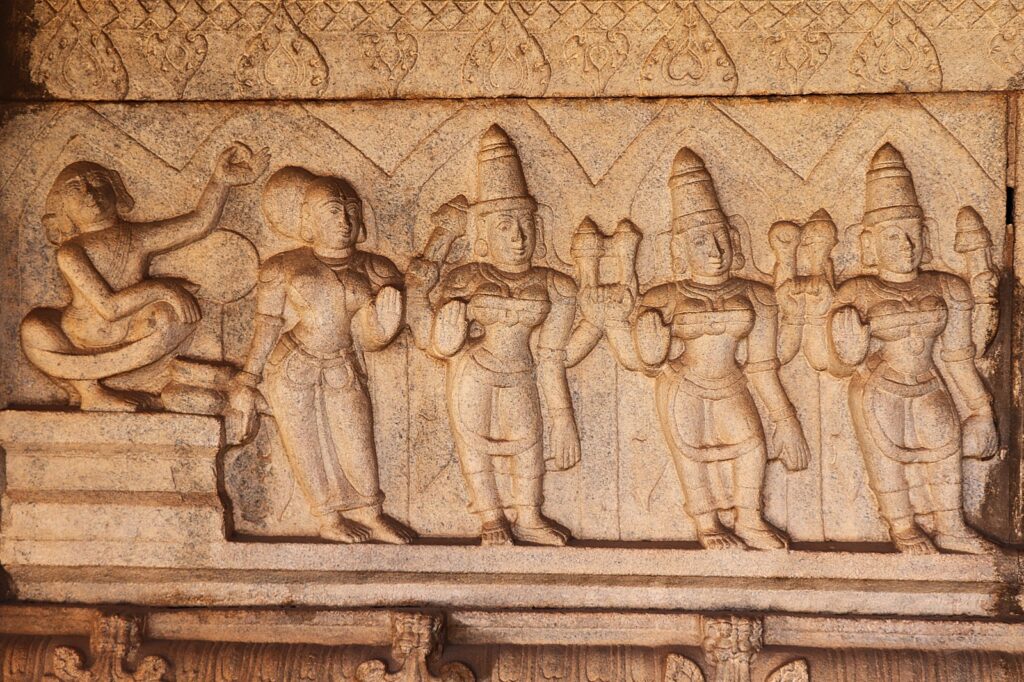
Narrative friezes on walls of shrines
Contemporary Use – Wedding Ceremonies:
- Local families occasionally book the pavilion for actual marriage ceremonies
- Couples believe marrying in this ancient space blessed by centuries of prayers brings auspiciousness
- Requires permission from temple authorities and ASI (limited availability)
- Must follow traditional rituals (no modern decorations that could damage structure)
My Privileged Observation:
During my March 2023 visit, I witnessed a homam (fire ritual) being conducted in the Kalyana Mantapa for a family’s special occasion. I ran my hand along one of these pillars, to feel the unbelievably smooth surface — almost slippery. The precision is such that if you close your eyes and trace the grooves, they feel machine-made.
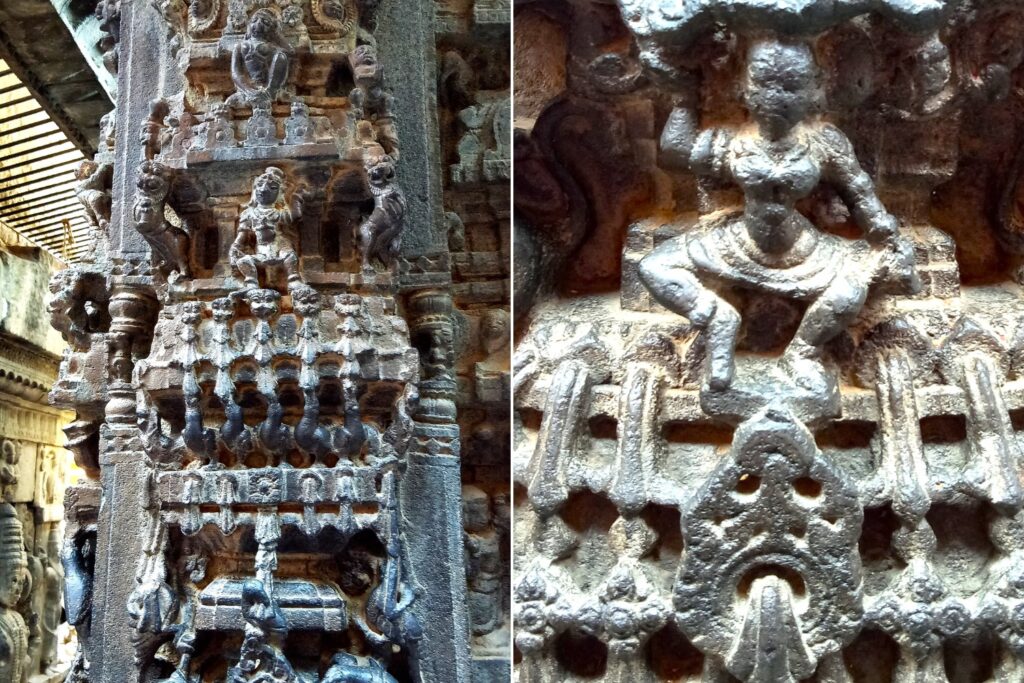
Carvings on Kalyana Mantapa
6. Shringi Teertha: Architecture Meets Hydrology
The sacred temple tank, Shringi Teertha, demonstrates ancient understanding of water management, ritual architecture, and hydraulic engineering that rivals Roman aqueducts in sophistication.
According to ASI documentation and local tradition, Shringi Teertha is believed to be the source of the South Pinakini (Ponnaiyar) River, named after Sage Shringi who performed penance here. Geologically, it’s likely a perennial spring fed by Nandi Hills’ underground aquifer system, which surfaces at this lower elevation.
Architectural Features of Temple Tank:
The temple tank, also known as Shringi Teertha, is a fine example of ancient engineering blended with sacred design.
- Its stepped ghats descend in tiers, allowing access to water at varying levels — the upper steps used in summer, middle for daily rituals, and the lower ones visible only during monsoon.
- Three sides of the tank are lined with pillared corridors, offering shade to devotees and framing the tank with elegant symmetry. These corridors also serve as pathways for ritual circumambulation.
- The tank’s overflow system is ingeniously planned — stone drains channel excess water to nearby fields, preventing flooding while ensuring nothing goes to waste.
- Beneath the surface, stone-lined walls and sand layers act as natural filters, keeping the water pure and minimizing seepage.
Together, these features make the temple tank not just a ritual space but a sustainable water system, centuries ahead of its time.
During my October 2025 visit (post-monsoon season), the tank was filled to the brim, submerging the lower steps entirely. The still water mirrored the temple’s vimanas perfectly — creating a “reflection mandala” that transforms the architecture into a doubled visual experience.
Ecological Aspect: The tank supports a complete aquatic ecosystem — turtle and fish (which I felt nibbling my feet when I sat on the steps in March 2023), aquatic plants, algae. This ecological integration shows that temples weren’t isolated monuments but connected to natural systems.
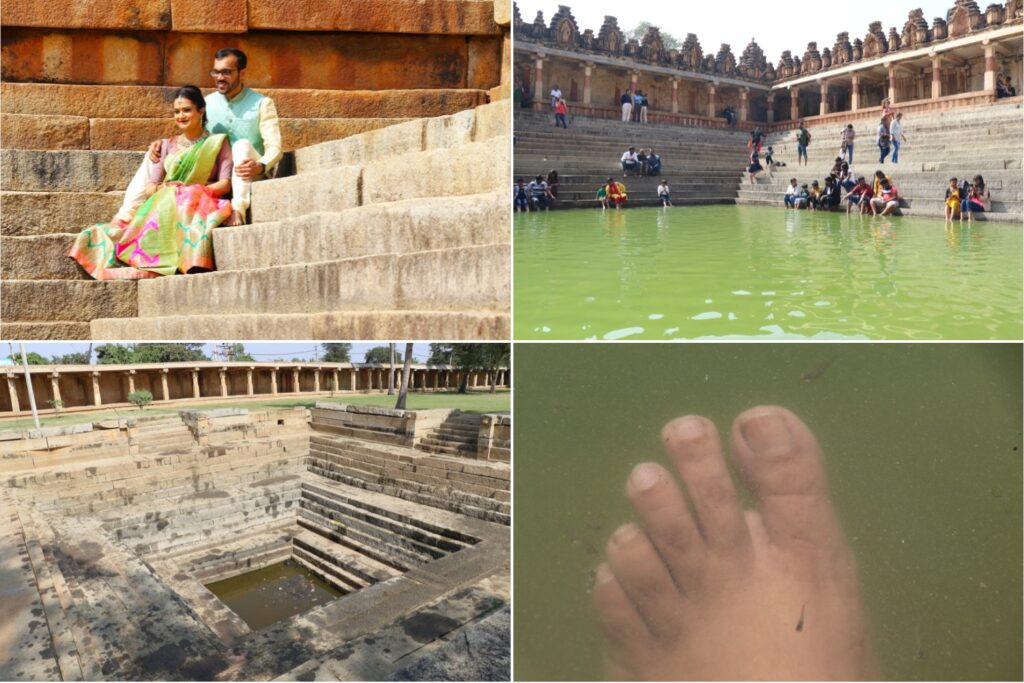
Pushkarini – Shringi Teertha – Bhoga Nandeeshwara Temple Tank
7. Rajendra Chola’s Sculpture: Political Iconography in Sacred Space
Inside the Bhoganandishwara shrine stands a sculpture of Rajendra Chola in meditative posture — a fascinating intersection of religious architecture and political iconography that reveals how temples functioned as both spiritual and political spaces.
Rajendra Chola I (ruled 1014-1044 CE) was one of the most powerful Chola emperors, known for military conquests reaching as far as the Ganges (earning him the title “Gangaikonda” — he who conquered the Ganges). His patronage of Bhoganandishwara Temple is documented through this sculpture and inscriptions.
The sculpture is modest compared to elaborate deity carvings — suggesting the Cholas maintained hierarchical proportion even in self-representation. The king is shown in humble, meditative posture (not triumphant or commanding), emphasizing his role as devotee rather than ruler.
The sculpture has survived remarkably well, with facial features, clothing folds, and posture clearly visible even 1,000 years later — testament to both granite’s durability and the temple’s protective interior environment.
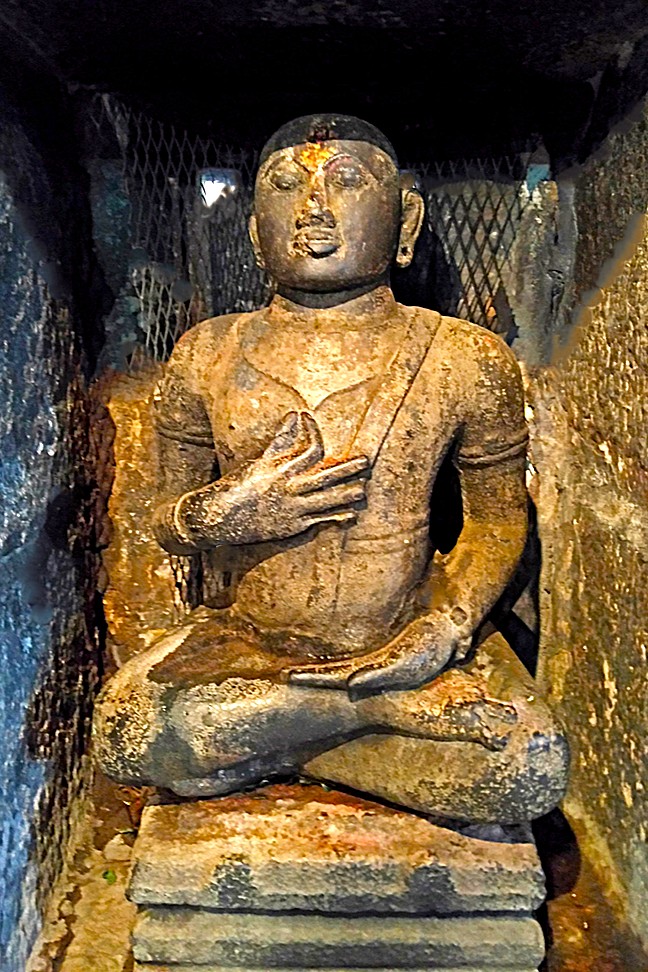
Statue of King Rajendrachola
Comparative Architectural Analysis
How Bhoganandishwara Ranks Among Karnataka’s Temples
While Belur/Halebidu excel in sculptural detail and Hampi dominates in scale, Bhoganandishwara offers the most complete architectural timeline and demonstrates exceptional engineering innovation. It’s the best “living laboratory” for studying how Dravidian architecture evolved across seven centuries.
Why It’s Underrated: Bhoganandishwara’s relative obscurity (compared to UNESCO sites) is primarily due to:
- Less accessible location (not on major tourist circuits)
- Minimal promotional investment
- Smaller scale (less “photogenic” for casual tourists)
- Academic/technical appeal (not immediately “Instagrammable”)
But for architecture students, engineers, and serious heritage enthusiasts, this “hidden gem” status is actually an advantage — you can study details without tourist crowds obstructing views or rushing your observation.
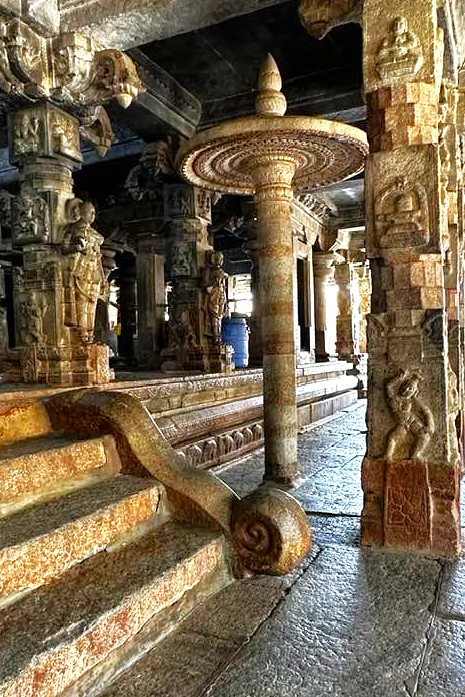
Architecture of Bhoganandishwara Temple spanning over 7 centuries
Architectural Conservation: What Visitors Should Know
The temple is maintained by the Archaeological Survey of India (ASI) under its Bengaluru Circle. During my visits, I noticed:
Well-preserved: Regular maintenance, minimal vandalism
Active worship: Temple rituals continue daily (unlike many ASI “museum temples”)
Weathering concerns: Some Hoysala-era soapstone carvings show surface erosion
Tourist infrastructure: Limited signage explaining architectural features
Visitor Recommendation: Hire a knowledgeable local guide (₹300-500 for 1-hour tour). The temple’s architectural nuances are easy to miss without expert context.
Photography Tips for Architecture Enthusiasts
Based on my visits, here are the best angles and times:
Best Light: 6.30 AM to 8 AM (soft golden light, long shadows highlighting relief carvings)
Drone Photography: Not permitted (ASI protected monument)
Tripod: Allowed in courtyards, not inside sanctums
Best Practices to be observed during your visit:
- Respectful Photography: Avoid flash in sanctums, don’t obstruct worship
- Hands Off: Don’t touch carvings (skin oils damage stone)
- Patience: Take time to observe; architectural understanding requires slow looking
- Multiple Angles: View each element from different positions/times
- Notes: Write observations immediately (easy to forget details later)
Why This Architectural Knowledge Enhances Your Visit
With architectural understanding, it becomes:
- Living textbook of 700-year Dravidian evolution
- Engineering marvel demonstrating passive cooling, acoustics, structural innovation
- Philosophical narrative expressed through spatial design
- Comparative context for understanding South Indian temple architecture broadly
- Full-day immersive experience that reveals new details with patient observation
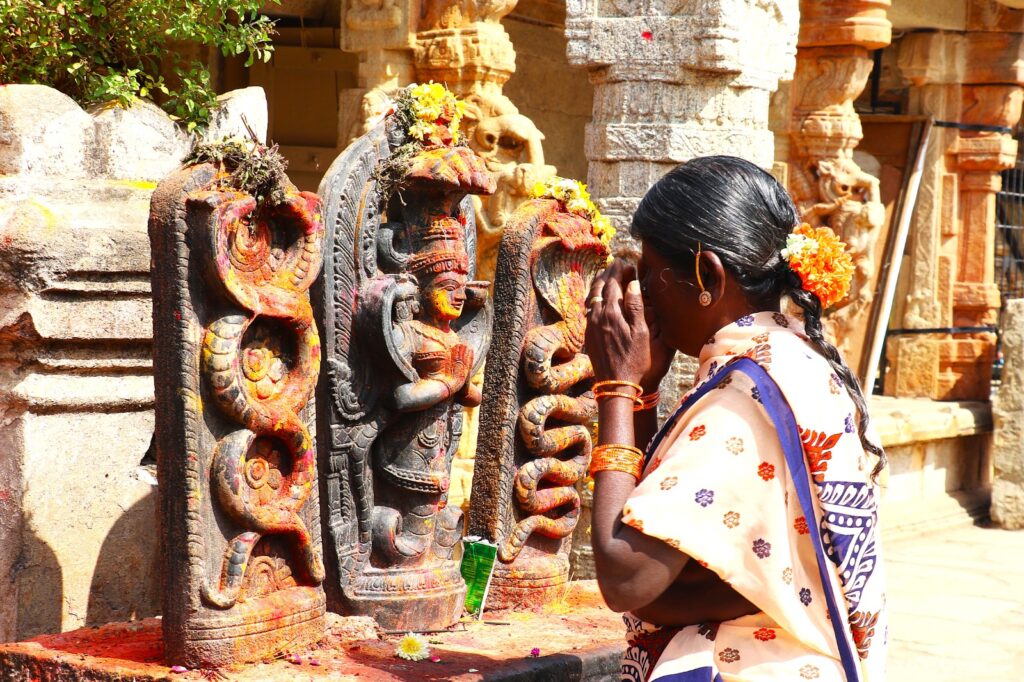
Tulasi Shrine – considered a manifestation of the Goddess Lakshmi
Architecture FAQ: Technical Questions Answered
Q. What makes Bhoganandishwara Temple’s Dravidian architecture unique?
The Bhoganandishwara Temple stands apart for its multi-dynasty evolution, reflecting over seven centuries of architectural refinement from the Nolambas to the Vijayanagara rulers. Its three shrines symbolizing Shiva’s life stages — youth, marriage, and renunciation — form a rare philosophical layout in Dravidian design. Add to that the temple’s passive cooling jalis, perfect acoustics, and the single-stone umbrella (chatra), and you get a structure that showcases not just artistry, but engineering genius.
Q. How did ancient builders achieve such precise acoustics without modern tools?
Temple acoustics were mastered through empirical observation and mathematical precision. Builders experimented with hall dimensions, pillar spacing, and dome curvature until they achieved natural sound clarity. These findings were later codified in the Shilpa Shastras. The halls often follow harmonic ratios (like 1:1.5:2), while the curved ceilings reflect and focus sound evenly. Using dense granite further amplified clarity.
Q. How do the jalis (perforated stone windows) cool the temple interiors?
The jalis act as natural air-conditioners. Their perforations filter sunlight, reducing heat gain by nearly 30%, while promoting cross-ventilation through the Venturi Effect, which keeps air moving even in still weather. The thick granite walls absorb and release heat slowly, maintaining interiors up to 3–5°C cooler than outside. Moisture from nearby temple tanks adds an evaporative cooling effect. Thermal imaging studies confirm these passive systems outperform many modern structures.
Q. Can these ancient design ideas inspire modern sustainable buildings?
Yes — and many architects already use them. Jali-inspired facades in contemporary buildings lower cooling loads by 30–40%. Temple-style thermal mass walls and water-harvesting tanks are being revived in eco-resorts and civic projects. Even concert halls borrow temple acoustics. The challenge lies in cost and craftsmanship, but hybrid designs now merge ancient wisdom with modern materials and simulation tools for sustainable architecture.
Q. Why is Nandi’s exact 90-degree alignment so important?
Nandi must face Lord Shiva directly, following Vastu Shastra principles and cosmic orientation. Ancient builders likely used shadow plotting, rope geometry, and star sightings to achieve a near-perfect east-west axis — modern surveys show deviations of barely 1–2 degrees. It’s faith, geometry, and science beautifully combined.
Q. Why did the Hoysalas use soapstone instead of granite?
The Hoysalas preferred soapstone (steatite), locally available near Hassan district, for its softness (Mohs hardness 1–2 vs. granite’s 6–7), which made it easier to carve intricate details like jewelry and drapery. The darker stone created a visual contrast with older granite structures, marking Hoysala artistry. Though less durable, soapstone was ideal for decorative elements, while granite remained the load-bearing material.
Q. How well is Bhoganandishwara Temple preserved compared to sites like Hampi?
Bhoganandishwara remains exceptionally well-preserved due to active worship, local community care, and low tourist impact. Covered halls protect carvings from weathering, and the ASI ensures regular maintenance. In contrast, Hampi’s open-air ruins, heavy tourist traffic, and historical damage have accelerated deterioration. Despite lacking UNESCO status, Bhoganandishwara’s carvings often survive in better condition than more famous heritage sites.

Architecture of Bhoganandishwara Temple
Conclusion
Personal Reflection
As someone who transitioned from engineering to travel writing, my regret about not studying architecture is most acute at sites like this. The mathematical precision hidden in “artistic” forms, the engineering intelligence embedded in “spiritual” structures, the scientific principles underlying “traditional” methods — Bhoganandishwara is where art, science, and faith converge seamlessly.
I suspect I could visit ten more times and still discover new architectural insights. That’s the mark of truly great architecture — inexhaustible complexity that rewards sustained attention.
Final Architectural Takeaway
The Bhoganandishwara Temple architecture proves that great design transcends time. Whether it’s the climate-responsive jalis, the acoustically optimized mandapa, or the philosophically arranged shrine layout, every element serves both aesthetic and functional purposes.
Standing in the central courtyard during my last visit, surrounded by structures built by five different dynasties over seven centuries, I realized: this temple isn’t just architecture — it’s a masterclass in adaptive design, where each generation honored the past while adding its own innovation.
Continue Your Bhoganandishwara Journey
Explore the Complete Series:
Start Here: Bhoganandishwara Temple: Complete Visitor Guide — Practical information, how to reach, timings, and temple overview (Perfect for first-time visitors planning their trip)
Historical Context: Tracing 1,000 Years: The Multi-Dynastic History — Understand how Nolamba, Chola, Ganga, Hoysala, and Vijayanagara dynasties each contributed to this architectural complexity.
Planning Your Visit? Complete FAQ: 16 Visitor Questions Answered — Comprehensive practical guide covering every aspect of your temple visit.
Are you an architecture enthusiast who’s visited Bhoganandishwara? What architectural elements impressed you most? Share your observations in the comments — I’d love to hear what other visitors noticed!
Pin and Share this for later
About the Author
 Indrani Ghose is a cultural travel writer and heritage documentation specialist with a unique perspective: she holds a degree in Electrical Engineering before transitioning to travel blogging — a background that brings both technical analytical skills and humanistic storytelling to her temple architecture writing.
Having visited and documented over 150 temples across India and Southeast Asia over 20 years, Indrani combines scholarly research with personal narrative. Her work has been published in Lonely Planet, The National (UAE), Whetstone Asia, Deccan Herald, and architecture journals.
Her engineering background allows her to analyze structural systems, acoustic properties, and passive environmental controls that many travel writers overlook. Yet her storytelling keeps technical content accessible to general readers.
This architectural analysis of Bhoganandishwara Temple draws from two site visits (March 2023, October 2025), consultations with ASI conservation officers, interviews with local guides, and comparative study of contemporary temples across Karnataka and Tamil Nadu.
Connect with Indrani: Follow Indrani on Instagram | Twitter | Facebook for heritage travel insights, photography tips, and offbeat destination discoveries.
Keywords: Bhoganandishwara Temple architecture, Dravidian temple design, passive cooling ancient architecture, temple acoustic engineering, Hoysala soapstone carvings, Karnataka temple engineering, single-stone chatra, jali perforation systems, multi-dynasty temple architecture, South Indian architectural marvels
Last Updated: October 2025