Lakshmi Narasimha Temple Javagal: A 13th-Century Hoysala Masterpiece Near Chikmagalur
The Forgotten Trikuta of Javagal
Just 12 km from Halebidu, in the unassuming village of Javagal, stands a temple that most travelers to Karnataka never see. The Lakshmi Narasimha Temple is a 13th-century Hoysala monument that rivals its famous neighbors in craftsmanship—yet remains remarkably quiet, even during peak tourist season.
I visited on a weekday morning and had the entire complex to myself. The temple follows the trikuta design, with three sanctums dedicated to Lakshmi Narasimha, Venugopala, and Lakshmi Narayana. What makes it architecturally significant is the work of Mallitamma, a celebrated Hoysala sculptor whose carvings also appear at Doddagaddavalli and Belavadi.
For those planning a road trip from Bangalore to Chikmagalur, Javagal is an easy 15-minute detour off NH 75. It’s also ideal as part of a hidden Hoysala circuit combining lesser-known temples in Hassan district.
– By Indrani Ghose | Last Updated: January 2026

Javagal Lakshmi Narasimha Temple Complex
Quick Facts about Lakshmi Narasimha Temple Javagal
| Attribute | Details |
| Location | Javagal village, Hassan district, Karnataka |
| Distance from Chikmagalur | ~35 km (45 min drive) |
| Distance from Halebidu | ~12 km (20 min drive) |
| Period | 13th century, Hoysala dynasty |
| Temple Style | Trikuta (three sanctums on a star-shaped platform) |
| Presiding Deities | Lakshmi Narasimha, Venugopala, Lakshmi Narayana |
| Notable Sculptor | Mallitamma (also worked on Belavadi and Doddagaddavalli temples) |
| Key Features | Star-shaped platform, ornate friezes, lathe-turned pillars |
| Best Time to Visit | October to March |
| Nearby Temples | Belavadi (18 km), Doddagaddavalli (22 km), Halebidu (12 km) |
| Ideal For | Heritage enthusiasts, architecture lovers, offbeat travelers |
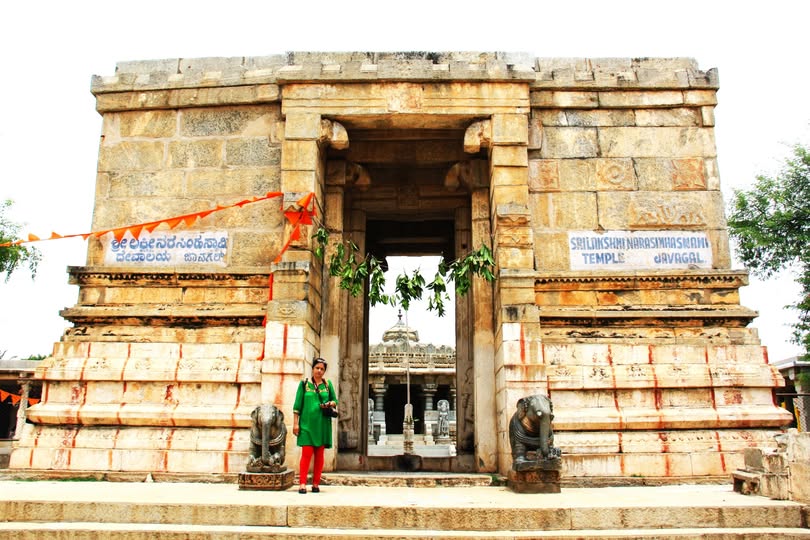
Entrance of the Sri Lakshmi Narasimha Swami Temple
Historical Significance: King Vira Someshwara’s Legacy
The Lakshmi Narasimha Temple at Javagal was built around 1250 AD during the reign of King Vira Someshwara, when the Hoysala dynasty was producing some of its finest architectural work.
Someshwara ruled during a period of relative stability, which allowed him to invest in temple construction across southern Karnataka—not just as religious monuments, but as displays of political power and artistic achievement.
Inscriptions and stylistic analysis link Mallitamma – one of the most skilled sculptors of the Hoysala period, to this temple, as well as to the more famous sites at Doddagaddavalli and Belavadi. His work is recognizable: precise detailing, well-proportioned figures, and narrative panels that are easy to read even after 750 years.
While temples like Belur and Halebidu attracted royal attention and large crowds, Javagal served a smaller, local community. It never became a pilgrimage center, which is likely why it remains so well-preserved and peaceful today.
For travelers interested in Karnataka’s temple heritage beyond the standard circuit, Javagal offers direct access to Someshwara’s architectural legacy and Mallitamma’s craftsmanship—without the tour buses.

Main Entrance: The complex is huge but not so well looked after like the temples in Belavadi and Doddagaddavalli. Sadly the temple doesn’t come under protection of Archaeological Society of India (ASI), hence the neglect!
Architecture of Javagal Lakshmi Narasimha Temple
The Lakshmi Narasimha Temple follows the trikuta layout—three separate sanctums sharing a common hall. Each shrine houses a different deity:
- Lakshmi Narasimha (Vishnu in his man-lion form)
- Venugopala (Krishna as a cowherd)
- Lakshmi Narayana (Vishnu with his consort)
This triple-shrine design was popular in 13th-century Hoysala architecture and allowed multiple forms of worship within a single complex. We saw each of the idols laden with several garlands of colorful flowers.
The temple sits on a raised jagati, or platform, which is characteristic of Hoysala temples in Karnataka. This platform serves two purposes: it elevates the temple visually, adding to its presence, and it provides a walkway for pradakshina (ritual circumambulation). At Javagal, the jagati is star-shaped, creating projections and recesses along the outer walls that catch light at different angles throughout the day.
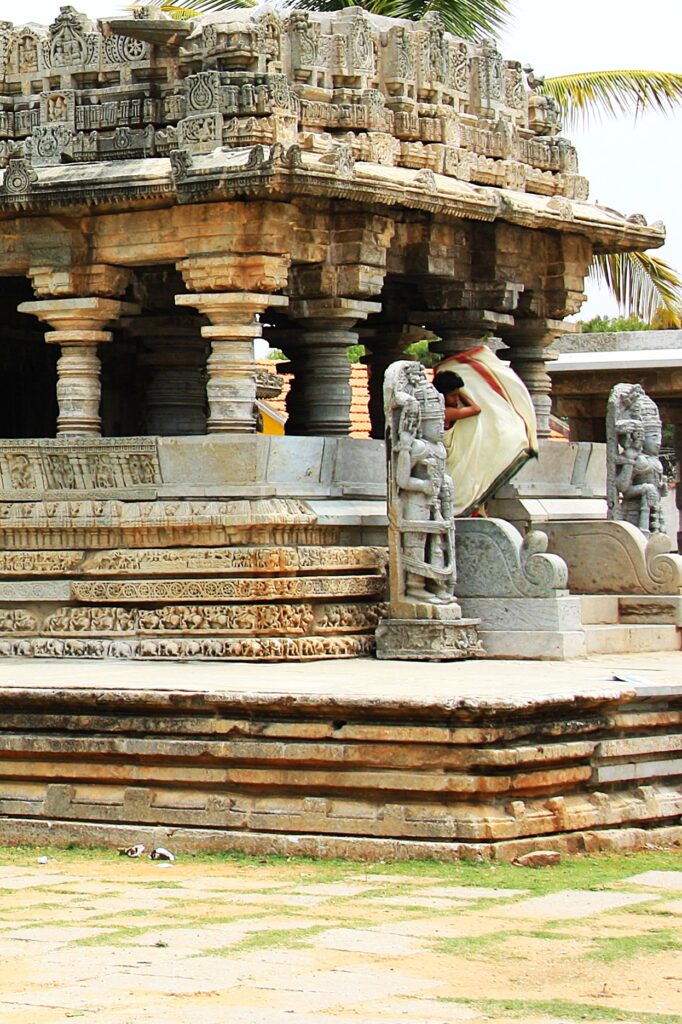
Raised Jagati of the Temple
Inside, the navaranga (central hall) features lathe-turned pillars—cylindrical columns that were shaped on a lathe and polished smooth. These pillars are simpler than the heavily carved ones at Halebidu, but they reflect the same technical skill.
The ceiling above is decorated with floral and geometric patterns, while the sanctum interiors remain relatively plain, focusing attention on the deity images.
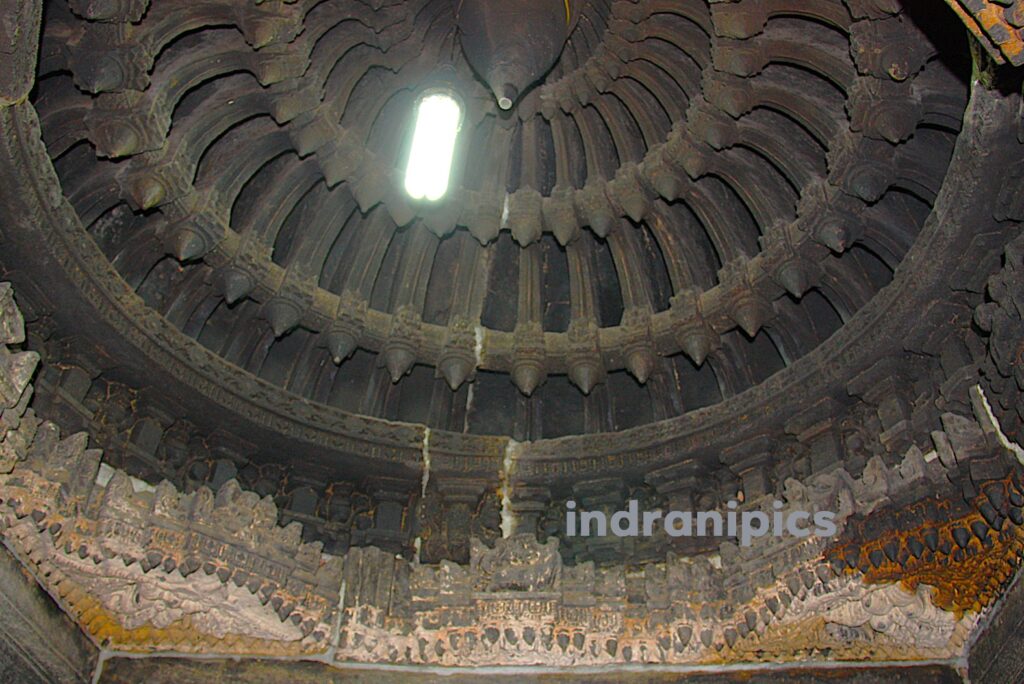
Ceiling details inside the shrine Javagal
What I found most striking about Javagal is its scale. It’s a compact temple—nothing sprawling or overwhelming—but the attention to detail is consistent across every surface.
For travelers interested in Hoysala architecture near Chikmagalur, Javagal offers a concise yet profound introduction to the dynasty’s design principles, making it a rewarding stop on an offbeat day trip.

Main Idol in temple: When we reached there the temple pujari, a young boy of 19 years was closing the temple for noon. Seeing us he readily opened the doors and helped us offer our prayers there.
The Exquisite Sculptures of the Outer Walls
The outer walls of the Lakshmi Narasimha Temple are covered with approximately 140 sculptural panels, each carved in high relief. The main theme is the 24 forms of Vishnu, a devotional concept that depicts the deity in different incarnations and cosmic roles. These include well-known avatars like Narasimha (man-lion), Vamana (dwarf), and Krishna, as well as lesser-known forms that emphasize Vishnu’s protective and sustaining functions.
Each panel is remarkably detailed. Ornaments, weapons, hand gestures (mudras), and facial expressions are all clearly defined, even on figures no larger than a foot tall. The sculptures are arranged in horizontal bands, following the typical Hoysala structure: elephants at the base (symbolizing stability), horses above them (representing movement), and then the primary deity panels, topped by decorative scrollwork.

140 panels include the Chaturvimsati Murtis
Beyond Vishnu, you’ll also find scenes from the Ramayana and Mahabharata, as well as depictions of celestial dancers, mythical animals, and floral motifs. The storytelling is clear and sequential, making it easy to follow even without a guide.
Mallitamma, the sculptor credited with much of this work, is known for his balanced compositions and narrative clarity. His carvings don’t overwhelm—they invite you to step closer and look carefully. That’s the difference between Javagal and Halebidu: here, the scale is human, and the sculptures feel accessible rather than monumental.
For heritage travelers, these carvings are not just art—they are a visual textbook of Hoysala iconography. Standing before them, you witness how devotion, storytelling, and craftsmanship converge, making Javagal a true hidden gem in Hassan Karnataka.
The base has 6 rectangular moldings of equal width
- Starting from the top, the friezes depict; hansa (birds) in the first frieze,
- makara (aquatic monsters) in the second, epics and other stories
- in the third (usually from the Hindu epic Ramayana, the Mahabharata, and stories of Krishna),
- leafy scrolls in the fourth,
- horses in the fifth
- and elephants in the sixth (bottom frieze).
Most impressive of all sights in the exteriors is how the friezes go all along the temple circumference… it is like the characters of the friezes are following the one ahead in a disciplined manner!

Lakshmi Narasimha Temple Javagal Hoysala Architecture Details

6 layers of sculpted details
Why Javagal is the Perfect Stop on a Bangalore to Chikmagalur Trip
Most travelers on the Bangalore to Chikmagalur route stick to NH 75 and drive straight through, stopping only for fuel or meals. But if you’re willing to take a short detour, you can visit three exceptional Hoysala temples that most tourists never see.
I’ve covered Belavadi and Doddagaddavalli in separate posts, and Javagal completes what I call the “Hidden Hoysala Circuit.” Here’s how they differ: Belavadi’s Veeranarayana Temple is large and symmetrical, with triple towers and impressive scale.
Doddagaddavalli, built in the early 12th century, is older and sits beside a peaceful lake. Javagal falls between them chronologically and stylistically—it’s compact, intricately carved, and associated with the sculptor Mallitamma, whose work appears at all three sites.

Lakshmi Devi Idol in temple
The three temples are within 20–25 km of each other, making them easy to visit in a single morning. Javagal is just 12 km from Halebidu, so if you’re already planning to stop there, adding Javagal takes less than 30 minutes.
This route works particularly well for travelers interested in Hoysala architecture near Chikmagalur who want more than the standard Belur-Halebidu combination. The temples are quieter, better preserved, and give you a deeper sense of how Hoysala architecture evolved across a century.
How to Reach Javagal: Road Trip Routes and Tips
Javagal is located in Hassan district, approximately 220 km from Bangalore via NH 75. The temple is 12 km from Halebidu, 35 km from Chikmagalur, and about 18 km from Belavadi.
Recommended route from Bangalore:
Bangalore → Hassan (via NH 75, ~180 km) → Halebidu (25 km) → Javagal (12 km) → Belavadi (18 km) → Chikmagalur (35 km)
The roads are well-maintained on the highway, though the final approach to Javagal involves rural roads that can be narrower and slower. Google Maps works reliably for navigation.
Practical tips:
- Leave Bangalore by 6:30–7:00 AM to reach Javagal by mid-morning with good light for photography
- There are no restaurants or cafes near the temple—carry snacks and water
- Halebidu has basic facilities (restrooms, small eateries), so plan your break there
- If visiting all three temples (Javagal, Belavadi, Doddagaddavalli), allow 3–4 hours total including travel time
This makes Javagal an easy addition to any Bangalore to Chikmagalur road trip, especially for heritage-focused travelers.

Lakshmi Temple in the complex
Essential Travel Information (Timings, Entry, & More)
Here’s what you need to know before visiting the Lakshmi Narasimha Temple Javagal:
- Opening Hours: 6 AM – 6 PM (daily; temple may close briefly for afternoon prayers)
- Entry Fee: Free (maintained by ASI)
- Photography: Allowed; no flash inside sanctums
- Best Time to Visit: October to March for comfortable weather; early morning (7–9 AM) for soft light and fewer visitors
- Time Needed: 30–45 minutes for a thorough visit
- Facilities: No restrooms or food stalls on-site; nearest facilities at Halebidu (12 km)
- Nearby Temples: Halebidu (12 km), Belavadi (18 km), Doddagaddavalli (22 km)
Bring water, sunscreen, and a hat if visiting between 10 AM and 3 PM.
Other things to do in Javagal City
Besides this architectural showpiece of the town, the Lakshmi Narasimha temple, Javagal has a dargah (mosque). It is known by the name: Dargah Hazrat Khalandar Shah Qadri, Javagal Shareef. It is located at National Highway 234, Javagal, Karnataka 573125, India.
If you love seeing houses of celebrities then don’t miss Javagal Srinath’s uncle’s home where he spent some holidays in his childhood. Srinath was raised in Mysore, his uncle’s house still exists in the village and villagers will happily point it out.
Tourist attractions near Javagal are:
- Hill station and coffee estates of Chikkamagaluru
- Temple town of Melukote famous for its Iyengars and puliyogare
- Jain pilgrimage site of Shravanabelagola that is home to the mighty Bahubali statue
- Bhadra tiger reserve that is known for river terns, tigers and leopards
Places to Stay
Basic budget accommodation can be found at Belur and Halebid. A luxurious stay option is Hoysala Village resort that is located between Belur and Hassan. There are plenty of plantation stays and resorts located in and around Chikkamagalur.

Lord Indra on Airavat Elephant
FAQ on Lakshmi Narasimha Temple Javagal
Q1. Who built Javagal temple?
The Lakshmi Narasimha Temple Javagal was commissioned by King Vira Someshwara of the Hoysala dynasty around 1250 AD. The temple’s exquisite carvings are attributed to the master sculptor Mallitamma, whose work is seen across several Hoysala sites.
Q2. Is Javagal Srinath from here?
Yes. Javagal is the native village of former Indian cricketer Javagal Srinath, one of India’s finest fast bowlers. The temple and the village often draw curiosity because of this connection.
Q3. Best time to visit?
The ideal time to visit Javagal is between October and March, when the weather is pleasant for exploring heritage sites. Summers can be hot, and monsoons may make rural roads less convenient for travel.
Q4. Is Javagal Lakshmi Narasimha Temple crowded like Belur or Halebidu?
No, it remains relatively quiet and offbeat, perfect for travelers seeking solitude and authentic heritage experiences.
Q5. What makes Javagal unique compared to other Hoysala temples?
Its trikuta layout, compact scale, and the detailed 140 sculptural panels make it distinctive among Hoysala shrines.
Q6. Are guides available at the temple?
Local caretakers may share basic information, but detailed guidance is limited. It’s best to read up beforehand or use heritage blogs for context.
Q7. Can Javagal be covered in a day trip from Chikmagalur?
Yes. Javagal, along with Belavadi and Doddagaddavalli, forms a perfect day circuit from Chikmagalur, combining heritage and countryside charm.

Each figure has a story to tell
Final Thoughts
The Lakshmi Narasimha Temple at Javagal won’t overwhelm you the way Halebidu does, but that’s precisely its strength. It’s quieter, more intimate, and easier to absorb. For travelers interested in Hoysala architecture near Chikmagalur—or anyone planning a Bangalore to Chikmagalur road trip—Javagal completes a rewarding triangle with Belavadi and Doddagaddavalli.
These three temples form what I consider the Hidden Hoysala Circuit: less famous, better preserved, and far more peaceful than the crowded sites. If you’re looking for hidden gems in Hassan Karnataka that offer genuine insight into 13th-century sculpture and temple design, Javagal deserves a spot on your itinerary.
Pin this for later…

About the Author
 Indrani Ghose is a cultural travel writer and heritage documentation specialist with over 15 years of experience exploring and writing about temples across India and Southeast Asia. Having visited over 150 sacred sites, she brings both scholarly depth and personal narrative to heritage travel writing.
Her work has been published in Lonely Planet, The National (UAE), Whetstone Asia, Deccan Herald, and various architecture and heritage journals.
Connect with Indrani: Follow Indrani on Instagram | Twitter | Facebook for heritage travel insights, photography tips, and offbeat destination discoveries.







Thanks for Sharing details about Indian culture, temple, Nature.
Lovely. I will definitely visit this place and temple when I take a trip to south. I haven’t explored Karnataka much yet.
Thank you for sharing these images of such a beautiful, ancient sacred site. I’ll never make it there but I feel I have.
looks like an awesome place, this type of architectural works always attracts me a lot, pic very nicely taken.
The architecture and details are just beautiful!! The last picture shows how magnificient the temple is. To be honest, had no idea Javagal was a village until I read about it here. Great post Indrani 🙂
I also know the temple town only through Javagal Srinath..and now so much info on the beautifully carved temples..Halebid is such a marvel ..
Its a new information for me that Javagal Srinath’s first name is derived from his native place . Amazing . I know that most of the Hindu names in Karnataka are starts with their native place as Hardanhalli of H.D.Devegodda. what a beautiful and intricate structure is exist in these temples.
Amazing architecture… some great sculptures, I wish to take my Grandma here :’)
Those well carvings are gorgeous. They remind me of the ones I have seen at Angkor Wat. I love the colorful garlands, too. Thanks for linking up this week! #TPThursday
Beautiful temple. The sculptures have been carved to perfection. I have always admired sculptors. The patience required is immense!
Wish we had visited this place too!
Great detailed write up.
Interesting History about Javagal. Prompted me to google it up ha 😀
Great read and love the temple pictures.
wow! so delicate are the carvings that i think will be quite difficult to to be done nowadays
Lakshmi Narasimhar is a warrior. People, in this part of TN, will pray him just to destroy their enemies.
Like the pictures
What an incredible architechture !! One gets awestruck by the magnificence of the sculptures . How many years the artisans must have worked to produce such gems out of rocks ,it is unimaginable !
Surely after reading this article this place will not only remember for cricket but also for masterpiece artwork and the hard work behind that.
The temple is truly magnificent, beautiful carvings and amazing architecture….but yea it is difficult to take out cricket from India. Javagal gets you Srinath’s name as top of the mind recall. Sunil Gavaskar and Srinath made an awesome opening pair 🙂
To be honest, when I read the title, I instantly remembered ‘Javagal Srinath’, but I agree with you, we should remember it for the beautiful temple it has.
Thanks for the detailed description, Indrani. Apart from the shots of the brilliant architecture of the temple, I really liked the close up shot of the idol. Hope to visit this temple soon.
The temples are awesome with all the ornate detailing. I cannot get enough of them.
I think is the most detailed temple you have shown. I wonder how long it took to complete the works and how many people participated.
Incredible photos! Fun to learn about the meaning behind the carvings as well as see so many wonderful details.
Wonderful tour of the temple. Thanks for sharing your visit. Great series of photos. Happy Wednesday, I hope you have a great day!
Wow, wonderful impressions of this special temple. I like the sculptures in stone.
Best regards, Synnöve