Veeranarayana Temple Belavadi: A 2026 Guide to the Hoysala Marvel
Most travelers rushing between Bangalore and Chikmagalur miss one of Karnataka’s finest Hoysala temples. The Veeranarayana Temple at Belavadi deserves better—this 13th-century architectural marvel rivals the famous Halebidu complex but sees a fraction of the crowds.
I discovered Belavadi in May 2016 during a dedicated Hoysala temple road trip from Bangalore. After visiting the Lakshmi Narasimha temple at Javagal and Lakshmi Devi temple at Doddagaddavalli, I reached Belavadi by late afternoon. The difference was immediate—while those temples impressed with their carvings, Belavadi commanded attention through sheer scale and symmetry.
The temple’s trikuta (three-shrine) design houses what many consider India’s most beautiful Krishna idol: the Venugopala sculpture. Standing beneath the expansive mandapa, surrounded by ornate lathe-turned pillars and intricate stone friezes, I understood why this offbeat Hoysala temple near Chikmagalur belongs on every heritage enthusiast’s itinerary.
For travelers seeking authenticity over tourist circuits, Belavadi delivers.
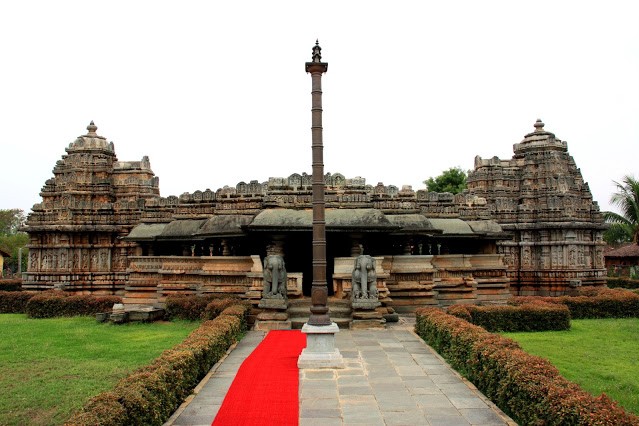
Veeranarayana Temple Belavadi entrance
Quick Facts: Planning Your Visit to Belavadi
| Feature | Details |
| Primary Deity | Sri Veeranarayana (Lord Vishnu) |
| Architectural Style | Hoysala (Trikutachala – Three Shrines) |
| Location | Belavadi Village, Chikkamagaluru District, Karnataka |
| Built | 13th century, by Hoysala king Veera Ballala II |
| Temple Timings | 8 AM – 2 PM and 4 PM – 7.30 PM |
| Entry Fee | Free (Parking is usually available nearby) |
| Best Time to Visit | October to March (or March 23 for the Solar Phenomenon) |
| Photography | Allowed in the outer complex; restricted inside the sanctum |
| Road Trip Tip | Ideal stop on Bangalore–Chikmagalur Hoysala circuit |
| Nearby Attractions | Halebidu, Doddagaddavalli, Javagal temples |
| Distance from Bangalore | Approximately 250 km (via NH75) |
The Legend of Ekachakranagara: History and Mythology
Belavadi carries a double identity that makes it unique among Hoysala temples—it’s both a documented historical site and a mythological landmark from the Mahabharata.
The Mahabharata Connection
Local tradition identifies Belavadi with Ekachakranagara, the town where the Pandavas spent part of their forest exile in disguise. According to the epic, a demon named Bakasura terrorized residents here, demanding regular human sacrifices.
Bheema eventually confronted and killed Bakasura, freeing the villagers. This connection isn’t just folklore—residents maintain the oral tradition with pride, and the village’s original name was reportedly Ekachakra before becoming Belavadi.
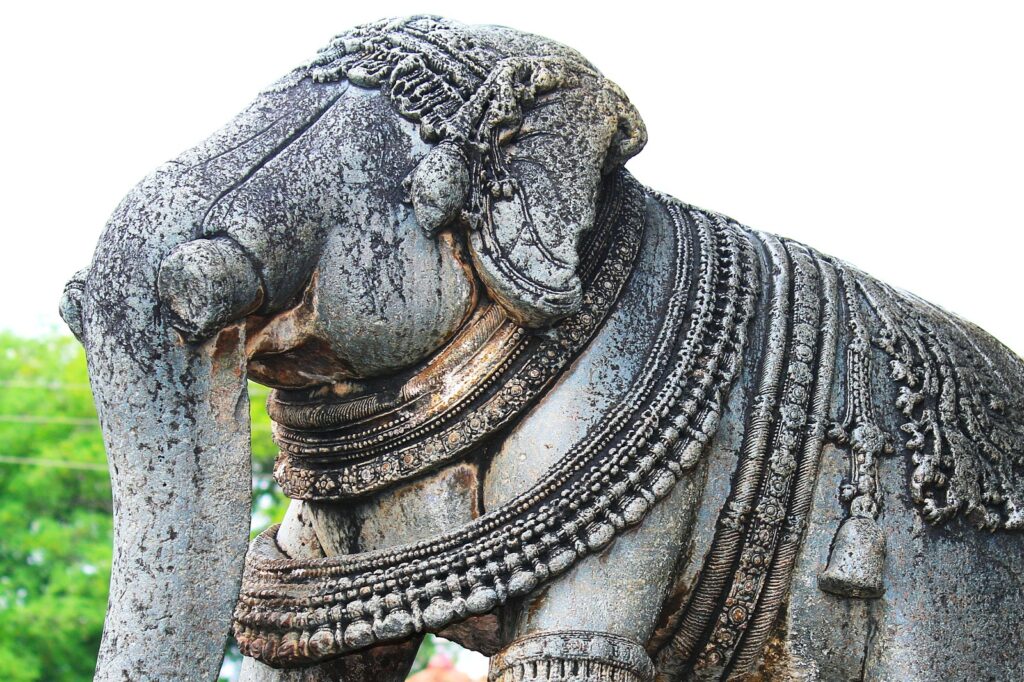
Statue of elephant with ornaments at entrance
The Hoysala Legacy
Historically, King Veera Ballala II commissioned Veeranarayana Temple around 1200 CE during the Hoysala dynasty’s architectural golden age. This is one of the largest Hoysala temple built in those times. Historians claim that King Ballala II’s conquests had made the Hoysalas the most powerful dynasty of the Deccan.
Historian William Coelho in comparing Ballala II to King Vishnuvardhana writes, “He vied in glory with his grandfather“. King Veera Ballala II constructed the beautiful Amrutheshwara Temple.
The trikuta design represents Vaishnava devotion through three manifestations:
- Narayana (Vishnu in regal form)
- Venugopala (Krishna as cowherd)
- Yoga Narasimha (Vishnu’s meditative aspect)
The central Venugopala idol is what sets Belavadi apart from other Hoysala temples. Art historians and devotees alike recognize this Krishna sculpture—depicting the deity playing the flute—as possibly the finest representation in India. The proportions, facial expression, and delicate detailing demonstrate the peak of 13th-century Indian sculpture.
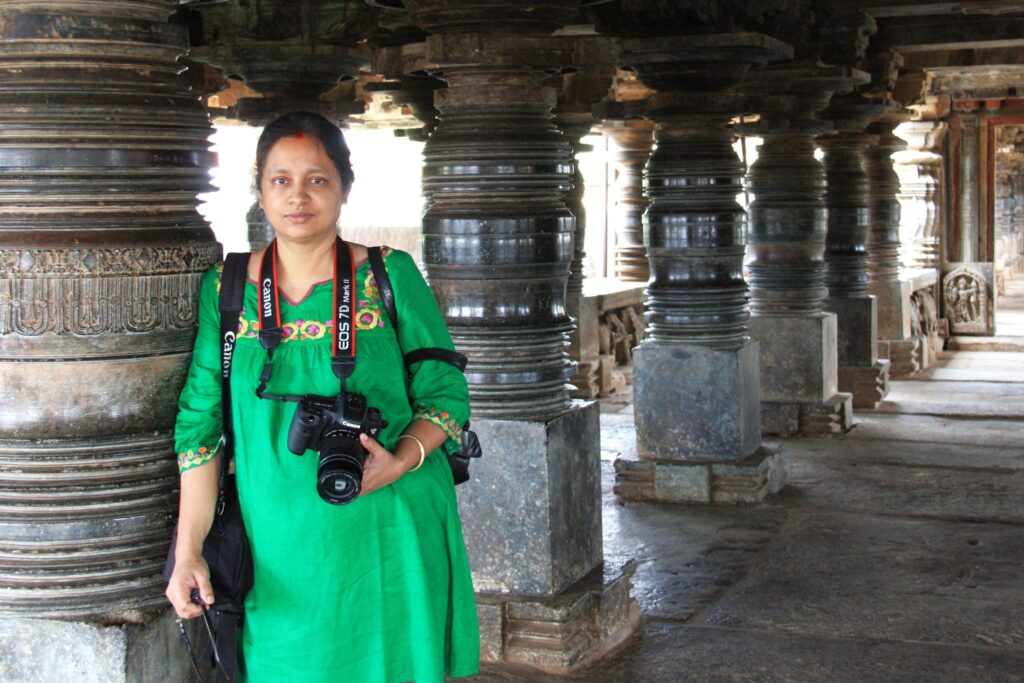
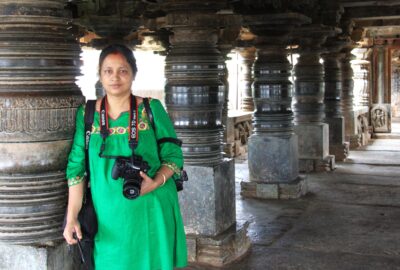
Forest of Lathe Turned polished soapstone pillars Belavadi Temple
Why Both Narratives Matter
The difference between Belavadi and Halebidu architecture lies partly in this dual heritage. While Halebidu focused purely on visual spectacle, Belavadi integrates mythological significance with architectural ambition.
During my visit, I noticed local priests still actively worship here, unlike some monument-only temples. The villagers’ connection to the Pandava story keeps Belavadi culturally alive rather than frozen as a historical artifact.
For visitors on a Hoysala temple road trip from Bangalore to Chikmagalur, this layered history—stone records meeting epic poetry—makes Belavadi more than just another architectural stop.
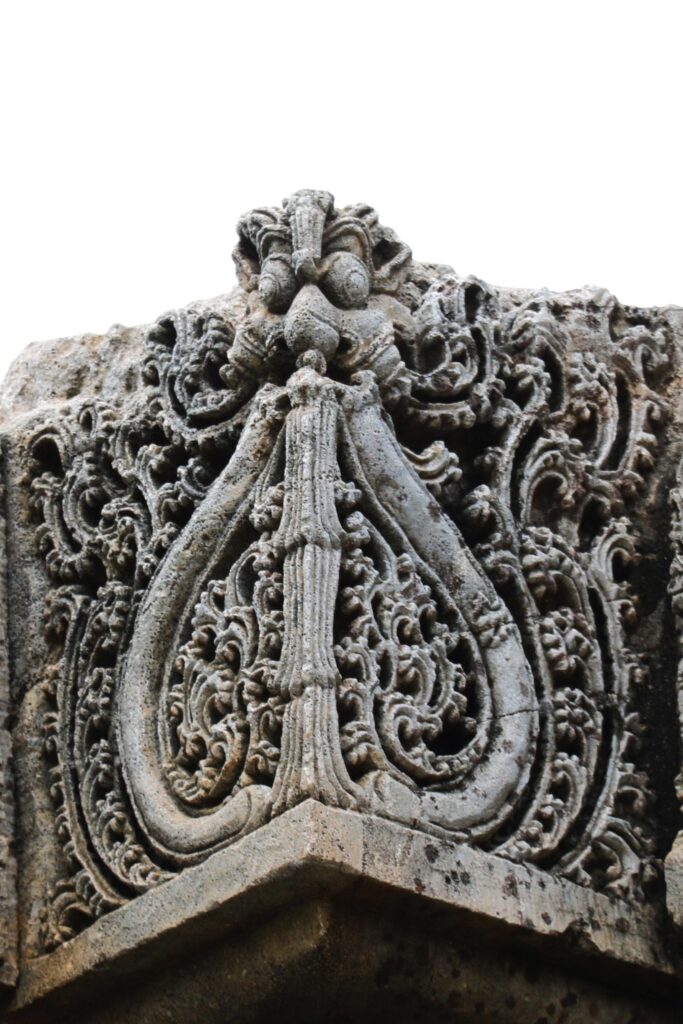
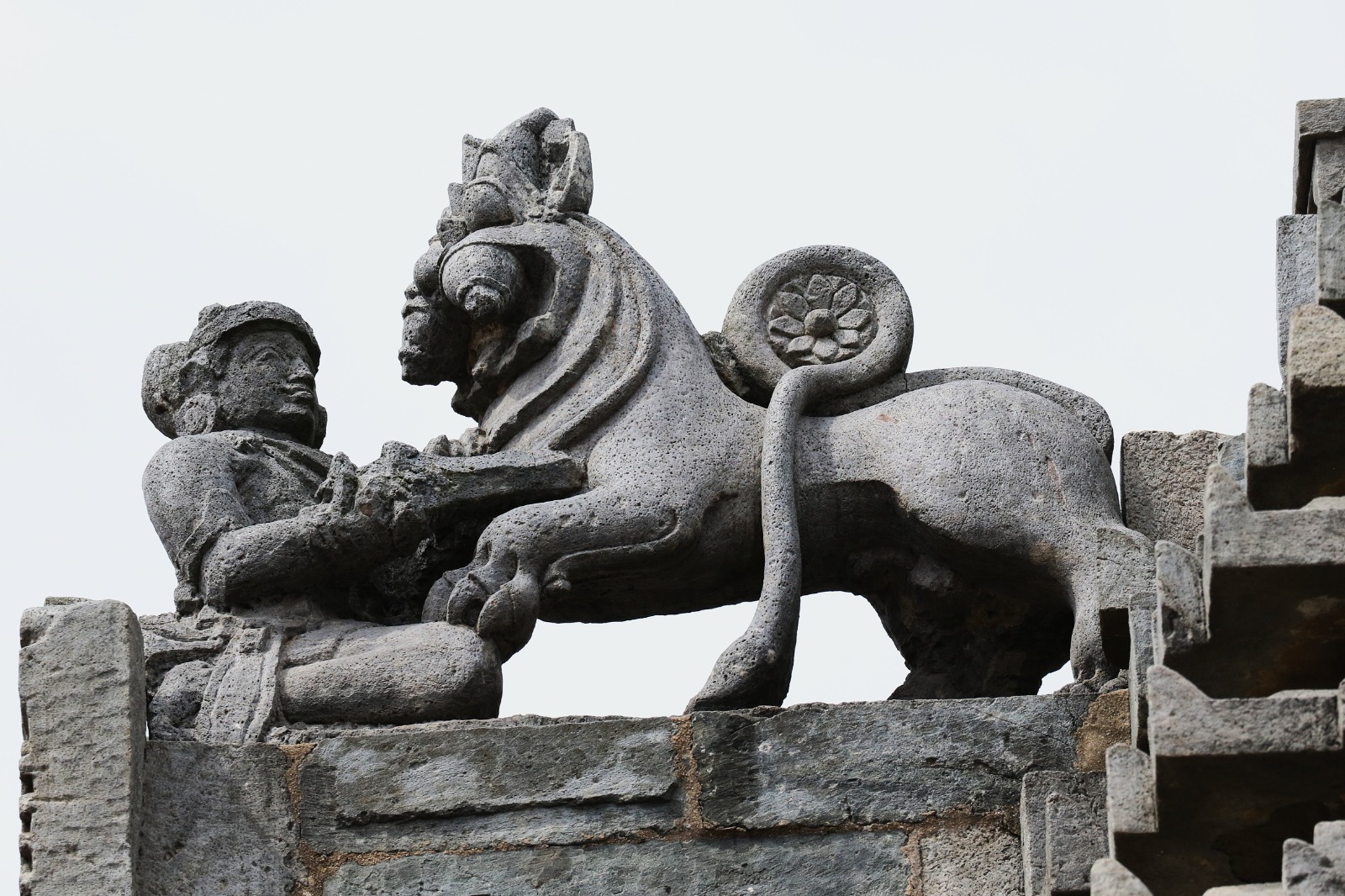
Detail in Vimana-Kirtimukha (Gargoyle)
Architectural Brilliance: Why Belavadi is Unique
The Trikutachala Style: Three Shrines, One Soul
The Veeranarayana Temple represents the trikutachala (triple-shrine) design at its most ambitious scale. While many Hoysala temples feature this layout, Belavadi’s execution is exceptional—three full sanctums dedicated to Narayana, Venugopala, and Yoga Narasimha connect through a massive central navaranga (assembly hall) that measures roughly 40 ft. across.
Instead of building three separate temples, the Hoysala architects created a unified structure where each shrine maintains its distinct identity while sharing common spaces. The central Venugopala shrine occupies the prime position, flanked by Narayana on the north and Yoga Narasimha on the south. All three open onto the same mandapa.
During my visit, I walked the circuit from shrine to shrine, and the spatial flow became clear—the architects designed sightlines so you can glimpse all three sanctums from certain positions in the hall.
The Lathe-Turned Pillars: Engineering Meets Artistry
The temple’s mandapa contains an estimated 108 pillars (the exact count varies by source), each carved from soapstone using lathe-turning techniques. This isn’t immediately obvious—when I entered the pillars appeared hand-carved, but I ran my hand along the surface, and I could feel the tell-tale smoothness that only rotational cutting produces.
The Hoysala artisans used lathe technology not just for circular shafts but for intricate profiles—bell capitals, lotus bases, and cushion-shaped sections that seem impossible to create on a turning axis. Modern stonemasons still debate the exact methods used.
What’s certain is that no two pillars are identical; subtle variations in ornamentation create visual rhythm throughout the hall.
I visited around 3 PM when afternoon light angled through the eastern entrance. The effect was striking—shadows from the pillars stretched across the stone floor in parallel lines, emphasizing the mandapa’s geometric precision. For photographers, morning light (7–9 AM) works even better, creating softer contrasts.
Standing in the center of this pillar forest, you genuinely feel the dynasty’s architectural ambition.
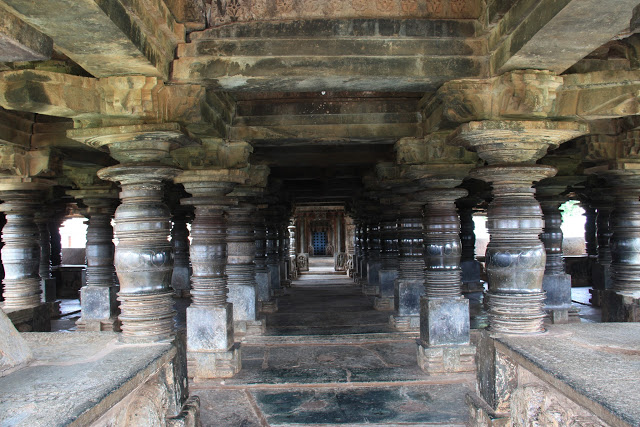
Veeranarayana Temple Belavadi Sabhamantapa Hall with pillars
The March 23 Solar Alignment: Ancient Astronomical Precision
Belavadi incorporates a precise solar phenomenon that occurs annually on March 23 (around the spring equinox). On this date, sunrise rays pass directly through the eastern entrance and illuminate the Veeranarayana idol in the central shrine. This wasn’t accidental—Hoysala architects calculated the temple’s orientation, doorway width, and shrine placement to achieve this effect.
I haven’t witnessed this myself (my May visit missed it by two months), but the temple priest explained how the alignment works. The phenomenon demonstrates the Hoysalas’ understanding of astronomy, similar to solar alignments at other ancient Indian temples. It also adds ritual significance—the annual meeting of sunlight and deity marks an auspicious day for worship.
Beyond the solar event, Belavadi showcases advanced material use. The entire structure uses soapstone (chloritic schist), a relatively soft stone when quarried that hardens with age. This allowed artisans to achieve the intricate detailing seen throughout—particularly in the exterior friezes depicting warriors in Veera Mudra (heroic pose), dancers, and mythological scenes. The carvings, while less dense than Halebidu’s, show superior finish and preservation.
Ceilings of the Temple
The ceilings are exquisitely carved, some have geometric patterns and others have figures of Gods and warriors in different postures. Just a few minutes of photography of the ceilings hurt my neck; I wondered how the sculptors of those days did this marvellous work without any modern amenities!
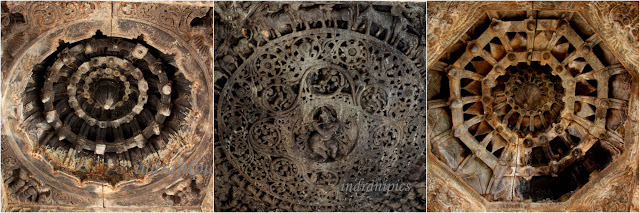
Veera Narayana Temple Ceilings
The Three Deities: Veeranarayana, Venugopala, and Yoganarasimha
The trikuta layout at Belavadi isn’t just an architectural choice—it creates a theological statement through three distinct manifestations of Vishnu. Each deity represents a different aspect of Vaishnava philosophy, and together they offer a complete devotional experience.
Veeranarayana: The Central Deity
The main (western) sanctum enshrines Veeranarayana, Vishnu in his protective, warrior aspect. The idol stands approximately 6 feet tall in a composed posture, holding the traditional conch, discus, mace, and lotus. Unlike the dynamic warrior imagery the name suggests, this Veeranarayana appears serene—emphasizing Vishnu’s role as cosmic protector through calm authority rather than aggression.
This shrine receives the March 23 solar alignment, when sunrise illuminates the deity directly. The priest I spoke with explained that this annual event draws devotees who believe the sun-blessed darshan (viewing) carries special significance. The sanctum’s positioning—central and facing east—reflects its primary importance in the temple’s ritual hierarchy.
Venugopala: India’s Finest Krishna Sculpture
The southern shrine contains what many consider the most beautiful Krishna idol in India—and I don’t use that description lightly. The Venugopala (flute-playing Krishna) sculpture stands roughly 5 feet tall, carved from dark soapstone that’s developed a subtle sheen over eight centuries.
Krishna stands in tribhanga (triple-bend pose)—weight on one leg, torso gently curved, head tilted—creating an S-shaped posture that suggests movement frozen mid-dance. The flute rests at his lips, fingers positioned as if sound might emerge. His expression combines playful charm with divine composure, a balance that’s extraordinarily difficult to achieve in stone.
The Archaeological Survey of India has cited this as among the finest Hoysala sculptures, and standing before it, you understand why. The proportions are perfect. Every detail works: the peacock feather crown, the delicate anklets, the flowing dhoti with realistic fabric folds.
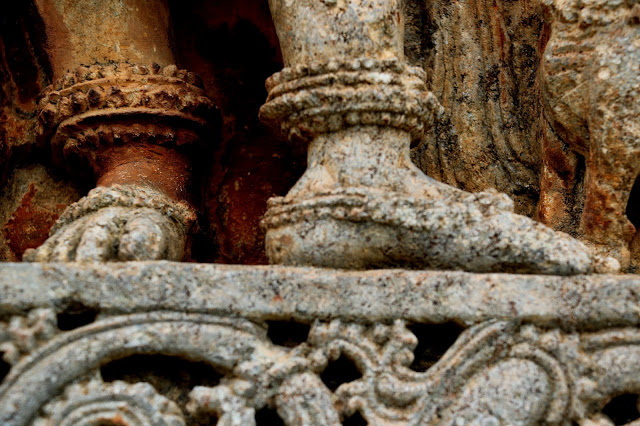
Intricate sculptural details on idols
Yoganarasimha: Ferocity in Meditation
The northern shrine houses Yoganarasimha, a rare meditative form of Vishnu’s fierce man-lion incarnation. Instead of the typical depiction showing Narasimha disemboweling the demon Hiranyakashipu, this idol presents him seated in padmasana (lotus position), claws resting calmly on his knees.
This portrayal is unusual in Hoysala iconography. The lion-faced deity appears introspective, combining Narasimha’s protective ferocity with yogic contemplation. The sculptors captured an interesting theological concept: divine anger transformed into controlled power through meditation. The carving quality matches the Venugopala—detailed mane, expressive face, precise musculature—but the mood is entirely different.
Together, these three deities create a progression: Veeranarayana’s protective serenity, Venugopala’s joyful divinity, and Yoganarasimha’s contemplative strength. For visitors interested in Indian sculpture and iconography, Belavadi offers a masterclass in how stone can express complex spiritual ideas.
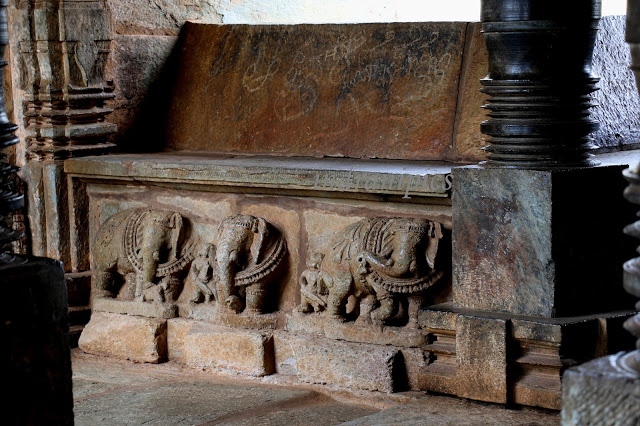
Belavadi Veeranarayana-Temple-Seating in Natya mandapa
Exteriors, Facade of the Temple
We spent as much time walking around the temple as we did inside it, because the exterior too is richly carved with countless figures and intricate designs. Vimanas (towers) are decorated with sculptures such as kirtimukhas (gargoyles).
The outer wall of the temple starts from the top with eaves running around the temple where the superstructure meets the wall of the shrine. Below this are miniature decorative towers on pilasters (shrines). This is followed by second eaves.
Then there is elaborate panel of Hindu deities and their attendants are below. Further down, these eves are followed by a set of five moldings that form the base of the wall. This is more or less the same pattern followed by all Hoysala temples.
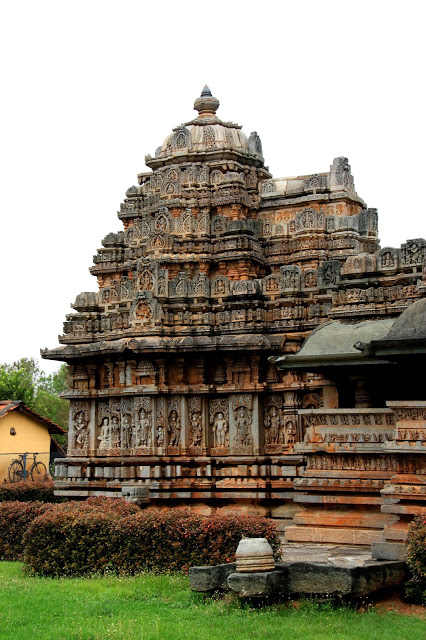
Veeranarayana Temple shrine
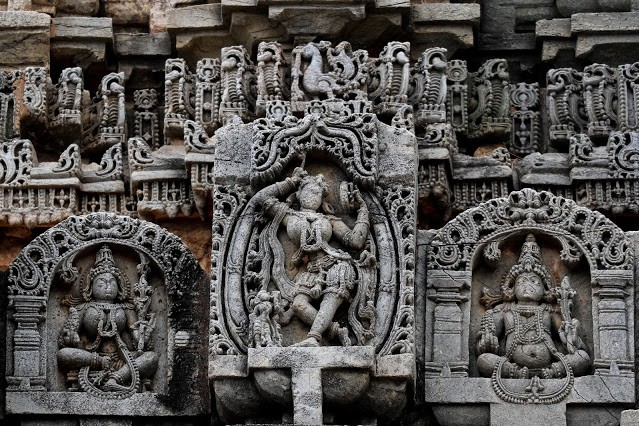
Sculptured divine figures on facade of Veeranarayana Temple Belavadi
Practical Travel Information for 2026
Getting There
Belavadi sits 29 km southwest of Chikmagalur and approximately 240 km from Bangalore via NH73 and SH57. The drive from Bangalore takes 5–6 hours depending on traffic through Hassan. Roads are well-maintained two-lane highways, though expect narrower village roads for the final 8 km stretch from the Chikmagalur-Javagal route.
Belavadi Temple Timings
8 AM – 6 PM daily (no entry fee). Visit between 7.30–9.30 AM for the best photography light—soft morning sun illuminates the mandapa pillars beautifully—and to avoid afternoon heat.
Best Time to Visit
October through March offers ideal weather for this Hoysala temple road trip from Bangalore to Chikmagalur. Daytime temperatures range 20–28°C, comfortable for exploration. April–May turns hot (35°C+), while June–September monsoons make roads slippery, though the surrounding landscape turns intensely green.
On-Site Facilities
Belavadi remains an active worship site—dress modestly (covered shoulders and knees). No tickets required, but donations accepted. Facilities are minimal: no restrooms, food stalls, or shops. Carry water and snacks. The nearest restaurants are in Chikmagalur, 30 minutes away.
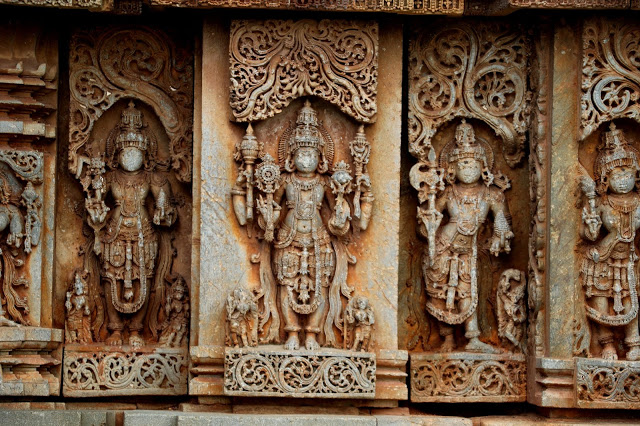
Veeranarayana Temple Facade details
Maximizing Your Visit
Allocate 60–90 minutes for thorough exploration. Combine Belavadi with Doddagaddavalli (20 km, 30 minutes) and Javagal (45 km, 1 hour) for a complete offbeat Hoysala temples circuit near Chikmagalur. Starting early from Bangalore (6 AM departure) allows comfortable visits to all three temples plus lunch in Chikmagalur.
Belavadi vs. Halebidu: Which Should You Visit?
Both temples showcase Hoysala genius but offer different experiences. Halebidu’s Hoysaleswara Temple overwhelms with exterior carving density—every inch covered with narrative friezes depicting mythology. It’s monumental, crowded, and feels like an open-air sculpture museum.
Belavadi prioritizes interior refinement over exterior spectacle. The trikuta layout, lathe-turned pillars, and Venugopala idol represent sculptural perfection rather than decorative abundance. You’ll have space to breathe, photograph freely, and absorb details without crowds.
For first-time Hoysala visitors: Start with Halebidu to grasp the dynasty’s scale, then visit Belavadi to appreciate their artistry.
For offbeat temple enthusiasts: Belavadi delivers superior experience—better light, fewer tourists, and arguably finer individual sculptures.
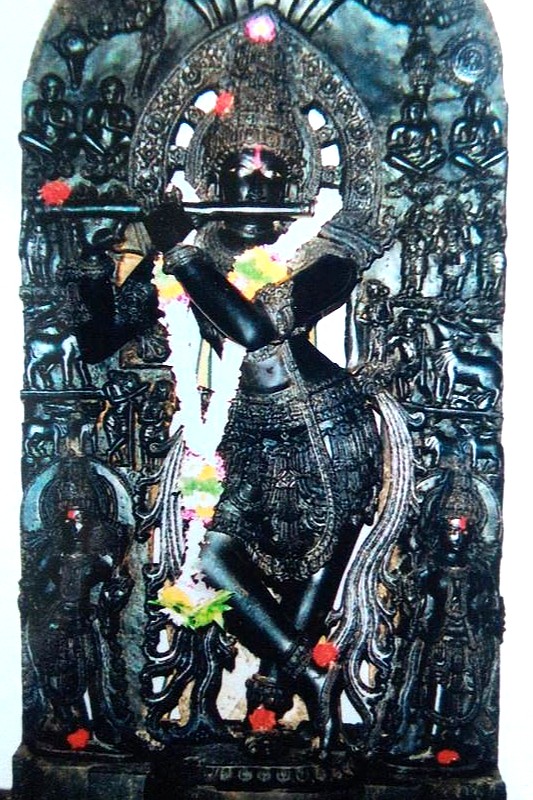
Venugopala idol – the finest Krishna sculpture in India (Image courtesy: The purohit at the temple)
FAQ — Veeranarayana Temple, Belavadi (Near Chikmagalur, Karnataka)
Where is Veeranarayana Temple located?
The Veeranarayana Temple is in Belavadi village near Chikmagalur, Karnataka (about 29 km from Chikmagalur town and 220 km from Bangalore). It lies on the quieter Hoysala heritage route between Javagal and Halebidu.
What makes Belavadi Temple unique among Hoysala temples?
Belavadi is one of the largest Hoysala temples and is built in a rare trikuta (three-sanctum) layout. Its 108 lathe-turned pillars and the exceptionally graceful Venugopala sculpture make it stand apart from Halebidu and Belur.
Is the Venugopala idol really among the finest Krishna sculptures in India?
Yes. TheArchaeological Survey of India has described the Belavadi Venugopala as one of the finest Krishna depictions — admired for its tribhanga posture, balance, and lifelike detailing.
What is the March 23 solar alignment at Belavadi Temple?
Every year around March 23, the rising sun’s rays enter the temple and illuminate the Veeranarayana idol. This precise alignment reflects the astronomical knowledge of Hoysala architects.
How much time is needed to visit Belavadi Temple?
Plan 60–90 minutes to explore the three sanctums, pillars, and sculptures at a relaxed pace.
Is Belavadi worth visiting if I’m already going to Halebidu and Belur?
Yes — especially if you enjoy quieter heritage sites. Halebidu and Belur impress with scale, while Belavadi offers proportion, serenity, and closer viewing of carvings without crowds.
Best route from Bangalore for a Hoysala temple circuit?
Bangalore → Javagal → Doddagaddavalli → Belavadi → Chikmagalur stay → Halebidu → Belur → Bangalore. This route covers lesser-known temples first and major monuments later.
Are there places to stay near Belavadi Temple?
No hotels in the village. Stay in Chikmagalur (29 km) where budget lodges and coffee-estate homestays are available.
Will I get mobile network coverage at Belavadi?
Network is available but patchy. Airtel and Jio work intermittently; BSNL is usually more reliable.
What should I wear when visiting Belavadi Temple?
Wear modest clothing covering shoulders and knees, as it is an active place of worship.
Are guides available at Belavadi Temple?
No official guides. The priest or caretaker may explain the temple if asked respectfully.
Is there an entry fee for Belavadi Temple?
No — entry is free.
Best time of day to visit Belavadi Temple?
Morning or late afternoon, when the light highlights the carvings and the temple is peaceful.
Should I visit Belavadi or Halebidu?
When comparing Belavadi’s Veeranarayana Temple with Halebidu’s Hoysaleswara Temple, both stand as pinnacles of Hoysala craftsmanship, yet they embody different architectural philosophies and artistic emphases.
Comparative Table
| Feature | Belavadi (Veeranarayana) | Halebidu (Hoysaleswara) |
| Layout | Trikutachala (three shrines) | Dvikuta (twin shrines) |
| Deities | Narayana, Venugopala, Yoganarasimha | Shiva (Hoysaleswara & Shantaleswara) |
| Highlights | Venugopala idol, 108 lathe-turned pillars | Elaborate friezes, star-shaped platform |
| Atmosphere | Quiet, offbeat, rural | Grand, crowded, capital city heritage |
| Artistic Focus | Interior elegance, proportion | Exterior narrative carvings, scale |
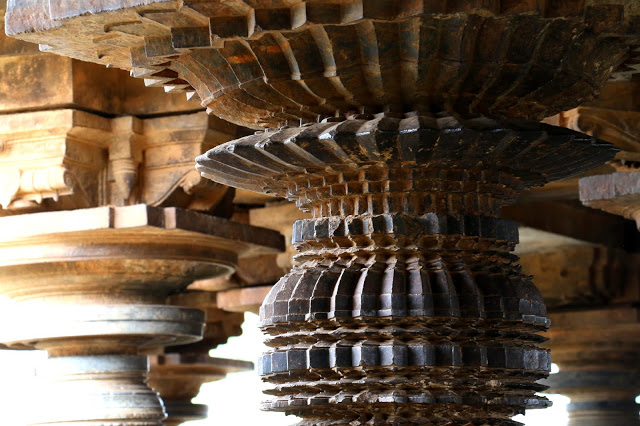
Belavadi Veeranarayana Temple Pillar
The “Hoysala Trail” Road Trip Itinerary
The optimal route: Bangalore → Javagal (220 km, 4.5 hours) → Doddagaddavalli (25 km, 40 minutes) → Belavadi (20 km, 30 minutes) → Chikmagalur (29 km, 45 minutes for overnight stay).
Before reaching Belavadi, I stopped at the Lakshmi Narasimha Temple in Javagal —a temple often overlooked but equally mesmerizing. On the way back towards Chikmagalur, the Lakshmi Devi Temple at Doddagaddavalli offers a unique Chatuskuta (four-shrine) contrast to Belavadi’s Trikuta style.
Day 2
Explore Chikmagalur or continue to Halebidu (34 km) and Belur (16 km from Halebidu) before returning to Bangalore.
This sequence follows geographical logic, covering offbeat temples first when you’re fresh, then ending with the famous Halebidu-Belur complex.
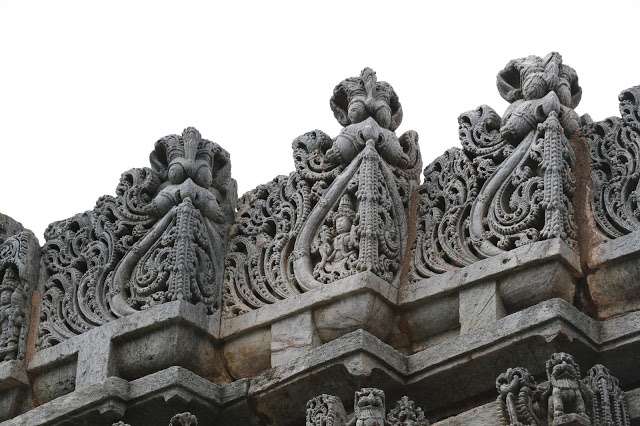
Vimanas decorated with kirtimukhas
Travel Tips for Veera Narayana Temple
- No guide around this place, it will be good to read up about the place to know what you can expect to see there.
- If you visit on March 23rd you can see the rising sun’s rays falling on the navel of idol of Veeranarayana.
- Leave footwear outside.
- No washrooms in the vicinity.
- Small local eateries around. Better to get your own food and water.
Pin this for later…

About the Author
 Indrani Ghose is a cultural travel writer and heritage documentation specialist with over 15 years of experience exploring and writing about temples across India and Southeast Asia. Having visited over 150 sacred sites, she brings both scholarly depth and personal narrative to heritage travel writing.
Her work has been published in Lonely Planet, The National (UAE), Whetstone Asia, Deccan Herald, and various architecture and heritage journals.
Connect with Indrani: Follow Indrani on Instagram | Twitter | Facebook for heritage travel insights, photography tips, and offbeat destination discoveries.









Hoysala sculpture and architecture is really exquisite and this is so evident in this Belavadi temple. I am intrigued by the fact that this is the village where the Bakasura incident of Mahabharata is supposed to have taken place. As a Kid, I too was fascinated by this story and used to ask my dad to tell it again and again.
Fascinated from the history and the detailed carvings of the exteriors.
I agree…the Hoysala temples are just amazing owing to their art
What a lovely carvings and intricacy! Its connection with Mahabharata katha makes it special . In my recent visit to Satopanth , Uttarakhand I came to know about strong connection of Pandavas with Karnataka specially with Humpy . Beautiful post Indrani ji
Yes indeed. Vali and Sugreev and Hanuman lived here in Karnataka.
Incredibly intricate! You mention hugging the pillars, is this something that is done or just a reference to the size?
Hi Jim, I meant with reference to size.
Thanks for the visit and comment. 🙂
Amazing carvings on this temple. Aren’t there so many gorgeous temples in the world? Thanks for the tour of this one. 🙂
Wow…gorgeous images! Beautiful post, Indrani!
nice, thanks for the post.
I find these carvings just incredible. I visited quite a few in Southern India and could have stayed quite a long time in each one just admiring the sculptures.
Even I love architecture of Hoysala temples. These are pride of Karnataka. Always wonder all temples have same kind of architecture and similar carvings. Lovely photos.
What amazing craftsmanship. Must have taken them forever to create these carvings. Very ornate and so beautiful.
Worth a Thousand Words
Absolutely stunning captures.. “What draws me towards these Hoysala Temples is the ‘exquisite beauty of sculptures’ in the temples!” very true.. Hoysala Architecture is just flawless ..
Hello Indrani, the Temple is beautiful and the details are just amazing. A lovely place to visit and your photos are beautiful. Great post.
Happy Friday, enjoy your weekend!
Beautiful Pictures and lovely Tour of Sri Veeranarayana Temple, Belavadi, Karnataka by your post.
Indrani, great post as always! It feels good when we have the opportunity to visit places that we grew up knowing about or places we have heard a lot about. Hope you can continue discovering places that have a beautiful meaning to you.
Simply amazing and mind blowing, thanks a lot for sharing, really i did not know about it, one day will visit for sure.
Incredibly ornate and beautiful!
I love the intricate carvings on the exterior of the temple.
The craftsmanship of these Hoysala temples amazes me…such beautiful intricate carvings.
Why is there a red carpet…some VIP was on a visit? or is it always kept there, Indrani?
It was there, I didn’t ask why… simply walked over it imagining it was for me. 😛 🙂
Thank you for the comments Bushra.
What a stunning temple – massive yet so intricate at the same time. Fantastic!