How to Visit Jerónimos Monastery: Tickets, Hours, and Tips
Standing in front of Jerónimos Monastery at 9.45 AM on a late May morning, I watched the golden limestone façade catch the early light—and I watched the queue snake around the block. By the time the doors opened at 10, there were easily 200 people ahead of me.
That’s when I learned my first lesson about visiting, Mosteiro dos Jerónimos, one of Lisbon’s most spectacular landmarks: timing and tickets matter more than you’d think.
Monasterio Jerónimo isn’t just another church on your Portugal itinerary. It’s a UNESCO World Heritage masterpiece of Manueline architecture, home to Vasco da Gama’s tomb, and a living monument to Portugal’s Age of Discovery. The intricate stone carvings—maritime ropes, coral motifs, armillary spheres—look almost impossible to create by hand. But here’s the reality: everyone knows it’s spectacular, which means managing the crowds is half the battle.
Just that one visit taught me a lot – I’ve figured out the system. This guide shares everything I wish I’d known before my first visit—from the smartest ticket options to the hidden corners most tourists miss.
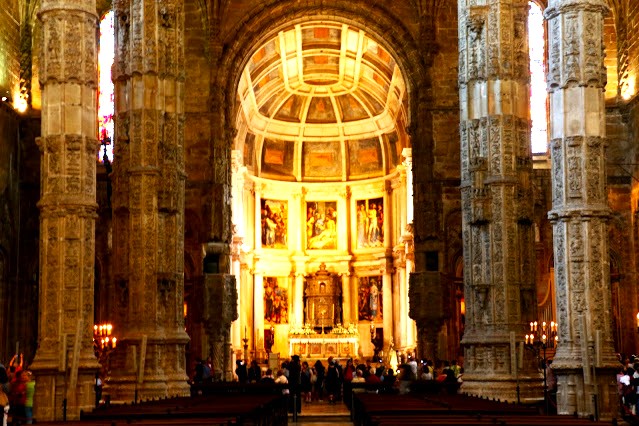
Interior of Jerónimos Monastery
Here’s everything you need to know about Jerónimos Monastery at a glance:
Location: Praça do Império, Belém, Lisbon
Closest Transport: Belém Station (Train), Tram 15
Entry Type: Paid (Combo tickets available)
Average Visit Time: 1 to 1.5 hours (I spent 2+ hours on my last visit)
Best Time to Visit: Before 10 AM or after 4 PM
Accessibility: Wheelchair accessible (cloisters and main church; some upper areas limited)
Closed: Mondays, January 1, Easter Sunday, May 1, December 25
Pro tip from experience: Block out a full afternoon in Belém. The monastery is walkable to Belém Tower (10 minutes), the Monument to the Discoveries (5 minutes), and the legendary Pastéis de Belém bakery (3 minutes). Trust me, you’ll want that custard tart after all the walking.
The Ticket Strategy: How to Actually Skip the Line
How long does it take to get into Jerónimos Monastery?
On my first visit, I waited 90 minutes. One more trip and I can walk in straight. Here is the strategy –
Best ways to buy Jerónimos Monastery tickets
- Book online through the official website (what I do now)
The Património Cultural portal sells timed-entry tickets that let you skip the general admission queue entirely. You can also grab combo passes that include Belém Tower and the National Archaeology Museum—usually €12–16 depending on the combination, compared to €10 for monastery-only entry.
The catch? Book at least 2–3 days ahead in high season (May–September). Tickets for prime morning slots sell out fast.
- Buy tickets at nearby monuments (a backup plan)
Here’s a trick most guides don’t mention: you can purchase combo tickets at the National Coach Museum or other nearby sites and use them same-day at Jerónimos. The queues at these locations are typically much shorter, especially before 11 AM. - Skip-the-line guided tours (best for first-timers)
Platforms like GetYourGuide and Viator offer guided tours with dedicated fast-track entry. You’ll pay €25–40, but you get expert commentary plus context you’d otherwise miss (like why those stone knots represent Portugal’s maritime rope-making mastery). Look for tours that bundle multiple Belém sites—better value and pacing. - Lisboa Card (ideal for multi-day explorers)
If you’re spending 2 to 3 days in Lisbon, the Lisboa Card pays for itself. It includes free entry to Jerónimos, Belém Tower, dozens of museums, and unlimited public transport. It can cost you €42 for 48 hours and save probably €60+ in combined entry fees and metro rides. - On-site ticket purchase (only if you’re desperate)
Yes, you can buy tickets at the monastery entrance. But between 10 AM and 2 PM, expect 45 to 90 minute waits. I only recommend this if you’re visiting in winter (November–February) on a weekday, when crowds thin out considerably.
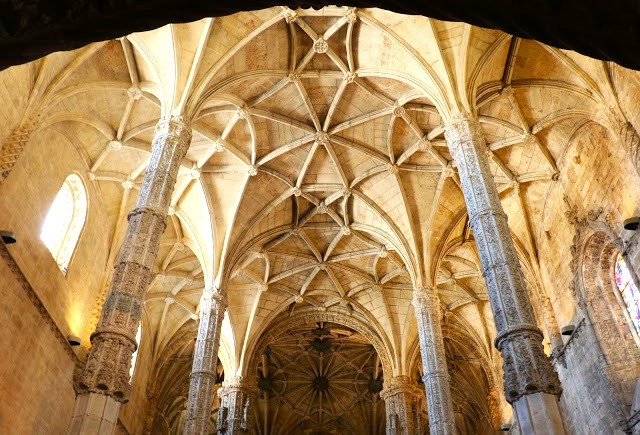
Mosteiro dos Jerónimos Cloister Ceiling – Manueline architecture Portugal
When to Visit: Jerónimos Monastery Opening Hours
October to April: 10 AM to 5.30 PM
May to September: 10 AM to 6.30 PM
Ticket office closes: 30 minutes before closing
Closed every Monday + January 1, Easter Sunday, May 1, December 25
Best times to visit
Before 10 AM – My number one recommendation. Arrive at 9.45 AM, be first in your time slot, and you’ll have the cloisters almost to yourself for 20 to 30 minutes. The morning light through the eastern arches is also stunning for photos.
After 4 PM – Second-best option. Most tour groups have left, the light turns golden, and there’s a quieter, more contemplative atmosphere. You’ll have about 90 minutes before closing—plenty of time if you stay focused.
Avoid 11 AM to 2 PM – This is when cruise ship tours and organized groups converge. The cloisters get shoulder-to-shoulder crowded, and you’ll spend more time dodging selfie sticks than admiring the architecture.
Winter weekdays – If your schedule is flexible, visiting in January or February on a Wednesday or Thursday is ideal. You can get entire sections of the cloisters to yourself, almost private experience.
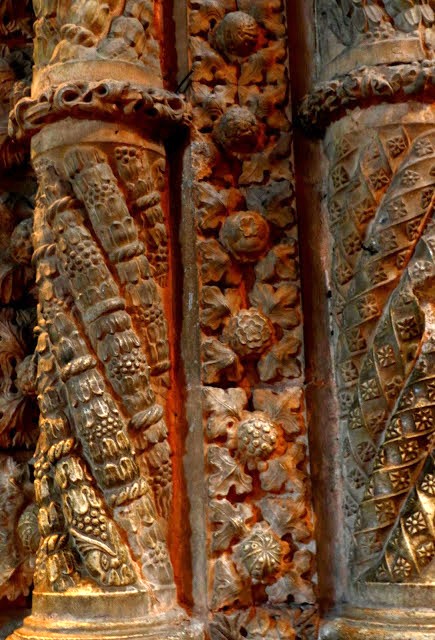
Pillar details in Mosteiro dos Jerónimos Cloister
What to See at Jerónimos Monastery
Walking through the entrance, you’re immediately hit by the scale and detail. This isn’t a building you glance at—it demands your attention. Here’s what absolutely cannot be missed.
The Cloisters: Where Manueline Architecture Comes Alive
It is so lovely inside and very peaceful. They are strict about maintaining silence inside. Photography is permitted but without flash. The double-level cloisters are the soul of Jerónimos. I’ve seen Gothic cloisters across Europe, but nothing quite like this. Every column tells a story.
What makes them special:
- Intricate maritime carvings: Look closely at the columns and you’ll spot twisted ropes, coral branches, armillary spheres (Portugal’s navigation symbol), and botanical flourishes from newly discovered lands. It’s like a stone encyclopaedia of 16th-century Portuguese exploration.
- The architectural paradox: The cloisters feel both delicate and monumental. The columns are surprisingly slender, yet they support massive vaulted ceilings. It’s Gothic verticality meets Renaissance symmetry, filtered through Portugal’s maritime obsession.
- Two levels, two moods: The lower level is where monks once walked in silent contemplation—it’s shaded, cool, intimate. The upper level opens to more light and offers better views of the ornate ribbed vaulting. Spend time on both.
- The courtyard: The central garden is simple, almost austere, which makes the surrounding stone artistry feel even more dramatic. Find a quiet corner, sit, and just look up. The detail is overwhelming in the best way.
Photography tip: Early morning or late afternoon gives you the best light and shadow play. The western arches in particular create stunning geometric patterns when the sun is low.
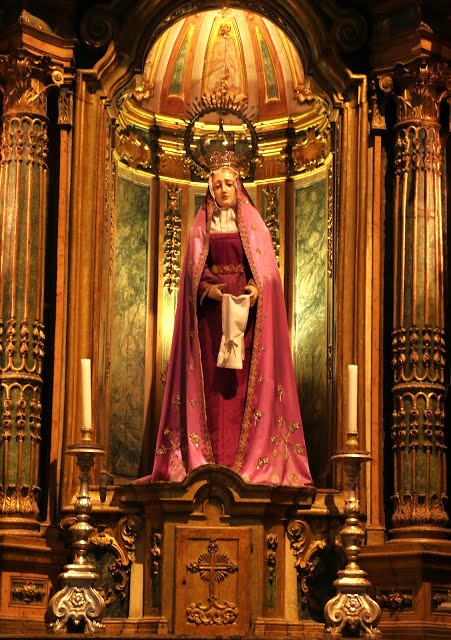
Jeronimos-Monastery-Altar
Church of Santa Maria: Portugal’s Pantheon
Attached to the monastery, the church is where Portugal honors its greatest heroes. The interior feels almost impossibly tall—slender columns rise like stone trees, supporting a ribbed vault that seems to float above you.
Tomb of Vasco da Gama
Vasco da Gama’s tomb sits near the entrance, a marble masterpiece. Vasco da Gama has committed several atrocities in India, yet in his country he is the most celebrated explorer. If you are interested in history like me you can read more about him in this wiki link. Vasco da Gama in Malabar
Vasco da Gama is credited for Portugal’s success as an early colonizing power. His third voyage to India was final one. He got infected with malaria and died in Kochi, Kerala in 1524. He was buried in St. Francis Church, which was located at Fort Kochi in the city of Kochi initially. Later his remains were returned to Portugal in 1539. It is said the body of Vasco da Gama was re-interred in Vidigueira in a casket decorated with gold and jewels.
The place is so crowded with tourists. We had to cooperate among ourselves so as to not enter the frame of photographers capturing the tomb.
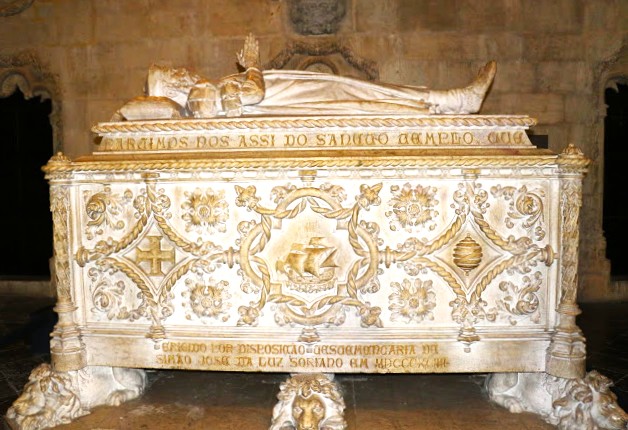
Tomb of Vasco da Gama
Tomb of Luís de Camões
Directly opposite is Luís de Camões, Portugal’s national poet, whose epic Os Lusíadas immortalized da Gama’s journey. The symmetry is intentional—the explorer and the poet, the deed and the word, forever mirroring each other.
The church is free to enter (it’s technically separate from the monastery), which means it’s usually more crowded than the cloisters. But the stained glass, the acoustic quality, and the sheer spiritual weight of the space make it essential. I recommend visiting the church first, then moving to the cloisters for a quieter, more contemplative experience.
Understanding Manueline Architecture: A Style Born at Sea
If you’re wondering why Jerónimos looks unlike any other monastery in Europe, it’s because Manueline architecture is uniquely Portuguese—a style that emerged during King Manuel I’s reign (1495–1521), right when Portugal was discovering the world.
It’s not just decorative excess. Every carved rope, every armillary sphere, every exotic plant motif represents Portugal’s global reach. The stone becomes a narrative.
Key elements to spot:
- Armillary spheres: Portugal’s symbol of navigation and King Manuel’s personal emblem
- Crosses of the Order of Christ: The religious-military order that funded many voyages
- Twisted ropes and maritime knots: Celebrating the sailors and rope-makers who made exploration possible
- Exotic flora and fauna: Plants and creatures from Africa, Asia, and Brazil, carved by artisans who’d never seen them in person
- Gothic structure + Renaissance detail: The underlying architecture is Gothic, but the ornamentation is Renaissance, creating a hybrid style that’s distinctly Portuguese
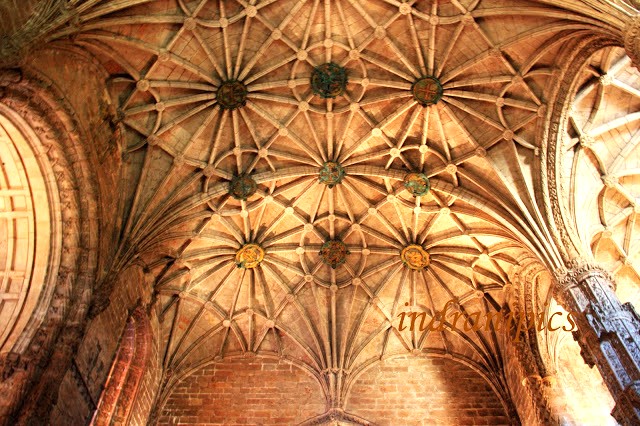
Details in ceiling – Mosteiro dos Jerónimos Cloister
Why this matters
Understanding Manueline architecture transforms how you see Jerónimos. You stop looking at “pretty decorations” and start reading a story—of ambition, faith, wealth, and a tiny nation that briefly dominated global trade routes.
Take your time in the cloisters. My zoom lens helped me see details (seriously—some carvings are high up and easy to miss). And don’t rush. This is the kind of place that rewards slow, careful observation.
Getting to the Jerónimos Monastery (Directions)
Located in the Belém district of Lisbon, Jerónimos Monastery is easily accessible by public transport and ideal for a half-day itinerary.
- By Tram: Take Tram 15E from Praça da Figueira or Cais do Sodré. Get off at the Mosteiro dos Jerónimos stop.
- By Train: From Lisbon’s Cais do Sodré station, hop on the Cascais Line and alight at Belém Station. The monastery is a short walk from there.
- By Bus: Several buses stop nearby, including 728, 714, and 751.
- By Taxi/Uber: A 15-minute ride from central Lisbon. Use “Mosteiro dos Jerónimos” as your drop-off point.
- Biking – There’s a dedicated bike path along the river. It’s flat, scenic, and takes about 30 minutes from Praça do Comércio. Bike rental apps like Gira make this easy.
- Parking: Limited street parking is available, but not recommended during weekends or holidays.
What to Combine with Your Jerónimos Monastery Visit
Belém is practically a UNESCO World Heritage neighborhood. You could easily spend a full day here without backtracking into central Lisbon. Here’s how I’d structure it.
The Classic Belém Day (Half-Day Option)
9.45 AM – Arrive at Jerónimos Monastery, enter at 10 AM
11.30 AM – Walk to Pastéis de Belém (3 minutes)—grab the famous custard tarts while they’re still warm
12 PM – Belém Tower (10-minute walk)—another UNESCO site with incredible river views
1.30 PM – Lunch at a riverside café or head back toward central Lisbon
Total time: 4 to 5 hours
Cost with Lisboa Card: Free entry to monuments + unlimited tram rides
Cost without: Around €20–25 in entry fees + €6–8 for transport
The Full Belém Experience (Full Day)
Add these to the classic route:
Monument to the Discoveries – A massive riverside monument celebrating Portugal’s Age of Exploration. You can go inside and climb to the top for panoramic views. It’s a 5-minute walk from Jerónimos. Budget 45 minutes.
MAAT (Museum of Art, Architecture and Technology) – Stunning contemporary building right on the waterfront. The architecture alone is worth seeing, and the exhibitions are usually excellent. 15-minute walk from Belém Tower. Budget 1–2 hours.
National Coach Museum – One of the world’s best collections of royal carriages and coaches. It’s extravagant, bizarre, and surprisingly fascinating. Right next to Jerónimos. Budget 1 hour.
Belém Cultural Center – Often overlooked, this has beautiful gardens and sometimes hosts free exhibitions. Great spot to rest between monuments.
Smart combinations for different interests
For history lovers: Jerónimos + Belém Tower + Monument to the Discoveries + National Coach Museum
For architecture fans: Jerónimos + MAAT + Belém Cultural Center
For families with kids: Jerónimos (they’ll love the tomb stories) + Belém Tower (climbable) + riverside playground near MAAT
For food lovers: Start with Pastéis de Belém pastries, visit Jerónimos, lunch at Café In, afternoon at MAAT, dinner at Enoteca de Belém
FAQ: Your Jerónimos Monastery Questions Answered
Q. Is Jerónimos Monastery worth visiting?
A. Absolutely. It’s one of Portugal’s most significant historical and architectural landmarks. If you only visit three sites in Lisbon, make this one of them (along with São Jorge Castle and Alfama). The craftsmanship and historical importance justify the visit.
Q. How much does it cost to go to Jerónimos Monastery and what are the different ticket options?
A. Standard ticket price for visiting the Jerónimos Monastery Cloister and Church is typically €12 (subject to change). Combined tickets, often bundled with the Belém Tower and the Ajuda National Palace, offer a significant discount.
Free admission is available on the first Sunday of every month, but be prepared for very long queues.
Q. Do I need to buy tickets in advance for Jerónimos Monastery to skip the line?
A. Yes, absolutely recommended to purchase your Jerónimos Monastery tickets online before your visit to join the much shorter fast-track entrance line. The queue for buying tickets on-site can take over an hour, especially during peak season (April to October).
Q. Is the Lisboa Card worth it for Jerónimos Monastery and other attractions?
A. The Lisboa Card includes free entry to the Jerónimos Monastery and several other monuments, museums, and provides unlimited use of public transport. If you plan to visit three or more paid attractions in a single day, the Lisboa Card is definitely worth the investment for the convenience and cost savings.
Q. Is there a separate ticket for the church at Jerónimos Monastery?
A. The Church of Santa Maria (where Vasco da Gama is buried) is free to enter via a separate, quicker entrance on the west side of the building. The paid ticket is specifically for the Cloister and the upper choir, which contains the monastery’s famous Manueline architecture.
Q. What are the opening times for Jerónimos Monastery and when is the best time to visit to avoid crowds?
A. The Monastery is typically open from 9.30 AM to 6.30 PM in the summer (May–September) and 10 AM to 5.30 PM in the winter (October–April). The best time to visit is immediately when it opens (before 10:00 AM) or late in the afternoon, about an hour before the last entry at closing time.
Q. What day of the week is Jerónimos Monastery closed?
A. The Jerónimos Monastery is closed every Monday, as well as on a few public holidays (January 1st, Easter Sunday, May 1st, June 13th, and December 25th). Always check the official website for any unannounced closures before planning your trip.
Q. How long does it take to tour the Jerónimos Monastery?
A. Allow approximately 1.5 to 2 hours to fully explore the Cloister, the Chapter Room, the Refectory, and the Church of Santa Maria. If you are only visiting the church, you can see it in about 20 to 30 minutes.
Q. How do I get to Jerónimos Monastery from Lisbon city center using public transport?
A. Easiest way to reach the Jerónimos Monastery from central Lisbon: take the Tram 15E from Praça da Figueira or Cais do Sodré.
Alternatively, take a regional train from Cais do Sodré station to Belém station. The journey takes about 15 to 20 minutes.
Q. Is there a dress code for visiting the Jerónimos Monastery?
A. While there is no strict dress code for the Jerónimos Monastery, as a functioning religious building (Church of Santa Maria), it’s respectful to wear clothing that covers your shoulders and knees.
Q. Where is Vasco da Gama buried inside Jerónimos Monastery?
A. The tomb of Vasco da Gama is located in the lower choir of the Church of Santa Maria, on the left side (south entrance) just inside the main entrance to the church.
Q. Where can I find the famous Pastéis de Belém bakery near the Monastery?
A. The original Pastéis de Belém bakery is located just a five-minute walk from the Jerónimos Monastery on Rua de Belém. The bakery is famous for its original Pastel de Nata recipe and is a must-do before or after your visit.
Q. Can I bring food or drinks inside?
A. No. There’s no café inside either, so eat before or after your visit.
Q. Is Jerónimos Monastery the same as Belém Tower?
A. No, they’re separate monuments about 10 minutes apart on foot. Both are UNESCO sites and both are worth visiting. Combo tickets cover both.
Q. What’s the best time of year to visit?
A. Late fall (October–November) and early spring (March–April) offer smaller crowds, pleasant weather, and softer light. Winter is quietest but can be rainy. Summer is hot and packed.
Conclusion: Your Gateway to Portugal’s Golden Age
Visiting Jerónimos Monastery isn’t just about ticking off a UNESCO site—it’s about stepping into the soul of Portugal’s Age of Discovery. With the right ticket strategy, smart timing, and a deeper appreciation for its Manueline artistry, your experience can be both seamless and unforgettable.
Whether you’re chasing history, architecture, or poetic legends, this guide equips you with everything you need to explore Jerónimos Monastery like a pro.
Pin this for later
 About the author: Indrani Ghose is a travel blogger and photographer who has explored 15+ European countries across multiple trips. Based in Bangalore, she shares authentic travel experiences to help fellow travelers navigate the world more safely and confidently. You can follow her on her social media handles Instagram, Twitter and Facebook to see the wonderful destinations, beautiful offbeat places and get instant updates about them.










Hi Indrani – thank you for dropping by my blog again. Thank you too for sharing this reminder of Vasco da Gama – I’d not heard the name since school days (and that was a LONG time ago) !!
This is great! I am a history buff, so, I would love to visit Vasco da Gama’s tomb.
WOW! That looks grand!
Europe is full of them.. I have pics of dozens of chappels and struggling to put a post about them
Fascinating pictures and information Indrani ji . Vasco De gama , I think was a resident of a village of Purtgal . But as you wrote Vasco da Gama has committed several atrocities in India, yet in his country he is the most celebrated explorer. This is the symbol of their respect to their Hero .
Nice photos and details! I do wish to visit here 🙂
How interesting! Vasco da Gama’s tomb! A treat for history lovers 🙂
Great architecture 🙂 Loved the pictures.
A 100 years? Looks like it was all worth it. Look at those interiors — so grand!!
OMG you have taken me back to my travelling days. There are few places you cant imagine your life can give youa chance to visit but bless the bloggers for giving us such a beautiful virtual trip to these places.
and hello to you Indrani 🙂
So enormous and yet distinctly warm and indoor-ish in its beauty
Truly marvelous
history and architecture always fascinate me too
Great captures as always !
Nice monastery, always makes it look good.
Very informative and incredible post with such grand pictures of magnificent architechture of the interiors of the Monastery.
This seems to ooze out sheer grandeur
Such beautiful pictures and observations. You make me want to travel again.
Lovely pictures, nicely captured. Vasco De Gama is a celebrity in India too. In school text books he is taught as “The Explorer who discovered India” as if India didn’t exist before that.
Anyhow, nice article. Thanks for sharing.
Your snaps speak of this place’s beauty–worth visiting if one was the travelling kind 🙁
The ceiling is reminiscent of Gaudi’s Sagrada Familia, isn’t it? Your picture is too familiar. I believe I have been here too.
Worth a Thousand Words
These photos from inside the monastery are so soothing. Love your write up too,Indrani.
Beautiful capture as always, Indrani!! There is so much beauty in Lisbon and I’m so glad I was able to visit there when I lived in Europe years ago!! Thank you, as always, for sharing!! Have a wonderful new week!!